EV Trucks + Utility Trailers: What Really Determines Towing Range?
EV truck tow rating and EV towing range answer different questions. Tow rating describes approved mechanical capability; practical distance between charging stops depends on trailer drag, speed, load, terrain, weather, usable battery energy and charging access.
Use the specific truck's payload, axle, hitch and towing labels—not only the model's advertised maximum.
Use real towing efficiency in kWh per mile under representative speed, load and weather.
Confirm charger spacing, reliability, connector compatibility and physical trailer access.
In This Article
- Tow rating vs. towing range
- 2026 pickup capability
- Seven range variables
- Shape vs. weight
- Speed and air speed
- Real-world examples
- What tow rating controls
- Payload limits
- Terrain and regeneration
- Temperature and weather
- Tires and rolling resistance
- Charging-site geometry
- Range calculation
- First-trip calibration
- Compare tests correctly
- EV-friendly trailer design
- Local vs. long-distance
- Trip-planning checklist
- Implications for OEMs
- GOODIN perspective
- FAQ
- Conclusion
- Technical references
Tow Rating Is Not Towing Range
Electric pickups have reached a point where the motor is rarely the first question in utility-trailer towing.
The more difficult question is energy.
A modern electric truck may have enough torque and an official tow rating to pull a substantial tandem-axle trailer, yet the distance between charging stops can change dramatically depending on the trailer attached behind it.
That is why EV truck towing range should never be predicted from tow rating alone.
Two trailers of similar weight can produce very different energy consumption if one is low and aerodynamically exposed to little additional air while the other is tall, wide and box-shaped.
Conversely, a relatively light enclosed trailer can create a surprisingly large range penalty at highway speed because its frontal area and wake increase aerodynamic demand.
2026 Electric Pickups Already Have Serious Towing Capability
The current electric-pickup market demonstrates how far tow capability has developed.
| Electric pickup | Current range reference | Towing reference | Important qualification |
|---|---|---|---|
| 2026 Chevrolet Silverado EV | Up to 493 miles EPA-estimated on Work Truck Max Range | Up to 12,500 lb on specified Trail Boss configuration | Maximum range and maximum towing figures depend on trim, battery and equipment. |
| 2026 GMC Sierra EV | Up to 478 miles GM-estimated on available Max Range configurations | Up to 12,500 lb available on Sierra EV Denali | Specific vehicle payload and towing labels remain controlling. |
| Rivian Gen 2 R1T | Up to 420 miles EPA-estimated on selected Dual-Motor configuration | Up to 11,000 lb when properly configured | Battery, drivetrain, tires and hitch configuration affect capability. |
These numbers answer an important question:
Can the truck be engineered to pull meaningful trailer weight?
For many current electric pickups, the answer is yes.
They do not answer:
How far will that particular truck travel with your particular trailer at 70 mph into a headwind?
That answer requires a different calculation.
Seven Variables Determine EV Towing Range
A useful electric truck towing model should consider at least seven variables:
- Trailer aerodynamic drag.
- Road speed.
- Trailer and vehicle mass.
- Terrain and elevation.
- Wind and ambient temperature.
- Battery energy and real towing efficiency.
- Charging availability and site geometry.

Why Trailer Shape Can Matter More Than Trailer Weight
One of the most useful lessons in EV towing utility trailer discussions is that trailer weight alone is a poor predictor of highway energy consumption.
Weight and Drag Consume Energy in Different Ways
Additional mass matters when:
- Accelerating.
- Climbing grades.
- Rolling through tire and bearing resistance.
- Repeatedly slowing and accelerating.
Aerodynamic drag becomes increasingly important as road speed rises.
For that reason, a dense low-profile load can sometimes create less highway energy penalty than a lighter but much taller enclosed trailer.
Frontal Area Matters
If a trailer projects substantially above the truck roof or outside the truck's width, more air must be displaced by the combination.
Examples include:
- Tall enclosed cargo trailers.
- Travel trailers.
- Horse trailers.
- Utility trailers carrying tall machinery.
- Landscape trailers with upright ramps or large equipment.
An Open Utility Trailer Is Not Automatically Aerodynamic
Removing a box body reduces some frontal surface, but exposed machinery can still create significant turbulent drag.
A compact skid steer carried low between the wheels presents a very different aerodynamic condition from a tall tractor, stacked cargo or upright loading gate.
A V-Nose Is Not a Complete Aerodynamic Solution
The front of the trailer matters, but so do:
- Overall trailer height.
- Width.
- Truck-to-trailer gap.
- Underbody airflow.
- Wheel and fender turbulence.
- Rear wake.
Commercial trailer aerodynamics provide a useful engineering analogy. EPA SmartWay identifies front gap devices, underbody devices and rear fairings as separate ways of managing airflow.
The exact percentage benefits measured on 53-foot commercial semitrailers should not be directly transferred to a small utility trailer, but the underlying airflow mechanisms remain relevant.

Speed Is One of the Fastest Ways to Change Range
Aerodynamic drag rises approximately with the square of air speed, while the power required to overcome that drag rises approximately with the cube of speed.
That does not mean total vehicle energy consumption follows one simple cube-law formula because rolling resistance, drivetrain losses, terrain and auxiliary loads remain present.
But it explains why highway speed matters so much.
The difference between towing at 60–65 mph and maintaining a much higher highway speed can be substantial when a large trailer is pushing through the air.
Air Speed Is More Important Than Speedometer Speed
A truck traveling at 65 mph into a 20-mph headwind can experience an aerodynamic condition closer to an 85-mph relative air speed from the front.
A strong tailwind produces the opposite effect.
That is why owners can report very different consumption on the outbound and return legs of the same route.
Real-World Towing Data Shows Why One Percentage Is Misleading
The internet often reduces EV towing to one statement:
“Expect to lose 50% of your range.”
That may be a useful emergency planning assumption for some large trailers, but it is not a universal engineering rule.
Case 1: Silverado EV and a 6,500-lb Tall Trailer
A published towing test used a Chevrolet Silverado EV 4WT with a 6,500-lb trailer approximately seven feet tall.
The truck covered approximately 232 miles before the test concluded with about 15 miles indicated remaining, while reporting roughly 1.1 kWh per mile.
The important lesson is not the exact 232-mile result.
It is that actual towing energy consumption provides a much better planning input than the unloaded range estimate.
Case 2: A 2026 Silverado EV Owner With a 7,500-lb Camper
In a 2026 owner discussion, one Silverado EV driver reported roughly 350–360 miles of highway range without the trailer at around 75 mph and approximately 200 miles while towing a camper weighing around 7,500 lb.
This is owner-reported anecdotal data rather than a controlled test, but it aligns with the broader point: a tall camper produces a very different highway load from the unloaded truck.
Case 3: A Much Lighter 6×10 Enclosed Trailer
Another 2026 owner report described a roughly 3,000-lb, 6×10 enclosed trailer reducing a standard-range F-150 Lightning's practical full-charge towing range to around 130 miles.
Again, the vehicles, battery sizes, weather and routes are not directly comparable.
But the example is valuable because the trailer was relatively light while still presenting substantial aerodynamic area.
This is why a buyer asking only “How much does the trailer weigh?” is missing one of the most important range variables.
Tow Rating Still Matters—Just for a Different Reason
A high tow rating should never be dismissed simply because aerodynamic drag dominates some highway range calculations.
The electric truck tow rating still defines a critical mechanical limit.
It reflects the vehicle's approved towing configuration and works together with:
- GCWR.
- Payload.
- Rear-axle capacity.
- Hitch rating.
- Tongue-weight limit.
- Tire capacity.
- Cooling and structural requirements.
Range calculations do not authorize exceeding any of those ratings.
Payload Can Limit an EV Truck Before Tow Rating Does
Electric pickups can carry large battery packs, so buyers should pay particular attention to the payload label on the specific vehicle.
A hypothetical truck may advertise a very high maximum towing number while the actual configured truck has limited payload remaining after:
- Passengers.
- Bed cargo.
- Tools.
- Accessories.
- Hitch equipment.
- Trailer tongue weight.
For bumper-pull trailers, tongue weight enters the tow vehicle through the hitch and must be included in vehicle payload and axle calculations.
Always use the door-jamb label and vehicle-specific towing documentation rather than only a model's advertised maximum number.
Terrain Changes Where Weight Matters
A heavy trailer may show a smaller penalty on a level constant-speed highway than it does on a route with repeated elevation changes.
Climbing
Raising additional trailer mass against gravity requires additional energy.
The heavier the complete combination, the greater the energy requirement for the same elevation gain.
Descending and Regenerative Braking
Electric trucks can recover some energy during deceleration and descending grades.
But regeneration does not make a mountain round trip energy-neutral.
Energy is lost through:
- Motor and inverter conversion losses.
- Battery charging losses.
- Rolling resistance.
- Aerodynamic drag.
- Friction braking when regeneration is limited or insufficient.
Regeneration should therefore be treated as partial energy recovery, not as a way to cancel the energy required for the climb.
Long mountain descents also remain a braking-system issue. For utility trailers that will regularly operate on grades, see GOODIN's Utility Trailer Brakes for Mountain Towing: Retrofit Guide .
Temperature Changes Both Battery and Trailer Demand
Cold weather can reduce available EV range through battery temperature, cabin-heating demand and increased road resistance.
Hot weather can increase HVAC and thermal-management demand.
Rain, standing water and snow can also increase rolling resistance.
When towing near the edge of a comfortable charging interval, these environmental effects should be part of the reserve rather than treated as unexpected exceptions.
Tire Pressure and Rolling Resistance Still Matter
Aerodynamics dominates much of the highway discussion, but that does not make rolling resistance irrelevant.
The truck and trailer should both use the tire pressure specified for the actual application.
Underinflated trailer tires increase casing deformation and heat while adding unnecessary rolling resistance.
A towing-range strategy should never involve exceeding tire pressure specifications or reducing pressure below the approved value simply to change ride quality.
Charging Geometry Can Matter as Much as Charger Power
A 300- or 350-kW charger is not useful to a towing combination if the driver cannot physically reach it without blocking traffic or disconnecting the trailer.
Many first-generation public charging stations were built as conventional parking spaces.
A truck and trailer may then need to:
- Unhitch before charging.
- Block several unused stalls.
- Approach the charger from an awkward angle.
- Find another station entirely.
Trailer-Friendly Charging Is Improving
The infrastructure is beginning to change.
Tesla's current navigation documentation defines a trailer-friendly Supercharger as a site containing stalls that allow a vehicle to pull through and charge while the trailer remains attached.
Tesla navigation can also prioritize trailer-friendly charging locations when an equipped vehicle is operating in Trailer Mode.
Rivian has similarly built pull-through fast-charging positions at selected Adventure Network locations specifically for vehicles towing trailers, campers or boats.
Highway travel-center charging is also expanding, including covered high-power installations at Pilot locations.
The practical lesson is that EV trailer charging planning should include station geometry—not simply charger output and connector type.

A Practical EV Towing Range Calculation
The most useful EV towing range calculator does not begin with EPA range.
It begins with battery energy and real towing consumption.
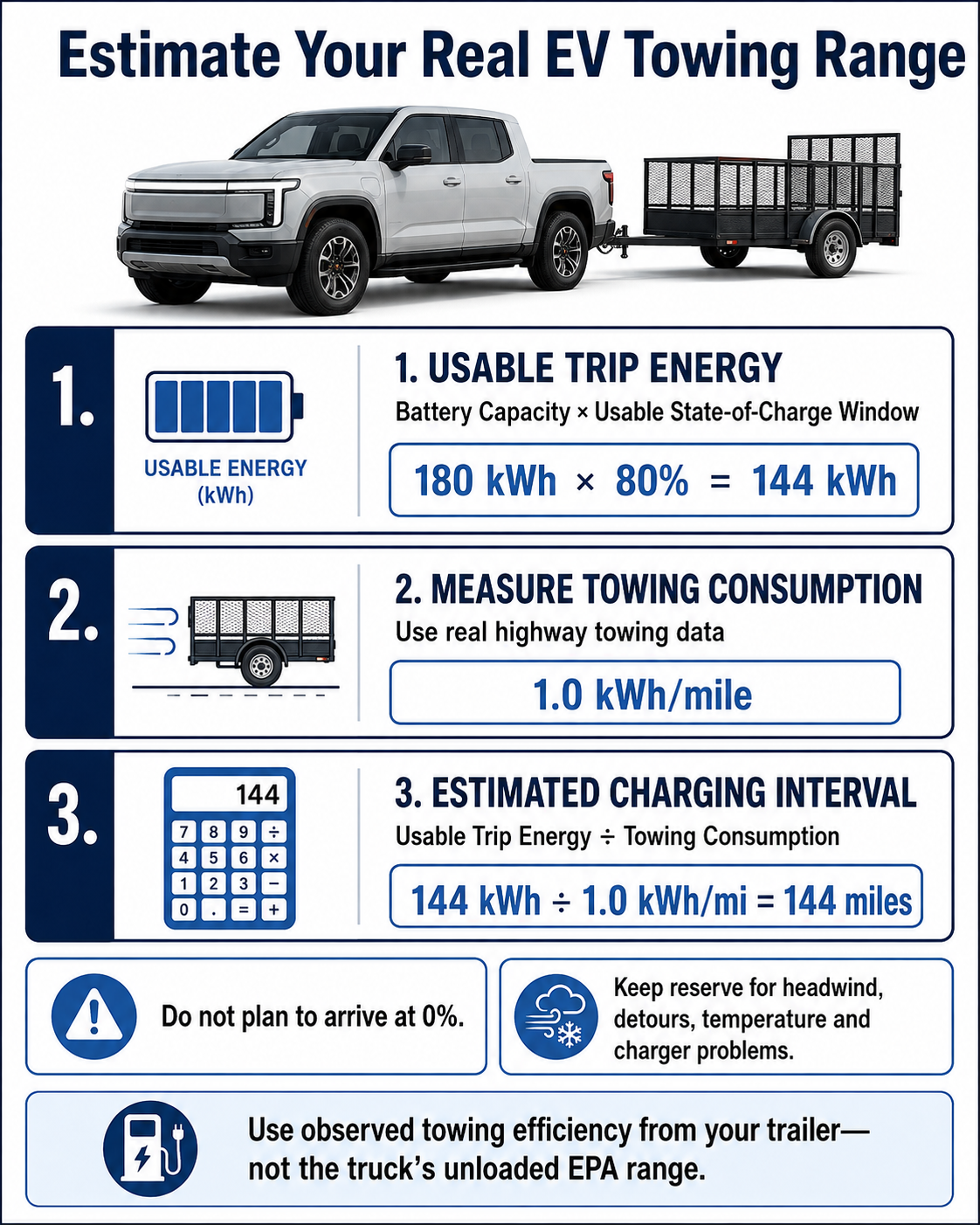
Step 1: Determine the Usable State-of-Charge Window
Assume a hypothetical electric truck has:
- 180 kWh usable battery capacity.
- Departure at 90%.
- Desired arrival reserve of 10%.
The planned state-of-charge window is:
90% − 10% = 80%
Planned usable trip energy:
180 kWh × 0.80 = 144 kWh
Step 2: Measure Real Towing Consumption
Suppose a representative highway test with the actual trailer records:
1.0 kWh/mile
Step 3: Calculate the Theoretical Charging Interval
144 kWh ÷ 1.0 kWh/mile = 144 miles
That is the theoretical interval using the chosen SOC window.
The driver should still shorten it to account for:
- Headwind.
- Temperature.
- Elevation.
- Detours.
- Unavailable charging stations.
- Battery conditioning.
Why the First 50 Miles of a Trip Are Valuable Data
The first portion of a real towing trip can be treated as a calibration run.
Once the truck and trailer reach stable highway conditions, record:
- Average speed.
- Energy consumption in kWh/mile or miles/kWh.
- Outside temperature.
- Wind direction.
- Elevation change.
- Trailer load.
That measured efficiency can then replace a generic internet range-loss percentage in the next charging calculation.
Do Not Compare Two Towing Tests Without Comparing the Trailers
A headline saying one electric truck traveled 230 miles while another traveled 130 miles may be technically true and still be a poor vehicle comparison.
Before comparing results, check:
- Battery capacity.
- Starting and ending SOC.
- Trailer frontal area.
- Trailer height and width.
- Trailer mass.
- Road speed.
- Wind.
- Temperature.
- Elevation.
- Tires.
Without those variables, a range number is a case study—not a universal vehicle rating.
What Type of Utility Trailer Is Most EV-Friendly?
There is no single ideal trailer, because cargo requirements come first.
But if an OEM is designing specifically around EV towing efficiency, useful priorities include:
- Reduce unnecessary frontal height.
- Avoid excessively exposed structural features in the airflow.
- Keep cargo low when practical.
- Control airflow around the trailer front.
- Reduce unnecessary truck-to-trailer turbulence.
- Manage underbody and wheel-area airflow.
- Avoid unnecessary mass without sacrificing structural capacity.
Do Not Sacrifice Structural Safety for Aerodynamics
Removing structure, using underrated tires or moving cargo only for aerodynamic reasons can create more serious mechanical problems than the range it saves.
Aerodynamic optimization must remain inside:
- GVWR.
- GAWR.
- Tire ratings.
- Load distribution requirements.
- Tongue-weight requirements.
- Cargo-securement requirements.
Local Towing and Long-Distance Towing Are Different EV Use Cases
Local and Regional Utility Work
For contractors, landscapers, farms and facilities where a trailer travels a predictable daily route and the truck returns to overnight charging, EV towing can be operationally straightforward.
The important calculation is whether the normal day's energy requirement fits comfortably inside the available battery window.
Long-Distance Highway Towing
Cross-country towing introduces additional dependencies:
- Fast-charge spacing.
- Charging speed.
- Trailer-accessible stations.
- Weather variation.
- Higher sustained aerodynamic demand.
The truck can be mechanically excellent at towing while the trip remains inconvenient because of infrastructure.
EV Trailer Trip Planning Checklist
Verify the Specific Truck's Ratings
Do not use the maximum number from an advertisement if the actual battery, wheel, hitch or trim configuration has different limits.
Check Tow-Vehicle Payload
Include passengers, cargo, hitch hardware and trailer tongue weight.
Record the Trailer's Actual Loaded Weight
Use real operating weight rather than empty or advertised trailer weight.
Evaluate Trailer Aerodynamics
Record trailer height, width, body shape and exposed cargo.
Use a Realistic Highway Speed
Do not calculate trip range from low-speed efficiency if most of the route will be interstate driving.
Measure Real Consumption
Use the truck's actual towing efficiency once enough representative miles have been driven.
Check Wind, Weather and Elevation
Build those variables into the energy reserve.
Verify Charging Before Departure
Check connector compatibility, charging power, station availability and recent operating information.
Check Whether the Trailer Fits the Charging Site
Prioritize pull-through or explicitly trailer-friendly stations where possible.
Keep an Energy Reserve
A trip plan that requires arriving at every charger at 1–2% leaves very little room for a closed stall, headwind or detour.

What This Means for Trailer OEMs
Electric tow vehicles create a new product-development opportunity for utility-trailer manufacturers.
Traditionally, trailer specifications have focused heavily on:
- Payload.
- Axle capacity.
- Deck dimensions.
- Durability.
- Cost.
Those remain essential.
But an EV-oriented trailer specification may increasingly include:
- Frontal area.
- Loaded height.
- Airflow around ramps and gates.
- Underbody airflow.
- Low-drag wheel and fender design.
- Weight reduction without loss of structural capacity.
For fleets, “How many pounds can it carry?” may gradually be joined by another purchasing question:
“How many kWh per mile does this trailer require behind our tow vehicle at highway speed?”
GOODIN Industry Perspective
EV towing changes the way trailer efficiency becomes visible.
Gasoline and diesel tow vehicles also consume substantially more energy when pulling high-drag trailers, but the driver often notices the result primarily as lower MPG.
With a battery-electric truck, the same efficiency loss immediately changes the distance to the next charging stop.
That makes trailer design itself a more visible part of the towing-energy equation.
For utility-trailer OEMs and distributors, future specifications should increasingly evaluate:
- Real loaded mass.
- Frontal area and body height.
- Cargo position.
- Ramp and gate design.
- Tire rolling resistance.
- Axle and bearing efficiency.
- Trailer brake condition.
- Support hardware mass and placement.
Traditional trailer hardware still matters in this electrified environment.
The trailer must still be supported during coupling, parking, loading and maintenance. GOODIN's Trailer Jack range covers support configurations for utility, equipment, marine, RV and other trailer applications.
For an EV-oriented trailer program, the goal should not be to remove hardware indiscriminately to save weight.
The better goal is to specify every component around its real structural requirement while eliminating unnecessary mass and aerodynamic penalty elsewhere.
Focused FAQ
How much range does an electric truck lose when towing?
There is no universal percentage. Large, tall trailers can reduce highway range dramatically, while lower-profile trailers may have a smaller effect. Trailer aerodynamics, road speed, mass, wind, temperature, terrain and the truck's battery capacity all matter.
Does trailer weight or aerodynamics matter more for EV range?
Both matter, but at steady highway speed aerodynamic drag can become more important than trailer mass. Weight becomes particularly important during acceleration and climbing. This is why trailer shape and speed should be evaluated together with loaded weight.
Can a lighter trailer reduce EV range more than a heavier trailer?
Yes. A lightweight but tall box trailer can create greater aerodynamic demand than a heavier low-profile trailer. Weight alone does not determine towing energy consumption.
Does a V-nose trailer significantly improve EV towing range?
A shaped nose can influence airflow, but it is only one part of the aerodynamic system. Overall height, frontal area, width, truck-to-trailer gap, underbody airflow and the trailer's rear wake also matter.
Why does speed affect EV towing range so much?
Aerodynamic drag rises rapidly with relative air speed. Once a large trailer is attached, maintaining higher highway speed requires substantially more power to push the combination through the air.
Does headwind affect EV towing range?
Yes. Aerodynamic drag responds to relative air speed rather than the speedometer alone. A strong headwind can significantly increase energy consumption even when road speed does not change.
Does regenerative braking recover the energy used climbing a mountain?
Only part of it. Regeneration can recover some potential and kinetic energy during descent, but conversion losses, aerodynamic drag, rolling resistance and friction braking prevent complete recovery.
Can I calculate EV towing range from EPA range?
EPA range is useful as a vehicle reference but is not a reliable direct towing calculation. A better method uses usable battery energy divided by measured towing energy consumption in kWh per mile.
What is a good reserve when planning EV towing?
There is no universal reserve percentage. The reserve should reflect charger spacing, weather, terrain, route alternatives and charging reliability. Long rural towing routes generally justify more margin than routes with frequent fast chargers.
Do electric pickups have enough towing capacity for utility trailers?
Many current electric pickups have substantial tow ratings. The important step is to verify the exact vehicle configuration, payload, axle ratings, hitch limits and trailer weight rather than relying only on the model's advertised maximum towing number.
Why can payload matter before towing capacity?
Trailer tongue weight, passengers, bed cargo and hitch equipment all consume tow-vehicle payload. A truck can remain below its advertised trailer-weight limit while exceeding its actual payload or axle rating.
Do EV charging stations accommodate trailers?
Some do and some do not. Trailer-friendly and pull-through charging locations are expanding, but site geometry remains location-specific. Check the actual station layout before relying on it for a towing route.
Do I need to unhitch my trailer to fast charge?
Not at a properly designed pull-through charging stall. At conventional parking-style charging sites, however, disconnecting may still be necessary to avoid blocking multiple stalls or traffic.
Are open utility trailers always better for EV towing range?
No. An open trailer carrying tall or irregular machinery can still create substantial drag. Loaded height and exposed cargo shape matter more than whether the trailer technically has an enclosed body.
What should I measure on my first EV towing trip?
Record loaded trailer weight, road speed, towing energy consumption, temperature, wind and elevation. That data creates a much better planning baseline for future trips than a generic percentage taken from another owner's trailer.
Conclusion
Electric trucks have largely answered the first towing question:
“Do they have enough torque to pull a serious trailer?”
For many current models, they do.
The more important question is now:
“How much energy does this exact trailer require at the speed and conditions in which I actually tow?”
That answer depends on far more than pounds.
Trailer frontal area, body height, exposed cargo, speed, headwind, temperature, terrain and battery capacity all combine to determine real towing distance.
This is why a relatively light enclosed trailer can sometimes create a larger highway range penalty than a heavier low-profile utility trailer.
Long-distance planning adds another variable: charging infrastructure.
A powerful fast charger is valuable only when it is close enough to the route, functioning, compatible with the vehicle and physically accessible while a trailer is attached.
For EV truck buyers, the best pre-purchase test is therefore not simply comparing maximum towing ratings.
Measure the real trailer. Understand its aerodynamic profile. Estimate its real tongue load. Then test or model the energy consumption at representative highway speed.
The useful formula is simple:
Usable Battery Energy ÷ Real Towing Energy Consumption = Practical Distance Before Reserve
Once that number is known, electric-truck towing becomes much easier to evaluate as an engineering and route-planning problem rather than a debate about whether EVs can tow at all.
Technical References
- Chevrolet — 2026 Silverado EV Specifications, Range, Towing and Charging
- GMC — 2026 Sierra EV Denali Range, Towing and Charging
- Rivian — Current R1T Maximum Towing Capacity
- Rivian — 2026 R1T Battery and EPA Range References
- Ford — Current F-150 Lightning Product Transition
- U.S. EPA SmartWay — Trailer Aerodynamic Devices
- U.S. EPA — Improved Aerodynamics and Highway Drag
- Tesla — Trailer-Friendly Supercharger Identification
- Rivian — Pull-Through Charging for Trailers, Campers and Boats
- Pilot — Highway EV Fast-Charging Network
- InsideEVs — Silverado EV 6,500-lb Trailer Range Test
Galvanized vs Aluminum vs Powder-Coated Steel Trailers
Do You Need Trailer Brakes? Rules, Electric vs Hydraulic/EOH & Controller Setup
Related Article