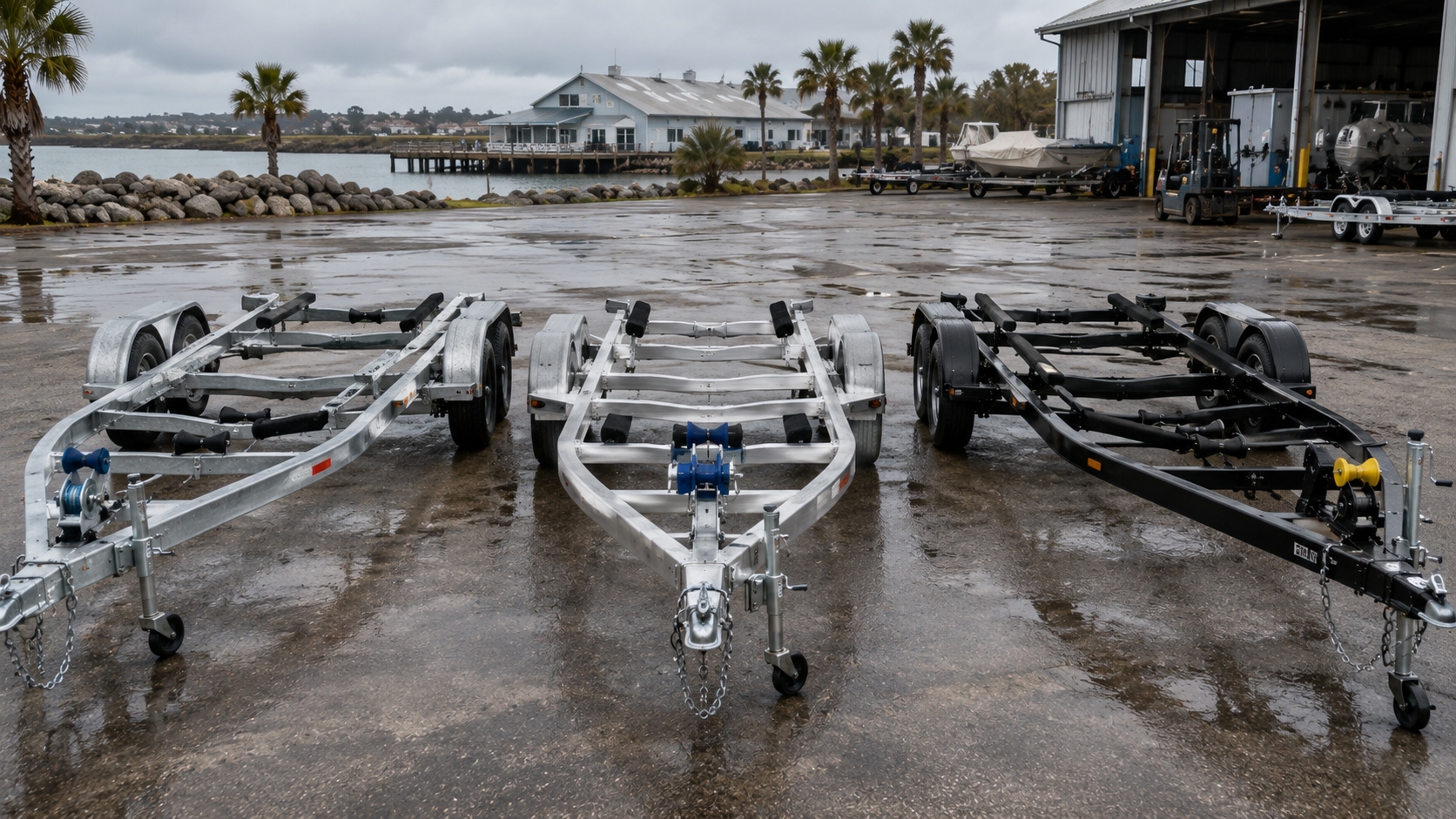
Do You Need Trailer Brakes? Rules, Electric vs Hydraulic/EOH & Controller Setup
Trailer brake requirements do not follow one nationwide weight threshold. The correct decision combines the trailer's actual loaded weight, every applicable jurisdiction, manufacturer instructions, operating duty and the compatibility of the brake system, controller and tow vehicle.
Start with law and loaded weight—not a catalog number
Verify current rules for the route, then select the wheel-end brake and actuation architecture as one complete, compatible system.
In This Article
- Legal requirements
- Engineering margin
- Three brake architectures
- Electric trailer brakes
- Surge hydraulic brakes
- Electric-over-hydraulic
- EOH compatibility
- Decision tree
- Disc vs. drum
- Tandem-axle braking
- Controller types
- Controller gain
- Breakaway system
- Retrofit planning
- Long descents
- Actual loaded weight
- Symptoms and causes
- Pre-tow checklist
- OEM / distributor RFQ
- GOODIN perspective
- FAQ
- Conclusion
Trailer brake requirements depend on the jurisdiction, actual trailer weight, vehicle combination, trailer configuration and, in some cases, stopping-performance requirements. Tow-vehicle and trailer manufacturers can also impose requirements that matter even when a local legal exemption appears to apply.
For buyers, dealers and trailer OEMs, the correct decision sequence is:
- Determine the real loaded trailer weight.
- Check the law for every jurisdiction in which the trailer will operate.
- Check the tow-vehicle and trailer manufacturer's requirements.
- Determine the operating duty and required braking reserve.
- Select a compatible trailer braking system.
Do not begin with the assumption that one frequently repeated number—3,000 lb, 3,500 lb or 4,500 lb—applies everywhere in the United States.
There Is No Single U.S. Trailer-Brake Weight Threshold
State rules differ, and commercial combinations can also be subject to federal requirements.
Florida is a useful example. Florida Statutes §316.261 provides a conditional exception for trailers not exceeding 3,000 lb, but the weight on the trailer wheels must not exceed 40% of the towing vehicle's gross weight and the combination must satisfy specified brake-performance requirements. Trailers above that threshold are subject to broader all-wheel braking and breakaway provisions.
Texas illustrates why copying another state's number can be misleading. Texas Transportation Code §547.401 provides an exemption at 4,500 lb or less and another limited low-speed provision for certain trailers between 4,500 and 15,000 lb.
| Example | What it demonstrates | Planning lesson |
|---|---|---|
| Florida | A ≤3,000-lb exception is conditional on weight relationship and braking performance. | Being under one weight number does not automatically create an unconditional exemption. |
| Texas | The general exemption and low-speed provisions use different thresholds. | Speed and operating condition can matter as well as weight. |
| Commercial vehicles subject to 49 CFR Part 393 | Federal motor-carrier brake requirements may apply separately. | Commercial buyers should not rely only on recreational-towing summaries. |
This article is therefore a system-selection guide, not a 50-state legal chart. Verify the current law in the registration state and every jurisdiction on the route before specifying or operating the trailer.
Legal Minimum and Good Engineering Are Not Always the Same Decision
A trailer can fall within a legal exception and still place substantial braking demand on the tow vehicle.
The more relevant engineering questions are:
- How heavy is the trailer when actually loaded?
- How large is it relative to the tow vehicle?
- Will it operate on long grades?
- Will it tow frequently at highway speed?
- Does it carry equipment, a boat, livestock or other high-value payload?
- How much braking reserve remains during an emergency stop?
A legal exemption establishes a regulatory boundary. It does not guarantee that an unbraked trailer is the best configuration for every route and duty cycle.
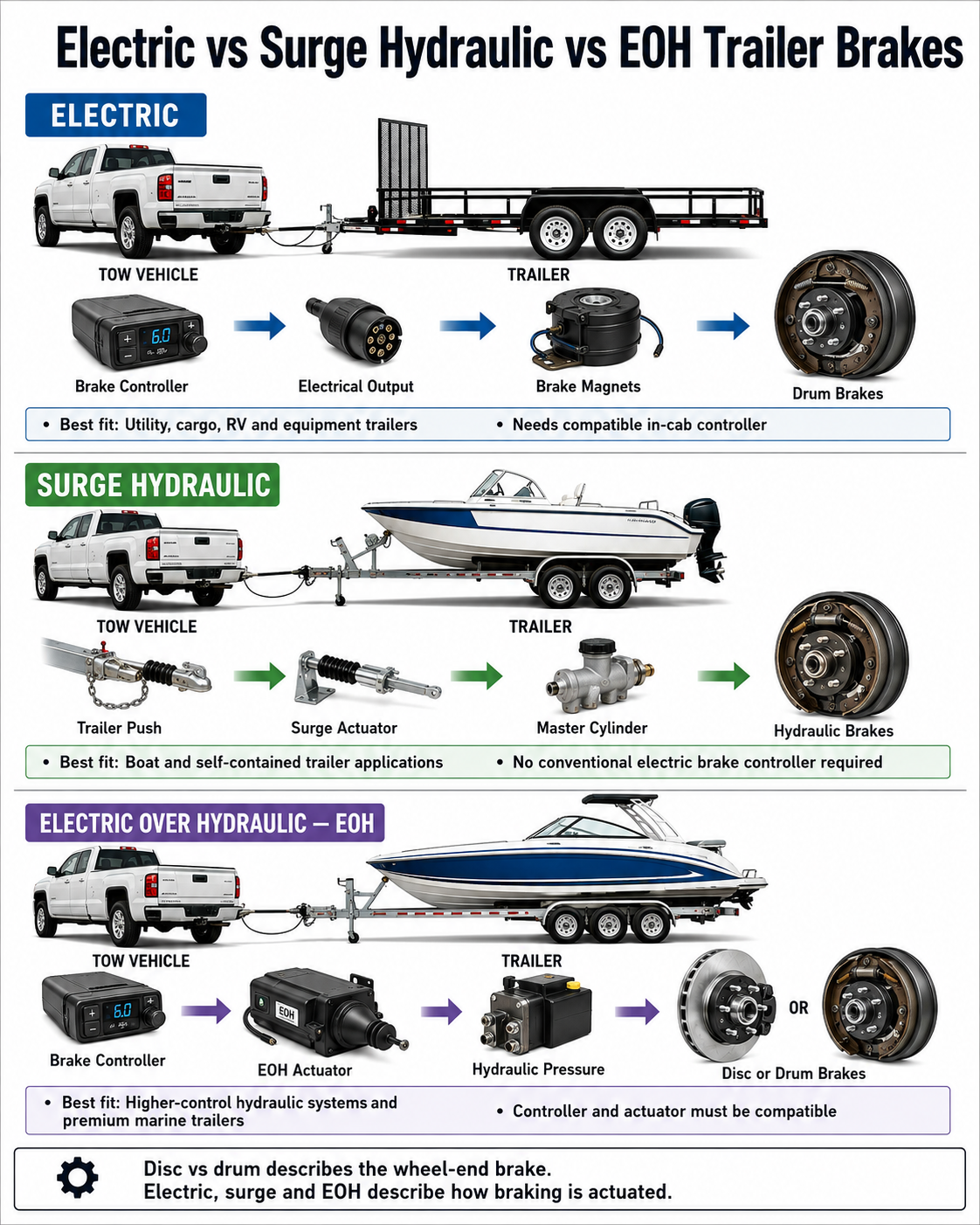
Three Brake Architectures Buyers Commonly Confuse
When buyers compare electric trailer brakes, hydraulic trailer brakes and electric over hydraulic brakes, an important distinction is often missed.
“Disc” and “drum” describe the braking mechanism at the wheel.
“Electric,” “surge hydraulic” and “electric-over-hydraulic” describe how braking force is commanded or generated.
| System | Control path | In-cab controller? | Typical wheel end | Common application |
|---|---|---|---|---|
| Electric | Controller → electrical current → magnet | Yes | Electric drum | Utility, cargo, RV, equipment trailers |
| Surge hydraulic | Trailer compression → actuator → master cylinder | Normally no conventional electric controller | Hydraulic disc or drum | Boat and self-contained hydraulic trailers |
| EOH | Controller → powered hydraulic actuator → brake lines | Yes, and compatibility matters | Hydraulic disc or drum | Premium marine, heavier and high-control hydraulic applications |
How Conventional Electric Trailer Brakes Work
A conventional electric drum system uses a trailer brake controller in the tow vehicle to send electrical output through the trailer connection to electromagnets inside the brake assemblies.
When energized, the magnet interacts with the rotating drum and the brake mechanism applies the shoes against the drum.
The complete system normally involves:
- Brake-ready axle and mounting flanges.
- Left- and right-hand brake assemblies.
- Compatible hub-drums.
- Trailer brake wiring.
- Reliable grounds.
- Seven-way connector or another approved electrical interface.
- Compatible brake controller.
- Breakaway switch and power source where required.
Where Electric Brakes Make Sense
Electric drums remain a practical architecture for utility, cargo, RV and equipment trailers because the driver can control braking output from the tow vehicle and the system can be integrated relatively efficiently on brake-ready axles.
They are particularly attractive when the tow vehicle already has a compatible proportional or factory-integrated controller.
What Electric Brakes Do Not Solve
A controller cannot compensate for:
- Incorrect shoe adjustment.
- Weak or damaged magnets.
- Contaminated friction material.
- Poor grounds.
- Undersized or damaged wiring.
- Worn drums.
- Incorrect axle or brake capacity.
Increasing controller gain to hide a mechanical problem can create an inconsistent system rather than repair the actual fault.
How Surge Hydraulic Brakes Work
A surge actuator replaces or integrates with the normal tongue coupler.
When the tow vehicle decelerates, the trailer continues moving forward and pushes against the actuator. The actuator telescopes or compresses and applies force to a master cylinder.
That master cylinder sends hydraulic pressure through the brake lines to hydraulic disc or drum brakes.
The Major Advantage: Self-Contained Actuation
The surge mechanism does not normally depend on a conventional in-cab electric brake controller to determine braking demand.
That simplicity is one reason surge-hydraulic architecture remains common in boat trailer brakes.
But Surge Does Not Mean Maintenance-Free
The system still contains:
- Sliding actuator components.
- Master cylinder.
- Brake fluid.
- Hydraulic lines.
- Fittings.
- Wheel cylinders or calipers.
- Reverse-lockout hardware where applicable.
Marine exposure can add corrosion risk to the actuator, hydraulic lines, calipers, fittings and wheel-end hardware.
For repeated saltwater launching, see GOODIN's Saltwater Boat Trailer Disc vs Drum Guide for a separate analysis of corrosion, disc/drum architecture and marine maintenance.
What Electric-Over-Hydraulic Changes
EOH combines two ideas.
The tow vehicle still generates an electronic braking command, but instead of energizing brake magnets directly at each wheel, that signal operates a powered hydraulic actuator.
The actuator creates hydraulic pressure and sends it through brake lines to hydraulic wheel-end brakes.
In simplified form:
Brake Controller → EOH Actuator → Hydraulic Pressure → Disc or Drum Brakes
Why EOH Appeals to Heavier and Premium Trailers
EOH can provide the driver-adjustable and proportional-control benefits associated with an electronic controller while retaining hydraulic disc or drum brakes at the wheels.
That combination is particularly attractive where hydraulic wheel ends are already desirable but greater control from the cab is wanted.
EOH Is Not Just “Electric Brakes with Fluid”
The powered actuator becomes a critical system component.
Specification must include:
- Disc- or drum-brake actuator compatibility.
- Required hydraulic pressure.
- Controller compatibility.
- Electrical power supply.
- Ground integrity.
- Hydraulic reservoir and fluid requirements.
- Brake-line sizing and condition.
- Bleeding procedure.
- Breakaway operation.

Controller Compatibility Is the EOH Question Buyers Miss
A truck having a factory brake controller does not automatically prove that every EOH actuator will work correctly with it.
Likewise, an aftermarket controller that operates electromagnetic electric brakes may not necessarily support EOH operation.
Modern controllers vary.
For example, some units provide a dedicated Electric-Over-Hydraulic operating mode, while other controllers are specified only for electromagnetic electric brakes.
Before selecting an EOH actuator, verify:
- Exact tow-vehicle year and model.
- Factory or aftermarket controller model.
- Whether an EOH mode exists.
- Actuator manufacturer's controller compatibility list.
- Required auxiliary power circuit.
- Any approved adapter requirement.
Do not design an EOH conversion around the assumption that “a seven-way plug and a brake-controller screen” prove compatibility.
A Practical Trailer-Brake Decision Tree
Does the Law Require Brakes?
Use actual loaded weight and check every jurisdiction where the trailer will operate.
If brakes are legally required, the decision is no longer whether to install them—it is which compliant architecture fits the trailer.
What Does the Manufacturer Require?
Check both the trailer and tow-vehicle documentation.
A legal exemption should not be used to override explicit manufacturer limits or towing instructions.
What Is the Operating Environment?
For primarily dry-road utility and RV use, electric drum brakes may offer an efficient and serviceable solution.
For frequent marine launching, hydraulic disc architecture may provide easier drainage, inspection and corrosion management when properly specified.
How Much Control Is Required?
If a hydraulic system is desirable but driver-adjustable proportional control is also important, EOH becomes a stronger candidate.
Is the Existing Trailer Ready for the Conversion?
A retrofit must begin with axle, spindle, brake-flange and hub compatibility—not with the brake-controller catalog.

Disc vs Drum Is a Separate Decision
One of the easiest ways to specify the wrong system is to compare “electric,” “hydraulic,” “disc” and “EOH” as if all four were parallel choices.
They are not.
A better selection process uses two layers:
| Decision layer | Typical options |
|---|---|
| Wheel-end braking architecture | Disc or drum |
| Actuation/control architecture | Electric magnet, surge hydraulic or electric-over-hydraulic |
A surge actuator can operate hydraulic disc or hydraulic drum brakes if it is correctly specified.
An EOH actuator can also be designed for hydraulic disc or hydraulic drum systems.
The actuator must match the pressure and fluid requirements of the chosen brake system. Do not assume that an actuator selected for hydraulic drums is automatically correct for a disc conversion.
What About Tandem-Axle Trailers?
Questions around tandem axle trailer brakes often focus on whether brakes can be installed on only one axle.
There is no responsible universal answer based only on the number of axles.
Check:
- Applicable law.
- Trailer manufacturer specification.
- Axle manufacturer's requirements.
- Actual loaded weight.
- Brake capacity.
- Intended road and duty cycle.
Do Not Choose One Braked Axle Simply Because It Is Cheaper
A tandem trailer may transfer loads dynamically between its axles during braking and over uneven roads.
If the legal and manufacturer requirements call for braking on more wheels, reducing the installation to one axle because the parts cost less is not a valid engineering substitute.
Balanced Braking Matters
Brake assemblies, hydraulic components and adjustments should be compatible and balanced across the required wheel positions.
A trailer pulling strongly to one side during braking should be inspected for the underlying mechanical, hydraulic or electrical fault rather than corrected only by changing global controller gain.
Proportional vs Time-Delayed Brake Controllers
Proportional Controllers
A proportional controller uses vehicle deceleration information to vary trailer braking output according to the braking event.
A light stop produces a lighter trailer-brake response; stronger deceleration can command greater output, subject to the controller setup.
Time-Delayed Controllers
Time-based designs increase output according to a preset response once the brake signal is detected.
They can operate correctly when properly specified and adjusted, but their response is not based on measured vehicle deceleration in the same way as a proportional controller.
Integrated Factory Controllers
Modern tow-package pickups may integrate the brake controller into the vehicle electronics.
Some allow the driver to select different trailer brake types—including separate electromagnetic electric and EOH modes.
Use the exact vehicle manual. Menu options, compatibility and setup procedures vary by manufacturer and model year.
How to Set Brake-Controller Gain
There is no universal gain number that is correct for every trailer.
Gain changes with:
- Loaded trailer weight.
- Number and size of brakes.
- Brake condition and adjustment.
- Tire grip.
- Road surface.
- Weather.
- Controller design.
The correct approach is to follow the tow-vehicle or controller manufacturer's setup procedure with the trailer in the representative loaded condition.
Do Not Copy a Forum Gain Number
A gain setting that works on another owner's boat trailer or travel trailer may produce weak braking or premature wheel lock on a different combination.
Recheck Gain When the Load Changes
A nearly empty utility trailer and the same trailer carrying a machine can require different braking behavior.
Road and weather conditions can also change available tire grip.
Manual Control Is a Setup and Control Feature—not a Mechanical Repair
Many controllers provide manual trailer-brake activation.
Use it only according to the controller and vehicle manufacturer's instructions.
It should not be used to mask poor adjustment, hydraulic faults, electrical resistance or an overloaded trailer.

The Breakaway System Has a Different Job
Normal trailer service braking and breakaway braking are related but different functions.
During normal towing, the controller or surge actuator coordinates trailer braking with the tow vehicle.
The breakaway system exists for the abnormal event in which the trailer separates from the tow vehicle.
Electric and EOH Systems Need Supported Emergency Power
The exact architecture varies, but a powered breakaway system may include:
- Breakaway switch.
- Pull cable.
- Battery or approved emergency power source.
- Charging circuit.
- Brake-output wiring.
The breakaway cable should be connected and routed according to the system and vehicle instructions.
Do not treat the breakaway switch as a routine parking brake.
A Trailer Brake Retrofit Starts at the Axle
A successful trailer brake retrofit is not simply a matter of bolting brakes onto an idler hub and installing a controller.
Identify the Axle
Record:
- Manufacturer.
- Capacity.
- Model or serial information.
- Spindle dimensions.
- Bearing numbers.
- Seal dimensions.
- Wheel bolt pattern.
Confirm the Brake Mounting Flange
Many brake-ready axles have a mounting flange positioned behind the spindle.
If no approved flange exists, do not assume that welding a generic plate onto the axle is a routine retrofit. Position, alignment, axle material and welding procedure affect brake geometry and axle integrity.
Match the Hub or Rotor
Wheel bolt pattern alone is insufficient.
Confirm:
- Inner bearing.
- Outer bearing.
- Seal.
- Spindle.
- Brake diameter.
- Brake width.
- Axle rating.
Then Build the Actuation System
For electric brakes, that may mean wiring, grounds, seven-way connection, controller and breakaway components.
For surge hydraulic brakes, it means an appropriate actuator, master cylinder, hydraulic lines, wheel-end brakes and reverse functionality.
For EOH, it adds the powered actuator, electrical supply and controller-compatibility requirements.
Long Descents Change the Brake-System Decision
The tow vehicle's ability to pull a trailer uphill does not prove that the combination has adequate braking reserve on the descent.
Long grades turn braking into a thermal-management problem. The trailer's mass continuously adds energy that must be controlled by the tow vehicle, trailer brakes, engine braking or other approved systems.
For a dedicated analysis of grade length, heat, electric-brake retrofits, seven-way wiring, breakaway systems and pre-mountain testing, see GOODIN's Utility Trailer Brakes for Mountain Towing: Retrofit Guide .
Actual Loaded Weight Still Comes First
Do not evaluate brake requirements from an empty brochure weight when the trailer normally travels with machinery, a boat, fuel, batteries, water, tools or accessories.
The real operating weight also influences controller setup, axle loading and the braking energy generated during a stop.
For a measurement-based explanation of GVWR, axle ratings, payload and tongue load, see GOODIN's GVWR, GAWR, Payload & Tongue Weight Guide .
Common Trailer-Brake Symptoms and What They Suggest
| Symptom | Possible causes to investigate | Do not assume |
|---|---|---|
| Trailer wheels lock too easily | Excess gain, light load, adjustment, tire grip or brake mismatch | More lock-up means better braking |
| Electric brakes feel weak | Low output, wiring resistance, poor ground, adjustment, magnets, unburnished new brakes | Controller automatically compensates for mechanical problems |
| Hydraulic braking is weak or delayed | Air, fluid loss, actuator condition, incorrect actuator, hydraulic restriction | Increasing electrical gain repairs the hydraulic circuit |
| EOH actuator does not respond correctly | Controller mode, compatibility, auxiliary power, wiring or actuator fault | Every factory controller supports every actuator |
| Trailer pulls to one side | Unequal adjustment, contaminated linings, caliper problem, wiring resistance or wheel-end fault | Global gain adjustment fixes left/right imbalance |
| One wheel stays hot | Brake drag, bearing issue, seized caliper or hydraulic/mechanical fault | All heat is normal after towing |
Pre-Tow Trailer Brake Checklist
Confirm the Real Loaded Weight
Use the actual towing configuration rather than an empty estimate.
Check the Legal Requirement
Verify current brake and breakaway rules for the route and operation.
Confirm Brake Architecture
Know whether the trailer uses electric drums, surge hydraulic brakes or EOH.
Confirm Controller Mode and Compatibility
For electric or EOH systems, verify that the controller supports the installed brake architecture and is set to the correct mode.
Inspect Electrical Connections
Check the seven-way connection, brake-output wiring, grounds and visible harness damage.
Inspect the Breakaway System
Verify the switch, cable, supported power source and system operation according to manufacturer instructions.
Inspect Wheel-End Brakes
Look for wear, contamination, leaks, corrosion, dragging components and incorrect adjustment.
Perform a Controlled Functional Check
Follow the tow-vehicle, controller and brake manufacturer's procedure in a safe environment before normal traffic.

What OEM and Distributor Buyers Should Put in a Brake-System RFQ
Trailer Platform
- Trailer type and target market.
- GVWR and actual expected operating weight.
- Single, tandem or triple axle.
- Axle manufacturer and capacity.
- Wheel and tire specification.
Brake Architecture
- Disc or drum wheel end.
- Electric, surge hydraulic or EOH actuation.
- Brake size and capacity.
- Number of braked axles.
Controller Interface
- Factory integrated or aftermarket controller.
- Target tow-vehicle platforms.
- Electric/EOH mode compatibility.
- Seven-way or other approved connector architecture.
Hydraulic Requirements
- Disc or drum actuator specification.
- Pressure requirements.
- Brake fluid specification.
- Hydraulic line material and routing.
- Bleeding and service requirements.
Environment
- Freshwater or saltwater exposure.
- Road salt.
- Ambient temperature.
- Mountain or repeated descent duty.
- Annual towing frequency.
Safety and Service
- Breakaway architecture.
- Diagnostic procedure.
- Replacement component availability.
- Maintenance and adjustment interval.
- Required local compliance documentation.
GOODIN Industry Perspective
Brake-system sourcing is a good example of why trailer components should not be purchased from isolated catalog specifications.
A buyer can select a correctly rated brake assembly and still build an unreliable system if the actuator is wrong, the controller is incompatible, the axle is not brake-ready or the electrical ground cannot carry the required current.
For marine trailers, corrosion exposure adds another system layer. For mountain and equipment trailers, thermal duty and loaded mass become more important.
The better RFQ therefore describes the complete use case rather than requesting only “3,500-lb brakes” or “an EOH actuator.”
Define the trailer's actual operating weight, axle layout, wheel-end brake architecture, actuation method, target tow vehicles, controller interface, operating environment, breakaway requirement and expected service cycle.
That information allows each part of the braking system to be checked against the same operating condition.
Continue the Trailer Engineering Review
Brake architecture should be checked together with the trailer's measured load, route, axle layout and operating environment. These related guides cover the two next decisions most buyers need to verify.
Focused FAQ
At what trailer weight are brakes legally required?
There is no single U.S. threshold that applies in every jurisdiction. Some states use different weight limits, conditions or stopping-performance requirements. Commercial combinations can also be subject to federal rules. Check the current law for every jurisdiction in which the trailer will operate.
Do electric trailer brakes need a brake controller?
Conventional electric trailer brakes normally require a compatible controller to regulate electrical output to the brake magnets. The controller may be integrated into the tow vehicle or installed as an approved aftermarket unit.
Do surge hydraulic brakes need a brake controller?
A conventional surge-hydraulic system normally generates braking pressure mechanically through compression of the tongue actuator rather than through an in-cab electric brake controller.
Does EOH need a brake controller?
Yes. An electric-over-hydraulic system needs a compatible electrical braking command to operate its powered hydraulic actuator. Verify that the tow vehicle or aftermarket controller specifically supports the actuator and EOH operating mode.
Are EOH brakes the same as electric brakes?
No. Conventional electric trailer brakes use electrical power at the wheel-end brake magnets. EOH uses the electronic command to operate a hydraulic actuator, which then sends hydraulic pressure to disc or drum brakes.
Is EOH better than surge brakes?
EOH provides additional electronic control from the tow vehicle and can be attractive for heavier, premium or frequently towed hydraulic-brake trailers. Surge systems remain mechanically simpler and can be a good fit for many boat trailers. The better choice depends on duty, cost, environment, tow-vehicle compatibility and maintenance requirements.
Can EOH operate drum brakes?
EOH systems can be designed for hydraulic drum or disc brakes, but the actuator must be specified for the wheel-end system. Disc and drum applications can require different hydraulic characteristics.
Can I use any brake controller with EOH?
No. Controller compatibility must be verified. Some controllers provide dedicated EOH support while others are intended only for electromagnetic electric brakes.
How should trailer-brake gain be set?
Follow the exact tow-vehicle or controller manufacturer's procedure with the trailer in a representative loaded condition. The correct gain depends on trailer weight, brake condition, tire grip, road surface and controller design, so another owner's number should not be copied blindly.
Should I change brake-controller gain when trailer weight changes?
Yes. Recheck the manufacturer's setup procedure when trailer loading, vehicle loading, road surface or weather differs substantially from the condition in which the controller was originally adjusted.
Do I need brakes on both axles of a tandem trailer?
Follow the applicable law and the trailer and axle manufacturers' specifications. Do not assume that braking only one axle is acceptable simply because the trailer has two axles or because a one-axle conversion costs less.
Does a seven-way connector mean the trailer has working brakes?
No. It only provides an electrical interface. The controller, wiring, grounds, brake assemblies and breakaway system still need to be present, compatible and functioning correctly.
Can I convert a trailer with no brakes to electric brakes?
Often, but first identify the axle and confirm approved brake flanges, spindle dimensions, bearings, seals and compatible hub-drums. If the axle is not brake-ready, replacing it with an appropriate complete axle may be more reliable than improvising a conversion.
Can I convert surge brakes to EOH?
Often yes when the wheel-end hydraulic brakes are suitable, but the actuator, hydraulic system, electrical supply, breakaway equipment and tow-vehicle controller must all be checked for compatibility.
Why are my trailer brakes locking?
Possible causes include excessive controller gain, light trailer loading, incorrect adjustment, brake mismatch or low available tire grip. Wheel lock should not be treated as proof of ideal braking performance.
Why do new electric trailer brakes feel weak?
New drum brakes may require manufacturer-specified adjustment and burnishing. Wiring voltage, grounds, magnet condition and controller output should also be checked before a new assembly is judged defective.
Conclusion
Choosing trailer brakes starts with a question of law, but it should not end there.
The complete decision includes actual loaded weight, axle configuration, operating environment, braking duty, tow-vehicle compatibility and the architecture of the brake system itself.
Conventional electric drums provide a practical electronically controlled solution for many utility, RV, cargo and equipment trailers.
Surge hydraulic systems remain attractive where a self-contained hydraulic system fits the application, especially on many boat trailers.
EOH combines hydraulic wheel-end braking with electronic control from the tow vehicle, but it introduces a critical compatibility requirement between the controller, electrical supply and hydraulic actuator.
None of these systems is automatically correct simply because it is more expensive or more technologically advanced.
The correct system is the one that satisfies the law, matches the trailer's loaded duty, works with the tow vehicle, remains within every component rating and continues to provide predictable braking when the combination is used in its real operating environment.
Technical References
- Florida Statutes §316.261 — Brake Equipment Required
- Texas Transportation Code §547.401 — Brakes Required
- 49 CFR §393.42 — Brakes Required on All Wheels
- Dexter — Surge Actuators
- Dexter — Electric/Hydraulic Actuation
- Dexter — Light Duty Service Manual
- Tekonsha — Prodigy P3 Electric and EOH Controller
- Ford — Selecting Electric or Electric-over-Hydraulic Trailer Brakes
- Ford — Adjusting Trailer Brake Controller Gain
EV Trucks + Utility Trailers: What Really Determines Towing Range?
GVWR, GAWR, Payload & Tongue Weight: Load a Trailer Without Sway
Related Article