
Galvanized vs Aluminum vs Powder-Coated Steel Trailers
Galvanized steel, aluminum and powder-coated steel are not three equivalent trailer materials. The right choice depends on the structural substrate, corrosion-protection system, mixed-metal interfaces, drainage, coating damage and the actual road-salt or marine exposure cycle.
A zinc coating provides both barrier and sacrificial protection to the fabricated steel structure.
The corrosion-resistant structural material can reduce mass, but wet dissimilar-metal joints need careful control.
Appearance and performance depend on pretreatment, edge coverage, cure quality and timely repair of damage.
In This Article
- Systems are not equivalent
- Why there is no universal winner
- How hot-dip galvanizing works
- Zinc finishes are different
- Road salt and galvanized steel
- Saltwater exposure categories
- Limits of salt-spray hours
- Aluminum corrosion behavior
- Control galvanic corrosion
- Aluminum weight savings
- How powder coating works
- Pretreatment and coating quality
- Why coating damage matters
- Three corrosion patterns
- Duplex coating systems
- Practical comparison
- Choose by environment
- Hardware and interfaces
- Drainage design
- Sealants and water paths
- Road-salt specification
- Marine specification
- OEM RFQ checklist
- Used-trailer inspection
- GOODIN perspective
- FAQ
- Conclusion
- Technical references
These Are Not Three Equivalent Material Choices
“Galvanized, aluminum or powder-coated steel?” sounds like a comparison between three trailer materials.
Technically, it is not.
An aluminum trailer uses aluminum as the structural base material.
A hot-dip galvanized trailer normally uses structural steel protected by a zinc coating produced after fabrication.
A powder coated steel trailer uses steel protected primarily by an organic barrier coating.
Those distinctions matter because the three systems do not fail in the same way when exposed to road salt, coastal air, boat-ramp immersion, stone impacts or trapped moisture.
There is also a fourth possibility that ordinary comparison articles often miss:
hot-dip galvanized steel can also be powder coated.
That combination is commonly called a duplex coating system.
A technically useful trailer coating comparison should therefore ask two separate questions:
- What is the structural base material?
- What corrosion-protection system protects that material and its joints?
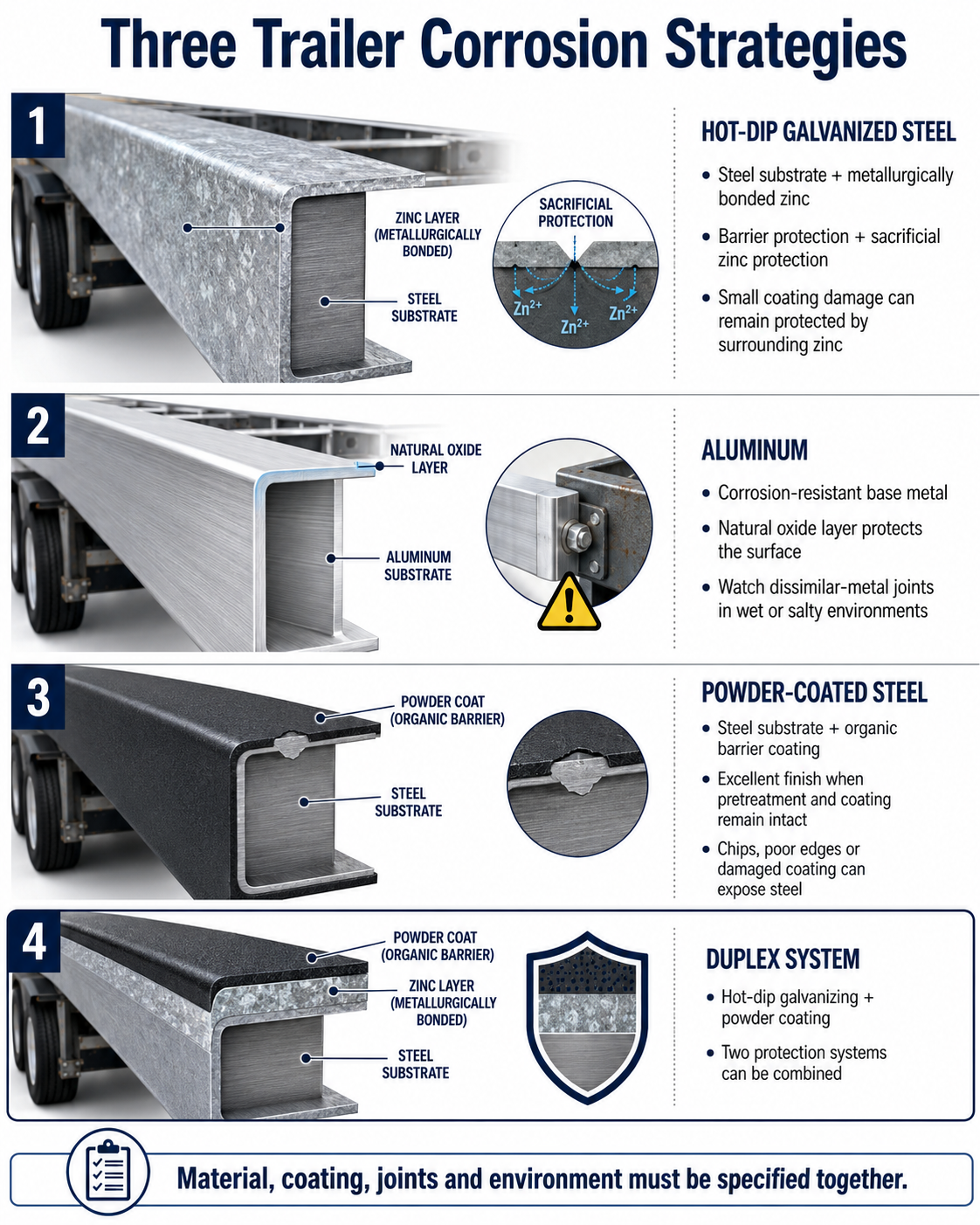
Why Trailer Corrosion Arguments Never Produce One Universal Winner
Trailer owners often compare materials using one personal experience:
- “My galvanized trailer lasted twenty years.”
- “My aluminum trailer still looks new.”
- “My powder-coated trailer rusted after one winter.”
All three experiences can be real without proving that one material is universally superior.
Corrosion depends on the complete exposure cycle.
Important variables include:
- Freshwater versus saltwater.
- Coastal air versus actual immersion.
- Wet road salt versus dry winter storage.
- How quickly the trailer dries after use.
- Whether hollow sections retain water.
- Stone impacts and coating damage.
- Dissimilar-metal contact.
- Cleaning frequency.
- Coating thickness and surface preparation.
This is why the useful question is not:
“Which trailer material is best?”
It is:
“Which material-and-protection system best fits the corrosion environment in which this trailer will actually operate?”
How Hot-Dip Galvanized Steel Protects a Trailer
A hot-dip galvanized frame begins as fabricated steel.
The completed steel component is immersed in molten zinc, creating a metallurgically bonded zinc coating.
That coating protects the steel in more than one way.
Barrier Protection
The zinc coating separates the steel from moisture, oxygen and contaminants.
Sacrificial Protection
Zinc is anodic to steel.
When a small scratch exposes the steel while surrounding zinc remains electrically connected in the presence of an electrolyte, the zinc preferentially corrodes and provides cathodic protection to the exposed steel.
This is a significant difference between galvanizing and a purely organic barrier coating.
The Zinc Surface Changes During Weathering
A galvanized surface does not remain visually identical throughout its life.
It develops zinc corrosion products and, under suitable atmospheric wet-and-dry cycling, a protective zinc patina.
That is why visual appearance alone is a poor method for deciding whether a galvanized frame has failed.
Do Not Confuse Hot-Dip Galvanizing With Every Zinc Finish
“Galvanized” is often used loosely in trailer advertising.
For an OEM specification, that word by itself is not precise enough.
A trailer may contain:
- After-fabrication hot-dip galvanized structural steel.
- Continuously galvanized sheet.
- Electroplated zinc hardware.
- Zinc-rich repair coating.
These are different processes with different coating structures and typical thicknesses.
If corrosion resistance is a purchasing requirement, define the actual process and acceptance standard rather than requesting only “galvanized steel.”
What Road Salt Does to a Galvanized Trailer
A galvanized frame is a strong candidate for trailers operating in snowbelt regions, but zinc is not chemically immune to road salt.
The aggressive condition develops when chloride-containing salts become wet and remain in contact with the structure.
Saltwater can accumulate around:
- Crossmember intersections.
- Spring hangers.
- Axle brackets.
- Fender mounts.
- Coupler structures.
- Closed tubes with poor drainage.
The practical design objective is therefore not simply “more zinc.”
It is:
- Appropriate coating specification.
- Drainage.
- Access for rinsing.
- Removal of accumulated salt.
- Repair of substantial damaged areas.
Saltwater Is Not One Single Exposure Condition
A trailer stored ten miles inland is not exposed like one parked beside a surf-zone marina.
A boat trailer that is backed into seawater several times per week is different again.
For a galvanized trailer, useful marine categories include:
- Coastal atmospheric exposure.
- Heavy salt spray.
- Intermittent immersion.
- Splash and wet/dry cycling.
- Long-term immersion.
Chlorides can consume zinc more rapidly, particularly where direct salt spray or repeated wetting removes corrosion products and exposes fresh zinc.
This is why a coastal trailer should be specified around its real proximity to saltwater and launching frequency rather than merely labeled “marine.”
Why Salt-Spray Hours Can Mislead Buyers
One of the most important procurement mistakes is comparing every corrosion-protection system by one accelerated salt-spray number.
ASTM B117-type salt fog testing can be useful for certain coating systems and quality-control comparisons.
It should not be treated as a universal conversion from laboratory hours to real-world service life.
This is particularly important for hot-dip galvanizing because continuous salt fog does not reproduce the natural atmospheric wet-and-dry cycle involved in formation of the mature zinc patina.
An OEM buyer should therefore ask:
- What test was performed?
- What substrate was used?
- What surface preparation was used?
- What coating thickness was tested?
- Was the panel intentionally scribed?
- What was the acceptance criterion?
- Does the test correlate with the intended field environment?
“1,000 hours salt spray” without those details is not a complete corrosion specification.
Aluminum Is Corrosion Resistant—Not Corrosion Proof
The main attraction of aluminum trailer construction is straightforward.
Aluminum combines low structural mass potential with inherent corrosion resistance, making it especially attractive for marine and weight-sensitive applications.
Unlike carbon steel, aluminum does not depend on an exterior zinc layer to prevent red rust.
Its surface naturally develops an oxide layer that protects the underlying metal in many environments.
That does not mean an aluminum trailer is immune to corrosion.
Galvanic Corrosion Is the Interface Problem
Galvanic corrosion aluminum problems can develop when:
- Aluminum contacts a dissimilar metal.
- An electrically conductive path exists between them.
- Water, saltwater or another electrolyte bridges the joint.
Trailer interfaces that deserve attention include:
- U-bolts.
- Stainless fasteners.
- Galvanized brackets.
- Steel axle hardware.
- Brake components.
- Jack mounting plates.
- Electrical grounds.
The highest corrosion risk is often concentrated at the connection rather than spread evenly across the entire aluminum frame.

How to Reduce Galvanic Corrosion on an Aluminum Trailer
The goal is to interrupt or control the galvanic cell.
Depending on the engineered joint, that can involve:
- Compatible material selection.
- Nonconductive isolation washers or sleeves.
- Barrier materials between mating surfaces.
- Approved joint coatings.
- Good drainage.
- Avoiding persistent saltwater entrapment.
The isolation method must still preserve the mechanical integrity of the connection.
A soft washer, improvised sealant or coating should not be added to a structural connection without checking clamping force, movement and manufacturer requirements.
Aluminum Trailer Weight Savings Are Design-Dependent
It is reasonable to describe aluminum as lightweight, but buyers should not convert that into a universal trailer-weight reduction percentage.
An aluminum frame does not use the same member sizes and fabrication details as a steel frame.
The final weight depends on:
- Alloy.
- Section dimensions.
- Wall thickness.
- Crossmember spacing.
- Joint design.
- Welding.
- Required fatigue life.
- Payload and GVWR.
Compare the certified finished trailer weight and payload rather than assuming the material name alone determines the final weight.
How Powder-Coated Steel Protects a Trailer
Powder coating uses an organic coating layer as a barrier between the steel and the environment.
A properly designed system can provide:
- Uniform color.
- Good appearance.
- Resistance to normal moisture and weather exposure.
- Good abrasion and impact performance when the system is correctly specified.
That makes powder coated steel trailer construction attractive for utility, equipment and enclosed trailers where appearance and cost matter.
The Powder Is Only One Part of a Powder-Coating System
The Powder Coating Institute defines pretreatment as preparation performed before powder application to improve adhesion and corrosion resistance.
That is a critical point.
Two trailers that both advertise “powder-coated steel” may have very different real corrosion performance.
Useful specification variables include:
- Steel cleanliness.
- Degreasing.
- Mechanical preparation where required.
- Iron phosphate, zinc phosphate or other approved pretreatment.
- Primer system.
- Powder chemistry.
- Film thickness.
- Cure schedule.
- Edge coverage.
- Drainage and hidden cavities.
Why Chips Matter More on Barrier-Coated Bare Steel
When powder coating on bare steel remains intact, it separates the steel from the environment.
When a stone chip, sharp edge, weld defect or abrasion breaches that barrier, the exposed steel can begin to corrode.
If moisture and chlorides migrate beneath poorly adhered coating, corrosion can spread beyond the original visible damage.
This explains why owner experiences with powder-coated trailers vary so widely.
The comparison is not simply powder versus zinc.
It is:
substrate preparation + coating system + edge design + damage history + environment.
Corrosion Does Not Look the Same on Every Trailer
Galvanized Steel
The zinc surface can develop white or gray corrosion products without automatically indicating that the underlying structural steel has begun severe red-rust failure.
Aluminum
Aluminum corrosion commonly produces light-colored deposits, pitting or localized attack, particularly at contaminated crevices or mixed-metal joints.
Powder-Coated Steel
Red rust emerging from a chip, edge or blister can indicate that the organic barrier has been breached and the steel substrate is now exposed.

Powder Coating Over Galvanized Steel Changes the Comparison
The three-way material debate becomes more interesting once a trailer corrosion protection system uses both galvanizing and powder coating.
A duplex system places the organic coating over hot-dip galvanized steel.
The top coating reduces direct environmental exposure of the zinc.
If the exterior coating is locally damaged, the galvanized layer remains underneath rather than immediately exposing bare carbon steel.
This architecture can be attractive when an OEM needs:
- Color and finish consistency.
- Long corrosion-protection intervals.
- Improved protection in aggressive atmospheric environments.
Duplex Does Not Mean “Powder Coat It After Galvanizing” Without Preparation
The galvanized surface must be prepared specifically for the coating process.
ASTM D7803 is used as guidance for preparing hot-dip galvanized surfaces for powder coating.
Cleaning, profiling, surface condition and outgassing control can all affect adhesion and finished appearance.
A duplex system should therefore be specified before fabrication and coating—not improvised after the trailer is complete.
Galvanized vs Aluminum vs Powder-Coated Steel: Practical Comparison
| Factor | Hot-Dip Galvanized Steel | Aluminum | Powder-Coated Steel |
|---|---|---|---|
| Base structure | Steel | Aluminum alloy | Steel |
| Main corrosion strategy | Zinc barrier + sacrificial protection | Corrosion-resistant substrate + natural oxide layer | Organic barrier coating |
| Small scratch behavior | Surrounding zinc can provide cathodic protection to limited exposed steel | No steel substrate beneath the scratch, but local aluminum corrosion remains possible | Bare steel can be exposed when coating is breached |
| Dissimilar-metal sensitivity | Must still be considered | Especially important at wet aluminum/other-metal interfaces | Important where coating is breached or joints expose different metals |
| Color flexibility | Limited without secondary coating | Natural, anodized or coated options | Excellent |
| Road-salt suitability | Strong candidate with drainage, rinsing and correct specification | Strong candidate when joints and hardware are engineered correctly | Highly dependent on pretreatment, coating integrity and repair |
| Marine suitability | Can perform well but chloride intensity and splash exposure matter | Common strong candidate, but galvanic joints remain critical | Requires a specifically engineered marine-duty coating strategy |
| Maintenance focus | Zinc condition, salt traps, major coating loss | Mixed-metal interfaces, pitting, welds and hardware | Chips, edges, blistering and underfilm corrosion |
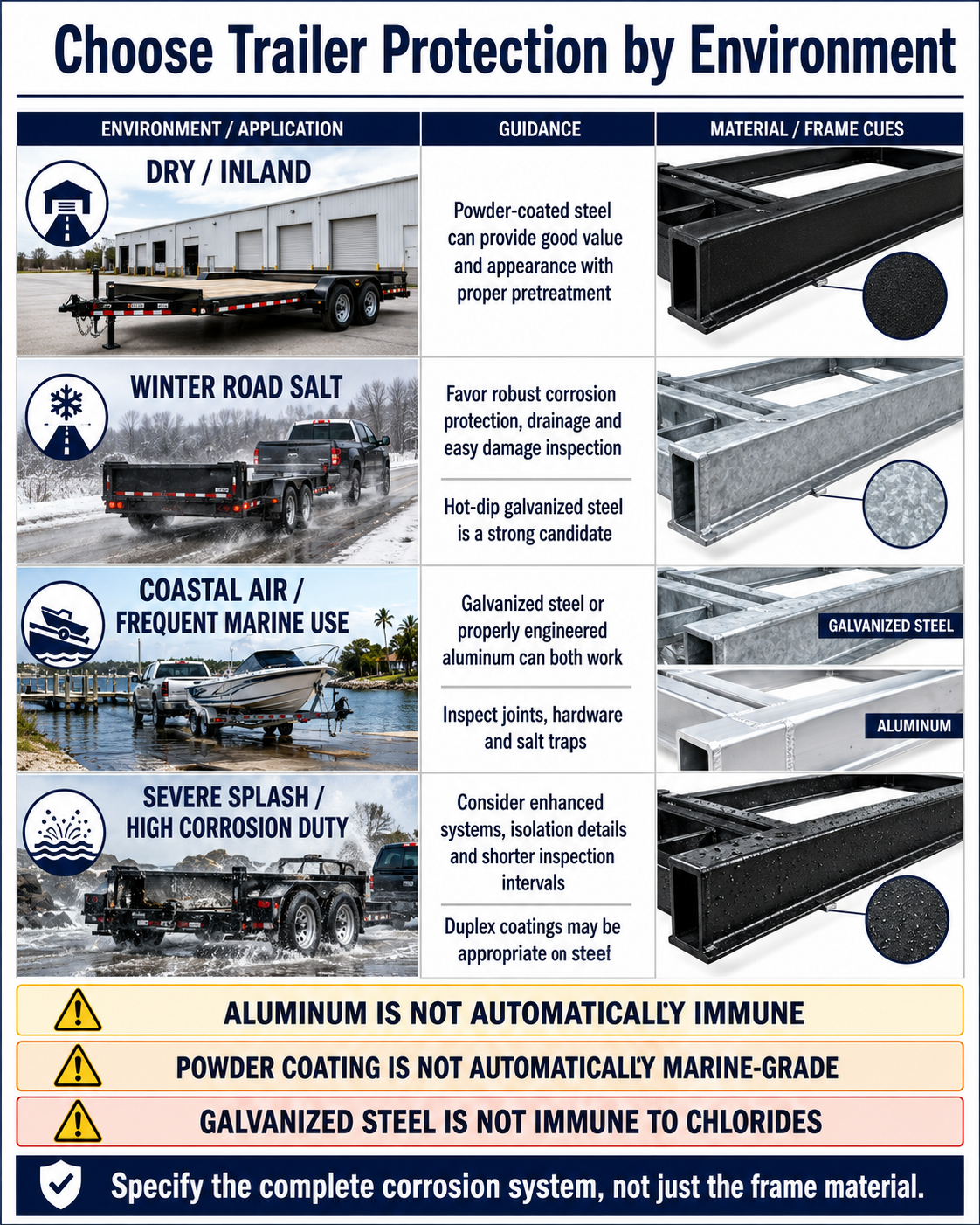
Choose by Environment, Not by Material Reputation
Dry Inland Utility Trailer
A properly prepared and powder-coated steel frame can offer an effective balance of cost, appearance and durability where salt exposure is limited and coating damage is inspected and repaired.
Snowbelt Utility or Equipment Trailer
Repeated wet road salt raises the value of a robust corrosion system, drainage and easy inspection.
Hot-dip galvanized steel becomes particularly attractive when scratches, gravel impact and winter contamination are expected.
Coastal Boat Trailer
Both aluminum and galvanized steel can be viable.
The final decision should consider:
- Launch frequency.
- Saltwater versus brackish water.
- Hardware materials.
- Brake system.
- Fastener isolation.
- Drainage.
- Freshwater rinsing.
For wheel-end corrosion specifically, see GOODIN's Saltwater Boat Trailer Brakes: Disc vs Drum Guide .
Appearance-Driven Commercial Trailer
Powder coating provides strong color and finish flexibility.
Where the corrosion environment is aggressive and appearance remains important, a properly specified duplex system may offer a better engineering approach than treating powder coating and galvanizing as mutually exclusive options.
The Hidden Problem Is Often the Hardware, Not the Main Frame
A corrosion-resistant main frame does not make every attached component corrosion resistant.
Trailer owners should also inspect:
- Axles.
- Leaf springs.
- U-bolts.
- Brake backing plates.
- Calipers.
- Fasteners.
- Electrical connectors.
- Safety-chain mounts.
- Winch posts.
- Jacks and jockey wheels.
An aluminum frame may outlast a poorly protected steel bracket.
A galvanized frame may remain healthy while an unprotected electrical ground or brake component fails.
A powder-coated frame may still require zinc-plated, galvanized or stainless hardware at selected interfaces.
Drainage Is a Corrosion-Control Feature
Materials are often blamed for failures that begin with geometry.
Water and chloride solution should not be allowed to remain indefinitely inside or against structural members.
Trailer design should consider:
- Drain holes.
- Ventilation.
- Tube orientation.
- Bracket geometry.
- Overlapping plates.
- Sealant location.
- Access for rinsing and inspection.
A material with excellent laboratory corrosion resistance can still perform poorly when a joint continuously traps salty moisture.
Do Not Seal Every Joint Without Understanding the Water Path
Sealants can prevent moisture entry when properly designed.
They can also trap water behind the joint if applied incompletely or after contamination has already entered.
For an OEM, sealing and drainage should therefore be part of the original joint design rather than an after-the-fact response to corrosion.
Road-Salt Trailer Specification
For trailers expected to operate through winter deicing conditions, the RFQ should identify road salt explicitly.
A useful specification can include:
- Expected annual winter mileage.
- Primary geographic market.
- Exposure to sodium, calcium or magnesium chloride deicers.
- Required coating process.
- Accessible rinse points.
- Drainage requirements.
- Approved coating-repair system.
- Inspection interval.
This is more useful than asking a supplier only for a generic salt-spray result.
Marine Trailer Specification
A marine RFQ should identify whether the trailer is exposed only to coastal atmosphere or is actually immersed.
Useful information includes:
- Freshwater, brackish water or seawater.
- Launch frequency.
- Typical immersion depth.
- Storage distance from the coast.
- Freshwater rinse availability.
- Fastener material.
- Brake architecture.
- Electrical ground strategy.
- Galvanic isolation details.
For support hardware, GOODIN's Boat Trailer Jack Upgrade Guide explains how corrosion resistance should be considered together with capacity, wheel design and marine operating conditions.
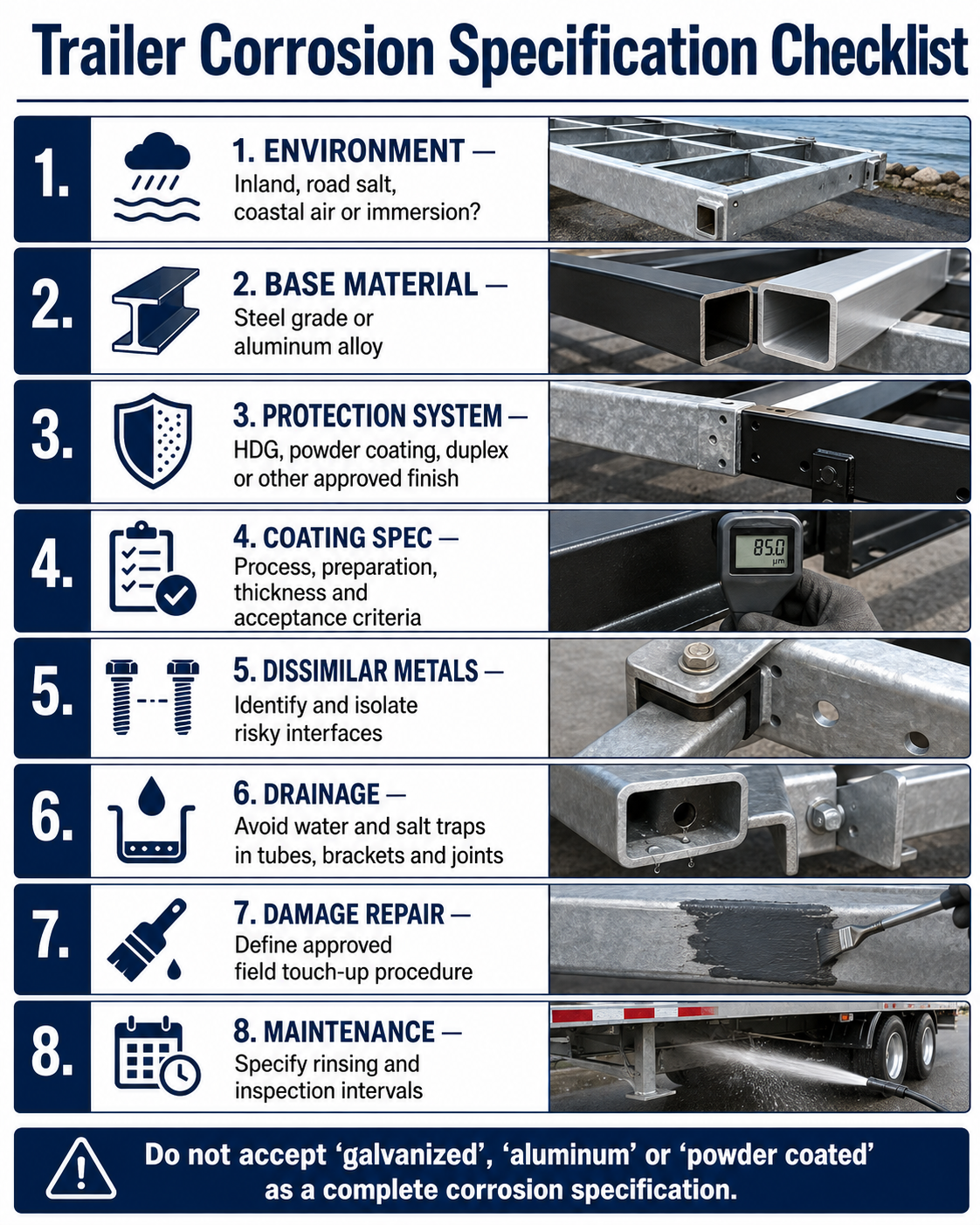
What OEM Buyers Should Put in the RFQ
Define the Base Material
For steel, specify grade and structural requirements.
For aluminum, specify the alloy and temper appropriate to the engineered frame.
Define the Corrosion-Protection Process
Do not write only:
“galvanized” or “powder coated.”
State the actual process, surface preparation and applicable acceptance standard.
Define Coating Thickness
Specify how thickness will be measured and which locations are included in receiving inspection.
Define Mixed-Metal Interfaces
Create a material map covering:
- Frame.
- Axles.
- Fasteners.
- Brakes.
- Jacks.
- Electrical connections.
Define Drainage
Identify locations where water can enter, leave or become trapped.
Define Damage Repair
A field technician should know exactly how a damaged coating is repaired.
For HDG, approved repair procedures can include suitable zinc-rich systems or other methods specified for galvanized-coating repair.
For powder-coated steel, the coating supplier should define compatible repair preparation and material.
Define Environmental Qualification
Specify the real application:
- Dry inland.
- Snowbelt road salt.
- Coastal atmosphere.
- Repeated saltwater immersion.
- Industrial chemical exposure.
Define Inspection and Maintenance
The corrosion specification is incomplete if nobody knows what should be inspected after the trailer enters service.
What Should You Inspect on a Used Trailer?
Galvanized Steel
- Large areas of exposed red-rusting steel.
- Deep section loss.
- Rust around weld repairs or drilled modifications.
- Heavy corrosion inside hollow members.
- Salt accumulation around brackets.
Aluminum
- White deposits concentrated around fasteners.
- Pitting.
- Crevice corrosion.
- Corrosion around steel or stainless interfaces.
- Cracks near welds or highly loaded mounts.
Powder-Coated Steel
- Stone chips exposing steel.
- Rust emerging from coating edges.
- Blistering.
- Loss of adhesion around welds.
- Hidden corrosion inside boxed sections.
Do not judge structural condition from surface color alone.
Significant pitting, section loss, cracking or deformation requires proper structural evaluation.
GOODIN Industry Perspective
The trailer industry often talks about corrosion as if one finish could solve the complete problem.
It cannot.
A frame is a system of:
- Structural members.
- Welds.
- Fasteners.
- Axle mounts.
- Brakes.
- Jacks.
- Electrical interfaces.
Every one of those parts may use a different metal or protective coating.
That means the best corrosion-resistant trailer is not necessarily the one with the most expensive frame material.
It is the one in which the materials are compatible, water is allowed to drain, chloride traps are minimized, exposed hardware receives appropriate protection and damaged areas can be inspected and repaired.
The same principle applies to trailer support equipment.
A jack mounted on a marine or snowbelt trailer needs its own corrosion specification rather than inheriting protection simply because the trailer frame is aluminum or galvanized.
GOODIN's Trailer Jack range includes galvanized, zinc-protected and coated configurations for different trailer applications.
For OEM buyers, useful corrosion-related jack data includes:
- Base material.
- Outer-tube coating.
- Inner-tube coating.
- Fastener material.
- Coating thickness where specified.
- Marine or road-salt exposure.
- Approved maintenance method.
The purchasing objective should be to match every exposed component to the same environmental duty cycle as the trailer around it.
Focused FAQ
Is aluminum better than galvanized steel for a saltwater boat trailer?
Neither material is universally better. Aluminum provides low-weight potential and inherent corrosion resistance, while hot-dip galvanized steel combines structural steel with zinc barrier and sacrificial protection. Launch frequency, joint materials, drainage, saltwater exposure and maintenance determine which system is more appropriate.
Does galvanized steel rust in saltwater?
The zinc coating is consumed as it protects the steel. Chlorides and repeated marine splash can accelerate zinc corrosion, and once adequate protective zinc is lost, the underlying steel can eventually rust. Galvanizing should therefore be specified for the actual marine exposure.
Is aluminum completely corrosion proof?
No. Aluminum is naturally corrosion resistant, but localized pitting, crevice attack and galvanic corrosion can occur, especially when dissimilar metals are electrically connected in the presence of water or saltwater.
Why does aluminum corrode around stainless or steel bolts?
A wet joint between dissimilar metals can form a galvanic cell. The severity depends on the metals, electrolyte, exposed surface-area relationship and joint design. Correct material selection and electrical isolation can reduce the risk.
Is powder-coated steel suitable for a boat trailer?
It can be appropriate for some environments when the steel is correctly prepared and a suitable coating system is used. Frequent saltwater immersion is a much more demanding condition because chips, edges and trapped moisture can expose the steel substrate. The coating system must be engineered specifically for that duty.
Why does powder coating sometimes rust underneath the paint?
Once moisture reaches bare steel through a damaged, poorly prepared or poorly adhered area, corrosion can begin beneath the organic barrier. Good pretreatment, edge coverage and timely damage repair are therefore important.
Is hot-dip galvanizing better after the trailer frame is welded?
After-fabrication hot-dip galvanizing has the advantage of coating the completed fabricated article, including many edges, weld regions and accessible surfaces. The frame still needs to be designed with appropriate venting and drainage for the galvanizing process.
Does a scratch ruin a galvanized coating?
Not necessarily. Zinc around a relatively small exposed area can provide sacrificial cathodic protection to the underlying steel. Larger damaged areas or areas outside the applicable repair limits should be restored using an approved galvanized-coating repair method.
Can galvanized steel be powder coated?
Yes. Powder coating over properly prepared hot-dip galvanized steel creates a duplex system. Correct surface preparation is critical, and ASTM D7803 provides guidance for preparing galvanized surfaces for powder coating.
Is a duplex coating better than powder coating bare steel?
For demanding corrosion environments it can provide an additional protection layer because zinc remains underneath the organic coating. Whether the additional process is justified depends on service environment, required appearance, cost and maintenance objectives.
Does road salt damage galvanized trailers?
Wet chloride-containing road salts are corrosive to zinc as well as other protective systems. Good drainage, freshwater cleaning where practical and preventing salty moisture from remaining trapped can reduce exposure severity.
Is white corrosion on a galvanized trailer the same as red rust?
No. White or gray zinc corrosion products involve the zinc coating, while red rust indicates corrosion of exposed steel. Surface appearance should be interpreted together with coating condition and remaining zinc protection.
Should I choose a trailer based on salt-spray hours?
Not by that number alone. Test method, substrate, pretreatment, coating thickness, scribe condition and acceptance criteria all matter. Accelerated salt-spray hours should not automatically be converted into expected field service life, particularly for hot-dip galvanized zinc coatings.
What is the best trailer material for winter road salt?
There is no universal winner. Hot-dip galvanized steel is a strong candidate because it provides both barrier and sacrificial protection. Properly designed aluminum can also perform well. Powder-coated steel requires particular attention to pretreatment, coating damage, edges and maintenance.
What should an OEM specify instead of simply saying “corrosion resistant”?
Specify the base material, alloy or steel grade, coating process, surface preparation, coating thickness, acceptance criteria, mixed-metal interfaces, drainage, field repair method, service environment and maintenance requirements.
Conclusion
The most useful conclusion is not that galvanized steel, aluminum or powder-coated steel wins every trailer-material comparison.
Each solves corrosion differently.
Hot-dip galvanized steel combines the structural characteristics of steel with zinc barrier and sacrificial protection.
Aluminum makes corrosion resistance part of the structural material itself while offering valuable weight-saving potential, but its interfaces with other metals require careful engineering.
Powder-coated steel provides excellent finish flexibility and can perform very well when pretreatment, film build, edges and damage repair are controlled, but it relies heavily on maintaining the integrity of the protection system over the steel.
And the decision is not always limited to those three choices.
A duplex system can combine hot-dip galvanizing and powder coating when corrosion resistance and finished appearance are both important.
For road salt, coastal use and marine trailers, the correct specification therefore begins with the environment.
Then define the base material, corrosion-protection system, mixed-metal interfaces, drainage, repair method and maintenance cycle.
That approach turns “Which trailer material is best?” from an owner argument into a specification that an OEM can actually manufacture, inspect and verify.
Technical References
- ASTM International — ASTM B117, Operating Salt Spray (Fog) Apparatus
- ASTM International — ASTM D7803, Preparing Hot-Dip Galvanized Surfaces for Powder Coating
- American Galvanizers Association — Why Hot-Dip Galvanizing Matters in Modern Construction
- American Galvanizers Association — HDG in Coastal Climates
- American Galvanizers Association — Road Salt and Hot-Dip Galvanized Steel
- American Galvanizers Association — Salt Spray Testing of HDG Steel
- American Galvanizers Association — Duplex Systems for Corrosion Protection
- American Galvanizers Association — Preparing HDG for Powder Coating
- Powder Coating Institute — Pretreatment and Corrosion Resistance
- The Aluminum Association — Aluminum Material Characteristics
- NASA Kennedy Space Center — Forms of Corrosion and Galvanic Corrosion
The Utility-Trailer Upgrade List: What to Add First—and Why
EV Trucks + Utility Trailers: What Really Determines Towing Range?
Related Article


