Fixed vs. Magnetic LED Trailer Lights: Which Setup Fits Your Trailer and Towing Needs?
On this page
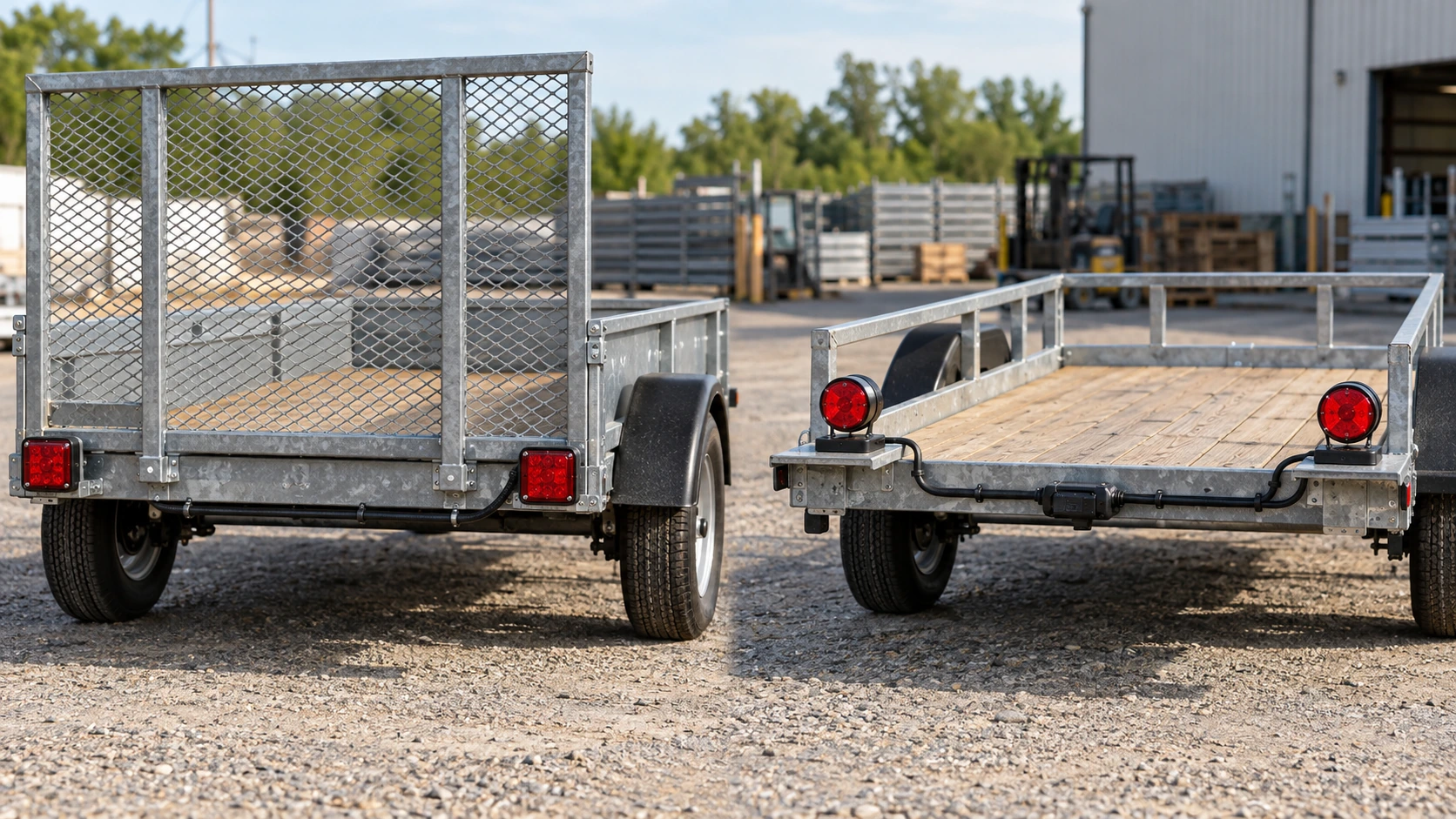
A boat-trailer owner is preparing for a trip.
The trailer lights worked during the last outing, but the owner now needs a dependable lighting arrangement before towing again.
Should they install a new set of permanent LED lights or buy a magnetic towing-light kit that can be attached when needed?
The question is more complicated than it first appears.
In a r/boating discussion [2], an owner described having to postpone a boat launch because the trailer lights unexpectedly stopped working.
The discussion produced several different recommendations. The available page did not reliably establish the original publication date or vote total, so neither is used here.
Some users preferred properly installed permanent LED lighting. Others described keeping magnetic lights as a backup or moving a removable kit between trailers.
But the discussion also included a warning: one owner reported losing a magnetic light less than ten minutes into a trip, while another described magnetic mounts or their adhesive connections coming loose.
These experiences do not establish that all magnetic lights are unreliable.
They demonstrate why the mounting method itself must be part of the purchasing decision.
A permanent LED lamp and a magnetic LED lamp may provide similar lighting functions, but they do not necessarily provide the same installation security, electrical configuration or application suitability.
For Product Selection, the useful question is not:
"Are magnetic trailer lights better than fixed lights?"
It is:
"Does this trailer need a permanent lighting installation or a removable towing-light system—and can the selected configuration satisfy every required lighting, mounting and electrical condition?"
That is the decision this guide addresses.
Model-level review: GD2060106 and GD2060010 functions, wiring, retention, water protection and market documentation must be confirmed before product approval.
Start with the Towing Task
Before comparing products, establish what the buyer actually needs.
Task 1: Permanent Lighting for a Regularly Used Trailer
The trailer is used repeatedly and requires a lighting system that remains installed during normal service.
Typical applications include:
- utility trailers;
- boat trailers;
- contractor and equipment trailers;
- regularly used cargo trailers;
- OEM trailer production.
In this case, the purchasing requirement is usually a fixed lighting system with suitable lamps, mounting interfaces, wiring, connectors and environmental protection.
The buyer should be able to specify a configuration that becomes part of the trailer's normal road equipment.
Task 2: Removable Lighting for a Defined Towing Operation
The buyer may need lights for:
- occasional towing of a compatible trailer;
- a particular temporary towing assignment;
- moving a trailer between locations;
- a removable backup lighting arrangement;
- a fleet operation involving different equipment.
A magnetic kit can be worth considering because it may avoid installing permanent lamp brackets at the temporary mounting position.
However, magnetic attachment does not remove the need for correct lighting functions, retention or electrical compatibility.
And a temporary lighting arrangement is not automatically permitted to replace the trailer's normal required lighting under every jurisdiction or operating condition.
The first selection decision should therefore be:
Permanent installation or defined temporary application?
Only then should the buyer compare fixed and magnetic products.
Fixed vs. Magnetic Trailer Lights: The Core Differences
| Selection factor | Fixed LED lights | Magnetic LED lights |
|---|---|---|
| Intended installation | Permanent or manufacturer-defined fixed mounting | Removable installation where permitted |
| Mounting interface | Screws, brackets, grommets or other approved fixtures | Magnetic base on a compatible mounting surface |
| Installation repeatability | Normally remains installed | May be removed and repositioned between uses |
| Electrical connection | Usually integrated into a trailer wiring harness | May be wired or wireless, depending on the exact kit |
| Retention | Depends on mechanical attachment and supporting structure | Depends on magnetic interface, approved orientation and any required secondary retention |
| Lamp positioning | Can be integrated into a defined trailer layout | Must be checked at every installation |
| Wiring exposure | Permanent routing must be protected | Temporary cables, where present, must be routed and secured |
| Water exposure | Select sealing appropriate to installation and use | Select sealing appropriate to installation, storage and use |
| Principal limitation | Requires suitable permanent mounting and wiring | Requires suitable magnetic surface, reliable retention and a compatible complete lighting system |
| Typical buying direction | Regular use and OEM integration | Temporary or transferable use, subject to all applicable requirements |
The distinction is not that one uses LEDs and the other does not.
Both can use LED light sources.
The fundamental difference is the mounting and system configuration.
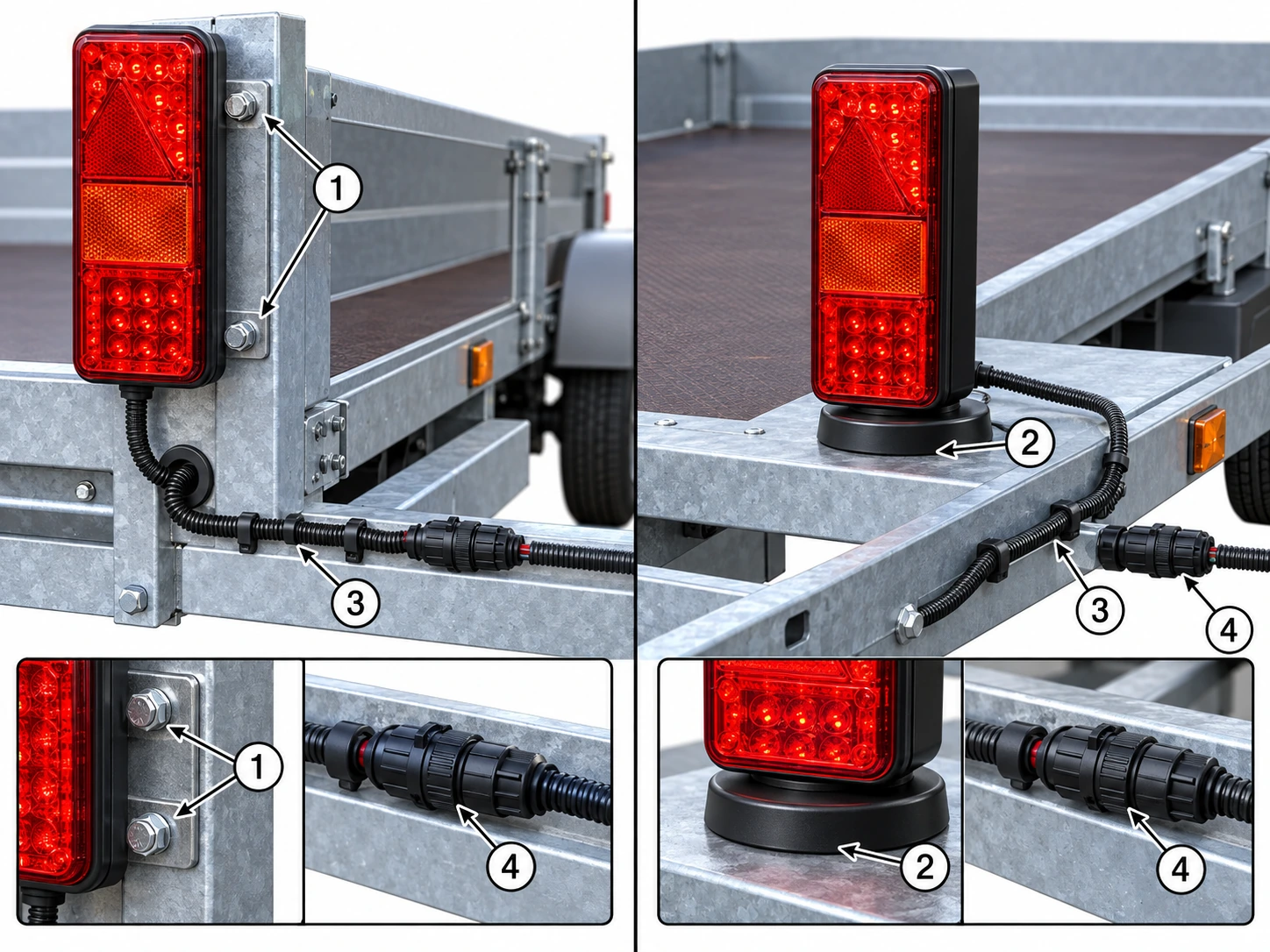
Permanent Mounting for Regular Use
For a trailer used regularly on public roads, a permanent lighting arrangement is generally the more straightforward configuration to evaluate.
Fixed lamps can be integrated into the trailer's designed mounting positions.
Wiring can follow protected routes through or along the frame.
The lamp positions can be established during production or verified when replacing the original equipment.
This is particularly useful for commercial trailers and OEM programs because the lighting arrangement needs to remain consistent across repeated use.
Permanent Mounting Provides a Defined Installation Position
A fixed lamp has a designated mounting interface.
Depending on the model, that may include:
- a mounting bracket;
- screw holes;
- a rubber grommet;
- a recessed housing;
- a specific cutout or mounting plate.
The exact interface matters.
For example, a 4-inch trailer light may have the correct general dimensions but the wrong mounting arrangement for the existing trailer.
A buyer replacing an original lamp should compare:
- outer dimensions;
- mounting dimensions;
- installation depth;
- orientation;
- connector arrangement;
- required lamp functions.
Do not assume that every product described as a "4-inch LED trailer light" is dimensionally interchangeable.
Permanent Wiring Can Be Designed Around the Trailer
A fixed installation gives the OEM or installer the opportunity to define:
- harness length;
- wire protection;
- connector position;
- grounding arrangement;
- branch locations;
- routing away from moving components.
CURT's trailer lighting guidance [8] distinguishes replacement lamps from complete lighting kits that include harnesses and supporting installation components.
That distinction is important.
Buying two lamps does not necessarily mean the buyer has purchased a complete wiring system.
For a trailer being built or fully rewired, the correct purchase may be a complete lighting package rather than two individual LED lamps.
When Fixed Lights Should Be Rejected or Reconsidered
A particular fixed light should not be selected if:
- its mounting geometry is incompatible with the intended location;
- it cannot be installed in a compliant position;
- it lacks a required lighting function;
- the available wiring cannot support its electrical interface;
- its documented environmental protection is insufficient;
- the installation would obstruct another required light or reflector.
The appropriate solution may be another fixed model, a different bracket or a complete approved lighting arrangement.
It should not automatically be a magnetic conversion.
Magnetic Mounting: Surface and Retention
A magnetic towing-light kit addresses a different requirement.
It allows the buyer to place lamps at an approved temporary mounting position without relying on the same permanent lamp attachment used by a fixed installation.
That can be useful when the towing task is occasional or when a removable system is specifically required.
For example, CURT's magnetic towing-light products [7] include kits intended for temporary towing arrangements, including applications involving trailers or dinghy-towed vehicles.
However, the word "magnetic" describes the attachment method.
It does not describe how the lamps receive their electrical signals.
Magnetic Does Not Mean Wireless
This is a critical distinction for procurement.
A magnetic trailer-light system may be:
Wired magnetic
The lamps attach magnetically, but a cable connects them to the tow vehicle's electrical system.
Wireless magnetic
The lamps receive lighting-control signals through a wireless system, typically requiring a compatible transmitter and a power source within or connected to the lamps.
The two systems have different purchasing requirements.
Hopkins' 2025 towing-products catalog [6] illustrates both configurations:
- Its C7300 magnetic LED kit uses a 20-foot wiring harness with a 4-way connector.
- Its C6304 wireless magnetic LED kit includes a transmitter and requires AA batteries in the lights.
Both use magnetic mounting.
Only one is wireless.
The buyer should therefore never infer wireless operation from a magnetic base.
The GOODIN GD2060010 is currently listed as a 12V Magnetic LED Towing Light. Its publicly verified listing does not establish wireless operation, a battery system or a particular radio transmitter.
Those features must be confirmed from the exact model's documentation before describing or purchasing it as a wireless kit.
The First Magnetic-Light Test: Is There a Suitable Mounting Surface?
A magnetic lamp needs an appropriate surface to attach to.
This sounds obvious, but it can eliminate an otherwise attractive configuration.
A trailer may have:
- aluminum body panels;
- galvanized steel frame members;
- painted steel sections;
- wooden structures;
- fiberglass components;
- plastic fenders.
Not every surface is suitable for a magnetic light.
For example, aluminum is not ferromagnetic and does not provide the direct magnetic holding behavior of a suitable steel mounting surface.
A magnetic light intended for steel cannot be assumed to attach securely to an aluminum trailer body.
Check More Than Material
Even when steel is present, mounting suitability depends on additional factors.
Check:
- available flat surface area;
- orientation of the mounting surface;
- curvature;
- coating thickness and condition;
- cleanliness;
- corrosion;
- surrounding protrusions;
- location relative to required lamp visibility.
The full magnetic contact area should engage the manufacturer-approved surface.
An uneven, curved or contaminated interface may not provide the holding performance expected from the product.
A small exposed steel bracket is not automatically equivalent to the intended mounting plate.
Does a Steel Adapter Plate Solve the Problem?
Sometimes a buyer considers attaching a steel plate to a nonmagnetic trailer surface.
That may be an option if both the plate installation and magnetic-light configuration are approved for the application.
But the buyer must verify:
- plate size and thickness;
- attachment strength;
- magnetic contact area;
- lamp orientation;
- plate location;
- lighting visibility.
Adding a steel plate does not automatically establish a secure or road-compliant magnetic-light installation.
Optronics' TLL21RK product page [9] identifies a magnetic base and a wired harness, but that description alone does not approve every mounting orientation. Buyers must obtain the exact kit's installation instructions before treating a horizontal or vertical steel surface as suitable.
That illustrates a general rule:
A magnetic light should be installed only in the orientations and conditions supported by its manufacturer.
Magnetic Retention Must Be Evaluated During Towing
A lamp that stays attached while the trailer is parked has passed only the first mounting check.
Road use introduces:
- vibration;
- shocks;
- airflow;
- surface contamination;
- changing road conditions.
A magnetic base must remain attached under the conditions for which the product is intended.
The boating discussion provides a useful contrast.
Some users reported successful trips with magnetic lights.
Others reported lights coming loose, including one account of a light being lost shortly after departure.
Those are owner experiences, not controlled performance testing.
They do, however, demonstrate why a buyer should not accept "strong magnet" as a complete technical specification.
What Should Be Confirmed?
A suitable magnetic-light specification should identify:
- approved surface material;
- minimum magnetic contact requirements;
- permitted mounting orientation;
- relevant retention instructions;
- environmental limitations;
- whether supplementary retention is required;
- instructions for cable routing, where applicable.
If the manufacturer specifies a tether or other secondary retention method, it should be included in the selected configuration.
A generic cable tie or improvised restraint should not be treated as a substitute for an approved mounting method.
Some magnetic kits provide dedicated attachment or tie-down features. Hopkins, for example, lists tie-down loops on its C6304 wireless magnetic light kit.
For GOODIN GD2060010, any retention accessory or approved installation method must be verified rather than inferred from the product category.
When Magnetic Lights Should Be Rejected
A magnetic configuration should be eliminated when:
- no suitable mounting surface exists;
- approved surface orientation cannot be achieved;
- lamps cannot be positioned as required;
- mounting retention cannot be confirmed;
- the installation interferes with other trailer functions;
- the complete system lacks necessary lighting functions;
- the relevant jurisdiction does not permit the proposed use.
Ease of removal is not a justification for uncertain retention.
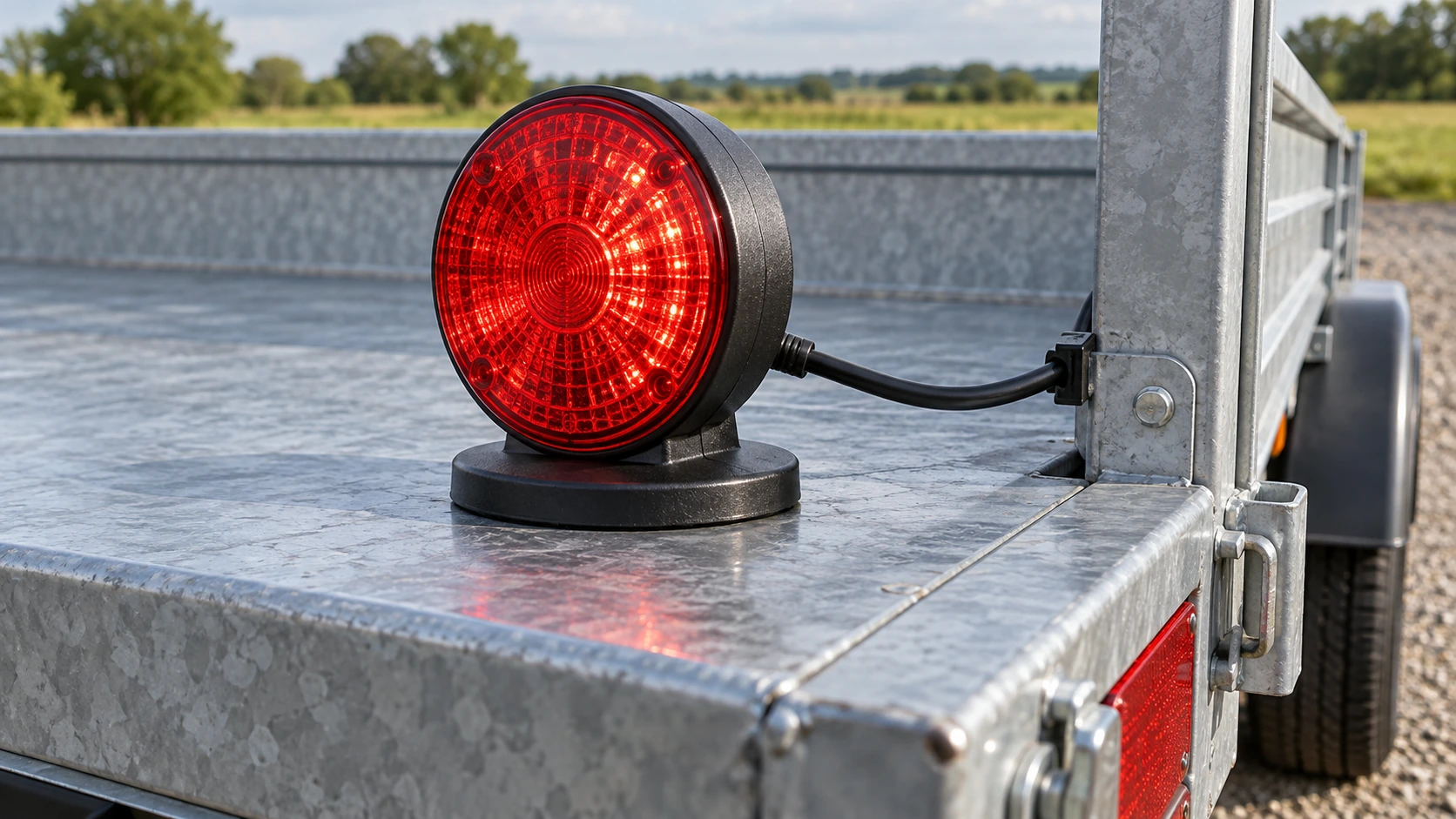
Verify the Complete Electrical Connection
A light kit can fit mechanically but remain electrically unsuitable.
This applies to both fixed and magnetic systems.
Before selecting a product, identify the tow vehicle's electrical interface and the functions available at that interface.
Confirm System Voltage
GOODIN GD2060010 is identified as a 12V magnetic LED towing light.
That establishes the nominal voltage category in its listing.
It does not establish compatibility with a 24V vehicle, a specific converter or every modern tow-vehicle lighting-control system.
If the towing vehicle uses another voltage, the buyer must obtain an appropriate manufacturer-supported electrical configuration.
Do not assume a 12V light can be connected directly to a 24V system.
Confirm the Connector
Common trailer connections include different 4-way, 5-way, 7-way and other market-specific formats.
However, connector pin count alone does not guarantee electrical compatibility.
The buyer must verify:
- connector physical type;
- pin functions;
- ground connection;
- available lighting signals;
- voltage;
- required adapter or converter.
A 7-way socket on the tow vehicle does not mean every magnetic light kit with a different plug will work without verification.
Nor does a physical adapter create lighting functions that are not provided by the original circuit.
CURT's LED electrical adapter documentation [10] demonstrates that some vehicle and LED-light combinations require attention to electronic compatibility in addition to physical connector fit.
Wired Magnetic Lights Need Sufficient Cable Length
For a wired magnetic kit, the harness must reach the actual lamp mounting locations.
Measure the intended route from the tow vehicle's connector to both rear lamp positions.
Include the actual route along the trailer rather than simply measuring its overall length.
The harness should be long enough to permit normal trailer articulation without being pulled tight.
But excessive unsecured wire can also be a problem.
Check that the cable can be supported away from:
- tires;
- suspension parts;
- sharp edges;
- hot components;
- road surfaces;
- loading equipment.
A temporary wired kit still needs an appropriate cable-routing arrangement.
Wireless Kits Have Different Requirements
If a specific product is confirmed to be wireless, additional selection questions apply:
- transmitter connector and signal compatibility;
- lamp battery type or charging arrangement;
- operating duration;
- communication range;
- pairing procedure;
- operating instructions;
- electrical and radio-equipment compliance where applicable.
A wireless configuration should not be selected merely to avoid routing a cable.
It must provide a verified way to maintain the required lighting functions during the intended operation.
These requirements apply only to wireless products.
They should not be attributed to GOODIN's magnetic kit without supporting product documentation.
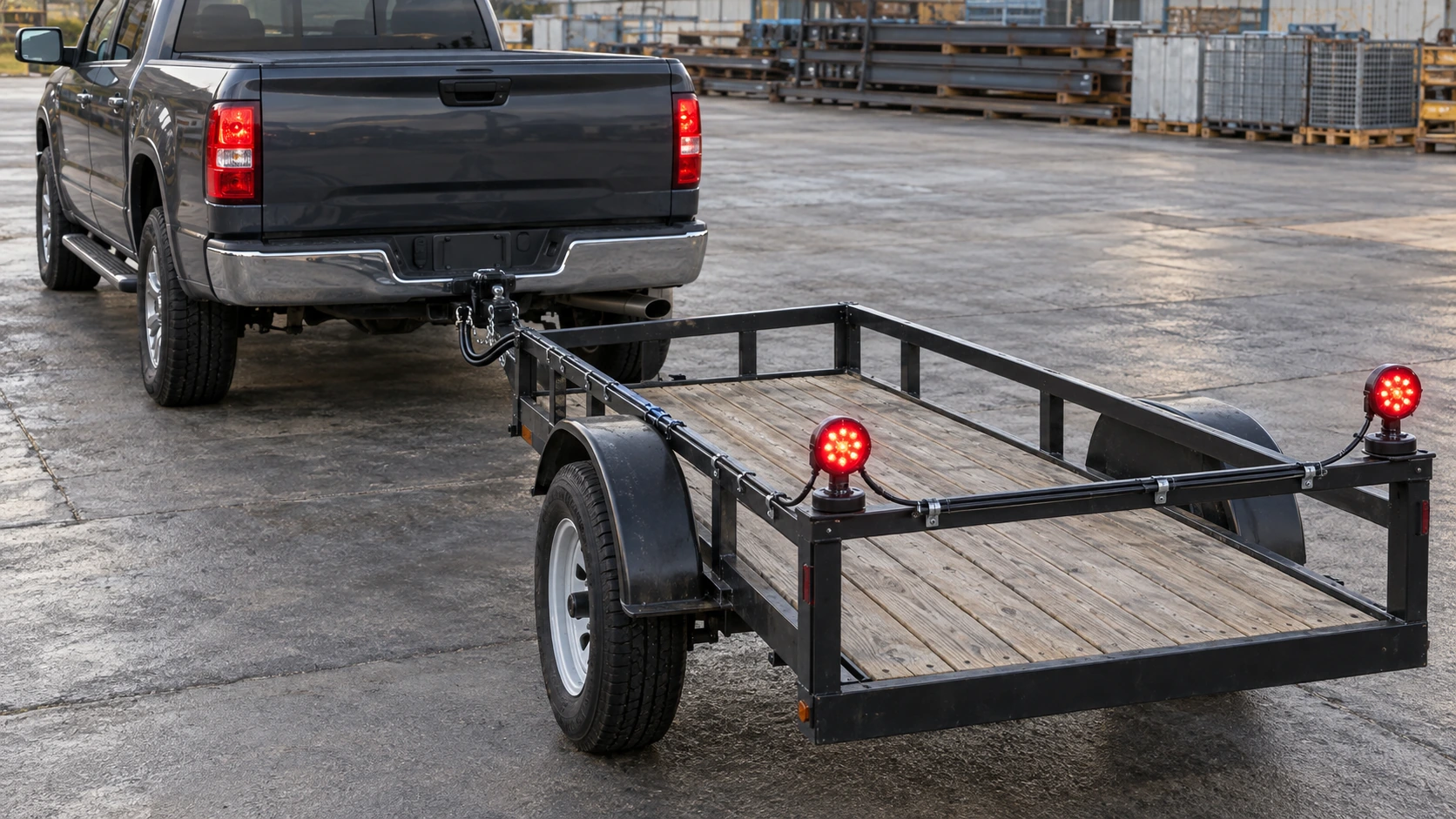
Lighting Functions, Road Rules and Water Exposure
This is arguably the most important selection question.
A buyer may see three functions listed:
Stop / Turn / Tail
and assume the trailer's lighting requirement is complete.
That can be incorrect.
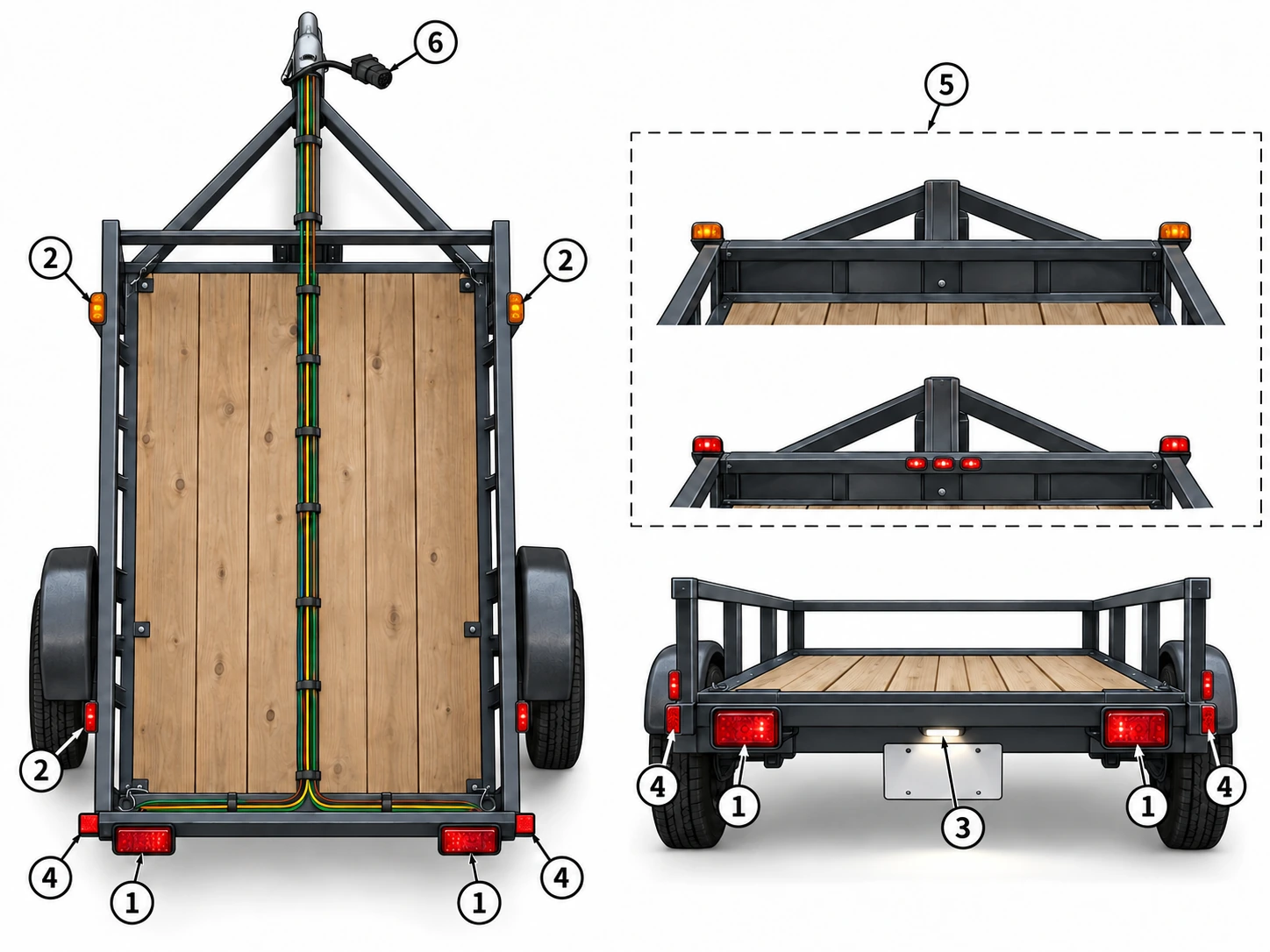
The trailer may also require:
- side marker lamps;
- front and rear clearance lamps;
- identification lamps;
- license plate illumination;
- reflex reflectors;
- additional lighting according to its dimensions and market.
The exact requirements depend on trailer characteristics and where the trailer will be used. [3] [5]
A removable rear lamp kit that provides stop, turn and tail signals does not automatically replace every other required lighting device.
Example: United States Lighting Requirements
In the United States, FMVSS No. 108 [3] defines requirements for trailer lamps, reflective devices and associated equipment.
The standard distinguishes required functions and includes further requirements for trailers based on size and configuration.
For example, trailers 80 inches (2,032 mm) or more in overall width have additional clearance and identification-light requirements.
Depending on the trailer, further requirements apply to side markers, reflectors and license plate illumination.
That means a buyer should determine the complete lighting requirement before selecting a two-lamp rear kit.
Replacement Lamps Must Match the Functions Being Replaced
FMVSS No. 108 also addresses replacement equipment.
A replacement combination lamp must provide the applicable required functions of the equipment it is designed to replace.
Therefore, a buyer replacing a multi-function lamp should not assume a visually similar LED unit provides the same functions.
The relevant information includes:
- certified lamp functions;
- emitted color;
- mounting orientation;
- positioning;
- photometric and visibility requirements;
- associated reflectors or additional devices.
These are product and installation questions, not merely LED brightness questions.
Regulatory Compliance Must Be Verified for the Destination Market
The United States is only one possible destination for GOODIN products.
Other markets may apply different requirements covering:
- lamp functions;
- color;
- position;
- electrical compatibility;
- approval markings;
- installation;
- temporary towing equipment.
For an export or OEM program, the buyer should identify the target market before approving the lighting specification.
Do not assume that a product acceptable for one market is automatically acceptable in another.
A magnetic mount does not independently establish legal suitability.
Neither does the presence of LED components.
Likewise, the term "DOT approved" should not be used casually. NHTSA explains that it does not provide individual product preapproval in the way the phrase sometimes implies; the manufacturer is responsible for applicable certification requirements. [4]
Compliance depends on the documented product functions and the complete installed lighting arrangement.
Water Protection: Boat Trailers Need a Separate Check
For boat trailers, environmental protection can become a decisive specification.
A lamp may encounter:
- rain;
- road spray;
- saltwater exposure;
- freshwater immersion;
- repeated wet-dry cycles.
Fixed lamps mounted near the boat-trailer rear may be exposed to water during launching.
A magnetic lamp placed higher on a suitable part of the boat or trailer may have a different exposure pattern.
But neither "fixed" nor "magnetic" establishes waterproof performance.
LED Does Not Mean Submersible
LED describes the light source.
It does not tell the buyer how the housing is sealed.
A product advertised as a trailer LED light should not automatically be assumed suitable for immersion.
Look for the exact manufacturer's declared environmental rating and applicable test conditions.
A published IP rating can be useful, but it should be interpreted according to the rating's defined test conditions.
An IP rating alone also does not automatically establish resistance to prolonged saltwater exposure, repeated impact or every launching condition.
The wiring connections and other components may have different protection requirements from the lamp enclosure.
Permanent Boat-Trailer Lighting
If the intended fixed lamp location is regularly submerged during launch, specify a product whose manufacturer explicitly supports that use.
Check the complete lamp assembly and electrical connection requirements.
CURT's lighting range [8], for example, distinguishes submersible boat-trailer lights from other surface-mounted trailer lighting options.
That distinction is more useful than simply choosing the brightest LED unit.
Magnetic Boat-Trailer Lighting
For a removable magnetic arrangement, determine whether the lamps will remain mounted during launching.
Do not assume they can be submerged because the product is described as weather-resistant.
If the intended operating procedure involves removing the lamps before exposure to water, that procedure must be practical and consistent with all applicable towing and lighting requirements.
The buyer should verify:
- permitted water exposure;
- cable and connector protection;
- operating and storage instructions;
- environmental limitations.
A magnetic kit may offer installation flexibility, but it does not automatically provide better waterproofing.
GOODIN Models and Three Purchasing Scenarios
GOODIN's current Trailer Accessories catalog [1] lists two relevant lighting products.
| Publicly identified specification | GD2060106 | GD2060010 |
|---|---|---|
| Product name | 4 Inch Square LED Trailer Light | 12V Magnetic LED Towing Light |
| Configuration category | Fixed-style trailer light | Magnetic towing light |
| Lighting technology | LED | LED |
| Published nominal size | 4-inch square classification | Not confirmed in the referenced catalog |
| Published voltage | Requires model specification confirmation | 12V |
| Mounting interface | Requires model drawing | Magnetic; surface and retention requirements need confirmation |
| Wired or wireless | Wiring interface to be confirmed | Wireless operation not verified |
| Full lamp functions | Requires model documentation | Requires model documentation |
| Connector and harness | Requires confirmation | Requires confirmation |
| Water-protection rating | Requires confirmation | Requires confirmation |
| Market approvals | Requires supporting documentation | Requires supporting documentation |
This comparison deliberately avoids assigning unverified performance characteristics.
It establishes that GOODIN has both fixed-style and magnetic product categories available for further specification review.
GD2060106: Fixed-Light Selection
GD2060106 is a relevant candidate when the buyer needs a permanent LED trailer-light arrangement.
Its 4-inch square product classification is useful for initial dimensional screening.
However, the buyer still needs the model's:
- mounting drawing;
- actual light functions;
- wiring diagram;
- electrical specifications;
- sealing information;
- applicable approvals.
It should not be declared a direct replacement for an existing 4-inch lamp solely from its nominal size.
GD2060010: Magnetic-Light Selection
GD2060010 is relevant when the buyer needs a 12V magnetic towing-light configuration.
Its magnetic attachment makes it a candidate for temporary mounting applications where that method is appropriate.
But the supplier must confirm:
- exact magnetic mounting requirements;
- whether the set is wired or wireless;
- connector type;
- lead length or transmitter specification;
- lighting functions;
- environmental protection;
- complete kit contents;
- destination-market compliance documentation.
Until those details are confirmed, neither universal compatibility nor wireless operation should be claimed.
Three Realistic Purchasing Scenarios
A configuration comparison becomes useful only when it can eliminate unsuitable options.
Consider the following scenarios.
Scenario 1: A Utility Trailer Used Every Working Day
A contractor uses a utility trailer for regular equipment transportation.
The trailer has defined rear lamp mounts and a conventional lighting harness.
The buyer wants a new LED lighting system.
Fixed LED Option
A compatible fixed kit can be integrated into the trailer's existing installation.
If the lamps provide the required functions and the mounting, wiring and environmental conditions pass, this is a logical configuration.
Magnetic Option
A magnetic kit might function as a separate temporary arrangement, but it introduces repeatable requirements for surface selection, retention and cable handling or wireless operation.
There is no obvious purchasing advantage to replacing a suitable permanent system with an unverified removable system for routine daily towing.
Decision: Prioritize a compatible fixed lighting system for the permanent installation.
A magnetic kit should be considered separately only if there is a defined use case and all conditions can be satisfied.
Scenario 2: A Trailer Needed for an Occasional Towing Assignment
A business occasionally moves compatible equipment between locations.
The towing operation requires temporary rear lighting.
There is a suitable magnetic mounting area, and the buyer is considering a removable light kit.
Fixed LED Option
A permanent installation may be appropriate if the trailer will continue to be used regularly.
But it may involve an unnecessary permanent installation for the specific temporary arrangement.
Magnetic Option
A magnetic kit may be suitable if the buyer can confirm:
- required lighting functions;
- compliant lamp positions;
- magnetic mounting surface;
- approved retention;
- electrical interface;
- destination-market requirements;
- installation instructions.
Decision: Consider a magnetic kit for the defined temporary task, but do not treat removability as a substitute for proper lighting and mounting.
Scenario 3: An Aluminum Boat Trailer Used at Saltwater Ramps
The owner has an aluminum boat trailer.
The rear lighting is regularly exposed to spray and occasional immersion.
The owner considers replacing the permanent lights with magnetic units.
Fixed LED Option
A suitable permanently mounted, submersible-rated lighting system can be specified for the expected launching conditions.
The complete harness and connections need appropriate environmental protection.
Magnetic Option
Direct magnetic mounting to aluminum cannot be assumed.
A suitable, approved ferromagnetic mounting surface or attachment arrangement would be required.
The lamps' water-exposure limits would also need verification.
If a suitable mounting arrangement is unavailable, magnetic lights should be eliminated.
Decision: Favor a properly specified fixed system unless the magnetic configuration has a verified mounting location, suitable environmental protection and an accepted operating procedure.
The Configuration Decision Table
| Actual purchasing requirement | Fixed LED setup | Magnetic LED setup | Decision condition |
|---|---|---|---|
| Regular, long-term trailer operation | Strong starting candidate | Needs a justified application and approved mounting | Prefer a verified permanent arrangement for routine use |
| Temporary towing task | Possible but requires installation | Potentially suitable | Confirm removable system meets all requirements |
| No suitable ferromagnetic mounting surface | Not dependent on magnet contact | Normally unsuitable without an approved alternative | Reject unsupported magnetic attachment |
| Existing fixed lamp mounts available | May provide direct mounting opportunity | Does not necessarily use existing mounts | Check exact dimensions and interface |
| Lighting shared between multiple compatible trailers | Requires installation on each trailer | Can be considered if properly reinstalled each time | Verify every trailer separately |
| Exposure to immersion | Select verified submersible arrangement | Do not assume submersibility | Confirm product environmental rating |
| No safe temporary cable route | Permanent protected routing may work | Wired kit may be unsuitable | Consider only an approved alternative configuration |
| Tow vehicle has incompatible connector | Requires appropriate electrical matching | Also requires electrical matching | Reject direct connection without compatibility |
| Mounting retention uncertain | Verify mechanical mount | Reject unverified magnetic mount | Installation security is mandatory |
| Additional trailer lamps required | Specify complete lighting system | May not provide all functions | Add required approved equipment |
| Target-market approval undocumented | Cannot approve product | Cannot approve product | Obtain applicable evidence before ordering |
Neither configuration should be selected if its required lighting performance or installation suitability cannot be established.
In that situation, the correct response is to specify another compliant system.
Seven Steps and a Compatibility Worksheet
The buying decision can follow a consistent sequence.
Step 1: Define the Towing Application
Record whether the lighting system is intended for:
- permanent service;
- occasional towing;
- a specific temporary assignment;
- a manufacturer-defined backup arrangement.
Also identify the trailer category, dimensions and operating environment.
Step 2: Establish the Required Lamp Functions
Determine the lighting and reflector requirements for the destination market and trailer configuration.
Separate:
- rear stop/turn/tail functions;
- side markers;
- clearance and identification lights;
- license plate illumination;
- reflectors;
- other applicable functions.
Do not assume a two-light kit covers all requirements.
Step 3: Evaluate the Mounting Location
For fixed lamps:
- check mounting geometry;
- installation depth;
- bracket or grommet requirements;
- approved orientation.
For magnetic lamps:
- confirm contact surface;
- permitted mounting orientation;
- retention;
- location and visibility;
- required secondary retention.
Step 4: Confirm the Electrical Interface
Check:
- nominal voltage;
- connector;
- pin functions;
- ground arrangement;
- compatibility with towing-vehicle signals;
- required adapters or converters.
For wired kits, measure the complete cable route.
For wireless kits, verify transmitter, power source and operating limitations.
Step 5: Match Environmental Protection
Record:
- road-spray exposure;
- freshwater or saltwater use;
- immersion requirements;
- cleaning methods;
- storage conditions.
Choose the documented protection level appropriate to the application.
Step 6: Verify the Complete Kit Contents
Determine whether the purchase includes:
- one lamp or a pair;
- wiring;
- connectors;
- mounting hardware;
- brackets or grommets;
- magnets;
- approved retention accessories;
- installation instructions.
Do not assume that a product identified as a "kit" contains every component required for the trailer.
Step 7: Obtain Applicable Product and Installation Documentation
Before approval, confirm:
- technical drawing;
- electrical diagram;
- lamp-function specification;
- environmental performance;
- installation instructions;
- relevant market-compliance documentation.
Only after all seven steps can the buyer confidently approve the configuration.
Fixed / Magnetic Trailer Light Compatibility Checklist
This is the primary pre-purchase worksheet.
| Selection item | Buyer must determine | Supplier must confirm | Reject / reassess if… |
|---|---|---|---|
| Intended use | Permanent or temporary towing | Product's intended application | Proposed use is unsupported |
| Trailer dimensions | Width, length and configuration | Applicable lamp functions and scope | Required functions are missing |
| Market | Country/region of use | Relevant certification or compliance evidence | Required documentation unavailable |
| Lamp functions | Stop, turn, tail and other required functions | Exact functional specification | A required function is absent |
| Lamp positions | Actual available mounting locations | Permitted orientation and installation | Location or visibility unsuitable |
| Fixed mounting | Existing holes, brackets, grommets | Mounting dimensions | Interface incompatible |
| Magnetic mounting | Surface material and shape | Approved contact and retention | Suitable surface unavailable |
| Secondary retention | Application need | Manufacturer's required method | Required retention cannot be provided |
| Supply voltage | Tow vehicle electrical system | Lamp operating voltage | Electrical mismatch |
| Connector | Existing vehicle socket | Plug, pinout and compatibility | Signals do not match |
| Harness length | Actual required cable route | Supplied lead length | Routing or length unsuitable |
| Wireless system, if applicable | Power and operating requirements | Transmitter, battery and range | Performance cannot be verified |
| Grounding | Actual circuit arrangement | Wiring requirements | Electrical compatibility uncertain |
| Water exposure | Rain, spray, immersion | Documented protection | Exposure exceeds permitted use |
| Complete contents | What installation requires | Detailed packing list | Essential parts omitted |
| Final configuration | All required equipment | Installation and compliance documentation | Complete system cannot be approved |
The table should be completed for the actual trailer and destination market.
A product is not approved merely because it passes the mounting test.
It must pass the lighting, electrical and application tests as well.
Specify, Verify and Approve the Complete System
For B2B purchasing, a request such as:
"12V magnetic LED trailer lights"
is incomplete.
It establishes the general product category and nominal voltage, but leaves several critical requirements undefined.
A practical RFQ should include the following.
Trailer and Market Information
- intended trailer type;
- destination market;
- trailer overall width and relevant dimensions;
- required lighting functions;
- expected frequency of operation;
- marine or nonmarine application.
Mounting Configuration
- fixed or magnetic;
- intended mounting position;
- mounting drawing or surface description;
- required orientation;
- retention requirements;
- installation hardware.
Electrical Requirements
- nominal voltage;
- connector type and pin assignment;
- required cable length;
- ground arrangement;
- current draw and vehicle-side compatibility;
- wired or wireless configuration, if magnetic;
- transmitter and power requirements, if wireless.
Environmental Requirements
- rain and road-spray exposure;
- freshwater or saltwater exposure;
- any immersion requirement;
- required sealing performance;
- operating and storage conditions.
Documentation
- model-specific drawing;
- electrical connection diagram;
- lamp-function test information;
- installation and retention instructions;
- applicable compliance/certification evidence;
- replacement parts;
- final kit packing list.
For distributors selling multiple trailer-light variants, these requirements should be defined separately for each market.
A product description should not advertise general road legality without establishing the relevant compliance conditions.
GOODIN View: Choose the Complete Lighting Setup, Not Just the Lamp
A fixed LED trailer light and a magnetic LED towing light can appear to solve the same problem because both illuminate the rear of a trailer.
But their purchasing roles are different.
A fixed lamp is part of a planned installation.
A magnetic lamp is part of a removable mounting system whose suitability depends on the surface, retention and complete operating arrangement.
For a trailer used regularly, the first choice should normally be a compatible permanent lighting system that meets the required functions and installation conditions.
For a defined temporary towing task, a magnetic configuration may be appropriate when mounting security, electrical compatibility and all applicable requirements can be confirmed.
GOODIN's GD2060106 and GD2060010 provide product categories for these two selection paths.
But product names alone are not enough to approve either model.
The manufacturer must confirm the exact electrical, mechanical and functional specifications.
Three purchasing distinctions are especially important.
Magnetic is not the same as wireless.
Wireless operation requires a documented transmitter and power arrangement. Magnetic mounting does not establish either one.
LED is not the same as compliant or waterproof.
Lamp functions, performance, installation and environmental suitability must be verified separately.
Temporary is not the same as exempt.
A removable light kit must still satisfy applicable road-lighting and installation requirements for the intended operation.
The resulting selection rule is:
Select fixed or magnetic lighting according to the towing task, then verify the entire mounting, electrical and lighting configuration before approving the product.
A trailer-light purchase is complete only when the selected lights can be mounted, connected and operated as part of a suitable lighting system.
For a model-specific lighting enquiry, view GOODIN trailer accessories and contact GOODIN with your trailer layout, intended market, mounting surface and electrical interface. Confirm the complete configuration before placing an order.
Final Selection Checklist
Before approving fixed or magnetic LED trailer lights, confirm:
- Is the intended installation permanent or temporary?
- What lighting functions does the trailer require in its destination market?
- Does the selected lamp provide every function it is supposed to replace?
- Can the lights be installed in suitable positions and orientations?
- If fixed, do the lamp dimensions and mounting interface match the trailer?
- If magnetic, is there a suitable mounting surface?
- Are magnetic retention and any required secondary restraints documented?
- Is the system wired or wireless, and has that been explicitly confirmed?
- Does the electrical voltage match the towing vehicle's system?
- Are connector type, pin functions and grounding compatible?
- For wired systems, is cable length sufficient and routing suitable?
- For wireless systems, are power supply, transmitter and operation verified?
- Is environmental protection appropriate for the intended towing and launching conditions?
- Are all additional required lights and reflectors accounted for?
- Does the supplied kit contain the necessary mounting and connection components?
- Is the required market-compliance documentation available?
If these conditions are satisfied, the buyer can make a defensible configuration choice.
If they are not, the next step is not to choose the more convenient-looking product.
It is to identify which requirement remains unresolved and exclude any configuration that cannot satisfy it.
Sources & Further Reading
Manufacturer examples apply only to the specified products. U.S. regulatory references are not universal market approval. Owner reports are anecdotal, not performance tests.
- GOODIN — Trailer Accessories Product Catalog
- Reddit / r/boating — Owner discussion about trailer lights
- eCFR / NHTSA — FMVSS No. 108 — Lamps, Reflective Devices, and Associated Equipment
- NHTSA — Interpretation GF000906 — Trailer lighting and manufacturer certification
- NHTSA — Required and Auxiliary Trailer Lighting
- Hopkins — 2025 Towing Solutions Catalog — Magnetic Tow Light Kits
- CURT — Magnetic Tow Lights — Model 53200
- CURT — Trailer Lighting and Replacement Options
- Optronics — TLL21RK — LED Magnet Mount Towing Light Kit
- CURT — LED Electrical Adapter — Model 57004
Choosing the Right Jockey Wheel Clamp: 35, 42, 48 or 60 mm—and What Else Must Match?
Underbody vs. Tongue-Mounted Tool Boxes: Where Should a Work Trailer Carry Its Tools?
Related Article