Choosing the Right Jockey Wheel Clamp: 35, 42, 48 or 60 mm—and What Else Must Match?
On This Page
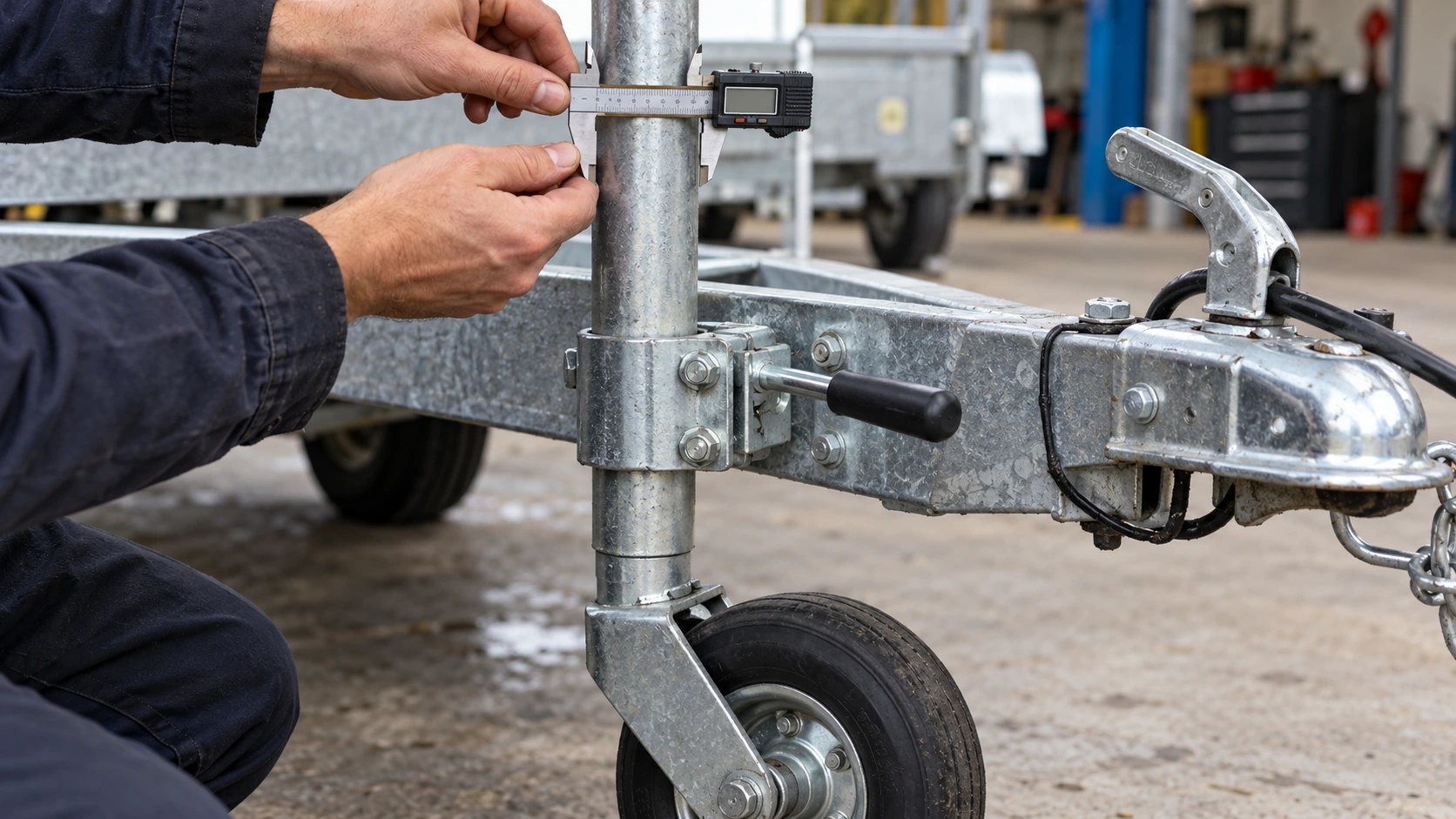
A caravan owner replaces a jockey wheel, tightens the existing clamp and discovers that the support tube still slides downward.
The clamp handle feels tight. The jockey wheel appears correctly positioned. Yet the clamp cannot reliably hold the tube.
Is the clamp worn out?
Or is the new jockey wheel simply the wrong diameter for the existing clamp?
In an October 2025 Practical Caravan forum discussion [1], an owner of a second-hand Bailey Unicorn Vigo reported exactly this problem. The jockey wheel kept dropping despite the clamp being tightened.
One respondent suggested measuring the outer tube diameter. A previous owner might have fitted a smaller 42 mm jockey wheel while retaining a clamp intended for a 48 mm tube.
Other possible explanations included contamination around the clamping surface or deterioration of the tightening mechanism.
The discussion did not establish which explanation was correct.
But it highlighted a common replacement-parts mistake:
A jockey wheel and its clamp are separate components, and buying one does not guarantee compatibility with the other.
Trailer-parts catalogs commonly distinguish jockey-wheel clamps by nominal tube sizes such as 35, 42, 48 and 60 mm.
GOODIN's current clamp range covers all four size classes.
However, the nominal diameter is only the first compatibility check.
A correct replacement must also match:
- the actual outside diameter of the supported tube;
- its surface profile;
- the clamp's gripping geometry;
- the trailer-side mounting pattern;
- the handle operating envelope;
- the required retention performance;
- the support-load requirements of the complete assembly.
For a replacement buyer, the central question is:
Will this clamp securely hold my existing jockey-wheel tube and fit the trailer's original mounting interface?
For an OEM buyer, the question becomes:
Which jockey-wheel and clamp combination should be specified together so that every trailer variant uses compatible components?
Both decisions begin with the tube diameter, but neither should end there.
Buying Guides · Product Selection #10 · Model-specific technical approval remains separate from nominal diameter screening.
Measure the Tube and Shortlist the Size
The term jockey wheel size can refer to several different dimensions.
A product listing may identify:
- wheel diameter;
- wheel width;
- outer support-tube diameter;
- overall assembly height;
- extension or travel.
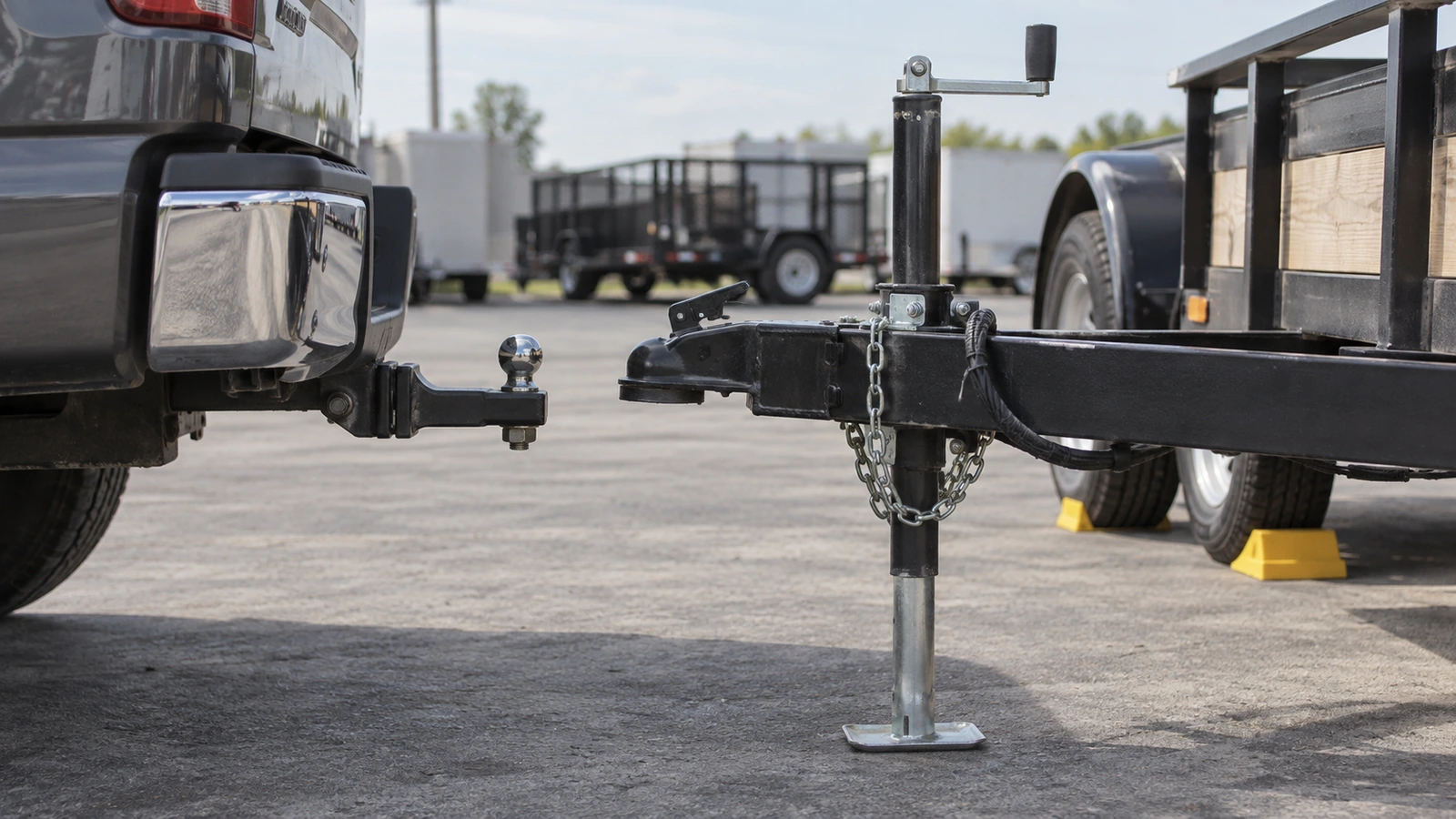
The clamp does not normally grip the wheel itself.
It grips the jockey wheel's outer support tube.
Therefore, the key measurement is:
Outside diameter of the tube at the actual clamping position.
Do not measure the smaller telescoping inner tube and assume it represents the required clamp diameter.
Do not select a clamp from the diameter of the rubber wheel.
And do not rely entirely on the nominal size stated in an old trailer manual if the jockey wheel may have been replaced.
Measure the Actual Clamping Zone
For an existing installation, identify the section of tube that passes through the clamp.
Record:
- The tube's outside diameter.
- Whether the tube is round and undamaged.
- Whether the surface is smooth, ribbed or serrated.
- Whether a sleeve, reinforcement or weld seam is present.
- Whether coatings or corrosion affect the contact surface.
A caliper measurement across the accessible tube can provide a useful starting point.
Where the tube is worn, dented or distorted, compare several positions around the intended contact area.
The objective is not merely to find a number close to 48 mm.
It is to establish whether the actual tube falls within the approved geometry of the candidate clamp.
What Do 35, 42, 48 and 60 mm Mean?
Jockey-wheel clamps are commonly organized around the outside diameter of the support tube they are intended to retain.
GOODIN currently offers the following configurations.
| Tube diameter class | GOODIN model | Published construction | Published thickness |
|---|---|---|---|
| 35 mm | K-2 | Formed clamp, manual lever | 3.0 mm |
| 42 mm | K-7 | Pressed / split clamp | 3.5 mm |
| 48 mm | K-3F | Pressed / split clamp, folding handle | 3.0 mm |
| 48 mm | K-5 | Cast clamp, folding handle | 3.5 mm |
| 60 mm | K-6F | Pressed / formed clamp, folding handle | 5.0 mm |
Source: GOODIN Clamp Product Range [2] and the corresponding product pages.
These values provide a useful initial selection framework.
However, the publicly listed thicknesses are product specifications. They should not automatically be assigned to every wall, handle, pin or other component without a dimensioned drawing.
More importantly, the different diameters do not establish a universal progression of carrying capacity.
A 60 mm clamp is not automatically approved for a particular load simply because it accepts a larger tube.
And two different 48 mm clamps are not necessarily interchangeable merely because they share the same nominal diameter.
35 mm: Confirm the Smaller Tube Class
GOODIN K-2 is specified for a 35 mm-class jockey-wheel or support tube.
For an existing light trailer or compact support arrangement, it may be a suitable candidate if the measured tube, mounting pattern and structural requirements match.
However, the 35 mm designation alone does not establish the intended trailer weight, jockey-wheel rating or permitted support load.
Those require separate verification.
42 mm: A Distinct Replacement Size
GOODIN K-7 is specified for a 42 mm tube.
This size is particularly relevant when an owner replaces a jockey wheel without replacing the clamp.
A 42 mm outer tube should not be assumed compatible with a 48 mm clamp.
If the clamp's compression mechanism cannot close sufficiently on the smaller tube, tightening the lever may fail to create the required retention.
The October 2025 forum discussion identified precisely this possible mismatch.
The correct purchasing response is to verify the actual tube and clamp sizes—not to apply increasingly greater force to the handle.
48 mm: Same Diameter, More Than One Configuration
GOODIN offers two notable 48 mm clamp constructions:
- K-3F pressed / split clamp;
- K-5 cast clamp.
This makes the 48 mm category especially useful for demonstrating why diameter is only the first selection parameter.
Both products target the 48 mm tube class.
But their clamp-body construction, attachment geometry and intended product configurations differ.
Neither should be selected solely because the buyer recognizes the number 48.
60 mm: Larger Tube, Separate Mounting Requirements
GOODIN K-6F targets the 60 mm tube class.
It has a published 5 mm thickness and a folding-handle arrangement.
Its larger tube opening and clamp body create a different packaging and mounting requirement from smaller models.
The buyer still needs to verify:
- tube profile;
- mounting holes;
- supporting trailer structure;
- handle space;
- required clamp retention;
- relevant load rating.
Moving to a larger tube class should therefore be treated as a system-compatibility decision, not a universal upgrade.
Check Tube Profile and Contact Condition
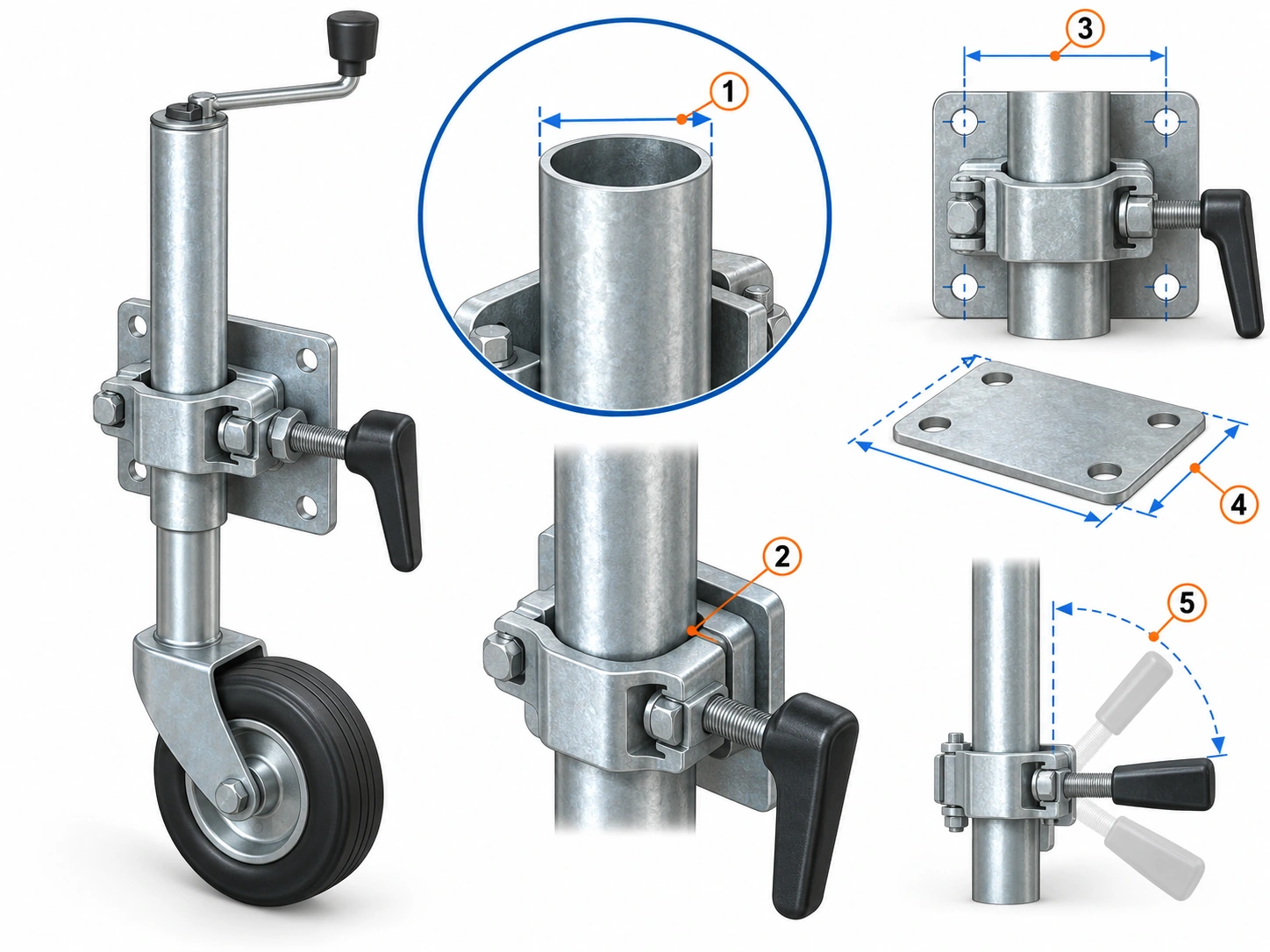
Suppose a buyer has measured a jockey-wheel tube at approximately 48 mm.
They find a clamp advertised for 48 mm.
Does that complete the selection?
Not necessarily.
The next question is whether the clamp is designed to grip the actual tube surface.
Smooth vs. Ribbed or Serrated Tubes
Some jockey-wheel tubes have a relatively smooth cylindrical surface.
Others use external ribs, grooves or serrated profiles.
These features can affect the way the clamp contacts the tube.
A clamp whose gripping surface is designed around a smooth tube may not engage a ribbed tube as intended.
Conversely, a clamp designed to work with a particular serrated profile may have different contact geometry.
This distinction is recognized in current specialist parts catalogs.
For example, Towing & Trailers' ribbed 48 mm clamp range [8] differentiates clamps suitable for ribbed or serrated tubes from pressed split clamps intended for smooth shafts.
Other cast clamp models may support both smooth and ribbed tubes, depending on their design.
The important point is:
Cast does not automatically mean ribbed-compatible, and pressed does not automatically define every permitted tube profile.
Compatibility must come from the exact product specification.
What About GOODIN K-3F and K-5?
GOODIN identifies K-3F as a pressed 48 mm clamp and K-5 as a cast 48 mm clamp.
However, their current public specifications do not establish a complete approved list of smooth, ribbed or serrated tube profiles.
Therefore, it would be premature to state that K-5 accepts every ribbed jockey wheel or that K-3F fits every smooth 48 mm tube.
For OEM procurement, the correct approach is to provide the actual tube profile drawing and obtain model-specific compatibility confirmation.
Surface Condition Matters Too
Even when the correct nominal tube and clamp are selected, the gripping interface must remain suitable.
Relevant conditions include:
- local tube deformation;
- damaged clamping surfaces;
- excessive corrosion;
- contamination;
- damaged clamp threads;
- worn or distorted pressure components.
The Practical Caravan forum discussion included suggestions that grease contamination or damaged clamp threads could contribute to the reported slipping.
Those were possible explanations, not confirmed findings.
For purchasing purposes, this matters because a buyer should not automatically order a different diameter when the real problem may be worn or incompatible existing hardware.
This guide does not attempt to diagnose every slipping clamp.
It establishes which dimensions and component conditions need confirmation before replacement.
Compare Pressed and Cast Constructions
A buyer choosing between GOODIN K-3F and K-5 already knows that both target a 48 mm tube.
The remaining decision concerns construction and compatibility.
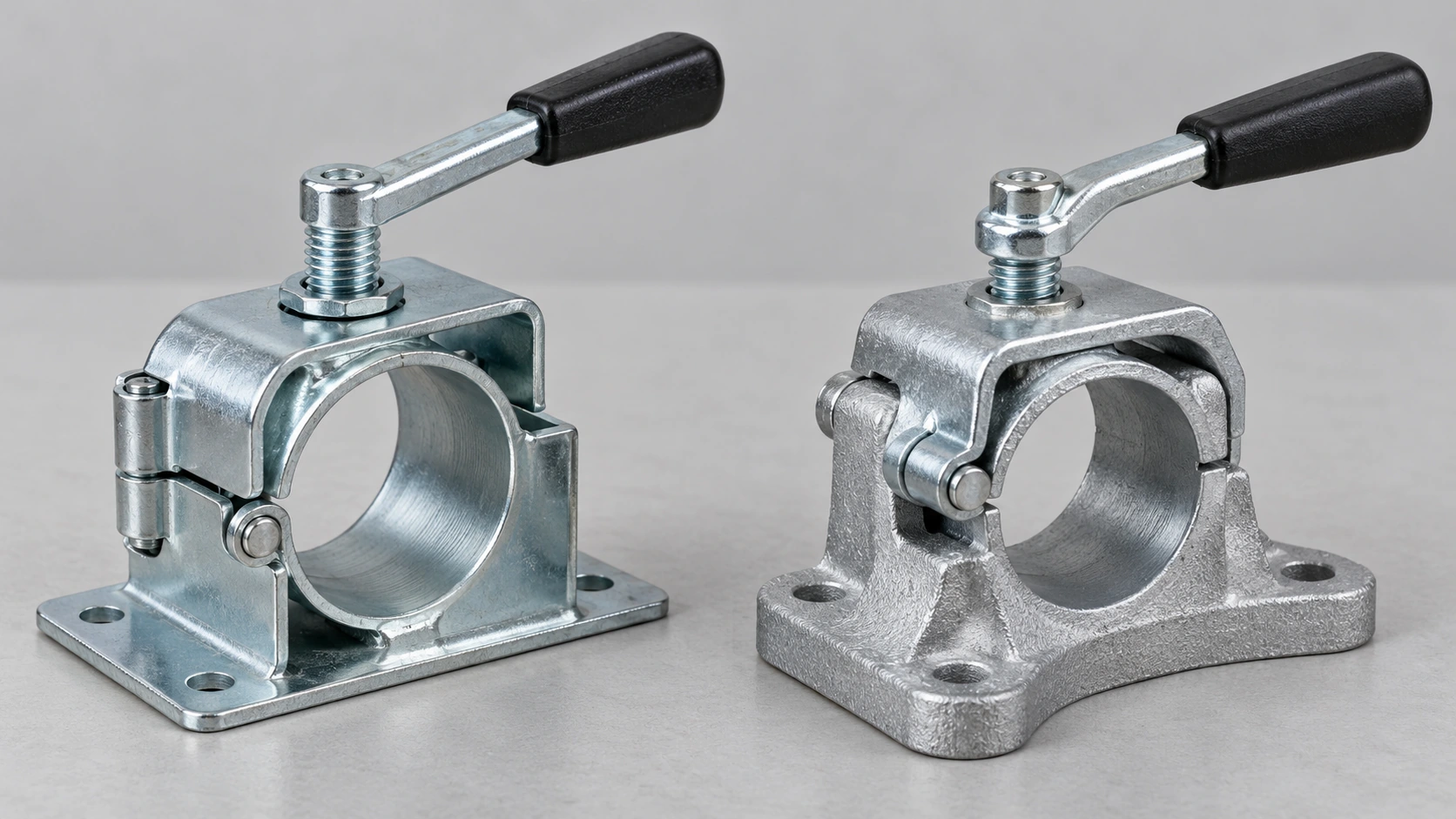
Pressed / Split Clamp
A pressed clamp generally uses formed metal components to create the tube seat and clamping mechanism.
GOODIN K-3F has this type of architecture.
Its publicly supplied specification includes:
- 48 mm tube class;
- 3.0 mm published thickness;
- folding handle;
- trailer-side mounting base.
A pressed / split arrangement may provide a compact attachment and service configuration, depending on the exact design.
However, a buyer should not assume that every pressed clamp can be fully opened around an installed tube.
The actual hinge, split geometry and assembly method must be checked.
Cast Clamp
GOODIN K-5 uses a cast clamping/base section with a folding-handle mechanism.
Its published specification includes:
- 48 mm tube class;
- 3.5 mm published thickness;
- cast clamp construction;
- folding handle.
A cast base can create a different mounting and tube-support geometry from a formed design.
But cast construction does not automatically prove a higher load rating.
Likewise, comparing 3.5 mm with 3.0 mm does not establish the relative structural capacity of these products.
The thickness values may refer to different component features, and construction geometry matters.
The buyer should request the required load or retention validation data rather than infer performance from appearance.
An Often-Missed Installation Question
Can the clamp be installed around the existing jockey wheel, or must the jockey-wheel assembly be partially dismantled to pass the tube through it?
That can matter during replacement.
For example, specialist retailers distinguish some non-split cast clamps that require the jockey wheel to be separated for installation from split or hinged designs intended for more convenient assembly.
Towing & Trailers' AL-KO cast-clamp listing [9] explicitly notes that its specific clamp is not split.
This does not establish the installation procedure for GOODIN K-5.
It demonstrates another question that should be answered from the exact product drawing.
For a distributor selling replacement clamps, this is a valuable product attribute to document.
Verify Mounting Holes and Structural Approval
Even if a clamp perfectly matches the jockey-wheel tube, it still has to mount to the trailer.
This is the second major compatibility gate.
Tube fit and trailer-side mounting fit are independent requirements.
A clamp may accept the correct 48 mm tube but have mounting holes that do not align with the existing drawbar or bracket.
That means a buyer who orders only by diameter can receive a part that cannot be installed without modifying the trailer.
Mounting-Hole Centers Are Not Universal
Commercial examples make this clear.
The AL-KO 48 mm cast clamp [9] is listed with mounting holes on approximately 105 mm centers.
A different Bradley 48 mm cast clamp [10] is listed with mounting centers around 150–155 mm.
Both target a 48 mm jockey-wheel tube.
Their trailer-side mounting interfaces differ.
That provides a clear replacement-purchasing rule:
A matching tube diameter does not guarantee a matching bolt pattern.
Do not transfer those example hole centers to GOODIN products.
GOODIN's current K-series public pages show mounting provisions but do not publish the exact production hole centers or complete fastener requirements.
Those must be obtained from the relevant GOODIN drawing.
What Mounting Dimensions Matter?
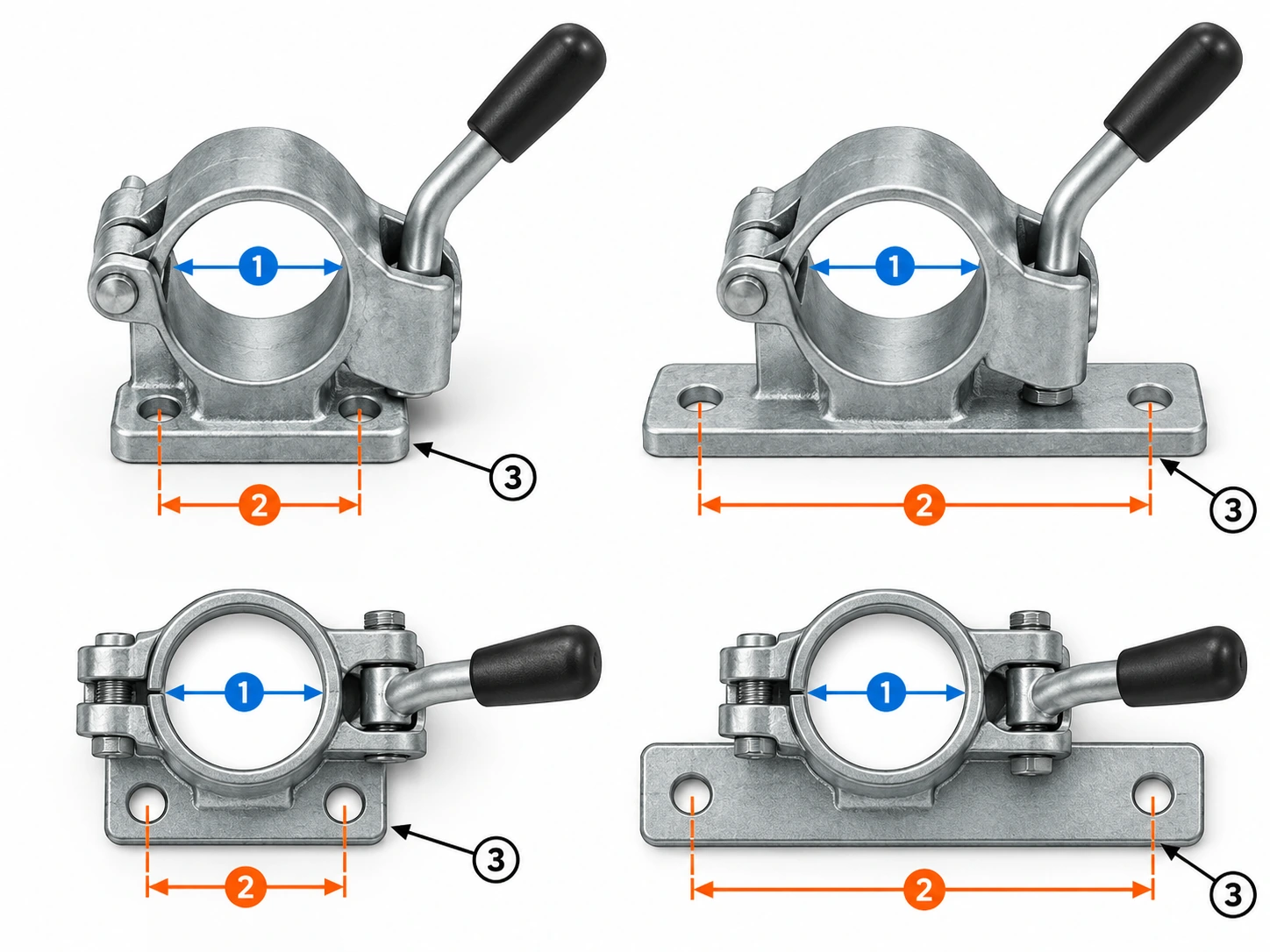
Before ordering a replacement clamp, record:
A — Mounting-hole center distance
For two-hole patterns, measure the center-to-center spacing.
For multi-hole arrangements, record the complete pattern.
B — Hole or slot dimensions
A round hole and an elongated slot are not equivalent simply because their centerlines appear aligned.
C — Mounting-base footprint
Check the overall area needed to support the clamp.
D — Fastener dimensions
Confirm approved bolt diameter, grade, washers and related hardware.
E — Supporting member
Identify whether the clamp attaches to a drawbar plate, chassis bracket, crossmember or another intended structure.
F — Mounting orientation
The clamp must place the jockey wheel correctly relative to the trailer.
A visually similar base does not prove that every mounting orientation is supported.
Do Not Redrill the Drawbar Just Because the New Clamp Almost Fits
A replacement clamp with a different bolt pattern can create a tempting workaround.
The buyer may consider drilling new holes or enlarging existing ones.
But a trailer drawbar is a structural component.
New holes or other modifications can affect the local connection and structural integrity.
A supplier's statement that a clamp is suitable for a 48 mm tube does not establish that new holes may be added to any trailer chassis.
If the replacement cannot use the existing approved interface, there are three possibilities:
- Select a different clamp with a compatible mounting pattern.
- Use an appropriate manufacturer-approved adapter or mounting arrangement.
- Obtain the relevant trailer-manufacturer approval or qualified assessment for the proposed modification.
The correct solution depends on the particular trailer.
For OEM production, the mounting pattern should be defined before manufacturing the frame or clamp brackets.
For aftermarket replacement, preserving the existing approved interface is often an important selection objective.
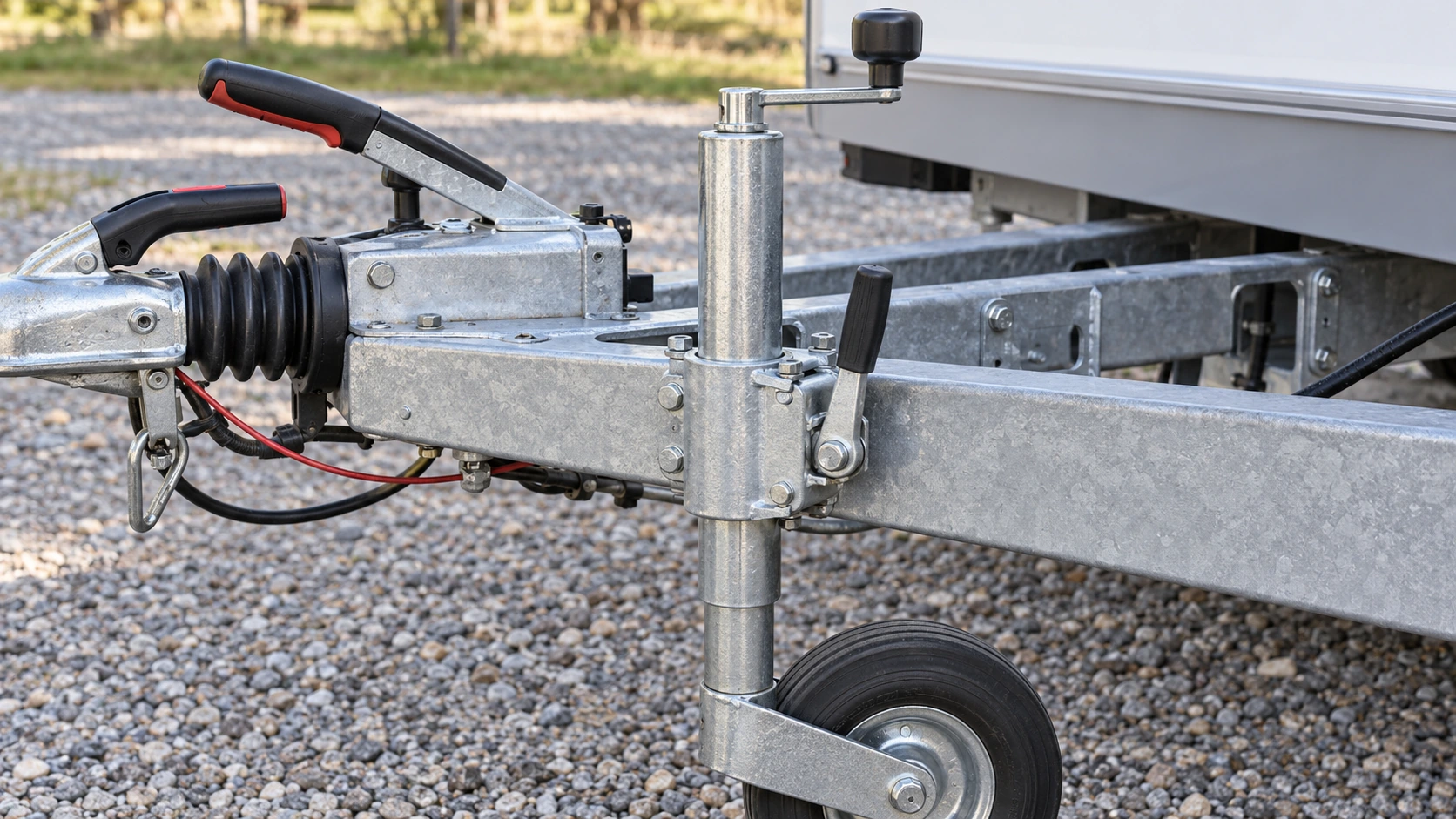
Check Handle Space and Travel Stowage
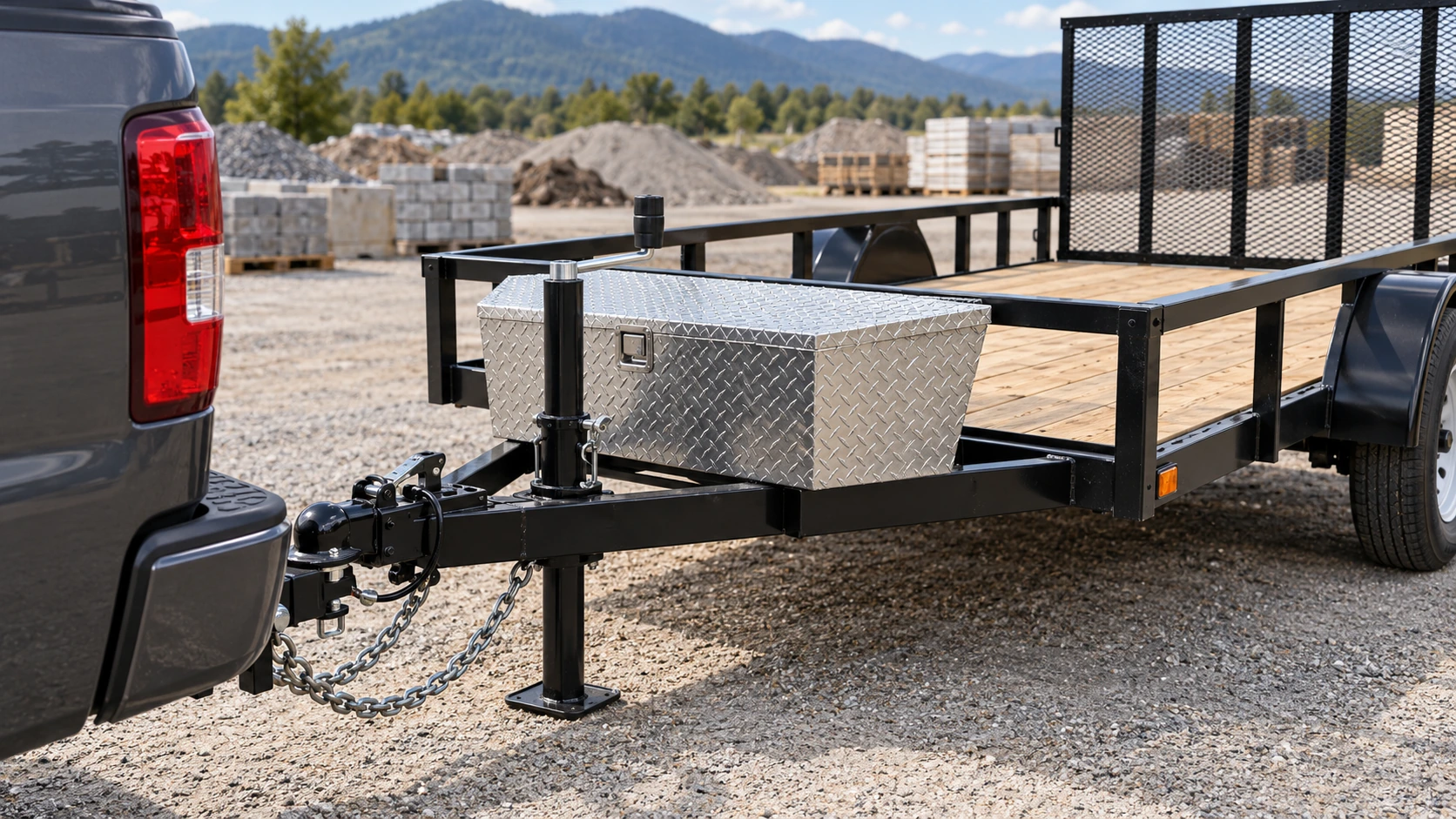
A jockey-wheel clamp needs space for its tightening mechanism.
This is easy to overlook because catalog images often show the handle without the surrounding trailer structure.
On an actual trailer, the clamp may sit close to:
- the coupler;
- A-frame members;
- an overrun-brake assembly;
- the handbrake lever;
- electrical equipment;
- a tongue toolbox;
- other trailer accessories.
The clamp handle must remain accessible and be capable of operating as designed.
Fixed and Folding Handles
GOODIN K-3F, K-5 and K-6F have published folding-handle configurations.
A folding handle can reduce the permanent projection of the lever after adjustment.
However, the handle still needs sufficient space to tighten the clamp and move into its intended folded position.
The folding feature does not automatically eliminate interference with nearby components.
Two Separate Clearance Checks
For any candidate clamp, verify:
Operating envelope
Can the user turn or reposition the handle to achieve the manufacturer's required clamping condition?
Stored-handle envelope
Once secured, can the handle remain in its intended position without interfering with other equipment?
A clamp that fits the tube and matches the mounting holes can still be unsuitable if its handle cannot be operated.
For OEM programs using the same clamp on several trailer platforms, handle orientation should be checked on every relevant tongue layout.
Clamp Height and Jockey-Wheel Stowage Still Matter
The clamp fixes the tube at a particular position relative to the trailer.
That position affects how much of the jockey-wheel assembly extends above and below the mounting location.
A different clamp body or mounting arrangement may therefore affect:
- the available adjustment position;
- crank access;
- clearance near the coupler;
- wheel and fork clearance;
- raised travel position.
The jockey wheel must reach the required working height and be able to retract or stow according to the complete assembly instructions.
AL-KO's jockey-wheel operating instructions [12] describe raising the jockey-wheel assembly into its travel position and tightening the clamp after hitching.
The purchasing implication is that a new clamp should preserve the complete jockey wheel's permitted working and travel arrangements.
This article does not need to repeat the full height-selection process from the earlier Trailer Jack Travel vs. Working Height guide.
It is sufficient to establish that clamp location can affect the usability of the entire assembly.
Confirm Support Loads and Clamp Retention
This is the most important rating distinction in the article.
The number 48 describes a nominal tube diameter in millimeters.
It does not describe:
- 48 kg of supported load;
- a particular nose-weight rating;
- a universal clamp retention force;
- a trailer GVWR;
- or a specific load rating for the complete jockey wheel.
The load requirement must be established separately.
The Complete Support System Has Several Components
The vertical and other reactions associated with a jockey wheel pass through:
trailer drawbar → mounting fasteners → clamp base → clamping interface → jockey-wheel tube → wheel assembly → ground
Every component and connection must be appropriate for the intended application.
Even a jockey wheel with a documented support rating does not establish the capacity of an unidentified clamp or its mounting bolts.
Likewise, a robust-looking cast clamp does not certify the strength of the trailer drawbar.
Stationary and Manoeuvring Ratings May Differ
AL-KO's jockey-wheel product range [11] explicitly distinguishes stationary nose load from manoeuvring load.
For example, AL-KO publishes some 48 mm models with ratings such as:
Other 48 mm models have higher published ratings, including configurations rated at 250 kg stationary and 150 kg manoeuvring. [14]
These are model-specific jockey-wheel ratings.
They demonstrate that even within the same 48 mm tube class, operating capacities can vary.
The same principle applies to clamps.
A clamp's tube diameter and construction style do not establish its allowable load.
What Must the Supplier Confirm?
For a complete OEM support system, the buyer should obtain the relevant:
- jockey-wheel stationary support rating;
- jockey-wheel manoeuvring rating, where applicable;
- clamp retention or load rating and its defined conditions;
- mounting-bolt requirements;
- trailer-side structural approval;
- permitted operating and stowage conditions.
Do not apply the jockey wheel's published rating to an unrelated clamp unless the manufacturer approves that combination.
GOODIN's Current Rating Boundary
GOODIN's public K-2, K-7, K-3F, K-5 and K-6F pages identify tube size, construction and selected product dimensions.
They do not publish a complete clamp-load or clamp-slip rating together with all mounting conditions.
Therefore, no specific support-load capacity should be assigned to those clamps from the public catalog alone.
For commercial procurement, this information should be included in the technical confirmation process.
Choose the Replacement Outcome
A compatibility guide should help the buyer decide what actually needs purchasing.
Not every jockey-wheel problem requires replacing the complete support assembly.
Outcome 1: Replace Only the Clamp
This may be appropriate when:
- the existing jockey-wheel tube is suitable;
- the jockey wheel remains in serviceable condition;
- its rating satisfies the application;
- the current clamp is damaged or incompatible;
- a replacement clamp matches the tube diameter and surface profile;
- the replacement matches an approved trailer mounting interface;
- required retention and load performance are confirmed.
For example, a suitable 48 mm jockey wheel may be retained while a damaged 48 mm clamp is replaced by a correctly specified model.
The buyer should not assume that any available 48 mm clamp is sufficient.
Outcome 2: Replace the Jockey Wheel and Clamp as a Matched Pair
This becomes appropriate when the intended new jockey wheel uses a different outer-tube diameter or surface profile from the original assembly.
For example:
Existing system: 48 mm clamp and tube.
Proposed replacement jockey wheel: 42 mm outer tube.
Retaining the old 48 mm clamp may leave an incompatible gripping interface.
The buyer should either select a jockey wheel compatible with the original approved clamp or specify a matching 42 mm clamp whose trailer-side installation is also suitable.
The same reasoning applies when moving between other size classes.
A complete change should account for the operating-height requirements and load rating of the new system.
Outcome 3: Reassess the Mounting Structure
This is necessary when a suitable clamp cannot be fitted to the existing trailer without changing structural mounting features.
Examples include:
- incompatible bolt pattern;
- inadequate mounting plate;
- damage to the supporting drawbar;
- unsuitable clamp orientation;
- required new brackets or welded attachments;
- a higher-load support application not covered by the existing installation.
At that point, selecting another catalog clamp is not enough.
The mounting arrangement requires appropriate technical confirmation.
Jockey Wheel + Clamp Compatibility Matrix
The following matrix provides a practical starting point for replacement and OEM procurement.
| Jockey-wheel tube | GOODIN clamp candidate | Primary compatibility check | Additional confirmation |
|---|---|---|---|
| 35 mm round tube | K-2 | Actual 35 mm OD and surface profile | Mounting interface, lever clearance, retention/load requirements |
| 42 mm round tube | K-7 | Actual 42 mm OD and surface profile | Hole pattern, tube fit, mounting structure |
| 48 mm round tube | K-3F | Actual 48 mm OD; pressed/split clamp compatibility | Tube surface, base dimensions, folding handle and rating |
| 48 mm round tube | K-5 | Actual 48 mm OD; cast clamp compatibility | Tube surface, installation method, base dimensions and rating |
| 60 mm round tube | K-6F | Actual 60 mm OD and surface profile | Mounting structure, folding-handle envelope and retention |
| Ribbed or serrated tube | Model-specific | Profile compatibility, not diameter alone | Approved tube/clamp pairing |
| Sleeved or locally reinforced tube | Model-specific | Actual diameter and geometry at contact zone | Approved clamping position |
| Non-round or damaged tube | No automatic selection | Dimensional conformity not established | Replace or reassess tube/system |
Important: This is a candidate-selection matrix, not a declaration that every listed tube and clamp combination has been approved.
The first five rows identify nominal size-class matches.
Final compatibility still depends on model-specific geometry, mounting and load verification.
A Replacement Example: Why the New Jockey Wheel Keeps Slipping
Consider an illustrative replacement situation similar to the October 2025 forum question.
The trailer originally used a 48 mm jockey wheel and matching clamp.
The previous owner installed a 42 mm replacement jockey wheel but kept the original clamp.
When the new owner tries to secure the wheel, the handle tightens but the outer tube still moves.
There are several checks to make before ordering a replacement.
First: Confirm the Tube OD
Measure the actual outer tube.
If it is 42 mm, the buyer should not assume the 48 mm clamp can compress far enough to hold it correctly.
Second: Identify the Existing Clamp
Determine the original clamp model, nominal tube diameter and clamping geometry.
Its condition also matters.
A worn or damaged mechanism can produce poor retention even with a correctly sized tube.
Third: Check the Mounting Interface
If a 42 mm clamp is required, verify that a suitable model matches the existing approved mounting pattern.
If the bolt pattern is different, the buyer may need another clamp design rather than modifying the drawbar.
Fourth: Confirm the Complete Support System
The selected jockey wheel, clamp and mounting arrangement must satisfy the intended support and manoeuvring requirements.
A smaller tube size should not be selected simply because it is available.
Possible Decisions
Case A — Original 48 mm clamp is sound and approved: Choose a compatible 48 mm jockey wheel that meets the application requirements.
Case B — New 42 mm jockey wheel is suitable: Select a matching 42 mm clamp only if its mounting and load conditions are also satisfied.
Case C — Neither combination matches the original mounting interface: Obtain an approved alternative arrangement or reassess the installation.
This example explains why slipping should not automatically lead the owner to buy a larger clamp, a stronger handle or an improvised shim.
The real task is to restore a verified component combination.
Specify Matched Parts and Approved Substitutions
For an OEM producing several trailer models, jockey-wheel clamp selection becomes a configuration-management task.
A trailer manufacturer may use different jockey wheels across its range because the products have different:
- support-load requirements;
- operating heights;
- tube diameters;
- wheel arrangements;
- customer applications.
The corresponding clamps must be specified consistently.
But standardizing every trailer around one clamp model may not be appropriate.
The objective should be to standardize compatible interfaces wherever practical.
Example OEM Product Family
Consider a hypothetical trailer OEM with three platforms.
| Trailer platform | Required tube class | Candidate GOODIN clamp family | OEM checks |
|---|---|---|---|
| Compact utility series | 35 mm | K-2 | Tube profile, mounting, operating clearance, approved ratings |
| General utility series | 48 mm | K-3F or K-5 | Construction choice, mounting pattern, tube profile, required retention |
| Larger equipment series | 60 mm | K-6F | Support reactions, frame interface, fasteners, handle and travel clearance |
The table is illustrative.
It does not assign any specific GOODIN load capacity or claim that those sizes are inherently appropriate for the stated trailer classes.
The actual selection must follow the OEM's engineered support requirements.
Why a Component Compatibility List Matters
Without a defined component list, a procurement team may order:
- the correct jockey wheel;
- a clamp from another supplier;
- a mounting bracket from an older trailer design.
All three parts might appear reasonable individually.
But the combination may not match.
For OEM production, each trailer platform should have a documented combination of:
Jockey Wheel SKU + Clamp SKU + Mounting Hardware + Approved Trailer Interface
That makes assembly more repeatable and helps prevent incorrect substitutions during after-sales replacement.
Build a Clear Spare-Parts Matrix
A manufacturer or distributor may stock multiple jockey-wheel and clamp diameters.
The spare-parts system should make it difficult to order an incompatible combination.
A useful compatibility record includes:
| Field | Example format |
|---|---|
| Trailer platform | OEM model / revision |
| Jockey-wheel part number | Exact SKU |
| Outer-tube diameter | 35 / 42 / 48 / 60 mm or other specified size |
| Tube surface profile | Smooth / ribbed / other defined profile |
| Clamp part number | Exact approved SKU |
| Clamp construction | Pressed / cast / other |
| Mounting interface | Drawing number and revision |
| Fastener kit | Approved part number |
| Stationary rating | Verified assembly requirement |
| Manoeuvring rating | Verified assembly requirement, if applicable |
| Handle clearance | Confirmed installation envelope |
| Approved substitutions | Listed by exact part number |
| Destination market | Relevant product/market requirements |
The key field is approved substitutions.
A distributor should not treat every part in the same nominal diameter category as interchangeable.
An approved alternate clamp may need a different bolt pattern or handle arrangement even when the tube size matches.
This information should be established before aftermarket parts are advertised as direct replacements.
What Should an OEM Ask GOODIN to Confirm?
For batch purchasing, an inquiry such as:
"Please quote 48 mm jockey wheel clamps."
does not establish enough information for technical approval.
A complete RFQ should include the following requirements.
Tube Compatibility
- nominal tube outside diameter;
- actual OD tolerance;
- tube roundness requirement;
- smooth, ribbed or serrated profile;
- coating and surface condition;
- tube drawing or sample.
Clamp Construction
- required pressed or cast design;
- material grade;
- surface treatment;
- published thickness and its drawing reference;
- split/hinged assembly requirement;
- handle type and orientation;
- clamp screw and pressure-pad geometry.
Trailer-Side Mounting
- mounting-base drawing;
- hole and slot dimensions;
- mounting-center spacing;
- suitable trailer-member geometry;
- approved fastener size and grade;
- any backing plate or bracket requirement.
Load and Performance
- actual support-load requirement;
- intended stationary and manoeuvring conditions;
- clamp retention or slip-resistance validation;
- required test conditions;
- applicable acceptance criteria.
Production and Spare Parts
- exact product and drawing revision;
- compatible jockey-wheel SKUs;
- permitted substitutions;
- inspection requirements;
- replacement handle or clamp hardware availability;
- packaging and part identification;
- required order quantity.
A fully specified clamp can then be evaluated as part of the intended trailer support system rather than as an isolated diameter-based accessory.
The Complete Pre-Purchase Compatibility Table
This worksheet combines the most important replacement checks.
| Check | Buyer should measure or identify | Supplier should confirm | Reject / reassess if… |
|---|---|---|---|
| Tube OD | Outside diameter at gripping zone | Nominal size and approved tolerance | Diameter mismatch |
| Tube profile | Smooth, ribbed, serrated or sleeved | Permitted contact profile | Contact geometry incompatible |
| Tube condition | Roundness, damage, coating | Acceptable dimensional condition | Tube cannot seat correctly |
| Clamp construction | Existing pressed/cast/hinged configuration | Proposed model and installation method | Assembly cannot be installed as intended |
| Mounting centers | Existing hole pattern | Production drawing | Holes do not align |
| Base footprint | Available supporting area | Base dimensions | Inadequate support |
| Fasteners | Existing approved hardware | Size, grade and arrangement | Connection not verified |
| Handle clearance | Space around tongue hardware | Operating and folded envelope | Handle cannot operate |
| Clamp position | Tube height and location | Permitted installation orientation | Required position unavailable |
| Travel stowage | Available raised/stowed space | Assembly operating requirements | Wheel or handle interferes |
| Stationary load | Actual support requirement | Applicable assembly rating | Rating insufficient or unknown |
| Manoeuvring load | Intended low-speed movement condition | Applicable dynamic/manoeuvring rating | Required performance not established |
| Clamp retention | Intended loads and operating conditions | Slip/retention criteria and evidence | Secure holding not verified |
| Trailer structure | Drawbar or bracket condition | Required structural interface | Installation requires unapproved changes |
| Replacement SKU | Existing model or desired substitute | Approved part compatibility | Substitution unverified |
No single row replaces the others.
A diameter match is necessary for most standard round-tube clamp replacements, but the final decision depends on the entire installation.
GOODIN View: Buy a Matched Support Interface, Not Just a Diameter
The first mistake in jockey-wheel clamp selection is assuming that a tube-size label establishes complete compatibility.
The second is assuming that a stronger-looking clamp automatically produces a stronger installation.
GOODIN's current clamp range provides five useful product configurations across the 35, 42, 48 and 60 mm classes.
K-3F and K-5 also demonstrate that even within one nominal 48 mm category, buyers may have more than one clamp construction to consider.
But a product can only be selected correctly when three interfaces are verified.
1. Tube to Clamp
The diameter, profile and contact geometry must match.
2. Clamp to Trailer
The mounting pattern, fasteners and structural interface must be suitable.
3. Complete Assembly to Application
The jockey wheel, clamp and trailer-side structure must satisfy the actual operating conditions and relevant load requirements.
If a clamp cannot securely retain the intended tube, its nominal size alone is not enough.
If the mounting holes do not match, the correct tube diameter does not make it a direct replacement.
And if the clamp has no verified load rating for the proposed installation, its cast construction or larger diameter cannot substitute for that missing information.
The purchasing rule is:
Specify the jockey wheel and clamp as a matched interface, then verify the complete support system against the trailer's actual requirements.
For replacement buyers, that prevents incorrect part orders.
For trailer OEMs, it creates a more consistent component specification and spare-parts system.
The right clamp is not necessarily the largest one or the one with the thickest-looking body.
It is the model whose tube fit, mounting interface, operating clearance and verified retention performance match the trailer.
For a matched jockey-wheel and clamp enquiry, view the GOODIN clamp range and contact GOODIN with the actual tube drawing, mounting pattern, required load conditions and intended trailer platform. Obtain the model-specific technical confirmation before ordering.
Final Selection Checklist
Before approving a jockey-wheel clamp purchase, confirm:
- Has the actual outer-tube diameter been measured?
- Was the measurement taken at the intended clamping zone?
- Is the tube smooth, ribbed, serrated or otherwise shaped?
- Does the selected clamp explicitly permit that tube profile?
- Is the clamp's gripping geometry compatible with the tube?
- Can the clamp be assembled around or onto the jockey wheel as intended?
- Does the mounting-hole pattern match the trailer's approved interface?
- Are the mounting base, fasteners and supporting structure suitable?
- Can the tightening handle operate without interference?
- Can the jockey wheel reach its required working and travel positions?
- Is the necessary clamp retention performance verified?
- Are stationary and manoeuvring load requirements separately addressed where applicable?
- Is the clamp being selected from manufacturer-confirmed specifications rather than appearance?
- For OEM orders, are the approved jockey-wheel and clamp SKUs linked in the bill of materials?
- Are any substitutions supported by current drawings and compatibility documentation?
If these checks are complete, the buyer can specify a compatible clamp with much greater confidence.
If they are not, the diameter on the product label remains only the first screening result.
Sources & Further Reading
Product data is limited to the exact published model. Forum reports are observations, not confirmed failure diagnoses. Market-example dimensions must not be applied to GOODIN clamps.
- Practical Caravan Forums — Wet and Windy in Clitheroe
- GOODIN — Clamp Product Range
- GOODIN — K-2 — 35 mm Jockey Wheel Clamp
- GOODIN — K-7 — 42 mm Jockey Wheel Clamp
- GOODIN — K-3F — 48 mm Pressed Jockey Wheel Clamp
- GOODIN — K-5 — 48 mm Cast Jockey Wheel Clamp
- GOODIN — K-6F — 60 mm Jockey Wheel Clamp
- Towing & Trailers — Ribbed 48 mm Trailer Jockey-Wheel Clamps
- Towing & Trailers — AL-KO 48 mm Cast Clamp — JC25
- Towing & Trailers — Bradley 48 mm Ribbed Cast Clamp — JC35
- AL-KO — Jockey Wheels for Trailers
- AL-KO — Premium Jockey Wheel Operating Instructions
- AL-KO — ST 48-200 V — Model-Specific Stationary and Manoeuvring Loads
- AL-KO — Reinforced 48 mm Jockey Wheel — Published Capacity Example
Fixed vs. Magnetic LED Trailer Lights: Which Setup Fits Your Trailer and Towing Needs?
Related Article