Trailer Jack Travel vs. Working Height: How to Choose a Jack That Actually Reaches Your Hitch
In this guide
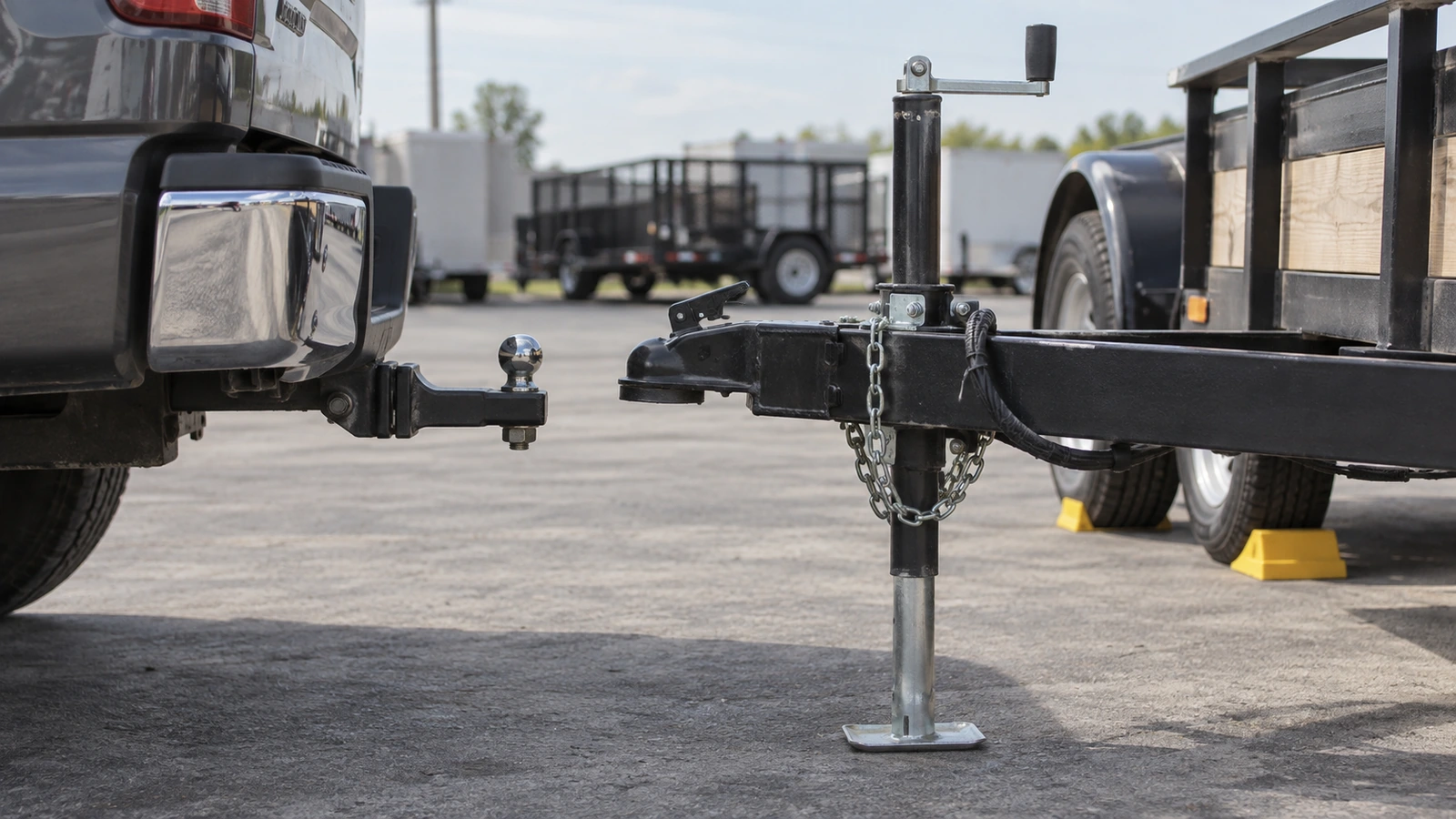
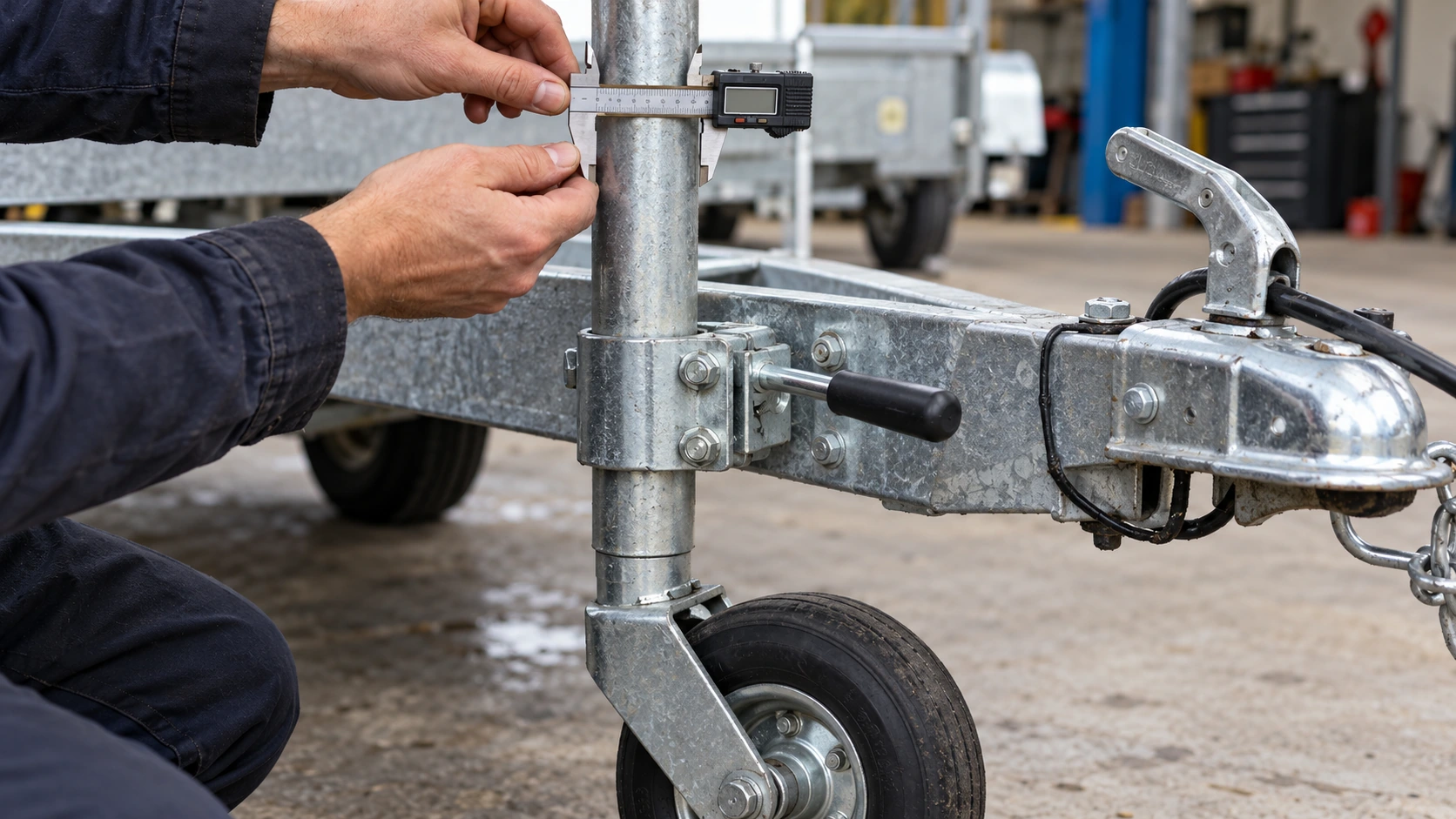
Consider a frustrating height mismatch: a trailer stands on flat ground, but its tongue jack reaches full extension before the coupler can rise above the tow vehicle’s hitch ball. The mechanism may still work normally; the installed height range is simply in the wrong place. This is an illustrative selection scenario, not a diagnosis of a particular trailer.
This is not necessarily a jack failure.
It can be a selection failure.
A buyer may see “15 in travel” and reasonably assume that the jack offers enough vertical range. But travel describes how far part of the jack moves. It does not, by itself, tell you where that movement begins, where it ends, how the jack sits relative to the trailer frame, or how much of the assembly remains below the frame when fully retracted.
For trailer-jack selection, the more useful question is therefore not:
How much travel does this jack have?
It is:
Does the jack’s installed working-height window cover every height this trailer actually needs?
That difference can determine whether the trailer can be coupled, uncoupled, parked and towed normally—or whether a seemingly adequate jack reaches the end of its stroke before the coupler clears the hitch ball.
Selection guidance, not an installation approval. Confirm the current model drawing and manufacturer instructions before ordering or modifying a trailer mount.
Why Travel Is Not Reach
Travel is a distance, not an absolute height.
Suppose two jacks both provide 15 inches of vertical travel. One may begin its usable range relatively low and finish at 28 inches from the manufacturer’s specified reference point. Another may start higher and finish close to 30 inches.
The amount of movement is similar. Their usable height windows are not.
GOODIN's current product specifications demonstrate this distinction.
The LF922-2015 publishes 15 inches of travel, a 14.375-inch bracket height and a 29.375-inch extended height. The LF932-2015 swivel model publishes 15 inches of travel, a 14.4-inch bracket height and a 29.4-inch extended height. GOODIN's heavier LF971-701513 square jack also has 15 inches of travel, but its published geometry is 13 inches at the bracket-height reference and 28 inches extended.
The same principle appears among shorter-travel products. GOODIN's LF931-2010 has 10 inches of travel with published 11.25-inch bracket and 21.25-inch extended heights, while the LF961-1010L also provides 10 inches of travel but publishes a 13-inch bracket height and a 23-inch extended height.
These models are not presented here as interchangeable products—their capacity, mounting architecture and other specifications differ.
They illustrate a more important purchasing rule:
Travel alone does not define where the jack can work.
A trailer that needs the jack to reach a particular coupler height must be matched against the complete dimensional geometry, not against the travel number alone.
Five Height Terms—and One Common Datum
Trailer-jack specifications can become confusing because manufacturers and sellers do not always use dimensional terms in exactly the same way.
Before comparing products, separate five different concepts.
| Specification | What it tells you | What it does not tell you |
|---|---|---|
| Travel | How far the jack mechanism moves between defined positions | The absolute lowest or highest installed working height |
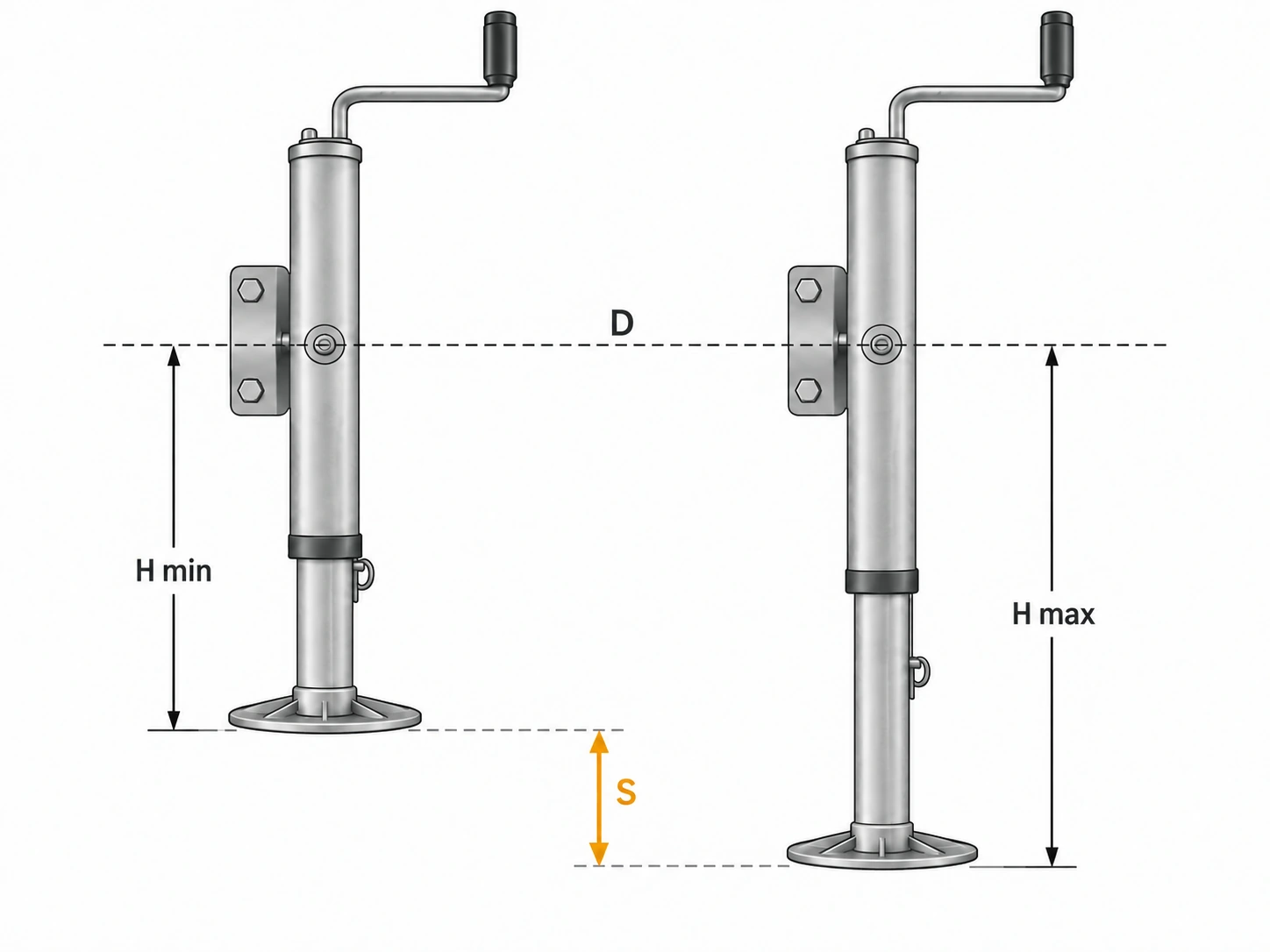
| Bracket Height | A height measured from a specified mounting/bracket datum to the foot or wheel under the manufacturer's defined condition | A universal retracted-height measurement |
| Retracted Height | The distance from a defined mounting reference to the bottom of the foot/wheel with the jack fully retracted | Maximum available working height |
| Extended Height | The distance from the same defined reference to the foot/wheel at full extension | Whether that height works with your trailer's mounting position |
| Drop-Leg Adjustment | Additional coarse positioning provided by an adjustable lower leg where equipped | Additional screw travel |
For some products, travel can be calculated directly as extended height minus retracted height. For example, trailer-jack specialists commonly publish retracted and extended bracket heights from a defined mounting point to the bottom of the foot. But the reference location itself varies by jack architecture, so buyers must confirm the manufacturer's dimensional drawing rather than assuming every “bracket height” uses the same datum.
That distinction is especially important when comparing an A-frame jack, side-mounted swivel jack, pipe-mounted jack and direct-weld square jack.
Their dimension labels can look similar while their mounting references are physically different.
Travel Is Stroke, Not Reach
If a jack moves 15 inches, it has 15 inches of travel.
That does not mean it can raise every trailer 15 inches above its normal position, nor does it mean its foot can reach every ground-to-frame distance between zero and 15 inches.
The jack already has a physical length before the moving tube begins extending.
The practical working window therefore depends on:
starting geometry + travel + mounting geometry + foot/wheel configuration
rather than travel alone.
Bracket Height Needs a Datum
“Bracket height” is useful only when you know where the manufacturer measured it.
On some side-frame jacks, the measurement may be taken from the centerline of the mounting bracket to the bottom of the foot. On A-frame designs, manufacturers may instead reference a mounting plate.
That is why a catalog value should ultimately be checked against the model drawing.
GOODIN already applies this boundary on current product pages: published bracket height is not automatically relabeled as complete retracted height unless the model-specific drawing establishes that relationship.
Measure the Trailer’s Required Height Window
A reliable height-selection process begins with the actual trailer and tow vehicle.
The goal is to define the vertical range the jack must cover before comparing products.
Step 1: Establish the Jack Mounting Reference
First identify where the jack will actually attach to the trailer.
For a replacement jack, this may already be fixed by an existing bracket, welded tube, A-frame opening or mounting plate.
For an OEM project, the mounting elevation may still be adjustable during design.
Choose the same type of reference that appears on the candidate jack drawing—for example:
- mounting-plate underside,
- bracket centerline,
- pipe-mount centerline, or
- another manufacturer-defined datum.
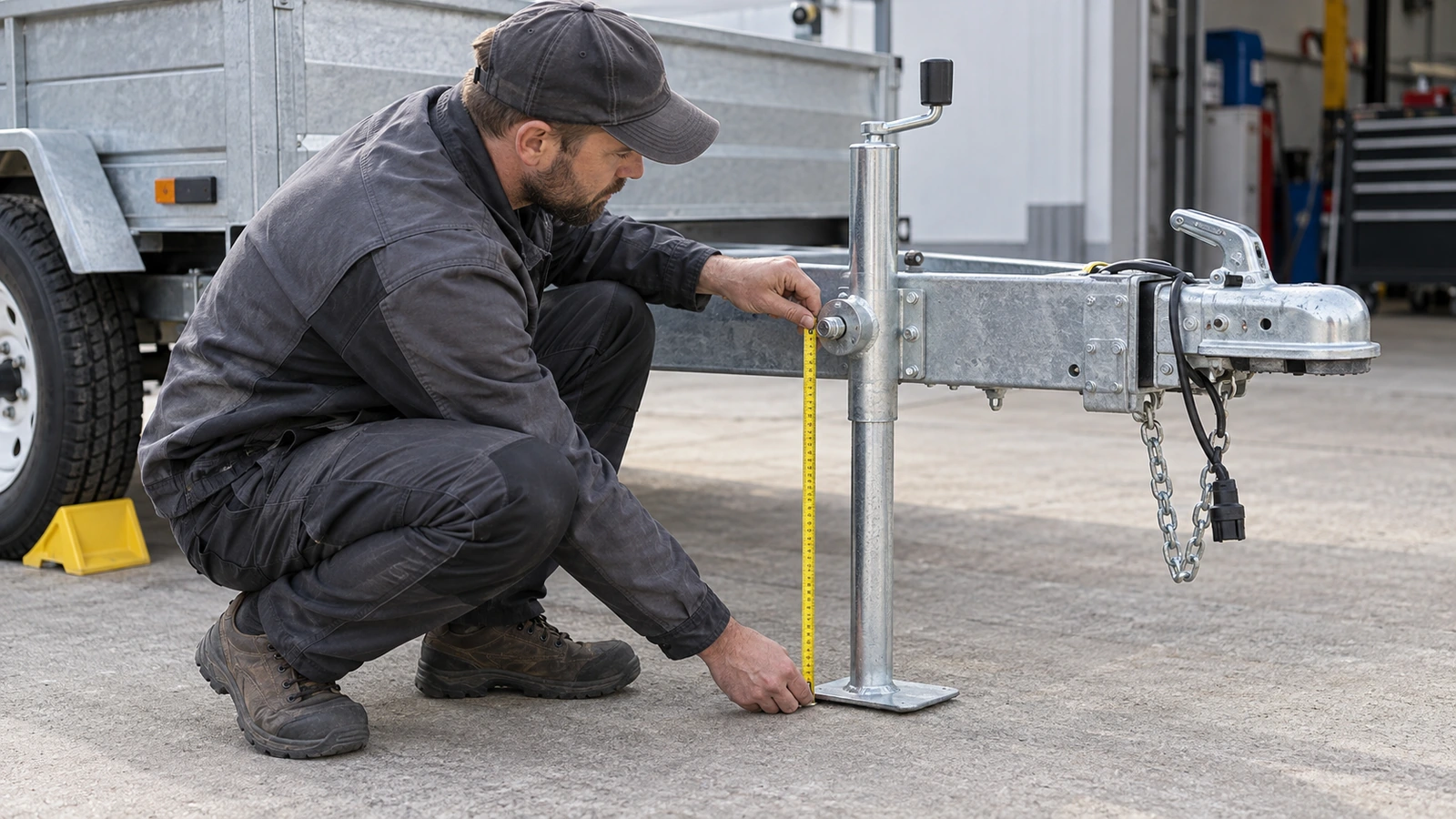
All subsequent measurements should use that same reference.
Without a common datum, comparing a 29-inch product dimension with a 29-inch field measurement can be meaningless.
Step 2: Measure the Height Needed to Clear the Hitch
Next determine how high the trailer tongue actually needs to rise during unhitching.
Follow the trailer, tow-vehicle and jack manufacturers’ procedures, secure the vehicles against movement and use appropriate stable support wherever required. Keep hands and body clear of pinch points; do not work beneath an unsupported trailer. Place the trailer and tow vehicle in the normal coupling configuration on an appropriate level surface. Then determine the mounting-reference-to-ground distance required for the coupler to rise sufficiently above the hitch ball for normal uncoupling.
Do not substitute the tow vehicle's published hitch height or the trailer's nominal coupler height if the actual assembled combination can be measured.
Vehicle suspension, hitch hardware, tire size, trailer attitude and load condition can all affect the real geometry.
This measurement becomes one of the most important numbers in the jack specification:
maximum required deployed working height.
The opening height-mismatch scenario illustrates what happens when this value exceeds the jack's usable range: the screw reaches full extension while the coupler is still below the height required to clear the ball.
Step 3: Measure the Required Parked Support Height
Unhitching is not necessarily the only height requirement.
The trailer may need to sit at a different tongue height when parked or stored.
Measure the same jack mounting reference to the supporting surface when the trailer is in its intended parked attitude.
For some trailers, the parked position sits comfortably inside the hitching range. For others, sloped storage areas, equipment geometry or trailer attitude may create another important working point.
The jack's selected range should therefore cover the actual operating positions rather than one idealized number.
Step 4: Check the Lowest Required Working Position
Maximum reach receives most of the attention, but the opposite endpoint matters too.
A jack can also be too long in its retracted deployed position.
If the lower assembly cannot retract far enough, the trailer may remain too high to settle onto the hitch ball, or the operator may have to remove a foot, wheel or support arrangement simply to complete coupling.
The required range is therefore not:
minimum travel required = maximum hitch height
It is closer to:
required working window = lowest necessary deployed height → highest necessary deployed height
A candidate jack needs to cover that window using the manufacturer's defined dimensional references. The height check does not replace the rated-load, stability, attachment or operating-condition checks.
Check Towing Clearance Separately
Step 5: Check Towing Clearance Separately
Once the trailer is coupled, the jack has another job: getting out of the way.
A fixed vertical jack normally needs enough retracted clearance below the trailer for the intended towing environment. A swivel jack instead needs enough room to rotate into its stored position and lock securely.
Lippert specifically instructs trailer owners to fully retract the jack before towing and verify adequate clearance under the jack or foot; some configurations may require an approved removable attachment or other model-specific arrangement to obtain the required clearance. [6]
This creates an important engineering trade-off:
Increasing downward reach can make ground clearance more difficult.
A longer jack is therefore not automatically a better jack.
Match the Required Window to the Jack
Before reviewing products, convert the trailer measurements into a simple specification sheet.
| Trailer requirement | What to measure | Product information to compare | Reject the candidate if… |
|---|---|---|---|
| Coupled position | Mounting datum to ground when coupler is seated on the ball | Retracted / minimum deployed geometry | Jack cannot retract enough for normal coupling |
| Uncoupling height | Mounting datum to ground when coupler clears the hitch | Extended working height | Jack reaches full extension before coupler clears |
| Parked position | Mounting datum to ground at required parked attitude | Working-height window | Required parked position lies outside usable range |
| Travel clearance | Lowest point of retracted jack relative to road/obstacles | Retracted geometry or swivel-stow envelope | Jack hangs too low or cannot rotate into storage |
| Drop-leg requirement | Additional coarse reach needed before screw operation | Approved drop-leg range and hole positions | Required position exceeds manufacturer's adjustment |
| Mounting position | Trailer-side bracket/plate location | Manufacturer drawing datum | Product dimensions use an incompatible mounting reference |
This table changes the purchasing process.
Instead of asking a supplier:
“Do you have a 15-inch travel jack?”
the buyer can ask:
“Can this jack provide the required mounting-datum-to-ground range in both the coupled and uncoupling positions, while retaining sufficient towing clearance?”
That is a much more useful specification.
A Worked Height-Matching Example
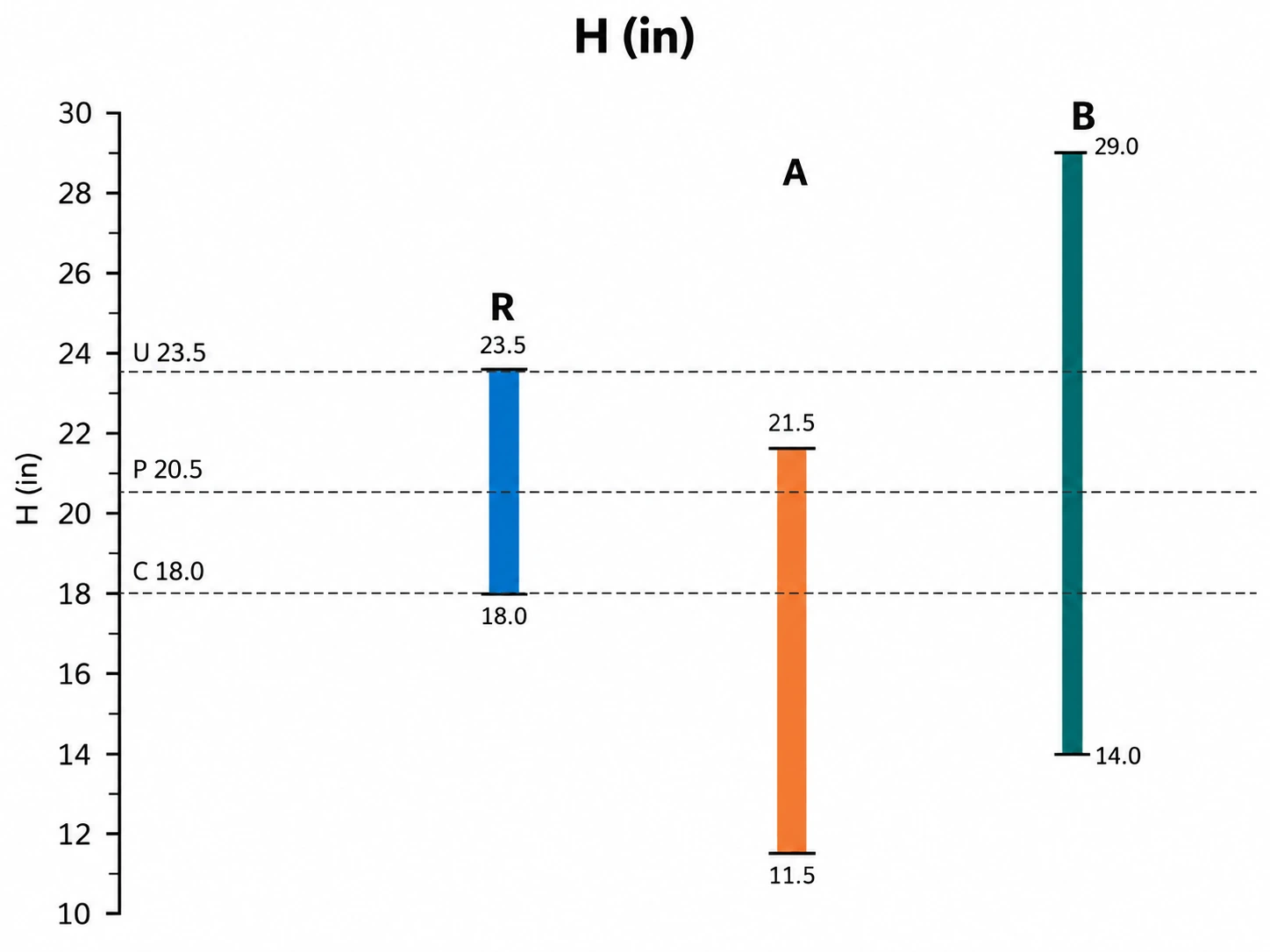
Consider a hypothetical trailer where measurements from the selected jack-mounting datum show:
- normal coupling position: 18.0 in to ground;
- parked support position: 20.5 in;
- required uncoupling position: 23.5 in;
- sufficient travel clearance must still remain after full retraction.
A candidate jack provides 10 inches of travel but has a verified working range from 11.5 to 21.5 inches using the same datum.
At first glance, 10 inches of travel seems generous because the trailer only moves 5.5 inches between its 18.0-inch coupling position and 23.5-inch uncoupling requirement.
But the jack still fails.
Its maximum working height is 21.5 inches.
The problem is not insufficient travel in isolation. The problem is that the entire travel window is positioned too low.
Now consider another candidate with the same mounting architecture whose drawing confirms a 14.0- to 29.0-inch usable range.
The trailer's 18.0-, 20.5- and 23.5-inch operating positions all fall inside that range.
Subject to the remaining mounting, capacity, handle-clearance and structural checks, this candidate passes the height screening.
This example explains why subtracting two trailer heights and then shopping only by travel can produce the wrong answer.
Three Ways to Correct a Height Mismatch
When a jack cannot reach the required height, buying a longer-travel version may solve the problem.
But it is not the only possible correction.
The geometry should identify which variable actually needs to change.
Solution 1: Select a Jack With a Higher Extended Working Height
If the mounting position is fixed and the existing jack simply runs out of stroke before the coupler clears the ball, a model with a suitable higher extended endpoint may be appropriate.
The critical specification is the resulting working-height window—not merely the additional inches of travel.
For example, GOODIN currently publishes the LF931-2010 at 10 inches of travel with 11.25-inch bracket height and 21.25-inch extended height, while LF922-2015 publishes 15 inches of travel with 14.375-inch bracket height and 29.375-inch extended height. These figures illustrate materially different height geometries, although mounting compatibility and capacity still need to be checked independently.
Solution 2: Change the Mounting Position—When the Trailer Design Allows It
For OEM applications, moving the jack mounting datum can reposition the entire working window.
That may allow an existing travel specification to cover both coupling and uncoupling positions more effectively.
But this is not a cosmetic adjustment.
Mounting height affects:
- maximum reach,
- minimum deployed height,
- towing clearance,
- handle or crank clearance,
- swivel storage clearance, and
- trailer-side structural loading.
A replacement buyer should therefore not relocate or fabricate a mounting bracket merely to make an otherwise incompatible jack fit unless the trailer structure and jack attachment method are approved for that configuration.
For OEM buyers, by contrast, mounting elevation should be treated as part of jack specification from the beginning.
Solution 3: Use an Approved Adjustable Drop Leg
Some trailer jacks use a pinned drop leg to provide rapid coarse height adjustment in addition to the screw mechanism.
This is fundamentally different from simply specifying more screw travel.
For example, the Extreme Max 5001.6268 manufacturer page separates 18 inches of powered travel from 4.5 inches of manual drop-leg extension, advertising 22.5 inches in combination. These are model-specific figures, not a universal allowance. [8]
A drop leg can therefore reposition the foot closer to the ground before the screw mechanism performs the working lift.
But the buyer must verify:
- whether the jack is designed for a drop leg,
- the approved adjustment range,
- pin-hole spacing,
- required engagement,
- retracted storage geometry, and
- the manufacturer's operating procedure.
A generic aftermarket extension should not automatically be assumed compatible with a jack.
Bulldog's drop-leg instructions, for example, state that the adjustment mechanism should not be operated while the jack is carrying a load and that the pins must be fully engaged in the intended adjustment holes before use. [7]
In purchasing terms, that means drop-leg adjustment is a defined product feature, not an improvised way to make an undersized jack taller.
Reach, Ground Clearance and Swivel Storage
There is another common mistake in height selection.
A buyer discovers that the current jack does not extend far enough and chooses a physically longer jack.
The new jack reaches the hitch—but now hangs too low when retracted.
This is particularly important on:
- low utility trailers,
- trailers used on rough or unpaved roads,
- boat ramps and transitions,
- trailers with fixed vertical jacks, and
- applications where the wheel or foot remains below the frame during transport.
The same geometry creates a practical trade-off: a buyer may need a shorter retracted height to avoid striking uneven ground while still needing substantial extension when the trailer is parked. Lippert’s selection guidance treats both retracted clearance and extended reach as relevant dimensions. [6]
Therefore both ends of the height range must be approved.
Maximum reach solves only half of the problem.
Swivel Jacks Add a Second Height Geometry
For a swivel-mounted trailer jack, fully retracting the tube may not be the final towing position.
The complete jack rotates into a horizontal or near-horizontal stored orientation.
That introduces another set of checks:
- Does the jack clear the trailer frame while rotating?
- Does the wheel or foot clear nearby structure?
- Can the locking pin fully engage in both working and stored positions?
- Does the stored jack interfere with the coupler, winch, toolbox or other tongue hardware?
GOODIN's LF932-2015, for example, combines a published 15-inch travel specification with a swivel bracket and spring-loaded locking-pin structure. Its height range must work vertically, while the complete assembly must also have room to rotate into its stored position.
For this type of product, “working height” and “storage clearance” should appear as separate lines in the purchasing specification.
Let the Drawing Control Product Approval
Catalog pages are useful for narrowing options.
The final approval should come from a model-specific drawing.
That drawing should establish at least:
- the exact mounting datum;
- retracted geometry;
- extended geometry;
- screw travel;
- foot or wheel dimensions;
- drop-leg range, if applicable;
- mounting dimensions;
- crank or handle envelope where relevant; and
- stored geometry for swivel designs.
This is especially important when two suppliers use similar specification labels but measure them differently.
Do not convert a manufacturer's “bracket height” into “retracted height” unless the drawing confirms that they describe the same dimension.
Do not assume that:
Travel + a catalog bracket number = actual installed maximum height
unless both values use compatible reference points.
And do not transfer dimensions from a visually similar jack to another model.
GOODIN Product Examples: Travel Is Only One Part of the Geometry
The following GOODIN models illustrate why the three height fields should be reviewed together.
| Model | Published Travel | Published Bracket Height | Published Extended Height |
|---|---|---|---|
| LF931-2010 | 10 in | 11.25 in | 21.25 in |
| LF961-1010L | 10 in | 13 in | 23 in |
| LF922-2015 | 15 in | 14.375 in | 29.375 in |
| LF932-2015 | 15 in | 14.4 in | 29.4 in |
| LF971-701513 | 15 in | 13 in | 28 in |
GOODIN publishes these dimensions on the corresponding current product pages. [1][2][3][4][5]
The table should not be read as a ranking.
It demonstrates that knowing the travel figure still leaves an essential question unanswered:
Where does that travel sit relative to the trailer?
Capacity, mounting architecture, foot or wheel configuration, handle clearance and other requirements still need independent approval before one model can replace another.
Specify the Complete Height Window
For a production trailer or bulk purchasing program, “2,000 lb jack, 15 in travel” is not a complete specification.
A more useful RFQ should identify:
Trailer-side information
- trailer type or platform;
- jack installation location;
- mounting drawing or frame dimensions;
- mounting-datum height in the normal coupling position;
- maximum mounting-datum height required for uncoupling;
- intended parked support height;
- minimum towing ground-clearance requirement;
- surrounding handle and storage envelope.
Jack information to confirm
- manufacturer's exact height datum;
- travel;
- retracted or minimum working height;
- extended or maximum working height;
- bracket height and its definition;
- drop-leg adjustment, if used;
- foot or wheel geometry;
- swivel storage position, if applicable;
- mounting interface and dimensions.
This gives the supplier enough information to confirm the actual geometry instead of selecting a model from capacity and travel alone.
GOODIN View: Specify a Height Window, Not Just a Travel Number
The most useful way to specify trailer-jack height is as a working window.
A buyer should be able to state:
At this mounting reference, the jack must operate from the trailer's lowest required coupling position through the maximum uncoupling and parked-support position, then retract or stow with adequate towing clearance.
Travel becomes one parameter used to achieve that requirement.
It is not the requirement itself.
If the current jack does not reach the hitch, the correct solution may be:
- a higher extended working height,
- a different retracted-to-extended geometry,
- an OEM-approved mounting-position change, or
- a manufacturer-approved adjustable drop-leg configuration.
The correct answer depends on where the trailer's required height window sits relative to the jack's actual dimensional envelope.
That is why a 15-inch-travel jack can still be too short—and why another jack with similar travel may work perfectly.
Final Selection Checklist
Before approving a trailer jack for height compatibility, confirm:
- What exact trailer-side datum is being measured?
- How high must the coupler rise to clear the actual hitch?
- What height is required when the trailer is parked?
- What is the lowest deployed position required for normal coupling?
- What towing clearance is required after the jack is fully retracted or swiveled?
- What datum does the product drawing use for bracket, retracted and extended heights?
- Does the full required working window fall inside the jack's usable range?
- Is any additional height provided by an approved drop leg, and is its adjustment specified separately from screw travel?
- Does the final mounting position preserve crank, swivel and surrounding-component clearance?
Only after those questions are answered does the travel number become meaningful.
For trailer jack selection, the objective is not to buy the jack with the most inches of travel.
It is to buy the jack whose installed geometry matches the trailer from hitching through storage and towing.
Sources & Further Reading
Published model dimensions are catalog examples, not interchangeable-product approvals. Confirm the current drawing, measurement datum and operating instructions.
- GOODIN — LF931-2010 — 2,000 lb Utility Trailer Jack
- GOODIN — LF961-1010L — 1,000 lb Single-Wheel Trailer Jack
- GOODIN — LF922-2015 — 2,000 lb Sidewind Trailer Jack, 15 in Travel
- GOODIN — LF932-2015 — 2,000 lb Sidewind Swivel Trailer Jack
- GOODIN — LF971-701513 — 8,000 lb Sidewind Square Trailer Jack
- Lippert — The Ultimate Guide to Trailer Jack Replacement
- Bulldog — Drop Leg Operation — N182815
- Extreme Max — 5001.6268 Power Electric Tongue Jack
Trailer Tongue Tool Box Sizing: How to Find a Box That Fits Without Compromising the Trailer
Replacing a Boat Trailer Winch: How to Match the Mount, Bow Eye and Pulling Angle
Related Article