Trailer Tongue Tool Box Sizing: How to Find a Box That Fits Without Compromising the Trailer
In this guide
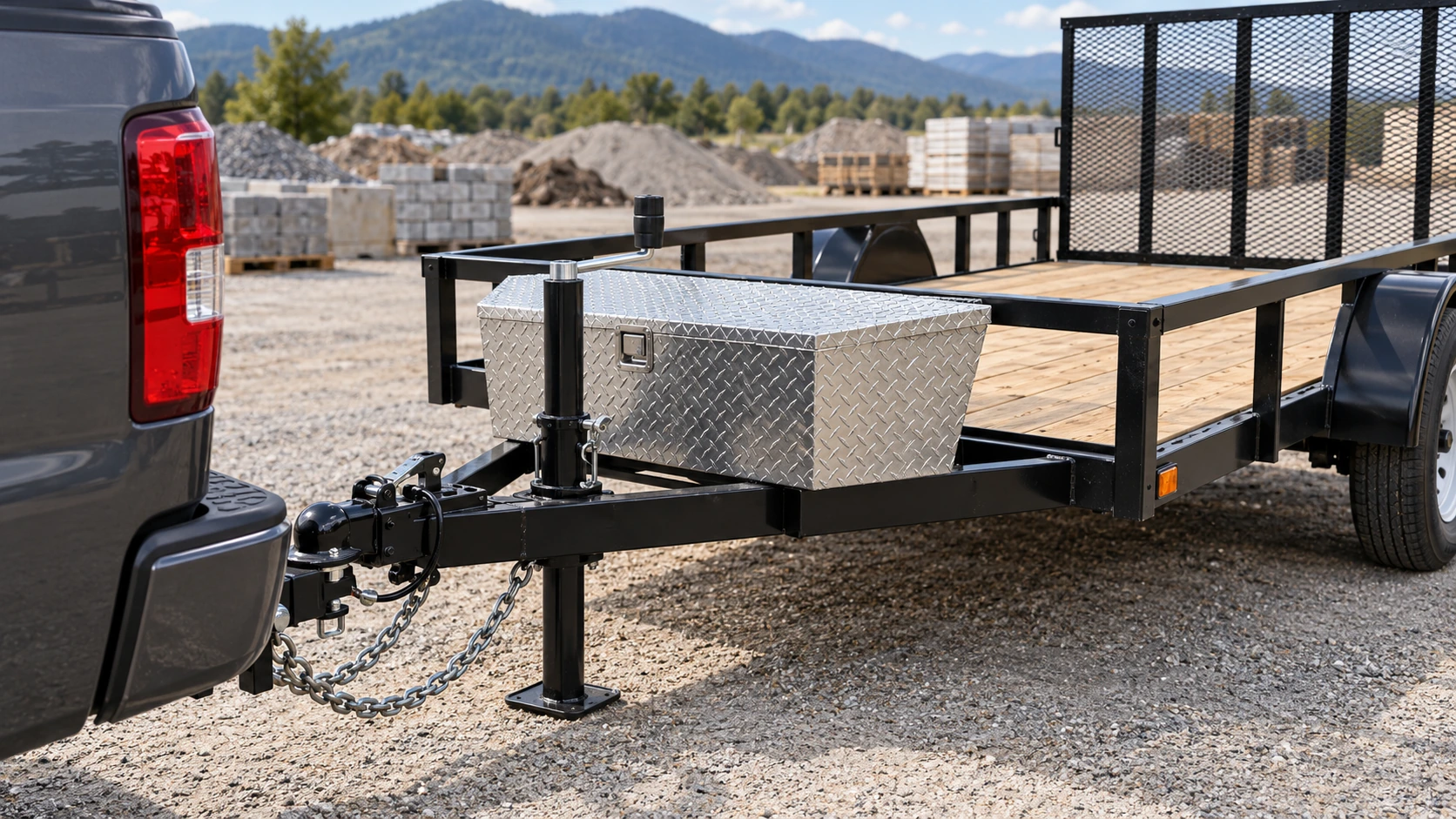
A 5 × 10 ft utility trailer seems to have plenty of room for a small toolbox.
The owner wants somewhere to keep tie-down straps, wheel chocks, hand tools and other equipment without using the trailer bed. A tapered tongue box looks like an obvious solution.
But what size should they buy?
In a 2026 r/towing discussion about a 5 × 10 utility trailer [2], one owner faced exactly this purchasing decision. They wanted to spend around $200, preferred a lockable, water-resistant box and were uncertain which construction and product would provide adequate quality.
The discussion also raises another issue: openings associated with wiring or box construction can leave an unwanted entry path for debris or small animals. That is a user-reported concern, not a verified ingress-protection test.
A separate towing discussion [3] exposed a more serious compatibility problem.
On a 5 × 10 dump trailer, the tongue toolbox extended far enough forward to interfere with the mounting position required for a weight-distribution hitch. The box occupied space that the hitch system also needed.
These are different problems, but they point to the same buying mistake.
The buyer selected a storage box without verifying the complete installation envelope.
A toolbox can be narrow enough to fit on the tongue but too large for the jack handle. It can clear the trailer frame while preventing its lid from opening. It can have a suitable external shape but inadequate mounting support.
And once filled with tools, it can change the trailer's loaded tongue weight.
For Product Selection, the useful question is therefore not:
"What is the largest toolbox that fits on my trailer tongue?"
It is:
"What toolbox dimensions, mounting arrangement and loaded storage capacity can this trailer safely accommodate without interfering with its existing equipment?"
That is the specification worth determining before purchase.
Selection guidance, not installation approval. Confirm the actual trailer geometry, approved supports and loaded condition; do not infer GDA006 fit or contents capacity from its exterior dimensions.
Trailer Bed Size Is Not the Toolbox Specification
A buyer may describe a trailer as:
- 5 × 8 ft utility trailer;
- 5 × 10 ft utility trailer;
- 6 × 12 ft cargo trailer.
Those dimensions describe the general trailer size.
They do not establish the usable area in front of the trailer bed.
Two 5 × 10 ft trailers may have very different:
- A-frame lengths;
- frame-rail angles;
- coupler positions;
- jack mounting locations;
- tongue crossmembers;
- accessory layouts;
- winch or spare-wheel arrangements.
One may have a relatively long open A-frame with a convenient crossmember.
Another may have only a short space between the coupler and trailer body, already occupied by a central jack and wiring.
That makes trailer length a poor substitute for measuring the tongue itself.
The toolbox should be selected from the actual tongue geometry, not from the trailer's advertised bed dimensions.
Measure the A-Frame and the Actual Box Footprint
The first job is to understand the space where the toolbox will sit.
Most tapered trailer tongue boxes are intended to work with the converging rails of an A-frame.
However, not every A-frame uses the same angle, rail spacing or construction.
The shape of the toolbox must be compared with the shape of the trailer at the proposed installation position.
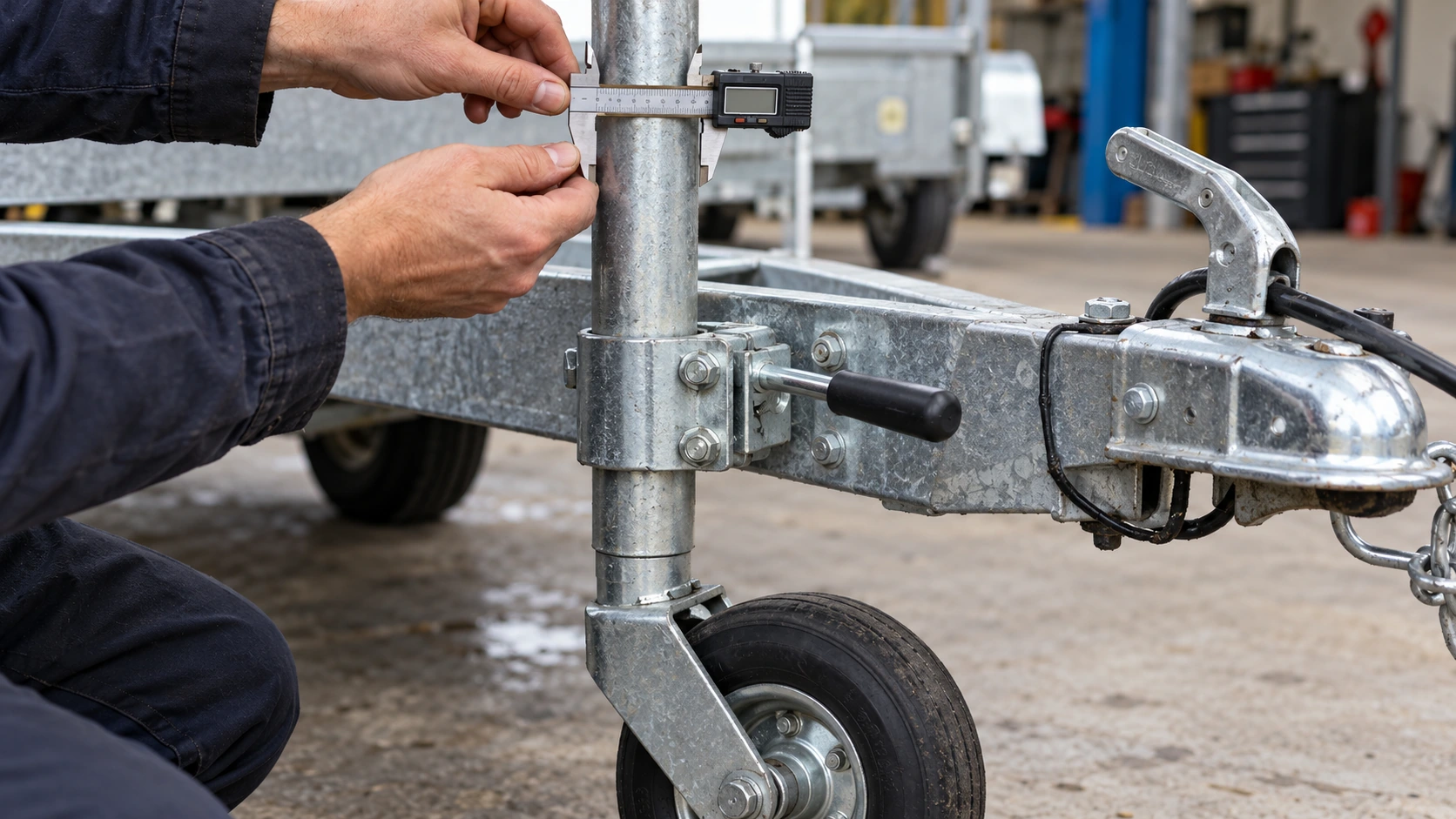
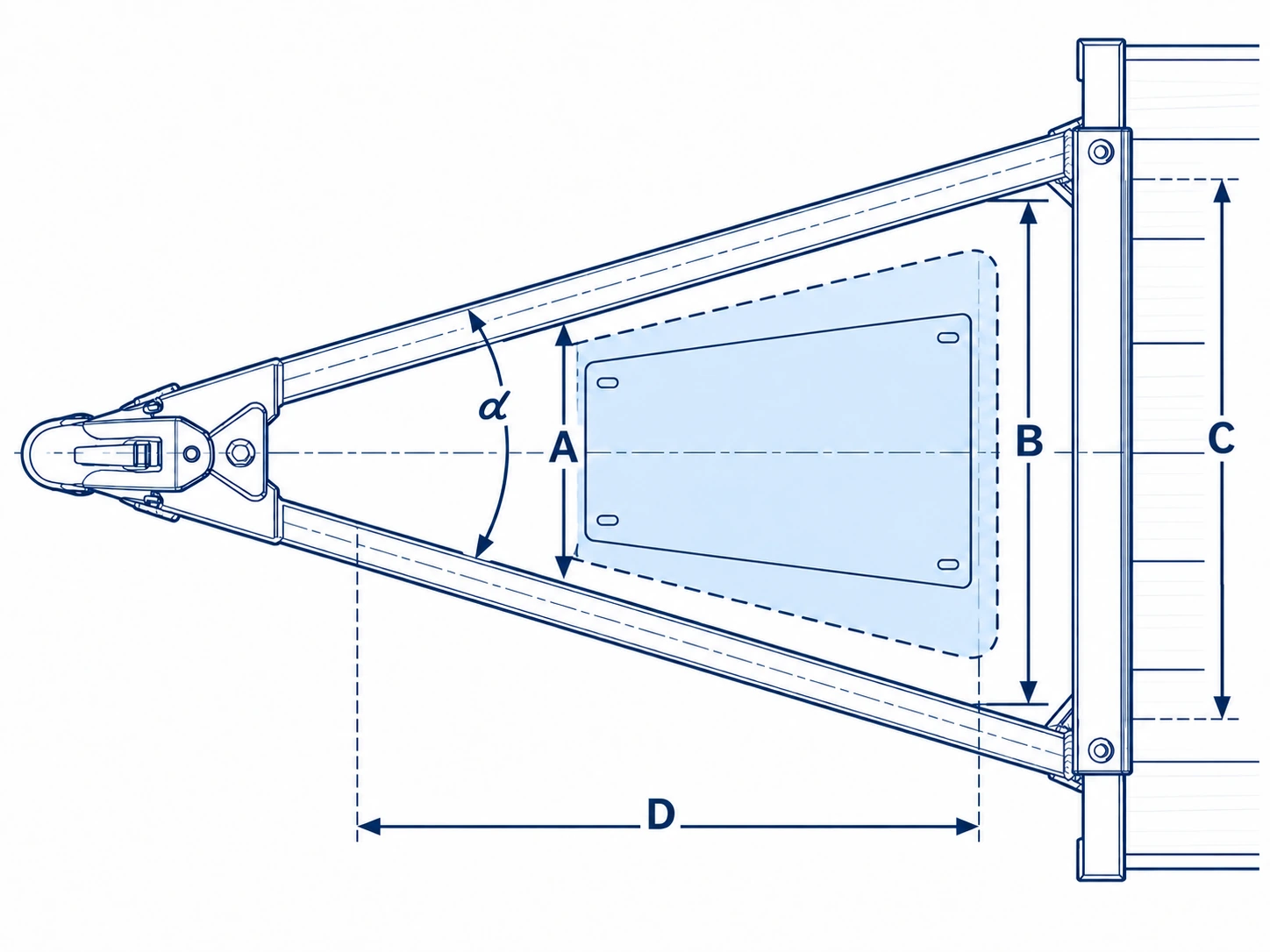
Measure the Rail Spacing at Two Positions
An A-frame becomes narrower as the rails approach the coupler.
Therefore, a single width measurement is not enough.
Identify the proposed front and rear positions of the toolbox.
Then measure:
A — Front rail spacing
The distance between the A-frame rails at the proposed front mounting position.
B — Rear rail spacing
The distance between the rails at the proposed rear mounting position.
C — Frame-rail outside dimensions
The outside-to-outside distance at both locations, including the actual rail section width.
Why measure both inside and outside spacing?
Because a tongue toolbox does not necessarily sit entirely between the rails.
Some boxes are designed to rest on or span the upper surfaces of the A-frame members. Others require mounting brackets or crossmembers.
Measuring only the empty gap between the rails can therefore misrepresent the available mounting area.
The correct comparison depends on the intended attachment arrangement.
Check the A-Frame Angle
Next, determine how quickly the rails converge.
Two trailers can have the same rear rail spacing but different convergence angles.
A tapered toolbox may fit one while leaving an unsuitable mounting relationship on the other.
The relevant information includes:
- A-frame included angle;
- front and rear rail spacing;
- longitudinal distance between those measurements;
- toolbox front and rear widths;
- toolbox side-wall taper.
The product drawing should provide enough dimensions to compare its footprint with the actual frame layout.
If the drawing only provides maximum length, width and height, additional dimensions may still be necessary.
Maximum Exterior Dimensions Are Not the Mounting Footprint
This is one of the most important distinctions in trailer toolbox selection.
A product might be listed as:
830 × 490 × 460 mm
Those numbers describe its maximum external envelope.
They do not necessarily describe the dimensions of the surface that actually contacts the trailer.
A tapered box may have:
- a wider rear face;
- a narrower front face;
- sloping side walls;
- a bottom panel smaller than the top;
- lid overhang beyond the body;
- mounting points set inward from the outside edges.
As a result, maximum dimensions do not tell the buyer exactly how the box will sit on the A-frame.
GOODIN GDA006: A Real Example
GOODIN's GDA006 Trailer Tongue Tool Box [1] provides a useful example.
Its published specifications include:
| Published specification | GDA006 |
|---|---|
| Maximum exterior dimensions | 830 × 490 × 460 mm |
| Approximate maximum width | 32.7 in |
| Empty net weight | 9.15 kg |
| General configuration | Tapered trailer tongue box |
| Lid | Top-opening, gas-strut supported |
| Closure | Recessed lockable paddle latch |
| Surface treatment | Plain |
The product photographs confirm that the body is tapered rather than a simple rectangular chest.
That makes it a relevant candidate for a trailer-tongue installation.
But the published dimensions alone cannot answer three critical questions:
- What are the exact front and rear widths at the intended mounting level?
- What area of the box bottom can be supported or attached?
- Which mounting arrangement is approved for the box and trailer?
Those measurements need to come from the model-specific drawing and installation requirements.
For a replacement or OEM order, 830 mm maximum width is a screening dimension, not proof of A-frame compatibility.
The same principle applies to other manufacturers' tongue boxes.
Measure the Available Tongue Length
Width is only one part of the fit.
The toolbox also needs sufficient longitudinal space between the coupler and the trailer body.
Measure:
D — Available longitudinal installation length
This is the usable fore-aft distance after accounting for existing components and their required clearances.
Do not measure from the very tip of the coupler to the front wall of the trailer and assume the whole distance is available.
Parts of that space may already be needed for:
- coupler operation;
- safety-chain movement;
- jack mounting;
- electrical connector storage;
- breakaway equipment;
- weight-distribution hardware;
- toolbox attachment brackets.
On some trailers, the rear of the available installation zone may also be limited by a spare tire, front gate, winch post or cargo-bed structure.
The box must fit inside the usable zone, not merely inside the overall tongue length.
Box Position Changes the Fit
Moving a tapered box rearward usually places it in a wider part of the A-frame.
Moving it forward places it closer to the narrower part.
However, moving it rearward can create interference with the trailer body, while moving it forward can reduce jack and tow-vehicle clearance.
This means the buyer should not compare one toolbox with one mounting position.
Instead, identify the range of permitted positions and determine where the box could actually be mounted.
If only one position is structurally suitable, that becomes a fixed selection constraint.
Preserve Jack Operation and Lid Access
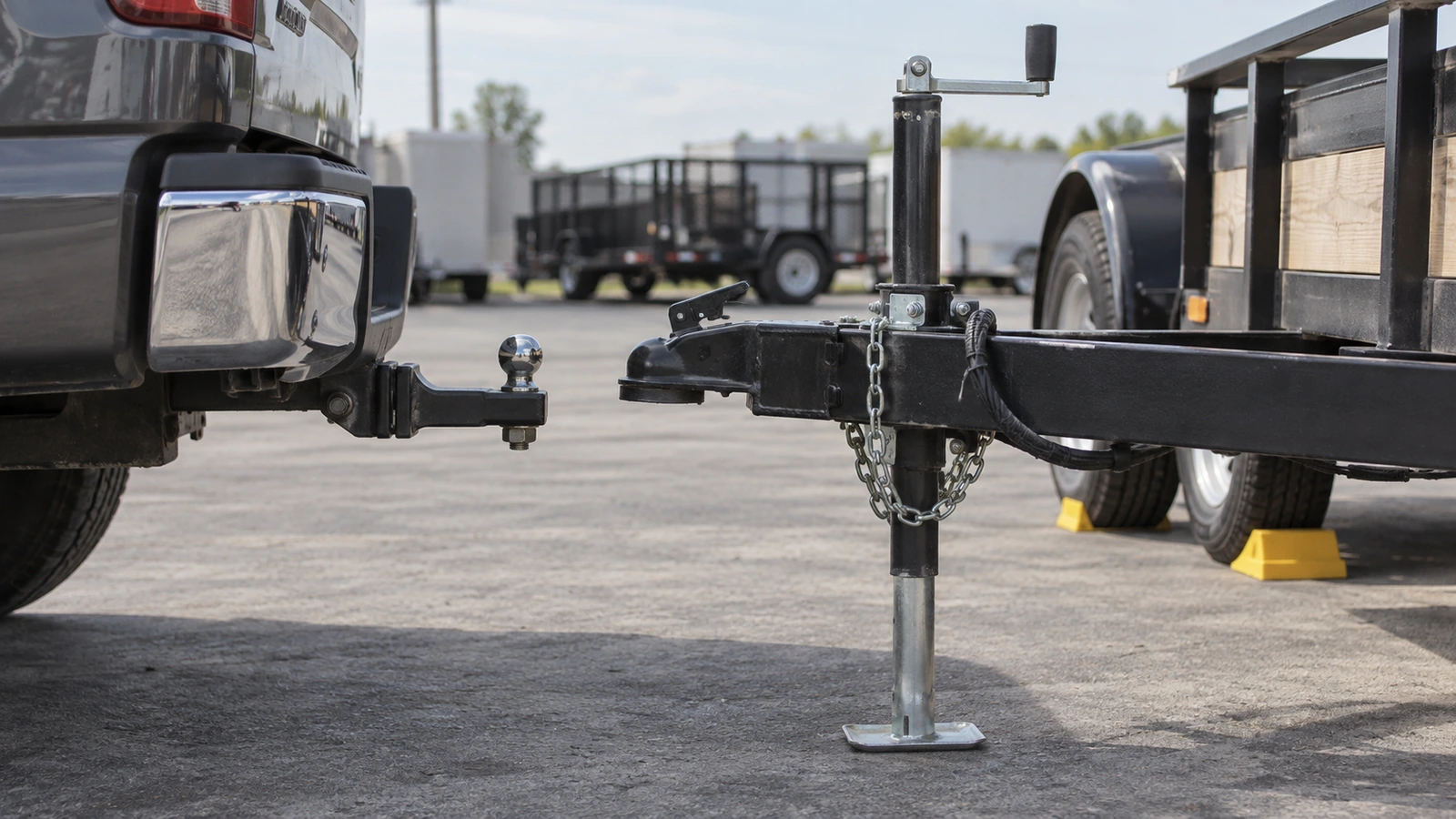
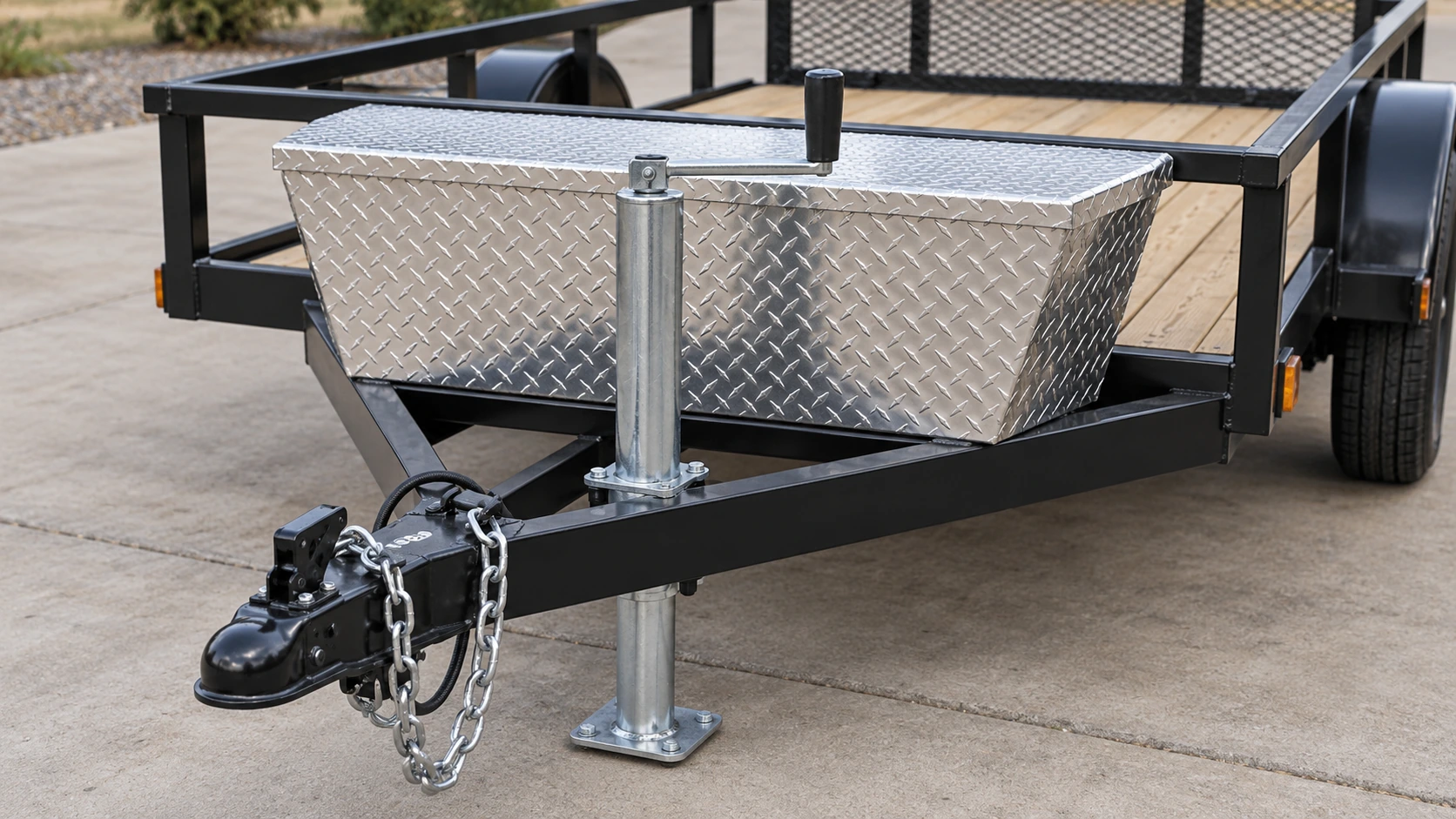
A trailer jack is often the component most likely to interfere with tongue storage.
But the relevant space is not simply the outside diameter of the jack tube.
The complete jack assembly occupies a larger operating envelope.
Fixed A-Frame Jack
A fixed central jack may extend vertically through the middle of the available space.
If its handle is top-mounted, it needs enough clearance to rotate.
A toolbox positioned close behind the jack may interfere with:
- handle rotation;
- operator hand access;
- jack removal;
- maintenance access.
A box that clears the jack tube by a few millimeters is not necessarily compatible.
Sidewind Jack
For a sidewind jack, the crank operates laterally.
Its rotating handle may approach the front wall or corner of the toolbox.
Measure the full handle sweep rather than only the shaft position.
Swivel Jack
A swivel jack has two different space requirements:
- The deployed operating position.
- The rotation and storage position.
The body, wheel or foot must be able to move into the manufacturer's intended stored orientation and lock correctly.
A toolbox can clear the jack when vertical yet block its rotation.
This is why the jack configuration must be recorded before selecting the box.
| Jack configuration | Toolbox clearance to verify |
|---|---|
| Central topwind A-frame | Jack body, top handle sweep, hand access |
| Sidewind fixed jack | Lateral crank arc and operating access |
| Side-mount swivel jack | Deployed position, full swivel path, stored position and lock access |
| Removable jack arrangement | Approved removal path and remaining mounting-hardware clearance |
Do not treat replacing or moving the jack as an automatic solution to a toolbox fit problem.
Any proposed jack relocation must separately satisfy the trailer and component manufacturers' mounting requirements.
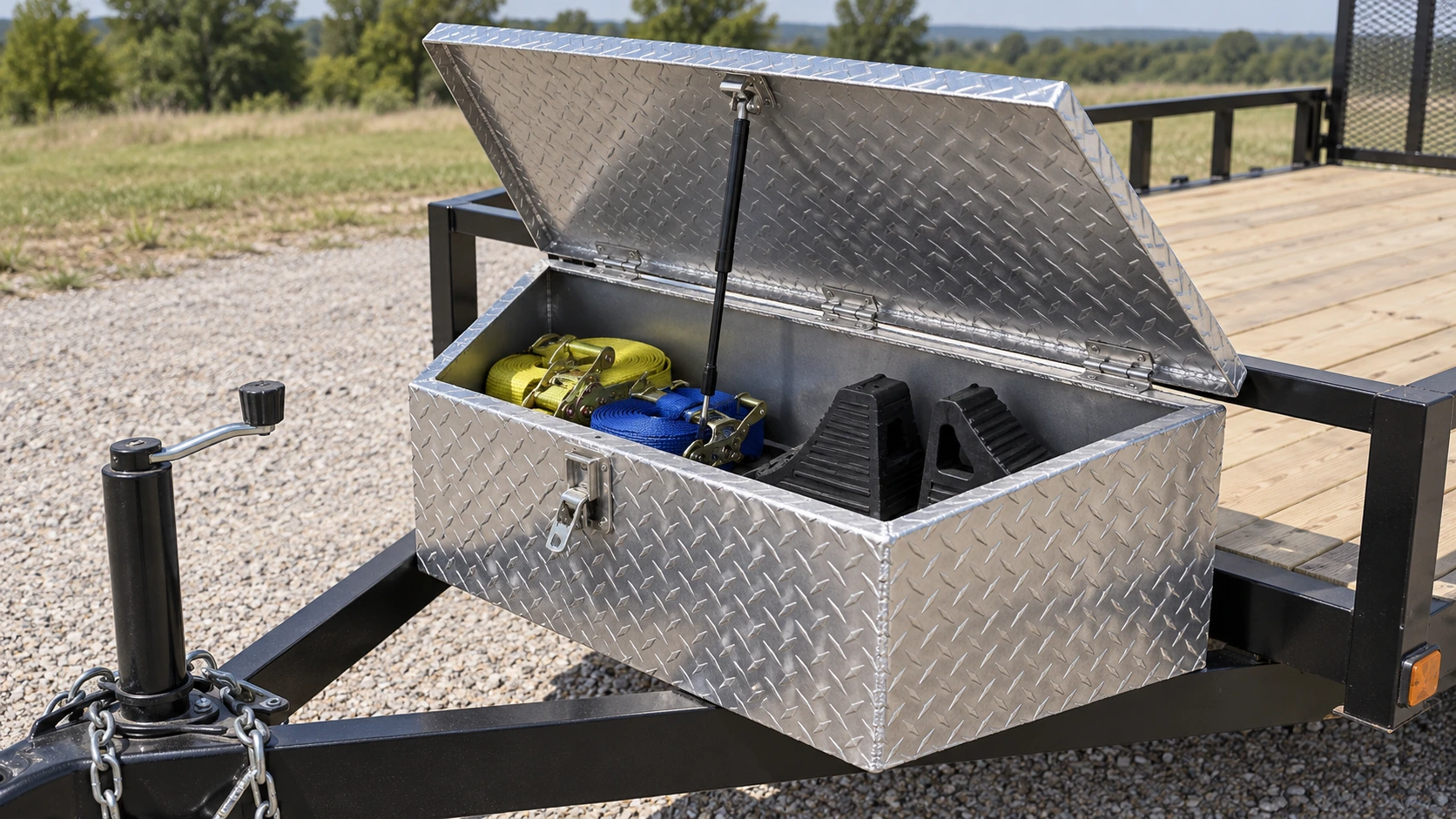
The Toolbox Lid Needs More Space Than the Closed Box
The next mistake is measuring the toolbox only when closed.
A box can physically fit on the A-frame and still be almost impossible to use.
Consider a top-opening toolbox installed immediately in front of a trailer bulkhead.
The closed lid may clear the bulkhead.
But when opened, its rear edge or hinge mechanism may move into the bulkhead's space.
The same problem can occur with:
- spare tires;
- front-mounted racks;
- jack handles;
- battery equipment;
- other trailer accessories.
GOODIN's GDA006 has a top-opening lid supported by a gas strut.
Its published 460 mm closed-product height does not establish the clearance required for the open lid.
Before purchase, confirm:
E — Closed-box height
The total height of the installed box in its normal closed condition.
F — Open-lid envelope
The maximum height and rearward/forward movement of the lid during opening.
G — Operating access
Space required for the user to open the lid, reach the stored equipment and operate the latch.
The approved opening angle and lid path should come from the manufacturer's drawing, a physical sample or a verified installation mock-up.
Do not assume all tongue boxes open through the same angle.
Check the Lock and Latch Access
A recessed latch reduces how far hardware protrudes from the box face.
It does not guarantee accessibility.
For example, placing the box too close to a central jack may make it difficult to:
- insert the key;
- operate the latch;
- lift the lid.
This is especially important when the buyer expects to access the box while the trailer remains connected to the tow vehicle.
A toolbox that cannot be opened in its normal operating position has failed the storage requirement, even if it fits the frame.
Protect Turning Clearance and Hitch Equipment
The trailer tongue is not stationary relative to the tow vehicle.
During a turn, the truck and trailer rotate around the hitch connection.
The rear corners of the tow vehicle move relative to the tongue, and a toolbox placed close to the coupler can enter the vehicle's turning envelope.
This risk depends on:
- distance from hitch ball to toolbox;
- maximum toolbox width;
- toolbox corner shape;
- tow-vehicle rear overhang;
- tailgate configuration;
- hitch extension or other approved hitch components;
- intended articulation range.
A tapered box can remove corner volume compared with a rectangular box of similar maximum width.
But that does not establish a universal turning-clearance advantage or guarantee compatibility with a particular tow vehicle.
Measure the Closest Approach
For the intended truck-and-trailer combination, determine the clearance between the toolbox and the tow vehicle across the expected articulation range.
A straight-line measurement with the trailer directly behind the truck is insufficient.
The relevant situation may occur during:
- tight forward turns;
- reversing;
- driveway maneuvers;
- parking;
- low-speed articulation on uneven ground.
For OEM projects, this can be evaluated from the hitch geometry and dimensional drawings.
For an existing trailer, an appropriate physical clearance assessment can help identify the limiting components, but the vehicle should not be deliberately driven into an unverified extreme articulation condition simply to discover the collision point.
If the box interferes with the tow vehicle during required maneuvers, reject that position or configuration.
Do not assume the driver can always avoid the interference by turning less sharply.
Do Not Block Hitch or Safety Equipment
The toolbox must also coexist with the towing equipment already installed on the tongue.
A particularly important example is the weight-distribution hitch.
In the r/towing discussion [3], the owner's existing tongue box occupied space needed for the hitch's frame brackets.
The installation problem was not that the toolbox failed to fit the A-frame.
It was that the toolbox and hitch system competed for the same frame area.
This distinction has an important purchasing implication.
Before specifying the box, identify any components that require a defined position along the frame rails.
These may include:
- weight-distribution brackets;
- sway-control equipment;
- jack brackets;
- breakaway-switch mounting;
- safety-chain connections;
- electrical and brake wiring;
- other manufacturer-specified hitch components.
Some of these positions are controlled by the equipment manufacturer's installation instructions.
They should not be moved simply to make a toolbox fit.
Do not cut, drill or reposition rated towing hardware without the relevant manufacturer's approval.
For toolbox selection, these areas should be marked as reserved installation zones before comparing candidate dimensions.
Verify Mounting Support Before Installation
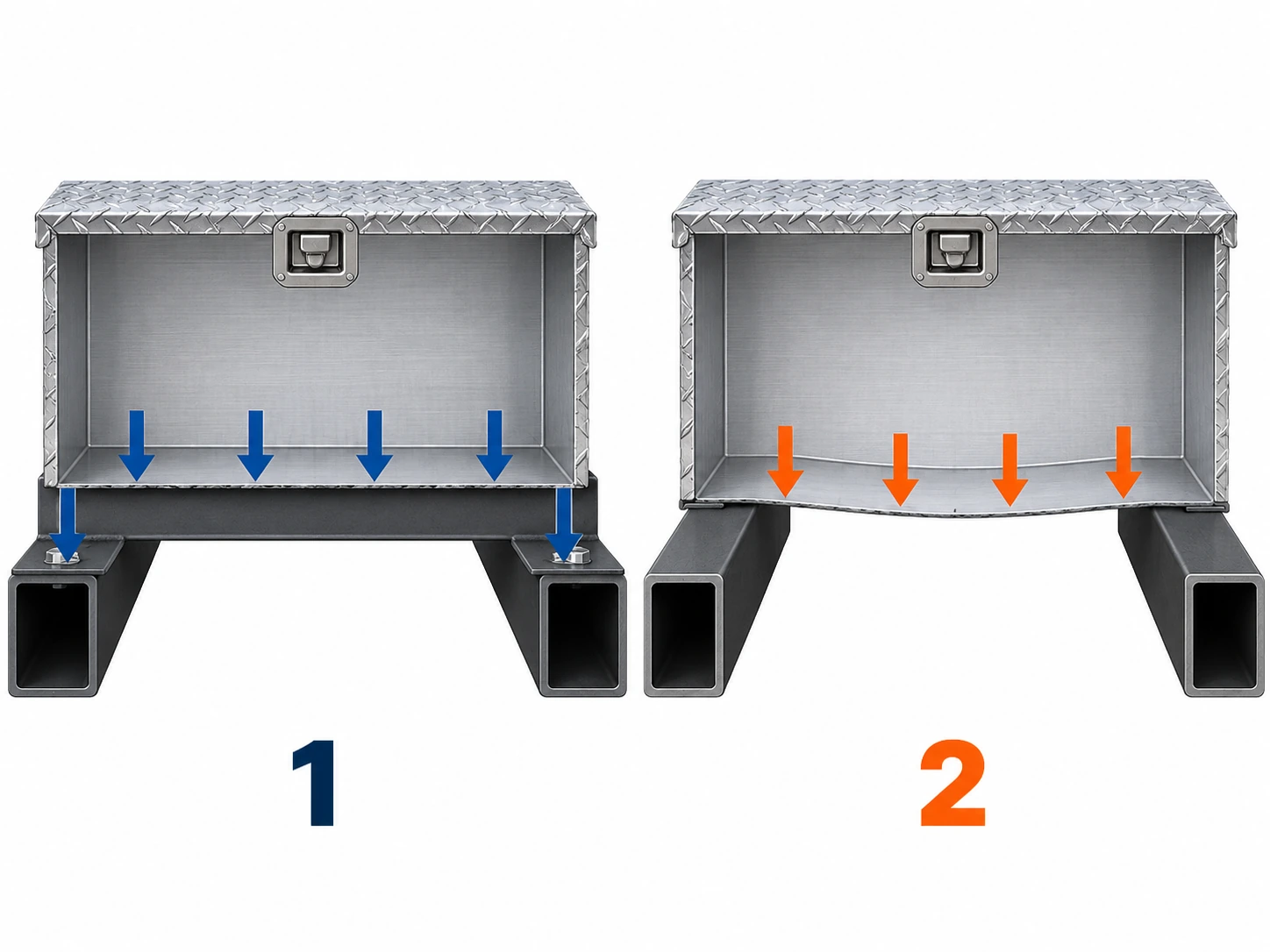
So far, the selection process has focused on geometric fit.
A toolbox may pass every clearance test and still be unsuitable for installation.
The reason is simple:
Available space is not the same as an approved mounting structure.
An A-frame has two main members that converge toward the coupler.
Depending on the trailer design, there may or may not be a suitable crossmember or support platform at the planned toolbox position.
A box may visually bridge the rails while having little or no approved support beneath its intended attachment areas.
Why Bottom Support Matters
The toolbox has to carry more than its empty weight.
When filled, the load is transferred through the box bottom, mounting hardware and supporting structure.
The attachment also has to resist movement during travel.
A mounting system should therefore account for:
- the expected loaded box mass;
- supported bottom area;
- attachment-point locations;
- local loading of the toolbox floor;
- frame and bracket strength;
- movement and vibration;
- clearance for fasteners and reinforcement.
A large aluminum box is not automatically capable of spanning a wide unsupported gap simply because its outer walls are rigid.
Likewise, a mounting arrangement that works for a lightly loaded accessory may be unsuitable for a toolbox filled with heavy steel tools.
Can You Use U-Bolts?
Some trailer toolbox systems use U-bolts or clamp-type mounting arrangements.
Others use manufacturer-specified screws, bolts or supporting brackets.
The correct method depends on the box, frame profile and approved installation design.
In a r/Tools trailer-toolbox mounting discussion [4], an owner questioned whether drilling the tongue frame could weaken it. Other users proposed U-bolts and backing plates as possible alternatives.
Those suggestions show a common installation concern, but they are not engineering approval for a particular trailer. Do not copy forum recommendations for salvaged fasteners, welding or unapproved frame alterations.
A clamp-type mounting system still requires verification of:
- frame-section compatibility;
- clamp size;
- local crushing or deformation;
- support-plate geometry;
- fastener specification;
- expected load;
- required retention.
The presence of a U-bolt does not automatically make an installation structurally suitable.
What About Drilling the Frame?
This is where generic installation advice can be misleading.
Some toolbox installation manuals explicitly describe drilled mounting arrangements.
For example, etrailer's A-frame toolbox installation instructions [5] for designated models explain a multi-point attachment method and recommend having a qualified technician perform the installation.
That instruction applies to the products and applications covered by that manual.
It does not authorize drilling any trailer frame at any chosen location.
An unrelated trailer may use a different frame section, manufacturing method or structural design.
Therefore:
Do not assume that drilling is either universally acceptable or universally prohibited. Verify the specific frame and approved attachment method.
If suitable attachment requires new holes, welding or structural modifications, obtain the relevant manufacturer's approval or appropriate qualified evaluation.
For OEM buyers, the better approach is to define the toolbox mounting structure during the trailer-design stage.
Match Internal Storage and Loaded Tongue Weight
Exterior fit is not the same as usable storage.
A tapered toolbox may provide a wide rear section while narrowing toward the coupler.
That shape affects what can be stored inside.
For example, a buyer might want to carry:
- long recovery straps;
- wheel chocks;
- a portable jack;
- a tool case;
- small spare parts.
The question is not simply whether the box has enough total volume.
It is whether the particular items can pass through the lid opening and fit within the usable internal geometry.
Measure the Largest Item First
Identify the largest or most awkward item that will be stored.
Record its:
- length;
- width;
- height;
- expected orientation.
Then compare those dimensions with:
H — Internal rear width
I — Internal front width
J — Internal depth
K — Internal usable height
L — Clear lid-opening dimensions
The internal dimensions must account for obstructions such as:
- gas struts;
- hinges;
- latch mechanisms;
- reinforcement;
- mounting fasteners.
A large volume figure does not guarantee that a rectangular tool case will fit in a tapered enclosure.
A narrow lid opening can also prevent a large item from entering even when the internal volume is sufficient.
GOODIN GDA006 Internal Dimensions
GOODIN currently publishes GDA006's maximum external size but does not provide a complete internal dimensional drawing or a published maximum storage-load rating on the product page.
Therefore, an OEM buyer should request:
- clear internal dimensions;
- front and rear internal widths;
- minimum internal height;
- lid-opening clearance;
- internal obstructions;
- permitted contents/load rating.
These should be confirmed before selecting the box for a specific equipment inventory.
Do not estimate usable capacity from the outside envelope alone.
The Loaded Box Changes Tongue Weight
A toolbox does more than occupy space.
It adds weight at a specific position on the trailer.
And because tongue boxes are generally installed ahead of the trailer's axle group, their mass affects the trailer's weight distribution.
GOODIN publishes an empty net weight of 9.15 kg for GDA006.
That is only the starting point.
The installed system also includes:
- brackets;
- fasteners;
- internal accessories;
- stored tools;
- other contents.
Suppose the owner intends to store heavy ratchet straps, sockets, tow chains and equipment in the box.
The loaded mass could be considerably greater than the empty box mass.
The actual effect on the hitch depends on the loaded mass and its position relative to the trailer axle group.
It should not be assumed that every kilogram placed in the box adds exactly one kilogram to the hitch.
Check Loaded Tongue Weight
CURT's official tongue-weight measurement guide [7] explains that tongue weight changes with cargo position relative to the trailer axle.
Its towing guidance describes measuring the actual downward force at the coupling point rather than relying only on estimates.
For conventional bumper-pull trailers, a tongue-weight range around 10–15% of loaded trailer weight is commonly used as general guidance, but the appropriate requirement must follow the specific trailer, tow vehicle and hitch manufacturer's instructions.
The important toolbox-selection requirement is:
Measure or verify the trailer's loaded tongue weight after including the toolbox and expected contents.
Also check the applicable:
- trailer GVWR;
- axle and tire ratings;
- remaining payload;
- hitch tongue-weight rating;
- tow-vehicle limits;
- tongue structure and toolbox mounting limits.
Every applicable rating must be satisfied. Compare like-for-like limits; GVWR, axle capacity, hitch tongue load and box contents capacity are not interchangeable ratings.
Storage Capacity and Weight Capacity Are Different
A toolbox may have enough internal volume for everything the buyer wants to carry.
That does not establish that its floor and mounting system can support the resulting mass.
A box intended for lightweight tie-downs may not be suitable for a concentrated load of heavy hardware unless the manufacturer provides an adequate storage-load specification.
For GDA006, a maximum contents rating should be confirmed rather than inferred from its aluminum construction or external size.
Work Through the Fit Example and Purchasing Worksheet
Consider a hypothetical 5 × 10 ft utility trailer.
The owner wants a tongue toolbox for:
- tie-down straps;
- wheel chocks;
- a small tool kit;
- spare towing accessories.
The trailer has a central A-frame jack and a limited space between the coupler and bed.
The buyer finds GDA006, with its published external envelope of 830 × 490 × 460 mm.
At first glance, it appears to be a reasonable candidate.
But the correct screening process looks like this:
| Selection step | What the buyer finds | Decision |
|---|---|---|
| Overall space | Maximum 830 mm box width appears compatible with available tongue area | Continue; not yet approved |
| A-frame taper | Actual front and rear box-footprint widths are not yet available | Request drawing |
| Mounting base | Frame has two converging rails but no confirmed attachment arrangement | Mounting approval required |
| Jack clearance | Central jack sits close to proposed front box position | Measure full crank envelope |
| Lid access | Trailer bulkhead is close behind the planned box | Confirm open-lid sweep |
| Turning clearance | Truck rear corners approach tongue during sharp turns | Check articulation envelope |
| Storage space | Largest tool case has not been compared with internal dimensions | Request usable interior dimensions |
| Loaded weight | Box weight known; tool weight not yet established | Define load and check tongue weight |
The product is not rejected.
But it is not approved either.
The missing information is exactly what should be resolved before placing an order.
When a Smaller Box Is the Better Choice
If a box cannot clear the jack, coupler or turning envelope while using an approved mounting position, selecting a smaller or differently shaped box may be the correct decision.
More storage volume is not automatically beneficial.
A smaller box that preserves the trailer's existing functions is better matched to the application than a larger box that forces compromises in essential towing equipment.
When a Different Mounting Position Works
Sometimes the box itself is dimensionally suitable, but its proposed position is not.
If the trailer has another manufacturer-approved mounting location that provides adequate support and clearance, repositioning the box may solve the problem.
But repositioning changes the geometry and potentially the load distribution, so the full screening process must be repeated.
When the Trailer Needs a Different Mounting Structure
If the box only fits by spanning an unsupported area or relying on an unapproved modification, the problem is no longer basic toolbox sizing.
The buyer should obtain an approved bracket or mounting solution, choose another product configuration or have the installation evaluated by qualified personnel.
Do not turn a storage purchase into an improvised structural modification.
Trailer Tongue Toolbox Sizing and Compatibility Table
The following table can be used as the main purchasing worksheet.
| Dimension or requirement | What to measure on the trailer | What to obtain from the toolbox supplier | Reject or reassess if… |
|---|---|---|---|
| A-frame front spacing | Rail spacing at proposed front box position | Front box footprint width | Box cannot occupy approved mounting zone |
| A-frame rear spacing | Rail spacing at proposed rear box position | Rear box footprint width | Footprint incompatible with rail geometry |
| Rail angle | Actual A-frame included angle | Box taper and mounting geometry | Taper prevents correct positioning or support |
| Longitudinal space | Usable coupler-to-body installation zone | External depth and mounting requirements | Required hitch/accessory zone is blocked |
| Mounting interface | Rail size, crossmembers, support surfaces | Bottom footprint, hole positions, approved mounts | No structurally suitable attachment |
| Box height | Available installed vertical space | Closed height | Box conflicts with surrounding equipment |
| Lid opening | Space above and behind box | Lid sweep and opening angle | Lid cannot open sufficiently |
| Jack clearance | Crank, body and swivel envelope | Complete outer box geometry | Jack cannot operate or stow |
| Turning clearance | Tow-vehicle/trailer articulation envelope | Box corner positions at installed location | Collision occurs in required maneuver |
| Hitch hardware | Reserved bracket and coupler zones | Box mounting position and overhang | Rated equipment cannot be installed correctly |
| Internal storage | Dimensions and mass of expected contents | Usable internal shape and opening | Required items do not fit |
| Loaded tongue weight | Existing and proposed loaded configuration | Empty box mass and contents-load limit | Applicable limits are exceeded |
| Outdoor protection | Weather exposure and storage requirements | Seal, latch and water-management specification | Protection is insufficient for contents |
A product should not receive final fit approval from one passing dimension.
External geometry, operation, mounting support and loaded configuration must all pass.
Specify Weather Protection and OEM Requirements
These are legitimate selection requirements, but they should come after confirming that the box can be correctly installed.
The 2026 r/towing buyer specifically wanted a box that locked and offered reasonable water resistance.
Those are common needs for open utility trailers.
However, buyers should distinguish between:
- a box with a lid;
- a box with a weather seal;
- a box with a documented water-resistance performance specification;
- a box with a lockable latch;
- a box with a defined security or theft-resistance rating.
These descriptions are not interchangeable.
For example, GOODIN GDA006 has a visible recessed lockable latch.
But the current public specification does not establish a formal waterproof or ingress-protection rating.
The supplier should confirm the lid seal, drainage or water-management arrangement and required exposure conditions for the application.
Similarly, a key-operated latch establishes a locking feature, not a quantified theft-resistance performance level.
For buyers storing electronics or moisture-sensitive tools, these details may become important rejection criteria.
OEM and Distributor Buyers Need More Than a Nominal Size
A distributor might initially request:
"33-inch trailer tongue toolbox."
That is useful for market categorization.
It is not a complete OEM specification.
The actual product program should establish:
Trailer interface
- A-frame included angle and rail spacing;
- usable installation zone;
- mounting surfaces;
- reserved equipment clearances.
Toolbox geometry
- external dimensions;
- front and rear widths;
- bottom footprint;
- mounting-hole or bracket arrangement;
- lid opening envelope;
- internal usable dimensions.
Storage requirements
- intended contents;
- maximum loaded contents mass;
- required lock and key specification;
- water-resistance requirement.
Trailer compatibility
- jack type and position;
- coupler and chain access;
- hitch bracket positions;
- turning envelope;
- allowable tongue-weight change.
Approval information
- toolbox drawing revision;
- mounting method;
- fastener and bracket specification;
- box contents-load limit;
- compatibility confirmation for the intended trailer platform.
For distributors stocking a box for multiple trailers, it is especially important not to advertise universal compatibility based on maximum width alone.
Different A-frame layouts may require different mounting kits or different box sizes.
GOODIN View and Final Pre-Purchase Checklist
For a trailer tongue toolbox, the most valuable purchasing measurement is not necessarily maximum exterior width.
It is the combination of:
usable storage space + actual mounting footprint + required clearance + permissible loaded mass
GOODIN GDA006 illustrates this distinction.
Its 830 × 490 × 460 mm envelope provides a starting point for selecting a tapered toolbox.
But that figure cannot establish the bottom support arrangement, the lid's complete opening path or the trailer's available turning clearance.
Those must be confirmed against the actual trailer.
A buyer should be able to answer four questions before placing an order:
1. Will the box physically fit?
The A-frame geometry and full exterior envelope must be compatible.
2. Will the box remain usable?
The lid, lock and stored contents must be accessible without interfering with the jack or other equipment.
3. Can the box be mounted correctly?
The intended attachment must be supported by the toolbox and trailer manufacturers' requirements.
4. Will the loaded trailer remain within its limits?
The actual box and contents must be included in the trailer's loaded weight and tongue-weight assessment.
If one answer is no, a larger box is not the solution.
The correct response may be:
- a smaller toolbox;
- a different tapered footprint;
- a lower-profile box;
- another approved mounting position;
- a properly designed supporting bracket;
- or a different storage location altogether.
That produces the central selection rule:
A tongue toolbox should be sized around the trailer's available operating and structural envelope—not around the empty space that looks largest in a photograph.
The right toolbox does more than hold the intended tools.
It allows the trailer to continue functioning as designed.
For GDA006, request four items before a final model match: a bottom-footprint drawing with front/rear widths and permitted fixing positions; a complete internal drawing including the tapered ends and gas-strut intrusion; approved supports, fasteners and connection method; and the rated contents mass for both the floor and complete box. Until confirmed, this remains preliminary screening, not a validated application example.
For a sizing enquiry, explore GOODIN toolboxes and contact GOODIN with the measured trailer layout and intended contents.
Final Pre-Purchase Checklist
Before approving a trailer tongue toolbox, confirm:
- Have the A-frame front and rear rail spacings been measured?
- Is the included rail angle known?
- Does the product drawing show the actual bottom footprint and front/rear widths?
- Is there enough longitudinal room without blocking coupler or hitch hardware?
- Can the jack operate and stow through its full intended movement?
- Can the toolbox lid open sufficiently without contacting other equipment?
- Can the latch be reached and operated normally?
- Does the toolbox clear the tow vehicle across the required turning envelope?
- Is the bottom support and attachment method suitable for the expected loaded box?
- Are any proposed frame modifications appropriately approved?
- Do the intended items fit the usable internal dimensions and lid opening?
- Is the required contents-load rating confirmed?
- Have box, brackets and stored equipment been included in the loaded weight assessment?
- Will the resulting tongue weight and other ratings remain within applicable limits?
- Are the sealing and locking features suitable for the intended storage environment?
If these checks pass, the buyer can specify a box with confidence.
If they do not, the product's advertised dimensions are still only a preliminary screening result.
Sources & Further Reading
Forum posts illustrate purchasing problems, not engineering approval. Manufacturer instructions apply only to the covered products. AI-generated images are generic concepts, not GDA006 photography, dimensioned production drawings or approved installations.
- GOODIN — GDA006 Aluminum Trailer Tongue Tool Box
- Reddit / r/towing — Need Recommendations on a Trailer Tongue Toolbox
- Reddit / r/towing — Tongue Box in the Way of WDH Brackets
- Reddit / r/Tools — Tool Box Mounting on the Tongue of a Trailer
- etrailer — Aluminum Trailer Tongue Toolbox Installation Instructions — LIT-00714
- etrailer — e44VV A-Frame Aluminum Trailer Tool Box Specifications
- CURT — How to Measure Tongue Weight
Underbody vs. Tongue-Mounted Tool Boxes: Where Should a Work Trailer Carry Its Tools?
Trailer Jack Travel vs. Working Height: How to Choose a Jack That Actually Reaches Your Hitch
Related Article