Underbody vs. Tongue-Mounted Tool Boxes: Where Should a Work Trailer Carry Its Tools?
Storage location guide
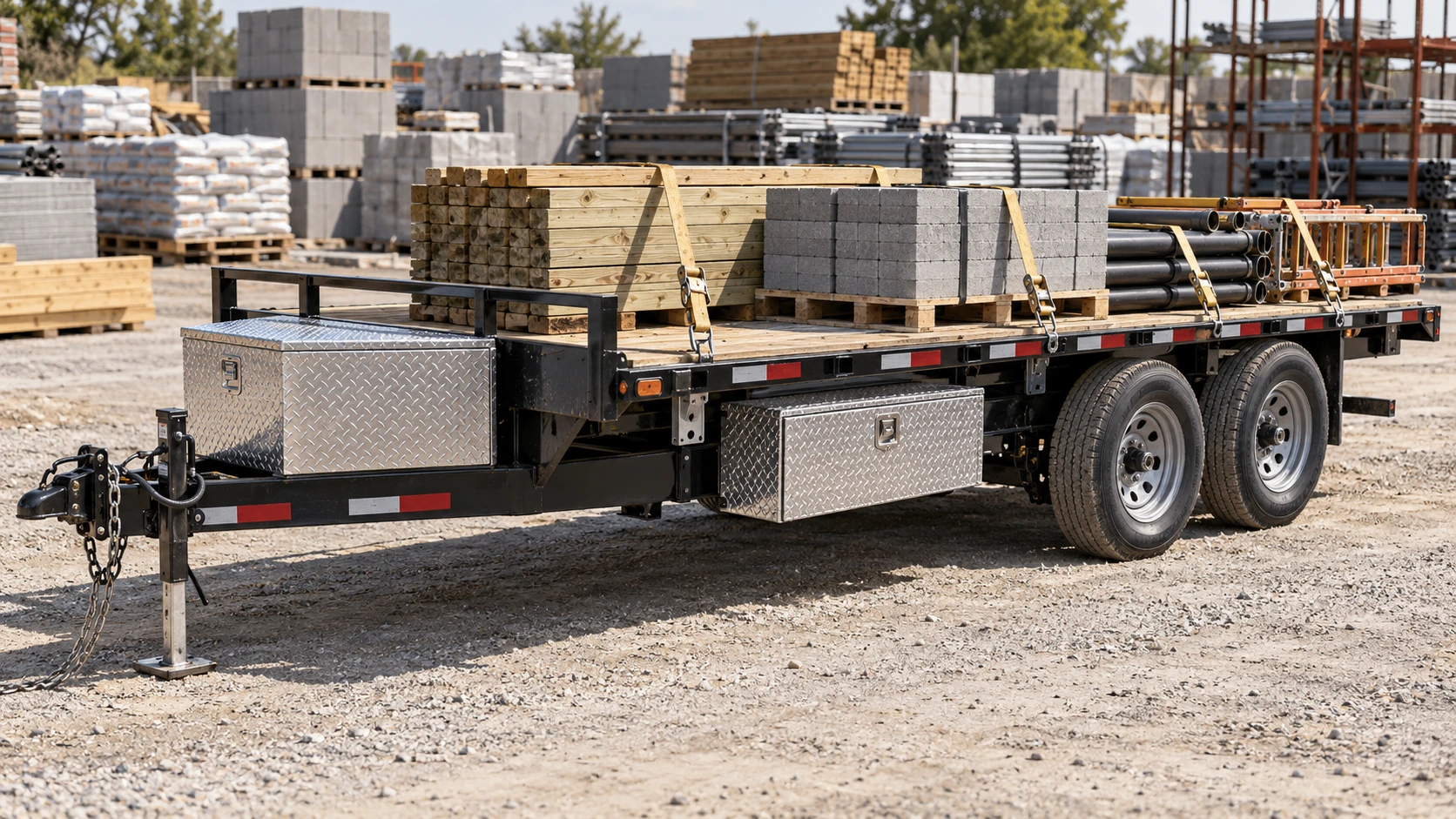
A contractor needs more tool storage on a work trailer.
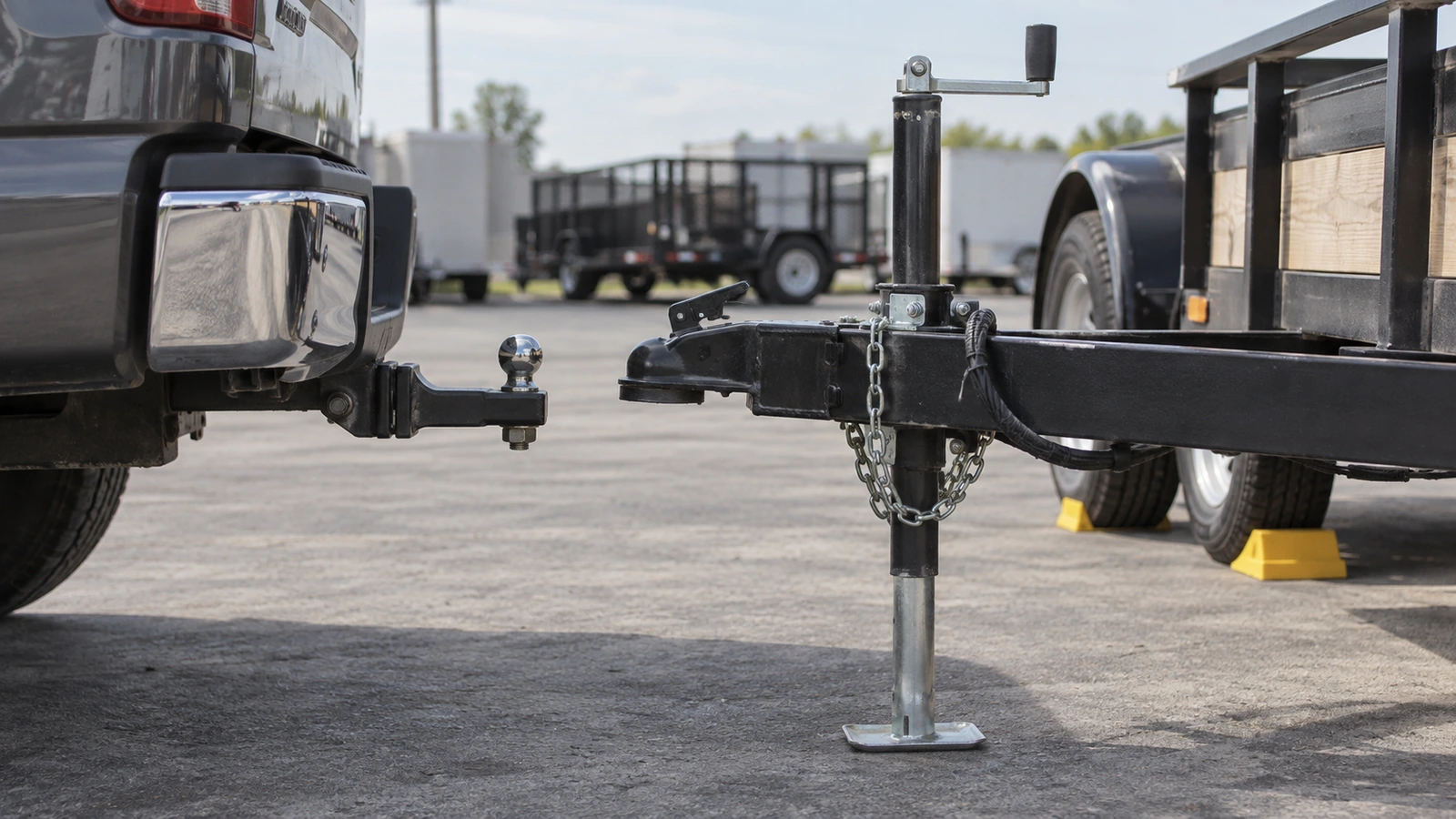
The trailer already carries equipment, materials and tie-downs. A dedicated toolbox would keep smaller items organized, but the front A-frame is crowded with the jack and hitch hardware.
Looking underneath the trailer, the contractor notices unused space beside the frame.
Why not install an underbody toolbox there instead?
It sounds like a straightforward solution. The toolbox would no longer compete with the trailer jack, and the cargo deck could remain available for equipment.
But the space beneath a trailer has different limitations from the space above its tongue.
A box mounted under the frame may reduce ground clearance, interfere with suspension movement or place its door too close to the ground for convenient access. It also needs a mounting structure capable of supporting the fully loaded box during transport.
A tongue-mounted box has its own compromises. It may be easier to reach, but it occupies the hitch area and adds weight toward the front of the trailer.
Neither location is automatically better.
In a contractor discussion [5], a masonry contractor described carrying scaffolding, tools and materials in a single trailer while trying to keep equipment organized and accessible without unloading other cargo first.
A separate trailer-toolbox mounting discussion [6] raised a different concern: the owner had purchased a tongue box but was uncertain how to attach it without making unwanted modifications to the trailer frame.
Commercial trailers with side skirts introduce a further purchasing question: can a box be fitted beneath the existing structure without interfering with the skirts or damaging load-carrying members? Such a proposal needs verified support and clearance; unused underbody space alone does not approve the installation. [3]
These conversations point to a purchasing problem that a toolbox catalog cannot answer by itself.
Where should the tools be stored, and what kind of box can that location actually support?
For a work trailer, the answer depends on four connected requirements:
- access during the working day;
- available installation and operating space;
- loaded weight distribution;
- verified mounting structure.
The correct toolbox configuration should satisfy all four.
Location-selection guidance, not installation approval. Verify the complete operating envelope, loaded mass and trailer-side support. Truck-toolbox classification does not establish trailer fit or a contents-load rating.
Compare Three Storage Architectures
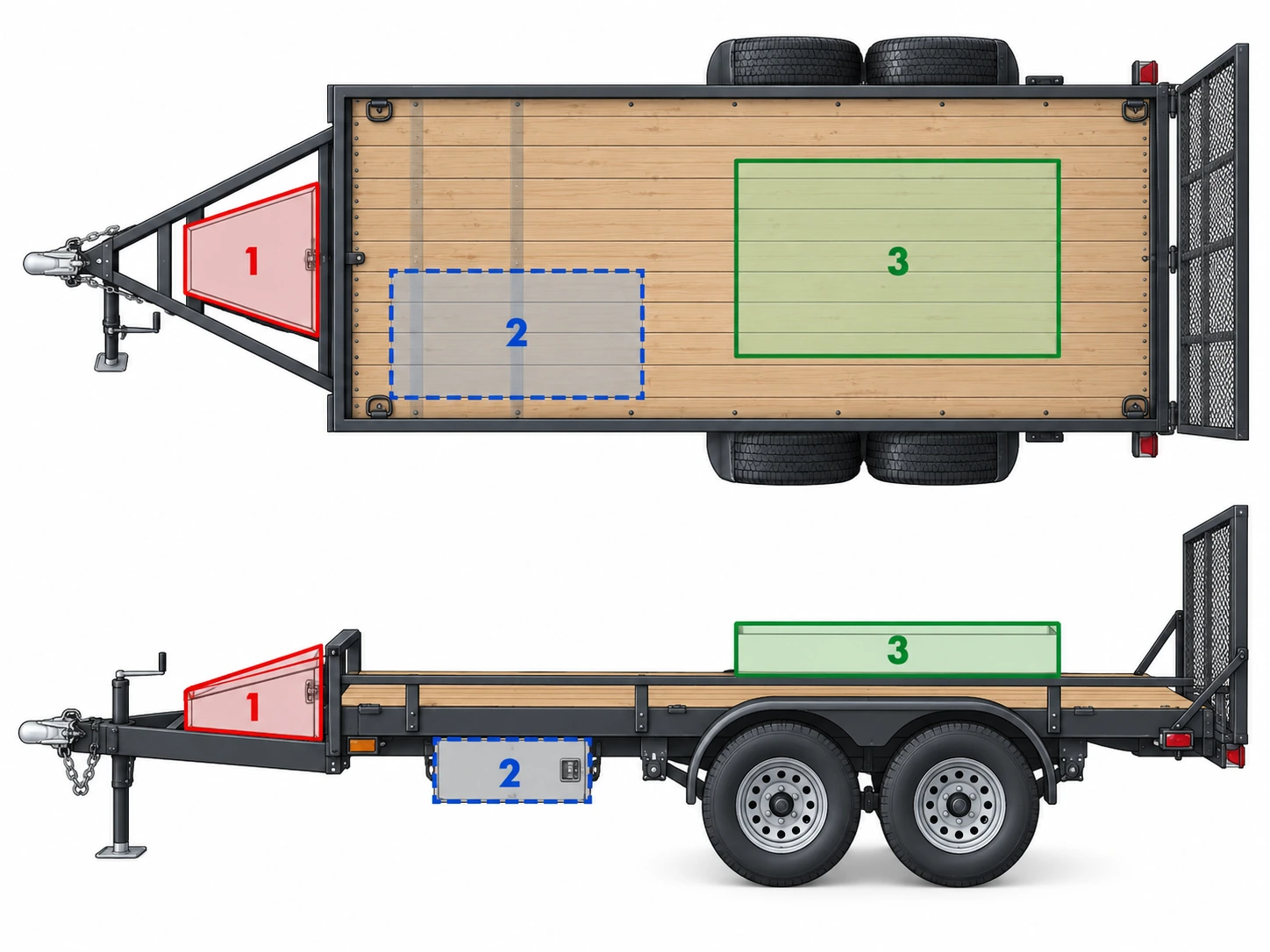
Before looking at individual dimensions, divide the options into three mounting categories.
1. A-Frame Tongue Toolbox
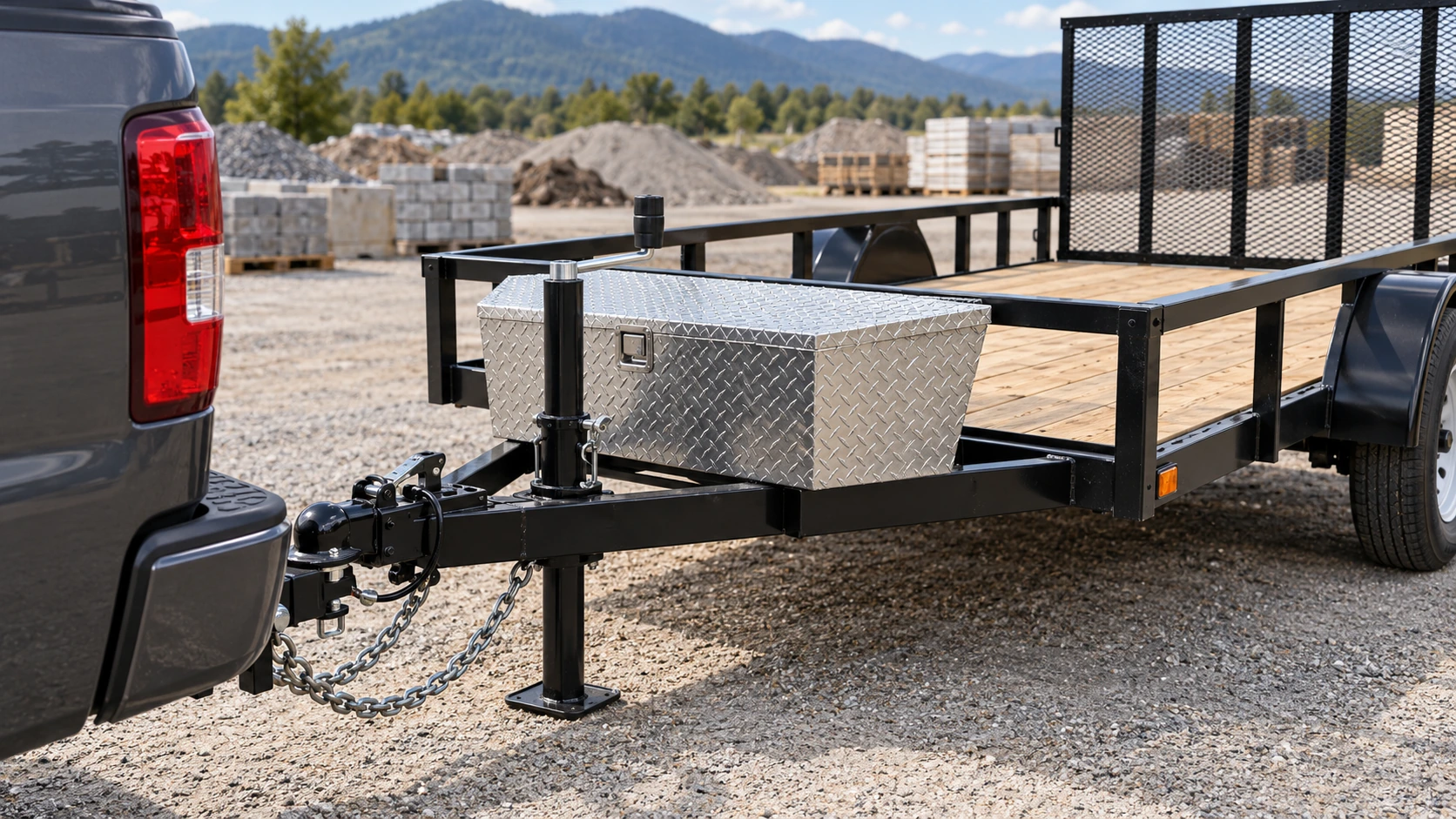
A tapered toolbox is installed in the front tongue area, normally between or above the converging A-frame members using an approved support arrangement.
This configuration makes use of space outside the main cargo deck.
It can work well for tie-downs, wheel chocks, hand tools and equipment that the operator needs while preparing or securing the trailer.
Its main limitation is competition with existing hitch and tongue components.
2. Underbody Toolbox
An underbody toolbox is carried beneath the trailer's deck or body, normally supported by a mounting bracket system connected to suitable structure.
Depending on trailer construction, this can preserve both the front tongue area and the cargo deck.
It can also provide side access to frequently used equipment on a commercial work trailer.
However, its usefulness depends heavily on frame layout, ride height, suspension clearance and door operation.
3. Deck-, Side- or Other Approved Storage Box
Some work trailers may accommodate a box on the deck, along an approved side structure or at another purpose-designed storage location.
This can be appropriate when neither the tongue nor underbody provides a satisfactory installation envelope.
A rectangular or low-profile box may offer different access and storage geometry from a tapered A-frame box.
But not every truck toolbox is automatically suitable for mounting on a trailer rail or deck.
The intended installation and attachment method must still be verified.
Initial Configuration Comparison
| Selection factor | A-frame tongue box | Underbody box | Other approved deck/side box |
|---|---|---|---|
| Main advantage | Uses front tongue space | Preserves tongue and cargo-deck space | Flexible placement on suitable structures |
| Typical access | From front or side of tongue | From side or below deck | Depends on location and lid/door design |
| Main interference risk | Jack, coupler, hitch hardware, turning clearance | Tires, suspension, ground, ramps and side equipment | Cargo, gates, tie-downs and loading operations |
| Clearance concern | Lid and hitch operating envelope | Ground clearance and door opening | Cargo/loading and access envelope |
| Weight-distribution concern | Mass added forward of axle group | Depends on fore-aft and lateral position | Depends on mounting location |
| Structural requirement | Approved tongue support and attachment | Verified hanger brackets and load path | Verified deck, rail or mounting structure |
| Typical rejection reason | Crowded or structurally unsuitable tongue | Insufficient clearance or approved support | Interference with work functions or inadequate mounting |
This table should be used to screen locations, not to rank the boxes.
The correct choice depends on the trailer's work cycle and construction.
Let Daily Tool Access Set the Location
A storage location can be structurally sound and still be inconvenient for daily use.
Contractors do not access every tool at the same frequency.
Some items may be needed every time the trailer is loaded or unloaded.
Others are used only when repairing equipment or responding to an unexpected problem.
Before specifying the box location, separate the expected contents into three groups.
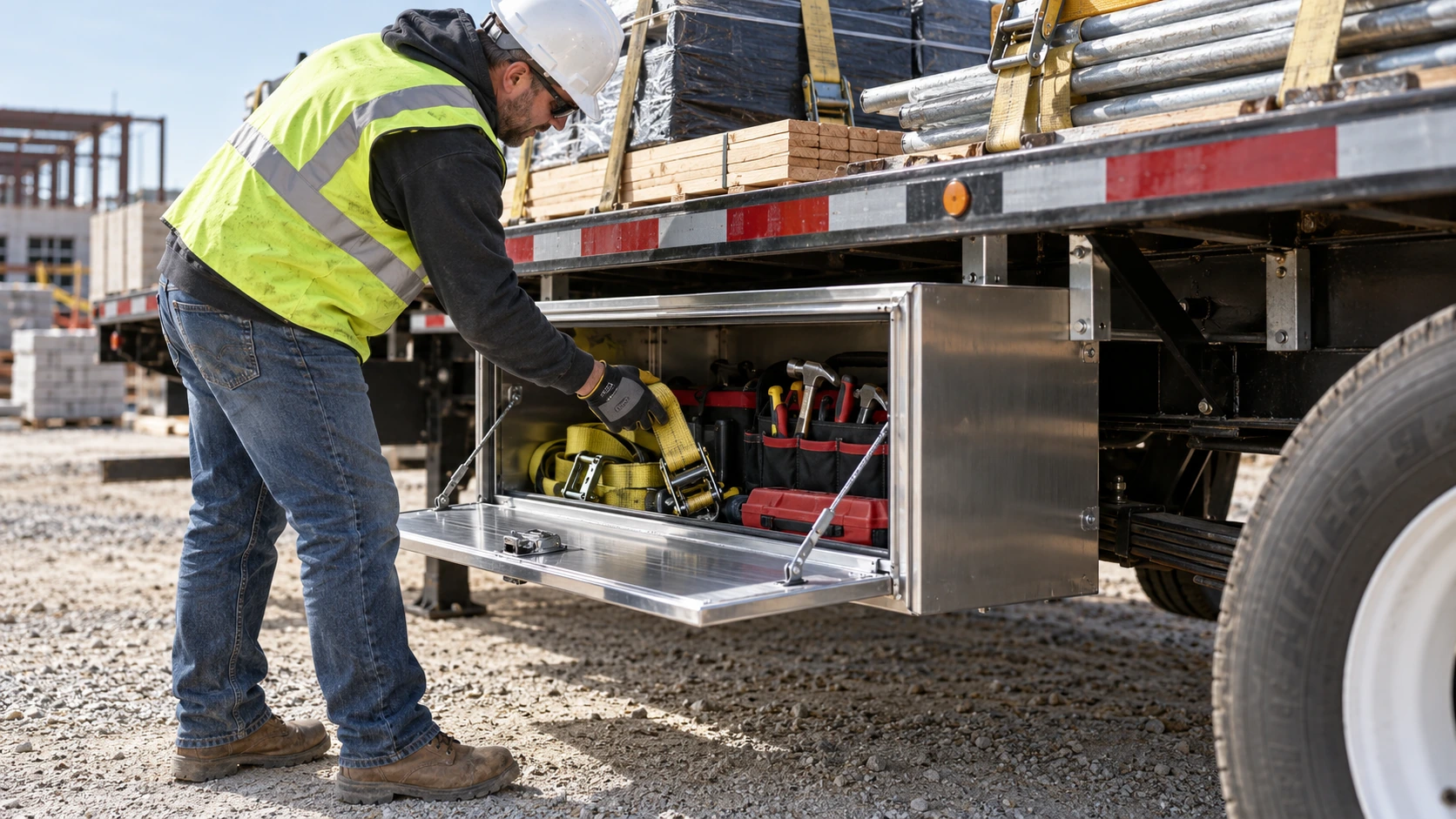
Frequently Used Tools
These might include:
- ratchet straps;
- commonly used hand tools;
- gloves;
- small equipment accessories;
- routine service items.
For these items, ease of access often matters more than maximum storage volume.
A box that requires the operator to kneel beside the trailer several times per day may be less convenient than a smaller box positioned at a comfortable working height.
However, a properly positioned underbody box with a suitable side-opening door may provide excellent access on a larger flatbed trailer.
The decision must come from the actual installed height and operator access, not from the word “underbody.”
Loading and Towing Equipment
Some equipment is typically needed at the front of the trailer:
- safety-related towing accessories;
- chocks;
- tie-down equipment;
- small maintenance supplies.
A tongue box may be convenient because the operator already works around the coupler and jack during hitching and loading preparation.
But that benefit disappears if the box blocks the very towing equipment it was meant to support.
Less Frequently Used or Bulky Equipment
Spare tools, replacement parts and equipment that is not needed at every stop may tolerate a less convenient access position.
These can be good candidates for a separate storage location if the installed box is approved for their weight and dimensions.
The first purchasing decision should therefore be:
What needs to be accessible, how often, and from which side of the trailer?
Only then should the buyer decide where the box belongs.
Side Access vs. Top Access: Which Fits the Work Cycle?
The door and access direction can be more important than the box's advertised storage volume.
Consider a contractor carrying hand tools and consumables.
A front tongue box might provide convenient top access while the trailer is parked.
But if the worker routinely approaches the trailer from one side, a properly mounted side-access underbody box may reduce unnecessary movement around the trailer.
Conversely, an underbody box might be inconvenient if the trailer is regularly parked beside walls, fences, equipment or adjacent vehicles.
In those conditions, its side door may not have enough room to open.
The selection should consider the actual job-site environment.
| Access question | Why it matters |
|---|---|
| Which side do workers normally approach? | Determines whether side-facing access is practical |
| Is the trailer regularly parked beside walls or equipment? | May block outward-opening doors |
| How often is the box opened? | Frequent access increases the importance of working height |
| How large are the stored items? | Determines the clear opening required |
| Will the trailer be loaded while the box is accessed? | Cargo and other equipment may affect access |
| Can the door remain securely open? | Affects safe and practical removal of tools |
| Can locks and latches be reached? | Prevents a nominally usable box from becoming inconvenient |
The best door design is the one that works in the box's installed location.
Do not assume that a side-door underbody box is always easier to use than a top-opening tongue box.
When Tongue Storage Is a Suitable Candidate
For a utility or contractor trailer with an open and suitable A-frame, a front toolbox can be an efficient way to add storage without occupying the cargo bed.
GOODIN's GDA006 trailer tongue toolbox [2] provides a relevant example of this configuration.
Its published maximum exterior dimensions are 830 × 490 × 460 mm, with an empty net weight of 9.15 kg. Its tapered body and top-opening lid distinguish it from rectangular work-truck boxes.
The purchasing advantage is the location, not simply the box shape.
A front box can keep commonly used equipment close to the trailer's normal preparation area.
It may also avoid using the side of the frame where an underbody installation could conflict with suspension components.
But three conditions must be satisfied.
The Tongue Must Have a Usable Installation Zone
A-frame rails converge toward the coupler.
That means the available front and rear widths differ.
The toolbox must fit the actual tongue geometry while preserving space for:
- coupler operation;
- jack movement;
- safety chains;
- breakaway equipment;
- wiring;
- weight-distribution brackets where applicable.
A free area visible in a photograph is not necessarily an approved mounting zone.
The previous GOODIN Product Selection guide, Trailer Tongue Tool Box Sizing: How to Find a Box That Fits Without Compromising the Trailer, addresses these dimensional checks in detail.
For this location comparison, the decision is simpler:
If the tongue cannot accommodate the box without compromising other equipment, eliminate that location before selecting a larger or smaller model.
The Lid Must Remain Accessible
Most conventional tongue boxes use a top-opening lid.
This requires room above the box and around the lid's opening path.
The operator should be able to open the lid and remove the intended contents without interference from the trailer body, jack or nearby accessories.
The Trailer Must Accommodate the Added Front Load
A tongue box adds mass ahead of the trailer axle group.
The effect on measured tongue weight depends on both the mass and its location relative to the trailer's support points.
Do not assume that the published empty box weight represents the complete installation.
Tools, brackets and other contents must also be included.
A front box may therefore become unsuitable if the trailer is already near a tongue-weight or other applicable loading limit.
Underbody Space Must Include Movement and Access
An underbody box is worth considering when the trailer has suitable space beneath the deck and that space can be used without compromising other vehicle functions.
Commercial underbody storage is a real product category, not an improvised concept. For example, etrailer's truck and trailer underbody-box catalog [4] includes purpose-designed products for flatbed, work-truck and trailer applications.
The core benefit is straightforward.
The box occupies a different part of the trailer's packaging envelope.
Instead of using the tongue or cargo deck, storage is placed beneath the working platform.
This can be especially attractive for:
- commercial flatbeds;
- equipment trailers with suitable frame clearance;
- service-oriented trailer platforms;
- trailers with busy front-mounted towing equipment;
- OEM designs where underbody storage can be integrated from the beginning.
But underbody mounting should pass several checks that a tongue-mounted box does not face in the same way.
Underbody Clearance Is More Than a Ground-to-Frame Measurement
The first underbody screening question is:
How much usable vertical space remains after the box and brackets are installed?
Measure from the proposed mounting reference to the ground in the intended loaded towing condition.
Then account for:
- bracket drop;
- toolbox height;
- fastener or hardware projections;
- the lowest part of the complete installed assembly.
The dimension that matters is the resulting clearance beneath the installed box, not merely the original frame-to-ground distance.
Measure Clearance at the Intended Loaded Condition
An empty trailer may sit higher than it does when carrying its normal work equipment.
For some suspension systems, added load changes ride height.
The minimum operating clearance should therefore be assessed under the relevant trailer loading and suspension conditions.
Avoid approving an underbody box only because it clears the ground when the trailer is empty and parked on level concrete.
Consider Ramps and Uneven Ground
Commercial trailers may regularly encounter:
- steep driveways;
- loading ramps;
- construction entrances;
- uneven yards;
- road-to-site transitions;
- ground changes near the trailer wheels.
A toolbox positioned too low can become a contact point during these maneuvers.
The box's fore-aft position also matters.
A low box near a trailer overhang may encounter a different clearance problem from one positioned near the middle of the trailer.
For selection, verify the expected ground-clearance and approach/departure/breakover requirements of the actual trailer.
There is no single underbody-box clearance dimension that can be assumed safe for every work trailer.
Tires and Suspension Need Their Own Clearance Envelope
An empty-looking space near the axle is not automatically usable storage space.
The wheels and suspension occupy different positions as the trailer moves.
On a leaf-spring trailer, the axle moves relative to the frame as the suspension compresses and rebounds.
On other suspension designs, the motion envelope can be different.
The available storage envelope therefore has to exclude the space needed by:
- tires and wheels;
- suspension arms or leaf springs;
- equalizers and shackles;
- axle and brake components;
- suspension bump travel;
- brake lines and electrical wiring;
- manufacturer-required service access.
Static Clearance Is Not Dynamic Clearance
Suppose an underbody box clears the tire by several inches while the trailer is unloaded.
That does not automatically establish compatibility.
Tire-to-box clearance can change with:
- suspension compression;
- tire deflection;
- axle movement;
- trailer roll;
- loading conditions.
The relevant exclusion zone should come from trailer and suspension manufacturer data or qualified evaluation.
Do not specify an arbitrary minimum tire gap as a universal rule.
Avoid Blocking Inspection and Maintenance
Even if the box does not physically contact the moving suspension, it may obstruct service work.
A work trailer needs access to its brakes, spring hardware, electrical connections and other components.
A box that must be removed before every routine inspection may be a poor location choice, especially for a high-use commercial trailer.
A structurally possible location is not necessarily a maintainable location.
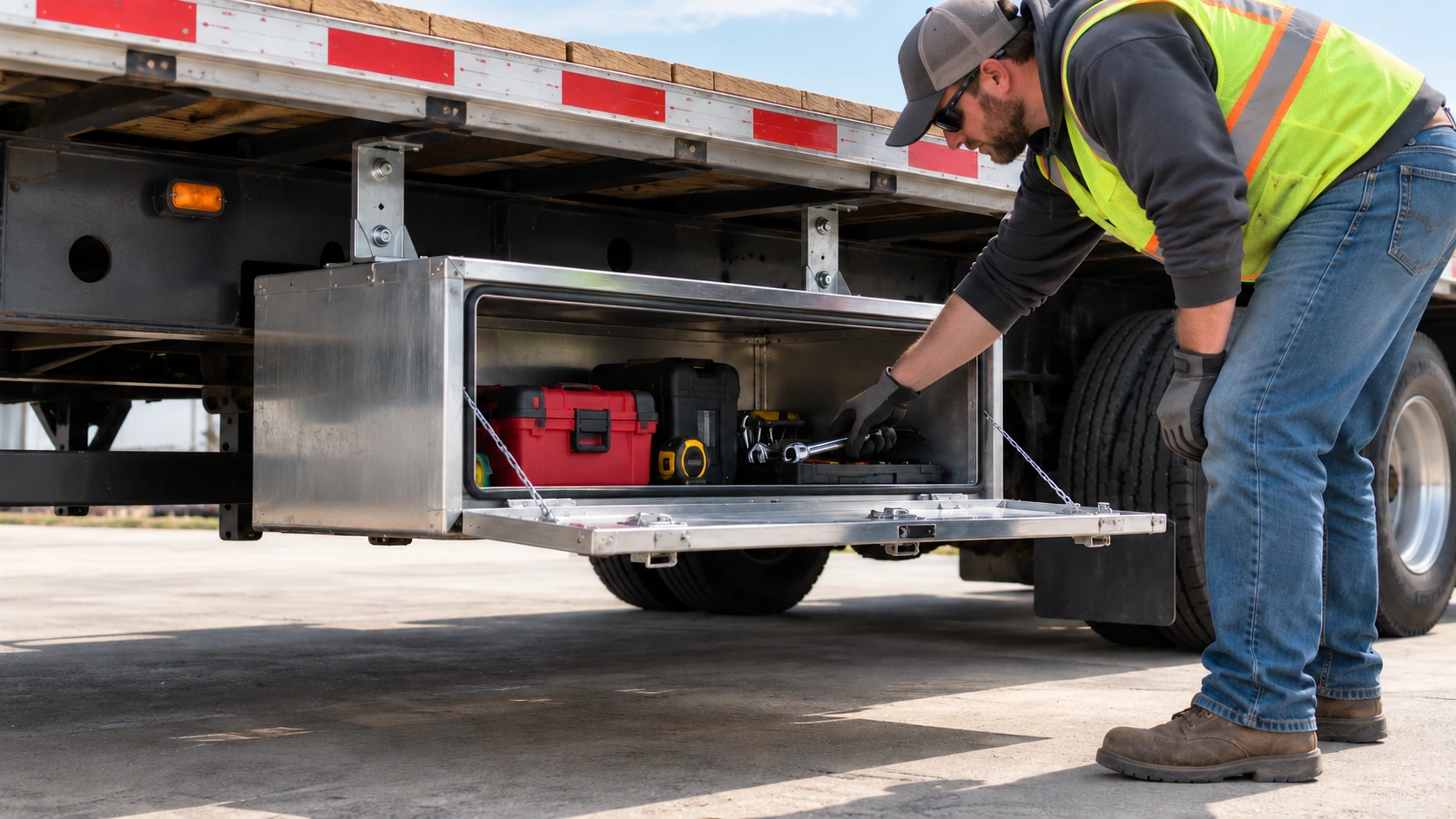
Underbody Doors Can Become the Main Limitation
A toolbox that fits beneath the trailer can still fail the daily-access requirement.
Underbody products may use:
- downward-opening doors;
- side-hinged doors;
- other model-specific opening systems.
The opening direction should not be assumed from product category alone.
A downward-opening door requires room beneath and in front of the box to move into its intended open position.
A side-hinged door requires lateral space.
Some configurations may also require access to external latches, retaining hardware or a specified support mechanism.
This distinction is important because the door's operating envelope is not the same as the closed-box envelope.
Manufacturer Example: Door and Bracket Interference
Minimizer's 50-inch Underbody Tool Box installation instructions [3] provide a particularly useful example.
The manufacturer explicitly requires installers to verify that the toolbox door will not interfere with the center support bracket when fully open.
This is a model-specific installation requirement, but it illustrates a broader purchasing principle.
The mounting brackets themselves can obstruct the toolbox door.
The final box position must therefore be evaluated with:
- door fully closed;
- door fully open;
- brackets installed;
- tools being inserted or removed.
A box that clears the trailer frame but cannot open properly is not a usable storage solution.
Tool Retrieval Height Matters
The correct height also depends on how workers will use the box.
A high underbody box might require reaching upward into a compartment.
A low box may require frequent bending or kneeling.
A side-access box near the trailer's working area can be convenient for regular tool changes if the door and contents remain easy to reach.
For a contractor who accesses equipment dozens of times during the day, this can matter as much as the total storage capacity.
The best location should support the intended workflow rather than merely conceal storage beneath the vehicle.
Verify the Complete Load Path and Weight Distribution
One of the largest differences between tongue-mounted and underbody storage is how the load reaches the trailer structure.
With a tongue box, the mounting system may sit on or span approved supporting members.
With an underbody box, the mass is often suspended below the main structure through brackets.
The resulting load path includes:
tools → toolbox body → box attachment points → hanger brackets → trailer frame
Every part of that path matters.
An underbody box with an adequate shell is not sufficient if its hanger brackets or trailer attachment points cannot support the intended installation.
Manufacturer Example: Rated Load Depends on the Bracket System
Minimizer's installation documentation states that its specific 50-inch underbody toolbox has a maximum cargo load of 250 lb when properly installed.
The instructions also identify the required hanger and center-bracket components and explain that the specified bracket arrangement is necessary for the manufacturer's warranty.
That 250 lb figure belongs to the Minimizer product and its specified installation.
It is not a general capacity rating for all underbody boxes.
It demonstrates why the purchase specification should include both:
- the toolbox's permitted contents load;
- the approved mounting-bracket system.
A box rating should not be transferred to another installation without checking the manufacturer's conditions.
Do Not Infer Trailer-Frame Approval From Available Space
The presence of a frame rail, crossmember or unused hole does not automatically establish a suitable mounting point.
Some trailers use frame components specifically designed to carry loads in particular directions.
Adding a suspended toolbox can introduce new local loads and moments.
The trailer structure, bracket layout, attachment method and fully loaded box therefore require approval for that configuration.
The manufacturer of the toolbox may specify how its brackets attach to a suitable vehicle structure.
That does not necessarily approve drilling, welding or clamping at an arbitrary location on every trailer.
For replacement projects, confirm the proposed attachment with the trailer manufacturer or obtain appropriate qualified evaluation.
For OEM projects, define the underbody support structure during design rather than treating it as an accessory added after the trailer frame is finalized.
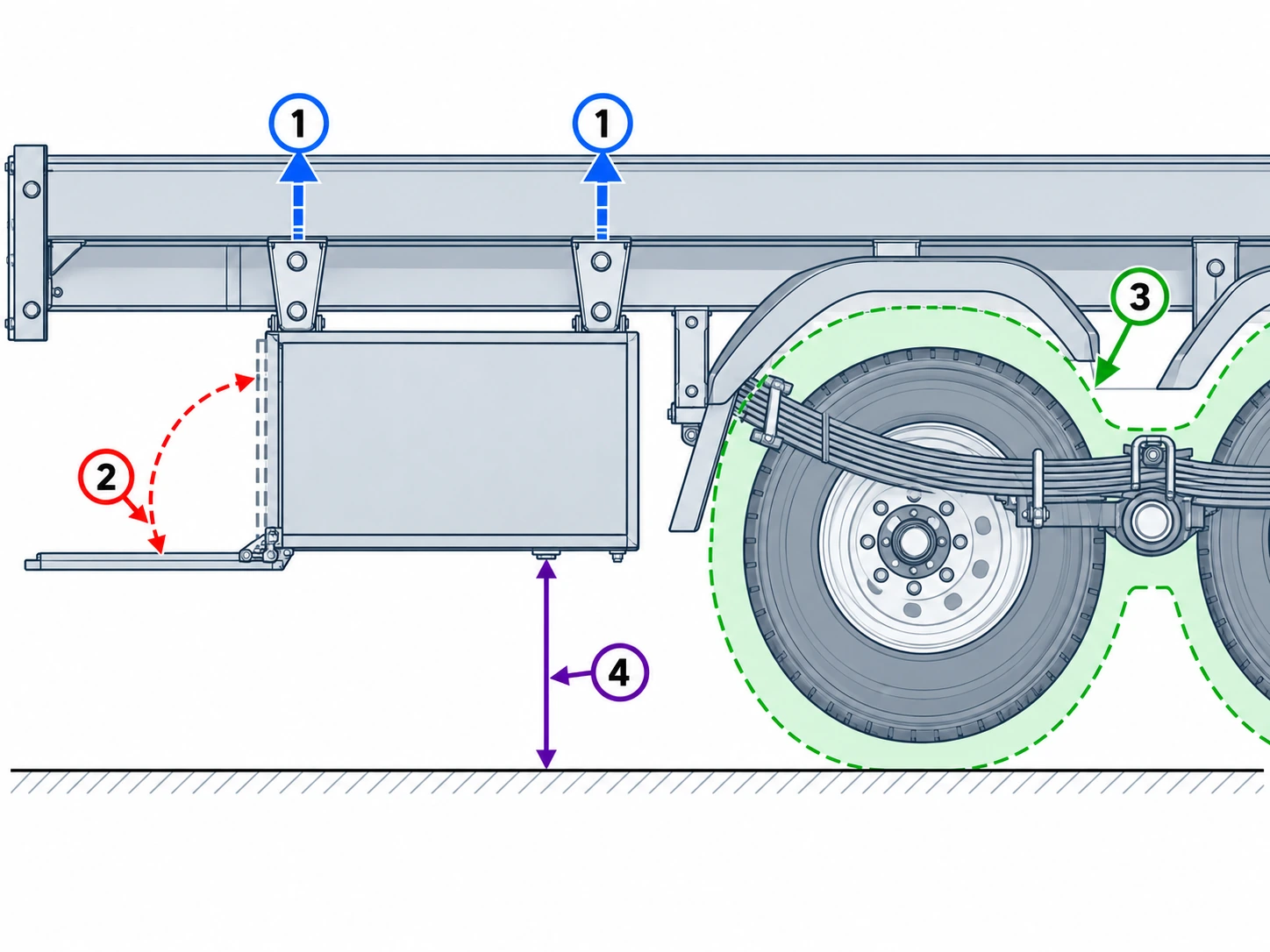
Toolbox Location Changes Weight Distribution
Tool storage is part of the trailer's load plan.
It should not be treated as mass that can be moved anywhere without consequences.
A loaded toolbox adds weight to the trailer.
Its location influences how that weight is distributed among the hitch and axle group.
Tongue-Mounted Storage
A box mounted well ahead of the trailer axle group generally increases the hitch's share of the total supported load.
That effect depends on its actual position and the rest of the trailer loading.
The increase in tongue weight is not necessarily equal to the full mass of the loaded box.
Underbody Storage
An underbody box can be installed at various longitudinal positions.
If it is placed closer to the axle group, it may affect tongue weight differently from an equally heavy box mounted farther forward.
If it is installed behind the axle group, it may reduce tongue weight relative to a forward placement.
That does not make rearward storage a universal solution.
Moving weight rearward can produce an unfavorable load distribution or violate the trailer manufacturer's loading requirements.
Left-to-Right Balance
An underbody toolbox may be installed on only one side.
This introduces an additional consideration: lateral load distribution.
Heavy tools concentrated on one side can change wheel and axle-side loading.
The effect should be evaluated against the actual trailer design, cargo loading and applicable wheel, tire and axle ratings.
For commercial or OEM applications, both longitudinal and lateral weight distribution should be part of the approved storage layout.
The purchasing rule is:
Select the location using the fully loaded toolbox mass, not only its empty product weight.
This includes the box, mounting brackets, fasteners, stored tools and any internal fittings.
Alternatives and GOODIN Product Boundaries
A buyer should not force one of these two configurations onto an unsuitable trailer.
Sometimes the correct solution is a third storage arrangement.
That may include:
- a purpose-designed deck-mounted box;
- an approved side storage compartment;
- a low-profile storage box in a suitable cargo area;
- separate storage on the work vehicle rather than the trailer.
The correct alternative depends on how the trailer is used.
For example, a deck-mounted box may offer convenient access without requiring an underbody frame modification.
But it consumes cargo-deck space and may obstruct equipment loading or tie-down access.
A side-mounted box may be conveniently positioned for a contractor but requires a verified supporting structure and must not exceed the trailer's permitted width or operating envelope.
A portable toolbox may offer flexibility but still requires appropriate restraint when transported.
These are not interchangeable mounting systems.
The objective is to find an approved storage location, not merely another empty area.
GOODIN Product Context: Three Different Storage Architectures
GOODIN's current Tool Box product range [1] includes different box shapes that can support these purchasing discussions.
| Model | Published product classification | External dimensions | Relevant selection direction |
|---|---|---|---|
| GDA006 | Trailer Tongue Tool Box | 830 × 490 × 460 mm | Evaluate where tapered A-frame storage is suitable |
| GDA007 | Aluminum Underbody Truck Tool Box | 750 × 400 × 250 mm | Evaluate an underbody-box architecture; trailer mounting requires separate approval |
| GDA013 | Low-Profile Aluminum Truck Tool Box | 900 × 330 × 180 mm | Evaluate low-profile storage in a compatible approved location |
These dimensions represent the published external product envelopes.
They do not establish:
- internal usable capacity;
- maximum contents load;
- installed ground clearance;
- door-opening direction or envelope;
- included mounting hardware;
- trailer-frame compatibility.
Those require model-specific confirmation.
GDA006: Tongue Storage Candidate
GDA006 is explicitly intended for trailer-tongue storage projects.
Its tapered form can be screened against an A-frame installation area.
However, the actual mounting footprint, lid sweep and attachment requirements must still be confirmed.
GDA007: Underbody Configuration Candidate
GDA007 is listed as an underbody truck toolbox.
This distinction matters.
A box designed for underbody storage on a truck is not automatically approved for installation on every trailer.
The trailer OEM or installer still needs to verify:
- supporting frame structure;
- bracket design;
- door operation;
- installed clearance;
- storage-load rating;
- intended service conditions.
GDA007's 750 × 400 × 250 mm dimensions provide a useful preliminary size reference, but should not be treated as an approved installation package.
GDA013: Low-Profile Alternative
GDA013 illustrates another type of box geometry. [8]
Its 900 × 330 × 180 mm envelope is comparatively shallow in one dimension, making it relevant when buyers are screening different low-profile storage formats.
However, its designation as a truck toolbox does not authorize arbitrary trailer-deck or side-rail mounting.
The selected position and product's attachment requirements still need to be confirmed.
GOODIN's product range therefore provides different box architectures—not three interchangeable trailer mounting solutions.
Three Work-Trailer Selection Cases
Consider a hypothetical contractor operating a small utility trailer.
The trailer carries lawn-care equipment and regularly travels over residential driveways.
The buyer needs to store:
- tie-down straps;
- gloves;
- hand tools;
- wheel chocks.
The front tongue is crowded by a central jack and other towing hardware.
The owner initially considers moving the storage below the deck.
Tongue Option
The tongue toolbox would provide convenient access, but the existing equipment leaves insufficient clearance for the required box.
The location fails the packaging check.
Underbody Option
Space appears available along the side of the trailer.
However, the trailer has relatively limited ground clearance and regularly crosses sloped driveways.
An underbody box may reduce that clearance further.
The proposed mounting structure also has not been approved.
The location has not passed the necessary checks.
Alternative
A smaller, appropriately mounted deck or other storage box may be a better solution if the trailer has a suitable installation area that does not interfere with cargo or loading.
Decision: Do not select an underbody box simply because the tongue is crowded. Confirm its dynamic clearance and attachment first; otherwise choose another approved storage location.
Worked Example 2: A Commercial Flatbed With Available Underbody Space
Now consider a hypothetical tandem-axle work trailer with a higher deck and suitable underbody structure.
The operator routinely carries construction materials on the deck.
Tools need to remain accessible without unloading cargo.
The trailer is still in the OEM design stage.
Tongue Option
The A-frame could accommodate a compact box, but the contractor wants frequent access from the working side of the trailer.
Front storage would require workers to walk around the tongue repeatedly.
Underbody Option
A side-access underbody box could provide a more convenient working location while preserving deck space.
The OEM can evaluate:
- bracket attachment;
- suspension envelope;
- tire clearance;
- loaded ground clearance;
- door swing;
- tool-access height;
- lateral weight distribution.
With those requirements verified, an underbody arrangement may be the stronger configuration.
Decision: Prioritize an underbody toolbox if the complete structure, access envelope and load plan can be approved.
The deciding advantage is not merely extra storage volume.
It is the ability to provide accessible storage without consuming the trailer's main working area.
Worked Example 3: Heavy Tools Concentrated on One Side
Consider a service trailer whose operator wants one large side-mounted underbody toolbox.
The box appears to fit and can be opened from the preferred work side.
However, the intended contents are heavy.
The entire loaded toolbox would sit outside the trailer's longitudinal centerline.
In this case, the selection cannot be completed from the box dimensions alone.
The buyer must verify:
- expected loaded mass;
- bracket and attachment capacity;
- axle and tire loading;
- left-to-right weight distribution;
- trailer manufacturer's permitted configuration.
Possible outcomes include using a different storage location, dividing the equipment between approved compartments or changing the OEM mounting design.
Decision: Do not approve a large one-sided underbody installation until the loaded trailer configuration has been evaluated.
Decision Matrix, Five-Step Process and Worksheet
Use this table to narrow the choice before selecting a product model.
| Actual work-trailer requirement | Tongue-mounted box | Underbody box | Other approved storage |
|---|---|---|---|
| Need access near hitching operations | Often suitable | Depends on position | Depends on position |
| Tongue already occupied by jack and hitch hardware | May be unsuitable | Can avoid tongue conflict | May be suitable |
| Must preserve cargo-deck space | Usually suitable | Usually suitable | Depends on location |
| Trailer has low ground clearance | Avoids low underbody projection | May be unsuitable | Consider non-underbody location |
| Trailer operates on steep transitions or rough sites | Check turning and tongue access | Requires particular clearance scrutiny | Location-specific |
| Tools accessed repeatedly from the trailer side | May require walking around trailer | Can be suitable with accessible door | Can be suitable |
| Suitable underbody attachment structure unavailable | Does not require underbody support | Reject unless approved support is provided | Evaluate separately |
| Suspension or tire envelope occupies available underbody area | Unaffected by that specific space | Reject interfering position | Evaluate separately |
| Frequent access without bending desired | Depends on box position | Low installation may be inconvenient | Can potentially offer better access height |
| Trailer already near tongue-weight limit | Added front mass requires review | Position may offer alternatives | Position-dependent |
| Heavy equipment stored on one side | Usually near centerline if central box | Lateral loading requires review | Position-dependent |
| OEM can integrate mounts during design | Can be designed into tongue | Can be designed with dedicated brackets | Can be designed into platform |
A location becomes a serious purchasing candidate only after it passes all applicable exclusion criteria.
The Five-Step Storage Location Selection Process
For a new work trailer or retrofit, the decision should follow a consistent sequence.
Step 1: Define the Stored Equipment
Record:
- tool dimensions;
- total expected contents mass;
- maximum single-item mass;
- access frequency;
- preferred access side;
- protection and locking requirements.
Do not begin by selecting the largest toolbox in the catalog.
Step 2: Map the Available Storage Zones
Identify possible locations:
- tongue;
- underbody;
- deck;
- other approved storage area.
Mark unavailable or reserved areas occupied by trailer components, moving parts and cargo operations.
Step 3: Reject Geometrically Unsuitable Locations
For each candidate location, check its complete operating envelope.
Tongue: jack, hitch, lid and turning clearance.
Underbody: ground, suspension, tire, door and service clearance.
Other positions: loading, gate, cargo and access clearance.
If the installation interferes with an essential trailer function, reject it before proceeding.
Step 4: Confirm Structural and Weight Compatibility
Determine whether the trailer has an approved mounting system for the expected loaded box.
Also evaluate:
- loaded trailer weight;
- tongue weight;
- axle and tire loading;
- lateral balance;
- applicable structural and component limits.
An empty storage space does not satisfy this step.
Step 5: Choose the Toolbox Architecture and Dimensions
Only after the location has passed should the buyer select:
- tapered or rectangular form;
- required dimensions;
- door or lid design;
- internal storage layout;
- mounting brackets;
- contents-load rating;
- environmental protection specification.
This order prevents a common purchasing failure:
Buying the preferred box first, then trying to make the trailer fit around it.
Pre-Purchase Location and Installation Checklist
The following worksheet can be used when comparing storage locations.
| Selection item | Tongue installation | Underbody installation | Supplier / OEM confirmation |
|---|---|---|---|
| Intended contents and mass | Required | Required | Maximum permitted contents load |
| Available installation envelope | A-frame and tongue geometry | Space beneath deck and beside frame | Product external dimensions |
| Access direction | Top/front/side access | Door opening toward accessible side | Door or lid arrangement |
| Opening clearance | Jack, bulkhead and other equipment | Ground, brackets and side clearance | Full opening drawing |
| Operator access height | Measured installed height | Measured installed height | Practical access requirement |
| Moving-component clearance | Jack and hitch movement | Tires and suspension movement | Approved exclusion envelope |
| Road clearance | Coupler/turning and associated geometry | Lowest installed edge to ground | Trailer operating requirements |
| Mounting structure | Tongue rails or approved supports | Approved hangers/brackets and frame attachment | Installation drawing |
| Contents-load limit | Confirm | Confirm | Rated contents mass and conditions |
| Weight distribution | Forward loading effect | Fore-aft and side-position effect | Loaded trailer approval |
| Service access | Jack and hitch systems | Brakes, axle, suspension and wiring | Maintenance clearance |
| Environmental exposure | Outdoor towing exposure | Road spray and underbody exposure | Sealing, drainage and finish |
| Final decision | Pass / Reject / Reassess | Pass / Reject / Reassess | Approved specification |
The buyer should not select a location because it passes one favorable criterion.
The complete installation must pass.
OEM Specification, GOODIN View and Final Checks
For an OEM trailer program, “underbody toolbox” or “tongue toolbox” is not a sufficient purchasing specification.
A useful RFQ should include the following information.
Trailer Platform
- trailer type and intended work application;
- frame and deck drawings;
- axle and suspension arrangement;
- normal and maximum loaded conditions;
- relevant tongue and axle loading limits;
- available mounting positions.
Storage Application
- type of tools and equipment;
- expected contents mass;
- maximum single-item dimensions;
- frequency of access;
- preferred access side;
- intended exposure environment.
Toolbox Configuration
- tongue-mounted / underbody / other;
- external and internal dimensions;
- opening direction and required clearance;
- door or lid retention mechanism;
- latch and lock specification;
- required finish and water protection.
Installation Requirements
- approved mounting bracket arrangement;
- trailer-frame interface;
- permitted fasteners and attachment method;
- loaded box capacity;
- ground clearance after installation;
- moving-component clearances;
- inspection and maintenance access.
Supplier Confirmation
- current production drawing;
- mounting bracket drawing;
- contents-load rating and conditions;
- supplied hardware;
- installation instructions;
- application limitations;
- replacement parts where applicable.
For underbody projects, it is particularly important to distinguish a complete approved mounting package from a standalone toolbox.
A supplier may manufacture the box without knowing the final trailer-side bracket design.
Those are separate responsibilities that must be resolved before installation approval.
For an OEM storage enquiry, explore GOODIN toolboxes and contact GOODIN with the trailer drawings, proposed storage zone, fully loaded mass and access requirements. Confirm the box drawing and trailer-side support design together before approval.
GOODIN View: Storage Location Comes Before Toolbox Capacity
For work trailers, toolbox selection should begin with the operating environment.
A tongue-mounted box can be a strong solution when the trailer has a suitable A-frame area, tools are needed near hitching operations, and the fully loaded box remains compatible with the trailer's loading requirements.
An underbody box can be a better solution when the front is crowded, the cargo deck needs to remain clear, and an approved below-deck mounting location provides suitable access and clearance.
Another storage configuration may be preferable when neither location satisfies the application.
GOODIN's GDA006, GDA007 and low-profile truck toolbox models represent different storage architectures.
The correct model should be selected only after the intended installation location has been established.
Three distinctions matter most:
Available space is not usable space.
A toolbox must fit with its doors open, the trailer operating and surrounding components moving as intended.
Available space is not structural capacity.
A frame area that appears empty does not automatically provide an approved attachment for a loaded storage box.
Maximum storage volume is not maximum usefulness.
A large box that is difficult to access, poorly located or incompatible with trailer loading may be less suitable than a smaller box in a better position.
The purchasing rule is therefore:
Choose the storage location that preserves the trailer's working functions, then specify the box and mounting system that the location can actually support.
A work trailer should carry its tools where they can be accessed efficiently, retained properly and accommodated within the trailer's complete operating envelope.
That is a more useful buying decision than simply choosing between a tongue box and an underbody box from their catalog photographs.
Final Selection Checklist
Before approving the storage configuration, confirm:
- What tools will the box carry, and how often are they accessed?
- Which location offers the most practical working access?
- Can the box open fully in the intended installation position?
- Does a tongue box interfere with the jack, hitch or turning envelope?
- Does an underbody box preserve sufficient ground clearance?
- Are tire and suspension movement envelopes clear?
- Will the box obstruct brake, suspension or wiring service?
- Is the trailer structure suitable for the intended loaded box?
- Are the brackets and attachment method approved for the installation?
- Have the box and contents been included in weight-distribution checks?
- Does the location produce unacceptable one-sided loading?
- Is the box suitable for its intended environmental exposure?
- Are the required mounting and contents-load specifications documented?
- If both locations are unsuitable, has another approved storage arrangement been evaluated?
If these checks are complete, the buyer can select the appropriate toolbox architecture and move on to exact product dimensions.
If they are not, the location decision remains open.
Sources & Further Reading
Forum discussions illustrate working and purchasing problems, not engineering approval. The skirt thread is background only and is not relied on for an installation claim. Manufacturer ratings and instructions apply only to their specified product and mounting system. AI-generated images are generic concepts, not GOODIN model photography or approved installations.
- GOODIN — Tool Box Product Range
- GOODIN — GDA006 Aluminum Trailer Tongue Tool Box
- Minimizer — 50-Inch Underbody Tool Box Installation Instructions
- etrailer — Trailer Underbody Tool Boxes
- Reddit / r/Contractor — Scaffolding and Trailer Help
- Reddit / r/Tools — Tool Box Mounting on the Tongue of a Trailer
- Reddit / r/Truckers — Toolbox Around Trailer Skirts — Background Thread; Not Relied On for Installation Approval
- GOODIN — GDA013 Low-Profile Aluminum Truck Tool Box
Fixed vs. Magnetic LED Trailer Lights: Which Setup Fits Your Trailer and Towing Needs?
Trailer Tongue Tool Box Sizing: How to Find a Box That Fits Without Compromising the Trailer
Related Article