Trailers as Productivity Tools: Why Contractors and Small Businesses Are Driving Utility and Dump-Trailer Demand
On this page
Contractors do not buy trailers because they are enthusiastic about trailers. They buy them because something in the business needs to move.
A landscaping crew needs to move mowers and tools. A hardscaping contractor needs to deliver compact equipment and remove debris. A tree-service operator needs space for brush. A small construction company needs to move lumber, tools and demolished material without making every job a logistics problem.
For these customers, a trailer is production equipment. The real question is not only “What does this trailer cost?” It is “What work can this trailer allow the business to complete faster, with fewer trips and less labor?”
Market Takeaway: A trailer becomes productive when it removes a bottleneck—not simply when it carries more.

Equipment World’s 2026 survey found that 83% of responding contractors planned to purchase equipment, while an earlier reader poll found 78% intended to buy at least one machine. Respondents cited growing workloads and avoiding breakdowns among the reasons for investment. Commercial landscaping businesses report the same focus on growth, workflow and margins. Against that background, a utility or dump trailer is not only transport. It is workflow capacity.
1. Utility Trailers Sit Directly Inside the Small-Business Workflow
Utility trailers occupy an unusual place in the equipment market. They are relatively simple compared with an excavator or commercial truck, but they interact with almost everything else a contractor owns.
A trailer may carry zero-turn mowers, compact loaders, mini excavators, trenchers, pallets, lumber, mulch, soil, branches, demolition debris, tools and consumables. It is not an isolated purchase; it connects the crew, tow vehicle, equipment and jobsite.
Trailer Shopper’s August 2026 marketplace analysis identifies landscaping and lawn-care businesses and small contractors among the primary utility-trailer customer groups in its dealer network. Because that is marketplace data rather than a national registration census, it is best treated as a directional signal.
A growing lawn-care company may start with one mower in a pickup bed. The next machine can make that arrangement impossible. A second mower, larger zero-turn, aerator or compact machine creates a transport bottleneck. At that point, the trailer does more than add cargo space: it enables the equipment investment that follows.
GOODIN’s GOODIN trailer product range shows how different trailer formats support different load paths and commercial tasks.
2. Contractors Measure Equipment in Hours, Not Features
Time is billable. Driving, waiting, searching for loose tools and repeated loading usually are not. A second trip for material or a return to the shop for a forgotten component consumes capacity without producing more revenue.
A July 2026 LawnCarePros discussion captured the point clearly: contributors advised new operators to standardize trailer layout early because every extra minute spent loading, fueling or driving becomes part of job cost.
This is why a contractor may willingly spend more on better ramps, organized tool storage, faster tie-downs, powered dumping, reliable jacks and accessible spare-tire storage. The buyer may not be purchasing a “premium feature.” The buyer may be purchasing five minutes saved, several times every working day.
For a practical component-by-component view, GOODIN’s utility-trailer upgrade guide explains which upgrades improve day-to-day utility first.
3. The Dump Trailer Is a Particularly Clear Productivity Case
A basic utility trailer can move bulk material. A dump trailer can move it and unload it mechanically. That changes the labor equation.
With mulch, soil, gravel, brush, roofing debris, demolition waste or landscape cleanup, hydraulic dumping can place most of the load where the crew needs it. The value is not the cylinder itself. It is what happens after the operator presses the button: less manual unloading and a faster move to the next task.
Current contractor discussions also connect dump trailers with junk removal, compost, rock, tree work, cleanup and equipment transport when ramps are fitted. The commercial logic is versatility plus labor reduction.

4. A Trailer Can Expand the Services a Business Can Sell
Productivity is not only about completing an existing job faster. Sometimes equipment changes which jobs a business can accept.
A landscaper with a mower trailer can perform routine maintenance. Add a dump trailer and the same company may be better equipped for mulch installation, property cleanup, hedge and tree debris, small demolition, soil removal, material delivery and hardscape preparation.
The trailer becomes a bridge between service categories. That matters because small-company growth often comes from increasing the revenue potential of the crew already employed rather than immediately adding a second crew.
NALP’s 2026 commercial landscaping data reinforce the pressure: 79% of respondents prioritized revenue growth, 41% focused on improving existing processes and 38% focused on margins. When labor is difficult or expensive to add, productivity per crew becomes more important.
5. Dump Trailer Versus Dump Truck Shows the Small-Business Logic
A March 2026 r/smallbusiness discussion provides a useful example. The owner of a two-person landscaping and hardscaping company was considering replacing a dump trailer with a dump truck. Several operators argued that the trailer remained more versatile for a business of that size.
The truck and trailer can be separated. One worker can leave the trailer at a site while the tow vehicle handles another task. Another suitable vehicle may tow the trailer if the primary truck is unavailable. The same trailer can move equipment, pallets or debris instead of remaining permanently configured for one purpose.
A dump truck may be the better choice for another operation. The lesson is not that one format always wins. It is that small contractors value flexibility because every asset has to do more than one job. Trailers add capacity without necessarily adding another powered vehicle.
6. The Real ROI Is Bottleneck Removal
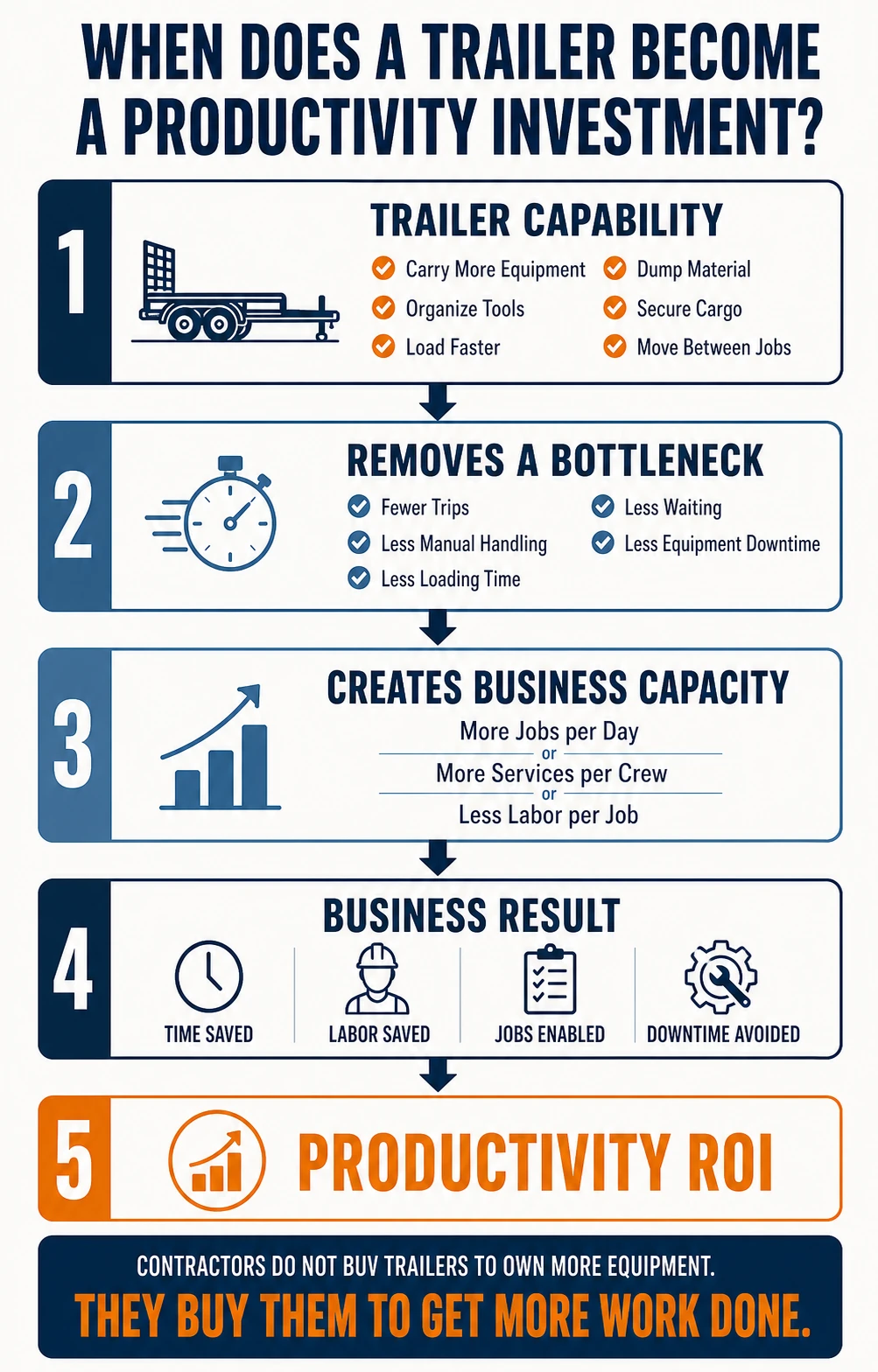
Trailer ROI should not be reduced to purchase price divided by years of ownership. The more useful questions are operational:
- Does it reduce trips? One correctly sized trailer may eliminate a second vehicle or repeated returns to the yard.
- Does it reduce loading time? Racks, ramps, tie-downs and organized storage shorten setup at every stop.
- Does it reduce unloading labor? Dump bodies and hydraulic systems remove repeated manual handling.
- Does it reduce waiting? Carrying the right material and tools prevents the crew from stopping.
- Does it prevent damage or loss? Lockable storage and secure tie-downs protect revenue-producing equipment.
- Does it add a service? Debris removal or equipment transport can turn previously rejected work into billable work.
Trailer value = time saved + labor saved + jobs enabled + downtime avoided.
The trailer becomes productive only when at least one of those values is real.
7. Bigger Is Not Automatically More Productive
Small-business owners can also overbuy. A 16-foot dump trailer with a high GVWR may appear more productive, but it also requires a larger tow vehicle, higher purchase and maintenance costs, more storage space, harder maneuvering and potentially different licensing or regulatory obligations.
A landscaping company working on compact residential properties may lose more time maneuvering a large trailer than it gains in hauling capacity. Oversizing can also encourage overloading of the combination.
The right productivity metric is not maximum trailer capacity. It is the smallest practical setup that consistently completes the jobs the business sells. This is also why lightweight engineering must be considered as a system, as discussed in GOODIN’s 2026 lightweight-trailer design analysis.
8. Hardware Turns a Trailer Into a Work System
A bare trailer deck transports equipment. A well-configured trailer supports the entire job. At that point, accessories stop behaving like accessories.
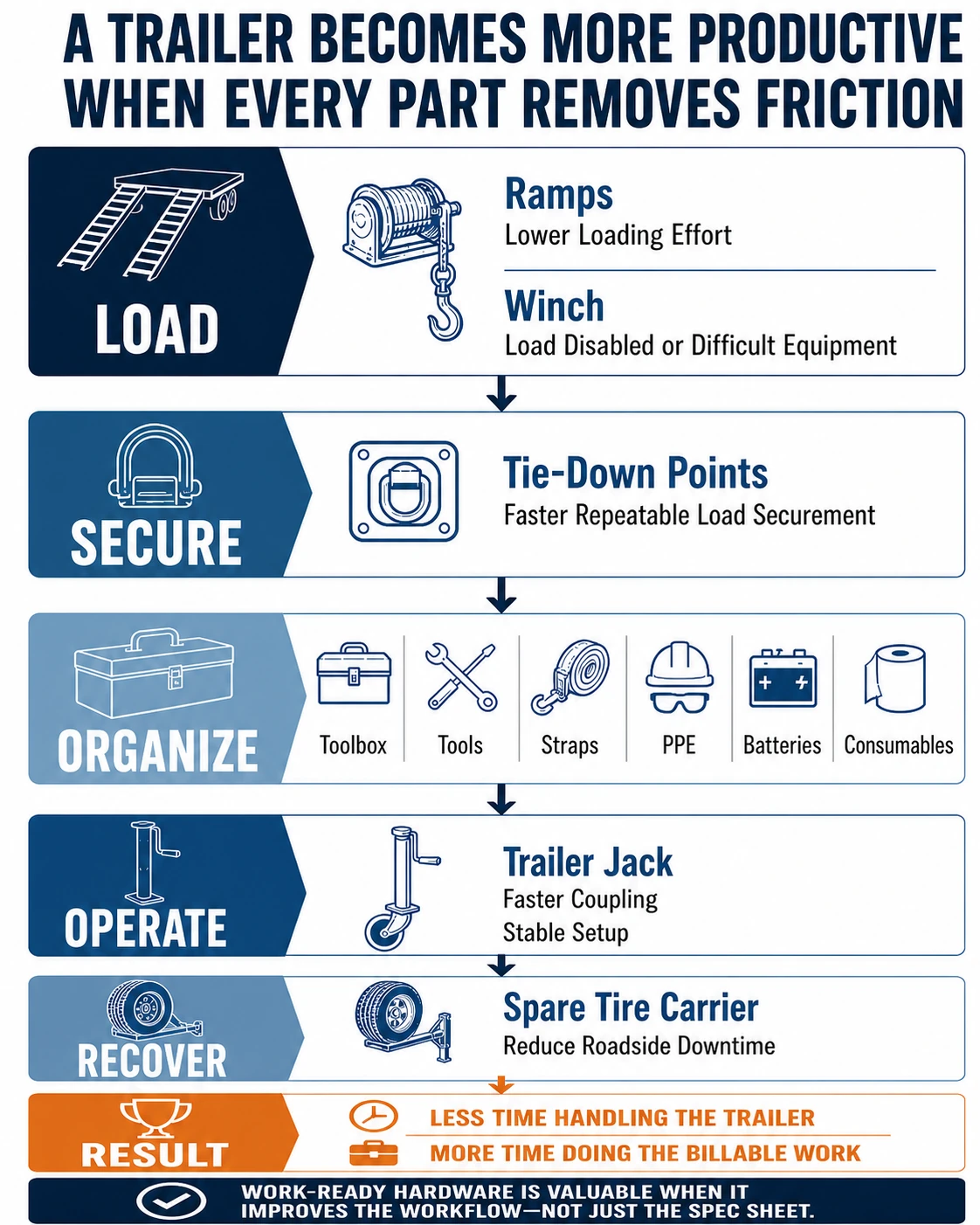
Toolbox
Lockable storage keeps straps, batteries, PPE, hand tools, lubricants and frequently used parts with the trailer. It reduces forgotten equipment and repeat trips.
Trailer jack
A reliable jack reduces coupling effort and supports safe, repeatable setup. For equipment connected every day, ease of operation is part of workflow.
Winch and ramps
A winch expands loading and recovery capability; practical ramp angle, storage and deployment matter when equipment is loaded several times daily.
Tie-downs and spare carrier
Correct tie-down points improve repeatability, while accessible spare-tire storage limits the time lost to a roadside failure.
Explore GOODIN’s aluminum toolbox range and trailer-jack portfolio as examples of hardware whose value should be explained in workflow terms.
9. Reliability Becomes Part of Productivity
Commercial users cannot separate equipment quality from business economics. A jack that fails Monday morning delays the crew. A damaged latch prevents secure storage. A corroded connector creates lighting or brake faults. An inaccessible spare tire extends a routine roadside stop.
Durability is therefore not an abstract ownership benefit. Reliability protects the schedule. Equipment World’s research similarly found that avoiding breakdowns was one reason contractors planned to replace or purchase machinery.
A commercial trailer does not need luxurious hardware. It needs hardware that still works when the crew is trying to start the next job. That ownership perspective connects directly to GOODIN’s trailer build-quality and serviceability analysis.
10. Productivity Pressure Can Support Premium Components
Commercial buyers remain price sensitive. EquipmentWatch’s 2026 dealer survey identified rising equipment cost as the biggest economic concern, and many dealers expected customers to delay purchases because of high prices.
That does not automatically create a race to the cheapest specification. It changes the test. A higher-priced component must prove operational value: a better toolbox may replace separate storage; a stronger jack may reduce service calls; a convenient ramp may save minutes at every property; better corrosion protection may extend replacement intervals; and a spare carrier may prevent hours of downtime.
The commercial buyer may pay more, but the benefit must be explained in work terms rather than marketing adjectives.
11. OEMs and Dealers Can Sell Ready to Work, Not Just Specifications
Traditional trailer listings emphasize dimensions, axle rating, GVWR, deck material, tire size, paint and price. Those specifications remain essential, but a contractor also needs to understand the workflow.
| Commercial use | Work-ready configuration | Bottleneck addressed |
|---|---|---|
| Landscaping maintenance | Open utility trailer, easy ramps, mower tie-down positions, trimmer storage, toolbox and spare tire | Fast repeated loading and organized daily setup |
| Cleanup and materials | Dump body, tarp, high sides, rear gate, ramps and tool storage | Manual unloading and service flexibility |
| Compact equipment | Low loading angle, winch, heavy tie-downs, appropriate jack and spare tire | Safe loading, recovery and roadside uptime |
Trailer Shopper’s current marketplace material promotes work-ready accessory bundling, consistent with the shift from selling a generic platform to selling an application-specific tool. The better commercial question is not “Which features can we add?” but “Which bottleneck does this configuration remove?”
12. The GOODIN Opportunity Is Productivity-Enhancing Hardware
A component supplier does not need to claim responsibility for contractor productivity as a whole. It should understand why OEM customers specify particular hardware.
A toolbox supports organization and equipment security. A trailer jack supports fast coupling and dependable daily operation. A winch expands loading and recovery. Tie-down and mounting hardware support repeatable securement. A spare-tire carrier supports recovery from a common roadside interruption.
Do not sell the component only as a piece of metal. Understand which part of the customer’s workflow it protects or improves.
OEMs with application-specific requirements can also use GOODIN’s customized trailer-jack program or customized trailer-jack to discuss an integrated hardware package.
13. What to Watch Next
The contractor-trailer market will not grow simply because more businesses decide they like trailers. Its direction will be determined by the economics of work.
- Contractor capital spending: equipment purchasing keeps transport capacity inside the investment cycle.
- Labor cost: as labor becomes more expensive, equipment that removes handling becomes more valuable.
- Small-equipment adoption: mini skid steers, compact excavators and stand-on machines create practical transport needs.
- Service diversification: mowing businesses expanding into cleanup, hardscape or delivery need different configurations.
- Financing and equipment prices: high acquisition costs can delay purchases and strengthen demand for multipurpose assets.
The strongest trailer designs will answer one question clearly: What does this allow the business to do better tomorrow than it can do today?
The Bottom Line
For contractors and small businesses, trailers are operating tools. A utility trailer carries the equipment that earns revenue. A dump trailer removes material without turning unloading into hours of manual labor. An equipment trailer allows one compact machine to serve multiple jobsites.
The useful market lens is productivity. A trailer creates value when it helps a business move more, handle less, waste less time, protect equipment, offer another service or complete another job.
That is why apparently minor hardware improvements can justify real investment. To the buyer, a toolbox, jack, winch, tie-down or spare carrier may be the difference between a trailer that simply carries equipment and one that genuinely helps the business work.
Focused FAQ
Why do landscaping businesses use utility trailers?
Utility trailers economically move mowers, blowers, trimmers, compact equipment, plants and supplies while keeping the tow vehicle available for other work.
Is a dump trailer worth it for a landscaping business?
It can be when the business regularly handles mulch, soil, brush, debris or cleanup work. The main value is reduced manual unloading and a broader service range.
Is a dump trailer better than a dump truck for a small contractor?
Not universally. A dump truck can be efficient for dedicated hauling; a trailer can offer flexibility and lower capital requirements. Utilization, payload, maneuverability and the existing tow vehicle decide.
What trailer accessories improve contractor productivity?
Toolboxes, well-designed ramps, tie-down systems, reliable trailer jacks, winches and accessible spare-tire carriers reduce setup time, protect equipment and limit downtime.
Should contractors buy the largest trailer they can tow?
Usually not. The productive choice matches normal equipment, payload, roads, jobsites and tow vehicle instead of maximizing size.
Why does hardware quality matter on a work trailer?
Commercial trailers are repeatedly coupled, loaded, unloaded and exposed to weather and vibration. Hardware failures create downtime, making component reliability part of productivity.
Technical References
- Equipment World — 2026 Tech & Spec Survey: Contractors' Equipment Purchase Plans
- Equipment World — Readers' Poll: 78% of Contractors Plan to Buy Construction Equipment in 2026
- National Association of Landscape Professionals / Aspire — The State of Commercial Landscaping in 2026
- Trailer Shopper — Utility Trailer Market 2026: Trends, Pricing & Dealer Profitability
- EquipmentWatch / Equipment World — Dealers Face High Pricing and Inflation in 2026
- Reddit / r/LawnCarePros — Contractor equipment setup and trailer workflow discussion
- Reddit / r/LawnCarePros — Dump trailer discussion
- Reddit / r/smallbusiness — Dump trailer or dump truck
From Base Model to Work Platform: Why Modular Accessories and Factory-Ready Upfits Are Growing
The Build-Quality Backlash: Why Trailer Buyers Are Looking Past Features to Frames, Hardware and Serviceability
Related Article