Lightweight Is Becoming a Feature, Not a Niche: What Buyers Want From the Next Generation of Trailers
On this page
For years, “lightweight trailer” described a relatively specific corner of the market.
In recreational vehicles, it usually meant a compact travel trailer designed for owners who did not want a full-size pickup. In commercial equipment, lightweight construction was more closely associated with specialized aluminum trailers where additional payload justified a higher acquisition cost.
In 2026, that distinction is becoming less useful.
Buyers across very different trailer categories are paying more attention to empty weight because it affects something they understand immediately: what they can tow, what they can carry and what the trailer costs them to operate.
RV LIFE's 2026 coverage reflects the consumer side of the shift, emphasizing compatibility with midsize pickups, SUVs, vans and some crossovers while also combining low towing weight with more accessible pricing.
Commercial trailer manufacturers are approaching the same issue from another direction. Great Dane introduced its all-aluminum Freedom Ultra around strength-to-weight efficiency and payload, while its redesigned combo flatbed removed more than 200 pounds through targeted engineering changes.
Different customers. Different trailers. The same question:
How much useful trailer can we get without carrying unnecessary trailer?
Market Takeaway: Lightweight is no longer a material category. It is becoming a performance feature that connects towability, payload, accessibility and operating value.
1. Consumers Are Connecting Trailer Weight to Tow-Vehicle Choice
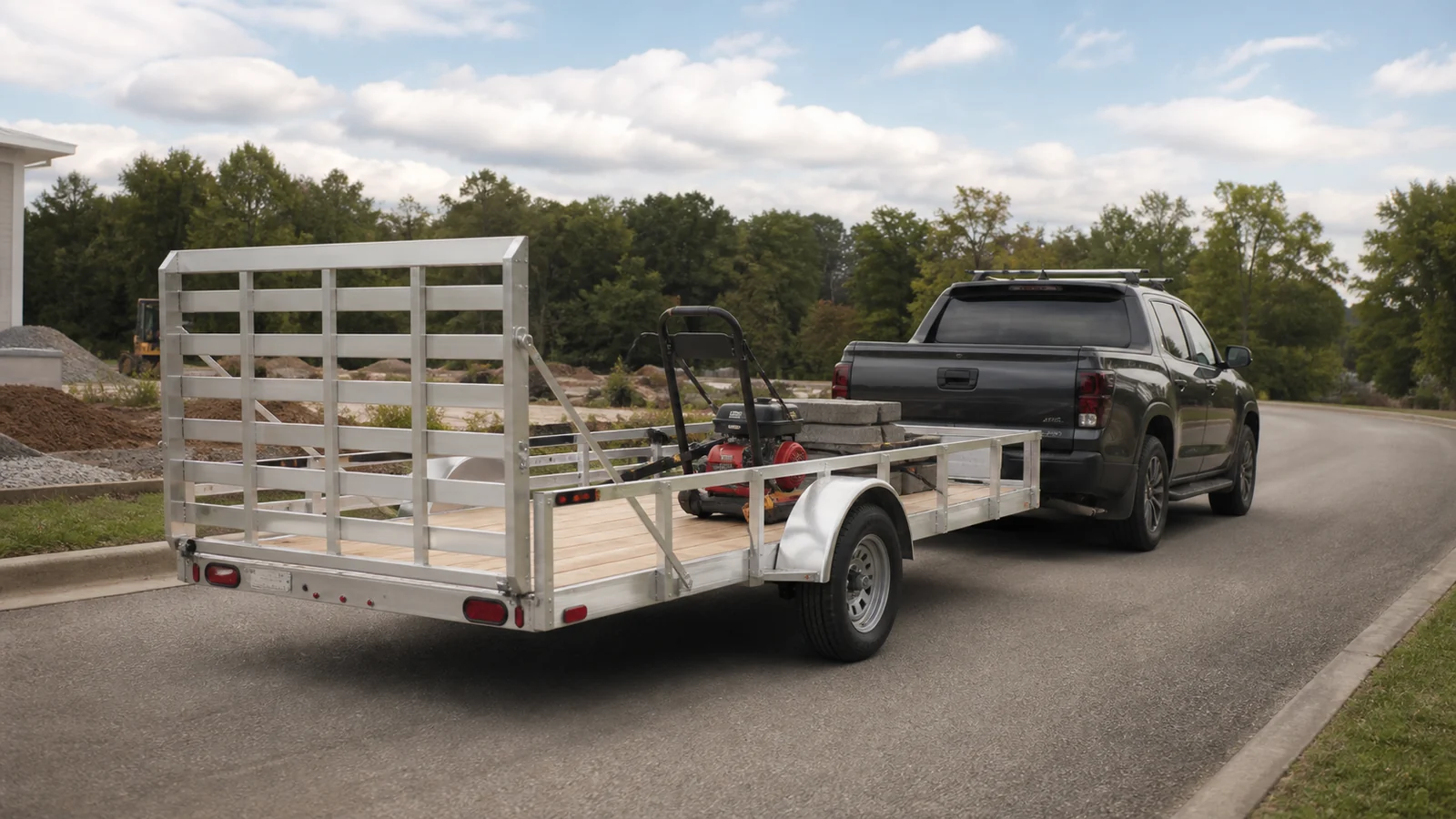
For recreational buyers, one of the strongest benefits of reducing trailer weight is obvious before the trailer ever moves: it can expand the pool of vehicles capable of towing it.
A buyer who can use an existing midsize pickup or SUV has a very different purchasing equation from one who must upgrade to a heavier tow vehicle.
Current lightweight-trailer coverage repeatedly positions easier towing and compatibility with smaller vehicles as central benefits. It also reminds shoppers to look beyond advertised maximum tow ratings to payload, hitch weight, passengers and cargo.
This changes how “lightweight” should be marketed.
The benefit is not simply “this trailer weighs less.” The benefit is “this trailer may fit more customers' existing vehicle, payload and ownership constraints.”
That makes weight part of accessibility. For first-time RV buyers in particular, a smaller trailer can also mean easier storage, easier maneuvering and a less intimidating towing experience.
Lightweighting therefore becomes part of the overall product proposition rather than an engineering specification hidden in the brochure.
2. Commercial Buyers See Weight as Payload
A contractor or freight operator may not care that a trailer sounds “lightweight.” They care about what the reduced tare weight allows them to do.
For weight-limited applications, less trailer can mean more payload.
Trailer Magazine's August 2026 coverage of Bulk Transport Equipment describes aluminum lightweighting in operational terms: lower tare can improve payload and productivity over the life of the equipment rather than simply reduce the amount of metal used.
Great Dane makes a similar case in North America. Freedom Ultra emphasizes payload capacity and load-to-tare efficiency, while the reworked combo flatbed removed more than 200 pounds by redesigning individual structures rather than simply changing the entire trailer to another material.
For a commercial customer, weight reduction can potentially create:
- more legal payload;
- greater cargo flexibility;
- less dead weight moved on every trip;
- easier matching to a tow vehicle;
- improved fleet productivity.
The value can repeat over thousands of operating miles. For broader demand context, compare GOODIN's 2026 utility-trailer and towable-RV market analysis.


3. Lightweighting Is Not the Same as “Use More Aluminum”
Aluminum is lighter than conventional carbon steel and remains important in weight-sensitive trailer construction.
But lightweight design and aluminum design are not synonyms.
A trailer can reduce weight through:
- aluminum;
- higher-strength steel;
- thinner optimized sections;
- hybrid steel/aluminum construction;
- composite panels;
- redesigned crossmembers;
- different flooring;
- lighter wheels;
- suspension choices;
- removal of redundant structure;
- component-level redesign.
Great Dane's combo-flatbed reduction illustrates this approach. Engineers analyzed specific assemblies and repositioned material while maintaining required structural performance. Specification choices such as flooring, wheels and suspension can reduce weight further.
The practical direction: Remove weight where it does not create value. Keep material where strength, stiffness, fatigue life or durability require it.
That is more sophisticated than replacing every steel component with aluminum. It also complements the sourcing questions examined in GOODIN's 2026 steel, aluminum and tariff analysis.
4. 2026 Is Making the Lightweight Equation Harder
Buyers increasingly value lighter equipment at exactly the same time that aluminum has become more expensive and trade policy has complicated material sourcing.
Trailer Body Builders reported in July that U.S. trailer OEMs continue relying on aluminum for lightweighting objectives, including those connected to EV adoption, even while elevated aluminum prices and tariffs are forcing manufacturers to reconsider where aluminum still makes economic sense.
Pressure 1: Reduce mass
Lower tare can improve payload, vehicle compatibility and operating efficiency.
Pressure 2: Control cost
Material premiums, tariffs, manufacturing complexity and supply risk can erase the value of an aggressive weight target.
The answer will rarely be the lightest possible trailer. It will be the trailer where the value created by weight reduction justifies what it costs to achieve.
That calculation can be different for a high-utilization flatbed than for an occasional-use utility trailer—and different from one component to another.
5. Buyers Want Lighter—But They Do Not Want Fragile
A trailer buyer rarely wants minimum mass at any cost. They want a lighter trailer that still feels capable of doing the job.
Commercial expectations
- structural capacity;
- fatigue resistance;
- floor strength;
- tie-down performance;
- jack and support capacity;
- durability on rough jobsites;
- practical repairability.
Recreational expectations
- stable towing;
- usable cargo capacity;
- durable interiors;
- weather protection;
- reliable running gear;
- reasonable ownership life.
Reducing material without understanding load paths can compromise exactly the characteristics customers depend on.
The correct engineering target is not minimum weight. It is minimum unnecessary weight at the required performance level.
Freedom Ultra is a useful current example of this positioning because its launch emphasizes both weight savings and structural rigidity rather than treating one as a substitute for the other.
6. A Lower Trailer Weight Can Create More Usable Capacity
GVWR provides a simple way to understand why buyers notice tare.
Consider two trailers with the same 7,000-pound GVWR.
Trailer A
2,000 lb empty weight
Theoretical payload before other constraints: approximately 5,000 lb.
Trailer B
1,700 lb empty weight
If all ratings remain valid, approximately 300 lb becomes available elsewhere in the weight budget.
That does not mean every pound removed automatically becomes usable cargo. Axle ratings, tire ratings, tongue weight, loading distribution and structural limits still apply.
But it illustrates why tare can have economic value. For commercial trailers, that value may be freight or equipment. For travel trailers, it may be batteries, water, camping equipment or simply more margin within the tow vehicle's payload and hitch constraints.
The buyer is increasingly interested in usable capacity, not just the number printed beside “dry weight.”
7. Smaller Tow Vehicles Make Weight More Visible
The trend toward midsize trucks, SUVs and crossovers changes the design target.
With a heavy-duty pickup, several hundred pounds of trailer-weight difference may not change whether the vehicle can legally tow the trailer. Closer to the limits of a smaller tow vehicle, the same difference can matter much more.
This is one reason lightweight RVs are attractive to buyers who want to avoid purchasing a larger truck.
Manufacturers still have to be careful with marketing. A lightweight trailer is not automatically suitable for every smaller vehicle.
Compatibility depends on:
- maximum trailer rating;
- vehicle payload;
- loaded tongue weight;
- axle ratings;
- hitch specification;
- passengers and cargo;
- brakes and local requirements.
“Towable by SUVs” is therefore less useful than publishing transparent weight information that allows the customer to evaluate a specific vehicle-and-trailer combination.
8. EV Towing Adds Another Reason to Care About Weight—With an Important Caveat
Electric tow vehicles make trailer efficiency especially visible because additional energy consumption immediately appears as reduced driving range.
Weight matters. Additional mass increases rolling resistance, acceleration energy and climbing energy.
But weight is only one part of the problem.
A 2026 SAE study using an instrumented Ford F-150 Lightning tested different trailer sizes and payloads specifically to separate mass and aerodynamic effects, confirming a substantial energy-consumption and range penalty from towing.
A separate 2026 modeling preprint evaluating flatbed, box and caravan configurations concluded that aerodynamic drag could exceed the influence of added mass across its tested configurations, particularly in highway operation.
A lightweight trailer can still be inefficient if it pushes too much air.
For EV-oriented towing, the next-generation design problem is likely to combine mass reduction, aerodynamics, rolling resistance and tow-vehicle integration. See GOODIN's data-led guide to EV truck and utility-trailer towing range.
Lightweighting helps. It is not a substitute for aerodynamic design.
9. Weight Reduction Is Becoming a Whole-Trailer Exercise
Once OEMs begin treating weight as a feature, attention moves beyond the main frame.
A trailer's tare weight is the result of hundreds of decisions. The frame may create the biggest opportunities, but components add up:
- tongue jacks;
- landing systems;
- toolboxes;
- brackets;
- couplers;
- winch mounts;
- fenders;
- battery boxes;
- spare-tire carriers;
- tie-down hardware;
- wheels;
- fasteners;
- wiring systems.
A five-pound saving on one component is rarely transformative. Repeated across a bill of materials, component-level optimization can support a meaningful vehicle-level target.
This changes the conversation between OEMs and suppliers. Instead of only asking “Can you make this cheaper?”, an engineering team may increasingly ask, “Can you achieve the same function with less mass?”
OEM teams can use GOODIN's trailer range as a practical reference point when reviewing how frames, running gear and mounted hardware work together. Connected systems also add their own hardware and power budget, as explored in the 2026 smart-trailer analysis.

10. That Creates a Natural Role for Component Suppliers
For companies supplying trailer hardware, lightweighting creates a different engineering challenge from building an entire aluminum trailer.
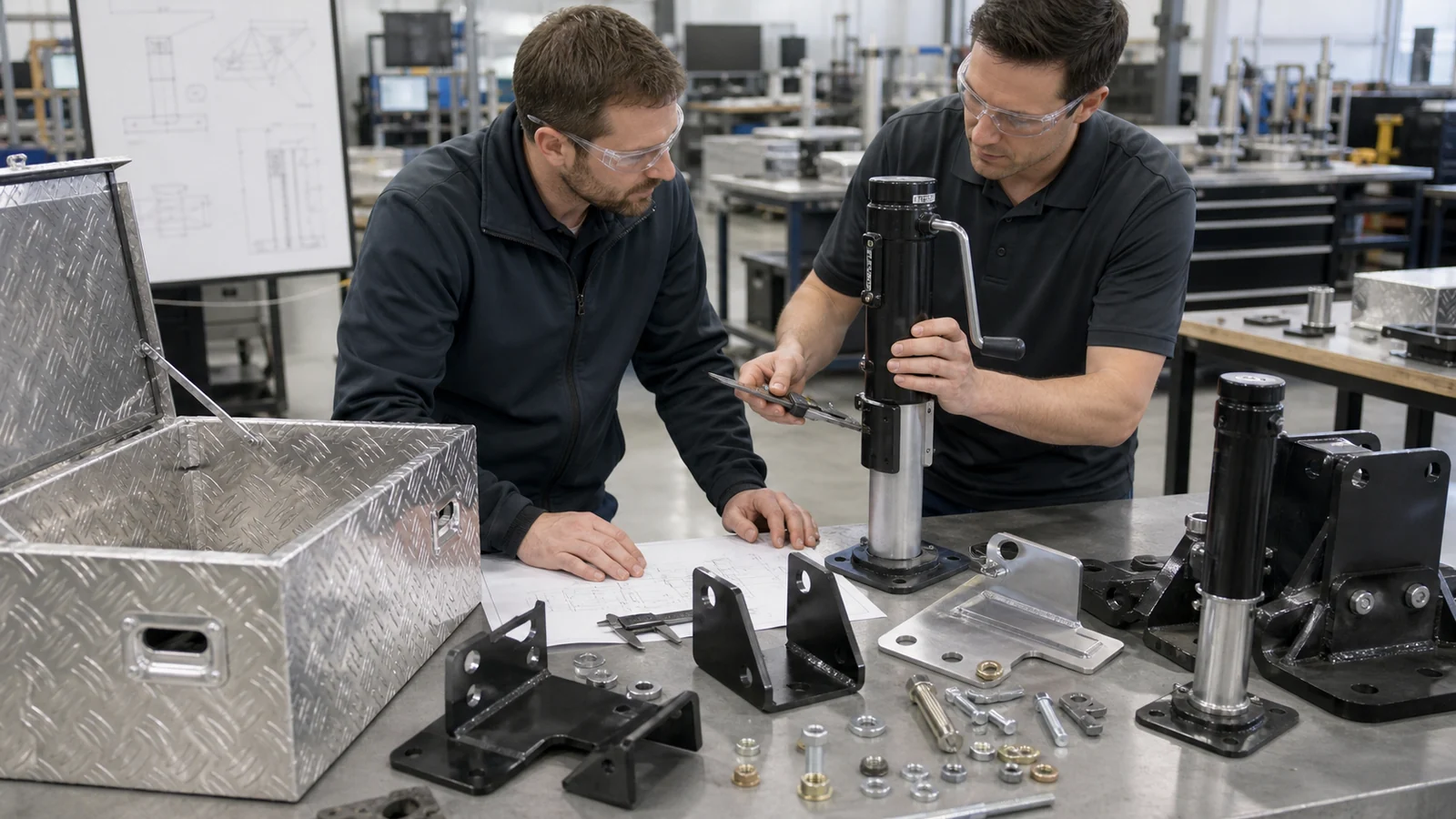
Consider a trailer jack. Its primary responsibilities still include supporting the specified load, resisting buckling and bending, surviving repeated operation, providing adequate travel, maintaining mounting integrity and resisting corrosion.
Reducing jack mass is useful only if those functions remain intact. GOODIN's trailer jack product range provides a relevant starting point for matching support capacity, mounting method and application requirements before weight optimization begins.
A toolbox creates another equation. Aluminum construction may offer a strong combination of lower mass and corrosion resistance, but cost, sheet thickness, hinge design and required impact resistance still matter. See GOODIN's aluminum toolbox range for component-level examples.
Brackets and mounting hardware may benefit from optimized geometry, higher-strength materials or selective thickness reduction. Where application-specific geometry is required, the customized trailer jack program illustrates the value of designing around load, travel, mounting and service conditions rather than reducing mass in isolation.
A GOODIN Perspective: The opportunity is not simply to advertise “lightweight parts.” It is to help OEM customers evaluate strength-to-weight, corrosion-to-weight and cost-to-weight at component level.
11. Buyers Are Really Asking for Five Things at Once
1. Easier towing
The trailer should fit a broader range of appropriate tow vehicles.
2. More usable payload
Reduced tare should create practical capacity rather than only a marketing number.
3. Strength and durability
Buyers will not accept visibly lighter construction if it creates concerns about flex, fatigue or service life.
4. Corrosion resistance
Outdoor equipment, marine environments and winter-road exposure make lifecycle protection essential.
5. Price discipline
A trailer that saves weight but becomes dramatically more expensive may remain a specialist product.
That final point is particularly important in 2026. Lightweighting becomes mainstream only when OEMs can deliver enough of its benefits without turning every lightweight product into a premium product.
12. What OEMs Should Measure
A useful lightweighting program should not begin with “How many pounds can we remove?” It should begin with a baseline.
| Question | Why It Matters |
|---|---|
| What is current trailer tare? | Establishes the starting point. |
| Where is the mass concentrated? | Finds meaningful opportunities. |
| Which parts are structurally critical? | Prevents unsafe cost-down. |
| Does lower tare increase usable payload? | Quantifies customer value. |
| Does it enable another tow-vehicle class? | Expands market access. |
| What is the cost per pound removed? | Tests economic value. |
| Does corrosion protection change? | Protects lifecycle performance. |
| Does manufacturing become more complex? | Identifies hidden cost. |
| Can the part still be repaired easily? | Protects serviceability. |
This turns lightweighting from a marketing exercise into an engineering and commercial program.
13. What to Watch Next
More hybrid construction
OEMs will increasingly use different materials according to component function rather than designing entire trailers around one metal.
More published tare and payload efficiency
Weight will increasingly be presented as a customer benefit rather than buried in specifications.
Greater focus on smaller tow vehicles
Recreational manufacturers will continue trying to expand the number of vehicles capable of using their products.
More component-level weight targets
Suppliers may increasingly receive RFQs that include mass alongside load rating, coating and cost.
More aerodynamic optimization
EV towing will make it harder to treat weight reduction as the only route to efficiency.
The broader trend is simple: the market is learning to see trailer weight as something that can be engineered—not merely accepted.
The Bottom Line
Lightweight trailers are not new. What is changing is why lightweighting matters and how widely buyers value it.
Recreational buyers connect lower weight with smaller tow vehicles, easier ownership and greater accessibility. Commercial operators connect it with payload and productivity. EV towing adds another efficiency incentive.
OEMs are responding not simply by building more aluminum trailers, but by reconsidering materials, structures and individual components across the entire vehicle.
For trailer manufacturers and suppliers, the opportunity is not to chase the lowest possible number on a scale.
It is to remove weight that does not create value while protecting everything that does: strength, capacity, durability, corrosion life, serviceability and cost.
That is when lightweight stops being a niche construction method and becomes a genuine product feature.
Focused FAQ
What is considered a lightweight trailer?
There is no universal industry weight threshold covering every trailer type. “Lightweight” is most useful when compared with trailers offering similar size, capacity and function.
Why are lightweight travel trailers becoming popular?
They can fit a broader range of tow vehicles and may be easier to maneuver and store. Current RV media also increasingly combines lightweight design with affordability and first-time-buyer accessibility.
Does a lighter utility trailer carry more payload?
Potentially. If GVWR and other component ratings remain unchanged, lower empty weight can create additional payload capacity. Actual capacity remains limited by axle, tire, structural and loading constraints.
Is aluminum always the best way to reduce trailer weight?
No. OEMs can also use high-strength steel, hybrid construction, optimized sections, composites and lighter component specifications.
Will a lightweight trailer improve EV towing range?
Reducing mass can help, particularly during acceleration and climbing, but highway towing efficiency also depends heavily on aerodynamics. Weight reduction should be considered alongside trailer shape and rolling resistance.
Should trailer components also be lightweight?
Where the saving creates useful vehicle-level value, yes—but load capacity, fatigue life, corrosion protection and serviceability should not be compromised simply to reduce component mass.
Technical References
- RV LIFE — 10 Best Lightweight Travel Trailers for 2026.
- RV LIFE — 5 Lightweight 2026 Travel Trailers Under $30,000.
- RV LIFE — 2026 Trailer Towing Guide.
- Trailer Magazine Australia — Lightweight Advantage, August 21, 2026.
- Great Dane — Freedom Ultra aluminum flatbed product and engineering information.
- Great Dane — Lighter Combo Flatbed Trailer: More Pounds Back for Your Payload.
- Trailer Body Builders — Global aluminum price plus U.S. tariffs drive OEM rethink, July 11, 2026.
- SAE International / Argonne National Laboratory — Quantifying the Impact of Towing on BEV Energy Use, April 2026.
- Kavalchuk, Mekhilef & Stojcevski — Evaluation of Range Limitations for Passenger Electric Vehicles with Various Types of Trailers and Towing Loads, SSRN preprint, July 2026.
Powered Trailers Are Coming: How e-Axles and Onboard Energy Could Change Towing
The Smart Trailer Shift: GPS, Telematics and Predictive Maintenance Move Beyond Fleet Niches
Related Article