Powered Trailers Are Coming: How e-Axles and Onboard Energy Could Change Towing
On this page
For more than a century, the basic division of labor in a tow combination has been simple:
The tow vehicle provides the power. The trailer follows.
That assumption is beginning to change.
A new generation of trailers is combining onboard batteries, electric drive axles, regenerative braking and increasingly sophisticated control systems. Instead of contributing only rolling resistance, aerodynamic drag and payload, the trailer can now provide some of the energy required to move itself.
In 2024, that idea was easy to describe as experimental. By 2026, it is harder to dismiss as a concept.
Lightship says deliveries of its battery-powered AE.1 travel trailer are underway, while Pebble began delivering Flow trailers in 2025 and entered volume production of additional powered versions in 2026. More importantly, the idea is escaping the RV niche: commercial mobile-energy trailers and heavy-freight e-trailers are now entering real deployments and fleet trials.
Market Takeaway: The trailer is beginning to evolve from passive cargo-carrying hardware into an active energy, propulsion and control platform.

1. “Self-Propelled” Does Not Mean the Trailer Drives Itself Down the Highway
The terminology can be confusing. A powered or self-propelled trailer is still designed to operate as part of a tow combination. Its electric axle does not normally behave like an independent rear vehicle deciding when to accelerate.
Instead, the control system attempts to reduce the longitudinal force that the trailer places on the tow vehicle. When the truck accelerates or climbs a grade, the trailer can contribute propulsion. When the combination slows or descends, the electric axle can recover energy through regenerative braking. At low speeds, some consumer products can also use their powered wheels for positioning without the tow vehicle.
Pebble, for example, uses dual motors for towing assistance, remote campsite positioning and automated hitch alignment. ZF approaches heavy transport differently, combining its electric axle with trailer EBS data and control logic so propulsion, regeneration and stability remain coordinated.
The innovation is not “give the trailer an accelerator.” It is give the trailer enough intelligence to manage part of its own driving resistance. That is the propulsion layer that follows the sensing and connectivity trends covered in GOODIN’s smart-trailer telematics analysis.

2. Consumer Electric Trailers Have Crossed the Prototype Line
The clearest change since 2024 is commercial availability. Lightship’s AE.1 carries a 77 kWh battery and combines aerodynamic body design with its TrekDrive propulsion-assist system. The company says customer deliveries are underway and announced a factory expansion intended to more than quadruple production capacity by the end of 2026.
Pebble has moved further into its production ramp. The company says Flow deliveries began in summer 2025. In April 2026 it announced volume production and first deliveries of its Magic Pack trim. The Flow uses a 45 kWh LFP battery, while powered versions add dual electric motors, regenerative braking and Active Tow Assist.
These products remain expensive, technologically complex and low-volume relative to conventional RVs. But they are customer products rather than trade-show promises. The question is becoming less “Can an electric trailer be built?” and more “Can the economics, infrastructure and customer value justify scaling it?”
3. Powered Trailers Attack the EV Towing Problem From the Other End
Electric pickups already offer enough torque for many towing applications. Their more visible weakness is energy consumption. A large trailer adds mass, rolling resistance and—especially at highway speed—substantial aerodynamic drag.
The usual solution is to put more battery in the tow vehicle. A powered trailer proposes something different: put some of the energy behind the hitch. The tow vehicle and trailer then become a distributed propulsion system.
Lightship has published a 196-mile mixed-road test with an F-150 Lightning in which the AE.1 supplied 47 kWh and both truck and trailer returned at about 29% state of charge. This manufacturer-generated result is not a universal range guarantee, but it demonstrates how towing energy can be shared between two battery systems. For the underlying load, speed and aerodynamics variables, see GOODIN’s EV truck and trailer towing-range guide.
4. But a Battery Does Not Make Aerodynamic Drag Disappear
Adding 45, 77 or 205 kWh of battery capacity does not eliminate the physics that made towing inefficient. At highway speed, a large bluff trailer must continuously push air aside. A powered axle can change which battery supplies the energy, but the combination still has to overcome drag.
This is why Lightship combines propulsion assistance with a retractable low-profile road shape rather than relying on propulsion alone. The future powered trailer needs propulsion + aerodynamics + rolling efficiency + energy management. A badly shaped electric trailer can still be an inefficient trailer.
Lower structural mass cannot erase aerodynamic drag either, but it protects payload and helps offset the weight of batteries and drive hardware. GOODIN’s 2026 lightweight-trailer design analysis explains why lightweighting has become a whole-trailer performance strategy.
5. The Bigger Breakthrough May Be Onboard Energy, Not Propulsion
Once a manufacturer installs tens or hundreds of kilowatt-hours of battery capacity, the trailer can do much more than help itself move. That energy can support HVAC, refrigeration, tools, lighting, campsite equipment, communications, construction equipment, emergency systems, vehicle charging and temporary buildings.
Pebble offers power export from its 45 kWh battery for campsite equipment, appliances and EV charging. Lightship’s PowerSled pushes the same architecture directly into commercial work, listing configurations of 80, 160 or 240 kWh for utilities, construction, municipalities and emergency response.
A powered trailer does not have to be justified only by “how many towing miles does the battery add?” The battery may also earn value after arrival. For commercial applications, that second job may be decisive.
6. PowerSled Shows How RV Technology Can Move Into Work Trailers
Lightship originally developed its battery architecture and TrekDrive system for an electric travel trailer. Demand from infrastructure, utility and emergency-response users led to PowerSled: effectively a powered work-trailer platform.
A crew could arrive with payload + mobile battery + AC power + propulsion assistance in one trailer. That creates possible alternatives to an equipment trailer plus diesel generator, a service vehicle plus a separate battery trailer, or temporary generation plus fuel logistics.
Large batteries remain expensive and heavy, so the economics will not work for every task. Strategically, however, this proves the technology is not tied to RV interiors. The GOODIN trailer product range illustrates the breadth of mechanical platforms that future electrical packaging may need to coexist with.

7. Heavy Transport Is Testing the Same Principle at a Completely Different Scale
The ZEFES zero-emission freight project began real-world operation of a Kässbohrer container chassis equipped with ZF TrailTrax in March 2026. The combination ran between DPD distribution centers in Eindhoven and Augsburg on a roughly 700 km round-trip mission.
The electric tractor carried 375 kWh of usable battery capacity and the powered trailer added 205 kWh. During the six-week trial, the combination accumulated about 10,000 km without significant operational disruption. Preliminary results put practical range at roughly 420 km with the e-trailer versus about 280 km with a conventional trailer—a 50% increase in that specific trial.
One example is a premium travel trailer; the other is a 36.3-tonne freight combination. Both explore the same architectural change: allow the trailer to carry energy and contribute traction. Trailer Dynamics also reported about two dozen pre-series e-trailers operating in 2026, suggesting development is occurring across multiple segments.

8. Charging May Become the Hardest Real-World Problem
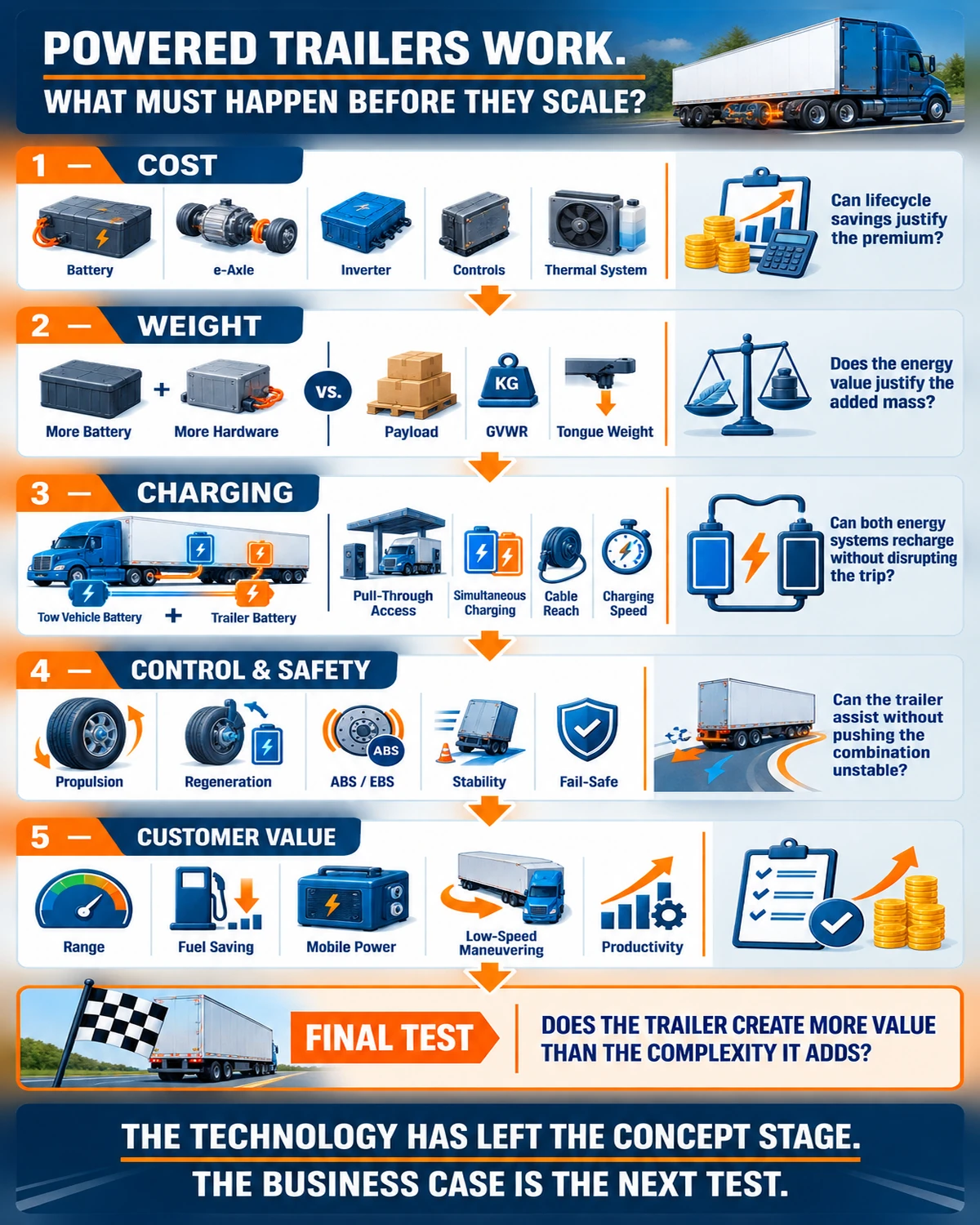
Putting another large battery into the combination creates an obvious question: what now needs to be charged? An EV tow vehicle may arrive with both truck and trailer batteries depleted. Ideally, both remain connected and charge simultaneously, but infrastructure is not consistently designed for that.
The ZEFES trial reported that simultaneous charging while coupled was often difficult because of cable reach and parking geometry, forcing drivers in many cases to uncouple. Future sites may need pull-through lanes, ports for both energy stores, higher site power and simple payment across two charging sessions.
This is not merely a trailer-engineering problem. It becomes an ecosystem problem.
9. Extra Batteries Also Add Weight and Cost
A powered trailer solves one towing problem partly by introducing another engineering constraint. Batteries, motors, inverters, thermal systems, protective enclosures and high-voltage wiring all add mass and cost.
That can affect trailer tare, payload, axle ratings, tongue weight, tires and structure. Commercial systems must prove that energy savings or productivity offset the extra capital and mass. Travel trailers must convince buyers that improved towing and off-grid capability justify a premium.
The technology is most defensible where the battery creates several values at once: towing assistance, onboard power, regenerative braking, low-speed maneuvering and off-grid energy.
10. Powered Assistance Does Not Rewrite Tow Ratings
A trailer that contributes propulsion does not allow a vehicle to ignore its certified towing limits. Pebble’s own FAQ states that Easy Tow does not change required GVWR or tongue-weight limits and that the tow vehicle must still satisfy its recommended towing-capacity rating.
Reducing longitudinal effort is not the same as changing the mechanical loads the combination must safely handle. The hitch still carries tongue load. The tow vehicle still has axle, tire, payload and braking constraints. The trailer still has GVWR, GAWR and structural limits.
A powered axle may make acceleration easier, but trailer mass still exists during emergency handling, cornering and system faults. Braking architecture therefore remains fundamental; GOODIN’s trailer brake requirements and EOH guide provides useful application context.
11. The Control System Is the Real Product
An e-axle alone is not enough. Too little torque delivers little benefit; too much positive force risks the trailer pushing the tow vehicle; poor regenerative control can interfere with stability.
ZF’s TrailTrax architecture illustrates the challenge. It uses EBS and e-axle data to decide when to drive, recuperate or shut propulsion down—for example during a safety-critical ABS event. Consumer systems solve the task differently, but the powered trailer still must understand the combination’s motion without asking the driver to consciously operate a second propulsion system.
Trailer engineering increasingly includes software, sensors, controls and functional safety alongside axles and frames. For a deeper look at the connected-data layer behind this shift, see GOODIN’s smart-trailer telematics fleet guide.
12. What This Means for Trailer Components
Powered trailers will not eliminate conventional hardware. They still need jacks, landing and support systems, couplers, brackets, battery protection, structural mounts, cable routing, weather sealing, service access and emergency/manual functions.
Large batteries and powered axles also change packaging. Space once used for toolboxes, spare tires or underbody equipment may compete with battery enclosures, inverters, thermal systems, chargers and high-voltage cables.
For GOODIN, the opportunity is not necessarily to manufacture the e-axle. It is to understand how proven support components fit around an electrified chassis. The trailer jack portfolio and customized trailer-jack solutions show the kinds of mechanical interfaces that may need lighter structures, corrosion resistance, packaging flexibility, onboard-power integration and dependable manual override.
The mechanical trailer is not disappearing. It is being asked to coexist with much more electrical hardware.
13. What Is Most Likely to Scale First?
Premium travel trailers
Already commercially available, but high prices will limit near-term volume.
Commercial mobile-power trailers
Attractive where stored energy can replace generators or additional support vehicles.
Heavy-freight e-trailers
Technically promising because benefits accumulate over high annual mileage, though payload, regulation and charging remain difficult.
Small utility trailers
Full propulsion may be hard to justify. GPS, electric jacks or modest auxiliary batteries may deliver better ROI.
Adoption will not be linear. Powered trailers are most likely to grow first where the trailer is valuable, heavily utilized, energy-intensive or expensive to tow.
14. What to Watch After 2026
- Production volume. Deliveries prove reality, but cost reductions require manufacturing scale.
- Independent efficiency data. More third-party tests are needed across speed, wind, terrain and tow vehicles.
- Charging infrastructure. Powered combinations need sites designed around trailers, not only passenger cars.
- Commercial ROI. Freight and work-trailer systems must show savings or productivity that justify added equipment.
- Regulation and interoperability. Tow vehicle, trailer, braking and propulsion systems must remain safe across manufacturers and markets.
The Bottom Line
For most of trailer history, the tow vehicle did all the energetic work. The trailer was payload, structure and resistance. That boundary is beginning to blur.
Lightship and Pebble show that powered travel trailers can reach customers. PowerSled moves the architecture into commercial mobile energy. ZF and ZEFES show the idea operating in European freight at heavy-truck scale.
None of this means passive trailers are about to disappear. A conventional axle remains dramatically cheaper and simpler than a battery, inverter, e-drive and control system. But some trailers are becoming too valuable—and carrying too much useful energy—to remain passive.
The long-term question is no longer simply “Will trailers become electric?” It is “In which applications does allowing the trailer to participate in propulsion and energy management create enough value to justify the added complexity?”
In 2026, the industry has finally begun collecting real-world answers.
Focused FAQ
What is a powered trailer?
A powered trailer uses an onboard battery and electric drive axle or motors to contribute propulsion while remaining coupled to a tow vehicle. It may also provide regenerative braking, low-speed maneuvering and external electrical power.
Are self-propelled trailers already available?
Yes. Lightship says AE.1 deliveries are underway, while Pebble began delivering Flow trailers in 2025 and expanded powered-version production in 2026.
Can a powered trailer increase EV towing range?
It can reduce the energy the tow vehicle must supply. ZEFES reported a 50% practical-range increase in one heavy-freight trial. Results depend on aerodynamics, speed, terrain, battery capacity and control strategy.
Does a powered trailer let me exceed my vehicle’s tow rating?
No. Propulsion assistance does not automatically change tow-vehicle GVWR, payload, tongue-weight or rated towing limits.
Does an e-trailer need to be charged separately?
That depends on the design. Large powered trailers have their own battery and need an energy source. Ideally truck and trailer charge together, but current infrastructure does not always accommodate coupled combinations.
Will all trailers eventually have powered axles?
Probably not. The cost, mass and controls are difficult to justify for many simple or low-utilization trailers. Early adoption is more likely in premium RVs, high-mileage commercial equipment and applications where onboard energy creates destination value.
Technical References
- RVTravel — Electric RV trailers promised to change towing. Now they’re hitting the road (July 14, 2026).
- Lightship — AE.1 product information.
- Lightship — Colorado manufacturing-capacity expansion.
- Lightship — Introducing PowerSled.
- Pebble — Magic Pack deliveries and volume production.
- Pebble — Product and towing FAQ.
- ZEFES — Trail operation of the e-trailer.
- ZF — TrailTrax control architecture.
- electrive — Trailer electrification and 2026 pre-series fleets.
The Build-Quality Backlash: Why Trailer Buyers Are Looking Past Features to Frames, Hardware and Serviceability
Lightweight Is Becoming a Feature, Not a Niche: What Buyers Want From the Next Generation of Trailers
Related Article