From Base Model to Work Platform: Why Modular Accessories and Factory-Ready Upfits Are Growing
In This Article
A trailer used to be relatively easy to define: choose the deck or body, axle capacity and length; add a jack, lights and perhaps a spare tire; then deliver it.
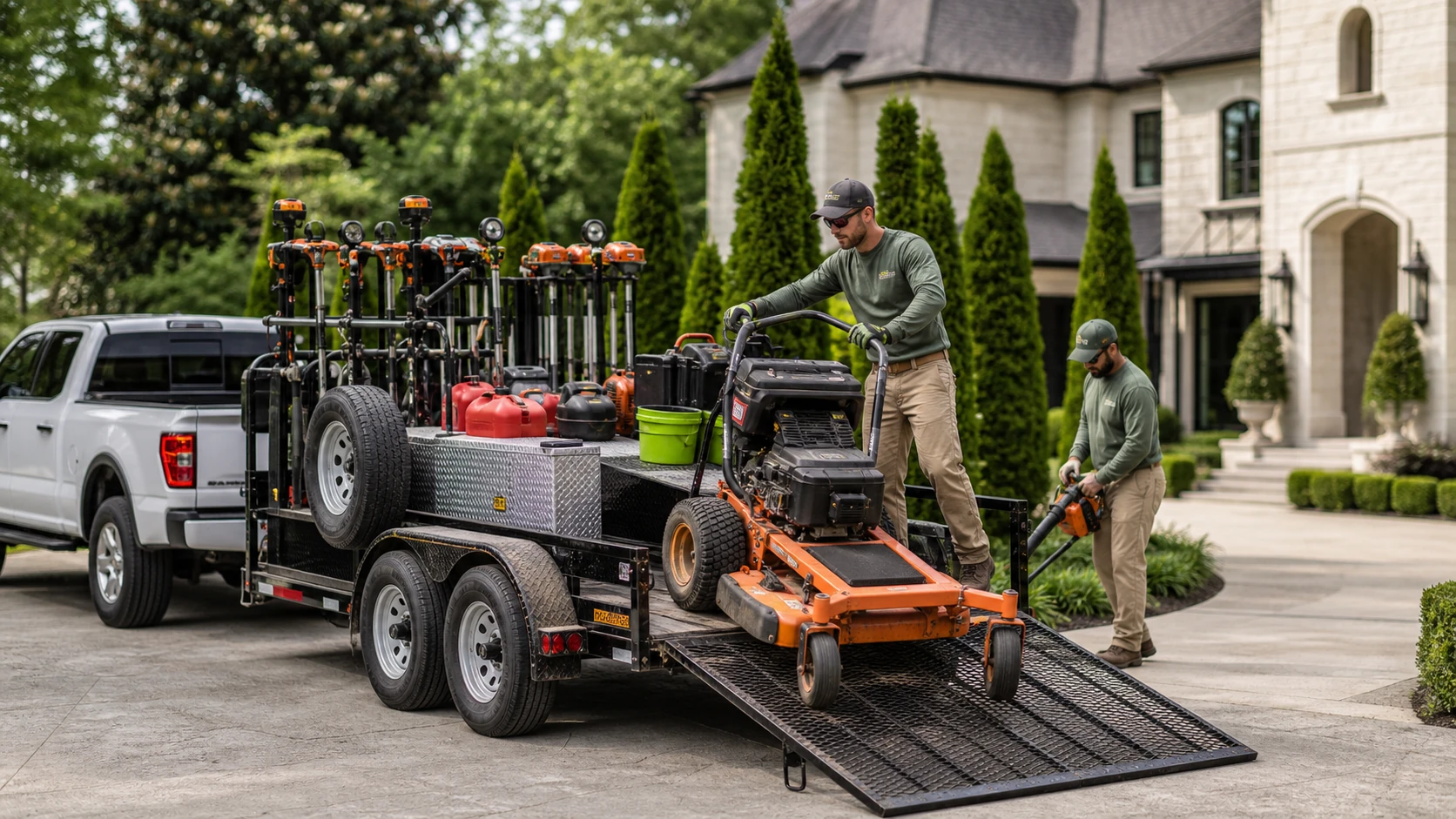
For an increasing number of commercial buyers, that is no longer where the purchase decision ends. A landscaper may need racks, storage and dedicated tie-down points. An equipment contractor may want a winch, upgraded ramps, work lights and a toolbox. A service fleet may need battery capacity, modular wiring and GPS tracking. A rental company may prioritize spare-tire access, standardized hardware and components that can be replaced quickly.
The buyer is no longer thinking only about the base trailer. They are thinking about the work platform that arrives on day one.
Market Takeaway: Commercial buyers increasingly value a trailer by how quickly it can enter the workflow—not only by how much empty deck they receive for the price.
1. A Bare Trailer Creates Work After the Sale
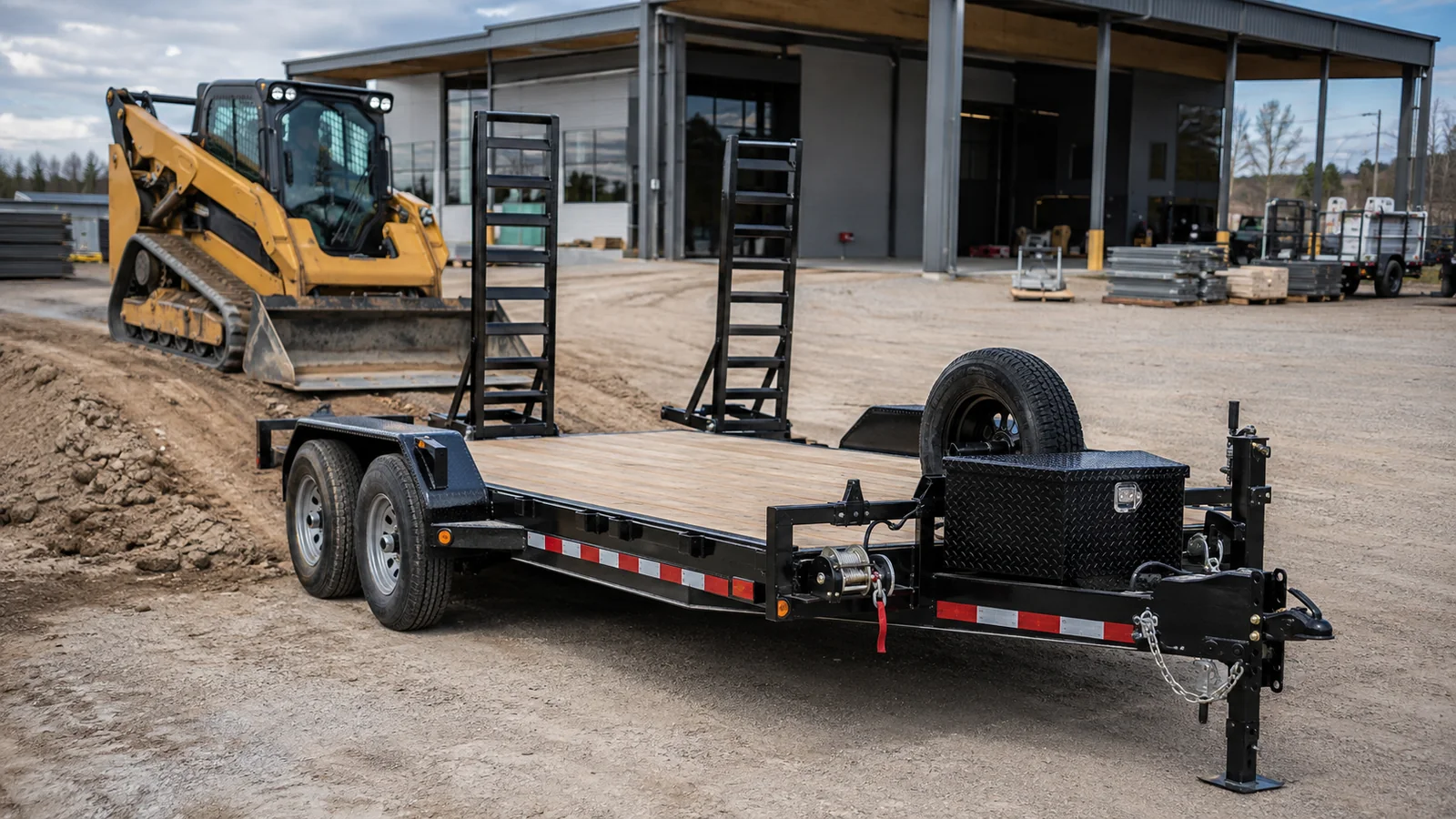
A base-model trailer can be completely functional and still be incomplete for the customer's actual job. An equipment contractor may need a winch, battery, toolbox, extra D-rings, spare tire, work lights, different ramps and rear stabilizers.
If those needs are discovered only after delivery, the customer inherits another project: selecting compatible parts, determining mounting locations, drilling or fabricating brackets, routing power, protecting wiring and checking that no change interferes with cargo, tongue load or service access.
For a hobby user, that customization may be enjoyable. For a contractor, it can be downtime. A lower purchase price is not necessarily lower total cost when the owner immediately spends money and working hours converting the trailer. The utility-trailer upgrade guide helps organize those practical needs; factory-ready and dealer-ready upfits reduce the friction.
2. Trailer Manufacturers Are Already Selling Configurability
The market does not need to wait for a formal “modular trailer” category. Configurability is already embedded in mainstream product catalogs.
Current equipment-trailer lines combine standard features with selectable D-rings, toolboxes, solar charging, winch plates and powered winches, ramp or dovetail combinations, spare tires, additional storage, powered landing gear and work lights. Several also use sealed modular wiring harnesses instead of treating the electrical system as an unstructured collection of wires.
This does not prove that every buyer wants a heavily optioned trailer. It shows that trailers are increasingly designed around configurable interfaces—the foundation required for factory-ready upfits to scale. Buyers can see the underlying platform logic across the GOODIN trailer product range.
3. “Work-Ready” Is Becoming Its Own Product Proposition
Some manufacturers go beyond a list of optional parts and design trailers around specific users. Contractor trailers combine jobsite-oriented storage, shelving, reinforced structures, ladder-rack availability and loading-door choices. Contractor-grade equipment trailers may package lockable toolboxes, spring-assisted ramps, stake pockets, rub rails and sealed modular wiring.
The individual components are not new. What changes is how the product is framed. Instead of trailer + accessories, the commercial proposition becomes trailer configured for a task.
A landscaping trailer does not need the same architecture as a skid-steer trailer, and a vehicle hauler does not need the same storage system as a mobile-service trailer. The base chassis may be similar; the work platform is not.
4. Modular Wiring Is More Important Than It Looks
One of the clearest 2026 signals comes from a component few customers admire in a showroom: wiring. Trailer manufacturers selected Optronics' plug-and-play harness kits and repair parts for NATM's Improved Towing Experience award, citing lower production labor and more reliable power delivery.
A modern trailer may need LED work lights, electric jacks, winches, hydraulic power units, batteries, chargers, cameras, GPS and telematics. If every accessory requires cutting an existing harness, adding improvised splices and rerouting power, customization becomes expensive and inconsistent. The same electrical architecture supports the capabilities discussed in our smart-trailer and telematics analysis.
A modular harness creates known connection points, allows dealers to add predefined modules and lets technicians replace sections rather than diagnose an entire improvised system. Plug-and-play architecture is therefore an upfit-enabling technology, not merely an electrical improvement.
5. Good Upfit Design Starts Before the Accessory Is Selected
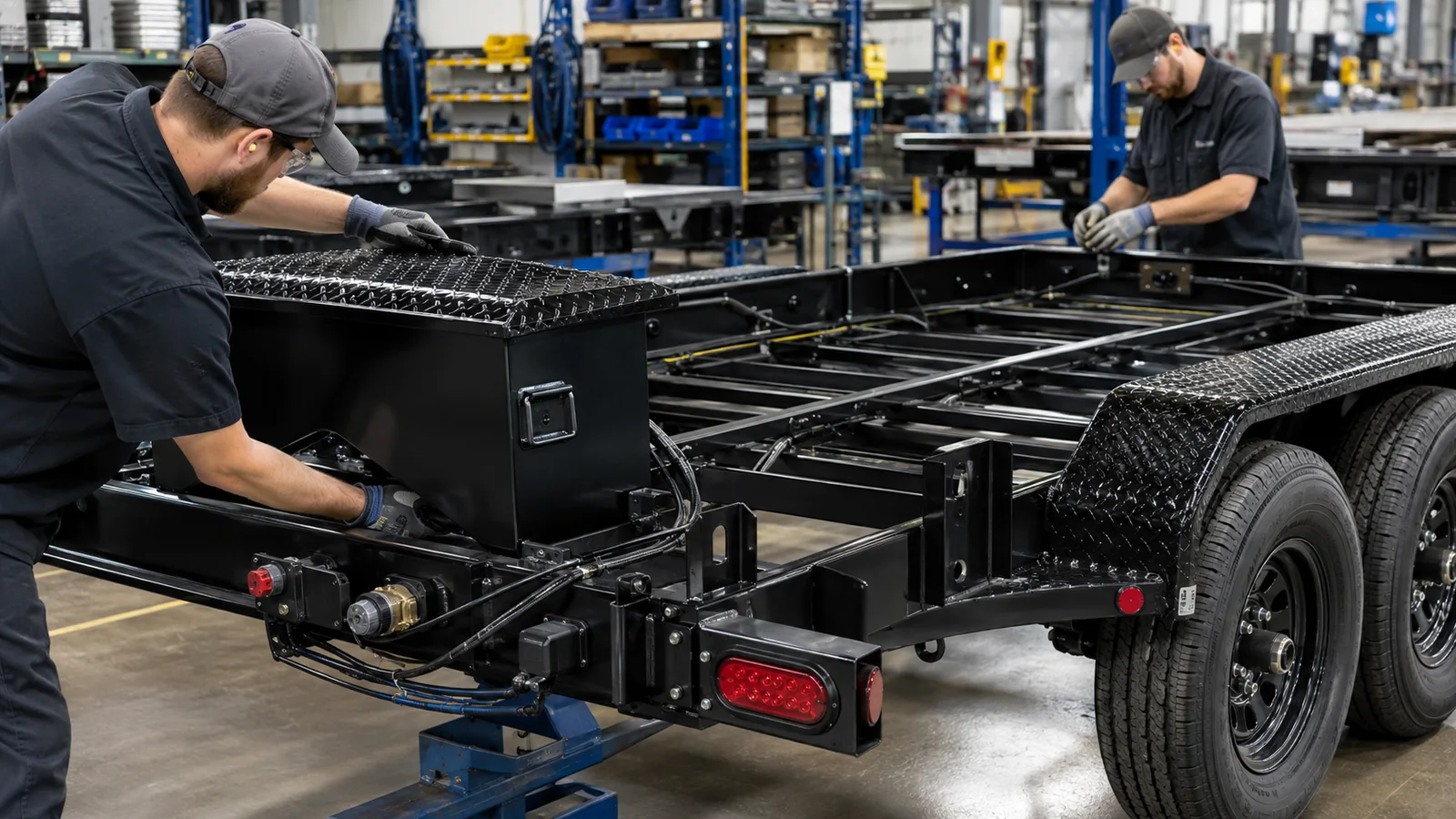
Accessories cannot simply be bolted into whatever empty space remains. A winch affects structural mounting, pulling direction, cable path, battery position, current demand, weather protection and cargo clearance. A toolbox affects tongue space, jack movement, coupler access, turning clearance, spare-tire placement and battery location.
Tie-down points must match real load geometry. A spare carrier changes service access and ground clearance. A GPS tracker needs power, signal and a protected mounting location. Weight must also be managed at system level, as the lightweight-trailer design analysis explains.
The best customization therefore begins at the architecture stage. The key question is: What interfaces should this trailer have so different work configurations can be built efficiently?
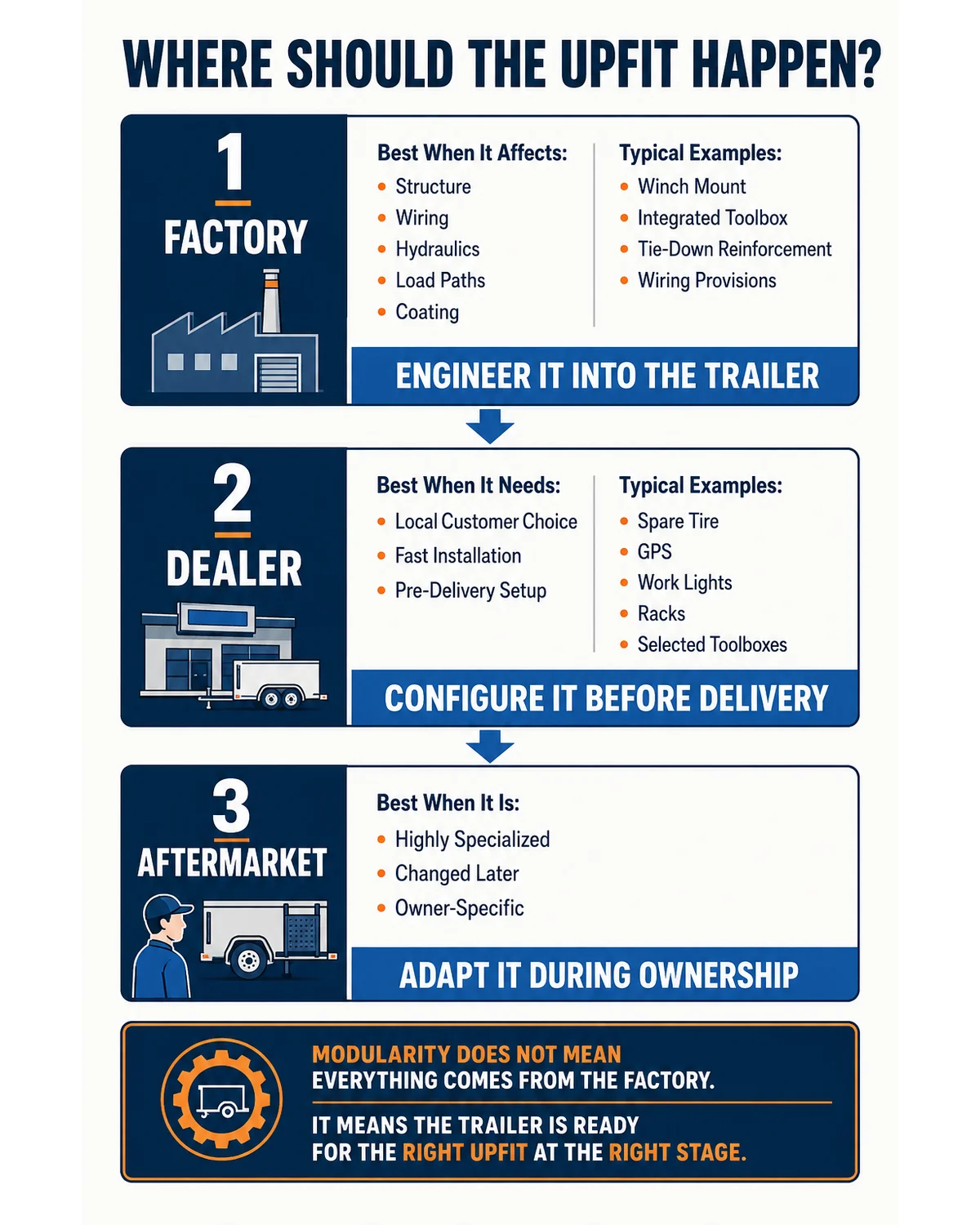
6. Factory Installation, Dealer Upfit and Aftermarket Each Have a Role
A mature trailer ecosystem needs three layers.
Factory-installed
Best for structure, wiring, hydraulics, load paths, certification and coating: winch mounts, integrated storage, wiring provisions and structural tie-down points.
Dealer-installed
Useful near delivery without major chassis redesign: spare tires, selected toolboxes, GPS, work lights, racks and some powered accessories.
Owner / aftermarket-installed
Appropriate for highly specialized equipment, changing requirements and personal preferences.
The trend is not that everything must come from the factory. It is that the trailer should accept the right accessory at the right stage without unnecessary re-engineering. That is what modularity means.
7. Dealers Have a Strong Reason to Care About Upfits
NATDA's 2026 Trailer Show sold out its exhibit floor well before the event. More than 300 exhibitors span trailers, truck beds, parts, accessories, technology and dealership services; over 750 dealerships and 4,500 professionals are expected, and 89% of surveyed dealers say the show influences buying decisions.
The diversity is revealing. A modern dealer sources the ecosystem around the trailer, not only the trailer. NATDA reinforced that direction with a dedicated 2027 Service Hub, noting that tighter unit margins and longer trailer lifespans encourage dealerships to expand repair operations and parts inventories.
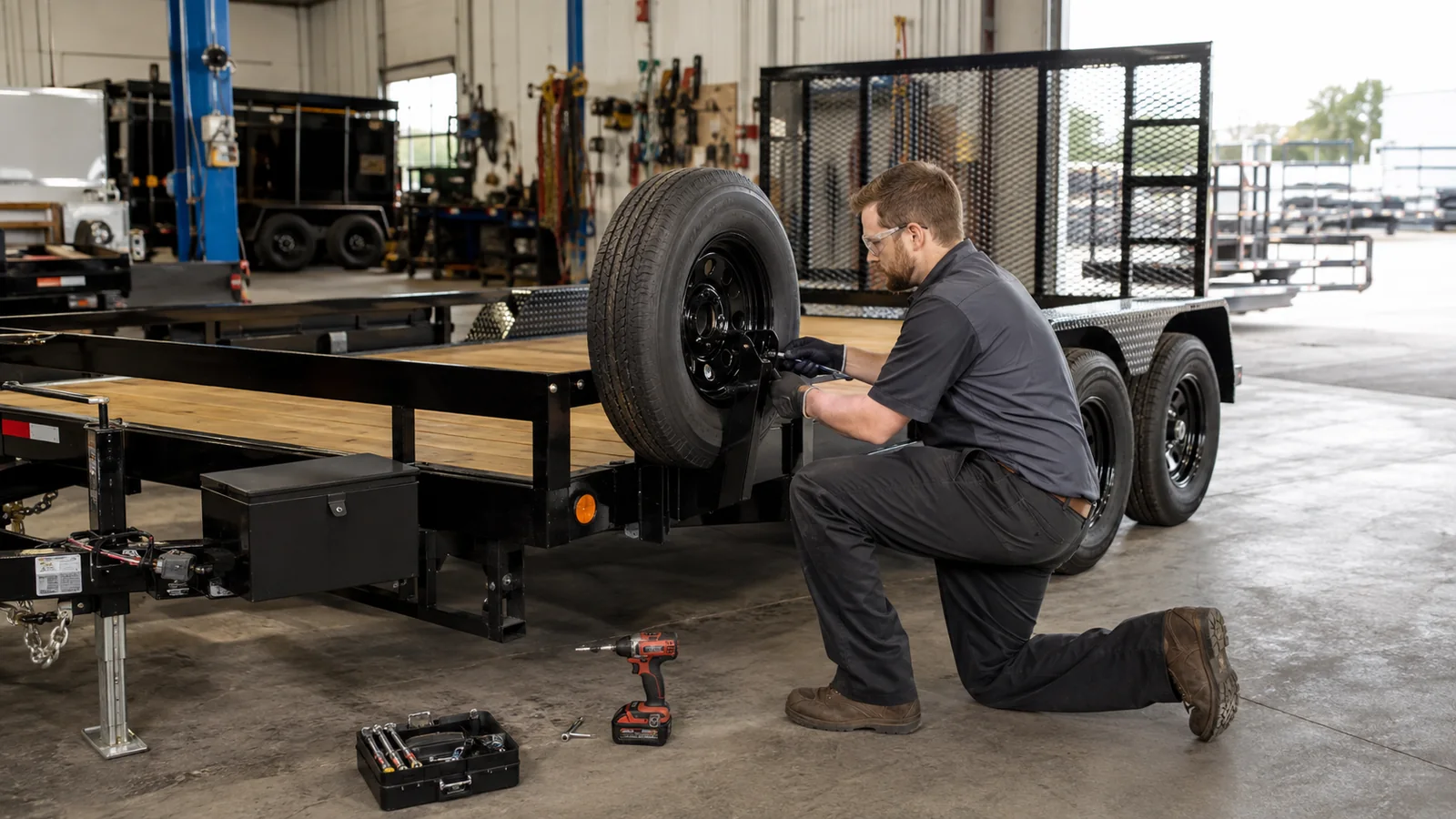
Upfits sit naturally between the original sale and long-term service. They can raise revenue per unit, distinguish similar base models, address local needs, create installation labor and future parts demand, and strengthen the customer relationship.
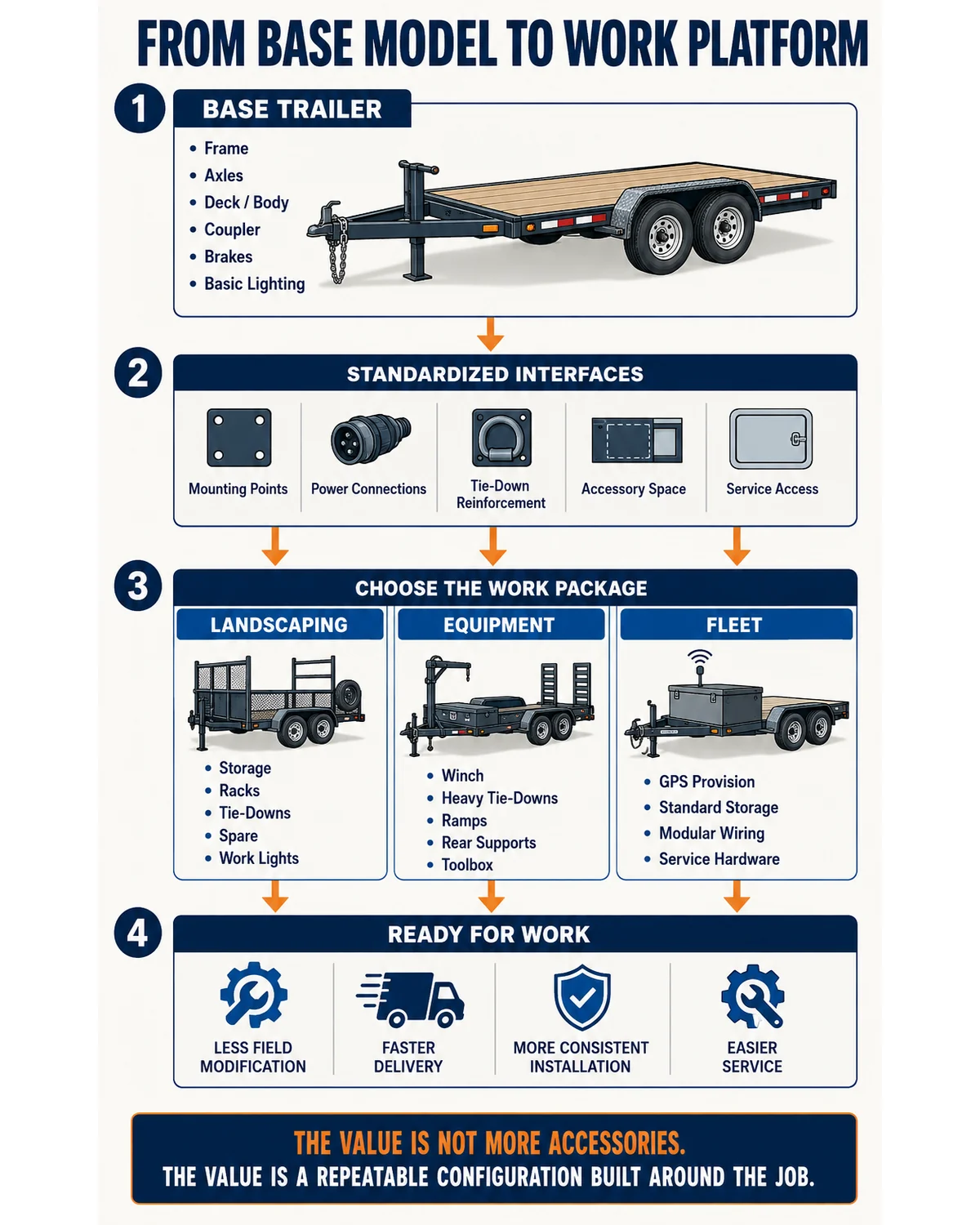
8. Option Packages Can Be Better Than Infinite Customization
Unlimited customization creates complexity across quoting, purchasing, inventory, assembly, installation, documentation, warranty and replacement parts. Thirty independent accessories can create thousands of theoretical combinations, but few manufacturers need to support all of them.
Landscaping Package
Toolbox, equipment racks, added tie-downs, spare tire and work lighting.
Equipment Package
Winch-ready structure, battery provision, heavy tie-downs, upgraded ramps and rear stabilization.
Fleet Package
Standard toolbox, spare carrier, GPS provision, modular wiring and service-friendly hardware.
Packages can still allow individual options, but they provide a tested baseline. Buyers understand the value more easily, while manufacturers control complexity.
9. The Best Accessory Is One That Removes a Bottleneck
A commercial user does not benefit because the trailer has more parts. They benefit when a component removes friction. A toolbox prevents trips back to the truck. A winch loads non-running equipment. Better ramps reduce setup time. A jack simplifies frequent coupling. Work lights extend loading conditions, a spare tire shortens roadside downtime, GPS helps manage assets and tie-downs make securement repeatable.
The value is how closely the configuration matches the workflow. That distinction prevents OEMs from adding cost and weight in the name of customization. A useful starting point is the GOODIN accessories range, but the best work platform is not the trailer with the most accessories—it is the one with the fewest missing capabilities for its job.
10. Modularity Can Improve Manufacturing, Too
The buyer is not the only beneficiary. Standardized interfaces can improve production. NATM's Optronics example matters because it links modularity with reduced labor and increased reliability.
If an OEM standardizes mounting-hole patterns, bracket interfaces, power connectors, toolbox envelopes, spare-carrier locations, tie-down reinforcement and service access, multiple configurations can share the same base process.
This reduces custom fabrication, welding after coating, field drilling, wiring rework, installation variation and service uncertainty. Accessories then stop behaving like an assembly burden and start functioning as a real modular product system.
11. Serviceability Becomes Part of the Upfit Architecture
Every accessory eventually needs inspection, adjustment or replacement. Designers should ask whether a jack can be replaced without cutting welds, a damaged harness section can be unplugged, a toolbox can be removed without disturbing critical wiring, and batteries, GPS units and common fasteners remain accessible.
NATM's recognition of both harness kits and repair parts is meaningful because the system addresses the lifecycle, not installation alone. The same principle runs through our trailer build-quality and serviceability analysis.
For a commercial user, a highly customized trailer is not productive if every minor repair requires specialist fabrication.
12. The Accessory Ecosystem Changes the Supplier Relationship
The supplier is no longer asked only, “Can you make this toolbox?” OEM teams increasingly ask whether it fits multiple trailer families, shares a standard mount, arrives as an installation kit, uses included fasteners, supports pre-terminated wiring and offers separately orderable replacement parts.
They may also ask whether one jack can serve several GVWR classes, whether brackets can be bolt-on rather than welded, and whether packaging supports dealer installation.
The component becomes part of an interface rather than an isolated object. Suppliers able to think at this level can build deeper OEM relationships.
13. Where GOODIN Fits Naturally
GOODIN products naturally sit inside this upfit ecosystem. A trailer-jack portfolio can use standard mounting interfaces and capacity levels. An aluminum toolbox range can be integrated around tongue space, batteries and work equipment. Winch hardware can be designed into a load-ready platform, while brackets, supports, spare carriers and tie-down hardware can be specified around the intended commercial load.
The B2B opportunity is not “buy more accessories.” It is helping OEMs turn a base trailer into repeatable, serviceable work configurations.
GOODIN's strongest role is to supply components that behave as parts of an engineered platform—not isolated add-ons.
14. What OEMs Should Ask Before Creating an Option Package
A useful factory-ready program should answer the following questions.
| Question | Why It Matters |
|---|---|
| Who is the end user? | Defines the workflow |
| Which accessories are repeatedly requested? | Identifies real demand |
| Which options affect structure? | Determines factory integration |
| Which need electrical power? | Defines harness architecture |
| Which can dealers install? | Reduces factory complexity |
| Can mounting patterns be standardized? | Improves modularity |
| What weight does the package add? | Protects payload |
| Are components serviceable? | Reduces lifecycle cost |
| Are replacement parts available? | Supports dealers |
| Can packages share components? | Controls BOM complexity |
This prevents an option catalog from becoming an uncontrolled list. The goal is a configuration system.
15. What to Watch Next
Five developments will show whether factory-ready upfits keep gaining importance.
- More application-specific packages: options organized around trades and workflows.
- More plug-and-play electrical infrastructure: standardized power for GPS, lights, powered jacks, winches and other electronics.
- Dealer service and installation growth: revenue beyond the original unit transaction.
- More bolt-on component design: replaceable hardware supporting factory flexibility and field service.
- More digital configuration: buyers building a work package before the trailer reaches production.
The direction is toward an industry where configuration is part of product engineering, not something that begins after delivery.
The Bottom Line
The base trailer is not disappearing. It is becoming the foundation. Commercial buyers increasingly evaluate what happens between delivery and the first working day. If the trailer immediately needs a toolbox, winch, spare, extra tie-downs, lighting, electrical work or storage, they may prefer those needs to be addressed before the asset enters service.
OEMs benefit when configurations are repeatable. Dealers benefit when upfits create differentiation, installation and service opportunities. Suppliers benefit when components are designed around standardized interfaces instead of one-off fabrication. The customer receives a trailer that already fits the job.
The next stage of customization is therefore not about adding as many accessories as possible. It is about making configuration intentional, modular and serviceable. The trailer of the future may still begin as a base model—but more buyers will judge it by how efficiently that base becomes their work platform.
Focused FAQ
What is a trailer upfit?
A trailer upfit adds or integrates equipment that prepares a base trailer for a specific use, such as toolboxes, winches, ramps, tie-downs, work lights, GPS, storage or powered accessories.
Are factory-installed trailer accessories better than aftermarket accessories?
Not automatically. Factory installation is most valuable when a component requires structural, electrical or hydraulic integration. Dealer or aftermarket installation can suit specialized or changing requirements.
Why are modular trailer accessories useful?
They simplify installation, standardize interfaces, improve serviceability and let OEMs or dealers build multiple work configurations from one platform.
What accessories are useful on a contractor trailer?
Common examples include toolboxes, winches, tie-downs, ramps, work lights, spare carriers, reliable jacks and trade-specific storage. The right set depends on the workflow.
Does customization reduce trailer payload?
Accessories add weight, so extensive upfitting can reduce available payload. OEMs should account for package weight when planning GVWR, tare and load capacity.
Why is plug-and-play trailer wiring important?
It can reduce assembly labor while making electrical systems more reliable and easier to repair. NATM highlighted both benefits when recognizing Optronics' modular harness system in 2026.
Technical References
- NATDA — The 2026 NATDA Trailer Show Floor Is Sold Out
- NATM — 2026 Smooth Operator Award Winner: Optronics
- NATDA — Service Hub Launch at the 2027 NATDA Trailer Show
- PJ Trailers — H7 10-inch Pro-Beam Super-Wide Equipment Trailer
- Big Tex Trailers — 16EH Super-Duty Tandem Axle Equipment Trailer
- Pace American — Contractor Trailers
- Appalachian Trailers — Contractor-Grade Equipment Trailers
Trailers as Productivity Tools: Why Contractors and Small Businesses Are Driving Utility and Dump-Trailer Demand
Related Article