The Build-Quality Backlash: Why Trailer Buyers Are Looking Past Features to Frames, Hardware and Serviceability
On this page
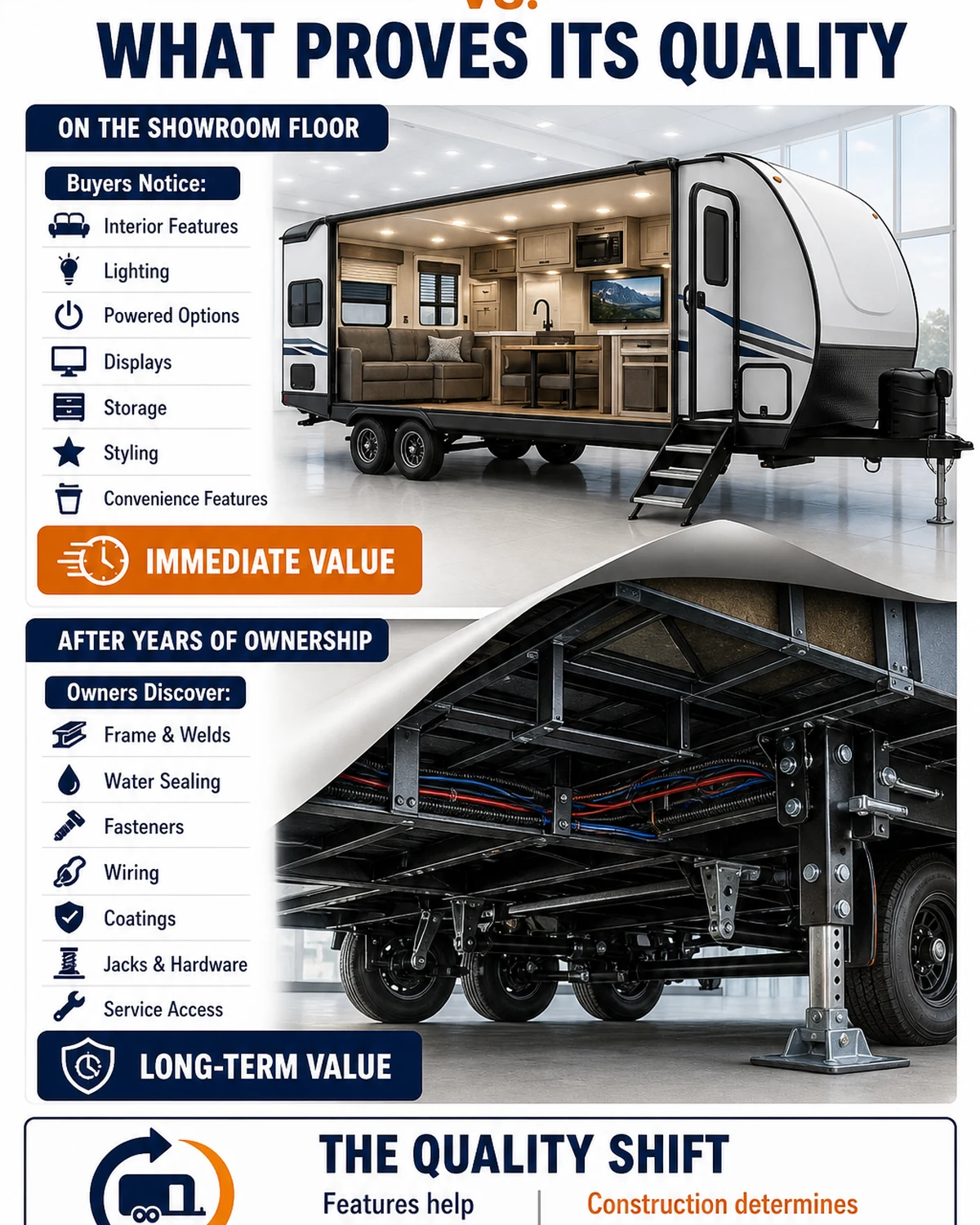
railer manufacturers have spent years adding features: more appliances, powered accessories, larger displays, smarter lighting, elaborate interiors and convenience packages.
Buyers still appreciate those things. But another conversation is growing underneath the feature list:
How well is the trailer actually built?
In 2026, buyer discussions increasingly focus on details that are difficult to appreciate in a showroom—roof seals, trim attachment, fasteners, wiring, weld quality, frame construction and whether a system can be repaired without dismantling half the trailer.
The evidence is qualitative rather than a statistical defect survey. Yet the direction is clear: a growing group of customers is becoming less impressed by what a trailer has and more interested in how the trailer beneath those features was built.
Market Takeaway: The buying conversation is resetting from feature count toward ownership value. Frames, wiring, jacks, fasteners, couplers, brackets and seals may not dominate the brochure, but they dominate the ownership experience when they fail.

1. Feature Fatigue Changes the Buying Conversation
Feature competition is easy to understand. A larger refrigerator, a powered accessory or a display is visible on the dealer lot. A better weld hidden beneath the deck is not. A thicker mounting bracket does not photograph as well as an upgraded interior, and properly protected wiring is difficult to turn into a lifestyle advertisement.
Ownership reverses that hierarchy. After several years, customers may remember little about the feature that differentiated two trailers. They remember whether the roof leaked, fasteners loosened, wiring failed, a jack became difficult to operate, hinges sagged, corrosion appeared or repairs required unnecessary disassembly.
The longer the ownership period, the more hidden construction becomes visible through performance. That is the foundation of the build-quality backlash—and it complements the weight-and-duty trade-offs discussed in GOODIN’s 2026 lightweight-trailer design analysis.
2. “Build Quality” Is Really Several Different Things
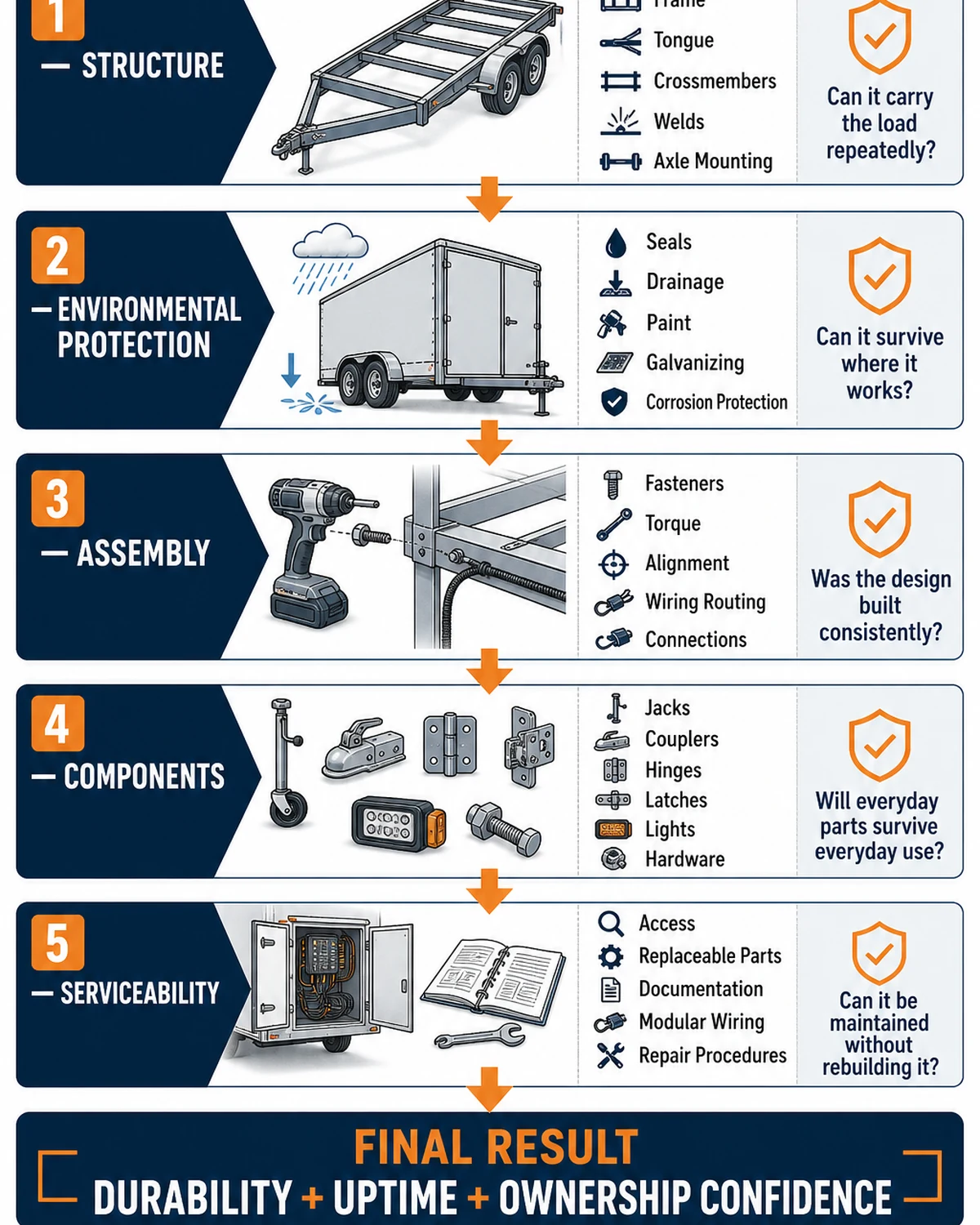
The phrase is often used too loosely. A crooked cabinet door and a cracked chassis weld may both be described online as poor build quality, but they represent very different engineering problems. A useful framework separates at least five areas.
Structural quality
Frame rails, tongue geometry, crossmembers, welds, axle mounting and load paths determine whether the structure performs as designed.
Environmental durability
Seals, drainage, coatings, galvanizing, paint preparation and material interfaces determine survival in rain, salt and humidity.
Assembly quality
Fasteners, torque, alignment, routing and production consistency determine whether a correct design is built correctly.
Component quality
Jacks, couplers, hinges, latches, lights and purchased hardware introduce their own durability limits.
Serviceability
Access, replaceable parts, modular wiring, documentation and availability determine what happens when maintenance is required.
A premium specification sheet can therefore disappoint if one layer is weak. Material choice matters, but it must be evaluated with fabrication, coating and supply consistency—the same system view used in GOODIN’s steel, aluminum and sourcing analysis.
3. Frames Are Coming Back Into the Buyer Conversation
Structural design used to be something many buyers assumed the manufacturer had handled. Online communities increasingly show buyers looking underneath. A March 2026 welding discussion attracted more than 700 votes after the owner of a new commercial flatbed trailer posted questionable fabrication and a crack near a suspension-related plate before normal use. The manufacturer reportedly agreed to cover corrective work.
Social-media discussion is not an engineering inspection, but it reveals what buyers are learning to inspect: crossmember spacing, tongue reinforcement, weld consistency, frame alignment, axle attachment, corrosion, material thickness and ratings of connected components.
That attention is relevant across the GOODIN trailer product range, because different trailer types create different load paths, duty cycles and component interfaces.

4. Small Hardware Can Create Large Quality Problems
Many expensive ownership problems begin with inexpensive parts: a loose screw, an underspecified fastener, a poorly located bracket, a hinge with inadequate corrosion protection, a wire rubbing against a sharp edge or a sealant joint that cannot tolerate movement.
RVTravel highlighted a 2026 example involving exterior aluminum sheeting and an RV Z-lock joint. Water entering the joint can corrode staples and screws, allowing exterior material to loosen during travel. Some manufacturers have responded by adding additional mechanical fastening.
A component can cost a few dollars while protecting a structure worth thousands. Fasteners, connectors, seals, hinges, latches, brackets, cable protection and jack mounts are rarely brochure headlines—but owners notice those decisions later.
5. Wiring Is Becoming a Visible Quality Signal
Modern trailers contain more electrical systems than previous generations: LED lighting, electric brakes, breakaway systems, winches, powered jacks, batteries, chargers, cameras, GPS trackers and telematics.
NATM’s 2026 Trailer Trends & Tech Showcase recognized a plug-and-play harness system partly because modular harnesses can reduce production labor while increasing reliability and simplifying repair. Better quality does not always require a more expensive part; it may come from making assembly more repeatable and less dependent on improvisation.
Protected routing, proper grommets, sealed connectors and replaceable harness sections also create the physical foundation for the monitoring and maintenance strategies described in GOODIN’s smart-trailer telematics analysis.
6. Compliance and Build Quality Are Not the Same Question
The trailer and RV industries already have meaningful compliance systems. NATM’s Compliance Verification Program provides member manufacturers with recommended practices incorporating federal standards, regulations and industry best practices, supported by onsite verification. RVIA operates an extensive standards and inspection system across safety-related requirements.
These programs matter enormously for safety and regulatory consistency. But compliance should not be confused with every dimension of perceived product quality.
A product can comply with applicable safety requirements and still frustrate an owner because an access panel is difficult to remove, a cosmetic fastener repeatedly loosens, wiring is inconvenient to diagnose, a seal demands frequent attention or replacement components are hard to source.
Safety compliance establishes the baseline. Durability, refinement and serviceability shape much of the experience above that baseline.
7. Serviceability Is Becoming Part of Build Quality
A trailer does not have to be maintenance-free to be well built. Bearings wear, brakes need adjustment, seals age and electrical components eventually fail. The better question is: what happens when maintenance is required?
A 2026 RVBusiness column argued that service delays are not simply a technician-headcount problem. Missing wiring diagrams, component locations, access instructions, torque specifications and troubleshooting information can make diagnosis and repair take longer.
A well-designed trailer should consider the technician who sees it five years later. Can a connector be reached? Can a jack be removed without cutting structure? Can a damaged harness section be replaced? Can the correct hardware be identified? These are the same ownership-value questions behind GOODIN’s customized trailer-jack solutions, where mounting, manual backup and service access matter alongside rated capacity.
8. Service Demand Makes Repairability More Valuable
Lightspeed dealer data entering 2026 showed parts and service helping stabilize dealerships while unit sales softened in several regions. That reinforces a basic product lesson: manufacturers should not treat service as something that begins only after a warranty claim.
Serviceability is a design decision. The best trailer is not necessarily the one that never needs repair. It may be the one that fails less often, makes problems easier to identify and makes normal wear easier to correct.
9. Buyers May Start Looking for Proof Instead of Promises
Terms such as heavy duty, premium construction and commercial grade mean little without evidence. Buyers can increasingly compare manufacturers through videos, owner groups, repair shops and photographs of the underside.
Useful evidence includes actual frame-section specifications, weld-process controls, crossmember spacing, coating preparation, wiring-routing photographs, sealed connector systems, hardware grades, component load ratings, corrosion tests, replaceable modules and published service documentation.
Historically, unattractive mechanical details were hidden beneath panels. In the next phase of the market, the underside may become part of the sales presentation.
10. Better Quality Does Not Mean “Make Everything Heavier”
A poorly engineered heavy frame can still create stress concentrations. A large weld is not automatically stronger than a correctly designed smaller joint. A thick bracket with the wrong load path can fail, while unnecessary material adds cost and tare weight without useful durability.
Good construction comes from engineering + material selection + process control + assembly consistency, not simply mass. The goal is not a trailer that looks overbuilt; it is a trailer where each element is appropriate for its actual duty.
11. Component Suppliers Sit Directly Inside the Quality Equation
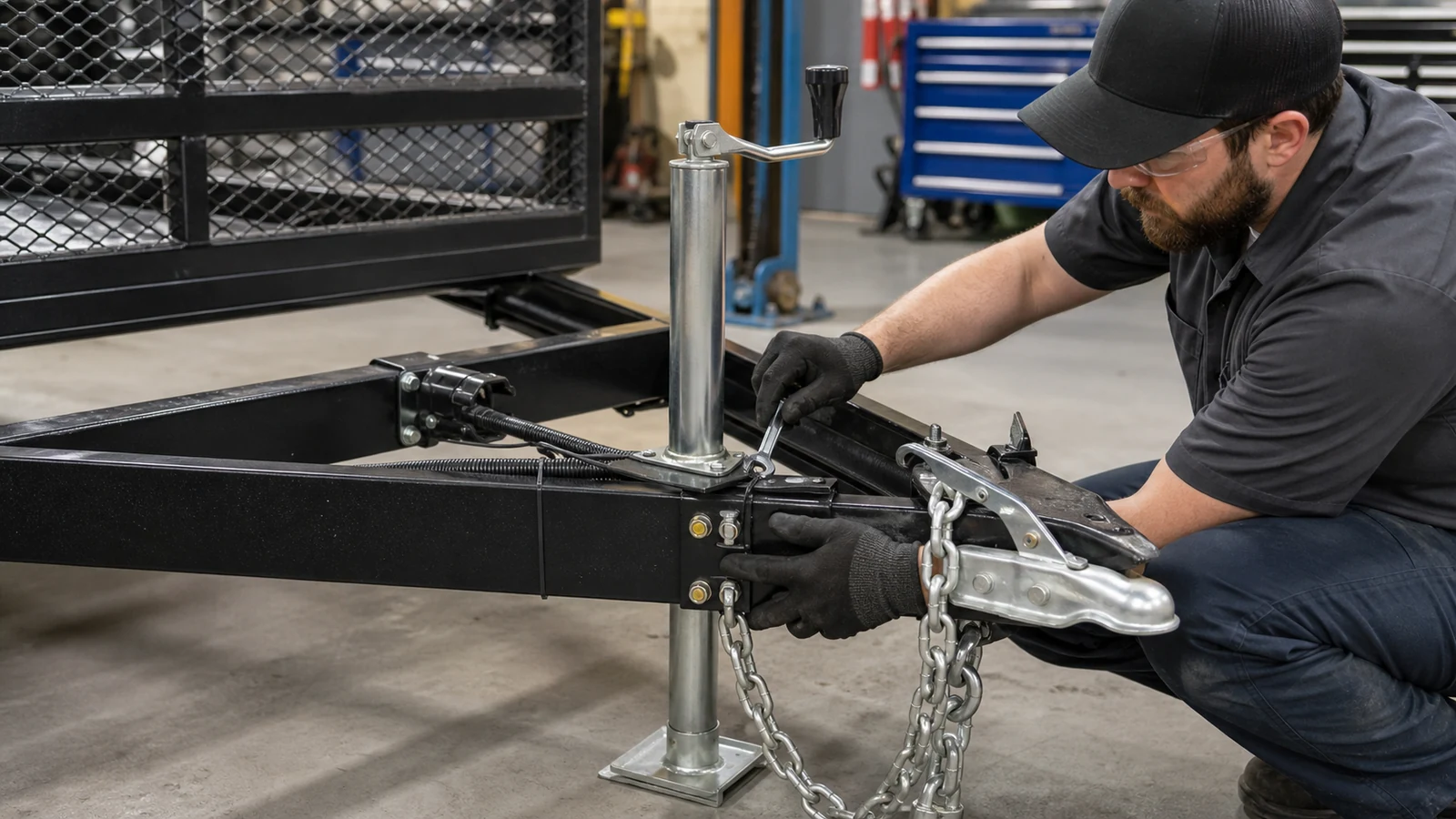
A trailer jack is rarely the visual reason someone purchases a trailer. Neither is a coupler, toolbox hinge or mounting bracket. But these products are used repeatedly through the trailer’s life and experience vibration, moisture, dynamic loading and corrosion.
Poor components make a good trailer feel cheap. Reliable components can make a simple trailer feel better built. The GOODIN trailer-jack portfolio and aluminum toolbox range show why support and storage hardware belong inside the total quality equation rather than at the edge of it.
The credible B2B position is not that one jack or hinge determines total quality. It is that long-term reliability is cumulative, and every component is one decision in that total.
12. What OEM Buyers Should Ask Component Suppliers
A quality-oriented RFQ should go beyond dimensions and price.
| Area | Questions worth asking |
|---|---|
| Structural performance | What is the rated working capacity? Which load assumptions are used? How is the mounting interface designed? |
| Materials | Which grade, thickness or section is specified? Are substitutions controlled? |
| Corrosion | Zinc plating, galvanizing or powder coating? What preparation and exposure are expected? |
| Hardware | Which fastener grade and locking method are specified? Can service fasteners be removed normally? |
| Consistency | How are welds and critical dimensions controlled? Is production traceable by batch? |
| Serviceability | Can wear parts be replaced? Is manual backup available? Are drawings and service instructions provided? |
These questions change procurement from “What is your cheapest jack?” to “Which jack will still make sense after years of use?”
13. What to Watch Next
More pre-delivery inspection
Buyers may increasingly inspect roofs, frames, seals, wiring and fasteners before accepting a unit.
Serviceability-focused design
Modular wiring and replaceable assemblies can turn repair efficiency into a product advantage.
More manufacturing transparency
OEMs investing in frame, corrosion and assembly quality have an incentive to show it.
Greater supplier scrutiny
Cost-down pressure will be balanced more explicitly against warranty, service and reputation risk.
Faster aftermarket feedback
Technicians and owner communities can expose repeated failure patterns faster than before.
The build-quality backlash remains a qualitative trend. There is no universal public Trailer Build Quality Index proving that all trailers are worsening or that every buyer has abandoned feature-driven purchasing. But a hidden cost-saving decision does not stay hidden for very long anymore.
The Bottom Line
Trailer buyers have not stopped wanting features. They are beginning to demand that those features sit on top of something worth owning.
The frame, welds, seals, wiring, fasteners, brackets, jacks, couplers and hardware all matter. When any eventually require attention, access and serviceability matter too.
Build the structure correctly. Protect it from the environment. Assemble it consistently. Use dependable components. Make it repairable. Then add the features.
For OEMs, that hierarchy may become a powerful form of differentiation. For component suppliers, it reinforces something less glamorous but more durable: the parts customers barely notice on delivery are often the parts they judge the trailer by years later.
Focused FAQ
What determines trailer build quality?
Trailer build quality includes structural engineering, frame and weld consistency, corrosion protection, wiring, fasteners, component quality, assembly control and serviceability—not simply the visible finish.
Does a heavier trailer have a stronger frame?
Not necessarily. Strength depends on material, section geometry, load paths, joint design and manufacturing quality. Additional weight alone does not prove better engineering.
What should buyers inspect on a utility trailer?
Important areas include frame alignment, tongue and crossmembers, visible weld consistency, axle mounting, wiring protection, coating coverage, coupler and jack ratings, fasteners, hinges and service access.
Are RVIA or NATM certifications guarantees of durability?
They are important compliance and safety frameworks, but regulatory compliance and long-term ownership quality are not identical. Durability, finish quality and serviceability extend beyond the safety baseline.
Why is trailer serviceability important?
Wear and repairs are unavoidable over a long service life. Accessible components, modular wiring, replacement parts and accurate technical information can reduce diagnostic time, labor and downtime.
Why do trailer hardware suppliers matter to build quality?
Jacks, couplers, brackets, hinges, latches and other hardware face repeated loading, vibration and weather. Their reliability contributes directly to the owner’s perception of overall quality.
Technical References
- Reddit / r/traveltrailers — “The build quality on these new rigs is actually a joke” (July 22, 2026).
- Reddit / r/RVLiving — “Why might someone do this?” (August 22, 2026).
- Reddit / r/Welding — new commercial flatbed trailer fabrication discussion (March 25, 2026).
- RVTravel — Z-lock, sealing and fastener deterioration (July 21, 2026).
- RVBusiness — Why “Hire More Techs” Won’t Fix the Bottleneck (May 12, 2026).
- RVBusiness — Ben Hirsch on quality and the ownership experience (August 12, 2026).
- NATM — Compliance Verification Program.
- RV Industry Association — Standards and inspection program.
- NATM — 2026 Optronics plug-and-play wiring-harness recognition.
- RVBusiness — Lightspeed reports service strength entering 2026.
Trailers as Productivity Tools: Why Contractors and Small Businesses Are Driving Utility and Dump-Trailer Demand
Powered Trailers Are Coming: How e-Axles and Onboard Energy Could Change Towing
Related Article