Section 301 Is Under Review Again: What Trailer Component Importers Should Watch in 2026
In this article
An American buyer asks a Chinese trailer-component supplier for a quotation. The reply is familiar: Trailer jack: $62. Lead time: 35 days. FOB Ningbo.
That is a starting price, not yet a sourcing comparison. Before it becomes commercially meaningful, the buyer needs to understand classification, origin, Section 301 treatment, exclusions, other applicable duties and who bears a change in cost before U.S. entry.
The second four-year review of the existing China Section 301 actions makes those assumptions worth revisiting. The practical task is not predicting Washington’s next decision. It is making today’s purchase orders workable if tomorrow’s treatment changes.

Reviewed September 10, 2026. Existing China technology-transfer Section 301 measures remain the purchasing baseline; the review itself does not cancel a duty. Confirm the current treatment for each entry.
The Review Is a Checkpoint, Not a Tariff-Removal Budget
USTR commenced the second statutory four-year review on May 6, 2026. It covers the July 6 and August 23, 2018 actions as modified by later product lists, exclusions and the first review. The first stage invited benefiting U.S. industries to request continuation; the two request windows ended July 5 and August 22.
The initiation notice says that qualifying continuation requests would lead to a further phase examining effectiveness, alternatives and economic effects. On September 10, the public Four-Year Review portal still listed only the initiation notice under the second review. No next-stage notice appeared there. That is a statement about the reviewed page, not proof that nothing has happened elsewhere.
Purchasing should not interpret the word “review” as permission to budget for repeal. USTR has stated in 2026 that the existing China technology-transfer tariffs remain in force. The first review provides a useful precedent: measures continued, while selected duties and exclusion arrangements changed. A review can preserve the broad framework and still change an individual product’s economics.
For current orders, use verified current treatment as the baseline. Keep possible changes in a separate scenario, with a named trigger for updating the model. A hoped-for removal is not a bankable saving, and a continuation request is not itself a new product-level rate.
Start With the SKU, Not “the China Tariff”
Commercially, trailer jacks, aluminum toolboxes, brackets and fasteners may all be called trailer parts. That phrase does not determine their Section 301 treatment. Classification follows the actual product’s function, design and construction; origin then determines whether the China-specific action is relevant.
USTR’s product-search tool starts with an eight-digit HTS subheading and reports the relevant action and additional duty rate. Use it as a screening resource alongside the current tariff schedule, Chapter 99 notes and applicable notices. A search result does not replace a supported classification or a detailed exclusion check.
In February 2026, USTR described existing China Section 301 rates as ranging from 7.5% to 100%, depending on the product. That broad range is not a trailer-parts rate table. Neither 25% nor any other single percentage belongs automatically on every Chinese-origin SKU.
Suppose Supplier A quotes $96 and Supplier B $103. A is about 6.8% cheaper at the quoted-price level. If the model omits a hypothetical applicable 25% duty on A’s assumed $96 customs value, it overlooks $24—more than the $7 price difference. This is not a complete supplier ranking: B’s duties and both suppliers’ other costs still need checking.
The purchasing record should therefore connect part number, supported classification, manufacturing facts, origin, price and the date of review. Customs assumptions hidden in someone else’s files cannot reliably inform a buyer’s comparison.

An Exclusion Is a Dated Cost Assumption
USTR extended 178 exclusions that had been due to expire in November 2025. The formal notice specifies November 9, 2026, at 11:59 p.m. EDT; the press release describes the extension as lasting until November 10. Preserve the legal notice’s stated timing and confirm current CBP implementation before an entry near the boundary.
These are 178 exclusions across the relevant China Section 301 measures—not 178 trailer-component exemptions. A product must satisfy the applicable description, reporting provision and conditions. An apparently matching catalog name or eight-digit heading is not enough. The exclusion removes only the specified duty, not every charge on the shipment.
USTR’s 2025 extension evaluation considered non-China availability, efforts to change sourcing and the need for more time. Procurement should treat an exclusion as temporary treatment rather than a permanent feature of a component.
For any qualifying SKU, maintain two cost cases: the currently supported exclusion case and a case without that exclusion. Record the exact description relied on, the supporting product facts and the relevant deadline. Do not assume extension, but do not forecast expiry as a certainty either; the published action then in effect controls.
Long-term pricing that crosses November needs this distinction before approval, not after the container departs.
Build One Landed-Cost Record for Each Quote
A Chinese-origin metal component may need examination under several independent systems. Section 301 coverage, relevant Section 232 treatment and product-specific AD/CVD proceedings cannot be inferred from the ordinary HTS rate alone. Equally, they should not be added mechanically: coverage, exclusions and any non-stacking rules must be checked separately.
Our Section 232 landed-cost analysis explains component-level classification and metal-related exposure. This article asks a different question: are the assumptions behind two supplier quotations comparable? The answer needs one traceable landed-cost record rather than an isolated percentage.
- Identify the SKU and specification revision, then document classification and origin.
- Record the currently applicable Section 301 action and exclusion status.
- Check other duties and their relevant valuation bases or interaction rules.
- Add freight, insurance where applicable, customs fees and logistics costs without double-counting charges already included in the quote.
- State currency, quantity, delivery term, destination and the expected entry period.
The workflow image shows review steps, not an instruction to add every trade remedy. Final landed cost includes more than tariffs; the customs value used to calculate a duty may also differ from a casually quoted unit price.
A useful comparison lets another colleague reconstruct the result. If a classification, exclusion or freight assumption changes, the team should know which SKUs and open orders require another look.

FOB and DDP Allocate Costs, Not Tariff Certainty
Under Incoterms® 2020 DDP, the seller generally handles import clearance and import duties. Under FOB, the buyer generally bears import-side clearance and duty costs. These contractual allocations do not change the government’s tariff or automatically replace statutory obligations of the importer of record.
The distinction affects how a cost change reaches the relationship. An FOB buyer may see it directly in its entry costs. A DDP seller may absorb it under the agreed price, seek a negotiated amendment or change future quotations. A tariff increase does not by itself give the seller an automatic right to rewrite a binding contract. The agreement and governing law matter.
A DDP offer should identify the named destination, price-validity period and any express duty assumptions. Confirm who can legally perform the import formalities and who will be importer of record. Calling a quotation “all inclusive” does not settle those operational questions.
FOB is a sea and inland-waterway rule, not a generic synonym for every supplier-origin shipment. For containerized deliveries handed to a carrier before vessel loading, FCA may be more suitable; choose the term to match actual delivery arrangements. The purchasing point is not to prefer one label universally, but to align price, responsibility and the physical handover.

Put the Entry-Date Gap Into the Contract
Imagine a September quotation, an October PO, November production completion and December U.S. entry. These are four different commercial events. A price agreed in September does not necessarily preserve September’s customs treatment for goods entered in December.
The relevant notice specifies the effective event and any exceptions. For the exclusion extension discussed here, the language concerns entry for consumption or withdrawal from warehouse for consumption. Do not substitute the PO date, vessel departure or port arrival without checking the actual provision.
That timing gap should be visible in the order record. An expected entry date is an assumption that can move with production delays, vessel schedules and clearance. It is particularly important when a cost case relies on an exclusion deadline.
A tariff-contingency discussion should answer:
- Which party bears a newly imposed or increased duty, and how is the increase documented?
- Does an agreed threshold trigger discussion, or an expressly defined price adjustment?
- What happens if an exclusion expires or the underlying product facts change?
- What notice, origin records and technical information must the supplier provide?
- Can volume be shifted, and what commitments for tooling, inventory or cancellation remain?
These are drafting topics for qualified commercial and trade counsel, not a ready-made legal clause. Incoterms alone do not answer every price-adjustment question. The aim is simple: allocate the risk before both parties discover after shipment that each expected the other to pay.
Qualify Alternatives Before an Order Needs Them
Finding a different country is not the same as having an executable alternative. A jack can require dimensional and load validation; a bracket may need tooling changes; a toolbox may need clearance checks. Coating, corrosion and fastener quality can all require requalification. A lower hypothetical duty does not make an unapproved component production-ready.
The excess-capacity Section 301 analysis explains why alternative manufacturing countries can also carry policy exposure. Here the more immediate issue is time: how long would a specific SKU take to switch if its landed cost moved outside the acceptable range?
Prioritize components that combine economic sensitivity with difficult substitution. Maintain drawings, approved samples, realistic capacity discussions and change-control requirements for selected alternatives. There is no need to duplicate every source or split every order evenly.
For trailer hardware, a common mounting interface can help, but matching holes alone does not establish performance or safety equivalence. Validate the complete application before approving a substitute. Include tooling, testing, freight and transition inventory when comparing the cost of keeping an option open.
Purchasing then has contingency capacity rather than a list of factories to call during a disruption. That option has value even when the original supplier remains the best production source.
GOODIN View: A Useful Quote Shows Its Assumptions
Questions about manufacturing location, materials and origin are not necessarily signals that a customer wants to leave China. They can mean the importer is trying to make its landed-cost model and customs records defensible. A supplier can support that work without claiming authority over the customer’s final U.S. classification.
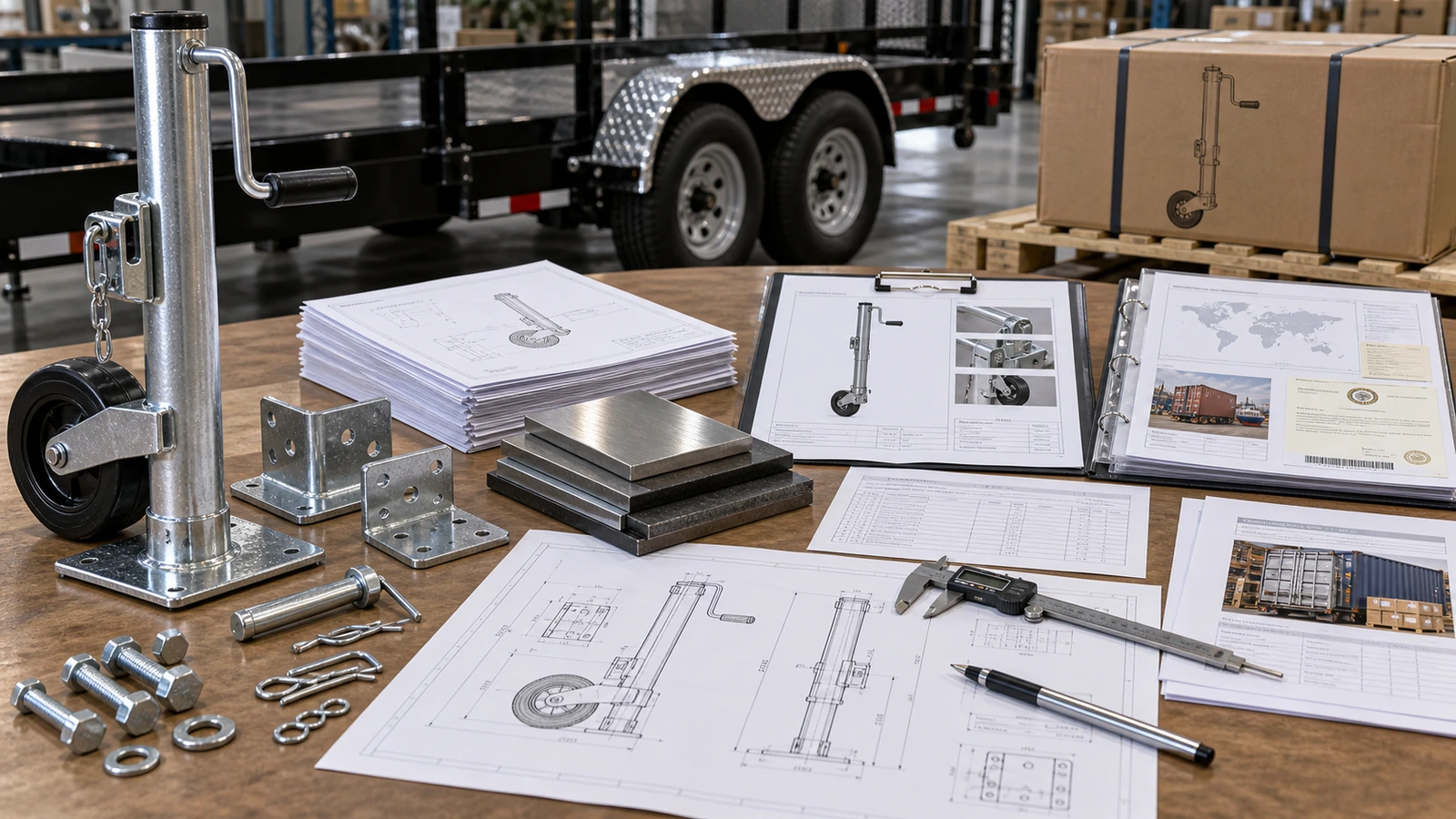
For GOODIN, the useful package links a stable part number and revision to the product’s function, construction, principal materials, dimensions, weight, manufacturing facts and consistent shipment documentation. Relevant origin and material records should support the stated facts. A generic certificate or an unexplained tariff code is not a substitute for technical evidence.
The stronger response is: your customs professionals should determine the applicable U.S. treatment; here is the information they need to review the product. That is more helpful than simply referring every question back to the broker.
GOODIN View: tariff assumptions determine whether a supplier quote is commercially meaningful. Show the present landed-cost case, any exclusion dependency, the entry-period assumption and the agreed owner of a change in cost. Keep possible future treatment separate from duties payable now.
The next review notice and the November exclusion deadline both deserve attention. Neither requires a purchasing strategy built around a prediction. The real improvement is a process that can update its numbers, honor its commitments and use qualified alternatives when necessary.
Importer questions
Are China Section 301 tariffs still relevant during the review?
Yes. The review itself does not cancel the existing technology-transfer measures. Check the current classification, origin, Chapter 99 provisions and applicable notices for each entry.
Does every Chinese trailer component carry 25%?
No. Treatment is product-specific. USTR’s February 2026 statement described a wider range across China Section 301 products, not a universal trailer-parts rate.
How should an importer check coverage?
Start with a supported HTS classification. USTR’s eight-digit search identifies actions and rates; the current tariff schedule, legal notes and exclusion descriptions remain necessary.
When do the 178 exclusions expire under the current extension?
The formal notice specifies November 9, 2026, at 11:59 p.m. EDT. Check the controlling notice and CBP instructions near the deadline; not every trailer part qualifies.
Does DDP remove the buyer’s tariff risk?
DDP generally allocates import duties to the seller, but does not remove the duty or settle every statutory and contractual issue. Verify the importer-of-record arrangement, price validity and any change-in-duty clause.
Sources & Further Reading
Regulatory information is current to the review date. Classification, exclusion eligibility and duty liability depend on the merchandise, origin, relevant entry date and Chapter 99 provisions. Consult qualified customs and legal professionals for a specific transaction. Illustrations and numerical examples are hypothetical.
- USTR / Federal Register — Initiation of Second Four-Year Review Process — May 6, 2026Accessed September 10, 2026
- USTR — China Section 301 Four-Year Review portalAccessed September 10, 2026
- USTR — How to Navigate the Section 301 Tariff ProcessAccessed September 10, 2026
- USTR / Federal Register — Product Exclusion Extensions — December 1, 2025Accessed September 10, 2026
- USTR — Statement on Supreme Court IEEPA Decision — February 20, 2026Accessed September 10, 2026
- USTR / Federal Register — Final Modifications Following the First Review — September 18, 2024Accessed September 10, 2026
- International Chamber of Commerce — Using Incoterms® 2020 to Manage Tariff Risk — April 2025Accessed September 10, 2026
- ICC Academy — Place of Delivery and Risk Transfer in International Trade ContractsAccessed September 10, 2026
CBAM Is Now Real: What Europe’s Carbon Border Rules Mean for Steel and Aluminum Trailer Components
The Next Tariff Wave? Why USTR’s 2026 Excess-Capacity Investigations Matter to Trailer Manufacturers
Related Article