The Next Tariff Wave? Why USTR’s 2026 Excess-Capacity Investigations Matter to Trailer Manufacturers
In this article
For much of the past decade, trade-risk diversification followed a familiar playbook: a U.S. buyer concerned about China tariffs moved production to Vietnam; a manufacturer seeking shorter lead times added Mexican assembly; another purchasing team qualified suppliers in India or Southeast Asia. The assumption was that a different country would mean a different risk profile.
USTR’s March 11, 2026 structural excess-capacity investigations challenge that assumption. They cover 16 economies and manufacturing sectors that include transportation equipment, steel and machinery. For trailer OEMs, the immediate question is how a sourcing network would perform if policy changed across several regions at once.
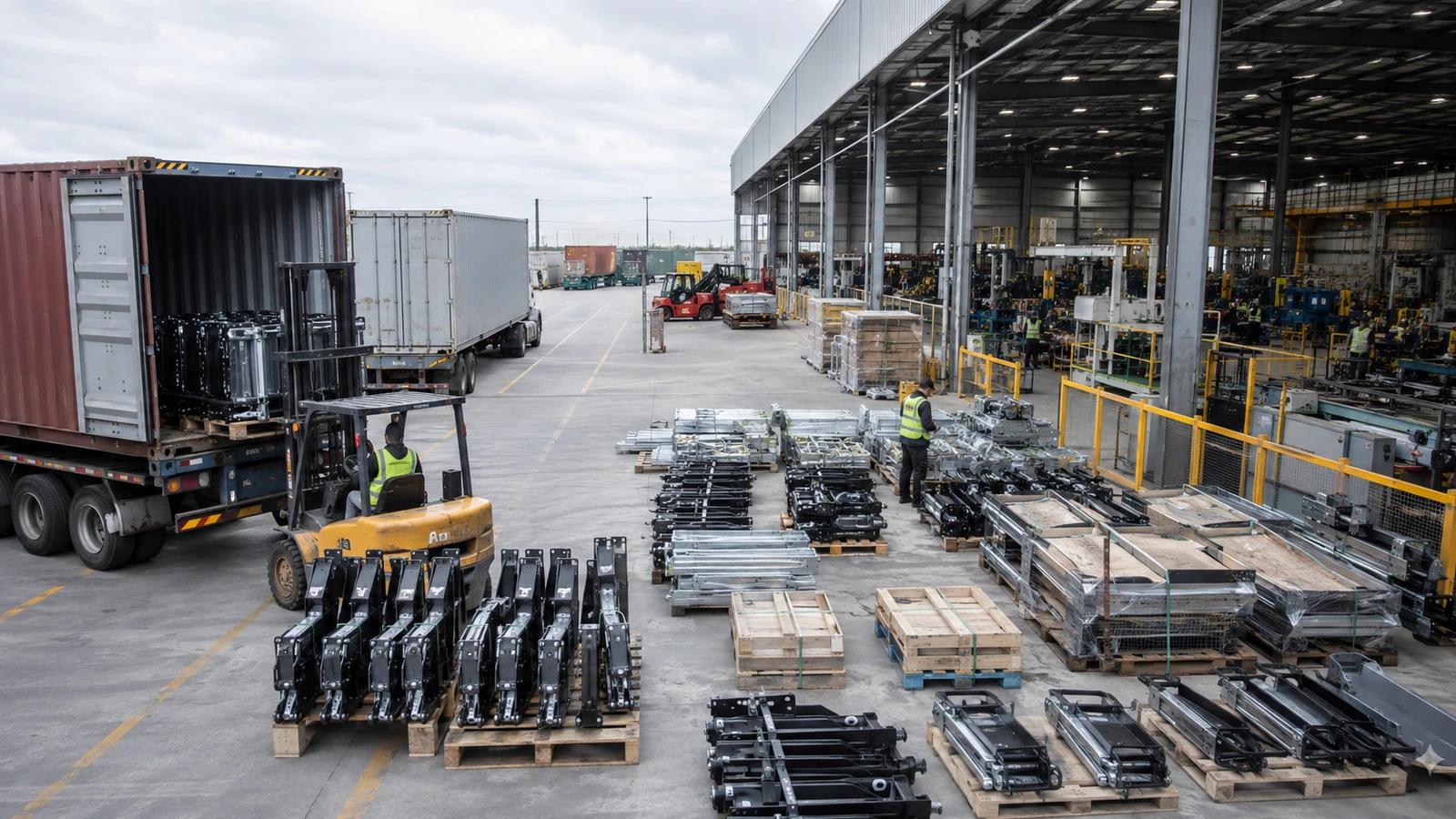
Status checked September 8, 2026: no final determination or new tariff schedule was identified in the reviewed USTR materials for this specific excess-capacity proceeding. An investigation is not an enacted duty.
What USTR Is Investigating—and What It Has Not Decided
USTR is examining government practices that may support manufacturing capacity and output beyond what market demand would economically sustain. Its distinction is between structural excess capacity and the ordinary cyclical underutilization that can occur during a recession. A slow factory is not, by itself, proof of an actionable practice.
The agency identifies possible interventions such as subsidies, subsidized lending, non-commercial state-enterprise activity, market-access barriers, wage or consumption suppression, financial and currency practices, and inadequate environmental or labor protections. These are matters under investigation, not findings that every supplier benefits from them.
The economies named are China, the European Union, Singapore, Switzerland, Norway, Indonesia, Malaysia, Cambodia, Thailand, South Korea, Vietnam, Taiwan, Bangladesh, Mexico, Japan and India. Canada is absent from this particular list. That absence is not a general assurance about other trade measures.
Steel, aluminum, automobiles, batteries, machinery, machine tools, electronics, robotics, ships and transportation equipment appear in the illustrative sector discussion. This is not a final product-level tariff schedule. The investigation asks whether the practices burden or restrict U.S. commerce and what response, if any, should follow.
As of the review date, the USTR case page contains the initiation notice, hearing materials and comment information; the official materials reviewed did not identify a final excess-capacity determination or new duty schedule. Inclusion does not establish wrongdoing, identical treatment among economies or tariffs on every sector.
China+1 Becomes a Starting Point
GOODIN distinguishes supplier diversification from trade-policy diversification. An OEM with factories in China, Vietnam and Mexico may reduce disruption at one plant while retaining exposure to a common policy process. More suppliers can improve operations without making the policy risks independent.
Consider a buyer of fabricated steel brackets. A Vietnamese offer may improve logistics, price or supply availability compared with the current Chinese source. But Vietnam is itself included in the new investigation. A sourcing decision based only on today’s duty difference would leave an important assumption untested. This does not make Vietnam unsuitable or mean its brackets will receive a new tariff.
A change of sourcing country can reduce geographic concentration. It does not automatically remove trade-policy exposure.
Mexico remains attractive for proximity and industrial integration. Its inclusion in this proceeding is separate from the USMCA review. Preferential origin and an additional trade remedy are different questions; assembly location cannot be used as a universal answer. The USMCA origin analysis examines that distinction without treating regional assembly as automatic immunity.
The practical purchasing question becomes: which alternatives remain usable if treatment changes in several countries at once? Look at actual manufacturing, product and material origin, available capacity, common upstream dependencies, qualification time and switching cost. A new invoice address or transshipment route is not the same as a new manufacturing source. The network illustration represents genuine sourcing alternatives, not a method of changing origin on paper.

Why the Trailer Industry Is Already in the Debate
Transportation equipment connects USTR’s manufacturing discussion to trailers, but the exposure is not limited to complete units. An OEM may depend on imported steel sections, aluminum sheet, axles, suspension, jacks, landing gear, couplers, brakes, wiring, toolboxes, fasteners and fabricated assemblies. Policy effects can therefore enter at several levels of the bill of materials.
A domestic trailer factory may have no imported finished trailers in its purchasing records and still be sensitive to changes in input costs or availability. Machinery used to make the product can also matter. The relevant map is the production system, not simply the customs category of the final trailer.
There is already a concrete industry connection. USTR held public hearings on May 5–8. In its May 14 account, the Specialized Carriers & Rigging Association (SC&RA) reported that Mike Appling, CEO of LiftHigh Cranes & Rigging, testified on its behalf about tariff effects on smaller businesses. The association explicitly discussed cranes, trailers, parts and steel inputs.
That participation is evidence of stakeholder concern, not confirmation that USTR has selected trailer products for a final action. Nor should one specialized-equipment association’s requests be presented as the unanimous position of all trailer manufacturers. The value of this testimony is that it shows how a broad manufacturing investigation can affect actual equipment purchasing and production decisions.
Two Industry Voices, Different Priorities
SC&RA sought zero Section 301 treatment for EU, Canadian and Japanese cranes, trailers and parts; proportionate Chinese tariff treatment; limits on Section 232/301 stacking for specified products; and a 24-month transition for certain new crane and trailer duties, with protection for existing commitments. It also requested relief for specific ultra-high-strength steels that it said were unavailable domestically in sufficient quantities.
These are advocacy requests, not granted exclusions or approved transition periods. SC&RA’s inclusion of Canada in its requests must not be confused with the investigation’s 16-economy list, which does not include Canada. The geographic scope of a stakeholder’s proposal can be wider than that of this proceeding.
CAST, the Council on American Steel Trade, stresses the downstream side from another direction. Its May 29 post-hearing account argues that steel embedded in machinery, vehicles and fabricated products can displace domestic steel demand much as direct steel imports do. It asks policymakers to examine steel-intensive goods as well as raw metal and advocates responsive measures. These are CAST’s positions, not USTR findings.
For trailer OEMs, the tension is practical: protection sought for an upstream industry can raise costs for downstream manufacturers using specialized imported inputs. The question is where a possible action would stop along the chain—metal, fabrication, components or finished equipment. Our van-trailer AD/CVD scope analysis addresses an existing product-scope proceeding; this excess-capacity discussion must not be treated as an extension of that case’s coverage.
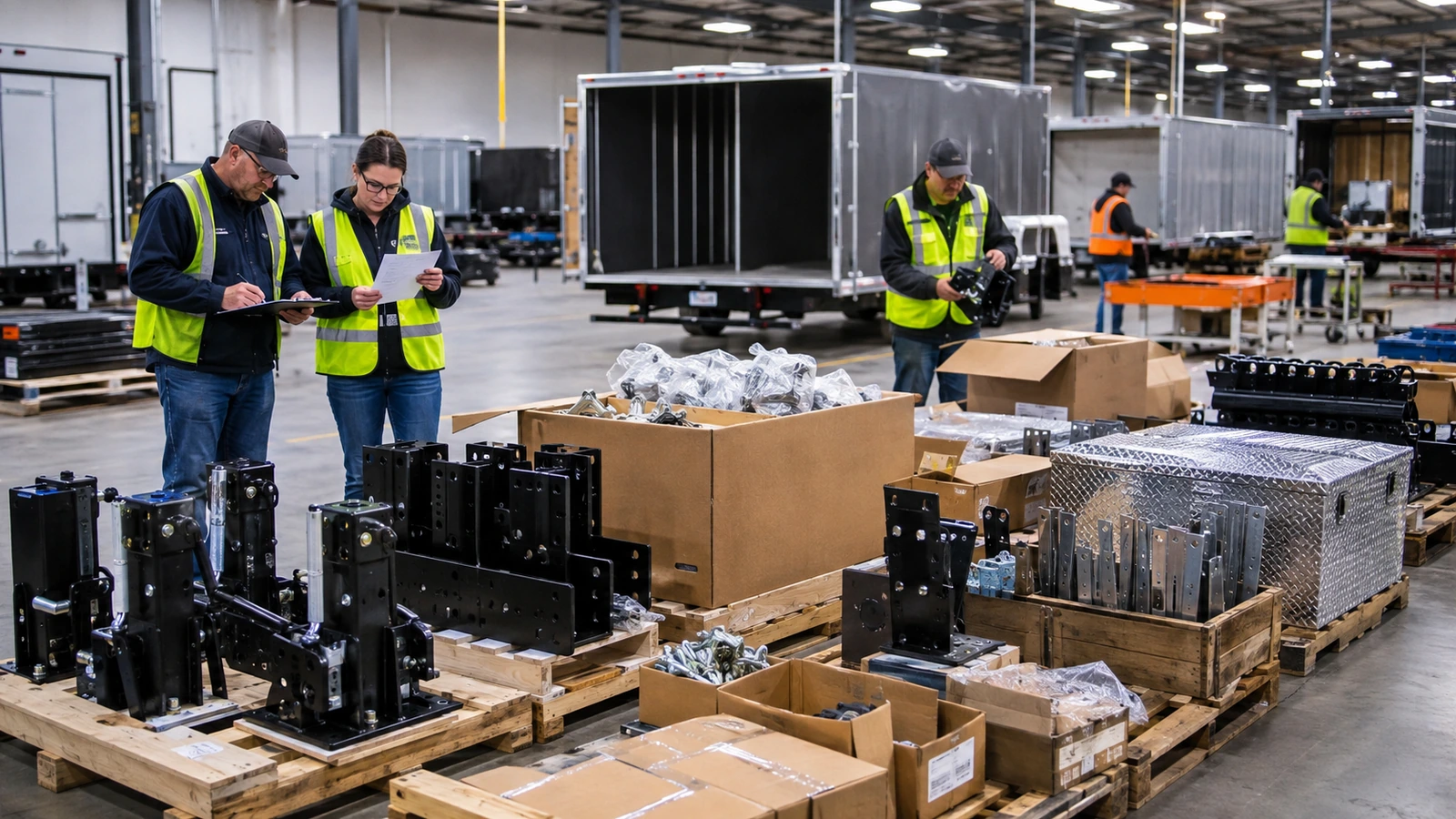
A Trailer Jack Reveals Six Layers of Sourcing Risk
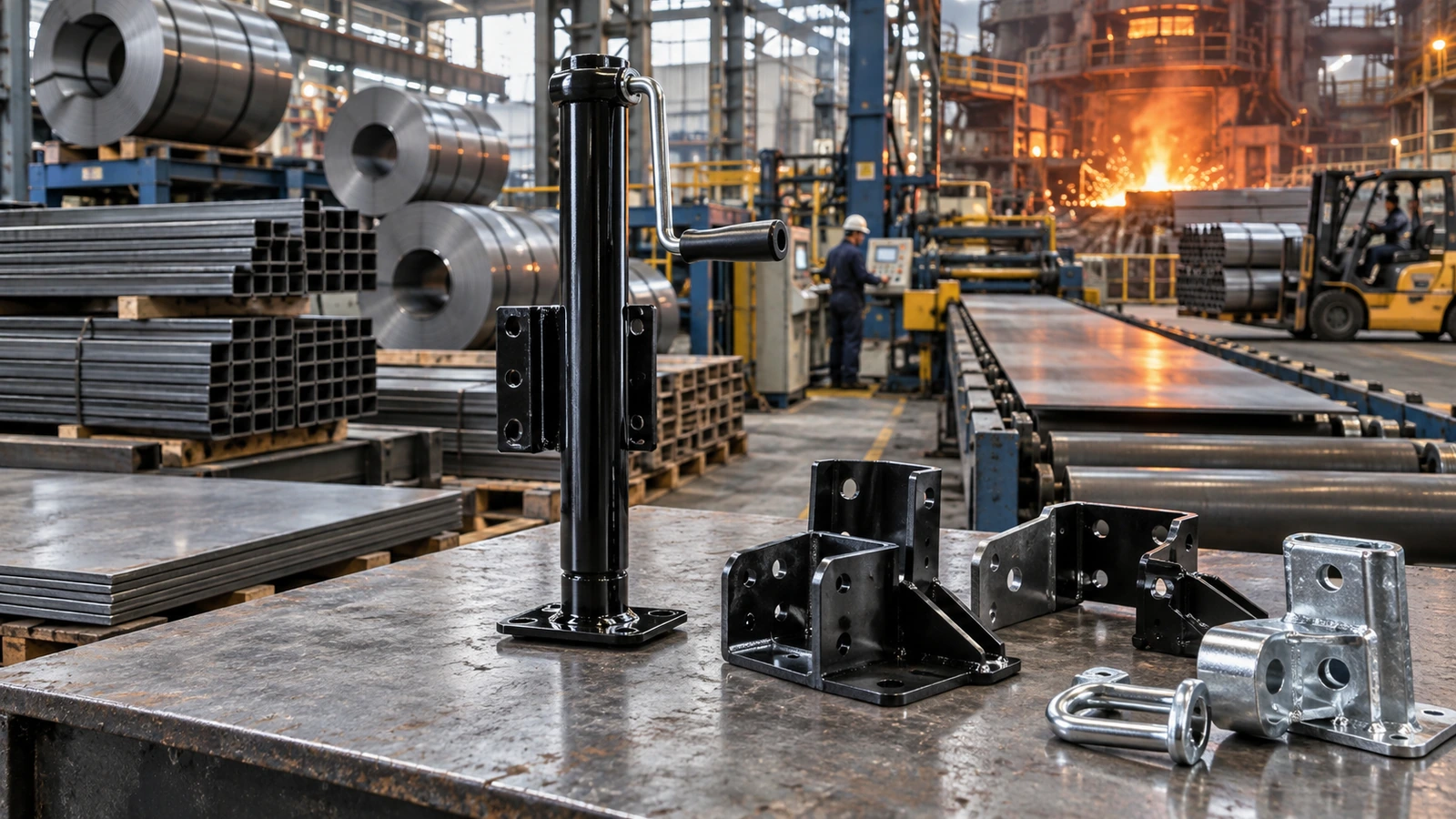
Take a trailer jack. Engineering still needs to evaluate capacity, lift, tube dimensions, coating, weld quality and service access. Purchasing still needs a price, minimum order quantity and reliable lead time. Policy risk adds questions; it does not replace those fundamentals.
- Country: Where is the manufacturing operation, and which policy processes could affect it?
- Product origin: Which origin rules apply to the actual production facts, rather than the invoice address?
- Material origin: Can relevant steel or aluminum inputs be traced where a measure requires it?
- HTS classification: What is the product’s supported classification, rather than a generic catalog label?
- Trade-policy exposure: Which duties apply now, and which separate investigations are only potential future exposure?
- Supplier switching cost: How long would an alternative take to qualify, and would substitution require redesign?
The six-factor graphic is a decision framework, not a scorecard ranking countries or estimating the probability of tariffs. There is no new universal rate to plug into it. The Section 232 landed-cost analysis covers component classification and landed cost in more detail; this article focuses on whether the sourcing arrangement remains workable as policy changes.
A low-price jack can become expensive if replacing it requires new weldments, tooling or validation. A more expensive alternative may still be valuable as a qualified contingency. Conversely, a second supplier provides little resilience if both depend on the same upstream factory. Assess the dependencies behind the quote.
The Competitive Value of a Switchable BOM
A single factory, tooling package and large-volume order can deliver an attractive unit cost. It can also make the OEM slow to respond when policy or supply conditions change. Selected interchangeable components create options before a disruption forces an engineering project.
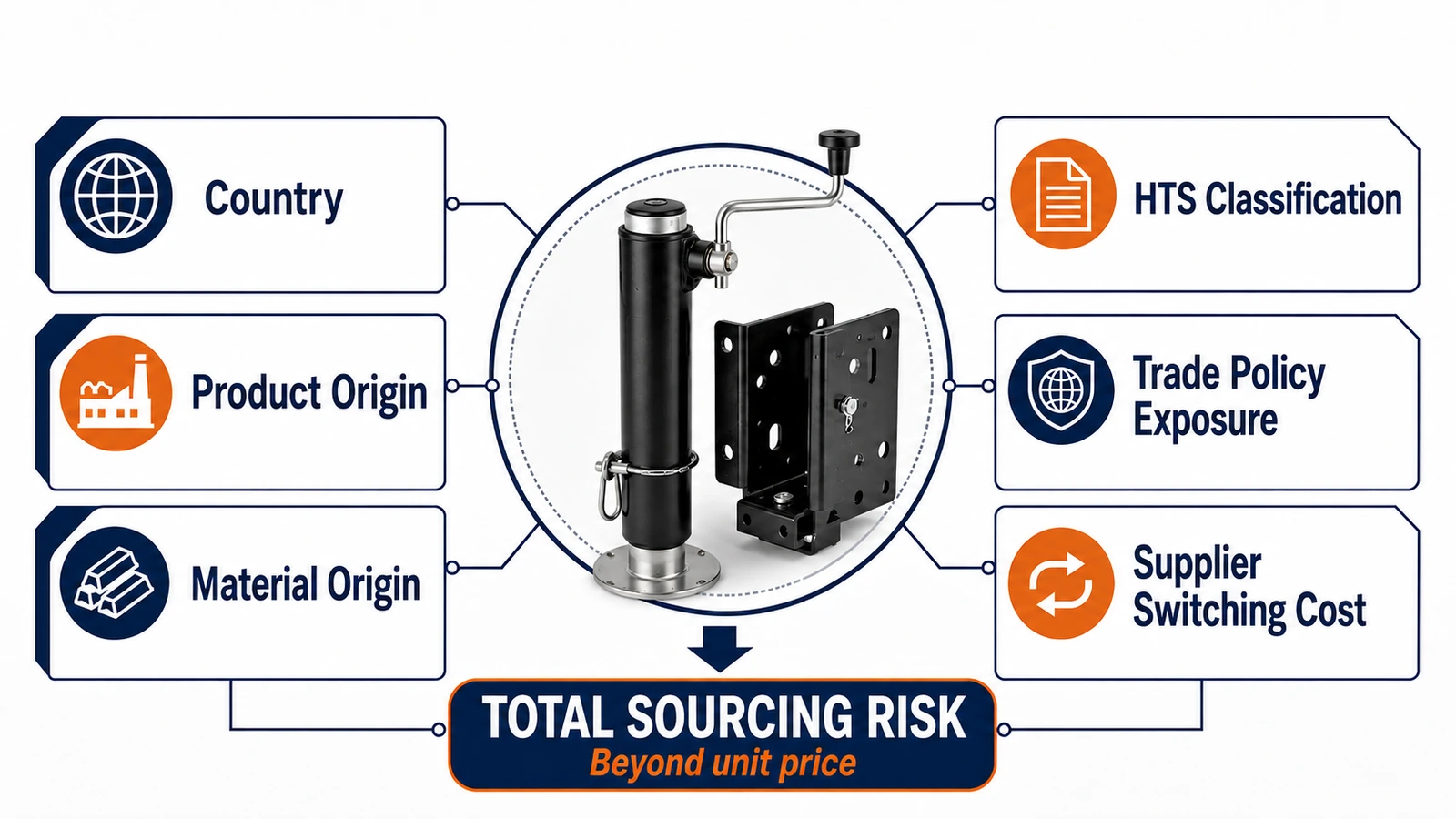
An OEM might qualify two compatible jack designs, more than one bracket fabricator, alternative hardware sources or regional and overseas toolbox options. The aim is not to duplicate every supplier. Focus on parts where interruption would stop production, qualification is lengthy or policy-sensitive purchasing assumptions are especially important.
For trailer hardware and aluminum toolboxes, compatible envelopes and mounting interfaces can reduce the work involved in a future change. Compatibility must be verified: similar appearance or matching bolt holes do not establish equal load performance, travel, clearance, corrosion resistance or serviceability. Drawings, samples and the relevant validation should support the approved alternative.
Identify the BOM items whose interruption would hurt production most, and make those items easier to switch.
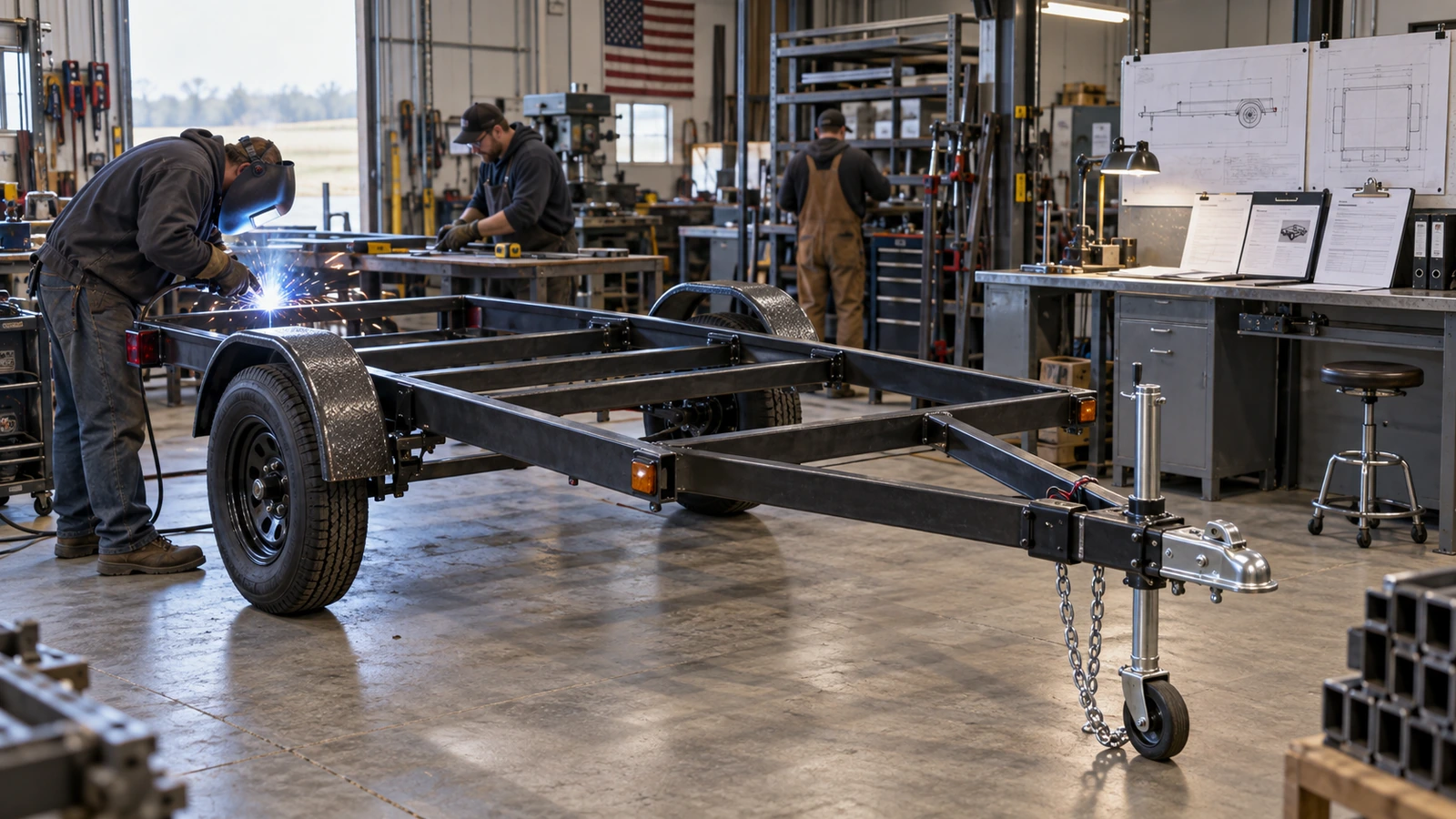
A second source need not receive half the volume to have value. A maintained specification, qualified sample, understood tooling arrangement and realistic capacity discussion can shorten reaction time. The engineering workbench image illustrates interface planning; it is not a certification that arbitrary jacks can be substituted safely.
The business case should compare the cost of maintaining an option with the likely operational consequences of losing it. Tooling, testing, freight, inventory and change control belong in that comparison alongside price.
What to Watch Before a New Tariff Exists
USTR’s May 5–8 hearing and subsequent submissions are process milestones. The next meaningful developments would be findings, proposed or final responsive action, product coverage, origin treatment, effective dates and any transition provisions. Public arguments for action should not be converted into a payable duty before the legal documents establish it.
For investigations of this general type, the ordinary 12-month determination timetable in 19 U.S.C. §2414(a)(2)(B) points from the March 11 initiation into March 2027. This is a statutory timetable, not a forecast of an announcement date or a guarantee that action will wait until then.
Other Section 301 proceedings must be tracked separately. The forced-labor investigations and this excess-capacity case have different records and legal decisions; action in one cannot supply a missing tariff schedule in the other. Likewise, Section 232, AD/CVD and USMCA each answer different questions about the same sourcing program.
USTR has also scheduled a G20 Trade Ministerial in Milwaukee for September 30–October 1, with structural excess capacity among the announced topics. That keeps the issue on the policy agenda, but the meeting itself does not impose a customs duty.
Purchasing teams should preserve the assumptions behind current quotes and decide which specific published change would trigger a review. Country names alone are too coarse a signal. An actual product list, origin provision or effective date can support a much more precise response.
GOODIN View: Build Policy Resilience Into the Next Program
Map country concentration at important Tier 1 and Tier 2 inputs. Identify proprietary tooling, unique mounting dimensions, long validation periods and customer approvals that would delay a switch. Separate a supplier’s manufacturing efficiency from savings that depend on today’s tariff treatment. Improve origin and material traceability, and qualify alternatives for the selected components that matter most to production continuity.
For GOODIN, a stronger supplier proposition combines stable specifications, repeatable part numbers, clear product descriptions, manufacturing information, material records and dependable drawings. Compatible interfaces and tooling continuity make the technical record more useful when a buyer’s requirements change. The aim is to support the OEM’s analysis, not to promise that a particular source is immune from future trade action.
China remains a substantial manufacturing ecosystem with capabilities in fabrication, tooling and production scale. The investigation does not eliminate those capabilities. It does mean that a sourcing proposal built entirely around the lowest current unit price may fail to address the buyer’s longer-term uncertainty.
China+1 is becoming a starting point. The more durable strategy combines usable alternatives, traceable production, verified component compatibility and an understanding of current versus possible trade exposure. Country diversification has value; its value grows when the OEM can actually execute a switch.
Questions from trailer buyers
Has USTR already imposed new excess-capacity tariffs?
No final determination or new tariff schedule under this specific proceeding was identified in the USTR materials reviewed as of September 8, 2026. Separate trade measures must be checked independently.
Which economies are covered?
China, the EU, Singapore, Switzerland, Norway, Indonesia, Malaysia, Cambodia, Thailand, South Korea, Vietnam, Taiwan, Bangladesh, Mexico, Japan and India.
Is Canada included?
Canada is not on this proceeding’s 16-economy list. Its appearance in SC&RA’s relief requests does not change that scope.
Are all trailer parts covered by a new duty?
No such conclusion follows from the illustrative transportation-equipment sector list. Actual exposure would depend on final action, product coverage, origin and other applicable rules.
Does China+1 remove trade-policy risk?
Not automatically. Vietnam, Mexico and India are also included in this investigation. Qualified alternatives and switching flexibility can improve resilience without guaranteeing exemption.
Sources & Further Reading
This article separates published proceedings, industry advocacy and GOODIN’s sourcing analysis. Future exposure depends on any final action, covered products, origin and applicable measures.
- USTR — Initiation fact sheet — March 11, 2026Accessed September 8, 2026
- USTR / Federal Register — Initiation notice — March 17, 2026Accessed September 8, 2026
- USTR — Structural excess-capacity investigation docketAccessed September 8, 2026
- USTR — Public hearings — May 5–8, 2026Accessed September 8, 2026
- SC&RA — SC&RA Presses for Tariff Relief at Hearing — May 14, 2026Accessed September 8, 2026
- CAST — Post-hearing comments — May 29, 2026Accessed September 8, 2026
- USTR — G20 Trade Ministerial announcement — May 19, 2026Accessed September 8, 2026
- U.S. Code — 19 U.S.C. §2414(a)(2)(B) — determination timetable (2014 edition)Accessed September 8, 2026
Section 301 Is Under Review Again: What Trailer Component Importers Should Watch in 2026
USMCA 2026 Review: Why Rules of Origin Could Reshape North American Trailer Manufacturing
Related Article