When a Trailer Part Becomes a Tariff Problem: How 2026 Section 232 Rules Are Rewriting Landed-Cost Math
In This Article
A trailer jack can still look like a trailer jack. A steel bracket can keep the same weight, material and supplier. Yet its U.S. customs economics can be radically different from what a buyer modeled one year earlier.
The April 2026 restructuring of Section 232 tariffs moved the issue beyond raw steel or aluminum prices. For covered articles and derivatives entered from April 6, the additional duty applies to the full customs value of the imported product. Different annexes then route listed products to different treatment.
For trailer-component buyers, the first question is no longer simply “How much steel is in the part?” It is: What exactly is this product under the HTSUS, and which current Chapter 99 rules attach to that classification?
GOODIN View: Classification Comes Before the Rate
GOODIN's central view is simple: in 2026, HTS classification is not a customs detail added after sourcing. For metal-intensive components, it can materially determine whether the commercial decision works.
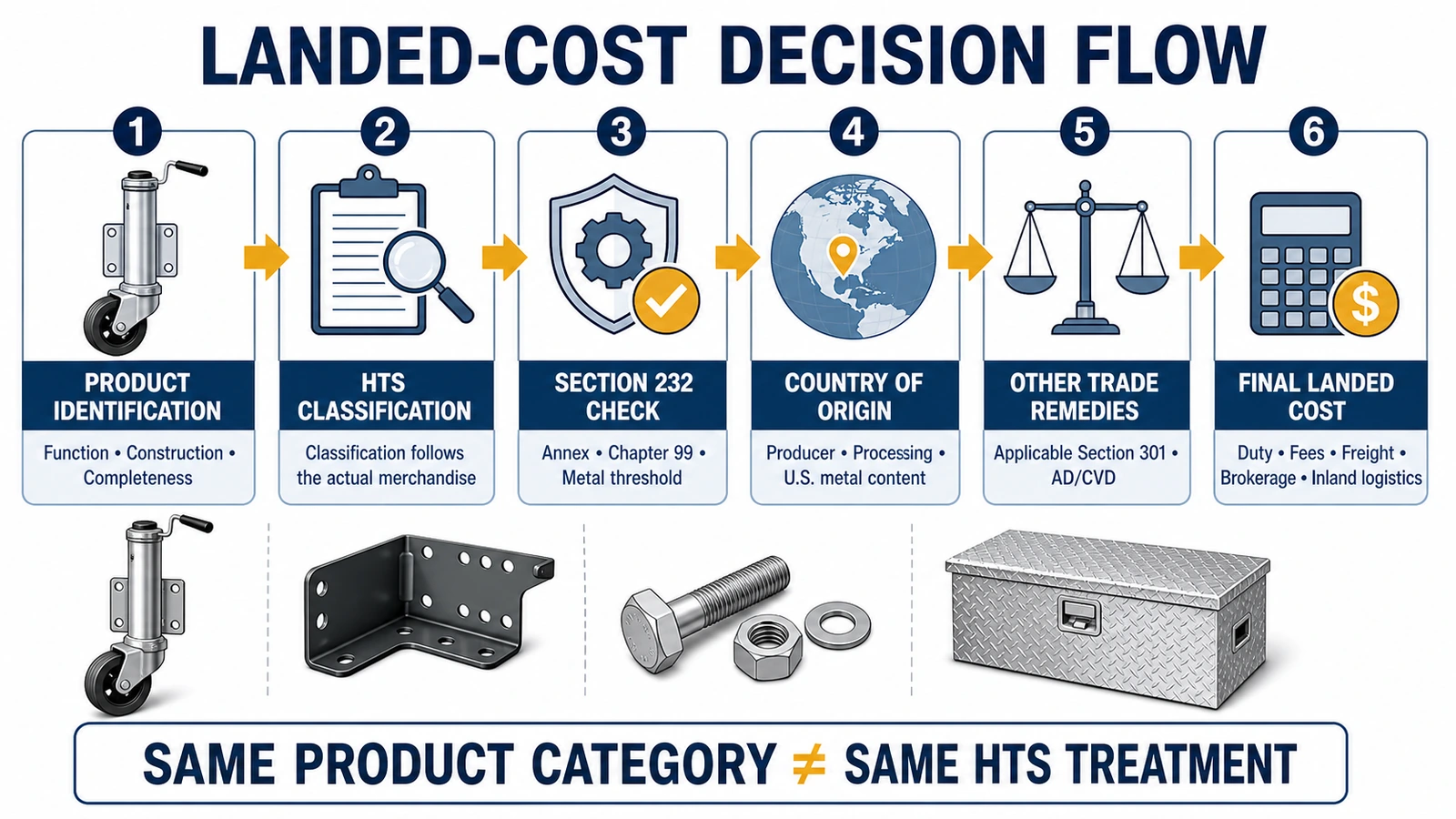
A buyer should resist the shortcut “made of steel equals tariff X.” The current sequence is closer to:
Product function, construction and completeness lead the analysis. Classification connects the merchandise to the tariff schedule. Only then can the importer test the current annex, applicable metal threshold, origin rules, other trade remedies, fees and logistics.
This is why the article does not assign one hard-coded HTS number to every trailer jack, toolbox or winch mount. Products with the same sales label can differ in principal function, construction, completeness and legal classification.
The April Rewrite: Full Value Changes the Math
Proclamation 11021 states that, for covered steel, aluminum and copper articles and derivatives, the additional Section 232 duty applies to the full customs value, regardless of the value represented by the metal content. The change became effective for covered entries from April 6, 2026.
Consider a simplified component with a customs value of $300 and an internal estimate that only $17 represents its metal. A 50% calculation against $17 would be $8.50. If the actual classified product is instead subject to a 25% Section 232 rate on full customs value, the additional duty is $75.
The product did not become five times more expensive to manufacture. The assessment base changed. That difference can overwhelm a price concession negotiated with the supplier.
The annex structure is equally important. Annex I-A lists products generally routed to 50% full-value treatment; Annex I-B contains a different set generally routed to 25%; Annex II identifies removals; other groups receive different or temporary treatment. “Section 232 rate” is therefore not a complete cost input without the product's classification and current list position.
“Derivative Article” Is a Legal List, Not a Material Description
A derivative article is not simply anything fabricated from steel or aluminum. The tariff treatment depends on whether the merchandise is classified in an HTS provision named in the relevant lists and whether the associated Chapter 99 conditions are satisfied.
The technical note adds a specific threshold for listed provisions outside HTS Chapters 72, 73, 74 and 76. For the identified headings, the applicable metal generally must account for at least 15% of the imported article's weight. If a provision appears on more than one metal list, the listed metal weights can be aggregated.
The rule is not “15% metal automatically means Section 232.” The correct order is: classify the product, locate that provision in the current lists, then apply the threshold and other Chapter 99 instructions.
This same need to separate a commercial description from legal scope appeared in our analysis of the 2026 van-trailer AD/CVD case. In both settings, a convenient industry label cannot replace the controlling text.
Why Trailer Parts Carry High Classification Risk
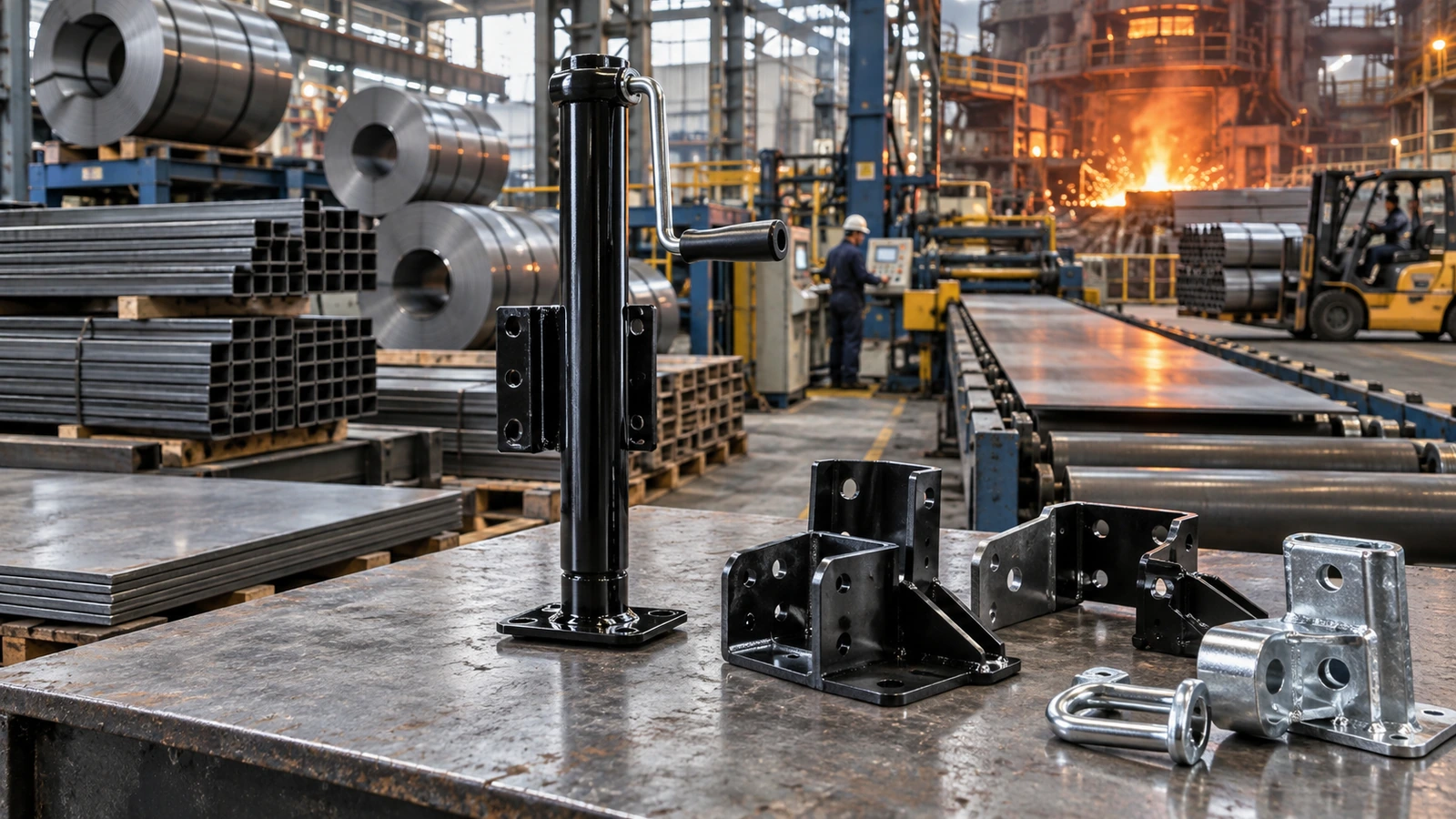
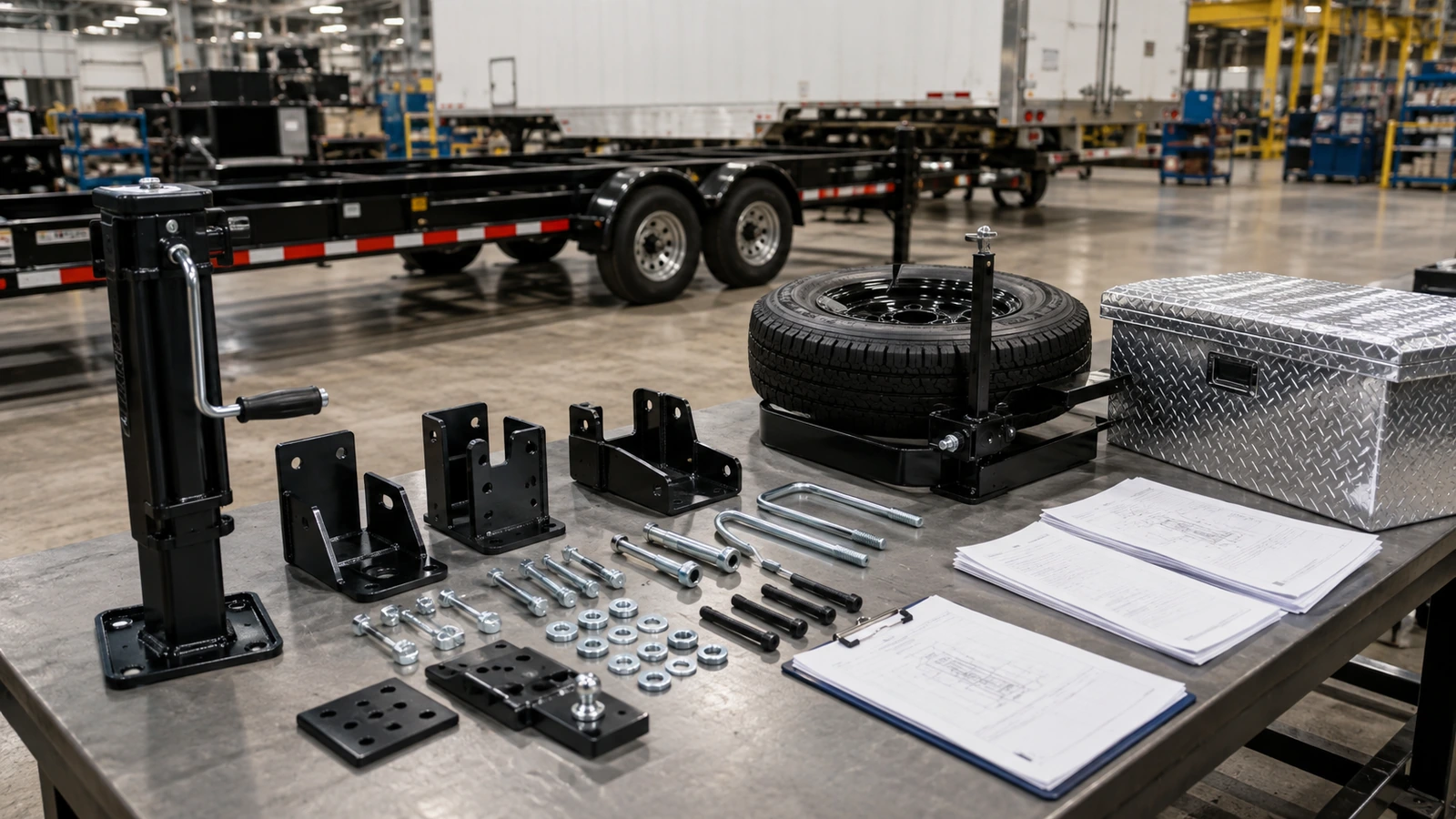
Trailer production uses many mechanically simple products that are difficult to classify from a catalog name alone: jacks, brackets, mounting plates, fasteners, toolboxes, winch mounts, spare-tire carriers, support hardware and fabricated accessories.
Depending on design and principal function, analysis may consider a lifting device, an article of iron or steel, a vehicle part, a fastener, an aluminum article, a structural item or another machinery category. Two items purchased from the same supplier for the same trailer may therefore follow different tariff paths.
Fasteners show the granularity. The Section 232 derivative lists contain numerous tariff lines within heading 7318 for screws, bolts, nuts, washers and related products. But that does not mean every fastener shares one rate. It means small BOM items may need the same classification discipline once reserved for major equipment.
For an OEM, the practical step is to organize parts around evidence rather than a general “trailer parts” label. The GOODIN accessories range, trailer-jack portfolio, aluminum toolbox range and clamp and mounting-hardware range categories each need sufficiently precise function, construction and material descriptions before an importer can determine treatment.
- Commercial and technical product name
- Principal function and operating method
- Imported completeness and included hardware
- Materials and weight by relevant metal
- Country of origin and actual producer
- Manufacturing and processing steps
- Drawings, dimensions and mounting method
- Comparable CBP rulings, where relevant

Tariff Stacking Turns a Quote Into a Scenario Model
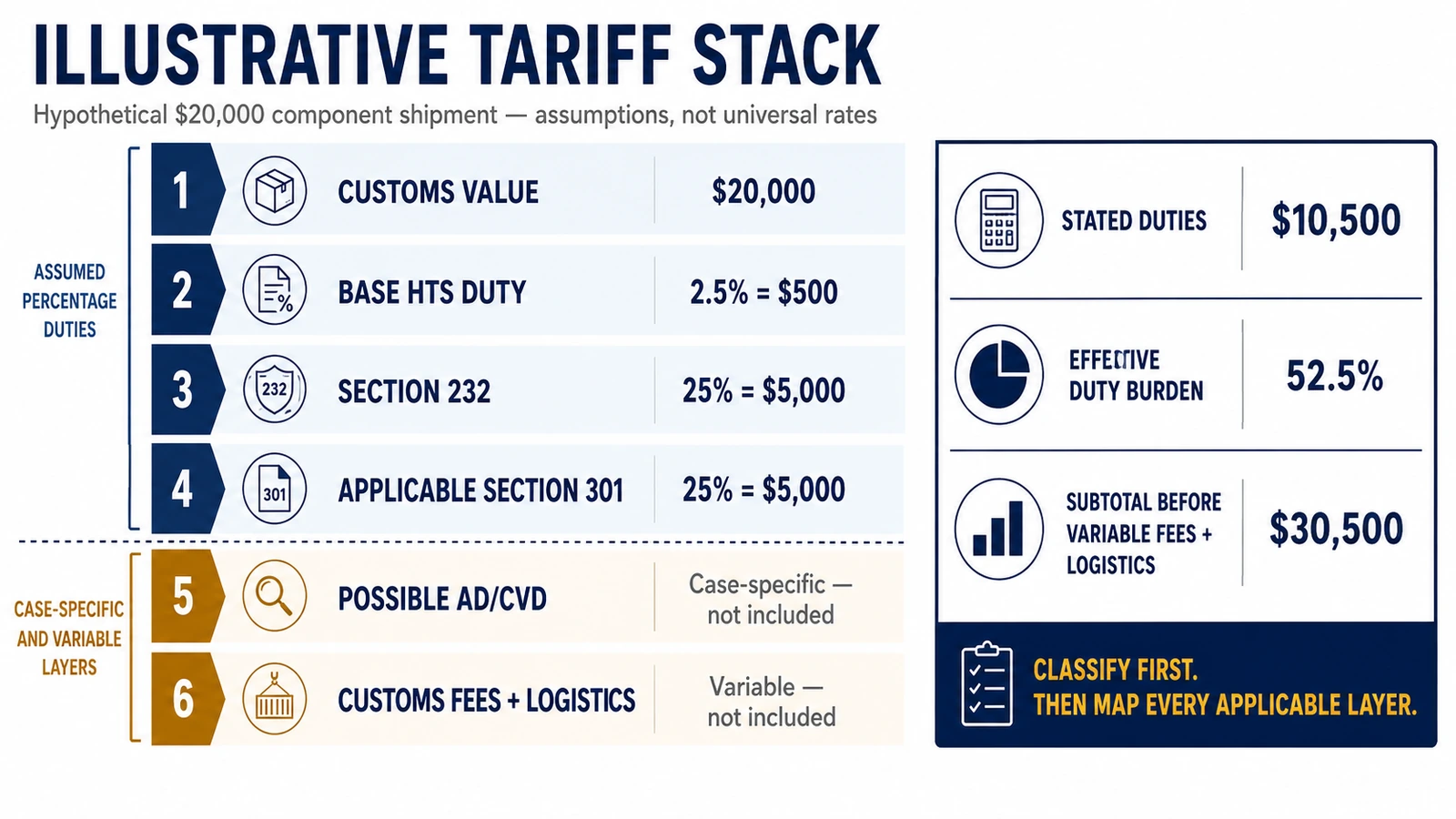
Section 232 is only one layer of entry cost. A practical model may need supplier price, freight, insurance, ordinary HTS duty, applicable Section 232 duty, applicable Section 301 duty, possible AD/CVD exposure, customs fees, brokerage and inland logistics.
The word “applicable” is essential. Legacy China Section 301 remedies remain relevant where a Chinese-origin product's classification is covered; country of origin, not merely export country, drives that analysis. The April Chapter 99 note also preserves applicable antidumping, countervailing and other duties.
But a different Section 301 action can behave differently. USTR's July 2026 forced-labor action imposed new tariffs on imports from 60 economies while expressly exempting articles and parts already subject to Section 232. Saying “Section 301 stacks with Section 232” can therefore be correct for one action and wrong for another.
In the illustrative $20,000 model, ordinary duty of 2.5% equals $500; an assumed Section 232 layer of 25% equals $5,000; and an assumed applicable legacy Section 301 layer of 25% equals another $5,000. Stated duties total $10,500, or 52.5%, before case-specific AD/CVD and variable fees. The example demonstrates the method—not the rate for a particular trailer part.
The Lists Move Faster Than Annual Purchasing Models
Static tariff assumptions can age quickly. The April proclamation created the full-value framework. Effective June 8, another action modified the annexes, introduced Annex I-C treatment for additional equipment categories and set an 85%-by-weight test for when a product's relevant metal content is treated as entirely U.S.-origin.
The USITC was already publishing 2026 HTS Revision 18 by September. A classification memo can remain useful while the associated Chapter 99 treatment changes around it.
For procurement teams, tariff monitoring is becoming closer to currency monitoring than an annual compliance exercise. Every cost model should record at least the HTS version, entry date, origin assumption, Chapter 99 provision, source of the rate and review date.
Design changes must also trigger review. A new mounting arrangement, added motor, altered component set or different material may change the physical facts on which the classification analysis rests. Material changes discussed in our lightweight-trailer material strategy can therefore carry a customs consequence as well as a weight or cost consequence.
Supplier Documentation Is Becoming a Commercial Capability
Historically, engineering designed a part, purchasing sourced it and customs classified it near shipment. The three functions now need to interact earlier.
A capable supplier should be able to explain what the product does, how it operates, what is included at import, which materials it contains, how much each relevant metal contributes, where it was manufactured and which process created its origin. Depending on the applicable provision, melt-and-pour or smelt-and-cast information and U.S.-origin metal evidence may also matter.
The importer remains responsible for exercising reasonable care. A supplier cannot issue a binding U.S. classification, and a customs broker's entry work does not remove the importer's responsibility. When uncertainty is material, CBP's binding-ruling program allows an interested party to seek a prospective classification decision using a complete product description and supporting evidence.
GOODIN should therefore compete on documentation quality without positioning itself as a customs broker. Stable specifications, drawings, material sheets, weight breakdowns, process descriptions, origin support and consistent transaction documents help the importer reach and defend its own conclusion.
Predictability becomes part of the product: not a guaranteed duty rate, but better information before tooling, production and shipment are committed.

GOODIN View: Landed Cost Is Becoming a Specification
The strongest sourcing process no longer looks like “find price, add freight, place order.” It looks like “define product, confirm classification, map remedies, calculate scenarios, choose the sourcing architecture, then place the order.”
A buyer comparing trailer jacks still needs lifting capacity, tube size, corrosion protection and handle design. A toolbox still needs volume, material, sealing and mounting compatibility. Those technical specifications remain fundamental. But landed-cost assumptions now belong beside them before a program is finalized.
This does not mean redesigning products artificially to avoid duties. Classification must follow the actual merchandise and the law. It means product teams should understand the trade consequences of what they are genuinely designing and sourcing.
The biggest 2026 risk may not be choosing steel instead of aluminum or one country instead of another. It is assuming that a familiar component still carries a familiar duty structure.
Make the product record as clear as the product
GOODIN can support OEM component programs with specifications, material information, drawings, packaging details and production records that help buyers perform their own customs and landed-cost review.
Discuss component documentation with GOODINFinal rule: do not begin with the tariff rate. Begin with the product classification, then verify every current provision that applies to the actual entry.
Focused FAQ
Are all steel trailer parts subject to a 50% Section 232 tariff?
No. Treatment depends on the actual HTS classification, current annex and Chapter 99 provisions, origin, entry date and other conditions. Steel content alone does not establish a universal rate.
Does Section 232 apply to the full value of a covered product?
Under the April 2026 framework, the additional duty applies to the full customs value of covered articles and derivatives under the applicable provisions, rather than only an internally calculated metal-content value.
Does at least 15% metal content automatically create Section 232 liability?
No. The threshold operates within the listed HTS provisions and Chapter 99 note for certain products outside Chapters 72, 73, 74 and 76. Classification and list coverage come first.
Can Section 232 and Section 301 both apply?
Potentially. Legacy China Section 301 can remain relevant to covered Chinese-origin goods, while the July 2026 forced-labor Section 301 action exempts articles and parts subject to Section 232. The exact action and entry provisions matter.
Who determines the correct HTS classification?
The U.S. importer must exercise reasonable care. Suppliers provide technical facts; qualified customs professionals can advise; and CBP can issue a prospective binding classification ruling for a fully described product.
Sources & Further Reading
The current HTSUS, Chapter 99 notes and the facts of the merchandise control. This article is industry analysis, not a classification ruling, customs entry instruction or legal advice.
- The White House — Proclamation 11021 — Strengthening Actions Taken to Adjust Imports of Aluminum, Steel, and Copper Into the United StatesApril 2, 2026; accessed September 4, 2026.
- The White House — Annexes I-A, I-B, II, III and IV to Proclamation 11021April 2026; accessed September 4, 2026.
- The White House — Further Adjusting the Tariff Regimes for Imports of Aluminum, Steel, and CopperJune 1, 2026; accessed September 4, 2026.
- The White House — Annex I-B — 25% Section 232 Tariff on Full ValueJune 2026; accessed September 4, 2026.
- U.S. International Trade Commission — 2026 Harmonized Tariff Schedule, Revision 18accessed September 4, 2026; accessed September 4, 2026.
- U.S. Customs and Border Protection — Section 301 Trade Remedies Frequently Asked Questionsaccessed September 4, 2026; accessed September 4, 2026.
- Office of the U.S. Trade Representative — Section 301 Action on Forced-Labor Import Policies — Fact SheetJuly 23, 2026; accessed September 4, 2026.
- U.S. Customs and Border Protection — Binding Ruling Programaccessed September 4, 2026; accessed September 4, 2026.
USMCA 2026 Review: Why Rules of Origin Could Reshape North American Trailer Manufacturing
The Trailer Trade War Is Here: What New U.S. Antidumping and Countervailing Duties Mean for Global Trailer Supply Chains
Related Article