A Trailer Is a Motor Vehicle Under U.S. Law: Why Small Manufacturers Face a Bigger Compliance Burden Than Buyers Realize
On this page
Walk through a small trailer shop and the business can look straightforward. Steel arrives, frames are welded, axles and wheels are mounted, and a coupler, jack, safety chains and lights complete a recognizable vehicle. Compared with an automobile, a basic utility trailer appears mechanically uncomplicated.
That appearance hides a different kind of complexity. A trailer manufactured primarily for public-road use enters the United States motor-vehicle safety system. Its manufacturer must connect the physical product to vehicle identification, applicable safety standards, certification and continuing responsibilities after delivery. Having no engine does not remove that legal status. [1]
The important question is therefore not how many components a buyer can count. It is who takes responsibility for the vehicle, what evidence supports its configuration, and whether the business can act when a safety problem appears. For small manufacturers, this creates a layer of work that buyers rarely see—and that a component supplier cannot understand by looking only at the purchase order.

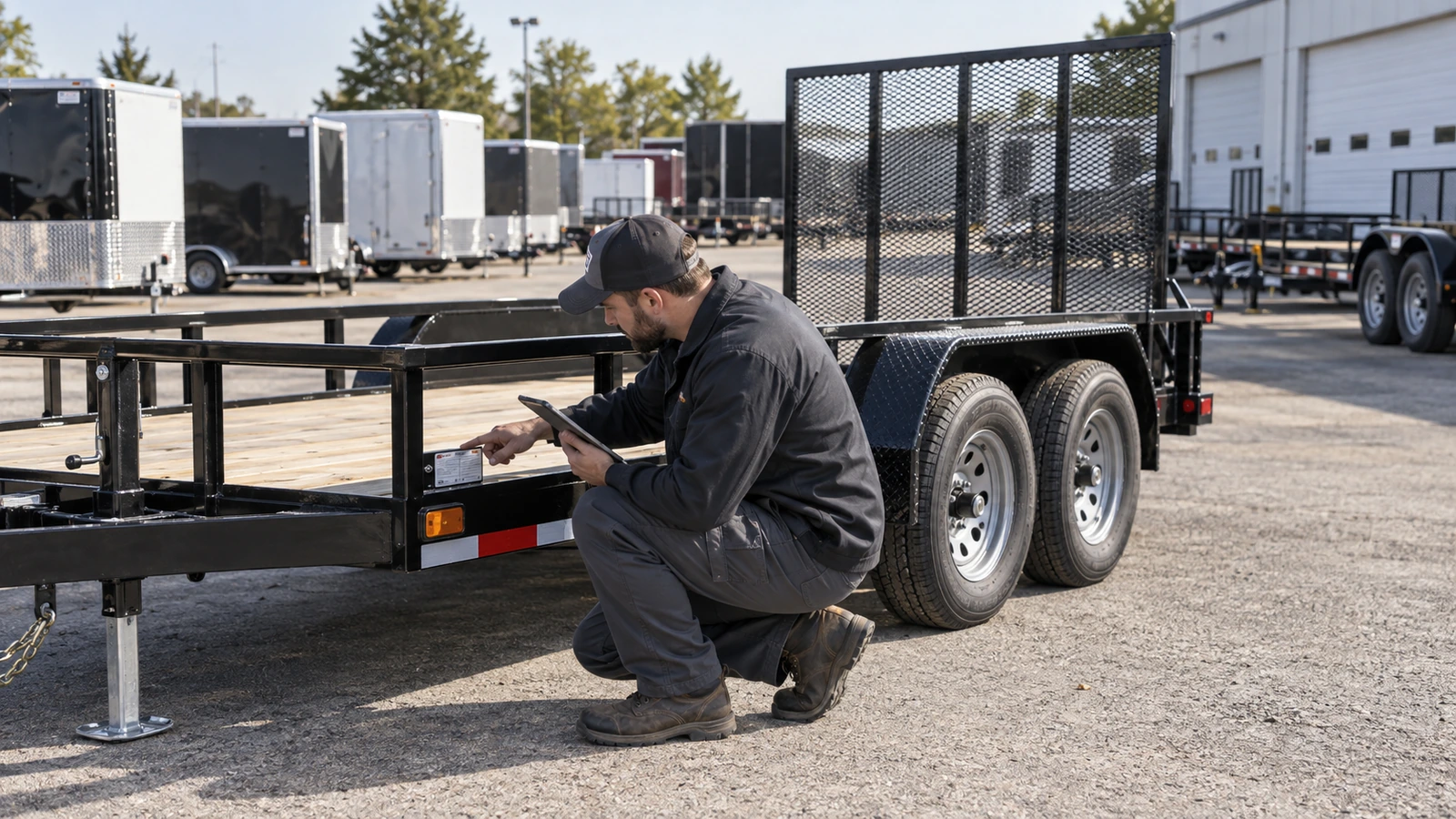
Regulatory review: September 13, 2026. U.S. federal framework for new road-going trailers; individual designs, import circumstances and state requirements need separate review. Images are editorial illustrations, not certified designs or label templates.
The legal classification behind a deceptively simple product
The federal definition of a motor vehicle covers vehicles driven or drawn by mechanical power and manufactured primarily for public streets, roads and highways. The trailer definition in 49 CFR §571.3 includes vehicles designed to carry persons or property and be drawn by another motor vehicle. These definitions explain why an ordinary road-going utility trailer belongs in the same broad safety framework as much more complex vehicles. They do not mean that every wheeled industrial platform or genuinely off-road machine is automatically a highway motor vehicle. Intended use and the relevant facts still matter. [1] [17]
Once a business manufactures a road-going trailer for sale, the legal question changes from whether it can fabricate a strong platform to whether it can place a compliant vehicle into commerce. Steel fabrication is one activity within that larger undertaking. Vehicle identity, system suitability, information supplied to purchasers and safety responsibilities cannot simply be delegated to the customer who tows it away.
Why the issue reached Capitol Hill
NATM's 2026 Regulatory Roundup illustrates this structural concern. The association reported that 40 members participated in 64 congressional meetings during the event week beginning April 20. Its account was published on June 19—not evidence that the event itself took place in June. NATM also attributed an estimated 77% of nearly one million newly registered U.S. trailers, and more than half a million American jobs, to the industry its members represent. These are association estimates, not independent measurements made for this article. [2]
The association's policy concern was broader than a single lighting rule. Because trailers are legally motor vehicles, legislation framed around the wider vehicle industry can affect trailer businesses even when their operating conditions differ from those of automobile manufacturers. Advocacy does not make the existing safety framework optional. It explains why a small fabrication business needs someone watching rules that may originate far outside the welding shop.
For GOODIN, the economic implication is straightforward: compliance work is driven by legal responsibility, not visual complexity. The customer sees a frame, axle, wheels and lights. The manufacturer must also see weight ratings, component interfaces, labeling, configuration records and the population of vehicles that could be affected by a later defect. These are different views of the same product.
A manufacturer producing 200 trailers cannot spread its regulatory learning, design review and records system over the same volume as a national OEM. Some obligations have size-dependent provisions, but the foundational status of the product does not disappear. This creates a relatively fixed layer of work around a variable quantity of physical production.
That distinction also helps buyers ask better questions. “Why does this trailer cost more?” cannot always be answered by comparing the visible steel. Neither can price alone prove compliance. The meaningful comparison includes the manufacturer's ability to explain the vehicle, substantiate the configuration and support it after sale. A small business can do that well; a large business can do it poorly. Factory size is not the certification.
The right starting point for a new entrant is therefore a responsibility map. Identify the legal manufacturing entity, the intended vehicle types, the markets served and the person responsible for maintaining the compliance process. Only then does a checklist of individual filings become useful.

Manufacturer identity, VINs and certification are different jobs
Manufacturer identification, the VIN system and the certification label are related, but they perform different functions. Treating them as one “NHTSA registration” task creates avoidable gaps. A company can appear in a manufacturer database without that listing demonstrating that a particular trailer meets every applicable safety standard.
Under Part 566, a new manufacturer must submit the required identifying information and product description no later than 30 days after beginning manufacture of a previously unreported vehicle or covered-equipment type. Relevant changes must also be reported within 30 days. The submission identifies the business and what it makes; it is not a vehicle design approval. For a trailer business, the product description should identify the specific trailer types rather than rely on an uninformative description such as “metal products.” [3]
A VIN is a controlled identification system
Part 565 requires the applicable 17-character VIN structure, including vehicle attributes, a check digit and identification elements. For trailers, the decoding information includes make, trailer type, body type, length and axle configuration. The number printed on a frame, entered in production records and passed into sales documentation needs to describe the same vehicle. A spreadsheet that merely counts finished units is not automatically a compliant VIN system. [4]
For U.S. manufacturers, SAE coordinates assignment of manufacturer identifiers under NHTSA's arrangement. Part 565 distinguishes high-volume manufacturers producing 1,000 or more vehicles of a given type annually from low-volume manufacturers below that level. Low-volume identification uses positions 1–3 together with positions 12–14; it does not dispense with the 17-character VIN. The older 500-vehicle language still visible in an alternative historical subpart should not be substituted for the current framework. [4]
The reporting deadlines also have different triggers. Section 565.16(b) addresses identifier submission at least 60 days before first affixing a VIN using that identifier; the SAE confirmation provision in paragraph (a) avoids needless resubmission of a confirmed assignment. VIN-decoding information under paragraphs (c) and (d) is generally due at least 60 days before the first vehicle using it is offered for sale, with a specific exception when sufficient vehicle-characteristic information is unavailable: submission within one week after it first becomes available. These are not interchangeable with Part 566's 30-day deadline. [4]
Certification is the manufacturer's statement
Part 567 generally requires the manufacturer to affix a certification label. For trailers, it belongs on the forward half of the left side, where it can be read without moving a vehicle part. Required information includes the manufacturer, manufacture date, GVWR, applicable GAWR information, VIN and the conformity statement specified by the regulation. The exact content and treatment depend on the manufacturing situation, including multistage vehicles. [5]
This is self-certification, not a routine NHTSA pre-sale approval of every model. Self-certification does not mean that printing a label creates compliance. The manufacturer needs a reasonable, good-faith basis for its statement, supported by the design, relevant engineering evidence and production controls. Agency compliance testing and enforcement remain separate from the manufacturer's own assessment. [6]
In practical terms, build the label from controlled configuration data. If the tire specification changes, if an axle option is substituted or if a model's rated capacity changes, the business must review the engineering and information consequences together. A perfectly legible label containing outdated information is still a problem. Identity, configuration and certification must remain synchronized from the first drawing to the finished vehicle.

FMVSS compliance happens at the interfaces
FMVSS is not one universal trailer test. Each standard has its own scope, definitions, exceptions and technical requirements. The manufacturer must establish which standards apply to the particular vehicle and its equipment. Width, GVWR, braking architecture, body geometry and intended configuration can change that assessment. A competitor's parts list is not an applicability analysis.
Lighting is an accessible example. FMVSS No. 108 regulates lamps, reflective devices and associated equipment, including their installation on applicable vehicles. Buying a compliant lamp does not ensure that its installed height, visibility, orientation or surrounding structure is acceptable. A side rail, ramp or accessory can obstruct a device that worked correctly on a supplier's test fixture. Additional lighting requirements can follow from vehicle dimensions. The conspicuity treatment for covered trailers involves both an overall width of at least 80 inches and a GVWR over 10,000 lb, subject to the standard's scope and exceptions—not width alone. [7]
Tire and rim requirements similarly depend on the vehicle category. For ordinary applicable trailers, FMVSS No. 110 addresses the 10,000-lb-and-below GVWR category, while No. 120 addresses the above-10,000-lb category. Tire selection, rim suitability, inflation information and relevant placarding must fit the actual configuration. The manufacturer's GVWR is a vehicle rating, not simply a number copied from an axle catalog. Tires, axles, frame, suspension, coupling and other load-carrying features need to work together within the design basis. [8] [18]
Similar weight numbers can govern different questions
Brake requirements require particular care. FMVSS No. 121 addresses covered trucks, buses and trailers equipped with air-brake systems. It should not be described as a universal electric-brake performance standard for every utility trailer. Standards for brake hoses and brake fluids, including Nos. 106 and 116, may be relevant to equipment and systems within their respective scopes. The absence of an applicable provision in one standard does not settle separate state brake-equipment or operating requirements. [9]
Rear-impact protection adds another distinction. FMVSS No. 223 addresses rear-impact guards; No. 224 addresses their installation on covered trailers and semitrailers, with a scope stated at 4,536 kg, approximately 10,000 lb, and above. Vehicle geometry and listed exclusions matter. This should not be reduced to “every trailer above a familiar weight needs the same bumper,” nor should the guard's own compliance be confused with correct integration into the vehicle. Manufacturers should verify the complete current text and any applicable interpretation for their design. [10]
The practical lesson is that component compliance and vehicle compliance are connected but not identical. A lamp can be suitable as equipment and incorrectly installed. A correctly rated tire can be used with an unsuitable wheel. A strong bracket can transfer load into a frame area that was not designed for it. Reviewing only each item's catalog rating misses the interface where the failure or noncompliance may arise.
This is why design changes need a route back to the applicability assessment. Increasing width, changing GVWR, relocating lights or selecting a different brake system can affect more than the component being changed. Engineering, purchasing and label preparation need to see the same revision.
For a small manufacturer, a manageable method is to maintain a model-specific compliance matrix: the relevant standard, why it applies, the evidence supporting the design and the production check that preserves it. That matrix is a working engineering tool, not a claim that every standard has the same test method. It makes the reasoning behind certification recoverable when staff, suppliers or models change.

Small production volume changes some duties—not the whole system
“Low volume” has no single meaning across all trailer regulations. The VIN framework uses one threshold; early warning reporting uses another. A business must read the specific provision instead of assuming that one small-manufacturer category creates a blanket exemption from identification, certification, defects or recalls.
For EWR, §579.24 applies when the relevant aggregate number of trailers reaches 5,000 or more during the reporting-period calendar year or either of the previous two calendar years. The qualifying activity includes manufacture for sale and other listed commerce or import activities. It is not simply a count of this month's factory completions. The required reporting includes production information and specified categories involving deaths, injuries, property damage claims, complaints, warranty claims and field reports. [11]
Manufacturers whose vehicles are not covered by those broader reports may instead have obligations under §579.27. That section includes specified death-related incidents identified through qualifying claims or notices, with conditions governing U.S. and foreign incidents, relevant products and time periods. It is inaccurate to say that a producer below 5,000 trailers has no safety reporting duties. It is equally inaccurate to require every small producer to file all the broader categories solely because it manufactures trailers. [11]
The 1,000-vehicle VIN distinction and the 5,000-trailer EWR threshold answer different questions. Neither tells a business that it can sell an uncertified vehicle or ignore a safety-related defect. A startup needs a process for checking its reporting category as it grows, including the historical lookback that can keep obligations relevant after annual volume falls.
A historical case shows how the gaps connect
NHTSA's 2017 consent order involving C&M Trailers is useful because it addressed several parts of the system together. In that order, C&M admitted violations involving EWR, applicable FMVSS, manufacturer identification, VIN requirements, consumer information, tire and purchaser records, and timely recalls. The documented vehicle issues included tire-information problems and lighting or reflector deficiencies. This is a historical enforcement record, not a statement about the company's current compliance. [12]
The remedy was broader than replacing one faulty part. The order required actions involving submissions, records, training and compliance management. Its significance for other manufacturers is organizational: separate administrative omissions and physical vehicle issues can accumulate when no one owns the complete process. A technically skilled shop can still have weak document control; a well-organized office can still rely on an unsuitable vehicle configuration.
For a five-person business, the owner may review designs in the morning, negotiate steel in the afternoon and answer dealer questions after production stops. That staffing reality explains the burden but does not resolve it. A proportionate system assigns responsibilities, keeps a calendar for applicable filings and routes safety information to someone who can evaluate it promptly.
The aim is not to recreate a large automotive bureaucracy. It is to make critical work reliable enough that it does not depend on memory. A controlled VIN log, a current specification set, documented changes and an accessible complaint history can be modest tools with important functions. Their usefulness depends on accuracy and consistent use, not software price.
Buyers seldom see this work when comparing two finished trailers. Yet it occupies real engineering and management time. The resulting cost is not proof that a more expensive product is safer; it is one reason a visible-material comparison cannot fully explain the economics of responsible manufacturing.

After the sale: complaints, traceability and recall decisions
A manufacturer's responsibility does not end when the trailer leaves the gate. Field information may reveal a safety-related defect, a noncompliance with an applicable standard, or a problem that needs further investigation. Those possibilities require a route from the dealer's first call to an accountable decision maker—not simply a credit note issued by the sales team.
Under §573.6, the manufacturer generally must report a determined safety-related defect or noncompliance to NHTSA within five working days after the determination. Required information that is not yet available is addressed through the regulation's subsequent-submission provisions. The deadline should not be rewritten as “five days after the first complaint,” but a business also should not postpone a decision indefinitely while waiting for perfect knowledge or a completed commercial settlement. [13]
An ordinary warranty claim is not automatically a recall. A scratched finish, misuse, wear and a safety-related structural problem may require different responses. The operational need is a documented assessment: what happened, which product was involved, what information is missing, who is investigating and whether similar incidents exist. Repetition across vehicles or a serious incident may change the assessment even if each complaint initially arrived through a different dealer.
Records make the affected population identifiable
Consider a hypothetical component batch used across several trailer models. A supplier later reports a manufacturing issue. If the OEM knows only the total quantity purchased, it may struggle to identify which finished vehicles contain the parts. If its records connect the supplier batch to production dates, configurations and VINs, it has a better basis for defining the potentially affected population and checking that determination.
The useful chain runs from component identification through the production record and VIN to the distribution channel and customer records. It is not a rigid sequence in which a defect can arise only after delivery. A problem may be discovered at receiving inspection, during assembly, on a dealer lot or in service. Traceability lets the manufacturer work backward and forward from whichever point first reveals the issue.
Tire records illustrate why downstream information matters. Section 574.10 addresses vehicle-manufacturer or designee records concerning new tires and first purchasers other than for resale. The dealer is often where the final customer information becomes available. The process therefore needs coordination, even though the participants do not all have the same legal role. Our discussion of dealer compliance and tire recordkeeping develops that channel-level problem in more detail. [14]
Component and vehicle manufacturers should also establish how they exchange safety information. Responsibility can depend on whether equipment is original or replacement equipment and how it is distributed. A purchase agreement can assign communications and operational tasks, but commercial wording alone should not be treated as eliminating duties imposed by law. Safety review must remain connected to the relevant manufacturer and the applicable reporting rules.
The practical value of a revision-controlled part becomes clear here. “The same jack we always buy” is not an adequate identifier when the supplier has changed its design twice. A batch reference, drawing revision and installation record can help distinguish vehicles that need attention from those using a different configuration.
This is not an argument for collecting every conceivable data point. It is an argument for keeping the information that allows a business to explain what it built and reach the relevant people when action is required. Records are most useful when designed before a problem, not reconstructed under the pressure of one.

Federal compliance does not replace import and state requirements
The legal term “manufacturer” is broader than the everyday image of a factory owner. Under 49 U.S.C. §30102 it includes people manufacturing or assembling motor vehicles or equipment and people importing them for resale. A business purchasing complete trailers overseas therefore should not assume that its only obligations concern customs entry and resale paperwork. Its exact duties depend on the product and importing arrangement, but the definition is an important starting point. [1]
NHTSA's importation and certification guidance explains the distinction between a vehicle's compliance status and the procedures governing its entry. A low purchase price, a foreign test report or a supplier's general export experience does not establish that a trailer can lawfully enter the United States through the intended route. The importer must assess the applicable entry basis, identification, certification and other conditions for the actual vehicle. Nonconforming vehicles involve separate rules; this article does not provide a shortcut around them. [6]
Foreign manufacturers, assemblers and importers covered by Part 551, Subpart D must designate a U.S. agent for service of process before offering the covered vehicles or equipment for importation. That agent designation is a legal communications mechanism, not a government endorsement of the product. It should not be described as a requirement imposed identically on every domestic business merely because it buys imported components. [15]
Different layers ask different questions
Federal manufacturing compliance and state title, registration, licensing and road-use requirements are related but distinct. An applicable federal certification requirement is not replaced by a state-issued title. Conversely, satisfying federal manufacturing duties does not answer every question about where, how or by whom the vehicle may be operated.
Brake-equipment rules, registration categories, operating limits and business licensing can vary by jurisdiction and vehicle use. A national industry article should not invent one universal state brake threshold or imply that a local registration exception removes federal manufacturing responsibilities. Manufacturers selling across state lines need an approach that identifies the relevant jurisdictions and obtains authoritative answers for the vehicles and activities involved.
For a new trailer business, a useful review separates four issues: whether the product is a road-going motor vehicle; who has manufacturing or importing responsibilities; what federal safety and information requirements apply; and what additional jurisdiction-specific requirements affect sale or operation. Combining these questions into a single “road legal” claim obscures where the supporting evidence actually comes from.
Industry assistance can make this work more manageable. NATM's Compliance Verification Program is mandatory for its member trailer manufacturers and combines reference materials with recurring consultations. Its published description emphasizes processes for building trailers in accordance with federal requirements and industry best practices. It is an industry program, not government type approval and not a transfer of the manufacturer's responsibility to NATM. [16]
The broader lesson is to use support without confusing the source of authority. An association checklist can organize work. A qualified specialist can help interpret a design-specific issue. A supplier can provide component evidence. None of those functions automatically substitutes for the manufacturer's own certification or the applicable importing requirements.
Thinking this way also improves project scheduling. Identity submissions, engineering review, supplier qualification and market-specific questions need attention before the delivery promise becomes irreversible. Compliance is a design and market-entry input, not a folder assembled at the shipping dock after the business has committed to a finished configuration.
The supplier delivers part of the evidence system
For a component supplier, the implications are more specific than “provide better paperwork.” The OEM needs information that supports a particular engineering decision and remains tied to the delivered part. A generic brochure may introduce a product, but it rarely answers every question needed to integrate that product into a controlled vehicle design.
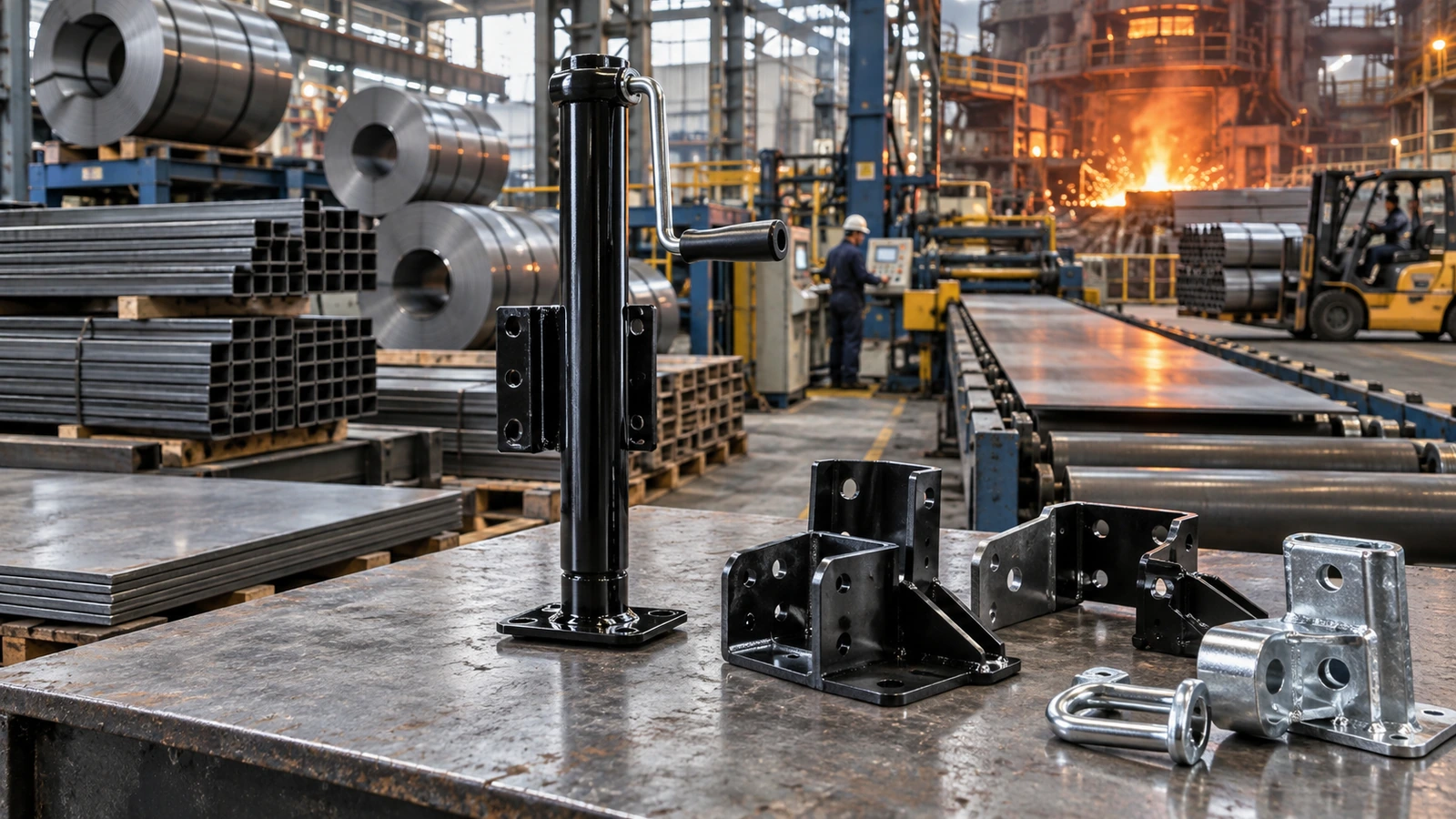
For trailer jacks, useful information can include the distinction between lifting and static support ratings, operating travel, mounting geometry, installation limits and the conditions under which performance was assessed. A rating without its meaning can invite an incorrect comparison. A product suited to one mounting arrangement should not silently be treated as suitable for every frame and load path.
For fabricated mounting hardware and accessories, the evidence may involve material grade, thickness, hole positions, tolerances, weld details, coating and the intended load direction. The supplier and OEM should agree which characteristics are critical and how changes are communicated. Not every bracket is directly subject to its own FMVSS; that does not make its effect on the completed vehicle irrelevant.
The same reasoning applies to aluminum toolboxes. Adding storage can affect available space, clearance, weight distribution, access to labels or visibility of lighting. The box's individual quality and the suitability of its installation are different questions. The manufacturer needs sufficient dimensions, mounting guidance and weight information to assess the actual configuration rather than infer suitability from a photograph.
Change control is part of interchangeability
Suppose two suppliers offer apparently equivalent support components. Both fit the mounting holes and both look strong. One provides only a catalog number; the other supplies a controlled drawing, clear rating definitions, revision history and batch identification. The second package does not automatically prove a compliant trailer. It does give the OEM a clearer basis for evaluating the component and controlling future substitutions.
The difference becomes important when a supplier changes steel grade, wall thickness, hole spacing, welding practice or fasteners. A commercially interchangeable part may no longer be technically equivalent under the manufacturer's original assumptions. A change process should establish what changed, which shipments contain it and whether the OEM needs to review or approve the new configuration before use.
An effective information package is proportional to the application. It might combine a defined part number and revision, an approved drawing, performance information relevant to the intended use, installation instructions and an agreed traceability method. The point is not to overwhelm the buyer with unrelated certificates. It is to make each relevant claim understandable and attributable to the delivered product.
This connects vehicle compliance to other procurement developments. forced-labor supply-chain traceability asks businesses to substantiate the supply chain behind the goods. CBAM and material traceability asks different questions about covered materials and emissions information. Those regimes are not FMVSS, and their requirements should not be merged. The shared operational direction is that information once kept inside a factory increasingly needs to travel with the commercial relationship.
For GOODIN, the supplier opportunity is therefore not to claim that a jack certifies the whole trailer. It is to help the manufacturer reduce uncertainty around the component: what it is, what its ratings mean, how it should be installed and how a later change or issue can be traced. That is a more credible contribution to compliance than a broad, unsupported “fully certified” slogan.
The result is a clearer division of work. The component supplier supports the evidence for its product; the vehicle manufacturer assesses integration and the completed vehicle. Their records should connect where the engineering responsibility connects, without pretending that either party can see or control every decision made by the other.

Two production systems—and a more useful definition of value
A modern trailer manufacturer effectively operates two production systems. One produces the physical vehicle: cutting, welding, assembling, finishing and inspecting. The other produces and maintains the evidence that explains the vehicle: identity, specifications, ratings, certification information, configuration history and the records needed to respond after sale.
The systems must describe the same product. If the shop installs a new tire option but the label process uses the old specification, the evidence has separated from production. If purchasing substitutes a bracket without recording the revision, the drawing no longer describes every vehicle shipped. If the dealer cannot connect a customer to a VIN, the post-sale record may be incomplete when it becomes most valuable.
This is a useful way to distinguish quality from compliance. Good welds, durable finishes and thoughtful usability matter. So do correct identification, applicable safety requirements and continuing obligations. The concepts overlap, but neither is a substitute for the other. A trailer can be attractive and robust while carrying an incorrect label; an accurate label cannot compensate for an unsuitable design.
What buyers should actually compare
When two black tandem-axle trailers look similar on a dealership lot, the buyer may focus on steel thickness, tire brand, capacity and price. Those remain legitimate purchasing factors. A fuller comparison also asks whether the manufacturer can explain the rating, support the delivered configuration, provide clear instructions and respond coherently if an issue arises.
These questions should not become a fear-based sales tactic against small manufacturers. Small teams often have excellent product knowledge and direct customer relationships. The challenge is to turn that knowledge into repeatable records and responsibilities as the business grows. A process that works only because the founder remembers every unit becomes fragile when volume, staff or supplier variety increases.
An OEM can begin with a few practical questions. Is there an accountable owner for regulatory work? Can the business retrieve the specification and major component revisions for a particular VIN? Are supplier changes reviewed before substitution? Can a safety-related complaint reach a decision maker promptly? Are dealers clear about the information they must return to support the manufacturer's process?
These are management questions as much as documentation questions. Adding software does not resolve an unclear responsibility. Outsourcing a test does not establish change control. Buying a respected component does not validate its installation. A dependable system connects decisions, evidence and the actual vehicle without relying on any one of those measures as a universal answer.
The commercial implication is that the barrier to entering trailer manufacturing is higher than the barrier to welding a usable platform. A business needs to be able to place that platform into a regulated market as an identifiable, appropriately certified vehicle and support the responsibilities that follow. That difference helps explain why experienced manufacturers value suppliers who understand more than fit and unit price.
GOODIN's long-term position should be equally concrete: supply hardware with the technical information needed for OEM evaluation and controlled use. Discuss the application, agree the relevant documentation and define how revisions and batches will be handled. To explore those requirements, discuss your next OEM program with GOODIN.
The central insight is simple. A trailer's apparent mechanical simplicity does not reduce the importance of its legal identity. Once the product belongs on public roads, the manufacturing task includes both the vehicle and the evidence behind it. Buyers, dealers and suppliers make better decisions when they can see both.
Frequently asked questions
Is a trailer a motor vehicle under U.S. law?
A trailer manufactured primarily for public-road use generally falls within the federal motor-vehicle framework even without its own engine. Genuine off-road equipment requires a fact-specific classification assessment.
Must a small trailer manufacturer identify itself to NHTSA?
Part 566 applies to covered manufacturers regardless of whether their factory is small. Required initial information is generally due within 30 days after beginning the relevant manufacture, with relevant updates also due within 30 days.
Does NHTSA approve each trailer design before sale?
The ordinary U.S. framework is manufacturer self-certification, not routine government type approval. A database listing or an assigned identifier does not establish vehicle compliance.
Do low-volume manufacturers still need 17-character VINs?
Yes. Current low-volume provisions change the structure of manufacturer identification within the VIN, not the requirement for a compliant 17-character VIN.
Does producing fewer than 5,000 trailers remove reporting obligations?
No. Broader EWR reporting has a threshold and a current-year/prior-two-year lookback. Smaller manufacturers may have specified death-related reporting duties under §579.27, as well as separate defect and recall obligations.
Which FMVSS apply to a utility trailer?
Determine applicability by the actual design. Lighting, tires and rims are common areas; brake and rear-impact requirements depend on their own scopes, configurations and exclusions. No single list replaces that assessment.
When must a determined safety defect be reported?
Section 573.6 generally requires notification to NHTSA within five working days after a safety-related defect or noncompliance determination. Incomplete initial information is handled through the applicable follow-up provisions.
Can an importer be a manufacturer under the Safety Act?
Yes. The statutory definition includes importing motor vehicles or equipment for resale. Specific obligations depend on the product, entry basis and business role.
Does every trailer component have its own FMVSS certification?
No. Some equipment is directly covered by specific standards and other components are not. A component can still affect vehicle safety, integration or defect responsibilities without having a standalone FMVSS certification.
Sources & Further Reading
Primary government materials and industry-association publications. References describe their own scope; an association program is not government approval. This article is general industry information, not legal advice or a substitute for design-specific compliance review.
- U.S. House of Representatives — 49 U.S.C. §30102 — DefinitionsAccessed September 13, 2026
- NATM — Regulatory Roundup 2026: Bringing the Trailer Industry’s Voice to Capitol Hill — June 19, 2026Accessed September 13, 2026
- eCFR — 49 CFR Part 566 — Manufacturer IdentificationAccessed September 13, 2026
- eCFR — 49 CFR Part 565 — Vehicle Identification Number RequirementsAccessed September 13, 2026
- eCFR — 49 CFR Part 567 — CertificationAccessed September 13, 2026
- NHTSA — Importation and Certification FAQsAccessed September 13, 2026
- NHTSA — Interpretation nht95-221 — Trailer Conspicuity RequirementsAccessed September 13, 2026
- eCFR — 49 CFR §571.110 — Tire Selection and Rims: 10,000 lb or LessAccessed September 13, 2026
- NHTSA — Interpretation 8877 — FMVSS No. 121 and Air-Braked TrailersAccessed September 13, 2026
- eCFR — 49 CFR §571.224 — Rear Impact ProtectionAccessed September 13, 2026
- eCFR — 49 CFR Part 579 — Reporting Information About Potential DefectsAccessed September 13, 2026
- NHTSA — C&M Trailers — Signed Consent Order (2017)Accessed September 13, 2026
- eCFR — 49 CFR §573.6 — Defect and Noncompliance Information ReportsAccessed September 13, 2026
- eCFR — 49 CFR §574.10 — Tire Records for Motor Vehicle ManufacturersAccessed September 13, 2026
- NHTSA — Designation of Agents for Service of ProcessAccessed September 13, 2026
- NATM — Compliance Verification ProgramAccessed September 13, 2026
- eCFR — 49 CFR §571.3 — DefinitionsAccessed September 13, 2026
- eCFR — 49 CFR §571.120 — Tire Selection and Rims: More Than 10,000 lbAccessed September 13, 2026
Compliance Is Moving Downstream: Why Trailer Dealers Are Being Pulled Into Safety Documentation and Tire Recordkeeping
Related Article