Compliance Is Moving Downstream: Why Trailer Dealers Are Being Pulled Into Safety Documentation and Tire Recordkeeping
In this article
For a trailer dealership, compliance can sound like work completed somewhere else: in the factory, in an engineering office or in a manufacturer's certification file. The finished trailer arrives, the dealer places it on the lot, and the customer takes it home. That picture leaves out what can happen between receiving the vehicle and delivering it.
NATM's published program for its inaugural Dealer Summit during the September 1–3, 2026 NATDA Trailer Show in Nashville included a session on compliance, tire recordkeeping and documentation. The listed speakers were NATM Technical Director Scott Crimmins and Felling Trailers sales director Nathan Uphus. The significance is the audience: manufacturing-side safety systems were being explained directly to dealers.
The legal system has not suddenly transferred every manufacturer's duty to the dealership. Rather, several established obligations meet at the point of retail delivery. Tires may be replaced, accessories installed, ratings explained and recall notices received. The dealer is where a certified configuration becomes the product and information actually handed to the owner. For GOODIN, this creates a practical upstream question: does its component arrive with information that can remain accurate through every subsequent handoff?

U.S. federal policy and industry-guidance snapshot: September 12, 2026. Dealer duties depend on the product, modification, tire configuration and transaction; not every activity creates the same obligation.
Certification Stays With the Manufacturer; Information Must Travel
The United States uses manufacturer self-certification, not a system in which NHTSA individually approves each trailer before sale. A manufacturer determines conformity with the applicable Federal Motor Vehicle Safety Standards and supplies the required certification. The federal framework generally prohibits manufacturing for sale, selling, offering for sale, importing or introducing noncomplying new vehicles and regulated equipment into interstate commerce, subject to the statutory exceptions.
Under 49 CFR §567.4, a completed trailer's certification label identifies such information as its manufacturer, manufacture date, gross vehicle weight rating, gross axle weight ratings, vehicle identification number and vehicle type. It also carries the required statement of conformity. The trailer label belongs on the forward half of the left side, readable from outside without moving any part of the vehicle. Its location and content are functional parts of the certification system, not simply branding choices.
Those responsibilities do not disappear when a dealer accepts the unit. A dealership selling an unchanged certified trailer does not become the manufacturer merely because it completes the retail transaction. Equally, the manufacturer cannot treat dealer education as a way to hand off its own certification duties. Understanding the boundary makes cooperation more precise: each business needs to know which decisions it controls and which information it must obtain from the party that made the original decision.
An industry decal and federal certification are different
NATM's Compliance Verification Program is mandatory for its trailer-manufacturer members. It combines guidelines covering federal requirements and industry practices with a biennial consultation examining whether manufacturers have suitable processes. The NATM decal reflects successful participation in that industry program. It is not a replacement for the manufacturer's federal certification label and should not be presented as government approval of an individual trailer.
The dealer-facing program matters because a symbol on the trailer is more useful when staff understand the process behind it. A salesperson can explain that a manufacturer participates in an industry verification program without promising that a decal approves every later accessory installation. A service manager can ask for the manufacturer's installation guidance without assuming the association will make a product-specific engineering decision. That is informed commercial cooperation, not an additional regulator on the lot.
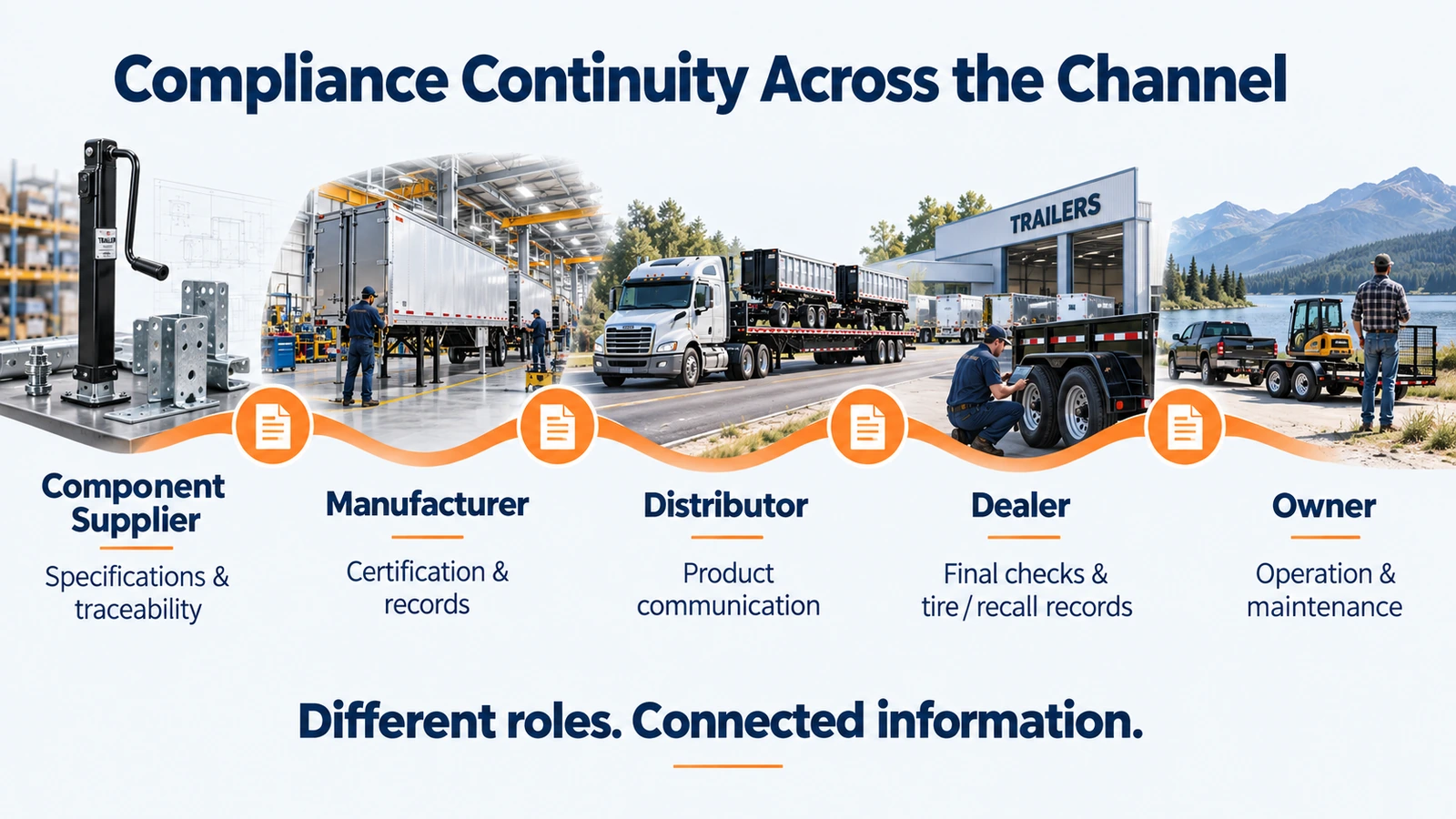
The information chain starts before the trailer manufacturer. A component supplier establishes specifications and identification; the OEM integrates those parts and certifies the vehicle; distributors preserve product communication; dealers control the final handoff; owners operate and maintain the product. These are not equal shares of legal liability. They are connected operational roles, and a missing piece of information can make the next participant's task harder even when the physical product has arrived on time.
Consider a dealer receiving an accessory kit without its current instructions. The manufacturer may have selected an appropriate component, and the supplier may have tested it correctly, yet the installer lacks the approved mounting boundary. The gap is not automatically a legal violation. It is a foreseeable point where a good decision can be lost. A connected process makes the approved information available before the dealer has to improvise.
GOODIN View: Compliance is becoming distributed across the channel, but the duties remain distinct. The objective is continuity of information and condition—not a transfer of every manufacturer's obligation to the dealer.
The Final Configuration Can Change the Dealer's Role
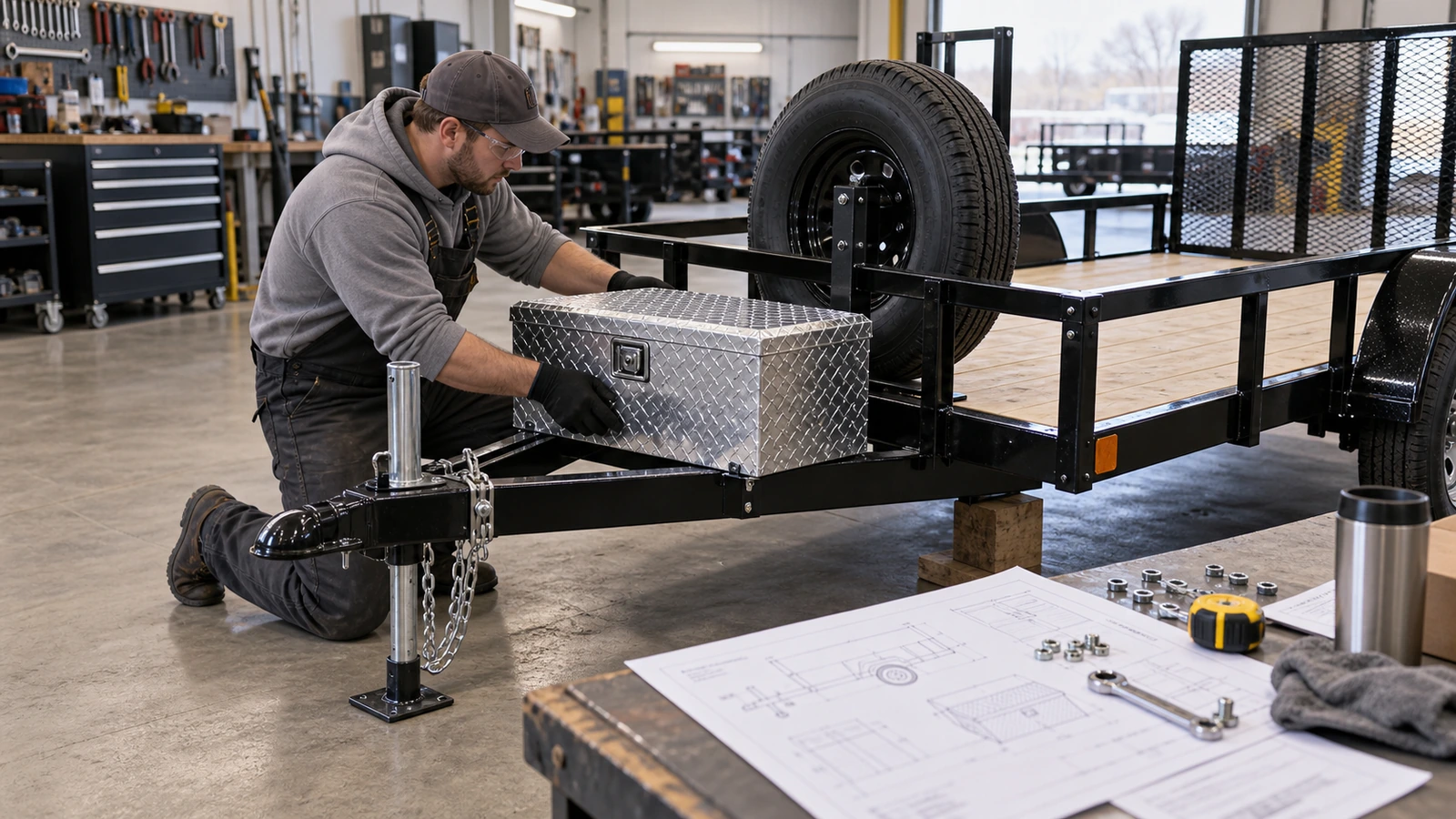
Between factory completion and first retail delivery, a dealership may change wheels, replace tires, fit a toolbox, install a jack or add a winch, rack or spare-tire carrier. It may also relocate a lamp or attach equipment that affects structural loading. The sales order calls these options; vehicle-safety analysis asks what was physically changed and whether the change affects the certified vehicle. The commercial description alone cannot settle that question.
The starting point should be the configuration received from the manufacturer. Staff need to identify the trailer, its ratings, relevant tire and rim information, installed options and the documentation supplied with it. A final inspection then compares the delivered configuration with that baseline and with any properly evaluated changes. This approach does not require a dealership to recreate the OEM's engineering file. It requires it to recognize when a proposed change needs an engineering answer.
Before first retail purchase: assess whether the work is an alteration
Under §567.3, an altered vehicle is a previously certified completed vehicle changed before its first purchase other than for resale, beyond the stated exceptions, in a manner that may affect FMVSS conformity, the validity of weight ratings or vehicle classification. The exceptions include readily attachable components, with mirrors and tire-and-rim assemblies given as examples, and minor finishing operations such as painting. The person making a qualifying alteration can become an alterer.
Section 567.7 then assigns certification-related duties for the alteration. The alterer must determine continued conformity with the applicable standards and add the required label while leaving the original certification and information labels in place and unobscured. Changed GVWR or GAWR values must be stated where applicable. The rule is not an instruction to remove the manufacturer's label or simply write a different number on it.
NHTSA interpretation aiam4563 illustrates the principle in a trailer setting. The agency considered completed trailers receiving permanently mounted generators and communications equipment before delivery to the first purchaser. On those facts, the installing parties appeared to be alterers, rather than merely sellers of accessories. It is a useful example, not a ruling that every toolbox, jack or bolted bracket creates identical duties. Current rules and the actual installation still control.
Nor does an exception from alterer labeling authorize an unsafe substitution. Tire registration is a separate question from tire suitability, and a component that is easily attached can still be inappropriate for the vehicle. A dealer therefore benefits from separating three decisions: whether the component is technically suitable, whether the work creates alterer obligations, and whether another recordkeeping requirement is triggered. A single check box labeled “bolt-on” cannot answer all three.
A proposed modular trailer upfit should make this review easier through defined interfaces and approved configurations. It should not encourage the assumption that modularity removes safety analysis. Installation instructions can identify permitted models, mounting positions and relevant limits; the manufacturer or qualified adviser can assess unresolved effects. Where the answer is uncertain, the sensible operational step is to resolve the question before committing the altered trailer to customer delivery.
After first retail purchase: the certification question changes
A used trailer generally does not require a new federal certification every time it is repaired or modified. However, 49 U.S.C. §30122 prohibits specified commercial businesses—including manufacturers, distributors, dealers, rental companies and repair businesses—from knowingly making inoperative a device or design element installed for compliance with an applicable safety standard, subject to the law's qualifications. “Used” does not mean that a professional installer can ignore existing safety systems.
The practical consequence for a dealership service department is continued attention to what a modification does. Blocking a required lamp, compromising a regulated system or replacing a safety-relevant component without understanding its role should not be treated as ordinary convenience work. This is not an argument against dealer-installed options. It is an argument for clear escalation, controlled instructions and a record of what was actually installed.
Tire Records Follow the Tires Actually Delivered
Tire recordkeeping offers a particularly clear example of responsibility following a physical change. Its purpose is to connect tires with purchasers so affected people can be reached when a safety problem emerges. The vehicle manufacturer, tire manufacturer and dealer do not all perform the same task. A useful process begins by identifying the transaction and the tires on or in the vehicle, rather than applying the slogan “every dealer must register every trailer tire.”
For original-equipment tires, §574.10 places the central vehicle recordkeeping duty on the motor vehicle manufacturer or its designee. It must maintain records of the new tires on or in each vehicle shipped through the distribution system and the first purchaser's name and address. The retention period is at least five years from the first retail sale. That statutory period should not be casually recast as a universal retention period for every dealership document.
NHTSA's interpretation 1983-3.4 explains that a dealer delivering a new vehicle with the original tires installed on or furnished by the vehicle manufacturer does not ordinarily have a separate registration responsibility for those tires. Although the letter is historical, this distinction is consistent with the current structure of §§574.9 and 574.10. Dealers can still participate in the manufacturer's customer-information process; assistance with that system is different from automatically becoming the tire dealer for every untouched new unit.
A tire change changes the information task
Section 574.9(b) treats a seller delivering a vehicle to its first purchaser with new tires that were not on it when shipped by the vehicle manufacturer as a tire dealer for Part 574 purposes. The applicable §574.8 requirements then apply. A customer-requested tire upgrade can therefore create an information obligation even when the physical work appears routine. The manufacturer's original record cannot, by itself, describe replacement tires selected after shipment.
The same regulation also addresses used vehicles equipped with new tires and vehicles leased for more than 60 days when equipped with new tires. These circumstances matter to dealerships that recondition used trailers or operate longer-term leasing programs. They should not be reduced to a rule covering every used tire or every short rental. Staff need to identify whether the tires are new and which transaction falls within the provision.
A practical tire record connects the full Tire Identification Number, the relevant purchaser information, dealer identification and transaction. A size designation, brand name or photograph that omits part of the TIN is not a substitute for the complete required identifier. A dealership can use its vehicle record to connect the tire transaction to the trailer, but keeping information internally is not necessarily the same as completing the required registration process.
Different dealers have different compliance paths
Section 574.8(a) gives independent tire distributors and dealers alternative paths. One is to provide the purchaser, at the sale or lease, an appropriate paper registration form containing the entire TIN and dealer identification. Another is to complete and return the required purchaser, tire and dealer information to the tire manufacturer or designee at no charge within 30 days. An authorized secure electronic submission is also available within that period.
For the electronic path, the rule also requires a statement on the invoice indicating that the dealer is complying through that method, with the invoice provided to the purchaser. That detail is easy to miss when a dealership focuses only on entering data into a portal. A process should identify the selected compliance path, the required fields, the recipient and the evidence of completion, rather than assume every form of data capture produces the same result.
Other distributors and dealers covered by §574.8(b) submit the applicable information at least every 30 days. The fewer-than-40-tires provision allows a delay until 40 new tires have been sold, but never beyond six months. That provision belongs to the specified category; it is not a general extension available to every independent dealer. Part 574 also requires distributors and dealers to stop selling a tire group when directed by the applicable defect or noncompliance notification.
The commercial lesson is to make the tire workflow part of delivery preparation. Establish who checks for substitutions, who records complete identifiers and who supplies or submits the registration information under the chosen route. Customer information should be handled securely and used through authorized channels. The point is not to collect more personal data than necessary. It is to preserve the connection needed for the tire safety system to work.

A Recall Must Connect to Inventory and Owners
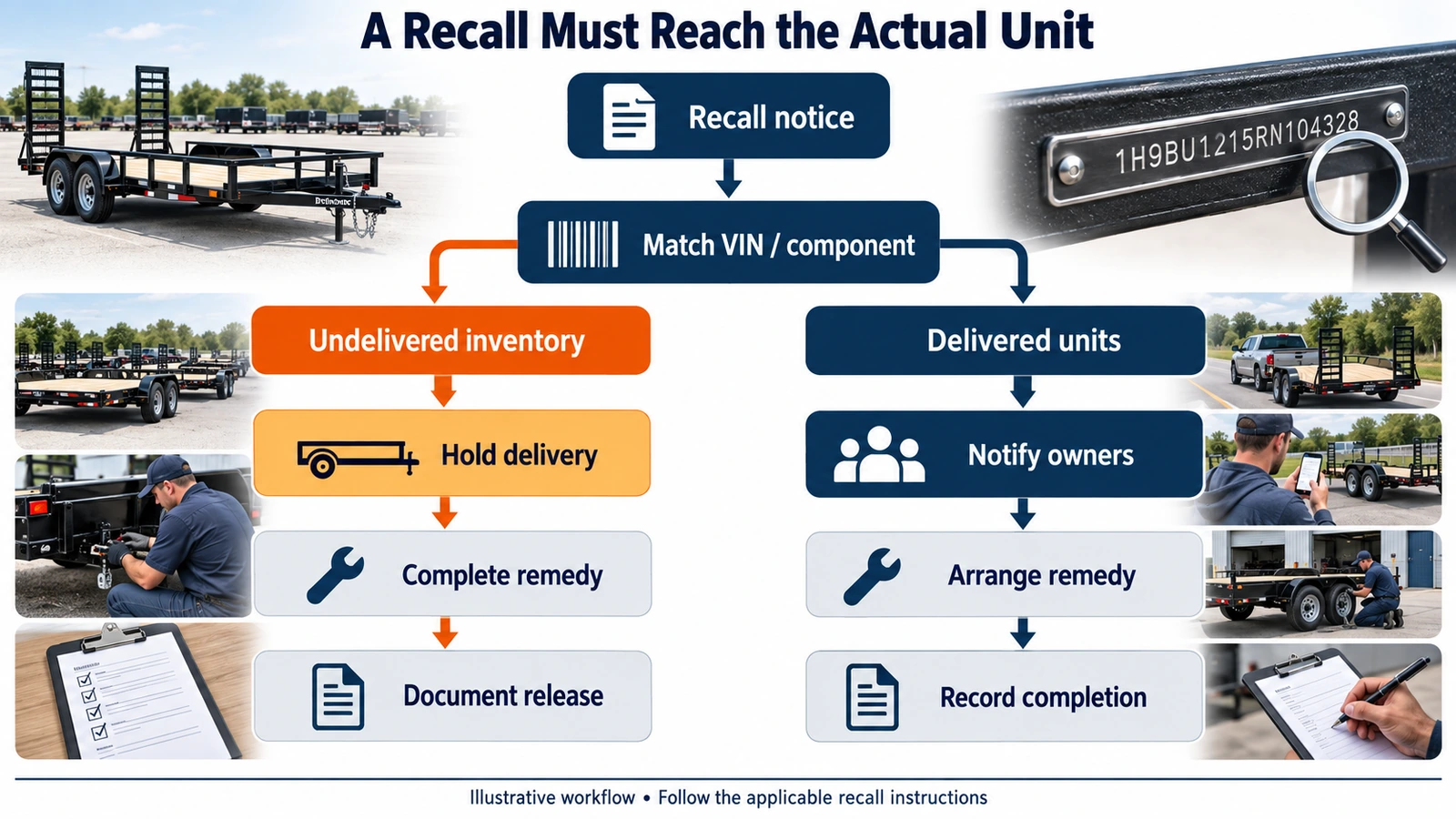
A recall notice turns a general documentation issue into a specific inventory decision. Under §577.13, dealer and distributor notifications identify the affected vehicles or equipment, explain the defect or noncompliance and its safety risk, and provide the remedy information and expected availability. Missing remedy details must be supplied as they become available. The notice is therefore not merely a news item; it contains information the dealership needs to act on particular products.
Section 573.11 generally conditions sale or lease of notified new vehicles and new replacement equipment in the dealer's possession on completing the required remedy before delivery, subject to its stated exception. The rule also distinguishes an offer for sale from a prohibited sale or lease. The practical control should be a clear hold that prevents delivery of an affected unit until the conditions for release are met—not an assumption that advertising status determines safety clearance.
The notification advisory required by §577.13(b) refers to new motor vehicles and new or used equipment covered by the notice. These provisions should not be flattened into one universal statement about every used trailer. The product, transaction and applicable law matter, and state requirements can add duties. A dealership handling mixed inventory should obtain the appropriate legal and manufacturer guidance rather than extrapolate a new-vehicle rule without checking its scope.
Match the notice to the unit, then control release
The first operational task is matching. A recall may be described by VIN, model, production dates, part number or component population. The dealership needs a route from that description to the trailer on its lot. An unread message in a single employee's inbox is a weak control. So is a handwritten note that the sales team cannot see when scheduling delivery.
Once a match is confirmed, the hold should reach the people and systems that can release the trailer. A designated employee can record the notice, affected identity, hold status and required next action. The service team documents the remedy according to the manufacturer's instructions. Release then depends on evidence that the required work is complete, not on an informal assumption that someone else has handled the campaign.
Units already delivered require a different operational branch. Manufacturer notification duties remain with the responsible manufacturer; dealers can help connect customer information, owner communications and remedy scheduling. Notification should not wait until a remedy has already been performed. An effective diagram therefore separates undelivered inventory from delivered units, rather than drawing “notify the owner” as the final step after every repair.
The same logic connects this article with our forced-labor traceability analysis. In trade compliance, the relevant record may lead from finished goods back to material sources. In a safety campaign, it may lead from a component batch to a trailer VIN, dealership and owner. The legal questions differ. The shared capability is a reliable relationship between an identifiable product and the records that describe its history.
That capability has ordinary business value as well. Even before a formal recall, an OEM investigating a component concern may need to understand where a suspect revision was installed. A dealership that records substitutions and installation dates can help narrow the population. Better records do not guarantee that a safety problem will never occur; they reduce the uncertainty and reconstruction required when action becomes necessary.
Ratings and Installation Details Need to Survive the Handoff
A component rating can survive several handoffs and still lose its meaning. A supplier advertises a trailer jack with “5,000 lb capacity.” The OEM selects it, the dealer repeats the figure and the owner interprets it as permission for a particular use. Unless the rating is defined, those participants may be discussing different things: static support, lifting capacity, tongue load, test load or ultimate failure load. The number alone is not the specification.
The documentation should identify what the rating represents, its conditions and the relevant mounting configuration. It should also distinguish the component's function from the ratings of the completed trailer. A jack rating is not automatically trailer GVWR or payload, and replacing one component with a higher-rated version does not automatically increase the vehicle's permissible ratings. Dealer communication needs to preserve these boundaries without turning a normal product explanation into a technical lecture.
The same issue arises with couplers, chains, carriers, winch mounts, brackets and other trailer hardware. Some equipment is directly subject to specific federal requirements; other parts are safety-relevant because of how they are integrated into a vehicle. There is no single universal federal rating label or identical instruction package for every accessory. A useful article must distinguish product-specific legal requirements from recommended technical information supporting the OEM's design and the dealer's work.
An installation boundary is more useful than a generic instruction
Consider a spare-tire carrier. Its position can affect clearance, load distribution, structural loading and the visibility or accessibility of other equipment. Whether a particular installation creates a regulatory issue depends on the actual arrangement. The appropriate response is to identify the OEM's approved mounting boundary, not to claim that every carrier is either harmless or a qualifying alteration.
A tongue-mounted aluminum toolbox presents a related issue. The box has weight, and its contents add more. Mounting location can influence how that weight acts on the trailer. Instructions should help the installer understand compatible models, the mounting interface, limits, clearances and the need to preserve access to the coupler, jack and relevant safety equipment. The article need not invent one load or tongue-weight rule for every trailer to make this point useful.
Good instructions can specify orientation, fastener requirements and tightening information where appropriate, along with conditions in which installation should not proceed. They should identify the product and revision to which they apply. A drawing that looks similar is not necessarily the correct drawing, and a torque value copied from an unrelated assembly can create false confidence. Where technical information is missing, guessing is not a substitute for clarification.
Dealerships also need consistent language for the customer conversation. Staff should explain payload, component use and maintenance from current manufacturer information rather than memory. An owner may later remember being told that any tire of a certain size was suitable or that the jack could support the entire loaded trailer. Controlled information reduces ambiguity before delivery; it does not guarantee that a signed handover form eliminates every possible dispute or responsibility.
The most useful documentation therefore has two audiences. Technical detail supports the OEM and installer; concise operating information helps the owner use and maintain the product correctly. These should be consistent views of the same approved product, not independently rewritten claims. When a rating or limitation changes, both views may need updating. That is why downstream readability is a supplier concern even when the immediate customer is an engineering department.
An OEM-Ready Component Includes Controlled Product Information
For GOODIN, dealer compliance does not mean taking over a dealership's program. It means understanding that the person installing, explaining or replacing the part may be several transactions away from the original purchase order. A clear technical package allows important information to travel through those transactions without being recreated from an ambiguous catalog description. The following capabilities are recommendations, not claims that every current GOODIN item already includes them.
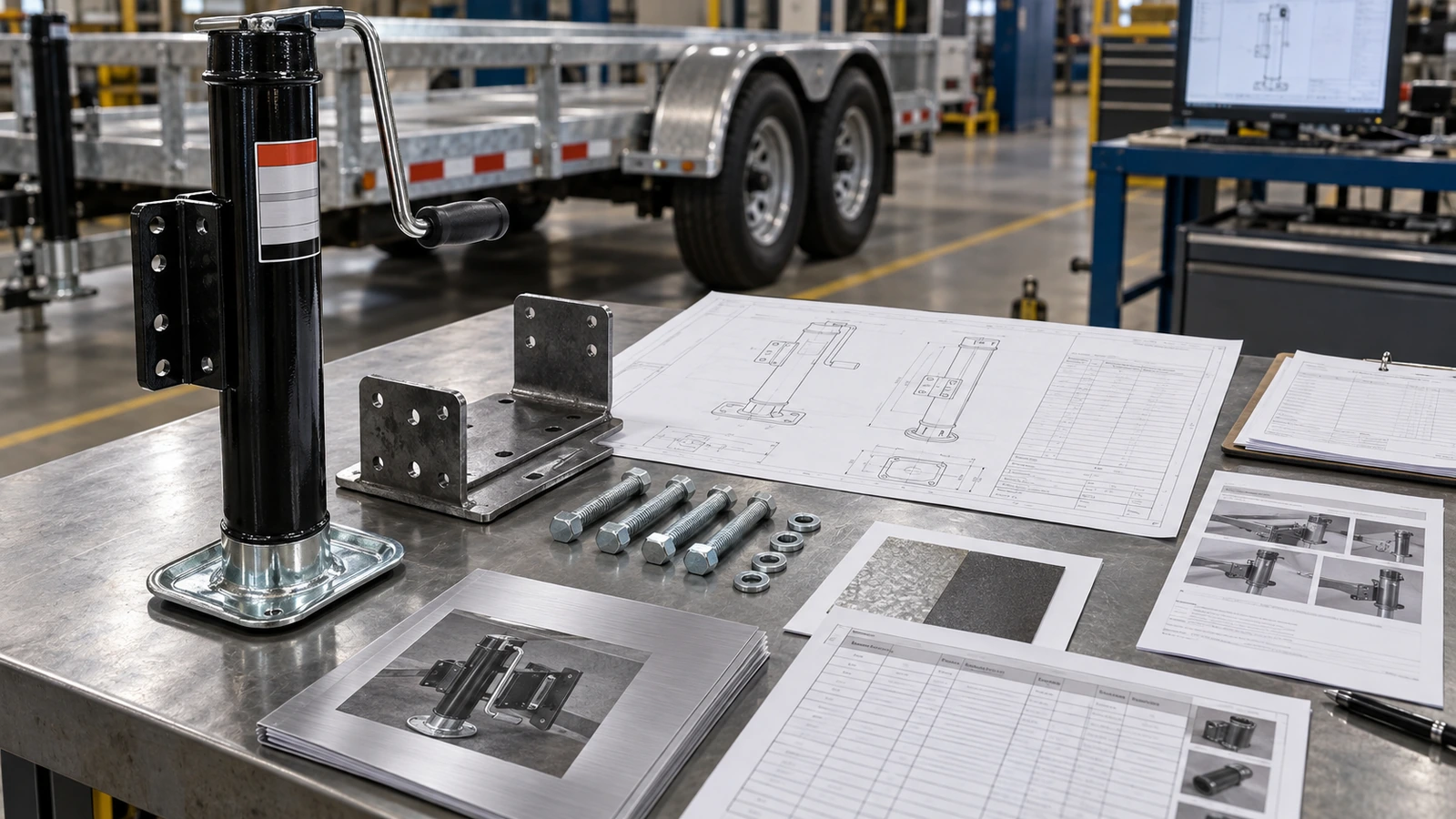
The foundation is a controlled product identity: part number, drawing reference and revision, dimensions, material and coating information, and the intended role in the trailer. The package should distinguish variants that look alike but have different mounting interfaces or limits. An OEM should be able to reconcile the supplied component, its packaging identification and the technical data used for approval.
Performance information comes next. Define the applicable rating and test basis where appropriate, along with the conditions and limitations relevant to its use. A test report can support an engineering decision, but it should not be presented as universal federal approval or proof that every possible installation is compliant. Where a specific FMVSS or equipment rule applies, the appropriate certification, labeling and compliance information belongs in the package as well.
Installation information should establish compatible interfaces, approved methods, cautions and the route for resolving questions. Replacement information should help identify the correct part and any relevant compatibility boundary. These details can reduce unnecessary interpretation by the dealer technician while leaving vehicle-level decisions with the responsible OEM or other qualified party. A complete-looking folder is less useful than a smaller set of current, connected documents.
A product change can require an information change
Suppose a mounting bracket's steel thickness changes, a hole pattern moves by 5 mm, a coating source changes or a fastener grade is substituted. These are hypothetical examples, not reports about GOODIN products. A supplier may see a manufacturing adjustment; the OEM may see a change affecting strength, corrosion resistance, mounting or the basis for an approved installation. Keeping the same commercial part number does not make those implications disappear.
A controlled process gives the OEM notice before a relevant change is implemented and provides enough information to evaluate it. The customer can then decide whether drawings, certification support, installation instructions, service information or dealer bulletins require revision. Not every change has the same significance, so the trigger and approval process should be agreed for the product and program rather than described as a universal legal formula.
The physical shipment needs to remain connected to the approved version. Batch or lot identifiers, packaging references and applicable revision records allow the parties to distinguish earlier production from later production. If old and new versions coexist, the replacement and installation guidance must not silently assume all inventory is identical. Clear identification matters most when a warehouse, dealership or owner encounters the part long after the original engineering discussion.
This is where supplier traceability supports a downstream safety investigation. If an issue relates to a defined batch, the OEM needs to identify where that batch was used. Supplier shipment records alone may identify the OEM customer but not every trailer VIN; the OEM and dealer records supply the next connections. Each participant contributes the information it controls. No single supplier document replaces the complete vehicle and customer record.
There is a natural connection with our CBAM material-data analysis and other documentation-intensive trade topics: more factory information is becoming commercially useful outside the factory. However, a carbon record, origin declaration, labor-traceability file and vehicle-safety document answer different questions. They can share product identity and revision discipline without becoming interchangeable evidence. A material certificate does not approve an accessory installation, just as an installation guide does not establish emissions.
The resulting offer is a part plus usable product information: specification, identification, installation logic, controlled changes and traceability. These elements should be proportionate to the part's role and risk. A cosmetic cover does not need the same package as braking equipment. The commercial objective is straightforward: make the component easier to evaluate, integrate, install, explain and support throughout its intended service path.
Build Dealer Records Around the Actual Trailer
A dealership does not need to begin with a large new software project. It needs a coherent record of the trailer it received, the changes it made and the condition and information handed to the customer. Existing inventory, sales and service records may already contain much of the structure. The first improvement is often connecting those records and making responsibility explicit, rather than collecting another independent checklist.
At receipt, the record can associate the VIN with the manufacturer, model, relevant labels, supplied options and the current technical contacts. Staff can identify missing or inconsistent information early. This is a recommended operating practice, not a claim that federal law prescribes an identical receiving file for every dealership. Its value is giving later decisions a reliable starting point.
Before installation, the service record can identify the component, applicable instructions, authorization or review where needed, and the person performing the work. Tire substitutions should trigger the appropriate registration review instead of remaining buried in a shop invoice. An unresolved technical question should have an owner and a path back to the manufacturer, rather than disappear when the trailer moves from the workshop to the sales lot.
At handover, the record should reflect the actual configuration delivered. Relevant manuals, operating limits, maintenance information and installed-option guidance need to match that configuration. A customer acknowledgment can document that information was provided, but it does not replace correct information or waive statutory obligations. The goal is a usable handoff, not a signature collected mainly to shift blame.
Digital systems help when the underlying links are sound
A dealer management system can associate customer information, VIN, transaction date, installed options, service history and recall status. It may also support tire-registration workflows and controlled document delivery. Those functions are valuable only if someone maintains the relationships and checks the output. An automated message linked to the wrong component revision is still wrong, even though it was delivered efficiently.
A practical system can distinguish a recall hold from routine service, record why a hold was released and make that status visible before delivery. It can preserve which manual or instruction revision accompanied an installation. Access to customer information should be limited appropriately, and retention rules should reflect the actual legal and contractual requirements rather than an invented single deadline for every record category.
Dealer evaluation of manufacturers can become more precise in the same way. Alongside margin, availability, warranty and lead time, ask how tire information reaches the recordkeeper, who answers configuration questions, how approved options are communicated and how affected VINs are identified during a campaign. Ask what happens when an original part is superseded and which version of a bulletin the dealer should use. These are operational questions a manufacturer can answer with a process.
The benefit is consistency across ordinary work. Sales, service and delivery teams can refer to the same product identity and current information. A small dealership may achieve that with a disciplined shared record and named contacts; a larger network may need integrated systems. Technology changes the method, but the underlying requirement for reliable handoffs does not depend on buying one particular platform.
Compliance Continuity Is a Commercial Capability
The industry's two unhelpful extremes are that compliance belongs entirely to the factory or that dealers are now responsible for everything a manufacturer does. Neither provides a workable operating model. Manufacturers retain their vehicle-design and certification responsibilities. Dealers have specific duties in particular circumstances and control several decisions that can preserve or weaken the intended final condition. Suppliers influence how well those decisions are informed.
For a dealer, the value of compliance education is therefore practical rather than threatening. It helps staff identify when a tire change needs a registration workflow, when a proposed modification needs review and when a recall must block delivery. It also helps them explain the distinction between an industry decal, a vehicle certification label and an accessory performance rating. Clear boundaries reduce unnecessary alarm as well as avoidable mistakes.
For GOODIN, the downstream user may be a dealership technician reading instructions, a salesperson explaining capacity or an owner trying to identify a replacement years later. Product information should be designed so its important meaning can survive that distance. A clear rating is easier to preserve than an ambiguous one; a controlled drawing is easier to integrate than an informal sketch; an identifiable batch is easier to investigate than anonymous hardware.
This adds a commercial dimension to supplier selection. Price, manufacturing quality, capacity, customization and delivery remain fundamental. Documentation compatibility asks whether the supplier's information fits the OEM's engineering process and the dealer's installation and support work. It is not a separate substitute for a good physical product. It makes that product easier to use correctly and easier to support when questions arise.
Consider two otherwise suitable components. One arrives with a basic catalog description; the other arrives with a defined rating, current drawing, appropriate installation boundary and usable identification. The second package may reduce duplicated engineering questions and inconsistent downstream explanations. That is a plausible business advantage, not a quantified savings claim or a guarantee against liability. Its value depends on the actual program and the quality of the information.
A modern component supplier does not only supply hardware. It supplies the information needed to keep that hardware compliant as it moves downstream.
The strongest interpretation of that GOODIN principle is modest and useful: support each participant with the information needed for its own role. It does not assert that one datasheet certifies a whole trailer, that a dealer can transfer all responsibility back upstream or that an owner manual cures an unsuitable installation. Compliance continuity works because the distinctions are preserved, not because they are erased.
NATM's dealer-focused education is a useful signal of this broader direction. The trailer leaves the production line as a physical product with a certified configuration. It reaches the owner through commercial decisions, possible changes and repeated exchanges of information. Keeping the product and its records aligned through that journey is becoming part of professional channel management—and a meaningful way for a capable component supplier to create value.
Planning an OEM component program with dealer installation or documentation requirements? Contact GOODIN to discuss the product identity, ratings, instructions, revision control and traceability information appropriate to the proposed program. The useful starting point is the actual application and the scope the parties can substantiate.
Frequently Asked Questions
Are trailer dealers responsible for certifying every trailer they sell?
No. The manufacturer generally determines conformity and provides the required certification for a new trailer. Selling an unchanged certified trailer does not by itself make a dealer the manufacturer. Dealers can have separate duties, including those triggered by qualifying alterations.
Can a pre-sale accessory installation make a dealer an alterer?
Potentially. A qualifying alteration before the first purchase other than for resale can trigger Part 567 duties. Readily attachable components and minor finishing operations are treated differently. The actual work and its effects—not simply the term accessory or bolt-on—need assessment.
Must a dealer separately register the factory tires on every new trailer?
Ordinarily not when the new trailer retains the original tires installed on or furnished by the vehicle manufacturer. Section 574.10 assigns vehicle tire records to the manufacturer or its designee. Substituting new tires before retail delivery can trigger dealer requirements.
What happens when a dealer replaces the original tires before sale?
Section 574.9 treats the seller as a tire dealer for Part 574 when the delivered new tires were not on the vehicle when shipped by the manufacturer. The applicable Section 574.8 registration path must then be followed. Suitability of the replacement tires remains a separate issue.
Can a recalled new trailer be delivered before the remedy?
After the applicable recall notification, Section 573.11 generally requires the remedy before delivery under a sale or lease of an affected new vehicle in the dealer's possession, subject to the rule's stated exception. The scope differs for used vehicles and equipment; review the specific notice and applicable law.
Is the NATM decal federal government approval?
No. The decal reflects successful participation in NATM's Compliance Verification Program. It does not replace manufacturer self-certification or approve every later modification to a trailer.
Does every trailer component require the same federal instruction package?
No. Requirements depend on the product and applicable rules. Defined ratings, current specifications, suitable installation information and traceability are recommended in proportion to the component's role. They support, but do not automatically establish, vehicle-level compliance.
Sources & Further Reading
Industry analysis, not transaction-specific legal or safety advice. State requirements and contractual duties may add obligations. Consult qualified vehicle-safety and legal professionals for an actual modification or transaction. Examples and illustrations are hypothetical; recommended GOODIN documentation capabilities are not assertions of existing certification or universal compliance.
- NATM — Protecting Your Dealership: Compliance, Tire Recordkeeping & DocumentationAccessed September 12, 2026
- NATM — Dealer Summit at the NATDA Trailer ShowAccessed September 12, 2026
- NATM — Compliance Verification ProgramAccessed September 12, 2026
- eCFR — 49 CFR Part 567 — CertificationAccessed September 12, 2026
- U.S. Code — 49 U.S.C. §30112 — Prohibitions on manufacturing, selling, and importing noncomplying motor vehicles and equipmentAccessed September 12, 2026
- U.S. Code — 49 U.S.C. §30122 — Making safety devices and elements inoperativeAccessed September 12, 2026
- NHTSA — Interpretation aiam4563 — Alterations to completed trailers before first purchaseAccessed September 12, 2026
- eCFR — 49 CFR §574.8 — Tire distributors and dealersAccessed September 12, 2026
- eCFR — 49 CFR §574.9 — Motor vehicle dealersAccessed September 12, 2026
- eCFR — 49 CFR §574.10 — Motor vehicle manufacturersAccessed September 12, 2026
- NHTSA — Interpretation 1983-3.4 — Registration of original-equipment tiresAccessed September 12, 2026
- eCFR — 49 CFR §573.11 — Prohibition on sale or lease pending remedyAccessed September 12, 2026
- eCFR — 49 CFR §577.13 — Notification to dealers and distributorsAccessed September 12, 2026
A Trailer Is a Motor Vehicle Under U.S. Law: Why Small Manufacturers Face a Bigger Compliance Burden Than Buyers Realize
Origin Is No Longer Enough: Why Forced-Labor Enforcement Is Turning Traceability Into a Sourcing Requirement
Related Article