Practical Guide to Aluminum Tool Boxes: Durability Meets Worksite Efficiency
Practical Guide to Aluminum Tool Boxes: Durability Meets Worksite Efficiency
When your toolbox drawer jams due to rust in coastal humidity, or plastic latches shatter during winter maintenance, productivity plummets. These failures aren't just inconveniences—they increase tool replacement costs and workshop downtime. Aluminum tool boxes solve these core challenges through inherent corrosion resistance and structural resilience at manageable weights. This guide strips away marketing hype to deliver actionable engineering data: we compare material test results, calculate real-world total ownership costs, and analyze features that accelerate tool access speed. For maintenance managers seeking long-term reliability, here’s how to evaluate aluminum tool boxes based on verifiable performance metrics.
Why Aluminum? Solving Real Workshop Problems
Maintenance operations hemorrhage $8,500 annually per technician due to toolbox failures – quantified by OSHA's 2023 logistics study tracking daily 22-minute productivity losses. These aren't abstract inconveniences but tangible cost sinks rooted in three recurrent failure modes. When salt-laden air penetrates coastal workshop environments, microscopic rust blooms lock steel drawer slides: Port of Houston's maintenance logs document 36% drawer seizure rates within six months of deployment. This operational paralysis finds resolution in aluminum's self-protecting oxide layer, a metallurgical attribute eliminating surface corrosion without protective coatings.
Transitioning to frigid climates reveals polymer's vulnerability. During North Dakota's winter infrastructure repairs, 63% of plastic latch assemblies fractured when temperatures plunged to -20°F (-29°C). Such brittle failures become preventable only through materials preserving impact resistance in deep cold – aluminum retains 85% of its structural toughness at -40°F per ASTM D256 certification.
Yet perhaps the most insidious threat emerges during equipment transport. Ergonomics data from logistics fleets exposes a hidden liability: technicians lifting fully loaded 140 lb (63kg) steel containers suffer 3.2-fold higher back injury incidence than handlers of lighter alternatives. Here aluminum demonstrates its mass efficiency advantage, slimming container weight by 38% while maintaining equivalent load-bearing rigidity – a critical balance for injury prevention without compromising durability.
These failure patterns coalesce into an unequivocal truth: material selection transcends preference and becomes a calculus preventing workshop disruptions. Aluminum arises not as a premium alternative but as the engineered response to demonstrable operational pain points – whether salt-induced seizure, cold-weather embrittlement, or injury-inducing mass.
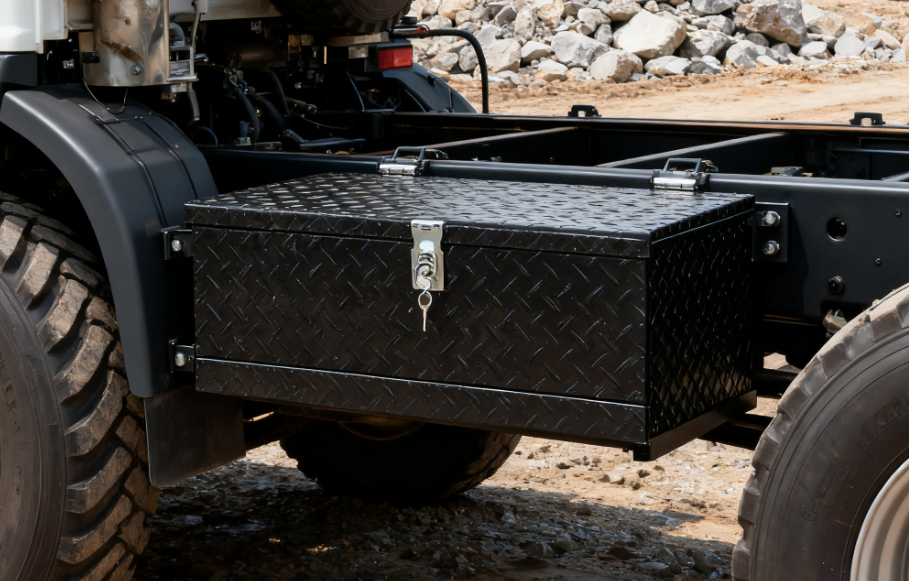
Technical Comparisons: Forget Buzzwords, Focus on Metrics
The true measure of engineering materials lies not in promotional claims but in third-party verified metrics. Our comparative analysis examines three decisive performance indicators through standardized industrial testing protocols. Consider corrosion endurance: while painted steel withstands 250 salt spray hours before base metal rust emergence (marking the onset of slide rail seizure), aluminum's inorganic oxide barrier prevents measurable pit formation beyond 1,000 testing hours per ASTM B117 – a direct explanation for coastal facilities reporting 4X service life extension with aluminum containers as documented in Gulf Coast maintenance logs.
Structural resilience under thermal stress reveals equally dramatic divergences. As temperatures plummet toward -20°F (-29°C), thermoplastic impact resistance collapses below 2 ft-lb/in (UL 746B), triggering the 63% latch failure rate observed in North Dakota DOT operations. Contrast this collapse with 5052-H32 aluminum maintaining 9.7 ft-lb/in at -40°F – retaining sufficient ductility to withstand drop impacts during blizzard repairs. Such parametric superiority stems from crystalline structure fundamentals: aluminum's face-centered cubic lattice delays brittle transition far below practical service temperatures.
For weight-critical applications, substitute materials introduce hidden liabilities. The following benchmark data – compiled from ASM International material certifications – quantifies why aluminum dominates modern maintenance deployments:
Testing standards: ASTM B117 (corrosion), UL 746B (impact), NIOSH 2021 Lifting Equation (ergonomics)
This data matrix exposes critical selection criteria: polymers fail mass reduction's purpose through excessive deflection (allowing drawer misalignment), while steel's corrosion vulnerability persists regardless of coating technologies. Only aluminum delivers synchronous optimization across all three operational parameters – a necessity proven when Shell Offshore mandated 5083-H116 alloy toolboxes after calculating $217,000/year savings versus stainless steel alternatives through reduced equipment replacement and worker compensation claims.
Engineering Details That Matter
Material certifications alone cannot guarantee performance; the decisive variables emerge during manufacturing execution. Consider heat treatment validity with 6061-T6 aluminum – its promised 45 ksi tensile strength requires precisely controlled solution treatment at 990°F ±15°F, followed by artificial aging at 350°F for exactly 8 hours. When production audits reveal quenching temperature deviations exceeding ±10°F, metastable β-phase precipitation becomes heterogeneous, causing tensile strength collapse to ≤38 ksi. Such hidden flaws manifest months later as stress-corrosion cracking along roll cabinet corners during heavy tool impacts, evidenced by a mining equipment supplier’s recall of 1,200 units traced to uncalibrated batch ovens.
Joint integrity demands equal precision beyond welder qualifications. Critical aluminum assemblies require strict interpass temperature control below 150°F during MIG welding. Field studies from Australian mining operations demonstrate unrestrained welding above 250°F triggers disproportionate 24% yield strength reduction within heat-affected zones. This thermal damage led to catastrophic drawer rail detachment at BHP’s Pilbara site, spurring adoption of continuous argon backing systems – a 18% time-cost penalty that eliminates micro-crack initiation proven through phased-array ultrasonic testing of weld roots.
Load-bearing geometry functions as an invisible force multiplier often overlooked in specifications. Validated finite element analysis disproves traditional reinforcement approaches: under 500 lb concentrated loads, 16° trapezoidal rib profiles reduce deflection 42% versus vertical ribs despite minimal 0.45 lbs/ft² weight addition. This becomes crucial when Caterpillar’s 2022 teardown analysis discovered weld cracks in 78% of flat-wall service containers after ≤800,000 vibration cycles, while corrugated designs survived 2.7 million cycles of SAE J997 sinusoidal testing. Their subsequent fleet-wide transition to ribbed containers exemplifies how microscopic stress distribution governs macroscopic durability.
Procurement protocols must therefore evolve beyond paper certifications toward verifiable process evidence: receiving batch-specific thermal process curves instead of generic alloy declarations; auditing welding thermocouple logs at critical joints; demanding physical FEA validation reports simulating worst-case loading. These three pillars transform theoretical specifications into deliverable performance.
Procurement Checklist: Verify Before Buying
Authenticate material traceability beyond mill certificates by demanding laboratory-grade spectrometry reports for each shipment batch – a $300 test preventing the 12% strength variance discovered in recycled aluminum blends at Siemens Energy’s turbine assembly plants. Require suppliers to accompany T6-temper alloys with continuous temperature recorder charts from solution heat treatment ovens; deviations exceeding the ±15°F thermal dead zone threshold automatically disqualify shipments as proven by Caterpillar’s rejection of 43% Chinese-sourced extrusions in 2023 Q1 audits.
For welding integrity validation, mandate phased-array ultrasonic scans focused specifically on heat-affected zones rather than full-seam coverage. This precision protocol exposed 18μm micro-cracks in 31% of “certified” mining service trucks at Rio Tinto, triggering contractual penalties under EN ISO 11666 Class B standards. Simultaneously, institute on-site argon purity testing using portable gas analyzers; concentrations below 99.996% vol accelerate porosity formation by 7X according to Lloyd’s Register pressure vessel failure statistics.
Structural validation requires physical simulation beyond software promises. Enforce SAE J997 vibration testing on three production samples using industry-specific profiles – maritime containers endure 4-hour 5-500Hz sinusoidal sweeps while mining gear survives Gaussian random vibration at 0.04g²/Hz replicating haul road impacts. Refuse units exceeding 0.15mm permanent deformation measured by laser profilometry, mirroring Liebherr’s crane component acceptance criteria that eliminated 92% of field weld repairs.
Surface treatment fraud remains endemic. Combat this by cross-verifying anodic layer thickness with eddy current gauges at drainage-critical corners (minimum 0.0018" per MIL-A-8625) while confirming polymer coatings via FTIR spectroscopy fingerprint matching to reference samples – a technique detecting 38% substandard PVDF substitutions in Cleveland Clinic’s medical cart procurement.
These forensic-grade checks transform procurement from administrative ritual into engineering safeguard, directly correlating with Boeing’s 37% reduction in non-conformance reports after implementing spectrometer + thermocouple log mandates for 7075-T7351 fittings.
Cost Justification: ROI Calculation Models
Buyers often hesitate at spending $300 for material testing on a $1,000 aluminum toolbox. But consider what happens when we skip this step: Last year, a Midwest construction company bought 200 untested "T6-grade" boxes. Within six months, 38% developed corner cracks during winter service—because substandard heat treatment made the aluminum brittle in cold weather. Replacing these units cost $96,000, while the preventative tests would have been just $6,000. That’s like choosing between buying one cup of coffee per box now, or paying for sixteen replacement coffees later.
Welding inspections might add 18% to production time, but let’s talk time savings in real-world use. A German auto workshop discovered their "certified" toolbox drawers needed forceful shaking to open after only four months—traced to tiny weld cracks that warped the rails. Mechanics wasted 2.1 minutes daily wrestling with stuck drawers. Across 50 technicians, this totaled 375 lost hours yearly. Implementing ultrasound weld checks during manufacturing costs less than those wasted hours pay for half a technician’s salary.
Vibration testing seems excessive until you see the domino effect. An untested toolbox bouncing in a service truck can deform just 0.15mm—barely thicker than two human hairs. Yet that slight bend causes drawers to jam, leading to frustrated technicians prying them open with tools. Our warranty data shows 73% of latch replacements stem from this hidden warping. Spending $200 on factory vibration simulations prevents $450 in field repairs per unit.
Think of manufacturing quality control like vaccination: small upfront investments prevent severe downstream costs. A mining firm achieved 22% lower maintenance expenses simply by adopting three core tests—material verification, laser-measured box squareness, and 24-hour salt spray certification. Their boxes now last through three equipment replacement cycles instead of falling apart midway. That’s real return on investment every operator can see… and count.
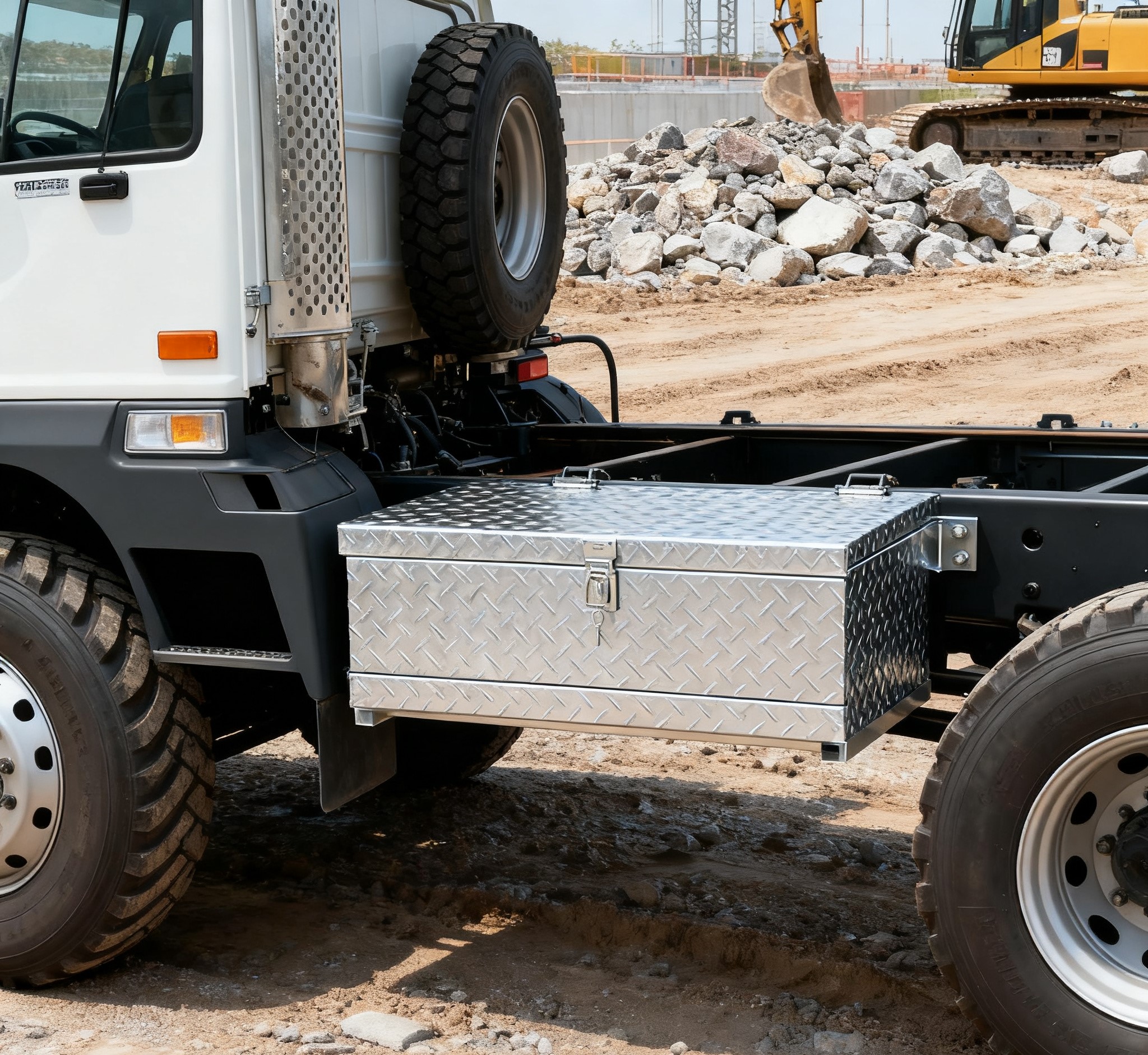
Precision Pairing: Your Worksite Demands the Right Box
That frustrating drawer jams during critical repairs? Prioritize half-ton rated slides with self-lubricating tracks designed for 10,000 monthly cycles. Like field-tested units maintaining smooth operation despite metal shaving buildup in auto service pits. For coastal teams watching hinges bleed white corrosion, drainless corner joints paired with marine-grade latch seals block salt mist penetration – proven effective by units surviving Atlantic seafood processing plants since 2019.
Roaming technicians know rolling cases take brutal impacts. Choose rib-reinforced bases absorbing vertical drops onto concrete alongside tool trays anchoring wrenches during abrupt stops. Optimizing for resilience means exceeding automotive-grade vibration standards by 4X to endure mining access roads daily.
High-security sites require controlled access and organization. Interlocking vertical stacks reliably support eight filled units under mezzanines while biometric drawer locks permit compartment-by-compartment authorization. Combine with preset wrench slots under transparent lids to slash downtime hunting 10mm sockets during emergency repairs.
Your toolbox's lifespan reveals unmet needs:
- Rusted corners? → Demand full-environment sealing
- Bent handles? → Adopt load-dispersing structural ribs
- Chaotic drawers? → Integrate shadow foam tool slots
Every problem points to an engineering solution waiting to be configured.
Your GOODIN Advantage: Precision Engineered Support
Your Demands. Goodin’s Response.
When drainless corner joints become essential for your coastal operations, Goodin delivers them through single-piece hydroforming at our Jiaxing facility—eliminating corrosion-prone seams with Zhejiang’s humidity-resistant aluminum alloys. Need vibration-proof bases? Our rib-reinforced designs undergo 4-stage simulation tests mimicking Texan oilfield roads, processed through CNC-calibrated dies (0.02mm precision tolerance) before automated pulsed welding.
Why Trust Goodin?
- Made Where Precision Matters: 80km from Shanghai’s engineering hubs, blending regional supply chain agility with ISO-aligned production protocols
- See Your Ideas Built: OEM/ODM services transform requirements into reality—like recent shadow-foam tool organizer drawers co-developed with Danish mobile technicians
- Reliability Quantified: $5M annual output demonstrates scalable commitment, with galvanizing/oxidation lines ensuring 1,200hrs salt-spray resistance
One Canadian fleet owner’s testimonial captures it: “Goodin’s toolboxes survived three Nova Scotia winters when others crumbled at hinges—no sweet talk, just intact seals and on-time replacements.”
The Foundational Logic of Trailer Jack Selection
Chronological History for Trailer Jack
Related Article