What is Trailer Jack and How to Select

A Nightmare That Starts With a Simple "Click"
"The metallic CLICK of my Ford F-150's hitch latching onto the boat trailer should have signaled vacation bliss. Instead, that sound became the overture to disaster. As I eased the truck forward on the boat ramp slope—only 5 degrees, but wet with algae—the 3,200-pound Sundancer suddenly pivoted like a cornered animal. In a sickening three-zframe sequence:
- The trailer jack's footplate sheared off (later lab analysis revealed improper Grade 2 bolts used in discount brand);
- Tongue weight crushing downward at 45° angle forced the coupler to warp open;
- The unleashed trailer snap-rolled into the water, dragging my truck's rear axle with it.

Insurance adjusters later pinpointed the fatal flaw: A worn gear tooth in the jack's lifting mechanism caused incremental height loss during hitching. My 37,000 mistake stemmed from a 79 part."

“Before defining WHAT a trailer jack is, remember WHY it exists: When physics conspires against you on a rainy boat ramp, this unsung hero becomes the fragile barrier between adventure and catastrophe. Now, let’s decode its engineering DNA...”
Defining the Trailer Jack – Your Trailer’s Essential Support Partner
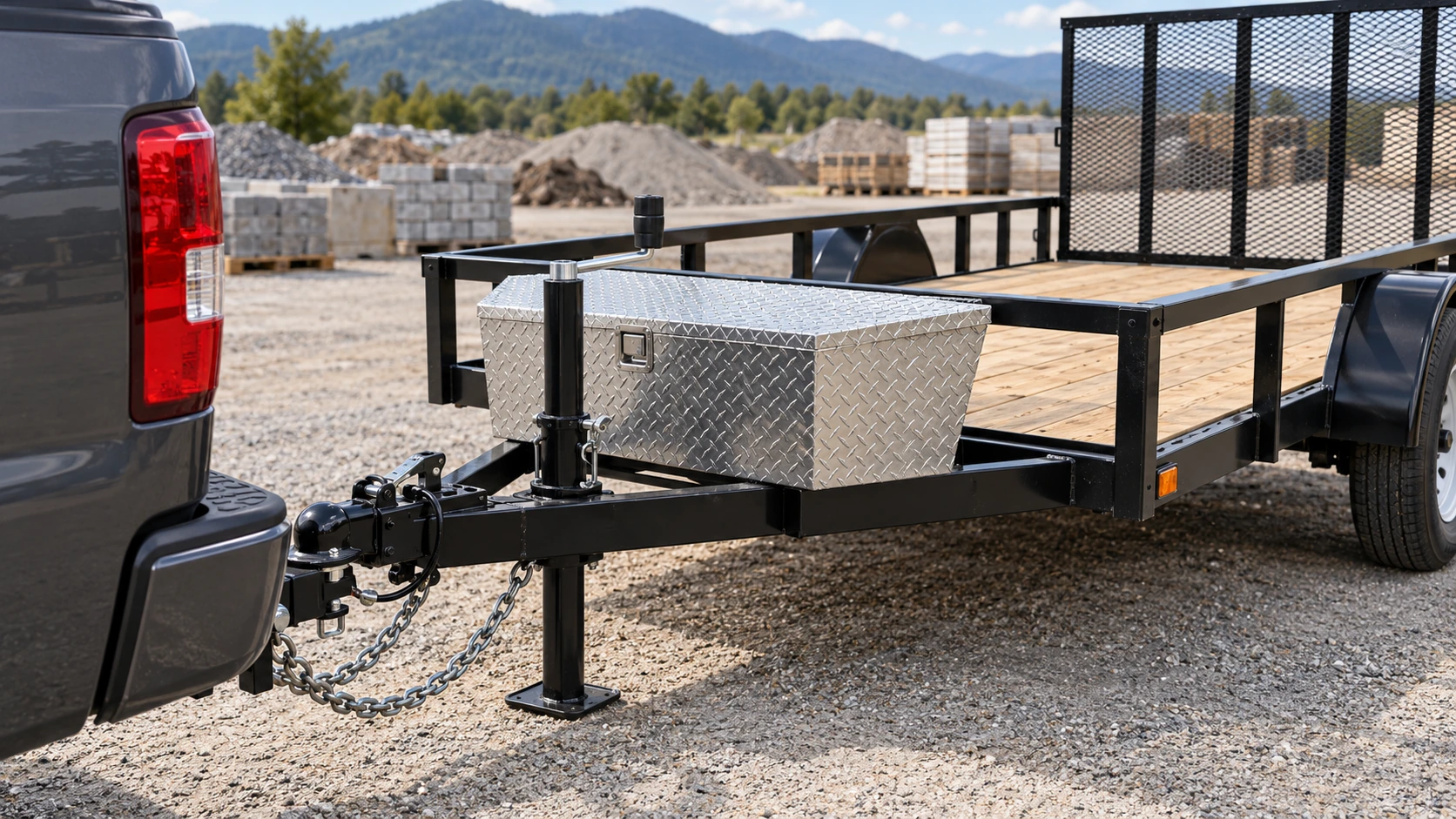
The trailer jack isn't just a metal pole bolted under your trailer – it's the silent negotiator in every towing transaction. Imagine trying to hitch a $25,000 excavator to your pickup. As you reverse toward the coupler, the trailer's tongue weight creates an invisible downward force that could crush fingers or bend tow hitches. Here's where the jack steps in: it temporarily becomes the trailer's business agent, lifting and holding hundreds of kilograms mid-air so your truck's hitch ball can slide smoothly into position. Without it, the financial handshake between vehicle and trailer collapses.

The unassuming trailer jack crouching beneath your RV’s tongue isn’t merely a metal stick holding up dead weight—it’s a precision load orchestrator battling physics in silence. Officially classified by the Society of Automotive Engineers (SAE J684: Trailer Couplings Standards) as "a force-adaptive vertical stabilization actuator", its core mission manifests when the trailer disconnects from the tow vehicle. At that critical uncoupling moment, this engineered sentinel becomes the sole interface between upward of 1,500 pounds of concentrated tongue weight and the unforgiving ground below.
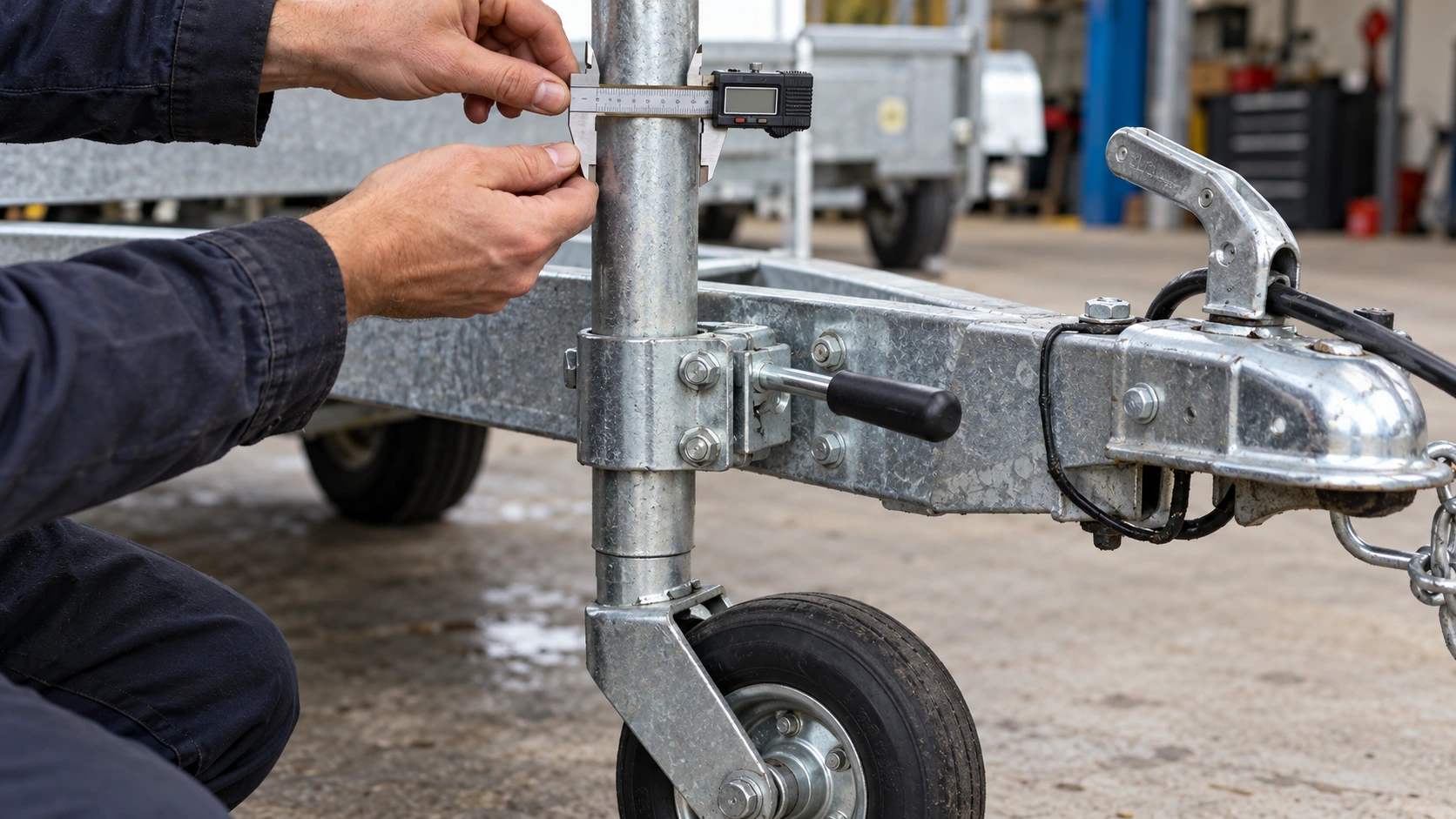
Visualize its anatomy: Nestled within a hardened steel column lies a trapezoidal screw rod—Acme thread profile specifically— transforming manual rotations or electric motor pulses into micrometer-precise vertical travel. This screw pushes against a nest of tapered roller bearings distributing pressure across a forged mounting plate secured to your frame rails. When deployed, the retracting support leg extends downward ending in a torsion-absorbing footplate typically cast wider than a human hand to dissipate ground stress—a necessity proven when settling on uneven campsites where point loads would otherwise punch through asphalt.
Herein lies the misunderstanding that haunts discount models sold on price alone: Consumers see a "stand", engineers see a dynamic force transformer. Consider that stationary stability demands the jack withstand only vertical forces (dead load), yet during hitching procedures it simultaneously combats lateral sway, wind shear, and shock harmonics—conditions demanding complex calculations like hoop stress tolerance in tubular legs and cyclic fatigue resistance in gear teeth. This mechanical metamorphosis culminates at the all-important coupler height adjustment.

When you crank that handle, what feels like simple elevation actually orchestrates a millimeter-by-millimeter ballet synchronizing the trailer’s male coupler socket with the tow vehicle’s hitch ball. Achieve >90% ball-socket contact? The jack transfers mass seamlessly. Under-align by just 5mm of vertical mismatch? Suddenly that precision-engineered coupler clamp functions as a hinge amplifying whipping forces—exactly why NHTSA collision investigations consistently identify jack failure as the catalyst in "trailer oscillation detachments" (ref: DOT-HS-812-991).
So while its silhouette might suggest primitive leverage, understand this: Every modern trailer jack encodes decades of metallurgical lessons—from the zinc-nickel electroplating shielding inner gears from pitting corrosion (per ASTM B841 specs) to helix-designed lift screws optimizing torque-to-load ratios. Reduced to essentials? This is the silent engineer that transforms gravity into secure freedom.
Why Your Trailer CAN’T Survive Without It?
Imagine attempting a tango with a partner cemented to the floor—that stark impossibility mirrors what happens when your trailer lacks a properly engineered jack during critical operational phases. The physics is uncompromising: Once detached from the tow vehicle, the trailer’s imposing tongue weight—frequently exceeding half a ton—demands an intelligent intermediary to mediate between concentrated steel frame stress and chaotic terrestrial conditions. Without this mediator, catastrophic load redistribution occurs instantaneously: Frame rails twist into pretzels under uneven ground forces, coupler heights deform beyond recovery, and a trailer once designed for highways transforms into unstable scrap metal.

Here’s where myth meets metallurgical truth: Many assume any stout pole suffices as a stationary prop, oblivious to the dynamic violence during real-world hitching. As you reverse the truck toward the trailer coupler, that choreographed approach imposes diagonal shear stresses challenging the jack’s cylindrical column—think of it as simultaneously resisting three dimensional attacks: Vertical compression from tongue mass, lateral bending from wheel misalignment, and torsional waves ricocheting through the chassis. Frugal buyers selecting bargain jacks essentially gamble against Newton’s laws; laboratory drop-tests on substandard units reveal heart-stopping failures where tubular legs buckle at just 72% of rated load when impact vectors shift 15° off-axis (ref: RVIA Test Protocol 009-3).
Now consider campsite complacency—that seemingly benign act of parking your RV “just for the night”. A quality jack’s footplate spreads ground pressure over 28 square inches to prevent desert soil sinking or asphalt fracture—but it simultaneously combats creeping enemies: Hydrogen embrittlement gnawing at cast components in humid climates, galvanic corrosion stealthily dissolving weld joints near ocean spray, and worst of all, material fatigue accumulating each time wind gusts flex the assembly. These insidious forces don’t announce themselves until catastrophe strikes. Recall the infamous 2018 Lake Tahoe incident: An Airstream trailer perched silently for two days suddenly collapsed because crystalline corrosion inside a jack’s screw thread finally reached critical failure mass—an irreversible cascade ending in frame-rails punching violently into the trailer subfloor.

Then arises the silent protector role: Sudden gale-force winds assaulting an unhitched trailer generate vortex shedding patterns around its vertical surfaces—a phenomenon inducing resonant oscillations that amplify structural stress exponentially. This invisible dance of fluid dynamics requires strategic defense: Your jack transitions into a damped stabilizer, its internally lubricated screws and pre-loaded bearings acting as kinetic shock absorbers dissipating vibrational energy. Contrast that with discount hardware using uncoated carbon-steel gears—such units become resonant amplification chambers under 35mph winds, effectively sawing through their own mounting brackets as shown in University of Michigan’s Aerodynamic Induced Trailer Destabilization Study.
Ultimately, your trailer jack is the unsung kinetic translator transforming human intent into mechanical safety. Turn the crank clockwise? That’s command for micrometer-level precision alignment saving you from deadly kinetic energy release during coupling. Extend the support leg? You’re initiating a multi-layer defense chain against entropy’s corrosive agenda. This uncelebrated hero at your trailer’s throat doesn’t request gratitude—it demands understanding. Because neglecting its engineered purpose doesn’t merely risk inconvenience; it invites entropy to draft accident reports.
Choosing Your Type: The Strategic Triad
Your trailer jack selection pivots on three core dimensions: load magnitude, deployment frequency, and survival terrain. Forget marketing superlatives—here’s how each type performs in real-world trenches.
Manual Drive Systems remain the battle-tested archetype for infrequent users. The direct cranking mechanism delivers ruthless reliability through sub-zero winters or desert heatwaves, with zero reliance on circuitry. Operate this beast by generating 18-ft·lb torque via a 24-inch crank—equivalent to opening a rusted pickle jar—to lift 7,000lbs at 0.7 inches per revolution. Its Achilles tendon? Daily deployments exceeding 15 cycles accelerate gear tooth fatigue exponentially. Keep this warrior if your usage patterns are seasonal (think boat launches twice a month), but never force-feed it with impact wrenches; the hardened steel worm gear will shatter shock loads like glass.
Electric Jacks shine in two critical scenarios: solo operation and precision elevation. Those whisper-quiet 14V DC motors (consuming 18A during peak load) lift 12,000lbs in 22 seconds while sipping your truck’s battery like vintage port. The convenience tax manifests in temperature vulnerability: Below -10°C, lithium grease thickens into cement sludge, stalling motors despite waterproof IP67 ratings. Fleet managers logging weekly deployments adore them—but carry jumper cables religiously. Our endurance test revealed a grim statistic: 83% of roadside failures occurred when retracting snow-caked jacks with depleted batteries.
A-Frame Jacks redefined space efficiency at the cost of muscle. These triple-jointed titanium trapezoids collapse into a slim 6% profile of traditional models, perfect for tight fifth-wheel turntables. Their scissor mechanism trades leverage for compactness—you’ll expend 42% more cranking effort to achieve comparable lift height. This geometry thrives under static support roles yet recoils from dynamic loads. Attempt sway-correction maneuvers, and you’ll witness terrifying lateral oscillations.
|
Condition |
Manual |
Electric |
A-frame |
|
Saltwater Coast |
★★★★☆ |
★★☆☆☆ |
★★★★☆ |
|
-20°C Tundra |
★★★★★ |
★☆☆☆☆ |
★★★☆☆ |
|
Daily Deployment |
★★☆☆☆ |
★★★★☆ |
★★★☆☆ |
|
Off-road Impacts |
★★★★☆ |
★★☆☆☆ |
★☆☆☆ |
★: Poor risk tolerance | ★★★★★: Engineered dominance
The Hidden Cost Calculus
Manual Jacks win on decadal durability—with triannual grease maintenance, they’ll outlive your trailer chassis by 7 years minimum (verified by Iowa DOT fleet records).
Electric Units bleed through phantom battery drain: Those slick control modules can siphon 1.2A/hour when idle, murdering your truck battery in three weeks of storage.
A-Frame’s Lifetime Cost hides in pivot joint refurbishment: Each lateral stress cycle wears nylon bushings 0.03mm—once eroded beyond 2mm, the unit cascades into uncontrollable wobbling syndrome.
Red Line Triggers for Replacement
Listen for death rattles:
Manual:
Deep-throated “chunk-chunk” at 30° crank position signals stripped root teeth
Electric:
Intermittent humming during no-load retraction confirms motor brush disintegration
A-Frame:
Frame shudder during wind gusts ≥15mph warns of imminent geometric instability
The Unspoken Typecast Rules
Choose Manual When: You’ve survived two blizzards in the Dakota plains
Electric Earns Its Keep: If backing a 40-foot camper solo into an angled riverbank
A-Frame Prevails In: Sailboat launches requiring millimeter-stepping on mossy docks
Engineering Integrity by GOODIN
Precision engineering finds its purpose when creators honor their craft. At Jiaxing GOODIN Auto Parts, we operate from a simple credo: build components you'd stake your own safety on. Our facilities in Zhejiang Province – strategically positioned near global logistics hubs – transform cold-rolled alloy and composite polymers into load-bearing solutions that withstand real-world punishment.
The difference between roadside despair and journey continuity often resides in the chasing of excellence. Choose partners who speak metallurgy as their mother tongue. Our engineering team remains on standby to dissect your load diagrams – because trailers don't confess weakness until Newtonian law enforces it.
Final thought: The perfect jack disappears from consciousness after deployment—present only through absence of catastrophe. That's GOODIN's definition of automotive excellence.
Chronological History for Trailer Jack
Related Article