The Foundational Logic of Trailer Jack Selection
Selecting an appropriate trailer jack is essentially a logical progression from load calculation to specification matching and finally to mechanical adaptation. It does not require intimate knowledge of every trailer component, but it demands adherence to a clear chain of reasoning: First, accurately calculate the actual "tongue weight" exerted on the hitch ball based on the fully loaded trailer. Second, verify that the jack's dynamic lifting capacity provides sufficient safety margin. Third, choose between manual and electric operation based on physical capability and usage frequency. Finally, ensure the jack's mounting configuration aligns seamlessly with the trailer's chassis. Only by clarifying these four aspects in sequence can one ensure the jack stands firm as a pillar under heavy load and tucks away neatly without scraping the ground during transit.

Accurate Estimation of Tongue Weight
The selection of a jack should not be based on the trailer's gross weight but rather on the "Tongue Weight"—the actual downward force exerted on the hitch ball. The safe range for tongue weight is typically 10% to 15% of the fully loaded Gross Trailer Weight (GTW). For example, a trailer with a fully loaded GTW of approximately 6,000 lb should have a reasonable tongue weight range between 600 lb and 900 lb.
When estimating tongue weight, calculations must be based on the fully loaded state. This includes not only the dry weight of the trailer but also the weight of full water tanks, cargo, batteries mounted on the tongue, and full propane cylinders. Furthermore, if a Weight Distribution (WD) Hitch is used in your towing setup, the jack must overcome not only the tongue weight but also additional leverage transferred from the tow vehicle's rear axle. Therefore, in scenarios involving WD hitches, the capacity requirement for the jack is higher, and a more generous buffer margin must be allocated.

Dynamic Capacity and Safety Redundancy
When reviewing a jack's specification sheet, it is critical to distinguish between two distinct concepts, as confusing them can lead to improper selection and safety hazards:
- Static Capacity: This refers to the maximum vertical load the jack can hold while stationary, acting solely as a support post. This number is usually large, but it cannot be used as the selection criteria.
- Dynamic Capacity (Lifting Capacity): This refers to the maximum weight the jack can safely lift during motion—while the crank is turning, gears are rotating, and the inner ram is sliding. This is the only valid reference metric for purchase.
Hard Selection Rule: The jack's Dynamic Capacity must be greater than or equal to the maximum estimated tongue weight of the fully loaded trailer.
Safety Redundancy Recommendation: Considering potential shifts in the center of gravity during loading/unloading, or momentary shock loads when operating on uneven terrain, it is strongly recommended to select a jack with a Dynamic Capacity rated at 1.5 times the fully loaded tongue weight. For instance, if the maximum calculated tongue weight is 880 lb, the selected jack should have a Dynamic Capacity of no less than 1,300 lb. This ensures that the gears and lead screw remain in a low-wear, high-reliability operational state during repeated heavy lifts and unexpected side-loading events.

Balancing Effort and Efficiency
The power source of the jack dictates the physical effort required and the operational tempo. There are three primary drive types, each with a distinct trade-off between cost and convenience:
- Manual Jack: Driven by human force rotating a crank handle. Its primary advantage lies in its mechanical simplicity, extremely low failure rate, and independence from external power sources. Provided lubrication is maintained, a manual jack offers exceptional reliability in harsh environments. The drawback is slower operation speed; for tongue weights exceeding 660 lb, significant physical effort is required, which may not be suitable for users with back concerns.
- Electric Jack: Driven by a 12V DC motor operating a planetary gearset. Its core value is the elimination of manual labor—heavy lifting is accomplished with the press of a switch. Limitations include the necessity of a connection to the trailer battery or tow vehicle power, higher vulnerability of internal electronics to moisture and dirt, and a purchase cost several times higher than manual models.
- Drill-Powered Jack: This is a modified design that retains the manual drive path but features a hex drive input on the top for a power drill. It strikes a practical balance between pure manual and full electric: it functions as a standard manual jack in emergencies, yet when coupled with a high-torque power drill, it achieves lifting speeds comparable to electric models. The only additional requirement is carrying a cordless drill with sufficient battery charge and torque.

Seamless Integration of Form and Function
Whether a jack fits correctly and functions stably depends on its physical compatibility with the trailer chassis. This stage involves three primary dimensions of matching:
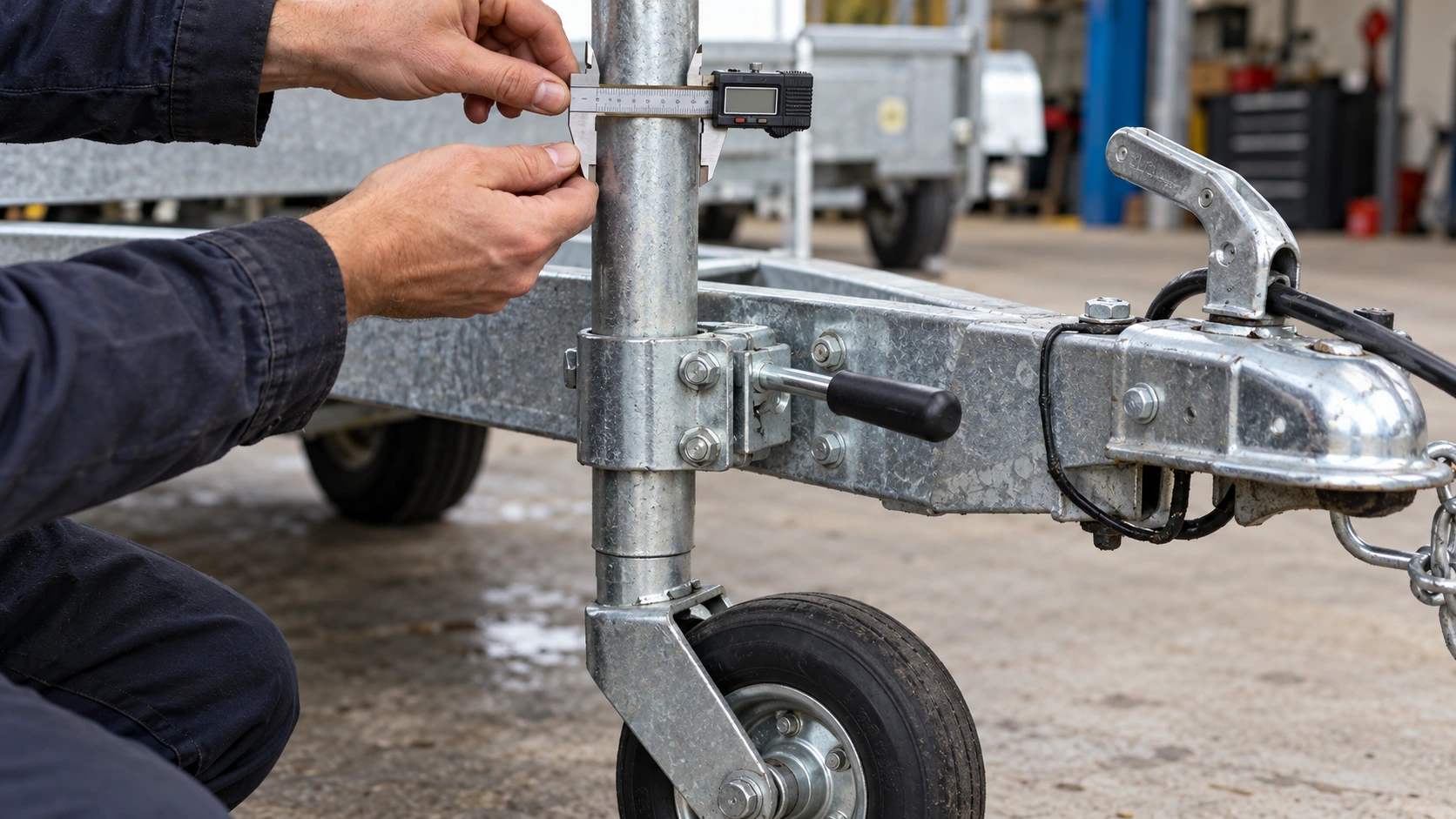
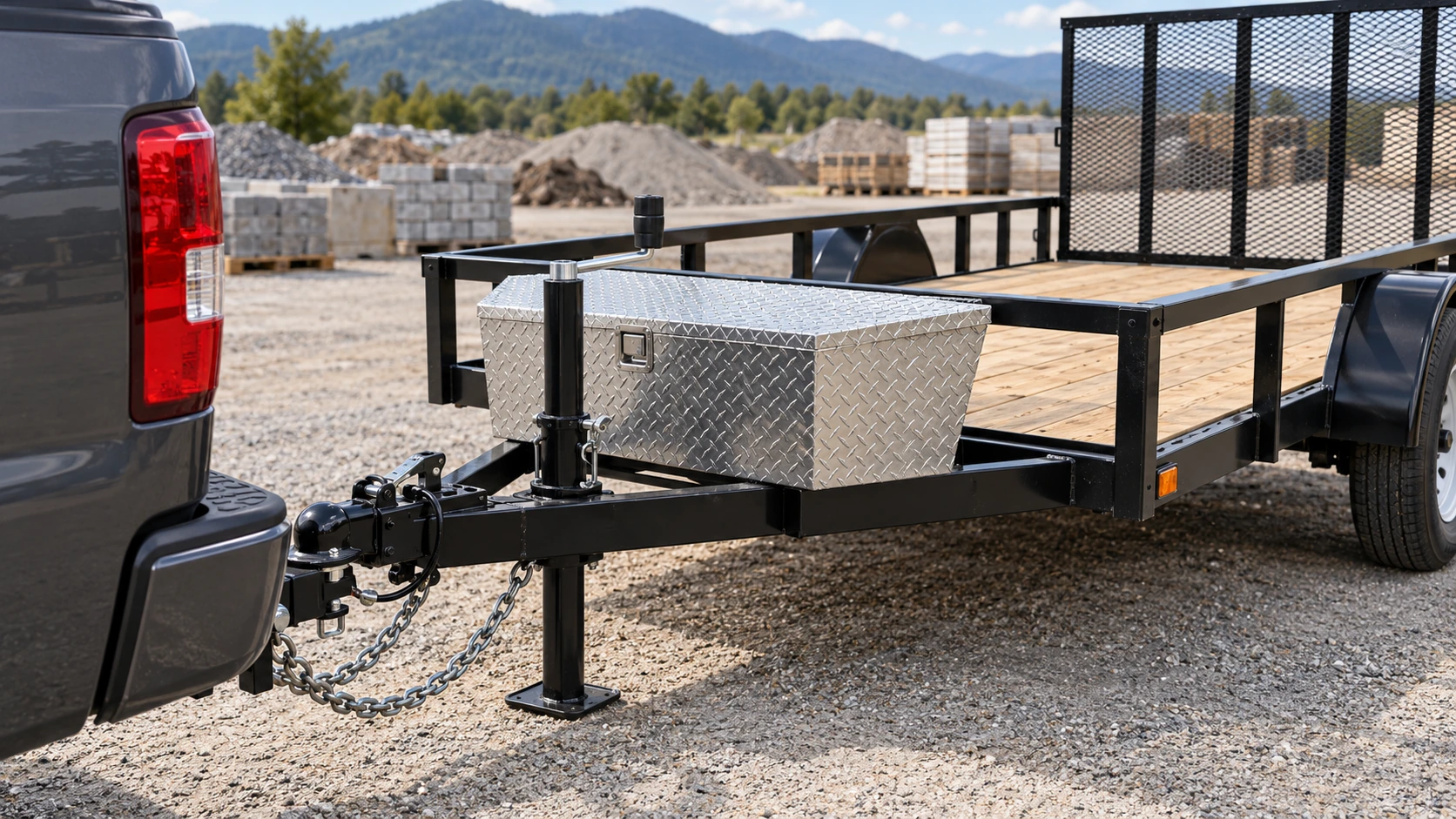
- Tongue Shape Compatibility: Trailer frames converge at the front in two primary configurations. A-Frame is the most common design, consisting of two angled beams forming a triangle; this requires a dedicated A-Frame Jack, which features a wide mounting plate for superior stability. The alternative is the Straight Tongue, often found on small utility or boat trailers, where the beam is a single straight tube; this requires a specifically designed bracket-style Straight-Tongue Jack.
- Mounting Method: This determines the connection rigidity between the jack and the frame.
- Weld-On: The outer tube is welded directly to the trailer frame. This provides the highest structural strength and resists lateral shear forces exceptionally well, though the position is permanent and non-adjustable.
- Bolt-On: The mounting plate is secured with high-strength bolts through pre-existing or drilled holes. This method allows for easy installation and future replacement/upgrades, making it the mainstream choice in the aftermarket.
- Clamp-On: Utilizes U-bolts to temporarily clamp the jack to the A-frame crossmember. This offers tool-free portability and is ideal for rental trailers or scenarios requiring only short-distance maneuvering within a campsite.
- Stowage Functionality: Addressing ground clearance concerns during travel, the Swivel Jack provides an effective solution. Its design incorporates a hinge mechanism; by releasing a locking pin, the entire jack body can be rotated 90 degrees upward and secured in a horizontal position. This significantly increases the ground clearance at the trailer's nose, effectively preventing scraping when navigating steep driveways or railroad crossings.

Returning to Safety Redundancy and Precise Matching
In summary, the process of selecting a trailer jack can be distilled into two golden rules: First, err on the side of higher capacity. Second, ensure precise structural fit.
Regarding capacity, focus exclusively on Dynamic Lifting Capacity and adhere to the 1.5x safety redundancy principle, ensuring the jack's actual lifting capability far exceeds the theoretical tongue weight. Regarding mechanics, verify that the jack's base plate matches the trailer tongue shape, the mounting style suits your usage habits, and the stowed position does not compromise road clearance. By following this logical progression from load estimation to specification filtering, power selection, and structural confirmation, the jack you ultimately choose will lift confidently under heavy loads and travel securely over long distances.
(The images used are from Pinterest. If there is any copyright infringement, please inform us and we will delete them immediately.)
Electro-Galvanizing vs. Hot-Dip Galvanizing
Practical Guide to Aluminum Tool Boxes: Durability Meets Worksite Efficiency
Related Article