New Boat Trailer First-Season Checklist: Delivery, 30, 60 and 90 Days
A new boat trailer can leave the dealer looking correctly assembled and still develop setup problems during its first months of real use.
Road vibration allows newly installed hardware to settle. Wet bunks compress differently from dry bunks. A winch stand that looked correctly positioned in the yard may pull the strap at an angle after the boat has been launched and retrieved several times. Brakes, hubs and bearings may behave normally during a short delivery trip but show heat, drag or leakage during the first long highway run.
That is why new boat trailer issues should not be treated only as warranty surprises. Many are early adjustment or inspection problems that can be found before they become roadside failures, hull-support problems or repeated launch-ramp frustration.
This guide uses a practical delivery-day, 30-day, 60-day and 90-day inspection framework. It is a first season trailer checklist, not a replacement for the torque values, service schedules and adjustment procedures supplied by the trailer, axle, brake, tire, jack and winch manufacturers.
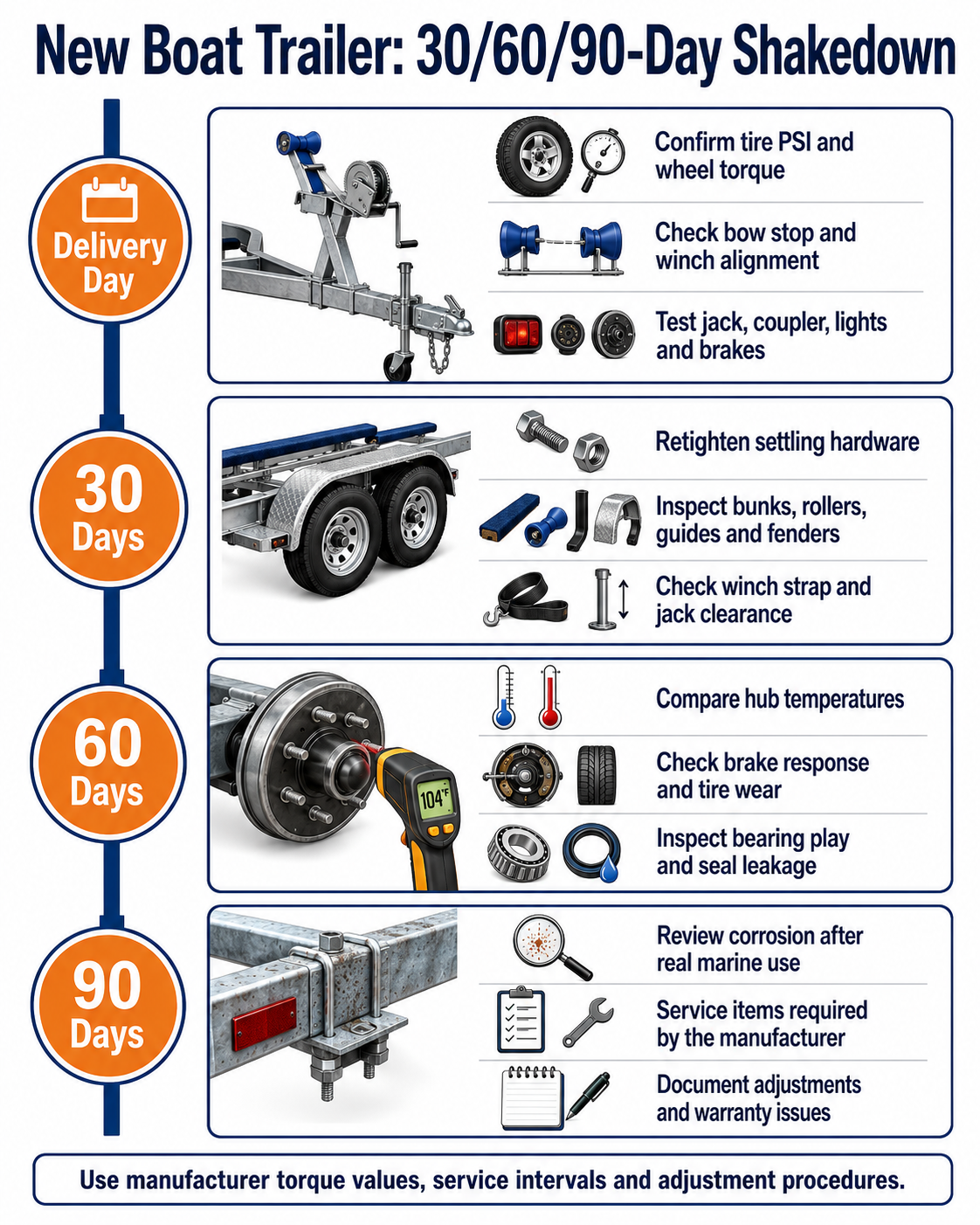
Establish a photographed delivery baseline, inspect settling after initial road and ramp use, compare heat and brake response after a representative trip, and finish with a corrosion, service and warranty review.
The 30/60/90-day framework is practical guidance. Any mileage, torque, lubrication, adjustment or service interval specified by the trailer or component manufacturer overrides it.
Why Delivery-Day Inspection Is Not Enough
A delivery inspection is a static snapshot. It can confirm that the parts are present and that the trailer appears correctly assembled, but it cannot reproduce every force created by highway speed, braking, ramp angle, wet supports, repeated retrieval or saltwater exposure.
The first season should therefore be treated as a controlled trailer shakedown. The objective is not to disassemble a new trailer repeatedly. The objective is to identify movement, heat, leakage, poor alignment and corrosion early enough to correct them safely.
New Hardware Can Settle
Wheel fasteners, bunk brackets, guide hardware, fender supports and winch-stand clamps may settle after initial loading and vibration. Paint, protective coatings and mating surfaces can also affect how a newly assembled joint stabilizes.
Use only the manufacturer's specified tightening sequence and torque. More force is not automatically safer; overtightening can damage wheels, fasteners, brackets and thin trailer tubing.
Wet Loading Changes the Support System
Carpeted bunks and other covered supports behave differently after repeated immersion. The boat may settle slightly into its support system, revealing a gap, an excessive pressure point or a bow-stop position that was difficult to judge while the trailer was dry.
Road Heat Reveals Problems
Brake drag, bearing preload, seal leakage, tire underinflation and uneven load sharing often become more visible after a representative highway trip.
A hub that remains cool during a short dealer delivery may become noticeably hotter than the other hubs after sustained towing.
Delivery Day: Establish the Baseline
The delivery-day inspection gives the owner, dealer and trailer supplier a documented starting point. Photograph each area before the trailer accumulates road miles or saltwater exposure.
Record the Trailer Specification
- Trailer manufacturer, model and VIN.
- Gross vehicle weight rating and axle ratings.
- Tire size, load range and cold-pressure specification.
- Wheel-fastener torque specification.
- Brake type and actuator or controller requirements.
- Bearing or hub system and approved lubricant.
- Jack model, rating, travel and mounting method.
- Winch model, strap or cable specification and rating.
Confirm Boat Position on the Trailer
The boat should be centered and supported by the intended bunks or rollers. Confirm that the transom, keel, chines and other structural areas are positioned according to the boat and trailer manufacturers' instructions.
Do not assume that a boat is correctly positioned simply because the bow reaches the winch stand. The rear support position and tongue weight also matter.
Check the Coupler and Safety Systems
- The coupler matches the hitch-ball size.
- The latch closes and locks correctly.
- Safety chains have appropriate attachment points.
- The breakaway cable has a clear route and correct length.
- The electrical connector and wiring do not bind during turning.
- The surge actuator or brake controller operates as specified.
Bow Stop and Winch Stand Alignment
Poor winch stand alignment creates problems that are often blamed on the winch or strap.
The Strap Should Pull in a Controlled Line
The strap or cable should run from the drum to the approved bow eye without severe side loading, rubbing against the winch frame or contacting sharp hardware.
If the strap continually winds against one side of the drum, check the winch position, bow-eye position and the relationship between the boat and trailer centerlines.
The Bow Stop Must Contact the Intended Area
Correct bow stop adjustment should hold the bow in its intended transport position without crushing the hull, missing the bow profile or allowing the boat to move forward during braking.
The bow stop should not be used to pull a boat into position when the main bunks, rollers or boat position are fundamentally incorrect.
The Winch Stand Must Be Structurally Supported
Inspect the stand, mounting plate, U-bolts, fasteners and trailer tongue. Look for visible flex, cracked coating, misaligned washers or clamp movement.
Before moving the stand, photograph and measure its original position. Changing the stand can affect boat position, hull support and tongue weight.

Check the Jack Before the First Trip
A new jack may operate correctly while unloaded but bind, flex or lose clearance under the actual tongue load.
Confirm Rating and Mounting
The jack should be selected for the vertical load it supports at its mounting position—not simply from the total trailer weight.
Its bracket must be installed on an appropriate structural member using hardware suited to the frame dimensions.
Check Operating Clearance
Evaluate complete boat trailer jack clearance in both the operating and stored positions:
- Crank clearance from the bow and winch stand.
- Wheel or foot clearance from the coupler and safety chains.
- Brake-line and wiring clearance.
- Swing-back rotation and locking-pin access.
- Ground clearance during towing.
- Clearance at driveway transitions and ramp entrances.
Test the Locking Mechanism
A swivel or swing-back jack must lock fully in its operating and towing positions. Partial pin engagement is not acceptable.
The wheel should also swivel and roll under the real tongue load rather than only when the trailer is empty.
What Changes During the First Trips?
The first few road trips and launch cycles can expose conditions that were not obvious at delivery.
Wheel and Bracket Seating
New wheel assemblies may require early torque rechecks. Bunk brackets, fenders, guides and other clamped components can also reveal movement through polished metal, shifted washers or fresh coating marks.
Boat Settlement
The hull may settle differently after wet loading. Recheck the relationship between the bow stop, winch stand, main supports and transom position.
Guide and Fender Contact
Look for fresh rubbing, scratches, displaced carpet or contact between the tire and fender. A stationary inspection may not reveal the full suspension movement that occurs on the road.
Brake and Bearing Behavior
A new trailer may need brake adjustment or diagnosis if it pulls, drags, responds unevenly or produces abnormal heat. Hub-temperature differences and grease or fluid at the rear of the hub should be investigated.

30-Day Inspection: Retighten, Realign and Document
The first 30-day inspection should occur after the trailer has experienced several launches and meaningful road use. A mileage or usage trigger specified by the manufacturer should take priority over the calendar.
Fasteners and Structure
- Recheck wheel fasteners using the specified torque sequence.
- Inspect winch-stand, bow-stop and jack mounting hardware.
- Check bunk, roller and guide brackets.
- Inspect fender supports and light brackets.
- Check frame, tongue and axle brackets for coating damage or deformation.
Winch and Loading Equipment
- Confirm the ratchet engages positively.
- Inspect strap edges, stitching, hook and drum attachment.
- Check that the bow remains correctly seated.
- Confirm the guide system does not pinch or lift the hull.
- Inspect bow and transom restraint points.
Jack Operation
- Confirm the bracket has not shifted.
- Check locking-pin engagement.
- Inspect wheel axle play and caster operation.
- Check for increasing crank effort.
- Confirm stored road clearance again.
60-Day Inspection: Evaluate Real Road Performance
The 60-day inspection should focus on heat, wear, braking and movement under realistic towing conditions.
Compare Hub Temperatures
After a representative highway trip, compare hubs operating under similar conditions. The absolute temperature depends on braking, load, ambient temperature and road conditions; a substantial difference between comparable hubs is often more useful than one isolated number.
Inspect Tires and Fenders
- Cold pressure and pressure retention.
- Uneven shoulder or tread wear.
- Sidewall cuts, bulges or cracking.
- Fresh tire-to-fender contact marks.
- Wheel position and visible alignment.
Perform a Trailer Bearing Inspection
Follow the hub or axle manufacturer's procedure for checking play, smoothness, lubricant condition and seal leakage. A bearing protector or grease fitting does not eliminate scheduled hub inspection.
Check Brake Response
Perform a controlled low-speed test in a safe area. Investigate:
- Delayed response.
- Pulling to one side.
- Dragging after brake release.
- Abnormal heat.
- Fluid loss.
- Loose or abraded brake lines and wiring.

Check Bunks, Rollers, Guides and Fenders
Bunks
Inspect carpet or covering for movement, torn areas, trapped debris and exposed fasteners. Confirm broad, appropriate hull contact rather than narrow edge loading.
Rollers
Confirm that rollers rotate, remain centered on their shafts and do not contact vulnerable hull fittings. Check brackets for movement and corrosion.
Guide-Ons and Target Bunks
The guide system should improve loading alignment without becoming an unintended transport support. Check spacing through the complete loading path, not only after the boat is fully seated.
Fenders
Inspect fender alignment, mounting brackets and tire clearance. Fresh rub marks indicate movement that requires investigation.
90-Day and End-of-First-Season Inspection
The 90-day inspection should combine the results of the first road miles, repeated launches and actual marine exposure.
Marine Trailer Corrosion Review
Early marine trailer corrosion often begins around moving joints, damaged coating, trapped salt and dissimilar hardware rather than on the largest visible frame surfaces.
Inspect:
- Jack pivot, locking pin, wheel axle and crank.
- Winch gears, strap bolt, hook and mounting fasteners.
- Brake actuator, calipers or drums and brake-line fittings.
- Hub seals, caps and rear hub surfaces.
- Electrical grounds, connectors and light housings.
- Bunk, guide, fender and axle brackets.
- Welds, drilled areas and coating chips.
Complete Required Service
Perform the bearing, brake, wheel, tire and fastener service specified by the relevant manufacturers. Do not postpone required work simply because the trailer is less than one year old.
Review Every Adjustment
Compare current photographs and measurements with the delivery-day baseline. Repeated movement in the same bracket or recurring brake, bearing or alignment problems should be reported to the dealer or manufacturer.

When to Stop Using the Trailer
A checklist should not become permission to continue towing a known safety defect.
Stop using the trailer and arrange qualified inspection if you find:
- Brake loss or severe brake drag.
- A substantially overheated hub.
- Loose wheel hardware that will not remain correctly tightened.
- A damaged, bulged or separating tire.
- Visible frame, tongue or weld cracking.
- A bent mounting bracket or deformed structural member.
- A coupler that will not close and lock correctly.
- A jack that will not lock or clear the road.
- A winch or bow connection that cannot be secured.
- A bearing that is rough, loose or leaking.
Dealer and Warranty Documentation
New-trailer problems should be documented before major modifications are made.
Keep a Written Record
- Date and mileage.
- Launch count.
- Photographs of the problem.
- Temperature or pressure readings where relevant.
- Fastener or alignment changes.
- Dealer conversations and repair invoices.
Do Not Modify Structural Components Without Approval
Relocating a winch stand, drilling a frame, welding a new bracket or moving axle-related equipment can affect support, tongue weight, braking and warranty coverage.
Obtain the appropriate manufacturer or qualified engineering guidance before modifying structural parts.
First-Season Inspection Checklist
| Stage | Main Checks | Main Objective |
|---|---|---|
| Delivery Day | Specification, tires, wheels, coupler, jack, winch, bow stop, lights and brakes | Establish a documented baseline |
| 30 Days | Fasteners, brackets, bunks, rollers, guides, jack clearance and winch hardware | Find settlement, movement and alignment problems |
| 60 Days | Hub heat, brakes, bearings, tires, fenders, seals and road response | Evaluate the trailer under real towing conditions |
| 90 Days | Corrosion, repeated faults, scheduled service and warranty documentation | Complete the first-season review and maintenance plan |
GOODIN Industry Perspective
For trailer manufacturers, distributors and OEM buyers, the first season is also a product-feedback period.
Recurring setup complaints often reveal that delivery documentation did not clearly define:
- Wheel-fastener torque and recheck procedure.
- Tire pressure and load specification.
- Brake type, adjustment and testing method.
- Bearing and seal service requirements.
- Bow-stop and winch-stand adjustment limits.
- Bunk, roller and guide contact requirements.
- Jack load, travel and stored clearance.
- Freshwater rinsing and corrosion-maintenance expectations.
A better B2B delivery process should include a signed baseline inspection, product-specific torque and service information, and a scheduled early follow-up after the trailer has completed real road and ramp use.
GOODIN's Boat Trailer Jack range includes wheeled and swing-back support configurations for different marine trailer applications.
The Trailer Winch range includes manual retrieval equipment that should be specified together with the bow eye, bow stop, winch stand and independent transport restraints.
The broader Trailer Jack range provides additional mounting, capacity and support configurations for OEM trailer projects.
Specify the Jack and Winch as Part of the Complete Trailer System
Match the jack to actual tongue load, travel, frame and stored clearance. Match the winch to the boat, retrieval geometry, bow eye and strap path.
Send the Delivery Baseline and First-Season Findings in One RFQ
Include trailer model and VIN, GVWR, axle ratings, tire and wheel data, tongue load, jack and winch details, bow-stop and bunk positions, brake and hub type, water exposure, recurring heat or movement findings, photographs, order volume and market.
Focused FAQ
Why Does a Brand-New Boat Trailer Need a 30-Day Inspection?
The first road miles and launches can reveal fastener settlement, wet-bunk compression, bracket movement, jack interference and alignment problems that were not visible during a static delivery inspection.
Should Wheel Nuts Be Rechecked on a New Trailer?
Yes, when required by the wheel or trailer manufacturer. Use the specified tightening sequence and torque value. Do not substitute a universal torque or overtighten the fasteners.
How Do I Know Whether the Bow Stop Is Correctly Adjusted?
The bow should reach its intended transport position, the winch strap should pull in a controlled line and the stop should contact the correct hull area without crushing, missing or lifting the bow away from the main supports.
Why Does a New Winch Strap Wind to One Side?
Possible causes include winch misalignment, an off-center bow eye, poor boat positioning, a twisted strap or an uneven first wrap on the drum. Correct the cause rather than repeatedly forcing the strap sideways.
What Should I Check If a New Trailer Brake Feels Weak?
Confirm the brake type, actuator or controller setup, brake-fluid level, breakaway system, adjustment requirement and wiring or hydraulic connections. A qualified service provider should diagnose continued weak or uneven braking.
How Can I Tell Whether a New Hub Is Running Too Hot?
Compare all hubs after similar road use. One hub that is substantially hotter than comparable hubs may indicate brake drag, bearing adjustment, lubrication or seal problems.
Should New Boat Trailer Bearings Already Be Serviced?
They should be inspected and maintained according to the axle or hub manufacturer's instructions. New age alone does not eliminate the need to check play, smoothness, lubricant condition or seal leakage.
Why Did My Boat Shift After the First Few Launches?
Wet bunks may allow different settlement, guide hardware may have moved, or the original support alignment may not have matched the hull. Recheck the complete support and bow-positioning system.
Can I Move the Winch Stand Myself?
Minor adjustable-position changes may be possible on some trailers, but moving the stand can change boat position, support and tongue weight. Document the original position and follow manufacturer guidance.
What Corrosion Should I Expect During the First Saltwater Season?
Light deposits may appear, but red rust, seized moving parts, damaged coating, corroded electrical grounds, brake deterioration or repeated salt accumulation require attention. Freshwater rinsing does not replace inspection.
Is the 30/60/90-Day Schedule a Manufacturer Service Interval?
Not necessarily. It is a practical first-season inspection framework. Any mileage, time, torque or service interval specified by the trailer or component manufacturer takes priority.
What Documents Should I Keep for a New Trailer Warranty Issue?
Keep the sales documents, VIN and component information, delivery photographs, inspection dates, mileage, measurements, temperature or pressure readings, repair invoices and written dealer communications.
Conclusion
A new trailer is not a maintenance-free trailer. Its first season is when assembly, adjustment and operating conditions meet for the first time.
The most useful approach is to establish a delivery baseline, inspect settling and alignment after initial use, evaluate heat and braking during representative road trips, and finish the season with a corrosion and service review.
The purpose of a boat trailer setup checklist is not to create unnecessary work. It is to find small problems while they are still loose bolts, poor clearances, developing heat or early corrosion—not after they become a damaged hull, failed bearing, weak brake or roadside recovery.
Delivery day confirms what was supplied. The first season confirms whether the complete trailer system actually works.
Technical References
- BoatUS: Time-Tested Spring Boat Launch Checklist
- BoatUS Foundation: Boat Transportation and Trailering
- Dexter Group: Trailer and RV Maintenance Schedule
- Dexter Group: Boat Trailer Preseason Inspection
- Karavan Trailers: Basic Trailer Maintenance
- Karavan Trailers: Wheel-Fastener Torque and Initial Recheck
Boat Trailer Corrosion-Resistant Hardware: A Procurement Guide
How to Move a Boat Trailer in a Tight Garage: Jacks, Dollies and Movers
Related Article