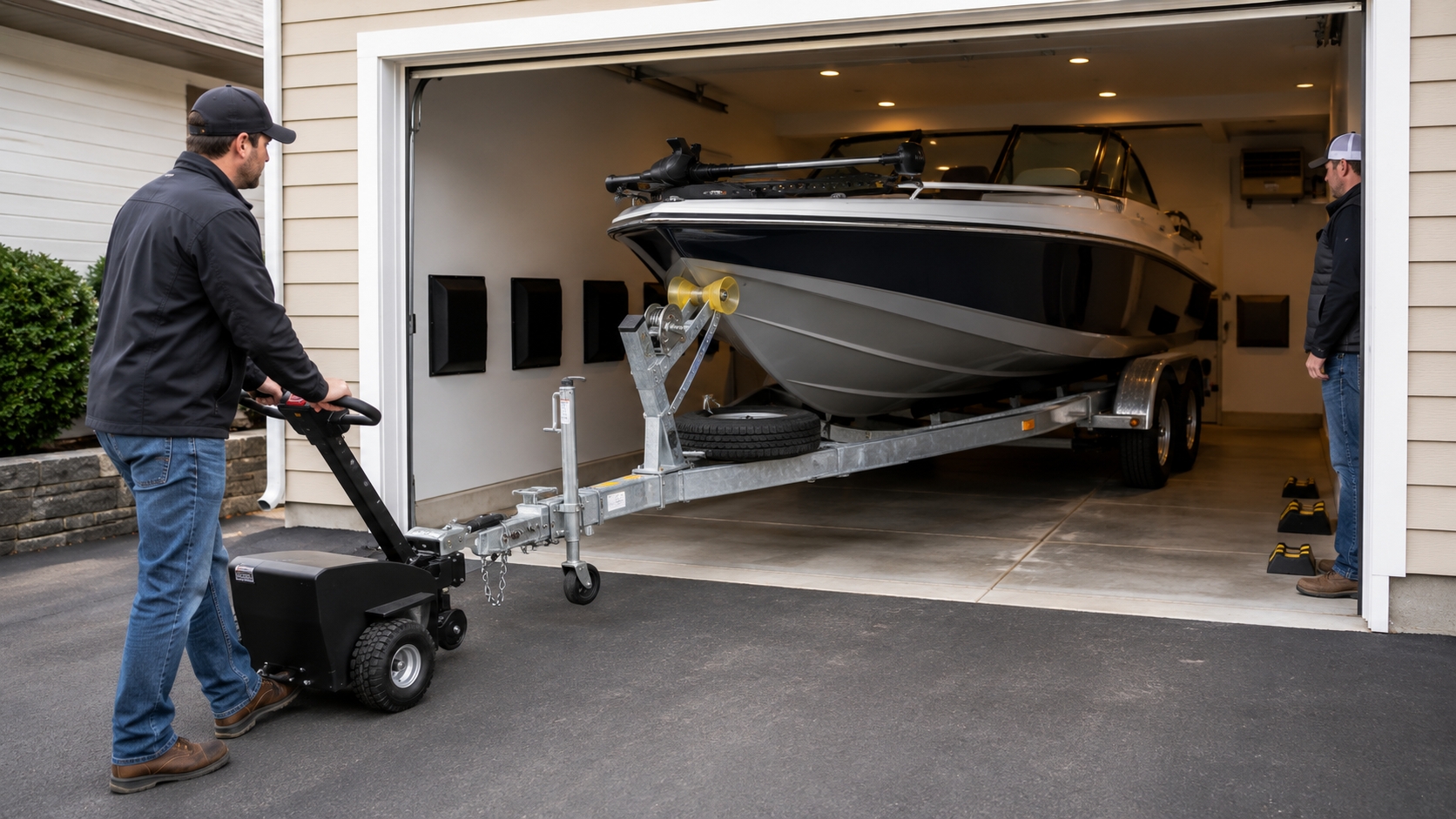
Boat Trailer Corrosion-Resistant Hardware: A Procurement Guide
Marine trailer corrosion should be specified as a component system—not as one finish name applied to the complete trailer. The frame, jack, winch, fasteners, brake hardware, lights and electrical grounds have different geometries, movements, strength requirements and maintenance access.
Define the service environment, identify the base material and component function, select the coating process, specify thickness and supplementary treatment, verify compatibility and then define inspection and maintenance.
Hot-dip galvanizing, electroplated zinc, zinc-nickel alloy coatings and stainless steel solve different problems. A bright new surface does not prove the process, thickness, passivation, sealing or marine suitability.
Corrosion Resistance Is Moving from a Maintenance Issue to a Buying Requirement
Saltwater corrosion is no longer being discussed only after a brake caliper seizes or a trailer frame begins showing visible rust. Owners, dealers and OEM buyers are increasingly looking at the complete hardware system before the trailer is delivered.
That system includes the jack outer and inner tubes, swing bracket, locking pin, wheel axle, winch frame, gears, hook, U-bolts, fasteners, lights, electrical grounds, brake hardware and structural frame.
The smallest of these parts can stop the trailer from operating even when the largest structural members still look acceptable. A seized jack pin can prevent the jack from folding. A corroded winch pawl can affect retrieval. A rusted ground connection can disable the lights. A weakened U-bolt can allow a bracket to move.
This is why corrosion resistant boat trailer hardware is becoming a procurement priority rather than an optional upgrade.
Why Small Hardware Often Fails Before the Main Frame
Large frame sections are visible and comparatively easy to rinse. Small components contain more edges, holes, threads, overlaps and moving interfaces where saltwater can remain trapped.
Moving Joints Remove Their Own Protection
Jack tubes, locking pins, winch gears and wheel axles repeatedly slide or rotate. Contact can polish, scratch or wear away part of the protective layer.
Once the base steel is exposed, retained moisture and salt can start localized corrosion beneath an otherwise bright-looking component.
Threads and Overlaps Hold Salt
U-bolts, nuts, washers, clamps and folded brackets create narrow spaces that do not drain or dry as quickly as open frame surfaces.
These crevices are also difficult to inspect. Red rust may remain hidden between a bracket and frame until the fastener loses section or the joint begins to move.
Electrical Components Combine Water and Dissimilar Metals
Trailer lights and wiring contain steel fasteners, copper conductors, aluminium housings, plated terminals and grounding points. Saltwater intrusion can therefore create both ordinary corrosion and galvanic interactions.
A sealed LED housing helps, but the connector, ground, wire entry and mounting hardware remain part of the corrosion system.
A Bright Finish Does Not Prove a Marine Specification
Two parts may look nearly identical when new while using different coating thicknesses, passivation systems, topcoats or surface preparation.
The difference often becomes visible only after repeated immersion, road abrasion and outdoor storage.
“Galvanized” Is Not One Single Specification
The word galvanized is frequently used for several different zinc-based processes. Procurement teams should ask which process was used rather than relying on the appearance or product name.
Hot-Dip Galvanized Steel
Hot-dip galvanizing immerses prepared steel into molten zinc, producing a comparatively thick zinc-based coating over properly accessible surfaces.
It is commonly suited to frames, crossmembers, large welded brackets and other components that benefit from substantial sacrificial protection.
For fabricated steel products, standards such as ASTM A123/A123M address hot-dip galvanized coatings. Smaller hardware items such as bolts and certain fittings may be covered by ASTM A153/A153M.
A correctly specified hot-dip galvanized trailer hardware system should define more than the process name. It should address:
- Applicable coating standard.
- Minimum coating thickness or coating mass.
- Venting and drainage of hollow fabrications.
- Coverage around welds and edges.
- Thread fit and removal of excess zinc.
- Repair of damaged or uncoated areas.
Electroplated Zinc
Electroplated zinc normally provides a thinner and smoother layer than after-fabrication hot-dip galvanizing. It is useful where dimensional control, sliding fit and a cleaner surface are important.
Typical applications can include jack tubes, small brackets, clamps, fasteners and other formed components.
However, a zinc plated trailer jack is not automatically equivalent to a hot-dip galvanized frame. Its performance depends strongly on:
- Coating thickness.
- Surface preparation.
- Passivation type.
- Sealant or topcoat.
- Coverage inside holes and recesses.
- Damage during forming and assembly.
ASTM B633 provides coating classes and supplementary-finish requirements for electrodeposited zinc on iron and steel. A purchase order that only states “zinc plated” leaves these variables undefined.
Zinc-Nickel Alloy Coating
Zinc-nickel is an electroplated zinc-alloy system rather than a stainless material or thick hot-dip layer.
It is often considered for fasteners, brake-related hardware, clips, springs and functional parts that require a thin, uniform coating with greater corrosion performance than a basic zinc-only electroplate.
The specification for zinc-nickel marine trailer hardware should identify:
- Applicable standard, such as ASTM B841 or a relevant ISO zinc-alloy system.
- Required alloy composition.
- Minimum coating thickness.
- Passivation and sealing system.
- Topcoat or lubricant where required.
- Corrosion test acceptance criteria.
- Hydrogen-embrittlement controls for susceptible high-strength parts.
Zinc-nickel is not automatically the best option for every trailer component. Applying a high-performance electroplate to a large frame can be economically and technically unsuitable, while using it on selected high-risk fasteners may be more rational.
Stainless Steel
Stainless steel provides corrosion resistance through its alloy composition and passive surface film. It is not a zinc coating.
Selected stainless steel trailer fasteners, hooks and fittings can be useful at exposed or difficult-to-service locations. However, the word stainless also covers multiple grades and property classes.
Marine buyers should consider:
- Stainless grade and mechanical property class.
- Chloride and immersion exposure.
- Passivation and removal of embedded free iron.
- Weld quality and post-weld cleaning.
- Crevice conditions under washers and brackets.
- Thread galling and appropriate assembly lubricant.
- Galvanic interaction with aluminium, carbon steel and zinc coatings.
Stainless does not mean immune to pitting, crevice corrosion or staining. A higher-cost stainless fastener can still fail when the grade, installation or metal pairing is wrong.

Material Comparison for Marine Trailer Buyers
| Protection system | Typical strengths | Suitable trailer areas | Main limitations to check |
|---|---|---|---|
| Hot-dip galvanized | Relatively thick sacrificial protection and broad coverage on suitable fabrications | Frame, crossmembers, winch stands and large brackets | Drainage, vent holes, thread fit, surface roughness and moving clearances |
| Electroplated zinc | Smooth, thin and dimensionally controlled finish | Jack tubes, clamps, formed brackets and general fasteners | Coating thickness, passivation, scratches and repeated saltwater immersion |
| Zinc-nickel | Thin, uniform alloy coating for functional and precision parts | Selected fasteners, clips, brake hardware and high-risk functional parts | Higher process cost, specification complexity and need for verified supplementary treatment |
| Stainless steel | Corrosion-resistant base material without a sacrificial zinc layer | Selected bolts, hooks, washers, pins and exposed fittings | Grade selection, crevice corrosion, galling, passivation and galvanic compatibility |
Boat Trailer Jacks Need More Than a Bright Finish
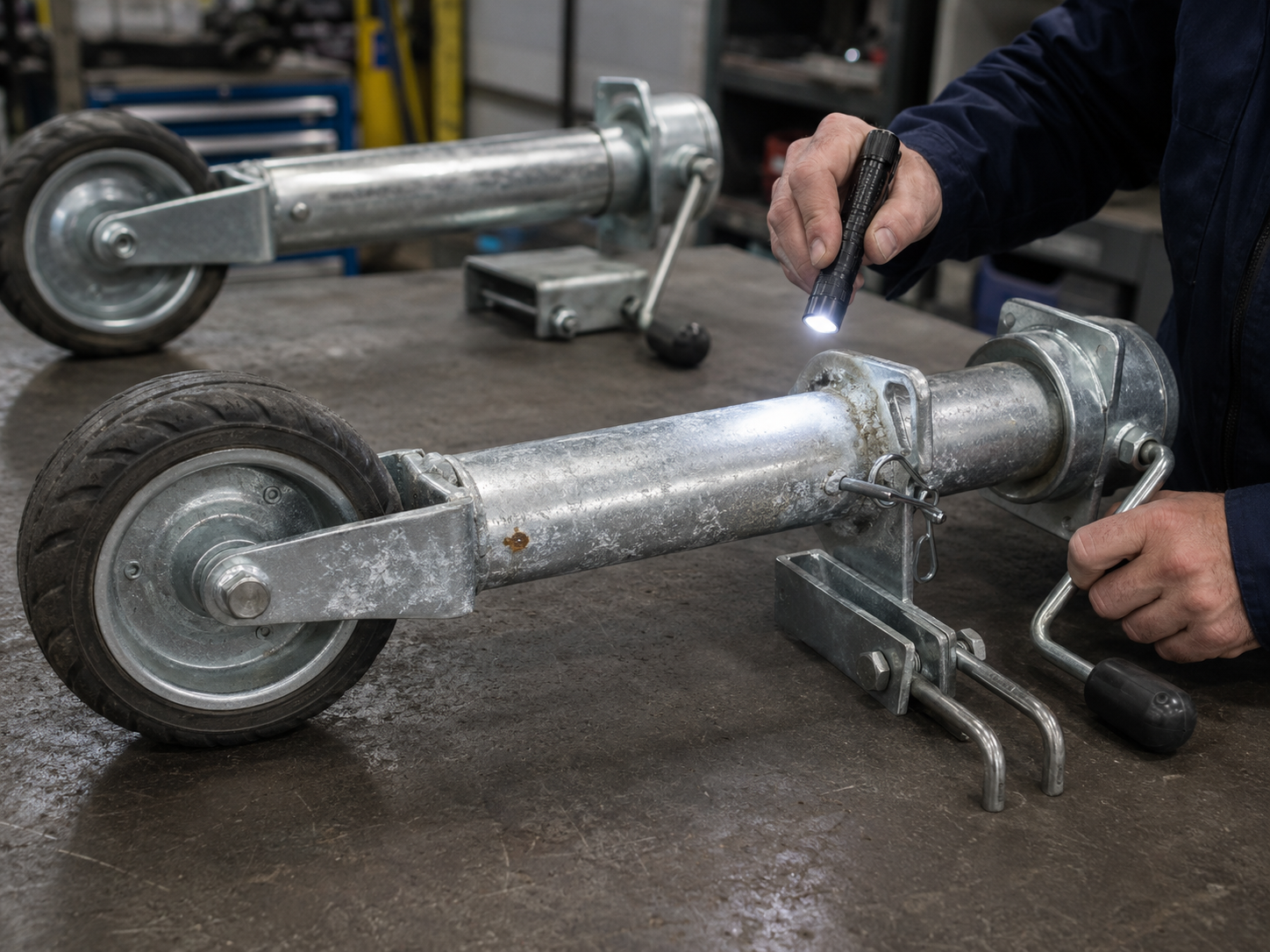
The jack combines sliding surfaces, a load-bearing screw, a pivot, a locking mechanism and a wheel assembly. Each part experiences a different corrosion condition.
Outer Tube
The outer tube receives road spray and saltwater dripping from the hull. Its coating should cover the full exposed surface, welds and bracket-contact areas.
A product described as a galvanized trailer jack should therefore identify whether the tube is hot-dip galvanized, electro-zinc plated, made from pre-galvanized tube or protected by another system.
Inner Tube
The inner tube must slide through seals, guides or close clearances. A thick or rough coating can interfere with movement, while a very thin coating can wear through quickly.
The inner-tube specification should balance corrosion protection, surface smoothness and dimensional tolerance.
Pivot Bracket and Locking Pin
The swing bracket contains holes, overlapping plates, a spring and a sliding pin. Salt can remain inside the joint even when the visible tube has been rinsed.
The pin should be removable or serviceable according to the manufacturer, and the coating should tolerate repeated mechanical contact.
Wheel Fork and Axle
The wheel may hide corrosion on the axle, retaining hardware and inside faces of the fork. A rubber wheel does not protect the metal rim or axle from saltwater.
Buyers should request materials and finishes for the complete wheel assembly rather than only the main jack tube.
Winches, Hooks and Bow Hardware Need a Component-Level Specification
A marine trailer winch contains a frame, gears, pawl, shaft, drum, handle, strap bolt and hook. The visible winch frame is only one part of the corrosion risk.
Winch Frame
The frame can use zinc plating, hot-dip galvanizing or another corrosion-resistant finish depending on its design and manufacturing process.
Inspect cut edges, bends, rivets, welds and mounting holes where protection may be damaged or incomplete.
Gears and Pawl
Gear teeth require controlled fit and movement. Excessively thick coating can affect engagement, while a weak or damaged coating can leave the teeth exposed.
The process must also remain compatible with the intended lubricant.
Hook
The hook receives impact, abrasion and concentrated loading. Buyers should specify the base material, strength requirement, coating process, latch design and corrosion test.
A stainless hook should not be assumed to be stronger than a coated alloy-steel hook. Corrosion resistance and mechanical strength are separate requirements.
Fasteners and Mounting Bolts
Winch mounting bolts should be compatible with both the winch frame and trailer structure. Mixing stainless fasteners directly with zinc-coated or aluminium components can require isolation and careful design.
Fasteners Are a High-Risk Procurement Detail
Fasteners have threads, recesses and bearing surfaces that are difficult to coat uniformly. They can also be manufactured from high-strength steels that require hydrogen-embrittlement controls during electroplating.
Specify the Complete Coating System
The purchase order should identify:
- Fastener material and property class.
- Coating standard.
- Coating thickness.
- Passivation and sealer.
- Topcoat and lubricant.
- Thread-fit requirements.
- Hydrogen-relief procedure where applicable.
- Corrosion-test and adhesion requirements.
Do Not Mix Fasteners Without Reviewing the Joint
Replacing a zinc-coated bolt with stainless steel can change:
- Clamp-force behavior.
- Thread friction.
- Galling risk.
- Galvanic interaction.
- Washer and nut compatibility.
- Required tightening procedure.
Inspect Hidden Faces
The exposed bolt head may remain bright while corrosion develops beneath the washer, inside the frame tube or between the bracket and trailer.
Receiving inspection should include representative disassembly or section review when the application is critical.
Trailer Lights and Wiring Are Part of the Corrosion Package
LED lights reduce heat and eliminate replaceable incandescent bulbs, but the trailer still contains connectors, grounds, wire splices, mounting screws and entry seals.
Specify Submersible or Properly Sealed Assemblies
The light housing should be suitable for the intended immersion condition, but sealing the housing alone does not protect the complete electrical circuit.
Protect Ground Connections
A ground point must provide electrical continuity while resisting water and corrosion. Coating placed beneath the terminal can prevent good contact, while exposed bare steel can corrode.
The joint needs a designed grounding method, compatible hardware and suitable sealing after assembly.
Support the Wiring
Wires should not rub against frame edges, hang in standing water or enter connectors without strain relief.
The procurement specification should include wire support spacing, abrasion protection, connector type and sealing method.
Frame Material Does Not Protect Every Attached Part
A hot-dip galvanized or aluminium frame can remain sound while the attached U-bolts, leaf-spring hangers, light brackets, fasteners and brake hardware deteriorate.
This is why saltwater boat trailer corrosion must be evaluated as a system rather than by looking only at the main frame material.
Hot-Dip Galvanized Frame
Inspect coating thickness, weld coverage, drainage, trapped ash or flux, bare spots and damage created during drilling or final assembly.
Aluminium Frame
Aluminium avoids red rust but remains vulnerable to galvanic attack, crevice corrosion and corrosion around dissimilar fasteners and steel brackets.
Painted or Powder-Coated Steel
Paint and powder coating provide barrier protection. Once the coating is chipped, corrosion can spread beneath the surrounding film if water remains trapped.
Drainage Is a Design Requirement
No coating performs well when saltwater remains inside a tube or bracket indefinitely. Frame and bracket design should allow water to enter, drain and dry without creating hidden reservoirs.
Why Salt-Spray Hours Are Not the Whole Answer
Neutral salt-spray testing is useful for quality control and comparative testing within a defined coating system. It does not reproduce every feature of real trailer service.
Real operation includes:
- Wet-and-dry cycling.
- Road abrasion.
- Coating scratches.
- Mechanical movement.
- UV exposure.
- Temperature changes.
- Trapped salt inside joints.
- Contact between different metals.
A supplier quoting only a high salt-spray-hour number has not fully described the coating.
Procurement teams should also request the test standard, failure criterion, coating thickness, passivation, sealant, substrate preparation and sample geometry used in the test.
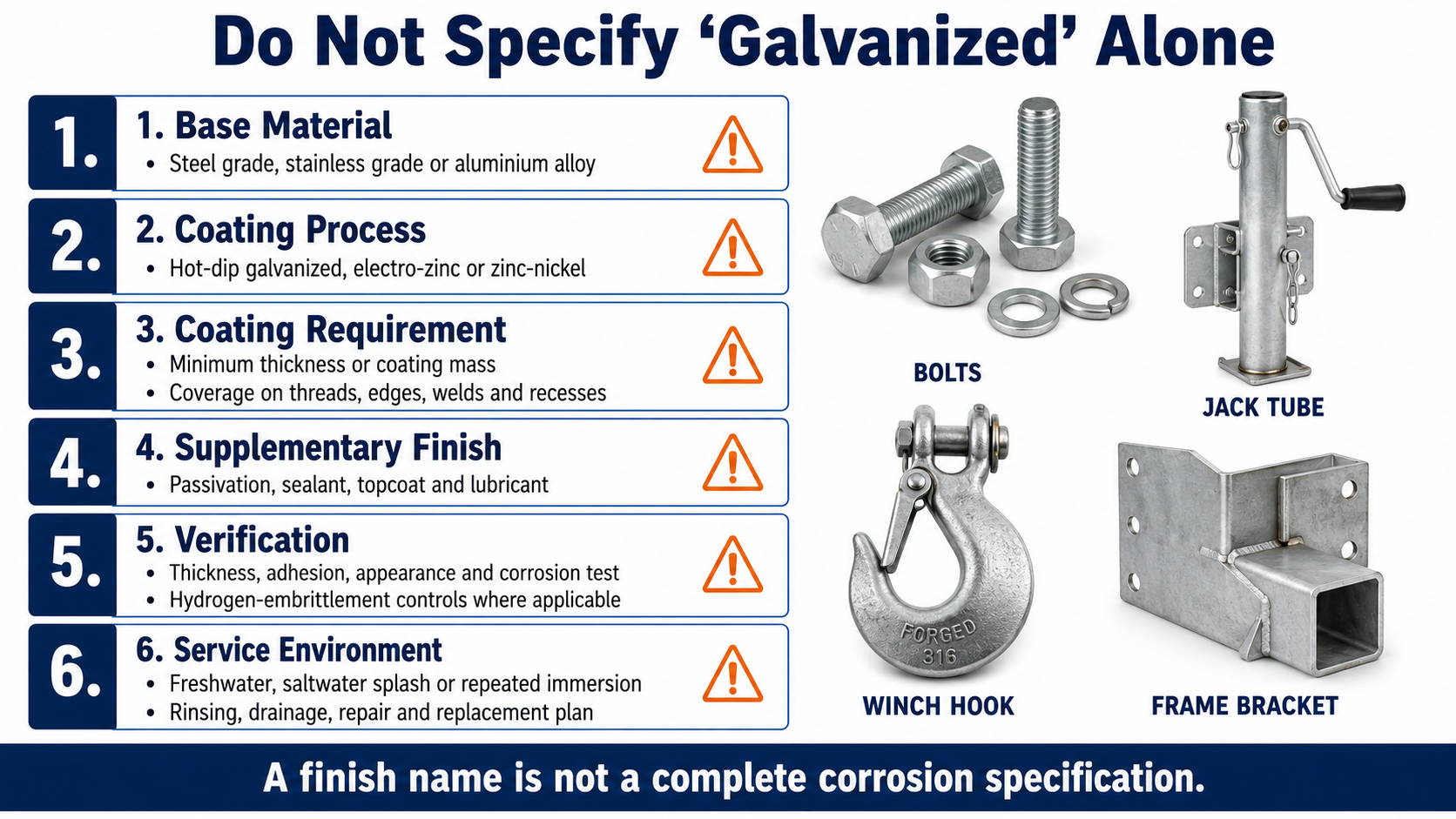
What a Marine Hardware RFQ Should Specify
A useful request for quotation should separate the product function from its corrosion specification.
1. Service Environment
- Freshwater only.
- Coastal atmospheric exposure.
- Saltwater splash.
- Repeated partial immersion.
- Repeated full immersion.
- Outdoor storage after use.
2. Base Material
- Steel grade and strength.
- Stainless grade and property class.
- Aluminium alloy.
- Rubber, polymer or wheel-rim material.
3. Coating Process
- After-fabrication hot-dip galvanizing.
- Electroplated zinc.
- Zinc-nickel alloy electroplate.
- Mechanical zinc coating.
- Paint, powder coating or duplex system.
- Stainless passivation where specified.
4. Minimum Coating Requirement
- Minimum local and average thickness.
- Coating mass where applicable.
- Coverage of edges, threads, holes and welds.
- Inside-tube or internal-surface requirement.
5. Supplementary Treatment
- Passivation type.
- Sealer.
- Organic topcoat.
- Lubricant.
- Colour requirement only where functionally relevant.
6. Verification
- Coating-thickness measurement method.
- Adhesion requirement.
- Appearance and coverage criteria.
- Corrosion-test standard and acceptance point.
- Hydrogen-embrittlement process control.
- Material and coating certificates.
7. Assembly and Compatibility
- Thread fit after coating.
- Moving-clearance requirement.
- Galvanic isolation.
- Approved assembly lubricant.
- Fastener tightening method.
8. Repair and Maintenance
- Approved repair coating.
- Rinsing and drainage instructions.
- Inspection interval.
- Replaceable high-risk components.
Receiving Inspection for Corrosion-Resistant Hardware
Verify Product Identification
Confirm that the model, material, coating and revision match the approved sample and purchase order.
Measure Representative Coating Thickness
Take readings from flat areas, edges, tubes, brackets and other agreed inspection points. One reading on the easiest surface does not represent the full component.
Inspect Coverage
Look for:
- Bare steel.
- Blisters or peeling.
- Heavy runs or deposits that affect fit.
- Burned or damaged passivation.
- Uncoated threads.
- Rust beginning at cut edges or welds.
Check Function After Coating
Operate the jack through its complete travel. Rotate the swing bracket. Engage the locking pin. Turn the winch, pawl and handle. Fit nuts and bolts to the specified threads.
A coating that passes appearance inspection but prevents proper operation is not an acceptable result.
Inspect Packaging
Wet packaging, salt-contaminated cartons and metal-on-metal contact can damage components before they reach the assembly line.
Packaging should keep parts dry, separated and protected from abrasion.
Maintenance Still Matters After Material Selection
No practical marine trailer coating eliminates the need for cleaning and inspection.
A suitable marine trailer maintenance routine should include the following steps.
Rinse Soon After Saltwater Exposure
Use fresh water to remove salt from visible and hidden hardware. Direct water toward:
- Jack pivots and locking pins.
- Telescoping tubes.
- Winch gears and hook.
- U-bolts and bracket overlaps.
- Brake assemblies and hubs.
- Light housings, grounds and connectors.
- Frame joints and drainage holes.
Allow the Trailer to Drain
Parking orientation should allow hollow members and brackets to drain. Rinsing that leaves diluted saltwater trapped inside the frame is incomplete maintenance.
Avoid Incompatible Cleaners
Acidic hull cleaners and aggressive chemicals can attack zinc coatings. Protect the trailer and follow the cleaner and coating manufacturers' instructions.
Inspect White and Red Corrosion Separately
White corrosion products indicate zinc-surface activity and retained moisture. Red rust indicates that the underlying steel is exposed or the zinc protection has been exhausted locally.
Both conditions should be investigated, especially around joints, fasteners and structural attachments.
Repair Coating Damage Correctly
Small damaged areas may be repairable using an approved zinc-rich coating or other manufacturer-approved method. Clean and prepare the surface according to the repair specification.
Do not cover active rust or trapped salt with paint and assume the problem is solved.

Marine Trailer Hardware Buying Checklist
| Component | Questions to ask | Common procurement mistake |
|---|---|---|
| Trailer frame | Which process, standard, thickness, drainage and repair method? | Buying from the word “galvanized” alone |
| Trailer jack | How are outer tube, inner tube, pin, bracket, axle and hardware protected? | Checking only the visible outer tube |
| Winch and hook | What are the frame, gear, hook and fastener materials and finishes? | Assuming one coating covers every part equally |
| Fasteners | Which property class, coating, passivation and hydrogen-relief controls? | Replacing all bolts with unspecified stainless steel |
| Lights and wiring | How are housings, grounds, connectors and wire entries sealed? | Checking only whether the light housing says waterproof |
| Brake hardware | Which materials protect calipers, lines, fittings and mounting parts? | Specifying the rotor while ignoring the small hardware |
GOODIN Industry Perspective
For OEM and distributor buyers, boat trailer corrosion protection should be treated as a component map rather than one finish applied to the complete trailer.
A practical system may combine:
- Hot-dip galvanized structural frame members.
- Electro-zinc-plated dimension-sensitive jack tubes and brackets.
- Zinc-nickel-coated selected fasteners or functional hardware.
- Appropriately graded and passivated stainless components at selected points.
- Sealed LED lights and protected wiring connections.
- Replaceable hooks, pins, straps and wheel hardware.
The correct combination depends on saltwater exposure, immersion frequency, required service life, maintenance access and target cost.
GOODIN's Boat Trailer Jack range includes different wheeled and swing-back arrangements for marine and recreational trailers.
The LF-J7-60 600 lb zinc-plated wheel jack lists a zinc-plated outer tube, clear-zinc inner tube and 220 × 65 mm rubber wheel. Buyers should still confirm the requested coating standard, thickness and supplementary treatment for the intended marine exposure.
The LF-J7-1 jockey wheel lists a zinc-plated outer tube and clear-zinc inner tube with a 200 × 50 mm rubber wheel. RFQs should use the detailed process requirement rather than relying only on the word “galvanised” in a product title.
GOODIN's Trailer Winch range includes manual winches for boat and utility trailer loading. Marine procurement should evaluate the frame, gears, shaft, fasteners, hook and mounting hardware individually rather than treating the winch as one uniformly protected component.

Request the Coating System Behind the Product Name
Product titles are useful for navigation, but an RFQ should still define the substrate, coating process, thickness, supplementary finish, inspection method and intended saltwater exposure.
Send the Exposure Map and Coating Requirements in One RFQ
Include freshwater or saltwater exposure, immersion frequency, outdoor storage, component list, base materials, strength classes, selected coating processes, minimum thickness, passivation or sealer, salt-spray or cyclic-test acceptance criteria, hydrogen-embrittlement controls, galvanic isolation, thread and moving-clearance requirements, inspection reports, repair method, order volume and target market.
Focused FAQ
Is Hot-Dip Galvanizing Always Better Than Zinc Plating?
No. Hot-dip galvanizing generally provides a thicker zinc coating and is well suited to large structural steel parts. Electroplated zinc provides a thinner, smoother finish that can be more suitable for sliding tubes, threads and dimension-sensitive parts. The correct process depends on component geometry and service conditions.
Why Do Two “Galvanized” Trailer Parts Have Different Service Lives?
They may use different processes, coating thicknesses, surface preparation, passivation, sealing and base materials. Edge coverage, weld quality, drainage and maintenance also affect performance.
Is Zinc-Nickel Better Than Ordinary Zinc Plating?
Zinc-nickel is often selected when greater corrosion performance is required from a thin electroplated coating. Its result still depends on alloy composition, thickness, passivation, sealing and process control.
Should Every Marine Trailer Fastener Be Stainless Steel?
No. Stainless grade, strength, thread friction, galling and galvanic compatibility must be considered. A correctly specified coated steel fastener may be more suitable for some structural or high-strength applications.
Is 316 Stainless Steel Completely Safe in Saltwater?
No stainless grade is completely immune. Chlorides, crevices, low-oxygen areas, welding contamination and contact with other metals can still cause corrosion. The specific grade and installation must match the environment.
What Is White Rust on Galvanized Hardware?
White corrosion products form when zinc reacts in wet conditions, particularly where moisture is trapped and air circulation is poor. It should be cleaned and investigated because persistent white corrosion can consume the protective zinc layer.
When Does Red Rust Become a Serious Warning?
Red rust indicates exposure of the underlying steel. Surface rust on a replaceable washer differs from section loss on a structural bracket, U-bolt or frame. Critical parts should be inspected and replaced or repaired according to manufacturer guidance.
Do Salt-Spray Test Hours Predict Real Trailer Life?
Not directly. Salt-spray tests are useful for controlled comparison and quality verification, but they do not fully reproduce abrasion, wet-dry cycles, mechanical wear, UV, trapped salt and galvanic contact.
Can I Apply a Rust-Inhibitor Spray Instead of Rinsing?
A corrosion inhibitor may supplement an approved maintenance program, but it does not remove salt. Rinse first, allow drainage and drying, and apply only products compatible with brakes, rubber, electrical parts and the original coating.
Can Acid Boat Cleaner Damage a Galvanized Trailer?
Yes. Acidic cleaners can attack zinc surfaces. Protect the trailer, rinse immediately and follow both the cleaner and trailer-coating manufacturers' instructions.
Should a Trailer Be Rinsed After Every Saltwater Launch?
Freshwater rinsing after saltwater use is advisable. Direct the rinse toward hidden joints, brake hardware, hubs, jack pivots, winch components, fasteners, lights and drainage areas.
What Should a Buyer Request from a Hardware Supplier?
Request the base material, coating process, applicable standard, minimum thickness, passivation or topcoat, test requirement, hydrogen-embrittlement controls where relevant, inspection report and repair guidance.
Conclusion
Marine trailer corrosion does not begin and end with the frame or brakes. The operational failures often begin at smaller points: a jack pin, wheel axle, winch pawl, hook, U-bolt, electrical ground or light bracket.
The term galvanized is too broad to guide purchasing by itself. Hot-dip galvanizing, electro-zinc plating, zinc-nickel and stainless steel each solve different engineering problems.
The stronger procurement approach is to identify the exposure at every component, then specify the base material, coating process, thickness, supplementary treatment, verification method and maintenance plan.
A trailer does not need the most expensive material at every point. It needs the correct corrosion strategy at each point—and enough documentation to prove that the supplied hardware matches the requirement.
Technical References
- ASTM A123/A123M-24: Hot-Dip Galvanized Coatings on Iron and Steel Products
- ASTM A153/A153M-23: Hot-Dip Zinc Coating on Iron and Steel Hardware
- ASTM B633-23: Electrodeposited Zinc Coatings on Iron and Steel
- ASTM B841-18(2024): Electrodeposited Zinc-Nickel Alloy Coatings
- ISO 15726: Electrodeposited Zinc-Alloy Coatings
- ISO 3506-6: Selection of Corrosion-Resistant Stainless Steels for Fasteners
- ASTM A967/A967M-25: Passivation Treatments for Stainless Steel Parts
- BoatUS: How to Wash a Trailer After Saltwater Use
- BoatUS: Trailer Wiring Care
- BoatUS: Six Boat Corrosion Myths
Oil-Bath Hubs vs Grease Bearings: Which Fits Your Boat Trailer?
New Boat Trailer First-Season Checklist: Delivery, 30, 60 and 90 Days
Related Article