
How to Move a Boat Trailer in a Tight Garage: Jacks, Dollies and Movers
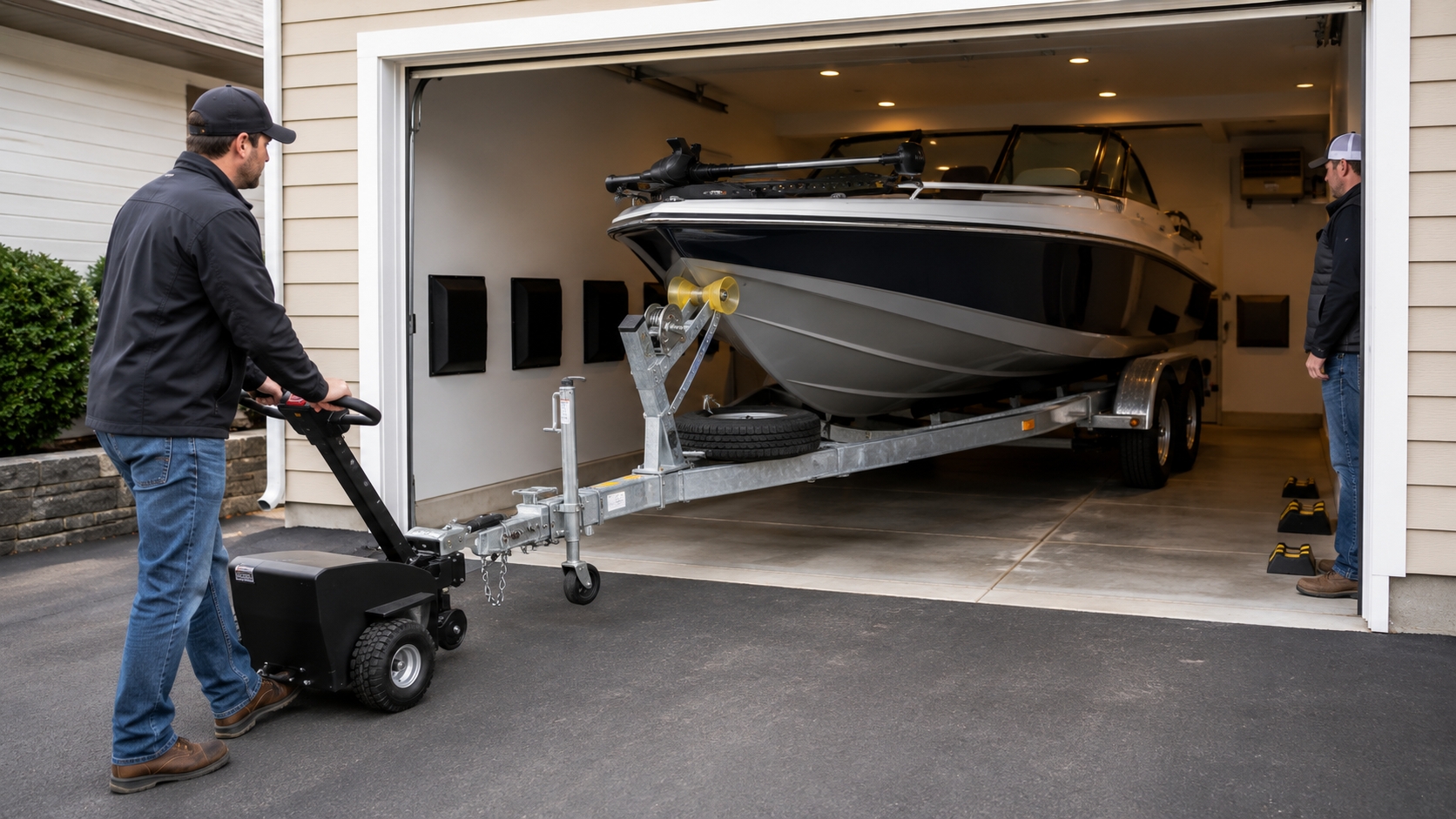
The hardest part of storing a boat is sometimes not launching it, towing it or maintaining it. It is turning the trailer through the final few feet between a narrow garage door, a wall, a parked vehicle and an angle the tow vehicle cannot comfortably reach.
That difficulty is driving interest in better trailer mobility systems. Owners are comparing larger jack wheels, dual-wheel jacks, manual dollies, tire-positioning dollies and powered trailer movers because the original tongue jack often provides lifting support without providing enough control for confined storage.
The right solution depends heavily on whether the trailer has one axle or two, how much it weighs, how much tongue load the mobility device must carry, whether the floor is level and how sharply the trailer must turn.
A mobility upgrade should reduce effort and improve control. It should never encourage an operator to manually restrain a heavy trailer on a slope or enter a crush zone between the boat and the garage wall.
A light single-axle trailer on level concrete may need only a suitable jack wheel or manual dolly. A tandem trailer, very tight turn, repeated storage cycle or high loaded weight usually requires a rated mover—and may also require tire dollies to reduce axle scrub.
Manual strength is not a braking system. Keep the tow vehicle connected through the inclined portion whenever practical, use positive wheel restraint and never stand between the boat and a wall, door or parked vehicle.
Why Tight Garage Storage Is a Different Trailer Problem
Normal towing uses the tow vehicle's steering, brakes, traction and mass to control the trailer. Once the trailer is uncoupled, those systems disappear.
The operator may then be asking one small caster, dolly or mover to:
- Support the full tongue load.
- Generate enough traction to move the trailer.
- Change direction inside a limited turning radius.
- Control momentum on a driveway.
- Cross a garage threshold or expansion joint.
- Stop before the boat contacts a wall or door frame.
A device that performs well on a level warehouse floor may not perform safely on loose gravel, wet concrete or a sloped driveway.
Start with the Garage, Not the Mobility Product
Before buying equipment to move boat trailer in garage conditions, measure the complete storage path.
Garage Opening
Measure the clear opening after accounting for the door tracks, weather seals, handles and any narrowing caused by trim or columns.
The trailer's maximum width may come from the fenders, guide posts, boat rub rail or mirrors on a connected tow vehicle rather than the trailer frame itself.
Overall Height
Check the windshield, console, antenna, folded tower, guide-on posts and outboard position. A trailer that clears the door at the center may still contact the door mechanism while entering at an angle.
Overall Length
Include the coupler, winch post, outboard, transom hardware and any swing tongue in its storage position.
Tongue Swing Area
When the trailer turns, the coupler and jack sweep sideways. Leave enough space for the crank handle, wheel fork, mover and operator.
Floor Condition
Inspect for:
- Garage-door thresholds.
- Expansion joints.
- Cracked concrete.
- Drain channels.
- Oil, algae or standing water.
- Changes in floor slope.
Small hard casters lose much of their mobility when they reach a raised threshold or damaged joint.
Single-Axle and Tandem-Axle Trailers Do Not Turn the Same Way
Single-Axle Trailers
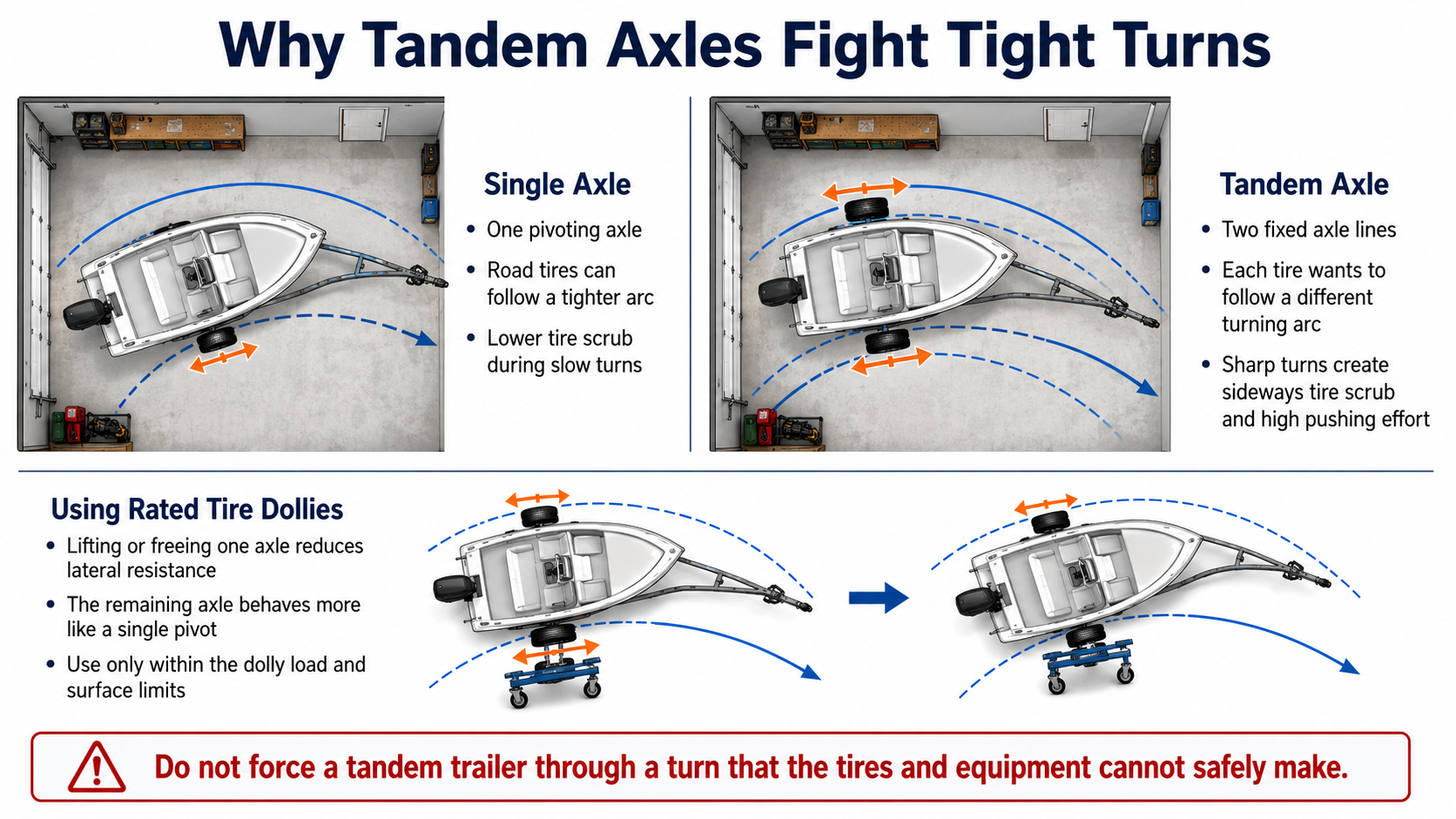
A single axle acts as one primary pivot line. During a slow turn, the two road tires can follow curved paths without fighting a second axle.
A light single-axle trailer may therefore be moved through small corrections using a properly rated jack wheel or manual coupler dolly on a level, hard surface.
Tandem-Axle Trailers
A tandem trailer has two fixed axle lines. During a sharp turn, the tires on the front and rear axles cannot all follow their ideal arcs.
Some of the tires must scrub sideways across the floor. This increases:
- Required pushing or pulling force.
- Stress on the jack and mover connection.
- Stress on tire sidewalls and suspension components.
- Risk of dolly caster overload.
- Risk of uncontrolled movement when the tires finally release.
A stronger jack wheel for boat trailer use can improve the front support, but it does not remove the lateral resistance created by four road tires.


Four Mobility Options and Their Limits
| Mobility option | Best-fit application | Main advantage | Important limitation |
|---|---|---|---|
| wheeled tongue jack | Light trailers and small hitch-alignment corrections | Already attached and quick to use | Limited traction, braking and tight-turn control |
| Manual coupler dolly | Light single-axle trailers on level concrete | Provides a steering handle and wider wheelbase | Still depends on operator strength and trailer momentum |
| Tandem axle trailer dolly or tire dollies | Reducing axle scrub during tight turns on smooth floors | Allows tighter pivoting and lateral positioning | Each unit must match the individual wheel load and tire size |
| Mechanical, drill-powered or electric trailer mover | Heavier trailers, repeated storage and precise control | Geared movement and improved low-speed control | Capacity and traction depend on weight, tongue load, surface and slope |
When a Jack Wheel Is Enough
A wheeled tongue jack can be effective when all of the following conditions apply:
- The trailer is relatively light.
- The actual tongue load is within the jack rating.
- The surface is level, hard and clean.
- The required movement is short.
- The turning angle is modest.
- The operator can maintain control without standing downhill or in a crush zone.
Larger Wheel Diameter
A larger wheel rolls over expansion joints and small cracks more easily than a small caster. It can reduce the initial force required to begin movement.
Wheel Width
A wider wheel spreads load over a larger surface area and may reduce sinkage on warm asphalt or firm grass.
Single-Wheel Behavior
A single wheel generally changes direction more easily on smooth concrete because it does not create the scrub resistance of two side-by-side wheels.
Dual-Wheel Behavior
A dual wheel trailer jack provides a wider footprint and can improve support on moderately soft surfaces. However, the two wheels must scrub during a sharp caster turn, so the assembly may require more steering effort on dry concrete.
What a Jack Wheel Cannot Do
A wheeled jack is not:
- A parking brake.
- A substitute for wheel chocks.
- A controlled mover for a steep driveway.
- A replacement for a tow vehicle on loose gravel.
- A way to make an overloaded tandem trailer easy to pivot.
When a Manual Trailer Dolly Makes Sense
A manual dolly connects to the trailer coupler and gives the operator a handle and a wider wheelbase than a typical tongue jack.
It is most useful for light single-axle trailers on smooth, level floors. The operator can face the direction of movement and steer the coupler more directly.
Its limitations remain significant:
- The operator supplies the pulling and braking force.
- Small wheels struggle with thresholds.
- A heavy trailer can build dangerous momentum.
- Tandem-axle tire scrub remains present.
- A slope can exceed the operator's ability to stop the trailer.
Do not select a manual dolly from trailer gross weight alone. Confirm both its towing limit and the vertical tongue load it can support.
How Tire Dollies Help Tandem-Axle Trailers
A rated tire dolly supports one road wheel on a low platform with multiple casters. When both tires on one axle are placed on compatible dollies, that axle can move sideways instead of resisting the turn through tire scrub.
This temporarily makes the trailer behave more like a single-axle trailer around the remaining road-wheel pivot.
Check Individual Wheel Load
A trailer weighing 8,000 pounds does not automatically place exactly 2,000 pounds on each of four road tires. Uneven loading, suspension equalization and tongue weight affect the real value.
Each dolly must be rated for the highest load it may receive—not merely the mathematical average.
Check Tire Size
Confirm the maximum tire width and diameter accepted by the dolly. A tire that does not sit correctly between the lifting rollers can shift or overload the frame.
Use a Suitable Floor
Small polyurethane or nylon casters work best on smooth, hard concrete. They are poorly suited to:
- Gravel.
- Broken asphalt.
- Garage thresholds.
- Drain grates.
- Sloped or wet floors.
Use a Separate Control Method
Tire dollies reduce resistance but do not provide steering or braking by themselves. Use a properly rated mover or controlled towing connection.
When a Trailer Mover Is the Better Solution
A mechanical or powered trailer valet-type mover is usually more appropriate when:
- The boat trailer is too heavy for safe hand movement.
- The storage process is repeated frequently.
- The operator needs inch-by-inch positioning.
- The tow vehicle cannot achieve the required entry angle.
- The garage has limited wall and door clearance.
- A tandem trailer is being used with compatible wheel dollies.
Verify Gross Trailer Weight
The mover's towing capacity must cover the actual loaded boat-and-trailer weight under the stated operating conditions.
Verify Tongue Weight
The coupler or mounting system must support the actual tongue load. Tongue weight also affects the traction available to the mover.
Verify Axle Compatibility
Tandem-axle trailers require more turning force than single-axle trailers. A mover may remain within its weight rating while still struggling to produce an extremely tight turn.
Verify Surface and Slope Ratings
A capacity quoted for a flat concrete surface should not be assumed to apply to a sloped driveway, wet surface or gravel yard.
Check the Attachment Method
Depending on the product, the mover may connect through:
- The trailer coupler.
- A side-mounted frame bracket.
- A dedicated ball attachment.
- An integrated jack-and-mover assembly.
The attachment must match the frame or coupler design and remain securely locked during movement.
A Sloped Driveway Is a Different Risk Category
On level ground, the mobility system mainly needs to overcome rolling resistance. On a slope, it must also control the trailer's gravitational force.
This creates a much higher-consequence failure mode. If the operator loses grip, the trailer may accelerate downhill faster than a person can stop it.
Keep the Tow Vehicle Connected During Initial Positioning
Where possible, use the tow vehicle to complete the sloped portion and disconnect only after the trailer reaches the level working area.
Follow the Mover's Published Grade Limit
Different movers have different incline limits. Orientation can also matter: some equipment instructions distinguish between pushing a trailer backward up a slope and pulling it tongue-first.
Use Wheel Chocks
Place suitable chocks before uncoupling and keep additional chocks ready while repositioning. A jockey wheel, stabilizer or mover should not be the only device holding the trailer stationary.
Keep People Out of the Downhill Path
No person should stand between the trailer and the garage, wall, parked vehicle or other fixed object.
Do Not Hand-Pull a Heavy Trailer Downhill
Human strength is not a braking system. If the slope cannot be controlled with the tow vehicle or an appropriately rated braking mover, the setup needs another solution.

Surface Conditions Can Decide Whether the System Works
Smooth Concrete
The best surface for jack wheels, caster dollies and most trailer movers. Keep it clean and dry.
Textured Concrete
Provides traction for powered movers but increases caster resistance. Small tire dollies may become harder to roll.
Asphalt
A narrow jack wheel can sink into softened asphalt during hot weather. Use a suitable wheel dock or load-spreading plate when parked.
Gravel
Small casters dig into loose stone. A larger or wider wheel may help, but a tow vehicle or traction-based mover designed for the surface is usually safer.
Grass and Firm Soil
Dual wheels or wide tires can reduce ground pressure, but wet ground can still allow sudden sinkage.
Sand and Mud
Standard jack wheels and garage dollies are generally unsuitable. A purpose-designed wide or pneumatic beach wheel may improve flotation, but trailer weight and slope still limit manual movement.
Garage Positioning Procedure
1. Empty the Movement Path
Remove bicycles, tools, storage boxes, hoses and anything that could block a wheel or distract the spotter.
2. Measure and Mark the Final Position
Use removable floor tape to mark:
- The desired tire position.
- The coupler position.
- Maximum tongue swing.
- Door-closing clearance.
- Outboard or transom clearance.
3. Inspect the Trailer
Confirm tire inflation, wheel condition, jack operation, coupler condition and brake release before movement.
4. Install the Mobility Equipment
Attach the dolly or mover according to its instructions. Confirm that pins, clamps, coupler locks and straps are fully engaged.
5. Chock Before Disconnecting
The trailer should not become uncontrolled during the change from tow vehicle to mobility device.
6. Use a Spotter
Agree on clear stop commands. The spotter should remain visible to the operator and outside all wheel and crush zones.
7. Move Slowly
Use the lowest available gear or speed. Stop before thresholds or large direction changes and reassess the caster positions.
8. Secure the Final Position
Once parked:
- Chock the road wheels in both directions where appropriate.
- Lower the approved support.
- Release load from temporary wheel dollies before long-term storage.
- Confirm the garage door can close without contacting the boat.
- Do not rely on the jack caster or trailer mover as the only parking restraint.
Common Garage-Mobility Mistakes
Trying to Pivot a Tandem Trailer with Only the Tongue Jack
The jack may swivel while the four road tires continue resisting the turn. Excess force can bend the jack bracket, damage the caster or move the trailer unpredictably.
Using Furniture or Automotive Dollies Without Load Verification
Caster size and frame appearance do not prove that a dolly is suitable for a loaded trailer tire. Use equipment with published wheel-load and tire-size limits.
Ignoring the Garage Threshold
A mover may roll easily across the floor and then stop abruptly at the door lip. Plan how every caster and road tire will cross the threshold.
Standing Between the Boat and the Wall
A spotter should observe clearance from a safe location, not attempt to push the hull away from an obstacle.
Using the Trailer Jack as a Brake
A swivel jack can rotate or roll. It does not replace wheel chocks, trailer brakes or the integrated brake of an approved mover.
Assuming More Tongue Weight Always Improves Mover Traction
Some traction-based movers need sufficient downward load, but excessive tongue weight can overload the coupler, mover or jack. Load distribution must remain within all trailer and towing ratings.
Leaving Tire Dollies Loaded for Long-Term Storage
Unless the dolly manufacturer approves long-term support, lower the trailer back onto its road tires or intended storage supports after positioning.
Garage Mobility Comparison
| Storage condition | Likely suitable solution | Main check |
|---|---|---|
| Light single-axle trailer, level concrete | Large jack wheel or manual coupler dolly | Tongue load and operator control |
| Medium single-axle trailer, frequent storage | Geared or powered trailer mover | Gross weight, tongue weight and traction |
| Tandem trailer, moderate turn | Rated trailer mover | Turning radius and axle scrub |
| Tandem trailer, very tight turn | Rated tire dollies on one axle plus a mover | Individual wheel load and smooth floor |
| Sloped driveway | Tow vehicle or mover explicitly rated for the slope | Braking, chocks, direction and grade limit |
| Gravel, grass or soft ground | Wide-wheel jack for minor movement or traction-rated mover | Sinkage and available traction |
GOODIN Industry Perspective
The growth of garage-mobility discussions shows that owners are evaluating boat trailer jacks differently. The jack is no longer judged only by whether it raises the coupler high enough to reach the hitch ball.
For many users, the more useful questions are:
- Can the wheel turn under the real tongue load?
- Can it cross the garage threshold?
- Will it sink into the driveway?
- Does it provide enough stability while connecting a mover?
- Can it swing clear after the trailer is coupled?
- Is the trailer too heavy or too resistant to turn for a jack wheel alone?
For OEM buyers and distributors, a garage-mobility RFQ should define:
- Loaded boat-and-trailer weight.
- Measured tongue weight.
- Single-axle or tandem-axle configuration.
- Required turning radius.
- Floor material and garage threshold height.
- Driveway slope and movement direction.
- Wheel diameter, width and material.
- Single- or dual-wheel jack preference.
- Required swing-back clearance.
- Whether a separate powered mover or tire dolly will be used.
GOODIN's Boat Trailer Jack range includes different wheeled and swing-back configurations for marine trailer support and low-speed positioning.
For heavier tongue loads where a broader wheel footprint is useful, buyers can review the LF965-2010B 2000 lbs dual-wheel boat trailer jack . Its suitability should be evaluated against the real support load, surface, frame dimensions and turning requirements.
For compact and lighter trailer applications, the LF-J7-1 galvanised jockey wheel provides a lighter 200 × 50 mm rubber-wheel arrangement that should be matched to its published capacity and the actual trailer application.

Choose the Front Support for the Real Tongue Load and Floor
A jack wheel can assist with short, controlled positioning, but it must be selected for the actual tongue load, threshold height, floor condition, required turning angle and frame clearance.
Define the Garage Route Before Selecting the Jack or Mobility System
Share loaded trailer weight, measured tongue weight, single- or tandem-axle layout, garage door dimensions, threshold height, final turning radius, driveway slope, floor material, jack mounting dimensions, wheel diameter and width, required swing clearance, whether tire dollies or a powered mover will be used, order volume and target market.
Garage Mobility Checklist
Trailer Data
- Loaded trailer weight is known.
- Tongue weight is measured.
- Single- or tandem-axle layout is confirmed.
- Individual wheel loads are known when tire dollies will be used.
Garage Data
- Door width and height are measured.
- Tongue swing area is marked.
- The floor is solid, dry and clear.
- Thresholds and drains are included in the route.
- The final boat, outboard and coupler clearances are marked.
Mobility Equipment
- Gross trailer and tongue-load ratings are sufficient.
- The attachment fits the coupler or frame correctly.
- Casters or traction tires suit the surface.
- Wheel dollies fit the tire width and diameter.
- The manufacturer's axle and slope restrictions are understood.
- Brakes, pins, clamps and controls operate correctly.
Operating Safety
- Road-wheel chocks are ready.
- A spotter is available.
- No person enters a crush zone.
- The trailer is moved at the lowest practical speed.
- The final parked position uses positive wheel restraint.
Focused FAQ
Can I Move a Boat Trailer in a Garage Using Only the Tongue Jack?
A properly rated wheeled jack may be sufficient for a light single-axle trailer and small corrections on level concrete. It is generally not the best control method for a heavy or tandem-axle trailer, a steep driveway or a very tight turn.
Why Is a Tandem-Axle Boat Trailer So Hard to Turn by Hand?
The two axle lines force the road tires to follow different arcs during a sharp turn. Some tires must scrub sideways, creating substantially more resistance than a single-axle trailer.
Will a Dual-Wheel Jack Make a Tandem Trailer Easy to Turn?
Not by itself. Dual wheels can improve front stability and reduce sinkage, but the four road tires still resist the turn. A rated mover or tire dollies may be needed.
What Is the Best Way to Make a Tandem Trailer Turn More Sharply?
On a smooth, level garage floor, properly rated tire dollies under both tires of one axle can reduce lateral resistance. A rated trailer mover should provide the steering and movement control.
Can Automotive Wheel Dollies Be Used Under Trailer Tires?
Only when the dolly manufacturer permits the application and each unit is rated for the actual wheel load, tire size and surface. Do not assume that an automotive dolly is automatically suitable for a loaded boat trailer.
Can a Trailer Valet-Type Mover Handle a Dual-Axle Trailer?
Some models are designed for tandem-axle trailers, but their effectiveness depends on total trailer weight, tongue weight, surface traction and turning radius. Check the exact manufacturer's limits.
Can I Use a Trailer Mover on a Sloped Driveway?
Only if the specific mover is rated for the measured slope, trailer orientation and load. Use wheel chocks and keep the tow vehicle connected whenever practical during the inclined portion.
Is a Single Wheel or Dual Wheel Better for a Garage Floor?
A single wheel usually turns more easily on smooth concrete. Dual wheels offer a wider footprint and greater stability but can create more scrub resistance during a sharp caster turn.
What Wheel Is Better for Gravel or Grass?
A larger and wider wheel generally crosses gravel and distributes load better than a small narrow caster. Very loose gravel, wet grass, sand or mud may still require a tow vehicle or purpose-designed mover.
Should Tire Dollies Remain Under the Trailer During Storage?
Only if the dolly manufacturer expressly approves long-term loaded storage. In most positioning workflows, the trailer should be lowered onto its intended road tires or approved storage supports after movement.
Do I Need a Spotter When Moving the Trailer into a Garage?
A spotter is strongly advisable when wall, door or boat clearance is limited. The spotter should remain visible and outside the path of the trailer and all crush zones.
How Can I Make the Same Garage Position Repeatable?
Mark the tire, coupler and outboard positions on the floor, add protected visual reference points, and use fixed wheel stops only where they cannot create a trip or caster obstruction.
Conclusion
Many tight-garage problems are not caused by poor reversing skill. They occur because the trailer's final movement requires a different tool from the one used for highway towing.
A wheeled jack can handle small adjustments on a light trailer. A manual dolly can provide better steering for a light single axle. Rated wheel dollies can reduce tandem-axle scrub on smooth concrete. A mechanical or powered mover can provide more control for heavier, frequently stored boats.
The limits matter as much as the benefits. Jack wheels do not provide braking. Tire dollies do not provide steering. Powered movers do not retain their flat-ground capacity on every slope or surface.
The correct approach is to measure the trailer, garage, floor and driveway first, then choose a mobility system that matches the actual weight, tongue load, axle configuration, turning radius and surface conditions.
The goal is not merely to make the trailer move. It is to make every movement slow, controlled and repeatable without placing the operator between several thousand pounds of boat and a garage wall.
Technical References
New Boat Trailer First-Season Checklist: Delivery, 30, 60 and 90 Days
Boat Trailer Tongue Weight and Jack Load: Capacity, Position and Frame Strength
Related Article


