Oil-Bath Hubs vs Grease Bearings: Which Fits Your Boat Trailer?

Few boat-trailer topics generate more repeated debate than oil-bath hubs versus grease-packed bearings.
Owners who tow long distances often value the ability to look through a clear cap and confirm that lubricant is present. Owners who launch frequently may prefer the simpler, more familiar grease system and its greater tolerance for a small amount of seal seepage.
Neither position proves that one system is universally superior.
The better question is whether the hub, cap, seal, spindle, brake arrangement, maintenance schedule and launch conditions are suited to the selected lubrication system.
It is also important to use accurate terminology. In many cases, oil bath hubs vs grease bearings does not mean two completely different bearing designs. Both systems may use tapered roller bearings. The main differences are the lubricant, hub cap, sealing arrangement, fill method and inspection procedure.
Choose the complete hub, cap, seal, spindle, lubricant and service system that the trailer or axle manufacturer approves—and that the operator can inspect, maintain and support with available parts.
Oil-bath and grease systems may use similar tapered roller bearings, but their cap, seal, fill method, air space and inspection requirements are not automatically interchangeable.
How an Oil-Bath Trailer Hub Works
An oil-bath hub contains liquid oil inside a sealed wheel-hub cavity. As the hub rotates, the lubricant moves around the bearings and races.
Most oil bath trailer hubs use a clear or partly transparent cap so the operator can inspect the lubricant level and appearance without removing the hub.
Main Components
- Inner and outer tapered roller bearings.
- Matching bearing cups or races.
- Rear oil seal.
- Oil-compatible hub cap and O-ring or sealing interface.
- Fill or drain plug where fitted.
- Manufacturer-specified lubricant.
- Required air space for thermal expansion.
Primary Advantage: Visible Condition Checks
A transparent cap allows an owner to check:
- Whether the oil level is within the specified range.
- Whether the oil has become cloudy or milky.
- Whether the hub is losing oil.
- Whether the lubricant appears unusually dark or contains visible debris.
This is especially useful before and during long-distance towing. A driver can walk around the trailer at a fuel stop and compare all hub levels without opening the system.
Primary Limitation: The System Depends Heavily on Sealing
Liquid oil can escape rapidly through:
- A damaged rear seal.
- A cracked clear cap.
- A loose threaded cap.
- A damaged O-ring.
- A leaking fill plug.
- A worn spindle sealing surface.
A grease-filled hub may continue retaining lubricant around its bearings after minor seepage. An oil-bath hub with an active leak can lose its working level much more quickly.
How a Grease-Packed Hub Works
A grease system fills the bearing rollers and surrounding hub cavity with a semi-solid lubricant rather than a visible liquid bath.
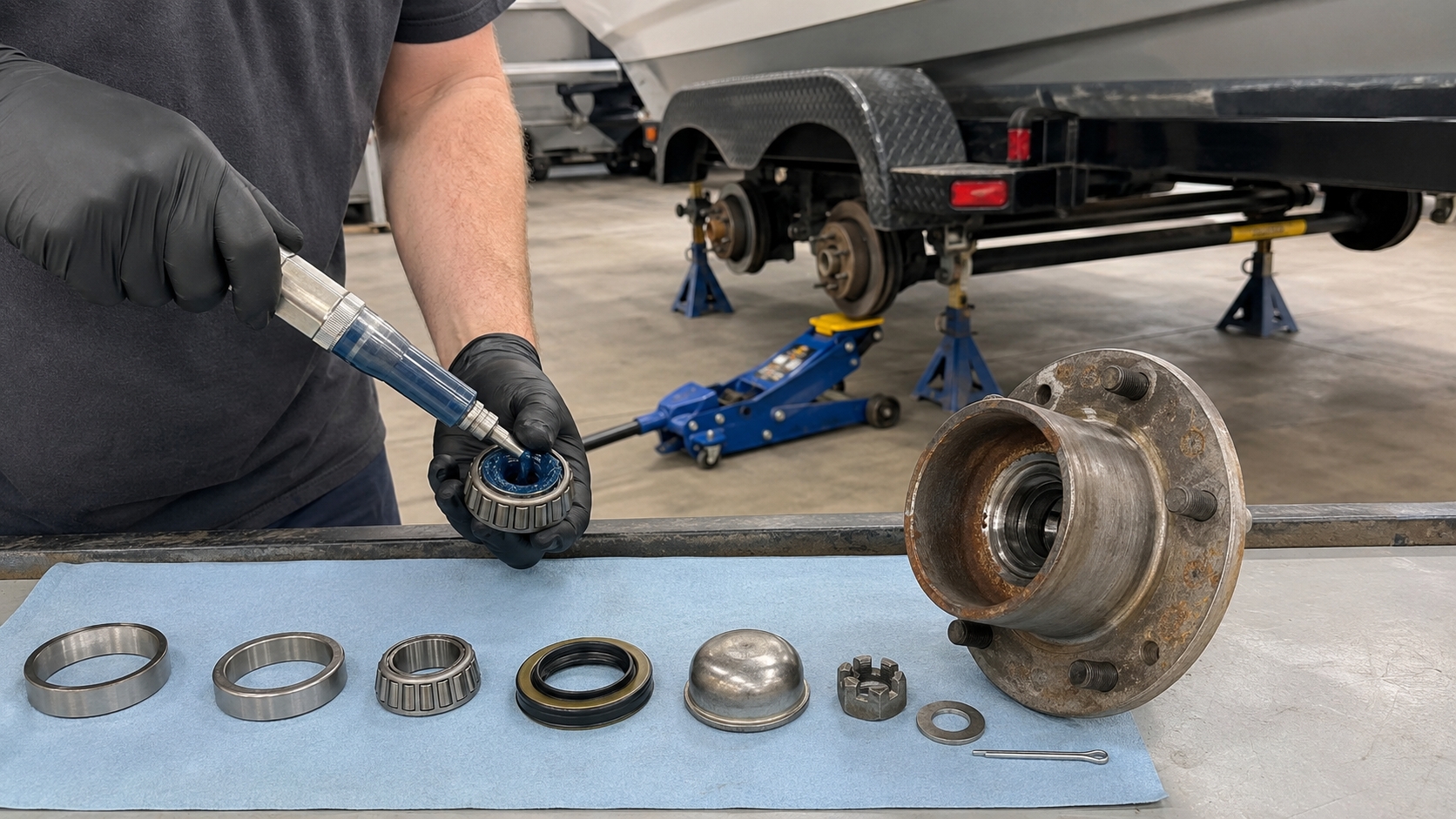
Correctly serviced grease packed trailer bearings have grease forced completely through the bearing until lubricant appears between every roller.
Main Components
- Inner and outer tapered roller bearings.
- Bearing cups or races.
- Rear grease seal.
- Standard grease cap or manufacturer-specific lubrication cap.
- Grease fitting or spindle lubrication passage where fitted.
- Compatible wheel-bearing grease.
Primary Advantage: Simplicity and Lubricant Retention
Grease remains in and around the bearing without requiring a liquid level. A small external seep does not necessarily drain the complete lubricant supply immediately.
Grease hubs are also widely understood by trailer workshops, and replacement bearings, seals and caps are commonly available.
Primary Limitation: Internal Contamination Is Harder to See
There is usually no transparent view of the grease around the inner bearing.
A hub may contain:
- Water-contaminated grease.
- Rust beginning on the rollers.
- A damaged inner seal.
- Grease separated by incompatible thickeners.
- Wear debris from a damaged race.
The outside cap can still look normal. A complete boat trailer bearing inspection may require removing and cleaning the hub.
Oil Bath and Grease Systems Solve Different Problems
| Decision factor | Oil-bath hub | Grease-packed hub |
|---|---|---|
| Pre-trip visual inspection | Oil level and appearance can usually be checked through a clear cap | Cap and external leakage can be checked, but internal grease condition is less visible |
| Response to minor leakage | Liquid level can fall quickly | Grease may remain around the bearings despite minor seepage |
| Water detection | Milky or cloudy oil can provide an early warning | Water may remain hidden until grease is purged or the hub is opened |
| Roadside checking | Fast visual comparison between hubs | External heat, leakage, play and noise checks remain important |
| Service familiarity | Requires correct oil, level, cap and seal knowledge | Commonly serviced by trailer and automotive workshops |
| Lubricant compatibility | Must use the oil specified for the hub | Different grease thickener systems may be incompatible |
| Conversion | Requires an oil-compatible cap, seal and approved hub design | Requires a compatible cap, seal and complete removal of unsuitable lubricant |

Why Long-Distance Towing Favors Visual Inspection
Long road trips create repeated heat cycles and extend the time between workshop inspections.
Oil-bath owners often prefer being able to check the lubricant at every stop. A low level or cloudy appearance provides an immediate reason to stop and investigate.
What to Check at Every Stop
- Oil levels are similar across comparable hubs.
- No cap is cracked or loose.
- No lubricant is present on the inside face of a wheel.
- No hub is substantially hotter than the others.
- No wheel has new looseness, noise or vibration.
This does not make oil-bath hubs maintenance-free. The clear cap only shows the lubricant visible at the cap. It cannot prove that the bearing adjustment, rear seal, races and spindle surfaces are undamaged.
Grease Hubs Can Still Be Checked During Long Trips
For grease hubs, compare:
- Hub temperature.
- Grease leakage around the cap or rear seal.
- Wheel play.
- Noise or vibration.
- Grease thrown onto the wheel, brake or fender.
A hub that is hot, noisy or loose requires investigation regardless of the lubrication system.
Why Ramp Immersion Changes the Decision
Boat trailers expose wheel hubs to a condition that most highway trailers avoid: repeated immersion after towing.
The hub, bearings and brakes become warm on the road. When the trailer enters cooler water, the air and lubricant inside the hub contract.
If the cap or rear seal cannot maintain the pressure change, trailer bearing water intrusion can occur.
Neither System Is Waterproof
Oil-bath and grease-packed hubs both rely on:
- Correctly installed rear seals.
- Undamaged cap interfaces.
- Suitable spindle sealing surfaces.
- Correct bearing adjustment.
- Controlled immersion and maintenance.
Let Unusually Hot Hubs Cool Before Launching
After a long or heavily braked tow, inspect hub temperatures before backing directly into cold water.
Allow an abnormally hot hub to cool and investigate why it became hotter than the others. Cooling does not repair a dragging brake, damaged bearing or low lubricant level.
Keep Immersion Time Short
Do not leave the trailer standing unnecessarily in saltwater after launching. Retrieve it, allow it to drain and rinse the hub, brake and frame areas with fresh water.

How to Inspect an Oil-Bath Hub
Check the Correct Oil Level
Use the mark, window or procedure specified for the exact hub. Do not apply one generic “half-full” or “two-thirds-full” rule to every design.
The hub requires the correct amount of oil and sufficient air space for thermal expansion.
Compare Every Hub
On a tandem- or triple-axle trailer, compare all caps. One hub with a noticeably lower level deserves investigation even if it still contains some oil.
Inspect Oil Appearance
Clean oil may darken with service. That alone does not always indicate failure.
However, milky oil in trailer hub usually indicates water contamination. Do not simply add fresh oil over contaminated lubricant and continue towing.
The hub should be drained and inspected according to the manufacturer procedure. Repeated contamination may indicate:
- A damaged rear seal.
- An incorrect seal size.
- A worn spindle sealing surface.
- A damaged cap or O-ring.
- A leaking fill plug.
- Hot-hub immersion.
Inspect the Inside Face of the Wheel
Oil on the inside of the wheel, rotor or brake assembly commonly points toward a rear seal leak.
Oil-contaminated brake friction material requires qualified inspection and service.
Check the Cap
Inspect the transparent lens, threaded body, O-ring, rubber fill plug and protective ring. Replace cracked or distorted components with parts specified for the hub.
How to Inspect a Grease-Packed Hub
Identify the Grease System
A standard packed hub, spring-loaded bearing protector and through-spindle lubrication system do not all operate the same way.
Before adding grease, identify:
- The axle and spindle system.
- The correct grease type.
- The required greasing method.
- Whether the hub should rotate during grease application.
- How displaced grease exits the hub.
Use Compatible Grease
Use only the marine wheel bearing grease specified or approved by the axle manufacturer.
Different soap or thickener systems may not be compatible. Mixing them can cause grease to harden, soften excessively, separate or lose performance.
When changing to an incompatible type, remove the old grease completely rather than mixing the products.
Do Not Overfill Blindly
Adding excessive grease or applying it too quickly can push lubricant past the rear seal and into the brake assembly.
Where a through-spindle fitting is used, pump slowly with the recommended manual grease gun while rotating the hub if required by the manufacturer.
Open the Hub at the Required Interval
Convenient grease fittings do not reveal:
- Pitted rollers.
- Damaged races.
- A grooved spindle.
- A hardened rear seal.
- Heat discoloration.
- Corrosion beneath apparently clean grease.
Periodic disassembly remains part of proper boat trailer hub maintenance.

Oil-Bath Failure Signs
- Oil level below the specified range.
- Cloudy, milky or foamy oil.
- Oil leaking around the cap or fill plug.
- Oil on the inside of the wheel.
- A cracked or loose transparent cap.
- One hub running hotter than comparable hubs.
- Metallic debris visible in the lubricant.
- Wheel looseness, roughness or noise.
A low level is evidence of a leak or incorrect fill. Topping up without finding the cause may only postpone the failure.
Grease-Hub Failure Signs
- Grease thrown onto the wheel or brake components.
- Water or rusty grease purged from the cap.
- Grease that has become hard, separated or unusually soft.
- A loose or missing grease cap.
- A rear seal leaking onto the brake assembly.
- Wheel play or rough rotation.
- Unusual heat.
- Bluing, pitting or corrosion found during disassembly.
Fresh grease appearing at the front of the hub does not prove that the inner bearing and rear seal are healthy.
Which System Is Better for Long-Distance Towing?
Oil-bath hubs have a practical advantage when the owner performs frequent visual walk-around inspections. The lubricant level and appearance can be compared quickly at rest stops.
They may be a good fit when:
- The trailer regularly travels long highway distances.
- The driver understands the sight-cap indicators.
- Correct caps, seals and oil are readily available.
- The hub system is protected from impact damage.
- The owner will stop immediately after detecting a leak.
Grease systems may be a better fit when:
- Local workshops are more familiar with grease-packed hubs.
- The trailer operates mainly over short or moderate distances.
- Replacement grease caps and seals are widely available.
- The owner follows regular repacking and inspection intervals.
- The trailer uses a manufacturer-designed marine lubrication system.
The long-distance winner is not automatically oil. An oil-bath hub with a damaged cap or unavailable replacement seal can create more roadside difficulty than a properly maintained grease hub.
Which System Is Better for Frequent Launching?
Frequent immersion increases the importance of seal quality, cap condition and maintenance frequency for both systems.
Oil-bath systems allow water contamination to become visible sooner when the oil turns cloudy. However, every immersion still tests the rear seal and cap.
Grease systems keep semi-solid lubricant around the bearing but can conceal moisture and corrosion until the hub is purged or opened.
For frequent saltwater launching, prioritize:
- A hub system specifically approved for immersion.
- High-quality double-lip seals where specified.
- Replaceable caps, plugs and O-rings.
- Spindle surfaces in good condition.
- Freshwater rinsing and drainage.
- More frequent inspection than a dry utility trailer.
Can You Convert from Oil to Grease or Grease to Oil?
Do not assume that the same hub can be converted simply by draining one lubricant and adding the other.
Conversion may require:
- A different front cap.
- A different rear seal.
- An oil-compatible O-ring or fill plug.
- A compatible spindle and sealing surface.
- Complete removal of the previous lubricant.
- Verification of brake and hub compatibility.
- Manufacturer-approved fill quantity and procedure.
Oil and grease systems can share a bearing cavity, but the sealing and cap requirements are not automatically interchangeable.
Obtain the hub, axle or trailer manufacturer's approved conversion parts and instructions. Improvised conversions can leak, contaminate brakes or leave bearings without adequate lubrication.
Service Intervals Are System-Specific
There is no universal maintenance interval for every boat trailer.
Examples of manufacturer guidance vary significantly:
- Some general light-duty axle guidance specifies bearing lubrication and inspection at annual or mileage-based intervals.
- Some marine through-spindle grease systems specify much shorter intervals because of repeated water immersion.
- Oil-bath systems may require frequent level checks even when the oil-change interval is longer.
- Saltwater, high mileage, heavy braking and prolonged storage can justify earlier inspection.
The trailer, axle and hub manual must take priority over a generic online schedule.
Pre-Trip Bearing and Hub Checklist
For Every Lubrication System
- Confirm the trailer is safely parked before inspection.
- Check wheel fasteners.
- Inspect the tire and inside face of the wheel for lubricant.
- Check for hub play, noise or roughness.
- Inspect rear seals where visible.
- Confirm caps and plugs are secure.
- Carry the correct spare hub, bearings, seal or cap where practical.
Additional Oil-Bath Checks
- Compare lubricant levels.
- Look for cloudy or milky oil.
- Inspect transparent caps for cracks.
- Check fill and drain plugs.
- Carry the specified oil and replacement sealing parts.
Additional Grease-Hub Checks
- Confirm the grease cap is secure.
- Look for purged grease or water.
- Check the bearing protector position where fitted.
- Confirm the grease gun contains the correct compatible product.
- Do not add grease solely because the hub has not been serviced recently.
After-Launch Checklist
- Remove the trailer from the water promptly.
- Rinse hubs, brakes, suspension and frame with fresh water after saltwater use.
- Allow water to drain.
- Check for fresh oil or grease leakage.
- Inspect transparent caps for newly cloudy oil.
- Follow the axle manufacturer's post-immersion lubrication procedure.
- Do not pressure-wash directly into seals or caps.
Selection Guide
| Operating profile | System that may fit better | Primary reason |
|---|---|---|
| Frequent long-distance highway towing | Oil bath, when correctly supported by parts and service | Fast visual oil-level and contamination checks |
| Short local towing with accessible service support | Grease packed | Simple servicing and widely available parts |
| Repeated saltwater launching | Either manufacturer-approved marine system | Seal and cap quality matter more than the lubricant label alone |
| Owner prefers visible daily checks | Oil bath | Oil level and appearance remain visible |
| Owner prefers common workshop service | Grease packed | More technicians are familiar with traditional packing procedures |
| Limited access to model-specific caps and seals | Common grease system may be easier to support | Replacement-part availability |
What B2B Buyers Should Specify
A procurement request should not state only “oil-bath bearing” or “greased bearing.”
It should define:
- Axle capacity and hub model.
- Bearing and race part numbers.
- Lubrication system.
- Approved oil or grease specification.
- Required lubricant quantity or level.
- Rear seal design, material and part number.
- Cap type, material and mounting method.
- Transparent-cap impact protection.
- Fill, drain and inspection procedure.
- Brake compatibility.
- Water-immersion profile.
- Saltwater or freshwater service.
- Replacement-part availability.
- Service interval and owner documentation.
Specify the Seal as Carefully as the Bearing
A premium bearing cannot compensate for an incorrect rear seal or worn spindle surface.
The boat trailer bearing seals should match the hub bore, spindle diameter, lubricant and immersion conditions.
Include Visual Inspection Requirements
For oil-bath hubs, specify:
- Visibility of the operating oil level.
- Cap material and impact protection.
- Fill-level marking.
- Plug and O-ring replacement availability.
Include Field-Service Requirements
The operator should receive:
- Lubricant specification.
- Fill or packing instructions.
- Bearing-adjustment procedure.
- Seal replacement procedure.
- Failure-warning images.
- Part numbers for a roadside spare-hub kit.
GOODIN Industry Perspective
Bearing reliability cannot be separated from the rest of the trailer service system.
Before a hub is inspected or removed, the trailer must be stabilized correctly. A tongue-mounted boat trailer jack supports and positions the front of the trailer, but it should not be assumed to be an axle-service jack.
GOODIN's Boat Trailer Jack range includes wheeled and swing-back configurations for tongue support, coupling and low-speed trailer positioning.
Axle and wheel service should use the trailer manufacturer's approved lifting points, a correctly rated service jack and suitable axle stands.
GOODIN's Trailer Accessories range includes clamps, lighting and other trailer hardware that should be evaluated as part of the complete maintenance and roadside-support system.
For B2B buyers, the central lesson is straightforward: the lubricant choice cannot rescue an incorrectly adjusted bearing, damaged seal, grooved spindle or unsupported maintenance program.
Do Not Use a Tongue Jack as an Axle-Service Jack
GOODIN's current public categories focus on trailer support, positioning and related hardware. Wheel and hub service still requires the trailer manufacturer's approved lifting points, a correctly rated service jack and suitable axle stands.
Specify the Complete Hub System—not Only “Oil” or “Grease”
Include axle capacity and hub model, bearing and race part numbers, lubricant specification, fill quantity or level, rear-seal material and part number, cap and plug design, brake compatibility, immersion profile, freshwater or saltwater use, replacement-part availability, service interval, owner instructions, spare-hub strategy, order volume and target market.
Focused FAQ
Are Oil-Bath Bearings Better Than Grease Bearings?
Not universally. Oil-bath hubs make lubricant level and contamination easier to see. Grease systems are simpler and may retain lubrication better after minor seepage. Seal quality, maintenance and operating conditions determine reliability.
Do Oil-Bath Hubs Run Cooler?
Liquid oil circulates through the rotating hub and can provide effective lubrication, but hub temperature also depends on bearing adjustment, load, brakes, seals, tire condition and speed. A hot hub should not be considered normal simply because it uses oil.
Can Oil-Bath Hubs Be Submerged in Water?
Only when the complete hub system is approved for the application. They still depend on sound rear seals, caps and plugs. Hot-hub immersion can increase the risk of water entering the hub.
What Does Milky Oil in an Oil-Bath Hub Mean?
It normally indicates water contamination. Drain and inspect the hub according to the manufacturer procedure. Do not simply top it up and continue towing.
How Full Should an Oil-Bath Hub Be?
Use the fill mark or quantity specified for the exact hub. Different designs require different levels and expansion space.
Can I Use Gear Oil in Every Oil-Bath Trailer Hub?
No. Use only the lubricant specified or approved for that hub. Viscosity and additive requirements vary by manufacturer and model.
How Often Should Oil-Bath Hub Oil Be Changed?
Follow the hub or trailer manufacturer's interval. Check the level and appearance before towing even when the scheduled oil-change interval has not arrived.
How Often Should Grease Bearings Be Repacked?
Follow the axle manufacturer's mileage, time and immersion schedule. Boat trailers used frequently in water may require more frequent service than dry utility trailers.
Can I Mix Different Wheel-Bearing Greases?
Not without verifying compatibility. Different thickener systems may harden, separate or lose performance when mixed. Remove the old grease completely when changing to an incompatible type.
Does Adding Grease Through the Zerk Replace Repacking?
No. A lubrication fitting can renew or purge grease in an approved system, but it does not replace periodic inspection of bearings, races, seals and spindle surfaces.
Can Too Much Grease Damage a Hub?
Yes. Excessive pressure or fast application can force grease past the rear seal and contaminate the brakes. Follow the specified procedure and use a manual grease gun where required.
Can I Convert an Oil-Bath Hub to Grease?
Only with manufacturer-approved caps, seals, lubricant and procedures. The hub cavity alone does not prove that the complete sealing system is compatible.
Can I Convert a Grease Hub to Oil Bath?
Only when the hub, spindle, rear seal and cap are approved for oil service. An ordinary grease cap and seal may not retain liquid oil.
Which System Is Easier to Check Before a Long Trip?
Oil-bath hubs generally provide the fastest visual check because the oil level and condition can be viewed through the cap. Grease hubs still require checks for heat, leakage, wheel play and noise.
Which System Is More Forgiving After a Small Seal Leak?
A grease-packed system may retain lubricant around the bearings longer after minor seepage. Oil can escape more quickly from an active leak. Neither system should continue operating with a known damaged seal.
Conclusion
The oil-bath-versus-grease argument continues because each system solves a different maintenance problem.
Oil-bath hubs make lubricant level and water contamination easier to see. That can be valuable for long-distance towing and frequent walk-around inspections.
Grease-packed hubs are mechanically familiar, widely serviceable and more tolerant of minor lubricant seepage. Their weakness is that internal water and bearing damage can remain hidden.
Neither system is waterproof, maintenance-free or protected from poor bearing adjustment. Both depend on correct seals, caps, spindle surfaces, lubricant and service procedures.
Choose the system whose parts, inspection method and maintenance schedule match the trailer's real operating environment. Do not select it from forum reputation alone.
Technical References
- Dexter Group: Proper Bearing Lubrication Type
- Dexter Group: Grease and Oil Caps
- Dexter Group: How to Manually Repack Trailer Bearings
- Dexter Group: Bearing Maintenance FAQ
- EZ Loader: H1000 Oil-Bath Hub Installation Information
- Venture Trailers: Super Lube Hub and Spindle Maintenance
- Venture Trailers: Routine Boat Trailer Maintenance
- National Trailer and Towing Association: Boat Trailer Immersion Advice
- BoatUS: Boat and Trailer Maintenance Checklist
How to Set Up a Weight Distribution Hitch with CAT Scale Data
Boat Trailer Corrosion-Resistant Hardware: A Procurement Guide
Related Article