How to Set Up a Weight Distribution Hitch with CAT Scale Data

A travel trailer owner can follow every installation video, count the recommended chain links and still end up with a poor towing setup.
The reason is simple: a correct weight distribution hitch setup depends on the actual tow vehicle, actual trailer loading, actual hitch geometry and actual axle loads.
Brochure dry weights, an empty dealer lot and a photograph of a level-looking truck do not provide that information.
A properly adjusted WDH begins with four questions:
- What does the trailer actually weigh when ready to travel?
- What is the actual downward load at the coupler?
- How much load does that tongue weight remove from the tow vehicle's front axle?
- How much of that front-axle load should the WDH restore according to the tow-vehicle and hitch manufacturers?
Once those numbers are known, spring-bar adjustment becomes an engineering process rather than an argument about how many links, washers or bracket holes another owner uses.
A correct WDH setting is defined by the loaded trailer, measured tongue load, vehicle-specific front-axle restoration requirement and compliance with every axle, receiver, hitch, bar, tire and trailer rating.
Do not apply a universal 50% or 100% restoration target. Do not use spring-bar tension to conceal incorrect ball height, unstable cargo placement, insufficient tongue weight or an overloaded tow vehicle.
What a Weight Distribution Hitch Actually Does
Connecting a conventional travel trailer places a downward load behind the tow vehicle's rear axle.
Because the hitch ball is behind the rear axle, that load acts through a lever:
- The rear axle receives additional load.
- The front axle loses some load.
- The rear suspension compresses.
- The front suspension may rise.
A WDH uses spring bars and the trailer frame as a second lever. Tension in the bars moves part of the load away from the tow vehicle's rear axle and places part of it toward the front axle and trailer axle group.
What It Can Change
- Front-axle load.
- Rear-axle load.
- Trailer-axle load.
- Tow-vehicle ride height.
- Steering and braking feel.
- Hitch and trailer attitude.
What It Cannot Change
- The tow vehicle's GVWR.
- The front or rear GAWR.
- The trailer's GVWR.
- The combined GCWR.
- Tire and wheel ratings.
- The lowest-rated hitch or receiver component.
- The structural capacity of the tow vehicle.
A WDH redistributes load. It does not grant additional axle, tire or chassis capacity.
Five Measurements That Replace WDH Guesswork
1. Loaded Trailer Weight
The loaded trailer weight includes the trailer, installed accessories, batteries, propane, freshwater, food, clothing, tools and every item carried during the trip.
2. Actual Tongue Weight
The real travel trailer tongue weight is the downward load produced by the loaded trailer at the coupler before the spring bars redistribute that load.
3. Front-Axle Load Removed
This is the reduction in front-axle scale weight when the loaded trailer is connected without WDH tension.
4. Front-Axle Load Restored
The central WDH measurement is front axle load restoration: how much of the removed front-axle load returns after the spring bars are engaged.
5. Every Applicable Rating
The final setup must remain within:
- Tow-vehicle GVWR.
- Front and rear GAWR.
- GCWR.
- Receiver weight-carrying and weight-distributing ratings.
- Hitch-head and shank ratings.
- Spring-bar ratings.
- Trailer GVWR and axle ratings.
- Tire and wheel ratings.

Do Not Select a WDH from Dry Hitch Weight
Dry hitch weight is normally measured before the trailer receives normal camping cargo and may exclude dealer-installed or owner-installed equipment.
The final tongue area may later contain:
- One or two batteries.
- Propane cylinders.
- An electric tongue jack.
- A generator tray.
- Tools and levelling equipment.
- Front storage cargo.
Freshwater, wastewater and cargo location can also change the tongue load depending on where the tanks and storage compartments are located relative to the trailer axles.
Measure in the Real Travel Configuration
Before selecting or adjusting the WDH, load:
- Passengers in their normal seats.
- Cargo in its normal storage locations.
- Fuel to a representative trip level.
- Water to the level normally carried.
- Propane cylinders and batteries.
- Bicycles, generators and rear-mounted accessories.
A setup based on an empty trailer may become under-rated or incorrectly adjusted when the family loads for the first trip.
Measure the Loaded Tongue Weight First
The spring bars should be matched to the effective load specified by the hitch manufacturer.
In many systems, the relevant load includes the trailer tongue weight plus cargo carried behind the tow vehicle's rear axle. Consult the exact hitch manual before selecting a bar rating.
Dedicated Tongue-Weight Scale
A purpose-built scale can measure the coupler load directly when:
- The trailer is loaded for travel.
- The wheels are securely chocked.
- The coupler is held at normal towing height.
- The trailer is approximately level.
- Stabilizer jacks are not supporting part of the weight.
- The WDH spring bars are not engaged.
Commercial-Scale Method
A commercial axle scale can derive raw tongue weight by comparing the tow vehicle's axle total with and without the trailer connected.
The loading and hitch hardware must remain consistent between the measurements.
Do Not Measure at an Arbitrary Height
Raising or lowering the coupler can alter the way the trailer axles share load. Measure at the normal towing attitude specified for the trailer.

Select the Correct Spring-Bar Range
The WDH tongue weight rating should contain the real operating load within the range specified by the hitch manufacturer.
Bars That Are Too Light
Under-rated spring bars may:
- Require excessive deflection.
- Fail to restore the required front-axle load.
- Run near their design limit.
- Reduce available adjustment range.
Bars That Are Too Stiff
Overly stiff bars may:
- Create a harsh ride.
- Make adjustment insensitive.
- Increase stress during driveway transitions.
- Encourage over-restoration of the front axle.
- Exceed the trailer-frame bracket recommendation.
The highest-rated bar is not automatically the safest choice.
Include Rear-Axle Cargo When Required
Some hitch manufacturers instruct users to add cargo carried behind the tow vehicle's rear axle to the trailer's measured tongue weight when selecting spring bars.
Examples include:
- A generator at the rear of an SUV.
- Heavy cargo near the pickup tailgate.
- A rear cargo carrier.
- Toolboxes mounted behind the axle.
Follow the specific hitch-sizing procedure rather than using one universal formula.
Three Controlled CAT Scale Passes
A controlled CAT scale WDH test uses the same passengers, cargo, fuel, water and hitch hardware in three configurations.
Pass A: Tow Vehicle Only
Weigh the loaded tow vehicle without the trailer.
Record:
- Front or steer axle.
- Rear or drive axle.
- Total vehicle weight.
Keep the hitch head, shank and loose spring bars in or on the tow vehicle so their weight remains part of the baseline.
Pass B: Trailer Connected, WDH Not Engaged
Connect the loaded trailer to the hitch ball but do not tension the spring bars.
Keep the bars in the tow vehicle if that is where they were during Pass A.
Record:
- Front axle.
- Rear axle.
- Trailer axle group.
- Combined total.
This pass reveals the raw effect of the tongue load on the tow vehicle.
Pass C: Trailer Connected, WDH Engaged
Install and tension the spring bars exactly as they will be used on the road.
Record the same four values again.
This pass shows how the hitch changes the tow vehicle axle weights and trailer-axle load.
Do Not Change the Loading Between Passes
Do not:
- Move cargo.
- Change passengers.
- Drain tanks.
- Refuel.
- Move spring bars between the truck and trailer inconsistently.
Pull away from the scale before changing the hitch configuration, and follow the scale operator's instructions.
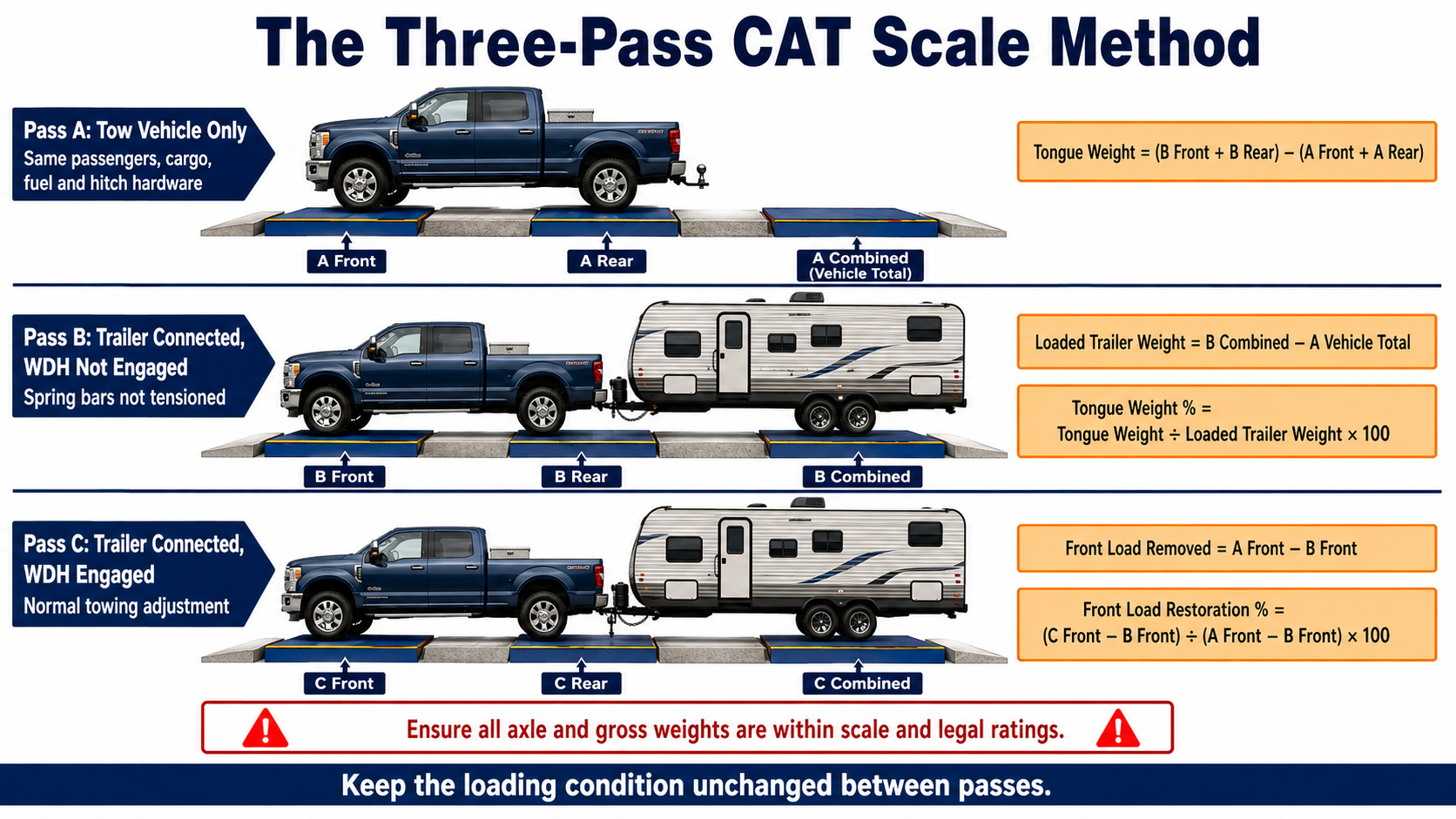
How to Calculate Tongue Weight and Front-Axle Restoration
Use the following symbols:
- A Front and A Rear: tow vehicle only.
- B Front, B Rear and B Trailer: trailer connected without WDH tension.
- C Front, C Rear and C Trailer: trailer connected with WDH engaged.
Raw Tongue Weight
Tongue Weight = (B Front + B Rear) − (A Front + A Rear)
This calculation uses the no-tension pass because engaged spring bars move some load back toward the trailer axles.
Loaded Trailer Weight
Loaded Trailer Weight = B Combined Total − A Vehicle Total
An equivalent calculation is:
Loaded Trailer Weight = B Trailer Axle Weight + Raw Tongue Weight
Tongue-Weight Percentage
Tongue Weight Percentage = Raw Tongue Weight ÷ Loaded Trailer Weight × 100
Many conventional travel trailers are commonly operated with approximately 10% to 15% of loaded trailer weight on the tongue, but the trailer and tow-vehicle manufacturers' requirements take priority.
Front-Axle Load Removed
Front Load Removed = A Front − B Front
Front-Axle Load Restored
Front Load Restored = C Front − B Front
Front-Axle Load Restoration Percentage
Restoration Percentage = Front Load Restored ÷ Front Load Removed × 100
Do not automatically target 50% or 100%. Use the value or measurement method specified for the exact tow vehicle and hitch.
Worked CAT Scale Example
The following figures are illustrative and are not recommended values for another vehicle.
Step 1: Raw Tongue Weight
(3,140 + 3,960) − (3,400 + 2,800) = 900 lb
Step 2: Loaded Trailer Weight
13,000 − 6,200 = 6,800 lb
Step 3: Tongue-Weight Percentage
900 ÷ 6,800 × 100 = 13.2%
Step 4: Front-Axle Load Removed
3,400 − 3,140 = 260 lb
Step 5: Front-Axle Load Restored
3,270 − 3,140 = 130 lb
Step 6: Restoration Percentage
130 ÷ 260 × 100 = 50%
This example shows 50% restoration. It does not prove that 50% is the correct target for another tow vehicle.
| Configuration | Front axle | Rear axle | Trailer axles | Total |
|---|---|---|---|---|
| A: Truck only | 3,400 lb | 2,800 lb | — | 6,200 lb |
| B: Hitched, WDH not engaged | 3,140 lb | 3,960 lb | 5,900 lb | 13,000 lb |
| C: Hitched, WDH engaged | 3,270 lb | 3,820 lb | 5,910 lb | 13,000 lb |
Why Front-Axle Restoration Matters
A heavy tongue load behind the rear axle reduces front tire loading.
Excessive front-axle unloading can affect:
- Steering response.
- Front tire traction.
- Braking balance.
- Headlamp aim.
- Driver-assistance calibration.
- Vehicle stability.
Too Little Restoration
If the spring bars do not return enough load:
- The steering may remain light.
- The rear axle may remain heavily loaded.
- The front ride height may remain excessive.
- The hitch may not meet the vehicle manufacturer's requirement.
Too Much Restoration
Over-tensioning the bars can:
- Place excessive load on the front axle.
- Unload the rear axle more than intended.
- Create a harsh or unstable ride.
- Increase stress at the receiver and trailer brackets.
- Cause the rear of the tow vehicle to rise above its unloaded position.
More bar tension is not automatically safer.
Fender Height Helps Adjustment but Does Not Verify Axle Loads
Many vehicle and hitch manuals use front-wheel-opening height as the field adjustment method.
The general process is:
- Measure the loaded tow vehicle without the trailer.
- Connect the loaded trailer without spring-bar tension.
- Measure the front rise.
- Engage the WDH.
- Adjust until the specified portion of the rise is removed.
Why Height Measurements Are Useful
- They require no scale during initial setup.
- They are easy to repeat after cargo changes.
- They are often the method specified by the vehicle manufacturer.
Why Height Measurements Are Not Enough
- Self-levelling suspension can hide load changes.
- Air springs can alter body height without restoring front-axle load.
- Tire pressure and pavement slope affect measurements.
- A visually level truck may still exceed rear GAWR.
- Height does not calculate actual tongue weight.
Use the manufacturer's height procedure for adjustment, then use axle scales to verify ratings and load transfer.
Airbags and Self-Levelling Suspension Do Not Replace Weight Distribution
Air springs, helper springs and self-levelling suspension can raise the rear body height.
They do not automatically move the tongue-induced load back to the front axle.
This means a truck can look level while:
- The front axle remains unloaded.
- The rear axle remains near or above its rating.
- The receiver still requires weight distribution.
Follow the tow-vehicle instructions for disabling, measuring or recalibrating self-levelling systems during WDH setup.
Adjust the Hitch in the Correct Order
1. Load the Vehicle and Trailer
Set the final cargo, passengers, tank levels and tongue accessories first.
2. Verify Coupler and Receiver Ratings
Confirm the ball size, shank rating, receiver label and weight-distributing limits.
3. Set Initial Hitch-Ball Height
Measure the loaded trailer on level ground and set the hitch-ball height according to the hitch instructions.
4. Establish Trailer Attitude
A conventional travel trailer should normally tow level or slightly nose-down where specified.
Do not use excessive spring-bar tension to correct an incorrect shank height.
5. Set Hitch-Head Angle
Use the washers, spacer rivet, serrated adjustment or other mechanism specified by the hitch.
6. Position Frame Brackets
Respect:
- Coupler-to-bracket distance.
- Propane and battery clearance.
- Frame depth and width.
- Slide-out, jack and A-frame hardware.
- Integrated sway-control contact surfaces.
7. Apply Initial Spring-Bar Tension
Follow the published starting setting.
8. Measure Front-Axle Restoration
Use the vehicle manual's fender-height method and confirm with scale data.
9. Recheck Trailer Level
Adjust shank height where necessary rather than using bar tension as the only correction.
10. Torque and Inspect
Tighten every fastener to the hitch manufacturer's specification and recheck after the initial towing period.

What Spring-Bar Adjustment Changes
Correct WDH spring bar adjustment can be achieved through different mechanisms depending on the hitch:
- Changing chain links under tension.
- Changing L-bracket height.
- Changing hitch-head tilt.
- Changing spacer washers.
- Changing cam or yoke position.
- Adjusting strap length.
Do Not Copy Another Owner's Setting
The same chain link count can produce different load transfer because of:
- Different coupler heights.
- Different A-frame geometry.
- Different hitch-head tilt.
- Different spring-bar length and stiffness.
- Different vehicle wheelbase and rear overhang.
- Different tongue weight.
Change One Variable at a Time
After each adjustment:
- Reconnect safely.
- Settle the suspension.
- Measure the front reference height.
- Confirm trailer attitude.
- Record the setting.
Weight Distribution and Sway Control Are Different Jobs
The phrase weight distribution hitch vs sway control describes two related but separate functions.
Weight Distribution
Weight distribution manages vertical load:
- Front axle.
- Rear axle.
- Trailer axles.
Sway Control
Sway control manages lateral trailer yaw or side-to-side motion.
Common systems include:
- Separate friction sway bars.
- Integrated friction at spring-bar brackets.
- Cam-based centring systems.
- Four-point friction systems.
- Electronic trailer sway control.
Integrated Does Not Mean Identical
Some WDH products contain integrated sway control. The same assembly performs both tasks, but the physical functions remain different.
The spring bars can restore front-axle load while the friction or geometry system resists lateral movement.

Sway Control Cannot Repair Incorrect Loading
A travel trailer sway control device cannot correct:
- Insufficient tongue weight.
- Heavy cargo placed behind the trailer axles.
- Overloaded tires.
- Low tire pressure.
- Loose wheel bearings or suspension.
- Incorrect trailer attitude.
- Excessive speed.
- Improperly matched tow vehicle and trailer.
Too Little Tongue Weight
A rear-heavy trailer can become dynamically unstable. Increasing friction does not replace moving cargo into a stable loading position.
Trailer Nose Too High
A nose-high trailer can change axle loading and aerodynamic behaviour. Correct the hitch-ball height before increasing sway-control friction.
Tire and Suspension Problems
Sway-control hardware cannot compensate for damaged tires, loose suspension parts or incorrect inflation.
Emergency Sway Response
Follow the tow-vehicle and trailer instructions. Common guidance includes reducing accelerator input, maintaining steering control and applying trailer brakes manually where the brake-controller manufacturer permits.
Do not accelerate aggressively or make abrupt steering inputs in an attempt to pull out of severe sway.
A WDH Does Not Increase Vehicle or Component Ratings
GVWR
The sum of the tow vehicle's actual front- and rear-axle loads with the WDH engaged must remain within GVWR.
Front and Rear GAWR
Each axle must remain below its own rating. A legal total vehicle weight does not excuse an overloaded rear axle.
GCWR
The combined loaded tow vehicle and trailer must remain below the manufacturer's combined rating.
Receiver Ratings
Some receivers have separate weight-carrying and weight-distributing ratings.
A higher weight-distributing rating can be used only when:
- The receiver label permits it.
- The tow-vehicle manual permits or requires WDH.
- The hitch system is correctly installed.
- No lower vehicle, tire or component rating is exceeded.
Payload
WDH changes the measured axle distribution and may move some load toward the trailer axles. It does not raise the tow vehicle's published payload or GVWR.
Check the actual engaged front- and rear-axle total against the vehicle's GVWR and both axle ratings.
Common WDH Setup Mistakes
Using Advertised Dry Hitch Weight
The trailer's real tongue load may be substantially higher after propane, batteries, water and cargo are added.
Choosing the Heaviest Spring Bars
Overly stiff bars can create harsh operation and poor adjustability.
Levelling the Truck with Airbags First
Body height may improve while the front axle remains under-loaded.
Targeting a Universal 50% or 100%
The correct restoration target is vehicle-specific.
Using Rear-Bumper Height as the Main Goal
Front-axle restoration and axle ratings matter more than cosmetic level.
Tensioning the Bars to Fix a Nose-High Trailer
Correct the hitch-ball height and shank position.
Measuring with an Empty Trailer
The final camping load can invalidate the setup.
Calling Every WDH a Sway-Control Hitch
Some systems distribute weight without active or integrated lateral resistance.
Ignoring the Trailer Brakes
A correctly adjusted WDH cannot compensate for weak trailer braking.
Failing to Reweigh After Major Changes
Recheck after adding:
- New batteries.
- A generator.
- Rear cargo racks.
- Solar equipment.
- Additional water capacity.
- A different tow vehicle.
- A different hitch or spring bars.
When the CAT Scale Data Shows a Problem
Rear Axle Over Rating
Possible responses include:
- Removing cargo from the tow vehicle.
- Moving appropriate cargo within the trailer while preserving safe tongue weight.
- Reducing carried water.
- Correcting WDH adjustment.
- Using a more capable tow vehicle.
Do not reduce tongue weight below the safe trailer range simply to rescue an overloaded tow vehicle.
Front Axle Still Too Light
Check:
- Bar rating.
- Bracket position.
- Head angle.
- Chain or bracket tension.
- Receiver flex or damage.
- Vehicle-specific WDH restrictions.
Front Axle Above the Intended Target
Reduce spring-bar tension according to the hitch manual and remeasure.
Tongue Weight Too Low
Move suitable cargo forward and verify that no axle, GVWR or hitch rating is exceeded.
Tongue Weight Too High
Review cargo and tank placement. Do not move so much weight rearward that the trailer becomes unstable.
Practical WDH Setup Checklist
Before Measuring
- Tow vehicle and trailer manuals obtained.
- Receiver weight-distributing rating verified.
- Loaded tongue-weight range identified.
- Spring-bar rating verified.
- Tire pressures set cold.
- Trailer brakes operational.
- All cargo loaded for travel.
- Tank levels set to normal trip condition.
Initial Adjustment
- Trailer parked on firm level ground.
- Coupler height measured.
- Initial ball height set.
- Hitch-head angle set.
- Frame brackets positioned correctly.
- Fasteners tightened to specification.
- Front-wheel-opening baseline recorded.
Scale Verification
- Pass A: loaded tow vehicle only.
- Pass B: trailer connected, bars not tensioned.
- Pass C: trailer connected, WDH engaged.
- Raw tongue weight calculated.
- Tongue-weight percentage calculated.
- Front load removed calculated.
- Front restoration calculated.
- GVWR, GAWR and GCWR checked.
- Receiver, tires and trailer ratings checked.
Road Check
- Trailer level or at the specified attitude.
- Steering response normal.
- Braking balanced.
- No bracket or bar interference.
- Spring bars clear road and frame components.
- Safety chains and breakaway cable route correctly.
- Sway-control system adjusted separately where applicable.
CAT Scale Worksheet
| Measurement | Front axle | Rear axle | Trailer axles | Total |
|---|---|---|---|---|
| A: Tow vehicle only | — | |||
| B: Hitched, no WDH tension | ||||
| C: Hitched, WDH engaged |
- Raw tongue weight: __________________
- Loaded trailer weight: __________________
- Tongue-weight percentage: __________________
- Front-axle load removed: __________________
- Front-axle load restored: __________________
- Restoration percentage: __________________
- Front GAWR margin: __________________
- Rear GAWR margin: __________________
- Vehicle GVWR margin: __________________
- GCWR margin: __________________
What OEM and B2B Buyers Should Specify
A WDH purchasing specification should not list only gross trailer weight.
Operating Load Range
- Expected loaded trailer weight.
- Minimum and maximum tongue weight.
- Rear-axle cargo contribution.
- Tow-vehicle receiver ratings.
Spring-Bar System
- Rated tongue-weight range.
- Round-bar or trunnion-bar design.
- Ground-clearance requirement.
- Adjustment increments.
- Replaceable wear surfaces.
Trailer-Frame Compatibility
- A-frame width and depth.
- Bracket mounting distance.
- Propane and battery interference.
- Frame manufacturer approval.
- Clearance through full articulation.
Sway-Control Function
- No sway control.
- Separate friction unit.
- Two-point integrated friction.
- Four-point integrated friction.
- Cam or geometric centring.
- Electronic sway mitigation.
Documentation
- Vehicle-specific restoration guidance.
- CAT Scale worksheet.
- Fender-height procedure.
- Torque values.
- Lubrication points.
- Backing and sharp-turn restrictions.
- Inspection and wear limits.
End-of-Line Verification
A dealer or OEM setup process should record:
- Delivered trailer weight.
- Estimated and measured tongue weight.
- Spring-bar model.
- Initial bracket and head settings.
- Front fender measurements.
- Customer cargo assumptions.
- Requirement to reweigh after loading.
GOODIN Industry Perspective
Weight-distribution setup occurs at the same A-frame area used by the coupler, batteries, propane cylinders and front jack.
The front jack can make spring-bar connection easier by raising the coupled truck-and-trailer combination according to the hitch manufacturer's procedure. It does not determine the correct spring-bar tension and should not be used to support the entire setup during inspection without approved procedures.
GOODIN's Trailer Tongue Jack: Manual or Electric? explains how manual and electric front jacks differ in operating effort, power dependency and emergency operation.
The Trailer Jack Encyclopedia describes tongue jacks, A-frame jacks and auxiliary trailer-support categories.
GOODIN's Trailer Jack range includes manual wheeled, A-frame, medium-duty and heavy-duty configurations for different trailer platforms.
For higher-capacity freight and equipment applications, the Heavy Duty Trailer Jack range includes square-tube and drop-leg support systems.
A tongue jack, stabilizer and WDH perform different jobs. The jack raises and supports the tongue during coupling. The WDH redistributes towing load. Stabilizers reduce movement after parking.
Specify A-Frame Clearance and Front Support Independently from the WDH
GOODIN's public categories cover trailer lifting, coupling, separation and parked front support. Spring bars and WDH frame brackets must be checked for clearance around the coupler, propane cylinders, batteries and front-jack hardware.
Specify the Front Jack After the Loaded Tongue Weight Is Known
For a trailer-jack enquiry, include trailer type, actual loaded support load, A-frame geometry, mounting position, required travel, retracted height, WDH bracket clearance, propane and battery interference, manual or powered operation, corrosion environment, order volume and target market.
Focused FAQ
Does a Weight Distribution Hitch Reduce Tongue Weight?
It redistributes how the tongue load is supported by the tow vehicle and trailer axles. The raw tongue weight should be measured with the spring bars disengaged.
Does a WDH Increase Payload Capacity?
No. It does not raise the published GVWR, GAWR, GCWR or payload rating. It changes the actual axle-load distribution, which must still remain within every rating.
Should the Truck Be Perfectly Level with a WDH?
Not necessarily. The required target is normally based on front-axle load or front-wheel-opening restoration, plus correct trailer attitude. Cosmetic level is not the primary objective.
How Much Front-Axle Weight Should a WDH Restore?
Use the tow-vehicle and hitch instructions. Some vehicles specify approximately 50% restoration, while others use a different percentage or a different measurement method.
Can I Restore 100% of the Lost Front-Axle Weight?
Only when the tow-vehicle and hitch manufacturers permit or require it. Excessive restoration can overload the front axle or create poor handling.
Do I Need Three CAT Scale Passes?
Three controlled passes provide the clearest data: tow vehicle alone, hitched without WDH tension and hitched with the WDH engaged.
Can I Calculate Tongue Weight from the Rear-Axle Increase Alone?
No. Connecting the trailer removes load from the front axle while adding load to the rear. Raw tongue weight is calculated from the change in the total of both tow-vehicle axles.
Should I Measure Tongue Weight with the WDH Engaged?
No for the raw coupler load. The spring bars transfer some load toward the trailer axles, so they should be disengaged for the tongue-weight calculation.
What Tongue-Weight Percentage Should a Travel Trailer Have?
Approximately 10% to 15% is a common range for conventional travel trailers, but the trailer and tow-vehicle instructions take priority.
Does the WDH Make All Three Axle Weights Equal?
No. It redistributes part of the tongue load. It does not attempt to make the front axle, rear axle and trailer axles carry equal weights.
Should I Use the Trailer's Dry Hitch Weight to Select Spring Bars?
No. Use the loaded travel-ready tongue weight and include rear-of-vehicle cargo when the hitch manufacturer requires it.
Are Heavier Spring Bars Safer?
Not automatically. Bars that are too stiff can create harsh operation, poor adjustment resolution and excessive load transfer.
Can Airbags Replace a Weight Distribution Hitch?
Airbags can raise the rear body height but do not perform the same leverage-based front-axle load restoration.
Is Sway Control Included with Every WDH?
No. Some systems distribute weight only. Others use separate or integrated sway-control mechanisms.
Will Sway Control Fix Low Tongue Weight?
No. The trailer must first be loaded with a stable tongue-weight distribution. Sway-control hardware cannot repair a rear-heavy trailer.
Can I Back Up with the WDH Connected?
It depends on the product. Some integrated systems permit backing, while separate friction sway bars may need to be removed. Follow the exact hitch instructions.
Should the Trailer Be Level?
A conventional travel trailer should generally tow level or slightly nose-down where specified. A nose-high trailer should be corrected through hitch height rather than excessive bar tension.
When Should I Reweigh the Setup?
Reweigh after major cargo changes, new batteries, generators, rear racks, different tank levels, a different hitch, different spring bars or a new tow vehicle.
Can a WDH Correct an Overloaded Tow Vehicle?
It may reduce rear-axle load by moving some weight forward and toward the trailer, but it cannot make an inadequate vehicle compliant with its ratings.
Why Does My Rig Still Sway After the WDH Is Adjusted?
Check tongue weight, cargo placement, trailer attitude, tires, suspension, wheel bearings, speed, crosswinds and the actual sway-control system. WDH adjustment alone does not address every lateral-stability problem.
Conclusion
A WDH is not a mysterious device that must be tuned by feel. It is a lever system whose effect can be measured at the tow vehicle's front axle, rear axle and the trailer axles.
The correct process starts with the loaded trailer—not its brochure dry weight. Measure real tongue weight, select the proper spring-bar range, establish hitch height and trailer attitude, then measure how much front-axle load is removed and restored.
Use three controlled scale passes to separate the trailer's raw tongue load from the redistribution produced by the spring bars.
Do not target a universal restoration percentage. Do not assume a level-looking truck is correctly loaded. Do not confuse weight distribution with sway control, and do not use friction to hide an unstable cargo arrangement.
The finished setup should satisfy five conditions:
- The loaded trailer has appropriate tongue weight.
- The tow vehicle receives the specified front-axle restoration.
- The trailer tows at the intended attitude.
- Every vehicle, axle, receiver, hitch, spring-bar and tire rating is respected.
- Sway-control requirements are evaluated separately.
Once those numbers are documented, WDH setup stops being a forum argument and becomes a repeatable towing procedure.
Technical References
- CAT Scale: How to Position a Tow Vehicle and Trailer for Axle Weights
- Ford 2025 Super Duty Owner's Manual: Weight-Distributing Hitches
- Ford Owner Information: Weight-Distributing Hitch Adjustment
- Ford 2025 Expedition Owner's Manual: Trailer Tongue-Load Guidance
- Equal-i-zer Hitch: Weight Distribution and Integrated Sway Control
- Equal-i-zer Hitch: Front-Wheel-Opening Setup Procedure
- CURT: Weight Distribution Hitch Setup Procedure
- Lippert: Weight Distribution Hitch vs. Sway Control
- Lippert: Trailer Load Transfer and Tongue Weight
- Lippert: Weight Distribution Hitch Fundamentals
Oil-Bath Hubs vs Grease Bearings: Which Fits Your Boat Trailer?
Related Article