Smart Trailer Telematics: How Fleets Should Choose Sensors and Alerts
A smart trailer is not defined by how many sensors are bolted to it. It is defined by whether trailer data reaches the right person or system early enough to change a dispatch, maintenance, cargo or security decision.
GPS remains the foundation, but modern trailer telematics can combine location with tire, ABS, door, cargo-temperature, axle-load, power, wheel-end and camera data. The procurement challenge is to connect each signal to a measurable business problem instead of building another dashboard that nobody acts on.
Start with the operational failure mode, define the decision that should change, then specify the minimum sensor, gateway, connectivity, platform and response workflow required to support that decision.
A fast alert with no owner, an axle-weight reading that is not calibrated for the intended use, or a door sensor that never enters a dispatch workflow can add subscription and maintenance cost without improving uptime or utilization.
Start with the Business Problem, Not the Sensor Catalog
Asset Visibility
Location data is valuable when it reduces trailer search time, unauthorized movement, assignment errors or detention.
- Yard search
- Geofence arrivals and departures
- Route history
- Unauthorized movement alerts
- Customer ETA visibility
Maintenance
Condition data is useful when it moves an asset into inspection before the next dispatch or roadside failure.
- Tire pressure and temperature
- ABS faults
- Wheel-end temperature or vibration
- Brake-health signals where supported
- Trailer power status
Cargo Protection
Refrigerated and high-value cargo can justify monitoring when the data protects product condition or documents an exception.
- Cargo temperature
- Door events
- Reefer status
- Interior cargo visibility
- Unauthorized access
Utilization
A trailer shortage can be an allocation problem rather than a fleet-size problem.
- High-idle assets
- Repeated detention
- Underused trailer groups
- Incorrect tractor-trailer assignment
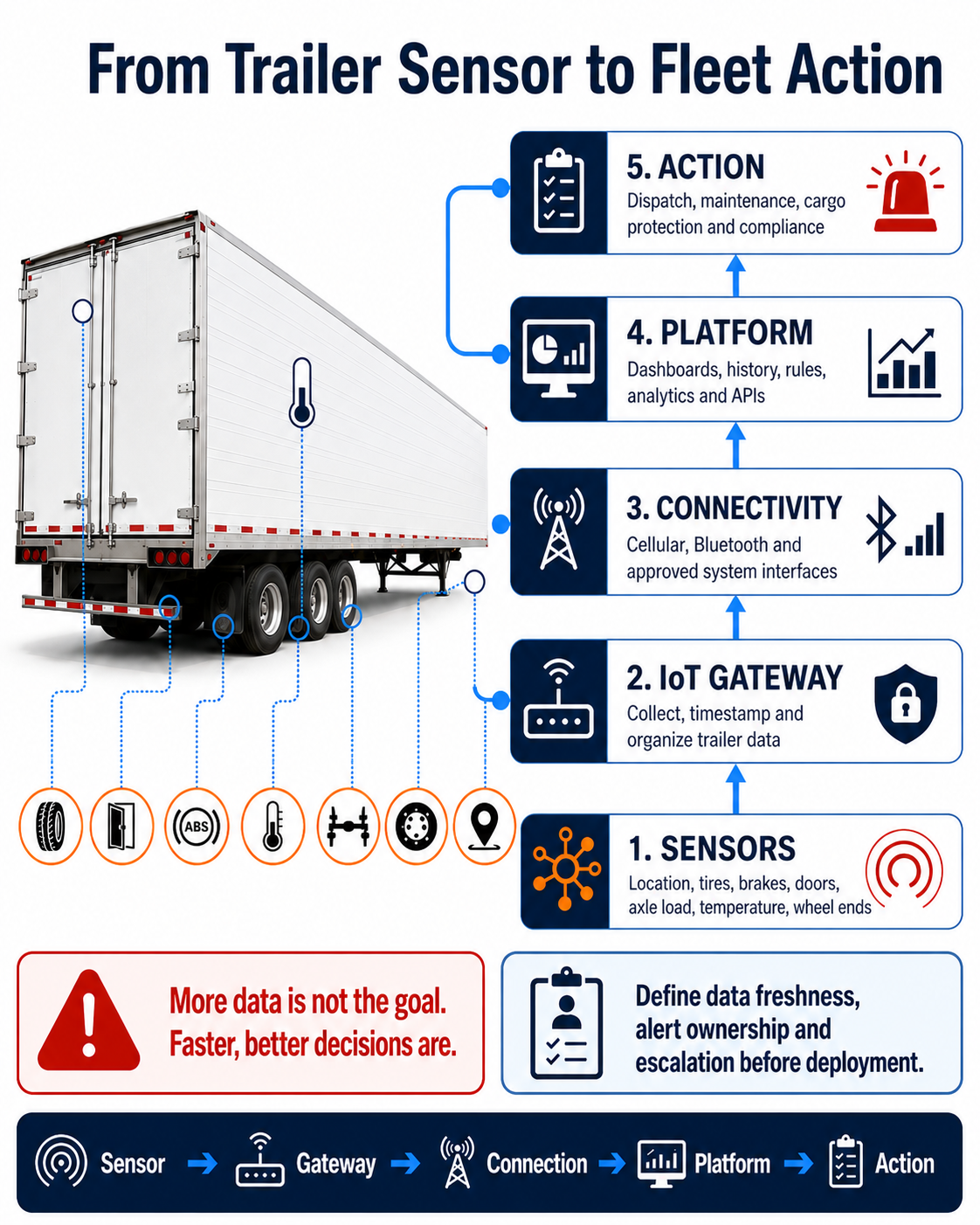
Use a Five-Layer Connected-Trailer Architecture
A reliable telematics deployment should be evaluated as an end-to-end chain. If any layer fails, the fleet may collect data without producing an accountable action.
Sensor Layer
Confirm the physical condition to be measured, the required accuracy, calibration needs, mounting environment and replacement process.
Gateway Layer
Specify supported interfaces, power input, environmental protection, device identity, local storage and firmware-update process.
Connectivity Layer
Test coverage, roaming, antenna location, reconnect behavior and the difference between moving and parked reporting.
Platform and Action
Define alert rules, users, APIs, escalation paths and what closes the event after dispatch or maintenance responds.
Keep Location Tracking as the Foundation
Real-Time Location
Dispatch can identify the nearest asset, verify return to yard, detect unexpected movement and reduce manual search time.
Geofencing
Entry and exit events can automate yard, customer and restricted-area workflows when event timing is appropriate for the business process.
Utilization History
Historical location reveals dwell at yards, customer sites and maintenance facilities, helping fleets distinguish true capacity shortages from poor allocation.
Assignment Control
Location and tractor-trailer pairing can support mismatch detection when the telematics platform and dispatch system share the right data.
Choose Sensors by Failure Mode
A trailer sensor kit should be designed around conditions that lead to a measurable maintenance, dispatch, cargo or security action—not around maximum sensor count.
| Business problem | Useful signal | Alert or decision | RFQ question |
|---|---|---|---|
| Yard search / utilization | GPS, movement, geofence | Reassign, dispatch or investigate idle asset | How often does location refresh while moving and parked? |
| Tire risk | Pressure, temperature, inflation-system status | Correct pressure or inspect before dispatch | Which wheel is identified and what threshold/delay applies? |
| Brake / ABS risk | ABS fault and supported brake-health data | Hold for inspection or route to maintenance | Are faults stored with trailer identity and history? |
| Wheel-end abnormality | Temperature or vibration trend | Inspect bearing, lubrication, brake drag or hub | Is raw/trend data available and how is severity assigned? |
| Cargo security | Door event plus geofence/location | Investigate unauthorized opening | How quickly is the event delivered and who receives it? |
| Cold chain | Cargo temperature, set point, reefer alarm, door event | Investigate excursion and protect load | Are history, duration and correlated events exportable? |
Tire Monitoring
Pressure data becomes operationally valuable when the alert identifies the wheel, threshold, delay and sensor status early enough for maintenance to respond before dispatch.
ABS and Brake Monitoring
An alert should identify the affected trailer and retain enough history for maintenance triage. A fault code is a trigger for inspection, not a remote proof of the failed component.
Wheel-End Monitoring
Temperature or vibration trends can expose abnormal behavior, but inspection is still required to distinguish brake drag, bearing condition, lubrication or hub problems.
Axle-Weight Data
Where designed and calibrated for the intended purpose, weight data can support load planning. It does not replace a certified scale where an official weight measurement is required.

Cold-Chain Monitoring Needs Event Context, Not One Temperature Number
Track Temperature Over Time
- Current temperature
- Historical trend
- Set point where available
- Out-of-range duration
- Door events
- Refrigeration-unit alarms
Correlate Events
A temperature rise is more useful when the fleet can also see trailer location, door opening, reefer status and the duration of the excursion.
Preserve Exportable History
Cold-chain buyers should confirm retention, export format, timestamp behavior and whether the platform can provide evidence without exposing the full internal dashboard.
Define the Response
Specify who receives an excursion alert, how quickly it must be acknowledged and when a driver, dispatcher, customer or maintenance team is contacted.
Turn Predictive Maintenance into a Closed Workflow
Predictive trailer maintenance should describe a process, not a marketing label.
Example: Rising Wheel-End Temperature
A medium-severity trend can trigger inspection of brake drag, bearing condition, lubrication, hub condition and adjacent wheel temperatures.
Avoid Alert Fatigue
- Threshold
- Delay
- Severity
- Recipient
- Escalation time
- Required action
Do Not Over-Diagnose
A sensor alert can justify inspection without claiming the software already knows the exact failed part.
Capture the Repair Result
Closing the loop gives the fleet better evidence for future thresholds and helps distinguish true predictive value from recurring false alarms.

Match the Telematics Device to Trailer Type and Power
Powered Reefers
Reliable trailer power can support more frequent communications and a broader sensor suite, provided the telematics installation does not interfere with critical trailer circuits.
Unpowered Assets
Battery-powered tracking may be appropriate when location and utilization are more important than high-frequency component monitoring.
Dry Vans and Flatbeds
Define which conditions are worth wiring for continuous monitoring and which can be handled by low-power wireless or periodic inspection.
Mixed Fleets
Do not assume every existing OEM sensor must be replaced. Verify integrations and data normalization before adding another gateway or dashboard.
Define “Real-Time” with Measurable Data-Freshness Requirements
Different events have different urgency. Faster reporting can increase data cost and battery consumption without improving the decision.
| Data type | Typical operational priority | Procurement question |
|---|---|---|
| Trailer location | Routine | How often is position refreshed while moving and parked? |
| Unauthorized door opening | High | How quickly is the event delivered and escalated? |
| Tire pressure warning | High | What threshold, persistence rule and delay apply? |
| Historical utilization | Low urgency | How much history is retained and exportable? |
| Wheel-end trend | Maintenance | Is raw or trend data available for analysis and maintenance review? |
Coverage Loss
Define local storage, event buffering and how quickly queued data synchronize after connectivity returns.
Parked Reporting
An unpowered trailer may deliberately report less frequently while stationary to preserve battery life.
Event Priority
Door, temperature or tire warnings can require different latency targets from location history and utilization reports.
Clock and Timestamp Behavior
For investigations, confirm time synchronization, time zone handling and whether device time is preserved when data upload is delayed.
Treat APIs, Integrations and Data Portability as Core Requirements
TMS Integration
- Trailer location
- Trip status
- Arrival/departure
- Temperature alerts
- Trailer assignment
Maintenance Integration
- ABS faults
- Tire alerts
- Wheel-end warnings
- Utilization or odometer data
- Service history
Customer Visibility
Share only the location, ETA or cargo information customers need rather than exposing the fleet's complete internal dashboard.
Exit Strategy
- Historical data export
- Documented API
- Subscription termination behavior
- Hardware reassignment
- Data ownership
- Credential revocation
A useful platform should make data easier to act on inside the fleet’s existing systems. A dashboard that becomes another isolated screen can increase administrative work instead of reducing it.
Put Cybersecurity and Data Ownership in the Same RFQ as Sensors
A connected trailer is an IoT endpoint. Cybersecurity requirements should be written before deployment, not added after hundreds of gateways are installed.
Device Identification
Every gateway should be uniquely identifiable so physical trailer, device, firmware and data source can be tied together.
Authorized Configuration and Access
Only approved users or systems should change alert thresholds, device settings, remote controls or integration credentials.
Data Protection
Ask how data are protected on the device, in transit, in cloud storage and during API exchange.
Software Updates and Lifecycle
Specify update authorization, update validation, vulnerability support, security-support period and end-of-support process.
Cybersecurity State Awareness
Determine whether the device or platform can expose security-relevant state to authorized administrators.
User Roles
Dispatch, maintenance, drivers, customers and administrators should not automatically receive the same permissions.

Deploy Smart Trailer Capability in Three Levels
Level 1: Asset Visibility
- GPS location
- Geofences
- Movement or power status
- Basic utilization
Level 2: Operational Health
- Tire monitoring
- ABS status
- Door monitoring
- Cargo temperature where needed
- Trailer power
Level 3: Predictive and Integrated Fleet
- Wheel-end trends
- Axle-load monitoring
- Cameras
- Predictive analytics
- TMS integration
- Maintenance integration
- Automated work-order or dispatch workflows
Gate to the Next Level
Do not add advanced data streams until the fleet has people, thresholds, integrations and processes ready to respond to them.
Measure ROI Around Operations, Not Sensor Count
Trailer Utilization
- Average idle days
- Trailer-to-tractor ratio
- Yard search time
- Customer detention
Maintenance
- Roadside events
- Unplanned maintenance stops
- Tire failures
- Wheel-end events
- Maintenance completed before dispatch
Cargo
- Temperature excursions
- Rejected loads
- Unauthorized door events
- Cargo claims
Administrative Efficiency
- Manual trailer searches
- Driver check calls
- Manual temperature reports
- Duplicate data entry
Compare the deployment against a baseline after the first operating period, then again after false-alert tuning and workflow adoption. Hardware installation alone is not proof of ROI.
Use a Smart Trailer Deployment Checklist
Before Procurement
- List business problems
- Segment trailers by type and power
- Identify existing OEM sensors
- Define alert response time
- Identify TMS and maintenance integrations
Hardware
- Confirm sensor compatibility
- Define gateway power
- Verify environmental protection
- Protect wiring and antennas
- Maintain service access
Software
- Define user roles
- Configure thresholds
- Set geofences
- Confirm retention
- Verify export and API
Operations
- Assign owner to every critical alert
- Define escalation
- Train dispatchers and drivers
- Document sensor replacement
- Review false alarms
Cybersecurity
- Inventory connected devices
- Control admin access
- Require protected updates
- Review data protection
- Document end-of-life support
Write the Smart Trailer RFQ Around the Operating Result
Sensor Requirements
- GPS
- Tire pressure/temperature
- ABS or brake-health interface
- Door status
- Cargo temperature
- Wheel-end monitoring
- Axle weight where required
Gateway Requirements
- Supported interfaces
- Power input
- Environmental rating
- Cellular coverage
- Local wireless
- Local buffering
- Remote firmware management
Platform Requirements
- Live asset view
- Historical data
- Configurable alerts
- Maintenance dashboard
- User access controls
- API documentation
- Data export
Commercial and Lifecycle Requirements
- Hardware cost
- Installation cost
- Connectivity fee
- Sensor replacement cost
- Subscription
- Integration fees
- Support period
- Data portability at exit
GOODIN Industry Perspective
Smart trailers create an integration requirement for component suppliers, but connectivity does not replace basic mechanical engineering.
For support hardware, the GOODIN Trailer Jack range should still be selected by actual supported load, mounting geometry, travel and duty cycle. A telematics platform cannot correct an underrated or incorrectly installed jack.
Where commercial trailers require higher support loads, the Heavy-Duty Trailer Jack category remains a mechanical support decision. Cycle counts, inspection dates or maintenance status can later be linked to a digital record, but the sensor does not change the component rating.
For OEM projects, Customized Trailer Jack discussions can include predictable wiring routes, service access, component identification and installation constraints that make future digital integration easier.
GOODIN's current public English site does not present a verified dedicated smart-trailer telematics category. This article therefore does not create a product claim for GPS trackers, IoT gateways, TPMS, ABS monitoring, cargo sensors or fleet software.
Specify Mechanical Support Separately from Telematics
These GOODIN categories cover coupling, separation and parked front support. They are not smart-trailer sensor, gateway, connectivity or fleet-software products.
Define the Mechanical Interface Before Adding Digital Integration
For a GOODIN support-hardware enquiry, include trailer type, supported load, mounting, travel, static support requirement, operating cycles, electrical supply where relevant, corrosion exposure, service access, component identification, quantity and target market. Telematics hardware and software remain a separate supplier specification.
Focused FAQ
What Is Smart Trailer Telematics?
It is a connected system that collects trailer location, condition or cargo data through sensors and sends it through a gateway and platform so fleets can monitor, analyze and act on the information.
Is a GPS Tracker the Same as a Smart Trailer System?
No. GPS mainly answers where the asset is. A broader smart-trailer system can also combine tire, ABS, door, power, cargo-temperature, axle-load, wheel-end and camera data.
Which Trailer Sensors Provide the Most Value?
The highest-value sensor is the one tied to a real operating risk and response. Common starting points include GPS, tire monitoring, ABS status, door events and cargo temperature.
Can Existing Trailers Be Retrofitted with Telematics?
Often yes. Feasibility depends on trailer power, sensor interfaces, mounting, existing ABS or reefer equipment, antenna position and the selected communications platform.
Can One Platform Monitor Different Trailer Brands?
Some platforms and integrations support mixed equipment. Verify the exact OEM, reefer, ABS, TPMS and gateway interfaces already present before procurement.
How Does Telematics Reduce Trailer Downtime?
Condition alerts can bring a trailer into inspection before a tire, brake, wheel-end or refrigeration issue becomes a road event, but only when the fleet has a response workflow.
Does Telematics Replace Driver Pre-Trip Inspections?
No. Remote data can strengthen maintenance decisions but does not eliminate legally required, company-required or manufacturer-required physical inspections.
How Often Should a Trailer Send Data?
It depends on the decision. Security, tire or temperature alerts may require low latency, while utilization reporting can tolerate a much longer refresh interval.
What Happens When Cellular Coverage Is Lost?
That depends on the gateway. The RFQ should define local storage, retained event types, queue capacity and synchronization behavior after connectivity returns.
Should Telematics Connect to the TMS?
For larger fleets, integration can reduce duplicate entry and allow location, ETA, temperature or assignment information to enter existing dispatch workflows.
What Cybersecurity Features Should a Fleet Require?
At minimum, evaluate device identity, authorized configuration, data protection, logical access, secure software updates, security-state visibility and long-term support.
How Should a Fleet Measure Smart-Trailer ROI?
Track operational outcomes such as utilization, yard-search time, roadside events, tire incidents, cargo claims, detention and maintenance completed before dispatch.
What Does Predictive Trailer Maintenance Actually Mean?
A useful definition includes detection, severity, an accountable recipient, an inspection or work order, and a recorded repair result. An alert alone is not predictive maintenance.
How Do Fleets Avoid Alert Fatigue?
Every important alert should have a threshold, persistence or delay rule, severity, recipient, escalation time and required action. Review false alarms after deployment.
Can Axle-Weight Sensors Replace a Certified Scale?
Not automatically. On-trailer weight data can support loading decisions when the system is designed and calibrated for that purpose, but official scale requirements still apply where required.
What Should an Unpowered Trailer Tracking Device Prioritize?
Usually battery life, reporting frequency, coverage, movement detection, environmental durability and service access. High-frequency sensing can shorten service life.
Who Should Own Smart-Trailer Data?
The contract should state data ownership, export rights, retention, API access, deletion, credential revocation and what happens when the subscription ends.
How Long Should Telematics Data Be Retained?
There is no universal period. Set retention from maintenance, cargo, security, customer, legal and analytics requirements, then confirm export and deletion behavior.
What Should a Smart-Trailer Pilot Measure?
Establish a baseline first, then measure utilization, search time, alert volume, false alarms, maintenance interventions, cargo exceptions, data latency, connectivity gaps and administrative effort.
What Belongs in a Smart-Trailer RFQ?
Define the business outcome, trailer segment, sensors, power, gateway interfaces, connectivity, refresh targets, APIs, cybersecurity, lifecycle support, commercial fees, data ownership and exit strategy.
Conclusion
Smart trailer value does not come from turning every component into a data source. It comes from detecting a condition early enough to change an operational decision.
The strongest deployments begin with a measurable business problem, segment the trailer fleet, choose sensors by failure mode, define data freshness and connectivity behavior, integrate alerts into real workflows, specify cybersecurity and data rights, then measure ROI against a baseline.
The purchasing question should therefore move from “How many sensors are included?” to “Which condition can this system detect, how quickly will the fleet know, who will act, and how will we prove the action improved utilization, maintenance, cargo protection or security?”
- Define the operating problem.
- Segment powered and unpowered trailers.
- Map each sensor to a failure mode.
- Specify latency, storage and connectivity.
- Assign every critical alert to an action.
- Write API, cybersecurity and data-ownership requirements into the RFQ.
- Pilot, tune and measure operational ROI before scaling.
Technical References
- Thermo King: TracKing Smart Trailer Telematics
- Thermo King: ConnectedSuite Telematics Portfolio
- Thermo King: TracKing Telematics and Data Sharing
- Samsara: Smart Trailer Tracking and Monitoring
- Samsara: Equipment Tracking and OEM Integrations
- NIST: NISTIR 8259 Series
- NIST: NISTIR 8259A IoT Device Cybersecurity Capability Core Baseline
- NIST: IoT Device Cybersecurity Capabilities Catalog
How Self-Propelled Electric Trailers Work: Powered Axles, Tow Assist and Safety
Can Electric Pickups Tow Heavy Trailers for Fleet Work?
Related Article