Semi-Trailer Landing Gear Is Hard to Crank: Gear Selection, Excess Load or Mechanical Binding?
In this article
The same trailer can be easy to wind down in one yard and surprisingly difficult to wind up at the next. Sometimes the handle turns freely but the legs move slowly. Sometimes low gear still requires much more effort than expected. These situations need different explanations.
Crank effort depends on the selected gear, the load actually passing through the landing gear, and resistance within the installed mechanism. Start by identifying when the effort changes: before the feet touch the ground, as they begin supporting the trailer, or after the tractor has taken the load. Confirm the correct gear and full engagement, then inspect the support conditions and visible alignment. Persistent resistance with the legs properly unloaded points toward a mechanical problem; abnormal resistance only under load can also indicate internal wear or bearing damage.
The important comparison is not simply loaded trailer versus empty trailer. It is loaded landing gear versus unloaded landing gear, with the operating conditions understood.
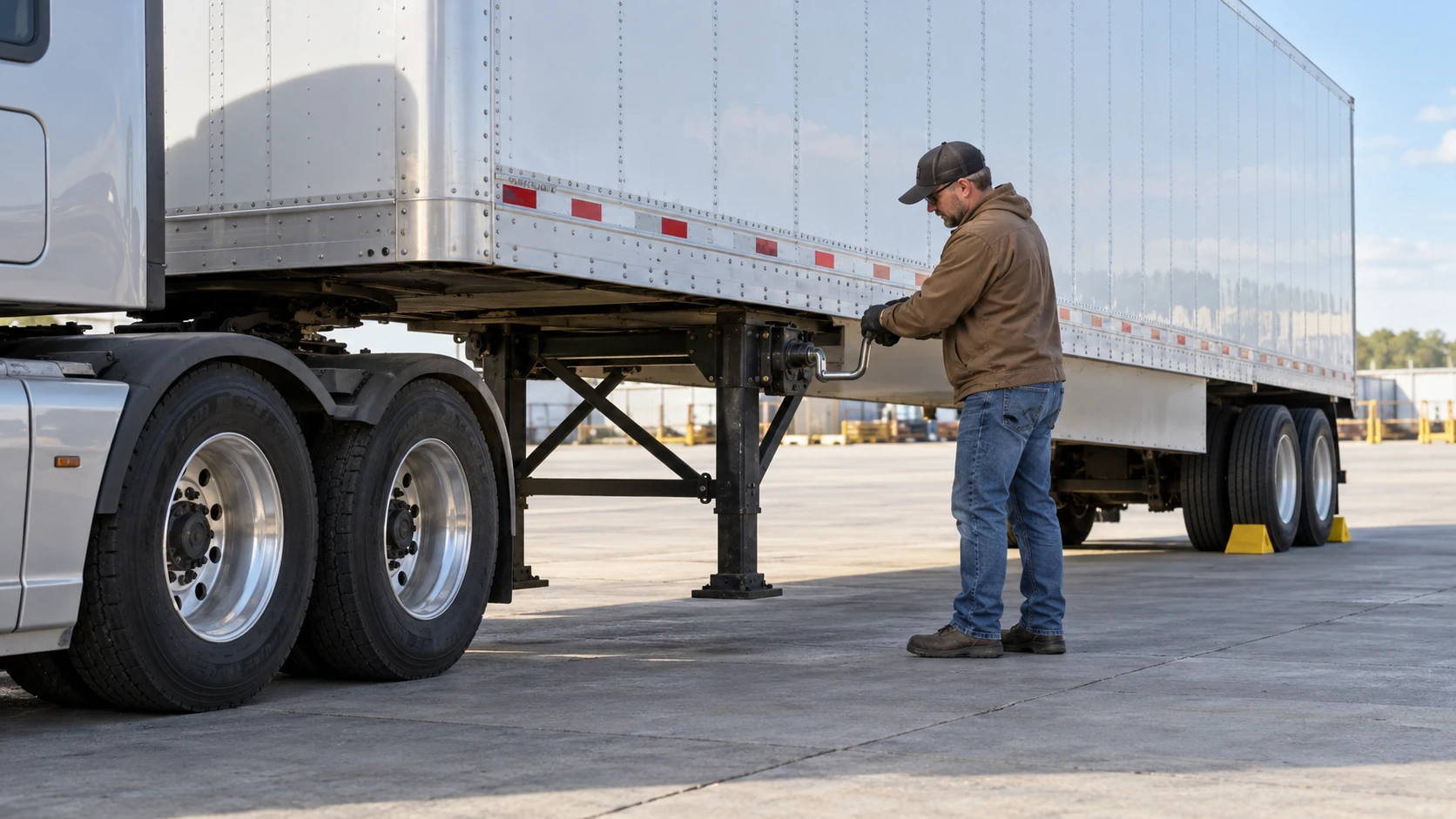
Why this problem causes so much confusion
In a February 2026 r/Truckers discussion about slow landing gear, a dry-van driver described repeated difficulty retracting trailer legs, with trying different gears helping only intermittently. The experience illustrates how slow movement, incomplete engagement and heavy winding can be difficult to distinguish from the handle alone.
A separate discussion from a new driver describes a related puzzle: the handle feels easier to turn when the legs move slowly, yet the faster-moving setting demands more effort. The first task is to distinguish that normal trade-off from resistance that remains excessive in the correct working gear.
A fast-spinning handle does not necessarily mean the legs are travelling quickly. Equally, a difficult handle does not establish that the trailer exceeds the landing gear's rated capacity. A useful diagnosis connects the handle's behaviour to leg movement, ground contact and the stage of coupling or uncoupling.
Before observing movement, secure the vehicle against rolling and check the equipment for visible damage. Keep people clear of the area beneath the trailer. Do not continue winding against a sudden jam, add an improvised handle extension, or use vehicle movement to force a bound leg free. Those actions can turn a diagnosable fault into a broken component or unstable support.
How does trailer landing gear work?
On a typical manual two-speed system, the crank drives a gearbox and a screw mechanism that extends or retracts the inner leg. A cross shaft transmits rotation to the opposite leg. The installed assembly converts the operator's rotary input into vertical movement at the trailer supports.
The two gears trade movement per handle revolution against mechanical advantage:
- High gear provides quicker positioning when the legs are travelling without supporting the trailer's front load.
- Low gear provides greater mechanical advantage for the part of the operation that raises or lowers the supported trailer front.
Low gear normally needs more handle revolutions for the same leg travel. That slower movement can be entirely normal. High gear can feel noticeably harder when used where low gear is required, because the operator has less mechanical advantage.
Distinguish leg movement from trailer movement. Extending a leg with its foot clear of the ground moves the foot downward. Continuing extension after the foot is firmly supported can raise the trailer front. Retracting a leg that is carrying weight initially lowers the supported trailer front; after the tractor has taken that load, further retraction lifts the foot away from the ground.
This change in what the mechanism is moving explains why effort can change partway through an otherwise normal operation. It also explains why comparing two handles without comparing their support conditions produces unreliable conclusions.
Identify the gear on the actual equipment
Do not apply a universal “push in” or “pull out” rule. For example, JOST's published operating instructions identify inward movement as high gear, while BPW's landing gear instructions describe inward movement for slow gear on the equipment covered by that manual. Follow the identification and procedure for the installed model.
In its coupling sequence, JOST's operating and maintenance instructions keep the landing gear in low gear until the feet leave the ground, then use high gear for full retraction. They also prohibit shifting under load. The practical lesson is to confirm the correct position and permitted shift condition before applying effort, rather than forcing the selector while it is carrying load.
Follow a consistent diagnosis order
Use the same sequence each time, rather than trying several remedies together:
- Check the support conditions and visible condition. Establish firm ground, secure the vehicle and identify obvious damage before operating the mechanism.
- Identify the selected gear. Use the installed model's markings and permitted shift procedure; verify full engagement.
- Identify the load-bearing stage. Distinguish free foot travel from raising or lowering the supported trailer front.
- Verify coupling and load transfer. Check the actual fifth-wheel relationship before assuming the tractor has unloaded the legs.
- Investigate persistent abnormal resistance. Hand over alignment, screw, bearing and drive checks for a properly supported workshop inspection.
Record the result at each stage. Correcting an operating condition and still finding a repeatable catch means there is another issue to resolve.
Record when the resistance begins
Make a short observation record before changing parts. Include the trailer and landing gear identification, whether the trailer is laden, the ground condition, the tractor's coupling state and the selected gear. Record whether the problem affects extension, retraction or both.
Describe the resistance in a way another person can reproduce safely: uniformly heavy, stiff at a particular extension, catching once per handle revolution, slipping, or turning without leg movement. Note noises and any visible difference between the two legs.
| Observation | What it suggests | What to establish next |
|---|---|---|
| Many easy handle turns produce small leg movement | Low gear may be working normally | Confirm the selected ratio and whether the legs are loaded |
| Effort rises when the feet begin supporting the trailer | The mechanism has entered a lifting or lowering phase | Confirm low gear, the supported load and suitable ground contact |
| Effort remains abnormal after the load is properly removed | Mechanical resistance deserves attention | Inspect alignment, damage, lubrication and drive components |
| Low gear is unusually heavy only under load | Load conditions or a load-sensitive mechanical fault | Compare the actual conditions and inspect the thrust-bearing or screw system as applicable |
| The handle turns but neither leg moves | Drive engagement or transmission may be interrupted | Check the selector and have the drive path inspected |
| One leg moves differently from the other | Synchronisation, connection or local leg damage | Stop operation and investigate the two-leg system |
| Resistance returns at the same point in travel | A local interference or damaged region may be involved | Record the position for a supported workshop inspection |
On a narrow screen, scroll the table horizontally.
These observations narrow the investigation. They do not, by themselves, identify a failed bearing, stripped gear or bent screw.
Check the load the legs are actually carrying
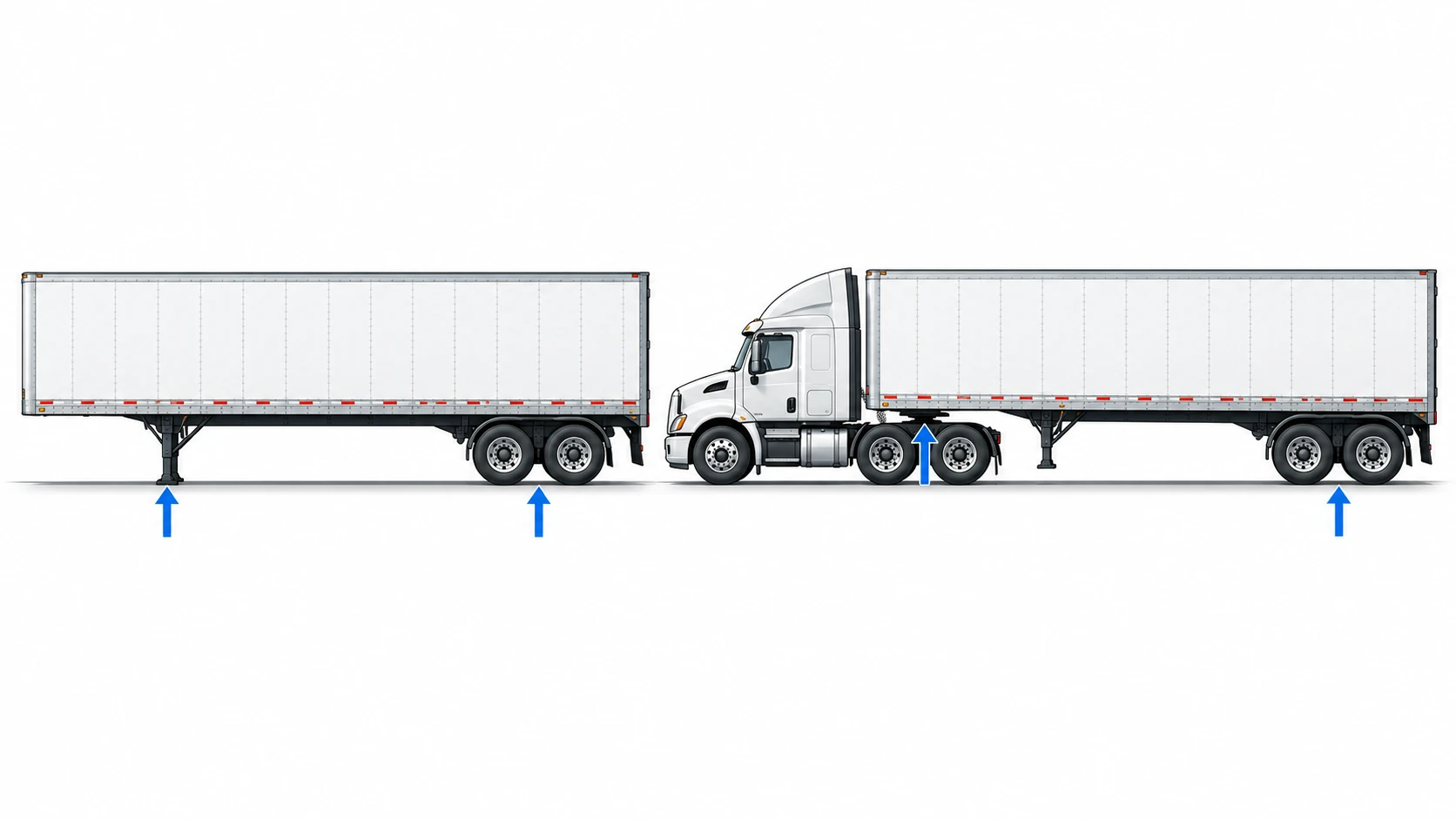
A laden semi-trailer does not place its entire gross weight on its front supports. The rear running gear carries part of the weight; the front reaction passes through the landing gear or the tractor, depending on the operating stage. Cargo position and trailer geometry influence that distribution.
This has two practical consequences. First, the same landing gear can operate very differently on the same trailer when its front support reaction changes. Second, trailer gross weight is not a substitute for establishing the landing gear load when evaluating capacity.
An empty trailer can also leave a meaningful front load on the legs. “Empty” does not mean “unloaded landing gear.” Conversely, a fully laden trailer that has been correctly coupled can have its front load carried by the tractor while its legs are being retracted.
Record whether the effort change happens as load transfers. If resistance drops when the tractor properly takes the trailer front load, that is consistent with a load-related effect. It is not a complete mechanical clearance. A damaged component can behave acceptably without load and become difficult when loaded again.
Compare like operating conditions
A useful comparison keeps the gear, travel direction, support condition and approximate leg extension consistent. Compare an assembly's behaviour with its own normal operation where that history is available. Different trailers can have different drive arrangements and operating handles, so one driver's impression that another trailer is easier does not establish a fault or a capacity problem.
There is also a difference between steady effort and a sudden obstruction. Note whether the mechanism remains smoothly driven or stops abruptly at a particular position. Check the documented travel limits before assuming an end-of-travel stop is an internal seizure. Repeatedly winding harder against a stop does not provide a useful test.
How much weight can a semi trailer landing gear hold?
Use the ratings for the specific installed equipment and their stated basis. A lifting rating concerns moving a supported load through the mechanism. A static rating concerns stationary support. Neither figure establishes that the operator should be able to lift that load in high gear or with negligible handle effort.
GOODIN's LF28-0001 dual-speed landing gear publishes 28 tons of lift capacity and 80 tons of static capacity. The 80-ton figure is not an 80-ton lifting allowance. Its public information does not provide an exact gear ratio or handle-effort value, so neither can be inferred from those capacity figures.
The rating basis, approved installation and load distribution must also be understood. Do not assume a published figure applies to one individual leg rather than the complete arrangement unless the engineering documentation says so. For a suspected overload, establish the supported reaction and the applicable rating instead of diagnosing capacity from how tired the operator becomes.
Inspect ground contact and fifth-wheel conditions
Look at both feet and the surface beneath them. A foot resting on a firm, even base behaves differently from one sinking into soft ground or contacting an uneven edge. Unequal contact can change load sharing and impose an awkward load path through the legs and bracing.
Do not compensate for an unsuitable support position by endlessly winding against increasing resistance. Arrange a suitable support surface and any approved base material through the normal operating procedure. A strong landing gear assembly cannot make weak ground carry an unlimited load.
Also consider whether the trailer's coupling height is appropriate for the tractor and fifth wheel. The fact that the tractor has backed toward the kingpin does not establish that the front load has transferred correctly. A trailer left too high or too low may require correction before normal coupling can be completed.
The CDL manual hosted by FMCSA explains checking trailer height so the tractor raises it slightly during coupling, followed by verification of the coupling. A coupling that merely looks close is not the basis for assuming the landing gear is unloaded.
Changes in tractor suspension height can affect this relationship, but an air-suspension adjustment is not a general-purpose cure for binding. Use the tractor, trailer and fifth-wheel manufacturers' coupling sequence. Avoid improvised backing, pulling or rocking manoeuvres intended to straighten a loaded leg.
After any unusual event, include the landing gear mounts and braces in the inspection. A displaced support assembly may remain difficult even when the immediate coupling-height problem has been corrected.
Confirm full gear engagement before diagnosing internal damage
A selector can appear to be near the intended position without being fully engaged. The operator may feel intermittent drive, hear an unusual catch, or find that the expected difference between gears is absent.
First check the model's identification and operating instructions. Confirm the crank handle is properly engaged for operation rather than left in its stowed or disengaged arrangement. Inspect accessible parts for a bent handle, interference with its holder or damage that prevents normal selector travel.
Follow the specified engagement procedure only in the permitted load condition. Do not hammer the selector into position, hold it between gears while winding, or force a shift under load. If the selector will not reach or retain its working position, stop treating the problem as simply a need for more effort.
Full engagement should produce a repeatable relationship between crank input and leg movement. A handle that jumps out of position or repeatedly loses drive needs inspection of the retaining and transmission components. Continued winding may damage surfaces that are only partly engaged.
When reporting the fault, distinguish “cannot select low gear” from “low gear selects normally but the mechanism is unusually stiff.” They direct the workshop toward different checks and help avoid replacing a complete leg for an external operating-linkage problem.
Trailer landing gear stuck: inspect the complete mechanism
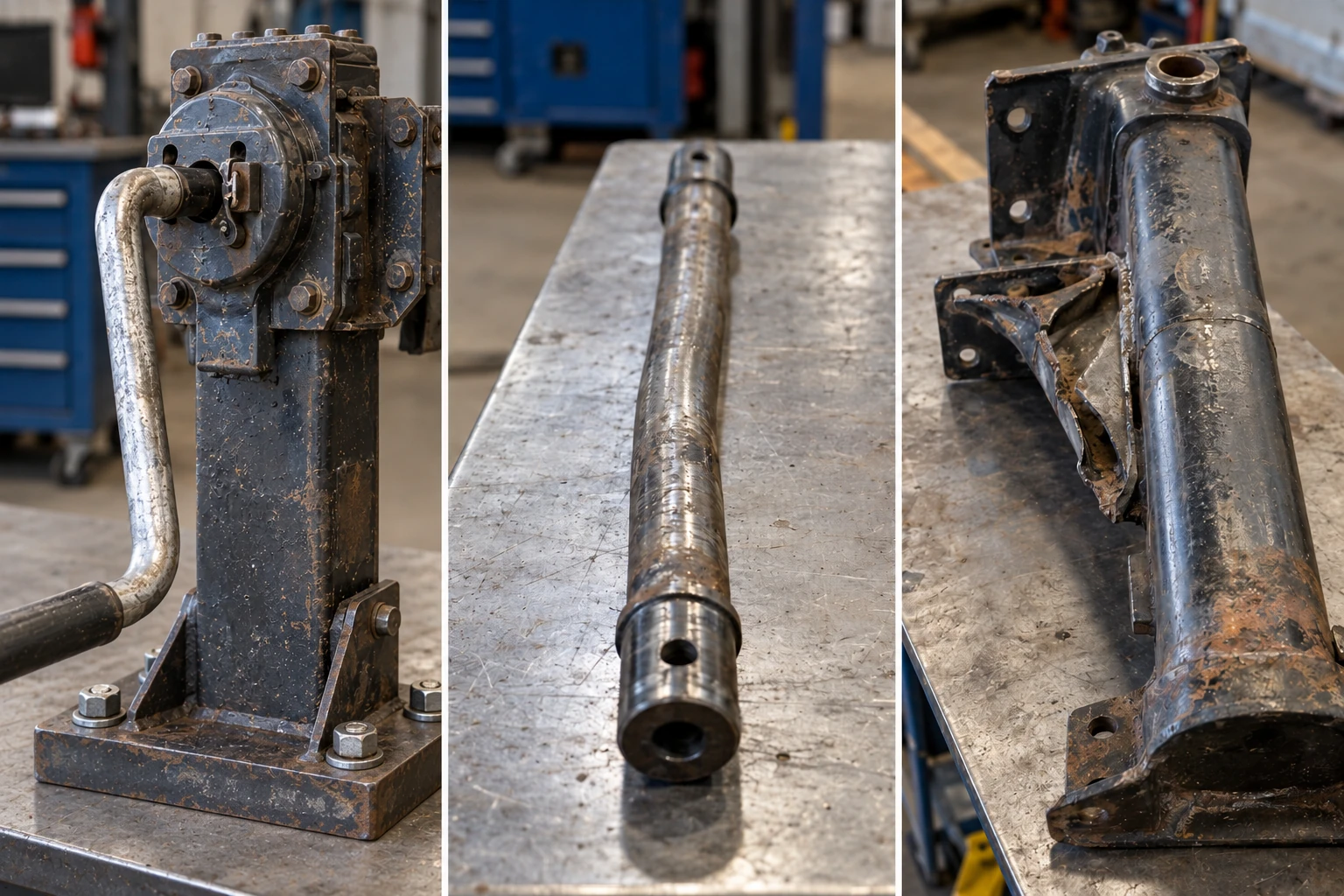
Inspect the installed system from the outside before assuming the central gearbox is responsible. Look for distorted mounting plates, damaged braces, impact marks, bent tubes and an unusual angle between a leg and the trailer structure.
Distinguish the alignment of the mounted housings from normal movement or clearance of an inner tube. A small visible angle alone does not establish that a leg is bent. Assess it against the manufacturer's permitted condition, together with any impact deformation, cracks, unequal travel or abnormal resistance. This avoids replacing a sound leg on appearance alone while still identifying real structural damage.
Consider the history. Did the problem start after a leg struck an obstacle, after installation, or after a cross-shaft replacement? Was the assembly easy to operate before a mounting repair? A clear change after work or impact is more useful than a general description that the gear has “always been heavy.”
The cross shaft must connect the drive without imposing unintended axial restraint or misalignment. Its required clearance and fastener arrangement are model-specific. Do not loosen connection bolts or remove the shaft while the landing gear is supporting the trailer to see whether it turns more easily.
SAF-HOLLAND's Mark V troubleshooting guidance identifies cross-shaft binding, leg misalignment, lubrication problems and damaged screw components among causes of hard cranking. It separately identifies a damaged thrust bearing as a possible cause when the problem occurs only under load.
That distinction matters. A smooth unloaded test does not rule out a load-sensitive fault. If effort has increased significantly under comparable working conditions, inspection should continue even if the feet travel freely when suspended.
Separate visible symptoms from confirmed causes
A repeatable tight point can help a technician locate the investigation. Resistance at a particular leg extension may suggest local interference or damage; a catch associated with drive rotation may suggest a rotating component. These are diagnostic clues, not a reason to name a particular gear or screw as failed without inspection.
Likewise, a handle that rotates without moving the legs belongs to a different fault category from a handle that cannot rotate. Lost drive can involve engagement, a connection or an internal transmission component. More grease will not restore a broken mechanical link.
Workshop isolation may involve checking the legs and drive separately. That requires an appropriate support arrangement, removal of load from the equipment being serviced and the manufacturer's procedure. The useful driver handover is a precise symptom and operating history, not an attempted dismantling beside a supported load.
How to grease trailer landing gear: use the correct maintenance procedure
Lubrication is a reasonable investigation when the mechanism has become generally stiff and its service history is uncertain. It should accompany inspection rather than replace it.
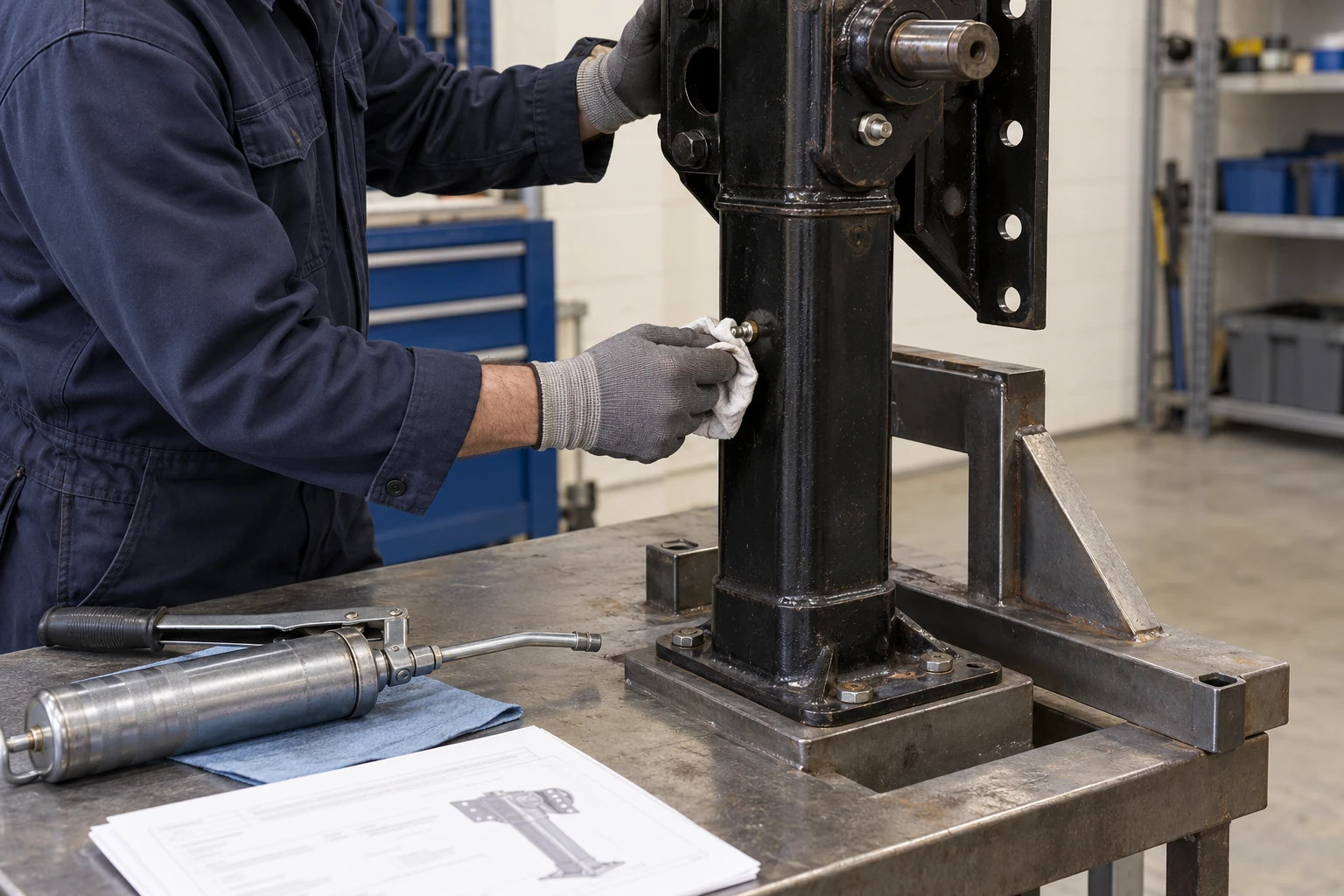
Identify the landing gear model and its lubrication requirements. Different assemblies may provide separate access for the gearbox, upper drive and screw or nut system. Grease at one visible fitting does not establish that every internal working surface has received lubricant.
For the person carrying out the maintenance, the sequence should be based on the applicable manual:
- Secure and support the trailer as required, with the landing gear unloaded where the procedure specifies it.
- Clean the access points and identify the specified lubricant, application points and leg position.
- Inspect fittings, plugs and surrounding areas for damage or contamination.
- Apply the specified amount using the prescribed method, without forcing grease through a blocked point.
- Distribute the lubricant by the permitted operating cycle, then assess movement and restore covers or plugs.
Do not substitute a fixed number of grease-gun pumps from another brand's manual. Pump output, access arrangements and internal designs differ. An exposed leg surface that looks greased also says little about the condition of a hidden screw or bearing.
BPW's instructions distinguish transmission lubrication from spindle and spindle-nut lubrication and provide a product-specific service schedule. This illustrates why a generic instruction to “grease the landing gear” can be incomplete. Use the BPW installation and operating manual for the equipment it covers, and the corresponding instructions for other makes.
After servicing, compare the result with the original symptom. If general resistance improves but a sharp catch remains at the same point, the maintenance has not resolved the whole fault. A bent leg or damaged drive component still requires its own repair decision.
Cold weather changes the investigation
If the problem appears primarily in low temperatures, record the temperature range and whether the same assembly operates normally in milder conditions. Ask whether the installed lubricant is suitable for the service environment.
JOST's winter hard-cranking bulletin addresses cold-related effort and lubricant selection for specified JOST series. Its grease compatibility statements should not be transferred to an unknown assembly. Confirm the correct lubricant for the actual product rather than mixing greases or applying heat as an improvised cure.
Cold-related resistance does not excuse visible damage, slipping engagement or a sudden jam. Those observations still need separate attention.
How to raise trailer landing gear after coupling
Here, raising the landing gear means retracting the feet for travel. It does not mean using the legs to raise the trailer front.
Complete and verify the coupling using the applicable vehicle and coupling instructions. Establish that the tractor is carrying the trailer front as intended before assuming that the landing gear can be retracted without lifting load.
Use low gear for the load-transfer portion of retraction where the equipment instructions require it. Once the feet are clear and the mechanism is unloaded, select high gear through the prescribed procedure for quicker remaining travel. Finish at the specified retracted position and secure the handle; do not repeatedly force the mechanism against its end stop.
If winding remains abnormally heavy with the feet clear of the ground, stop comparing the problem with normal loaded lifting effort. Record whether one or both legs are affected, the selected gear and the position where resistance occurs, then arrange inspection.
“It eventually came up” is not a sufficient repair result if it required unusual force, repeated loss of engagement or manipulation of the vehicle. Those details should remain on the defect report.
How to lower landing gear on trailer equipment before uncoupling
Lowering the landing gear means extending the feet toward the support surface. The initial movement can be relatively easy because the feet are not yet carrying the trailer front load.
Confirm a suitable parking position and both support surfaces. Extend according to the model's procedure, selecting low gear before the load-bearing phase as required. Watch for unequal contact, sinking or an assembly that starts to lean as weight transfers.
Follow the prescribed uncoupling sequence and verify support before completing tractor separation. Do not use a universal number of additional handle turns: manufacturers' procedures and equipment configurations differ. Nor should excessive winding be used to compensate for a poor surface or to leave the trailer at an arbitrary height.
An increasing but smooth effort as the mechanism begins supporting weight can reflect the changing task. A sudden catch, unstable support, pronounced asymmetry or a new extreme effort is a reason to stop and investigate the condition rather than continue winding.
Choosing the right semi trailer landing gear repair
The appropriate repair follows the confirmed fault. Start with whether the problem is an operating condition, an external installation issue or damage within the mechanism.
| Confirmed finding | Appropriate response | What must be checked afterward? |
|---|---|---|
| Wrong gear for the operating stage; equipment otherwise sound | Correct the operating method | Normal movement and effort in the correct gear |
| Unsuitable support surface or incorrect coupling height | Correct the support or coupling condition through the approved procedure | Stable support and the intended load transfer |
| Selector or handle interference | Repair the affected operating arrangement | Full engagement and reliable retention |
| Deficient lubrication without identified structural damage | Carry out the specified maintenance | Smooth movement and reassessment of the original complaint |
| Mounting, leg or cross-shaft alignment outside specification | Correct the installation in a properly supported workshop setup | Coordinated travel without binding |
| Damaged screw, bearing, drive or leg structure | Repair or replace components according to the service design | Both unloaded operation and the applicable approved working-load verification |
On a narrow screen, scroll the table horizontally.
Replacement may be preferable when structural damage, extensive wear or multiple defects make a reliable component repair impractical. A capacity label alone does not establish replacement compatibility. Mounting geometry, bracing, leg height range, cross shaft, operating arrangement and the approved rating basis must match the application.
After a repair, test the actual complaint rather than merely confirming that the handle rotates. If it previously failed only under load, an unloaded movement check is one stage of verification, not the whole acceptance test. Use the manufacturer's approved test conditions; an arbitrary heavy load is not an appropriate trial.
Three examples of how the diagnosis changes
Easy handle, slow feet. The feet are travelling without carrying the trailer front, but each revolution produces little movement. Confirming low gear explains the slow travel. If the permitted shift to high gear produces the expected faster movement with stable engagement, the observation supports a normal gear-selection explanation.
Heavy at ground contact, easier after correct coupling. Effort increases as the supports take weight and falls after the tractor takes the front load. Check low-gear selection and the support conditions. If the change matches normal behaviour under comparable loads, it may be expected. If the loaded effort is newly excessive, investigate further for a load-sensitive mechanical fault.
A catch at the same extension, even unloaded. Suitable support and correct engagement do not remove the repeatable tight point. That pattern makes an internal or alignment-related inspection more useful than another attempt to alter coupling height. The precise location of the catch helps the workshop assess the mechanism without repeatedly forcing it through the obstruction.
These are illustrative comparisons, not diagnoses of any specific trailer. Each links an observation to the next useful check.
Frequently asked questions
Why is low gear still hard to crank?
Low gear increases mechanical advantage; it does not eliminate load or friction. Check the actual supported load, ground contact and full engagement. A significant change from the assembly's normal behaviour can indicate binding or wear, including a component that becomes difficult only under load.
Does trailer landing gear not working always mean the gearbox has failed?
No. An incomplete operating connection, selector problem or interrupted drive can prevent movement. A leg or installation can also bind. Record whether the handle is immovable, slips or turns freely without moving the legs; those are different observations.
Is slow retraction a sign that the legs are overloaded?
Not by itself. Low gear gives slow travel even when the feet are clear of the ground. Check whether the mechanism is actually carrying trailer load, which gear is engaged and whether movement is smooth and coordinated.
Should the two legs carry exactly equal weight?
Do not assume that they do. Ground levels, installation and the load position influence the reactions. Both supports need suitable contact within the approved arrangement. Unequal movement or visible distortion requires investigation rather than an assumption that the system will share the load equally.
Can grease fix a bent leg or a slipping drive?
Lubrication cannot straighten a damaged component or replace a failed mechanical connection. It may reduce friction elsewhere while leaving the important fault unresolved. Reassess the original symptom after maintenance.
What should a driver put on the defect report?
Include the selected gear, coupling state, whether the feet were loaded, direction of movement, ground condition and the point where resistance changed. Add visible damage, noise, uneven travel and relevant recent work. A report that says “stiff in low gear with feet clear, catches at the same extension” gives the workshop a much better starting point than “hard to crank.”
Boat Trailer LED Lights Work Until They Get Wet: How to Diagnose Water-Related Electrical Failures
Related Article