Winch Strap vs. Steel Cable: Which Should You Specify for a Boat Trailer?
In this guide
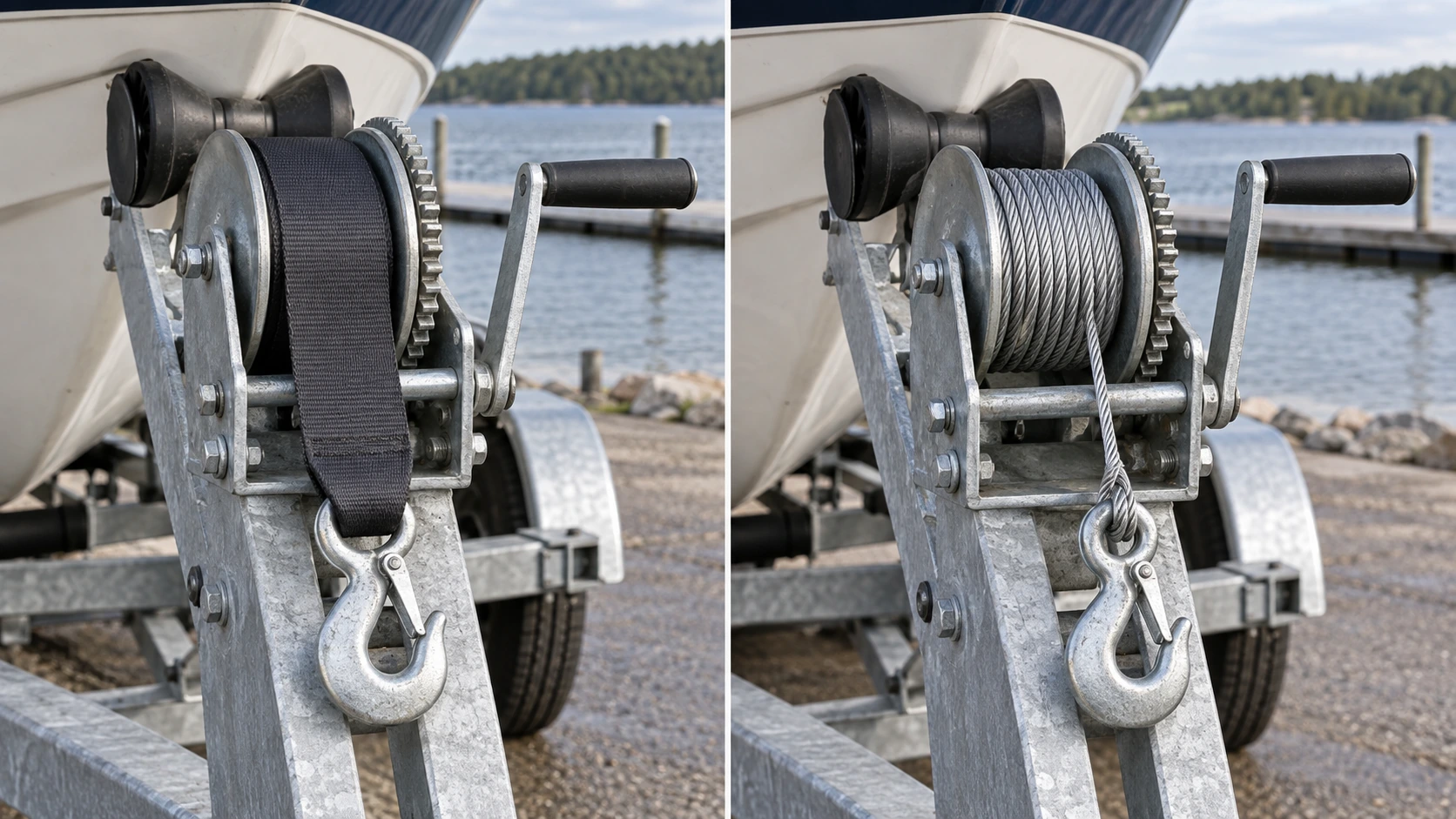
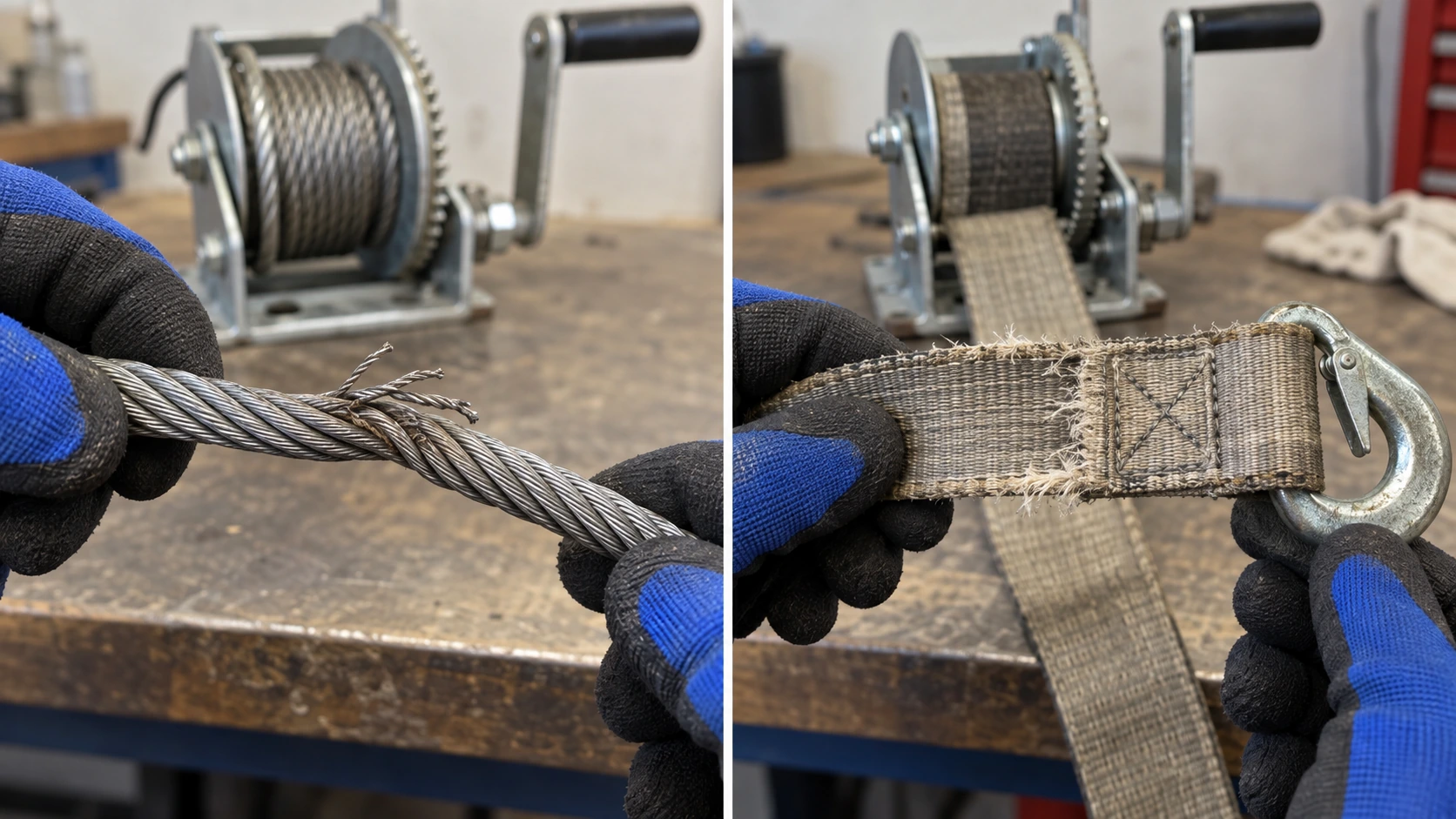
A boat owner replacing a worn winch line can face what looks like a simple purchasing decision: Should I buy another steel cable, or switch to a web strap? In practice, that question often leads to another one: Will the new pulling medium actually fit the winch already on the trailer? Consider an older boat trailer with a visibly worn and frayed steel winch cable. Its owner wants a belt-style strap system but is unsure which strap to buy or whether the existing winch should also be replaced. This is an illustrative replacement scenario, not a verified individual case.
A June 2025 r/boating post titled ‘New winch strap’ raises the other side of this compatibility question: the replacement was described as only a few inches longer than the old strap. A thicker replacement can also create excessive buildup and hardware contact; that mechanism is discussed here as a compatibility risk, not as independently verified evidence from the post. [6] Both situations point to the same purchasing rule: A replacement winch line must match the winch, not merely the boat.
If the required rated line pull has already been established, selecting between steel cable and web strap should therefore focus on six questions: Does the winch approve that line type? Does the drum have enough width and capacity? Is the length appropriate? Does the line attach correctly to the drum? Does the hook fit the bow eye? And can the line be routed and inspected properly in the intended marine environment? Only after those questions are answered does “strap vs. cable” become a useful choice.
Compatibility guidance, not conversion approval. Follow the exact model’s approved line, anchoring method, winding direction, retained wraps and inspection instructions.
Start With the Existing Winch
The most common mistake is beginning the search with a generic replacement part. A buyer sees a worn 2-inch strap and orders another 2-inch strap. Or sees a steel cable and assumes any cable with a similar diameter will work. That skips the most important first step: identify what the existing winch is designed and approved to use. Some hand winches can accept either steel cable or web strap. Others use different drums, attachment hardware or configurations and should remain with the pulling medium specified for that model.
Manufacturer documentation must establish that the exact winch accepts the proposed strap or cable. Dutton-Lainson documents both media for the DLx models covered by its instructions; this does not establish compatibility for a different winch. [3] Dutton-Lainson provides a useful manufacturer example. Its current DLx pulling-winch instructions specify separate attachment methods for cable/rope and nylon strap. For the models covered by that manual, a strap uses a sewn loop retained by a defined bolt-and-locknut arrangement through the reel side plates. The existence of those instructions establishes compatibility for those particular winches—it does not mean the same conversion method applies to every hand winch.
That creates the first selection gate:
| Existing winch condition | Appropriate next step |
|---|---|
| Manufacturer specifies cable only | Replace with the approved cable specification, or change to a strap-compatible winch |
| Manufacturer specifies strap only | Replace with an approved strap |
| Manufacturer explicitly permits both | Compare drum capacity, attachment and application requirements before changing medium |
| Winch model cannot be identified | Do not assume compatibility; obtain dimensions and manufacturer confirmation or replace the assembly |
| Drum or attachment hardware is damaged | Treat it as a winch-replacement problem, not simply a line-replacement problem |
The question is therefore not: “Can a strap physically wind onto this drum?” It is: “Is this winch designed to operate with that strap configuration?”
Same Capacity, Different Line Configurations
GOODIN's current 2,000 lb manual winch family provides a useful product-level comparison. The GD-C2000 is specified as a cable version with:
| Specification | GD-C2000 Cable Version |
|---|---|
| Rated capacity | 2,000 lb |
| Breaking force | 3,000 lb |
| Pulling medium | Steel cable |
| Published cable size | 4.8 mm × 10 m |
| Gear ratios | 4:1 / 8:1 |
| Operation | Two-way / two-speed |
Its related GD-S2000 strap configuration occupies the same 2,000 lb rated class and uses the same published 4:1 / 8:1 gearing, but changes the pulling medium to a 50 mm-wide, 8 m web strap. GOODIN's current product data identifies the strap as approximately 1.2 mm × 50 mm × 8 m. The same distinction exists in GOODIN's 1,200 lb family. GD-C1200 uses a 4.5 mm × 8 m cable, while GD-S1200 uses a 50 mm × 8 m web strap within the same 1,200 lb rated class and 4:1 gearing.
This comparison is useful because capacity is not changing. The pulling-medium configuration is. That means a buyer who has already decided that a 2,000 lb, two-speed winch is appropriate still has several separate specifications to determine:
- cable or strap;
- line dimensions;
- line length;
- drum geometry;
- attachment method;
- hook arrangement;
- marine exposure;
- inspection practice.
The pulling medium is therefore not an accessory chosen after the winch. It is part of the winch specification. These are separately published factory configurations, not authorization to convert GD-C2000 into GD-S2000 or GD-C1200 into GD-S1200. Obtain model-specific conversion approval, required parts and instructions before changing medium. [1] [2]
Strap vs. Cable: The Decision Is Mainly About Compatibility and Use
Neither steel cable nor web strap is automatically the correct choice for every boat trailer. Their differences matter because they interact differently with the drum, environment and inspection process.
| Selection factor | Web Strap | Steel Cable |
|---|---|---|
| Drum space | Flat material can build up quickly depending on width and thickness | Permitted length depends on diameter, drum geometry and packing; some cable variants offer greater reach |
| Typical replacement checks | Width, thickness, length, sewn loop/attachment, hook | Diameter, construction, length, drum attachment, hook |
| Common visible damage | Cuts, edge wear, abrasion, damaged stitching, weather/UV deterioration | Broken wires, kinks, crushing, flattening, corrosion |
| Handling | Broad, flat surface is generally easier to handle | Broken wires can create sharp projections; appropriate handling protection is important |
| Abrasion geometry | Sensitive to edge rubbing and local cutting | Must avoid kinks, crushing and damaging bends |
| Drum winding | Must remain flat and aligned; excessive thickness can overfill drum | Must wind without cross-laying, kinking or crushing |
| Length potential | Drum capacity may limit long, thick straps | Compatible drums can often carry greater line length |
| Marine inspection focus | Webbing, stitching, hook and attachment point | Wire condition, corrosion, deformation, hook and attachment |
GOODIN's current product information makes the inspection distinction clearly: its cable configurations require attention to broken wires, kinks, crushing and corrosion, while strap configurations require checks for cuts, edge abrasion, weather damage and deterioration around stitching. That does not make either one maintenance-free. It means the failure indicators are different. [1]
Width, Thickness, Length and Drum Capacity
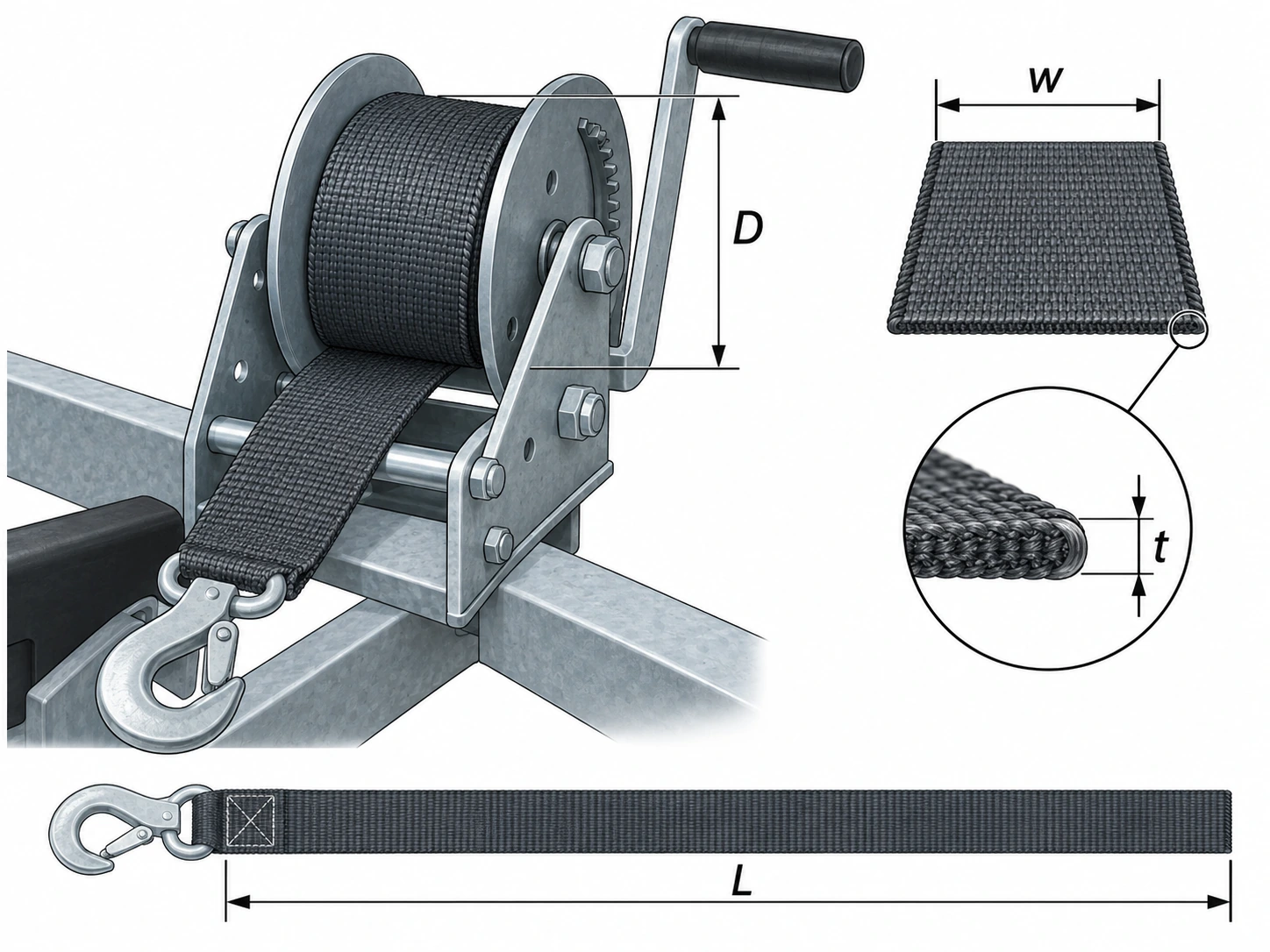
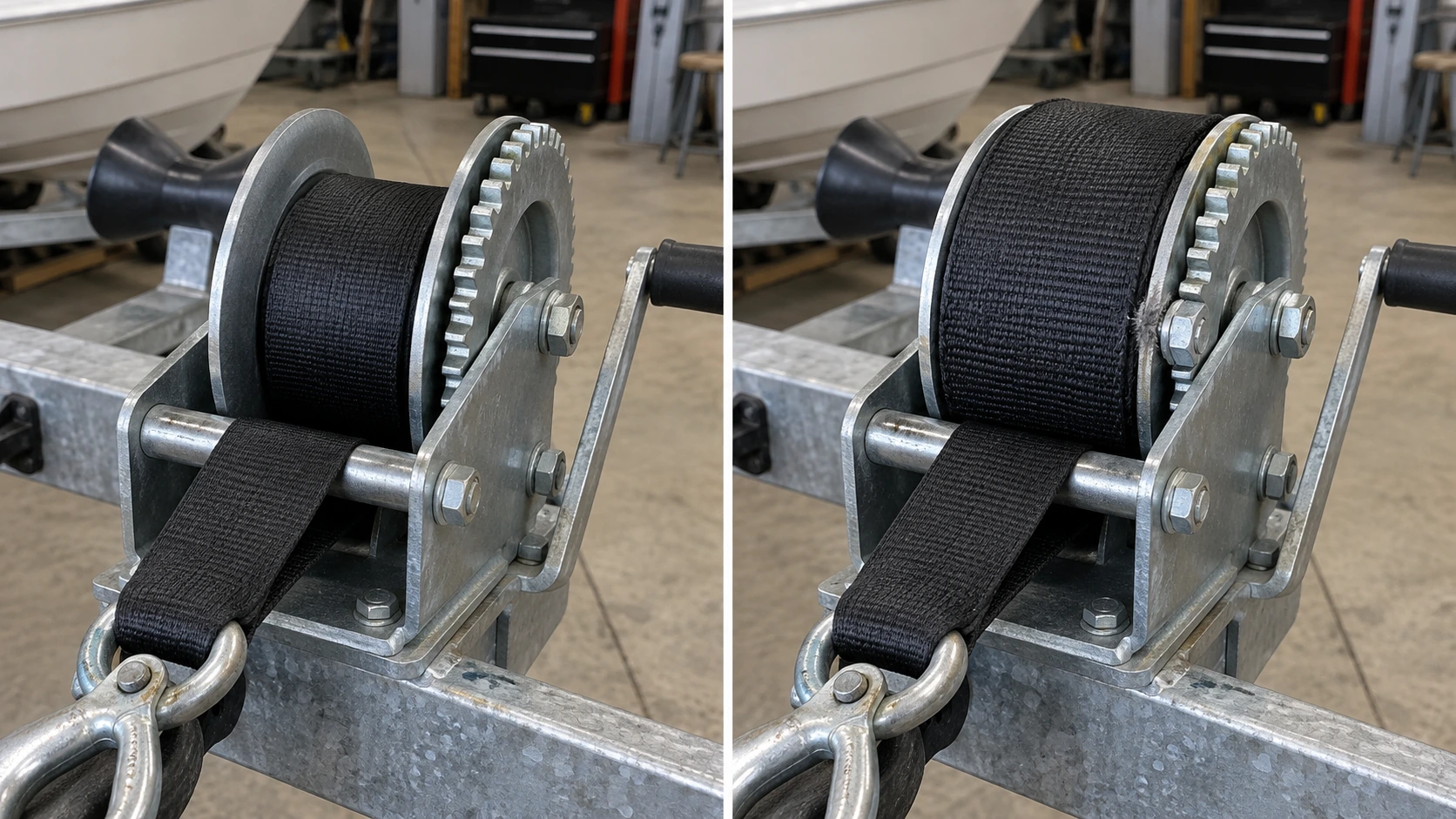
A common replacement-selection problem is focusing on only one strap dimension: width. A winch drum appears to accept a 2-inch strap, so the buyer orders another 2-inch strap. But a strap has at least three important physical dimensions: width × thickness × length. Together, they determine how much material occupies the drum. A hypothetical overfill scenario shows the consequence: a replacement strap thicker near its drum end can create excessive buildup. Changing its attachment does not necessarily solve the volume problem. If the wound package exceeds the usable envelope and rubs a nearby bolt, new abrasion can develop. This illustrates a failure mechanism, not an approved attachment change.
This is a critical Product Selection insight: Two straps with the same width and similar length can require different drum capacity if their thicknesses differ.
That means “2-inch replacement strap” is not a complete specification. For an OEM or replacement purchase, record: Width: ______ Nominal thickness: ______ Length: ______ End attachment: ______ Hook: ______ Required working/rated strength: ______ Maximum permitted wound diameter or manufacturer drum capacity: ______ If one of those fields is unknown, the buyer does not yet know whether the replacement is truly compatible.
Length Is Not a “More Is Better” Specification
A longer pulling medium sounds useful because it can reach farther down a trailer. But line length occupies drum volume. That creates two practical limits. First, the line has to fit on the drum without interfering with:
- frame members;
- mounting bolts;
- gear components;
- ratchet hardware;
- covers;
- or adjacent structure.
Second, additional layers increase the effective drum radius. As established in the previous Product Selection article, line pull changes as material accumulates on the drum. A replacement line that forces the winch to operate with a much fuller drum can therefore change both packaging and pulling conditions. GOODIN itself illustrates the length difference within a common capacity class: GD-C2000 is published with 10 m of 4.8 mm cable, while GD-S2000 uses an 8 m strap. The shorter strap specification should not be interpreted as lower winch capacity—the two configurations share the same published 2,000 lb rated class.
The difference shows why line length and rated capacity are separate parameters.
Measure the Required Line Length From the Trailer
For replacement selection, determine the longest real payout needed between the winch drum and bow eye during normal retrieval. That depends on:
- winch-stand position;
- boat position when retrieval begins;
- launch depth;
- trailer length;
- roller or bunk geometry;
- and normal operating practice.
Then compare that requirement with the manufacturer's permitted line size and drum capacity. Do not specify 10 m merely because the old winch contained 10 m. And do not shorten the line without confirming that it still reaches the bow eye under the intended launch conditions. Required usable payout must also leave the manufacturer-specified minimum wraps on the drum. Do not assume a generic wrap count, cut off a sewn end or shorten an approved line to solve overfill. [3]
The Attachment Is a Compatibility Gate
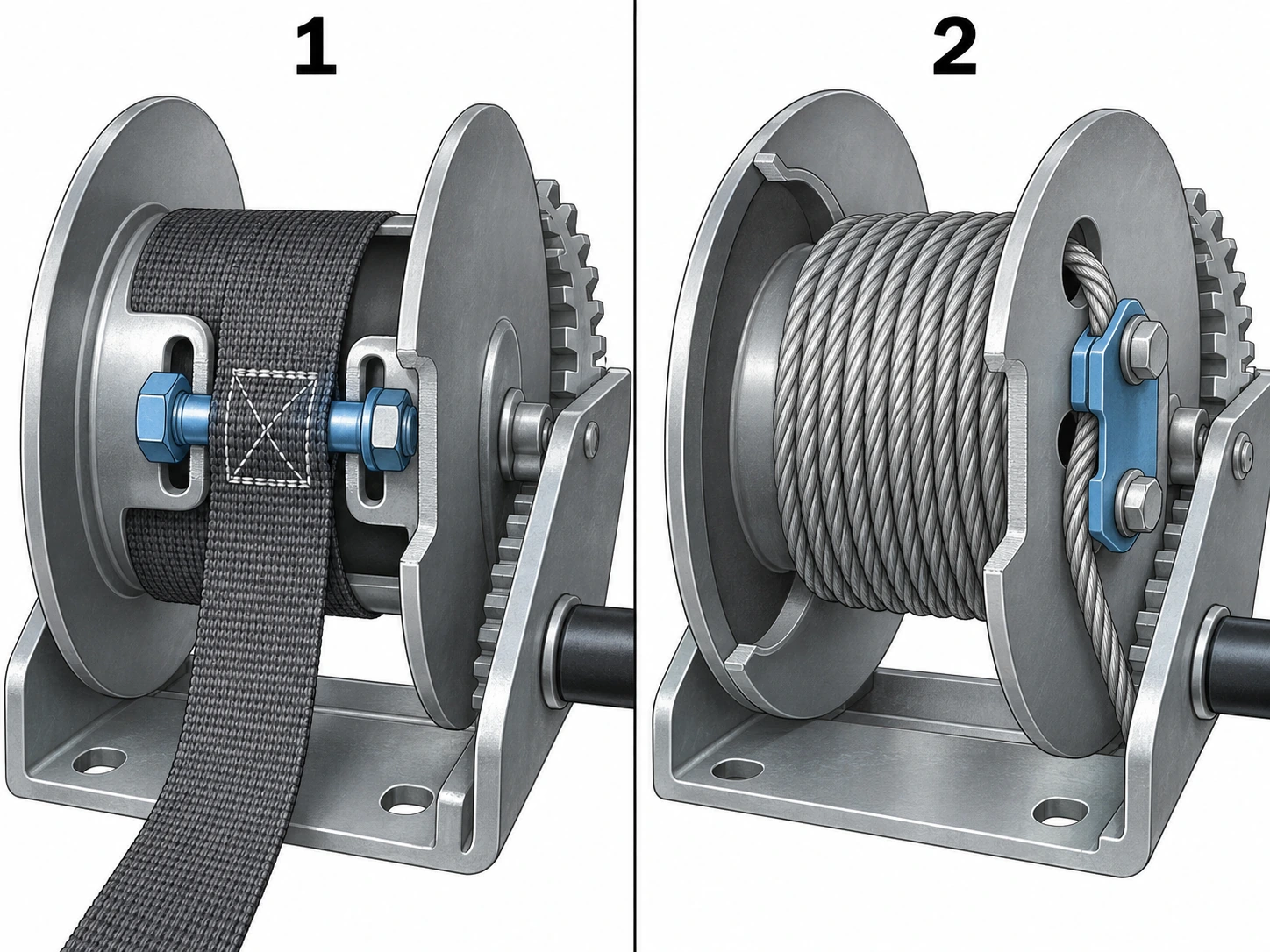
A replacement strap or cable has to connect to the drum before it can pull anything. Different winches accomplish this in different ways. A strap may use:
- a sewn loop around a retaining bolt;
- a dedicated drum bolt;
- another manufacturer-designed retention system.
Cable may use:
- a cable clamp;
- a hole or slot through the drum;
- specific retaining hardware;
- or another manufacturer-defined attachment.
Dutton-Lainson's DLx instructions illustrate why this detail matters. On the covered models, the manufacturer specifies a dedicated bolt arrangement for a nylon strap and separate illustrated cable attachment methods. A rope- or cable-oriented drum may lack the strap attachment provided on a strap-compatible model. The DLx manual's separate retention details show why buying a strap does not itself create a compatible assembly. If the required approved anchor does not exist, choose an approved line or a strap-compatible winch. [3]
This gives buyers a clear rejection condition: If the existing drum lacks an approved way to anchor the desired pulling medium, do not improvise an attachment simply because the material can be wrapped around the drum.
A bolt through whatever hole happens to be available is not automatically equivalent to the manufacturer's attachment system. Attachment orientation and winding direction must also follow the exact manual; do not reverse the line exit merely to gain clearance. Dutton-Lainson specifies different orientations for different models. [5] [3]
Replace the Line—or the Complete Winch?
A line-only replacement makes sense when the winch itself remains suitable and the new line matches its approved configuration. The following conditions should all be satisfied:
| Check | Line-only replacement can proceed when… |
|---|---|
| Winch capacity | Existing rated capacity still suits the actual loading requirement |
| Winch condition | Frame, drum, gears, pawl/ratchet and shaft remain serviceable |
| Medium approval | Manufacturer permits the proposed cable or strap |
| Drum width | New line fits between the flanges correctly |
| Drum capacity | Required width/thickness/diameter and length fit without overfilling |
| Attachment | Correct manufacturer-approved anchoring method exists |
| Hook | Hook size, latch and load rating suit the bow eye and application |
| Routing | Line exits the drum without rubbing brackets, bolt heads or sharp edges |
| Reach | Line is long enough for the real retrieval geometry |
| Rating | Replacement line and hook meet the manufacturer's required specification |
If all of these conditions pass, replacing only the pulling medium may be entirely reasonable. If several cannot be confirmed, replacing the complete winch may be more appropriate.
When Should the Complete Winch Be Replaced?
A cable-to-strap conversion becomes a winch-selection problem rather than a replacement-line problem when the existing hardware cannot support the desired configuration. This is especially likely in five situations.
1. The Existing Winch Is Not Approved for the New Medium
This is the clearest rejection condition. If the manual or manufacturer specifies cable only, a strap should not be assumed compatible. Follow the exact manufacturer's approved configuration. Permission documented for a DLx model cannot be transferred to an unidentified winch. [3]
2. The Drum Cannot Store the Required Strap
A new strap may be too:
- thick;
- long;
- wide;
- or bulky at the sewn loop.
If the full strap cannot wind without extending beyond the intended drum envelope, shortening it arbitrarily or forcing it onto the drum is not a sound compatibility solution. The overfill scenario above illustrates this failure mode; a similar nominal width does not establish usable drum capacity.
3. The Attachment Hardware Is Wrong
If the existing winch has no approved strap anchor—or the required bolt, slot or retaining arrangement cannot be installed according to manufacturer documentation—the conversion should stop. Do not drill new drum holes or substitute arbitrary fasteners without approval.
4. The Winch Is Already Mechanically Deteriorated
Replacing the cable makes little sense if inspection also finds:
- deformed drum flanges;
- damaged ratchet teeth;
- poor pawl engagement;
- excessive shaft movement;
- cracked or distorted frame components;
- severe corrosion;
- damaged mounting holes.
The older-trailer scenario raises this broader question: with an old winch, damaged steel cable and inconvenient operating hardware, replacing the complete winch can make more sense than rebuilding the pulling-medium system around aging hardware.
5. The Required New Configuration Changes More Than the Line
Suppose the current winch is a lower-capacity single-speed cable model, but the revised application requires:
- higher rated line pull;
- two-speed gearing;
- a different line length;
- web strap;
- different mounting geometry.
At that point, “convert cable to strap” is no longer the real purchasing task. The correct task is to specify a new winch.
Specify the Strap or Cable Completely
Once a strap-compatible winch has been confirmed, the buyer should specify the replacement strap from the complete system rather than from color or nominal width.
Width
The strap must fit within the usable drum width and remain aligned during winding. GOODIN's current strap configurations use 50 mm webbing in both its 1,200 lb and 2,000 lb families. That does not mean 50 mm is universal. Use the winch manufacturer's specified width.
Thickness
Thickness affects how quickly wound diameter increases. This is particularly important when replacing an older strap with a modern product that may use different webbing construction. A small increase per layer becomes substantial after many wraps. The overfill scenario is a practical warning against ignoring this dimension.
Length
The strap has to reach the boat while remaining within the winch's approved drum capacity. A 2,000 lb GOODIN strap configuration uses 8 m rather than the 10 m cable supplied with the related cable model, again demonstrating that the two media should not automatically be specified at identical lengths.
Strength Rating
The strap must satisfy the winch manufacturer's line-strength requirement. Do not substitute a strap's ultimate breaking number for the winch's rated line pull. Likewise, do not assume that buying an extremely high-breaking-strength strap is automatically better if its increased thickness prevents correct drum storage. Dutton-Lainson, for example, specifies a minimum winch-line breaking strength relative to winch rating for the DLx products covered by its instructions. That rule belongs to those products and should not be copied blindly to another manufacturer's winch; it demonstrates why the winch's own line specification matters.
Drum-End Construction
Confirm:
- sewn loop dimensions;
- retaining-bolt size;
- loop thickness;
- bolt position;
- washer/locknut requirements;
- direction of installation.
This is often where a nominally “correct” replacement strap fails to match an older winch.
Hook
Check both strength and geometry.
The hook must:
- seat properly in the bow eye;
- allow its latch to close where one is provided;
- avoid side loading;
- remain compatible with the strap's sewn termination.
A physically oversized hook can be just as inconvenient as an undersized one if it cannot enter the bow eye correctly. [3] [4]
Steel Cable Selection: Diameter Is Only the Starting Point
Cable replacement creates its own specification set.
Diameter
The drum and attachment system should be designed for the selected cable diameter. GOODIN currently publishes:
- GD-C1200: 4.5 mm × 8 m
- GD-C2000: 4.8 mm × 10 m
These are model specifications, not universal recommendations.
Length
Cable length must satisfy the retrieval geometry without exceeding drum capacity. A cable configuration may permit greater reach than a strap configuration, but this is not a universal consequence of cable diameter versus strap width. Thickness, usable drum width, packing and the anchor also matter. The permitted length must come from the model specification.
Construction and Rating
For OEM purchasing, “4.8 mm cable” is not enough information by itself. The supplier may also need to define:
- wire-rope construction;
- material/coating;
- required breaking strength;
- hook rating;
- termination;
- replacement criteria.
GOODIN's current public GD-C2000 page identifies diameter and length but does not publicly establish every one of these construction details, making them appropriate RFQ confirmation items rather than facts to infer.
Routing
Steel cable should feed onto the drum without being forced across:
- sharp edges;
- protruding bolt threads;
- pinch points;
- excessive bends.
GOODIN specifically identifies cross-winding, kinking, broken wires, crushing and corrosion as cable inspection concerns. If the original cable has been damaged primarily because it continually rubs another trailer component, installing another cable without correcting the route simply restores the same failure condition. [1] [2]
Inspect the Medium and the Entire Line Path
Boat-trailer buyers sometimes frame the choice as: steel cable rusts; strap doesn't—therefore strap is always better for marine use. That is too simple. A steel cable can deteriorate through corrosion, damaged wires, kinking or crushing. A web strap avoids wire corrosion, but the webbing still has its own failure mechanisms:
- abrasion;
- cuts;
- edge wear;
- damaged stitching;
- contamination;
- prolonged weather and UV exposure.
Inspect exposed webbing, stitching, hook and attachment for deterioration. Inspect normally hidden sections under the manufacturer's unloaded maintenance procedure, with the boat independently secured. Do not pay out a loaded line past the required retained wraps or put hands near a moving drum. Dutton-Lainson requires inspection and replacement of worn or abnormal straps and hooks. [4] The more useful selection question is therefore: Which pulling medium can be correctly installed, inspected and replaced under this trailer's actual service conditions?
No pulling medium should be treated as permanent.
Check the Entire Line Path Before Choosing Strap
Web strap is broad and flat. That gives it a different interference profile from round steel cable. A cable might pass close to a bolt head without contacting it. A 50 mm strap may not. Before conversion, look from the drum toward the bow eye and inspect:
- winch-frame edges;
- mounting bolts;
- bow stop;
- roller brackets;
- guide surfaces;
- trailer structure.
The strap should not be forced to run across an edge or nearby fastener simply because the centerline remains aligned with the bow eye. The overfill scenario illustrates the risk: buildup can bring webbing into contact with a securing bolt and create fresh abrasion on a newly installed component. For a strap conversion, therefore, routing must be evaluated in two conditions: nearly empty drum and fullest expected drum. The path can change as drum diameter increases.
Do Not Use the Winch Line as the Boat's Only Travel Restraint
Changing from cable to strap does not change the role of the winch. The pulling medium is intended to load and position the boat using the winch system. Once the boat is secured for road travel, towing restraint should follow the trailer and boat manufacturer's prescribed securement arrangement rather than relying on the winch line alone. GOODIN's existing Application Guide already addresses the distinction between the winch strap, bow restraint and transom tie-downs, so this Product Selection article does not need to repeat that securement guidance in depth. GOODIN's current guide explicitly treats the winch and road restraints as separate functions.
For this article, the purchasing implication is simply: do not select a stronger replacement strap in an attempt to eliminate other required trailer restraints. That is a different system requirement. [3] [7]
A Practical Conversion Check
Consider an older boat trailer with the following situation:
- current hand winch remains mechanically functional;
- rated capacity is appropriate for the boat-loading requirement;
- existing steel cable is frayed and needs replacement;
- owner wants to switch to web strap;
- original winch model is known.
The correct process is not: remove cable → buy a 2-inch strap → install it. Instead:
Check 1 — Is Strap Use Approved?
Review the manufacturer's manual or current technical documentation. If the exact winch permits both cable and strap, continue. If not, select either the specified replacement cable or a new strap-compatible winch.
Check 2 — What Strap Does the Drum Accept?
Confirm: maximum width: ______ permitted thickness / replacement part: ______ maximum length: ______ Do not derive these values from drum width alone.
Check 3 — How Is It Attached?
Determine whether the drum has:
- the correct through-bolt;
- slot;
- anchor;
- spacer;
- or manufacturer-specified mounting hardware.
Check that the replacement strap's sewn-loop geometry matches it.
Check 4 — Will the Full Strap Fit?
With the boat independently secured and the line unloaded, evaluate the complete wound package under the manufacturer’s procedure. Keep hands clear of pinch points; this is not a trial pull with an unapproved line. The fully wound drum must not force the strap into:
- nearby bolts;
- frame edges;
- gears;
- covers.
Check 5 — Does the Hook Fit?
Confirm that the supplied hook actually engages the boat's bow eye correctly.
Check 6 — Inspect the Winch Before Investing in the Conversion
If gears, pawl, drum or frame are already deteriorated, replacing the complete winch may provide a cleaner and more verifiable specification. That is the point where the buyer decides whether this is truly a line replacement or a winch replacement.
GOODIN 2,000 lb Example: Same Capacity, Different Pulling-Medium Package
GOODIN's GD-C2000 and GD-S2000 make the decision particularly easy to visualize.
| Specification | GD-C2000 | GD-S2000 |
|---|---|---|
| Rated Capacity | 2,000 lb | 2,000 lb |
| Breaking Force | 3,000 lb | 3,000 lb |
| Gear Ratios | 4:1 / 8:1 | 4:1 / 8:1 |
| Operation | Two-way / two-speed | Two-way / two-speed |
| Pulling Medium | Steel cable | Web strap |
| Published Line Size | 4.8 mm × 10 m | Approx. 1.2 × 50 mm × 8 m |
| Primary Inspection Focus | Broken wires, kinks, crushing, corrosion | Cuts, edge abrasion, weathering, stitching |
| Main Replacement Question | Cable diameter/construction/attachment | Strap width/thickness/loop/drum capacity |
The important conclusion is not that one is superior. It is that GOODIN already treats them as two defined product configurations rather than one winch with an arbitrary line fitted afterward. For OEM or distributor purchasing, that is the cleaner way to specify the product as well. If customers in one market predominantly request straps, specify the strap configuration from production. If another application requires longer steel cable, specify that variant and its replacement requirements. Do not rely on downstream distributors to create unverified conversions after delivery. [1]
Turn Compatibility Into a Purchasing Specification
The final purchasing decision can be reduced to the following table.
| Specification | Existing Winch | Replacement Requirement | Supplier Confirmation Needed? |
|---|---|---|---|
| Winch model | ______ | Same existing unit / new unit | Yes if unidentified |
| Rated capacity | ______ | Must remain appropriate to application | Yes |
| Approved line type | Cable / strap / both / unknown | Cable or strap | Yes—critical |
| Drum usable width | ______ | Must accept selected line | Yes |
| Drum capacity | ______ | Must hold required full line | Yes—critical |
| Cable diameter | ______ | ______ | If cable |
| Strap width | ______ | ______ | If strap |
| Strap thickness | ______ | ______ | If strap |
| Required line length | ______ | ______ | Yes |
| Drum attachment | ______ | Matching approved connection | Yes—critical |
| Hook type | ______ | Must fit bow eye and rating | Yes |
| Line strength specification | ______ | Manufacturer-approved value | Yes |
| Marine exposure | Fresh / salt / mixed | Suitable finish/material | Yes |
| Routing clearance | Pass / fail | No edge or hardware contact | Buyer verifies |
| Full-drum clearance | Pass / fail | No contact when wound | Buyer verifies |
| Inspection method | ______ | Cable- or strap-specific | Supplier/manual |
| Replacement part number | ______ | ______ | Preferred |
This table should be completed before purchasing a replacement line in quantity.
What an OEM or Distributor Should Put in the RFQ
For B2B sourcing, avoid specifications such as: “2,000 lb winch with strap.” That leaves too many unanswered variables. A useful RFQ should establish:
| RFQ Field | Example of the information required |
|---|---|
| Winch rated capacity | 2,000 lb rated operating capacity |
| Application | Boat-trailer retrieval |
| Pulling medium | Web strap or steel cable |
| Strap specification | Width, thickness, length, construction |
| Cable specification | Diameter, length, construction/coating |
| Line rating | Required working/breaking specification per winch design |
| Drum compatibility | Approved line volume and attachment arrangement |
| Drum-end connection | Bolt / loop / cable clamp / manufacturer design |
| Hook | Type, latch, opening dimensions, rating |
| Gear ratio | Already established from loading requirements |
| Winch mounting | Base drawing and fastener requirement |
| Line exit | Direction and expected bow-eye alignment |
| Environment | Freshwater / saltwater / mixed |
| Inspection requirement | Defined rejection criteria |
| Replacement availability | Spare strap/cable part number and interchangeability |
| Production testing | Required product and line verification documentation |
For a conversion project, include photographs of the existing drum and attachment arrangement rather than asking only: “Can I replace cable with strap?” That allows the supplier to identify whether the proposed change is actually compatible.
GOODIN View: Choose the Pulling Medium as Part of the Winch, Not After It
The most useful purchasing distinction is not: strap is better than cable or: cable is stronger than strap. Those statements are too broad to complete a real product-selection task. Instead, determine which complete configuration satisfies the application. A buyer who prefers web strap should confirm: Does this winch have the correct drum capacity, strap anchor, width clearance, required length and approved strap specification?
A buyer who prefers steel cable should confirm: Does this winch specify the required cable diameter, construction, length, drum attachment and marine inspection requirements?
If the existing winch passes those checks, the buyer may only need a replacement pulling medium. If it does not, replacing the whole winch is often the more technically defensible solution. The two replacement situations show why this distinction matters: an aging cable system raises a conversion-versus-replacement decision, while a seemingly similar strap can become incompatible once its thickness and wound diameter are considered. GOODIN's own 1,200 lb and 2,000 lb product families reinforce the same principle by providing separate cable and strap configurations with defined line dimensions.
The resulting purchasing rule is simple: Match capacity to the loading requirement first. Then match the strap or cable to the winch drum, attachment system, required reach and inspection environment.
Do not reverse those steps. And do not assume that because a replacement line physically fits through the winch frame, it is a compatible winch line. Explore GOODIN hand winches Send the winch model, drum photographs, approved line data and replacement requirements when you contact GOODIN.
Final Selection Checklist
Before replacing a boat-trailer winch strap or steel cable, confirm:
- Is the existing winch still the correct rated capacity for the application?
- Does the manufacturer approve cable, strap or both for this exact model?
- What line dimensions does the drum accept?
- For a strap, have width, thickness and length all been verified?
- For cable, have diameter, construction and length been confirmed?
- Can the complete line fit on the drum without overfilling it?
- Does the drum have the correct manufacturer-approved end attachment?
- Will the replacement hook fit the actual bow eye correctly?
- Does the pulling medium remain clear of bolts, edges and other hardware at both low and high drum fill?
- Are the inspection criteria appropriate for the selected medium?
- Is the winch itself mechanically sound enough to justify a line-only replacement?
- If compatibility cannot be confirmed, would a purpose-built cable or strap winch provide a cleaner specification?
If those questions are answered, the buyer can make a meaningful cable-versus-strap decision. If they are not, the purchasing problem has not yet been reduced to “which replacement line should I order?” It is still a winch compatibility problem. Safety boundary: this article concerns boat-trailer loading, not personnel lifting or suspended loads. A pulling rating does not establish hoisting approval. Do not continue using a damaged line while deciding on a replacement. [3]
Sources & Further Reading
Manufacturer instructions apply only to their covered products. Separate factory cable and strap variants do not approve field conversion. The owner-post reference is a reported purchasing question, not engineering evidence. Illustrative scenarios and AI-generated images are not installation instructions.
- GOODIN — GD-C2000 — 2,000 lb Two-Speed Hand Winch with Cable
- GOODIN — GD-C1200 — 1,200 lb Hand Winch with Cable
- Dutton-Lainson — DLx Pulling Winches — Instructions (206870)
- Dutton-Lainson — 6149 Winch Strap and Hook — Specifications and Inspection
- Dutton-Lainson — Frequently Asked Questions — Cable/Strap Winding Direction
- Reddit / r/boating — New winch strap — owner-reported replacement question
- GOODIN — Boat Trailer Winch Strap Safety: Why the Winch Alone Cannot Secure the Boat
Replacing a Boat Trailer Winch: How to Match the Mount, Bow Eye and Pulling Angle
How Much Hand Winch Do You Actually Need? Choosing Line Pull and Gear Ratio for Boat Trailer Loading
Related Article