EV Trucks and Utility Trailers: What Really Determines Towing Range?
Article navigation
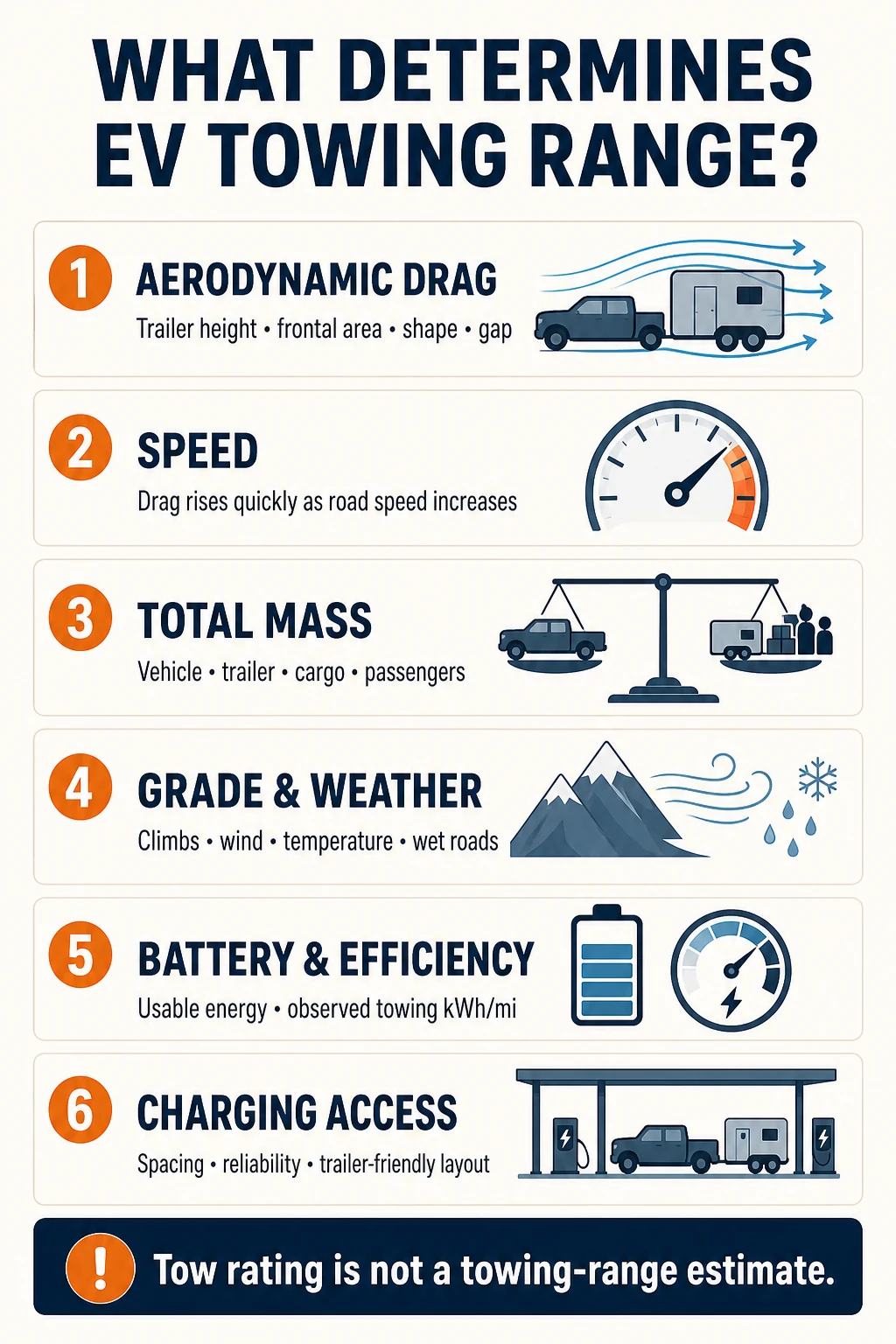
Electric pickups can tow substantial loads, but a tow rating is not a towing-range estimate. The distance a truck can cover with a utility or cargo trailer depends on a system: trailer aerodynamics, road speed, combined mass, route grade, wind, temperature, usable battery energy, observed efficiency and access to a charger that the connected combination can actually enter.
This distinction is becoming more important as fleets, contractors and recreational buyers compare EV trucks using headline range and towing figures. A reliable specification starts with the exact vehicle configuration and the actual trailer mission—not a percentage deducted from an empty-vehicle range label.
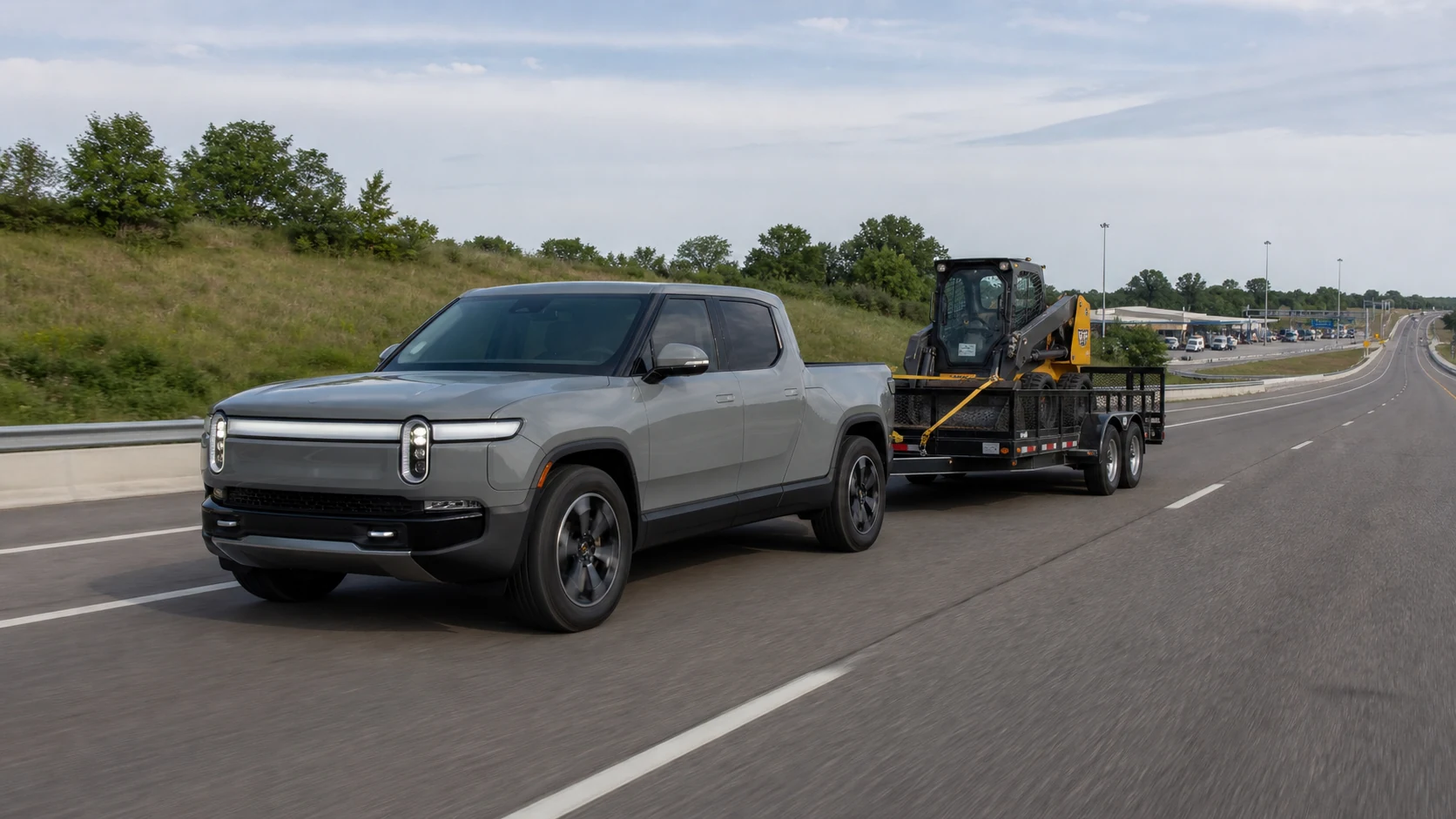
Reading the numbers correctly: the four figures above are manufacturer-published reference points for different configurations. The highest range and highest towing figure may not describe the same truck, wheel-and-tire package or operating condition. They cannot be multiplied together to calculate a loaded trip.
1. Tow Rating Is Not a Range Estimate
A maximum tow rating answers a structural and dynamic question: under defined conditions, what trailer mass may a particular vehicle configuration tow while staying within its ratings? It does not state how many miles the combination will travel between charges. Range testing, tow-rating procedures and a customer's real route examine different operating envelopes.
An empty or lightly loaded EV range figure likewise does not describe the aerodynamic wake of a tall trailer, sustained climbing, a winter headwind or charging detours. Even two trailers at the same gross mass can produce very different energy consumption if one is a low-profile open utility trailer and the other is a square-front enclosed box.
The first procurement step is therefore to separate three numbers:
- Vehicle ratings: GCWR, GVWR, axle ratings, hitch limits, payload and the configuration-specific maximum trailer rating.
- Published vehicle range: the applicable certification or manufacturer estimate for the exact vehicle configuration—not a towing result.
- Observed towing efficiency: the energy used per mile with the actual trailer, load, speed, route and weather.
2. Aerodynamic Drag Often Dominates at Highway Speed
For a combination moving at steady highway speed, aerodynamic drag rises approximately with the square of relative air speed. The power required to overcome that drag rises roughly with the cube of speed. That is why a modest increase in road speed—or an unexpected headwind—can create a disproportionate increase in energy use.
The trailer contributes frontal area, shape, exposed equipment, underbody turbulence and a large downstream wake. The gap between tow vehicle and trailer can also affect flow, but it must always preserve turning clearance, articulation and safe access. A low utility trailer carrying equipment below the tow vehicle's roofline may create less drag than a similarly weighted tall enclosed trailer, although the exact result requires measurement.
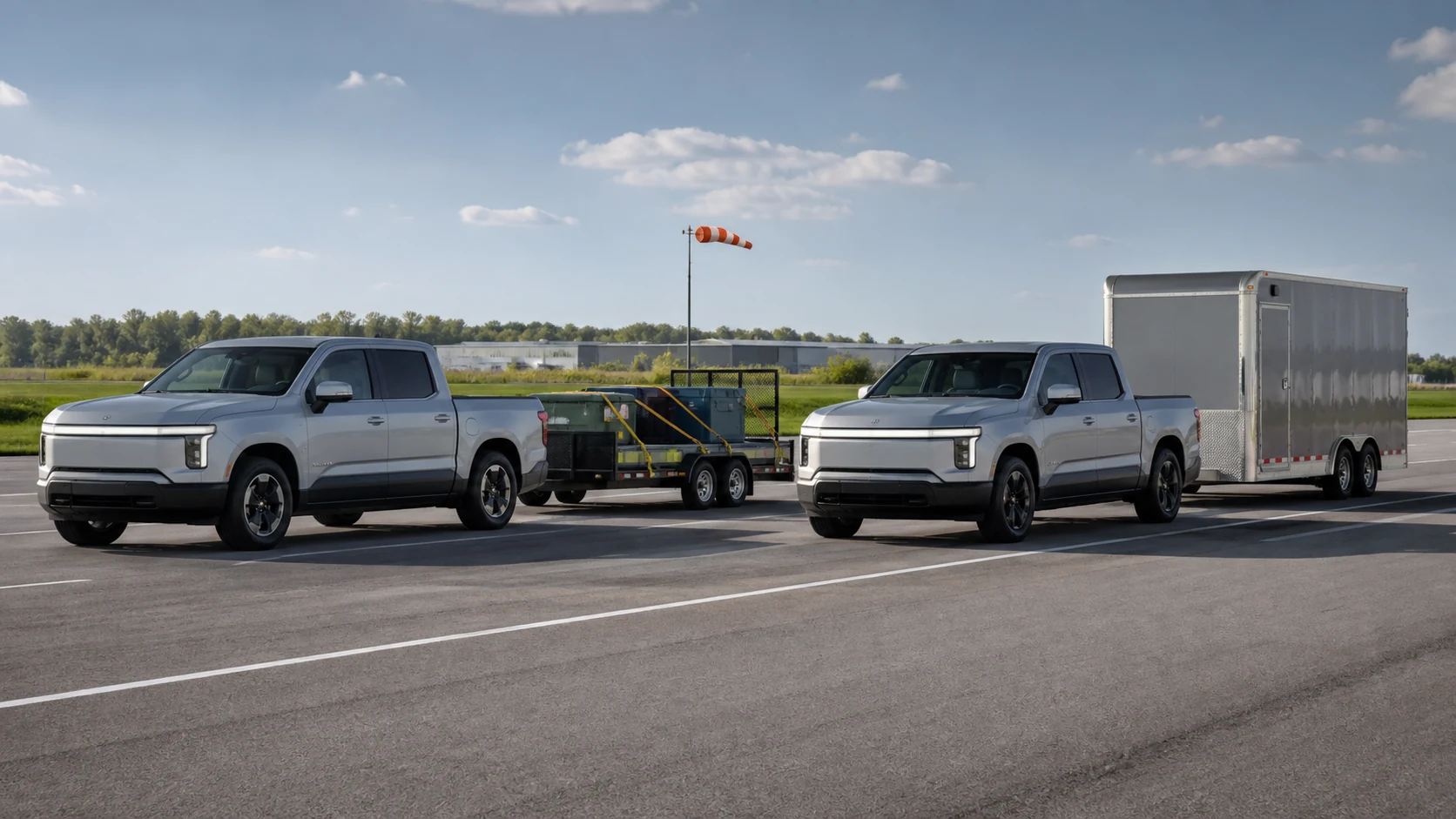
Low-profile utility trailer
Potentially exposes less frontal area when cargo stays below the tow vehicle's roofline. Open cargo still needs a secure, repeatable arrangement; loose covers or protruding equipment can disturb airflow and create safety risks.
Tall enclosed trailer
Protects cargo and supports a controlled interior, but the box height and front geometry can impose a larger aerodynamic penalty. Rounded transitions may help, but benefits depend on the whole combination.
3. Speed and Wind Change the Air the Combination Sees
The relevant input for drag is relative air speed, not the speedometer alone. A truck travelling at 65 mph into a 15 mph headwind may experience airflow closer to an 80 mph condition. A crosswind adds yaw, which can expose more side area and change stability as well as energy demand.
For range validation, test at the speed the operator will actually use. Record average moving speed, wind direction and strong gust periods. If a test loop mixes urban driving with short highway segments, it should not be used as the only basis for a long high-speed route.
Useful control variable: if a trip margin is shrinking, reducing sustained speed is often one of the fastest operational levers available. It does not change vehicle or trailer ratings, and it never replaces safe traffic flow or posted limits.
4. Mass Matters Most During Acceleration and Climbing
Combined mass affects the energy required to accelerate and climb. It also increases tire and bearing loads, and may increase rolling resistance. Regenerative braking can recover part of the energy during deceleration or descent, but conversion losses and battery power limits mean it cannot recover everything used on the climb.
Mass still has to be measured and distributed correctly even when aerodynamic drag is the dominant highway range factor. Confirm loaded trailer mass, tongue weight, tow-vehicle payload, axle loads and GCWR. Payload added to the truck—including passengers, tools, a toolbox and hitch hardware—reduces the payload available for tongue weight.
A public or certified scale gives more reliable inputs than catalogue curb weights plus estimated cargo. Weigh the loaded combination in the same state it will travel: occupants, accessories, fluids, batteries, tools and cargo included.
5. Weather, Temperature and Tires Add Variability
Cold conditions can reduce available battery energy and increase cabin-heating demand. Hot weather can add air-conditioning and battery thermal-management loads. Rain and standing water increase rolling resistance, while headwinds and crosswinds change effective airflow. These conditions may occur together, so a single fair-weather test should not become a universal range promise.
Tire pressure, construction, tread and alignment also influence energy use. Check truck and trailer tires cold, use the specified pressure for the actual load and inspect bearings and brakes for drag. Trailer brake faults or poor alignment can consume energy while creating a much more serious safety issue.
6. Plan From Usable Energy and Observed Towing Efficiency
The most useful planning input is the combination's observed towing energy use—commonly displayed as kWh/mi or mi/kWh—on a representative route. Start with energy available at departure, subtract a reserve, then divide by observed consumption. Recalculate whenever trailer shape, cargo arrangement, total mass, route, speed or weather changes materially.
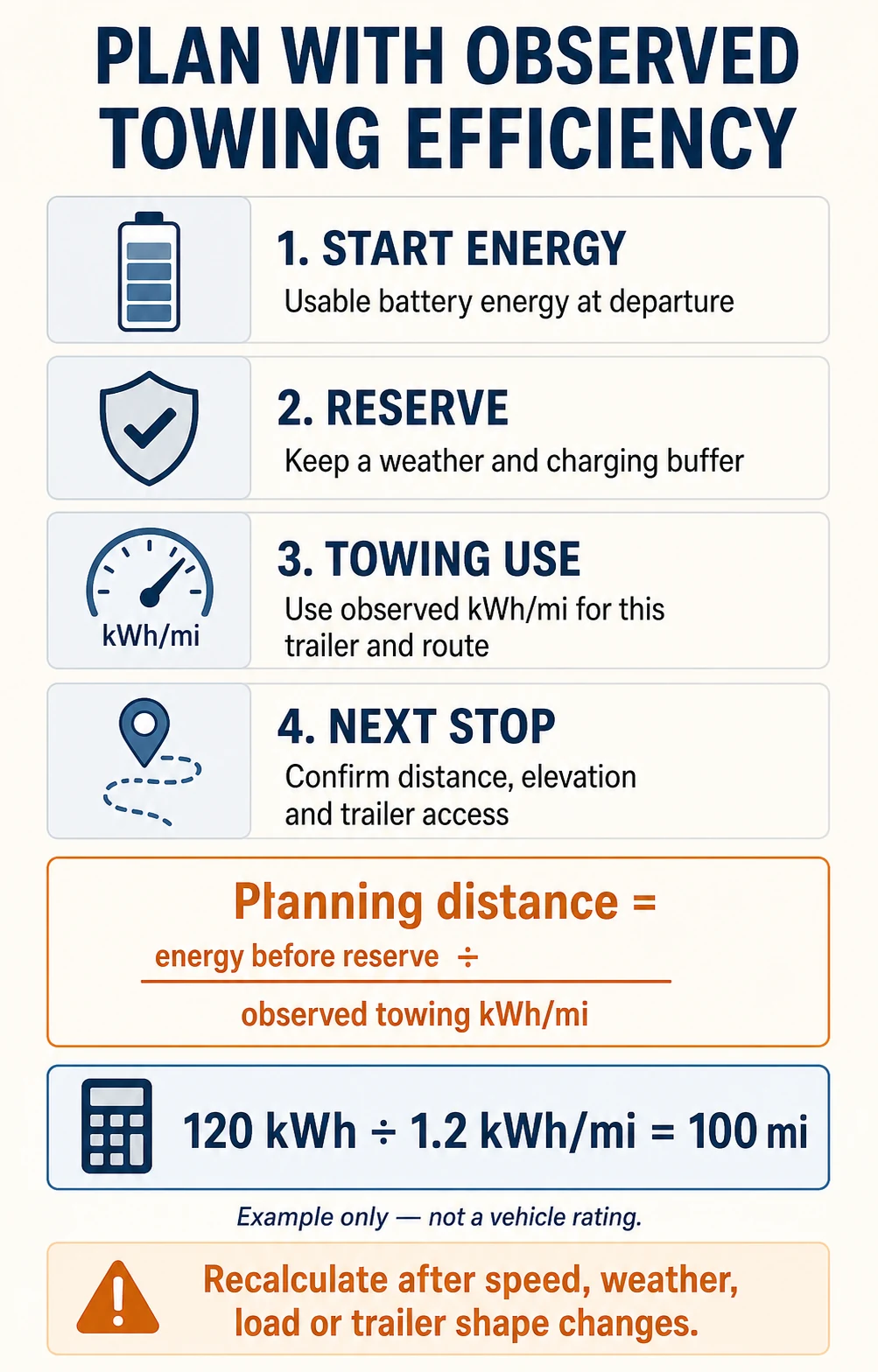
For example, 120 kWh available before the chosen reserve divided by an observed 1.2 kWh/mi equals a 100-mile planning distance. This is arithmetic, not a vehicle rating. Battery state of health, thermal conditions, elevation and charging reliability still need their own margin.
Fleets can retain these observations by trailer ID, cargo profile and route. A separate smart trailer telematics workflow may help organize trip and asset data, but sensor accuracy, cybersecurity, data ownership and system integration should be specified independently.
7. Charging Access Is Part of Usable Range
A charger pin on a map is not enough. Operators need to know whether the site is working, compatible, available and physically accessible with the trailer connected. Many passenger-car sites use short back-in bays. A long combination may need a pull-through stall, a perimeter charger or a safe place to unhitch without blocking circulation.
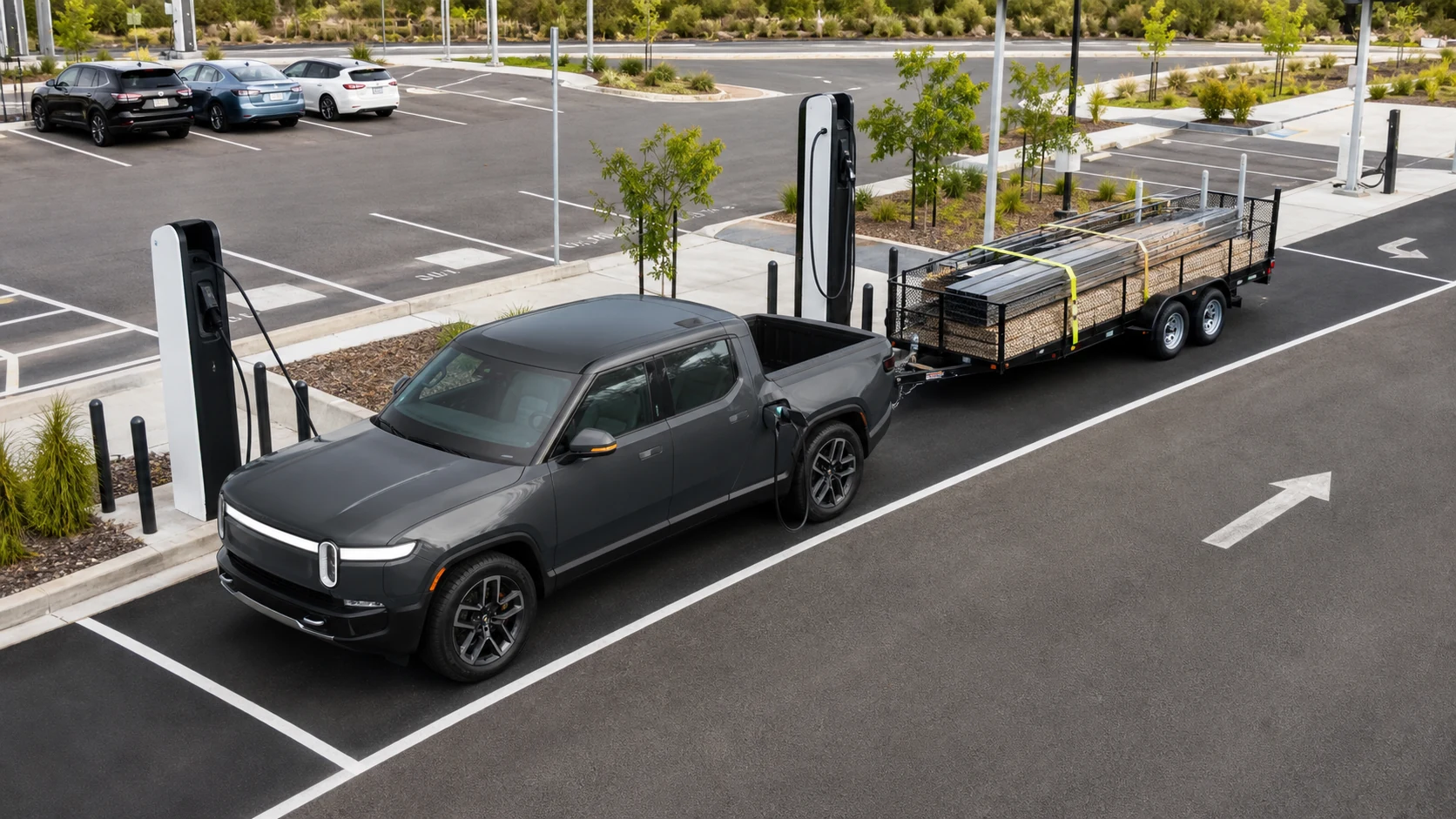
Route planning should record the distance between suitable sites, site layout, connector and power compatibility, operating hours, recent reliability information, elevation and an alternate. Photos and user reports can help, but site conditions change; confirm critical stops close to departure.
8. What Trailer Buyers Can Specify
Trailer design cannot eliminate the energy cost of towing, but it can make the mission more predictable. The goal is to control geometry, mechanical drag, load placement and repeatability while staying within every rating.
| Variable | Main effect | What to record | Specification or operating action |
|---|---|---|---|
| Trailer height and front shape | Aerodynamic drag | Overall height, width, frontal transitions, exposed cargo | Keep the profile mission-appropriate; evaluate rounded transitions and secure covers without compromising clearance. |
| Road speed and wind | Relative air speed | Average moving speed, wind direction, gusts | Validate at real operating speed; keep a weather margin. |
| Combined mass | Acceleration, grade and rolling losses | Loaded trailer, tongue, axle and combination weights | Use scale data and stay within GVWR, GCWR, GAWR, hitch and tire limits. |
| Tires, bearings and alignment | Rolling resistance and safety | Cold pressure, temperature, wear, service history | Specify load-appropriate tires and maintain brakes, bearings and alignment. |
| Battery and observed efficiency | Available trip energy | Departure energy, reserve, kWh/mi, temperature | Plan from representative towing observations, not empty range. |
| Charging layout | Route feasibility and dwell time | Stall length, cable reach, turning path, alternate site | Prefer verified pull-through or perimeter access; define a safe unhitch plan only where permitted. |
Aerodynamic accessories should be treated as engineering changes, not decorative promises. Request test conditions, baseline configuration and quantified results. Any fairing, cover or storage system must preserve lighting visibility, cooling, hitch articulation, inspection access and cargo securement.
9. A Repeatable Towing-Range Planning Workflow
- Lock the vehicle configuration. Record battery, drive unit, wheels, tires, tow package, payload label and every applicable rating.
- Define the trailer mission. Record body type, dimensions, coupler, axle ratings, tires, brakes, cargo profile and normal load states.
- Weigh the loaded combination. Confirm trailer mass, tongue weight, truck axles and total combination weight.
- Inspect mechanical losses. Check tire pressure, bearing condition, alignment, brake release, cargo securement, lights, coupler, chains and breakaway system.
- Run a representative route. Include the expected highway speed, grade and a return leg so wind and elevation effects are visible.
- Record observed energy use. Capture temperature, wind, speed, load state, kWh/mi and battery energy at consistent points.
- Map trailer-accessible charging. Verify stall layout, connector compatibility, reliability, detours, alternates and safe circulation.
- Set and review the reserve. Use an operating buffer suited to weather, route risk and charger spacing; update it with fleet experience.

10. Where GOODIN Fits—and Where It Does Not
GOODIN supports trailer OEMs and buyers with mechanical trailer components and integration discussions, including jacks, couplers, toolbox and storage hardware, chassis-related components and selected electrical or accessory interfaces. For an EV-towing project, the useful conversation is how those components affect payload, tongue weight, packaging, clearance, service access and the repeatability of the loaded configuration.
GOODIN does not provide EV battery packs, traction motors, charging networks, vehicle certification or a guaranteed towing-range figure. Final compatibility, ratings, installation, regulatory compliance and validation remain the responsibility of the vehicle and trailer manufacturers, qualified installers and operators.
For a useful RFQ, include: tow-vehicle configuration and ratings, trailer type and dimensions, loaded mass and tongue-weight targets, duty cycle, route and speed profile, weather range, charging constraints, component envelope, applicable standards and validation responsibilities.
Frequently Asked Questions
1. Does a higher tow rating mean longer EV towing range?
No. Tow rating defines a permitted load boundary for a specific configuration and test basis. Range depends on energy use, battery energy, trailer geometry, speed, route, weather and charging access.
2. Can I assume towing cuts EV range by 50%?
No universal percentage is reliable. Some combinations and routes may lose less; tall, fast, cold or windy missions may lose more. Use representative observed towing efficiency.
3. Is a heavy low trailer better than a light tall trailer?
Not categorically. The tall trailer may dominate aerodynamic demand at highway speed, while the heavier trailer requires more energy during acceleration and climbing. Both mass and geometry must be measured.
4. Why does a small speed increase matter so much?
Aerodynamic drag increases approximately with the square of relative air speed, and the power needed to overcome it rises roughly with the cube. Headwinds add to the air speed the combination experiences.
5. Does regenerative braking recover all energy used on a climb?
No. Regeneration recovers only part of the energy because of motor, inverter, battery and tire losses, plus power and state-of-charge limits.
6. Should I use battery capacity divided by empty-vehicle efficiency?
No. Use usable trip energy after the chosen reserve and divide it by observed towing consumption for the actual trailer and route.
7. Can every DC fast charger accept a connected trailer?
No. Many sites have short back-in stalls or limited turning space. Confirm site layout, cable reach, circulation and a permitted alternative before departure.
8. Do route planners account for my exact trailer?
Some can accept load or trailer inputs, but their assumptions vary. Compare the prediction with actual energy observations and verify trailer-accessible chargers separately.
9. How much reserve should I keep?
There is no single correct reserve. Set it according to weather, elevation, charger spacing and reliability, detour options, battery condition and the consequences of delay.
10. Will an aerodynamic add-on always improve range?
No. A benefit depends on the full combination and operating speed. Ask for controlled comparative data and ensure the device does not impair safety, cooling, lights, articulation or service access.
11. Can a toolbox affect towing range?
It can affect payload, tongue weight and airflow depending on its mass and placement. Include the installed toolbox, contents and mounting hardware in weight and clearance calculations.
12. Can GOODIN certify an EV towing range?
No. GOODIN can discuss trailer hardware and integration inputs. Vehicle-range certification and final system validation belong to the responsible vehicle and trailer parties.
Conclusion
The market is moving beyond the question “How much can an electric truck tow?” toward the more operational question “Can this exact combination complete this exact route with a controlled reserve?” The answer begins with ratings, but it is determined by aerodynamic drag, relative air speed, mass, grade, weather, mechanical condition, usable battery energy, observed towing efficiency and charger access.
Buyers who specify the trailer and route as one system can replace generic range-loss claims with auditable data. That improves trailer selection, component packaging, charging plans and operator confidence—without treating a catalogue maximum as a field guarantee.
Technical References
- Chevrolet, 2026 Silverado EV—range and maximum available towing information. Accessed August 2026.
- Rivian, R1T—configuration-specific range and towing information. Accessed August 2026.
- U.S. Environmental Protection Agency SmartWay, Learn About SmartWay Verified Aerodynamic Devices.
- U.S. Department of Energy Alternative Fuels Data Center, Alternative Fueling Station Locator.
- SAE International, J2807: Performance Requirements for Determining Tow-Vehicle Gross Combination Weight Rating and Trailer Weight Rating.
The 2026 Trailer Market Is Splitting: Why Utility Demand Is Holding Up While Towable RVs Cool
Cargo Theft Is Changing Trailer Security Specifications in 2026
Related Article