How U.S. Tariff Changes Could Affect Trailer Jack and Towing Parts Imports in 2026
Industry News · U.S. Import Compliance
Changes to low-value shipment rules, metal-related duties and customs classification may directly affect landed cost, DDP quotations and inventory planning.
U.S. importers of trailer jacks, jockey wheels and towing accessories are facing a more complicated cost environment in 2026.
Changes to low-value shipment rules, automobile and automobile-parts tariffs, and Section 232 duties on steel, aluminum and certain metal derivative products are making it more difficult to calculate the true landed cost of imported trailer equipment.
The key question is no longer only “What is the factory price?” It is “What will the final cost be after classification, tariffs, customs entry, brokerage, inland delivery and inventory handling?”

The U.S. Has Suspended Duty-Free De Minimis Treatment
One of the most important changes for small parcel imports is the suspension of duty-free de minimis treatment.
Previously, many shipments valued at USD 800 or less could enter the United States under the de minimis administrative exemption. This model was widely used by cross-border sellers and suppliers shipping samples, replacement parts and small quantities directly to customers.
Duty-free de minimis treatment was suspended globally beginning in August 2025. In June 2026, U.S. Customs and Border Protection issued rules implementing the indefinite suspension through updated customs procedures.
A shipment’s low value alone is no longer sufficient to avoid customs entry requirements and applicable duties.
This change can affect:
- Product samples sent to distributors
- Single replacement jockey wheels
- Small cartons of crank handles or mounting brackets
- Direct-to-consumer trailer jack orders
- Warranty replacement components
- Low-volume DDP shipments
Importers should therefore expect greater attention to HTSUS classification, country of origin, declared value, importer-of-record arrangements and customs-broker charges.

Are Trailer Jacks Classified as Automobile Parts?
Not automatically.
The term “automobile parts” is broad in normal commercial language, but U.S. customs classification is based on a product’s objective characteristics, principal function and the wording of the Harmonized Tariff Schedule of the United States.
A trailer jack is designed to raise, level, support or stabilize a trailer. Certain trailer jacks and trailer landing gear have previously been classified under heading 8425, which covers jacks and lifting equipment, rather than being automatically treated as conventional motor-vehicle parts.
A product marketed as a “trailer part” may still be classified as lifting machinery. A mounting component, crank handle, wheel assembly or landing-gear component may fall under a different heading.
The following products should not automatically be assigned the same code:
- Swivel trailer jacks
- A-frame trailer jacks
- Square drop-leg jacks
- Marine trailer jockey wheels
- Electric tongue jacks
- Semi-trailer landing gear
- Stabilizer legs
- Replacement crank handles
- Jack mounting brackets
- Replacement wheels and casters
Importers should confirm the exact classification for each model instead of using one code for an entire trailer-accessory catalogue.

Steel and Metal Tariffs May Affect the Landed Cost
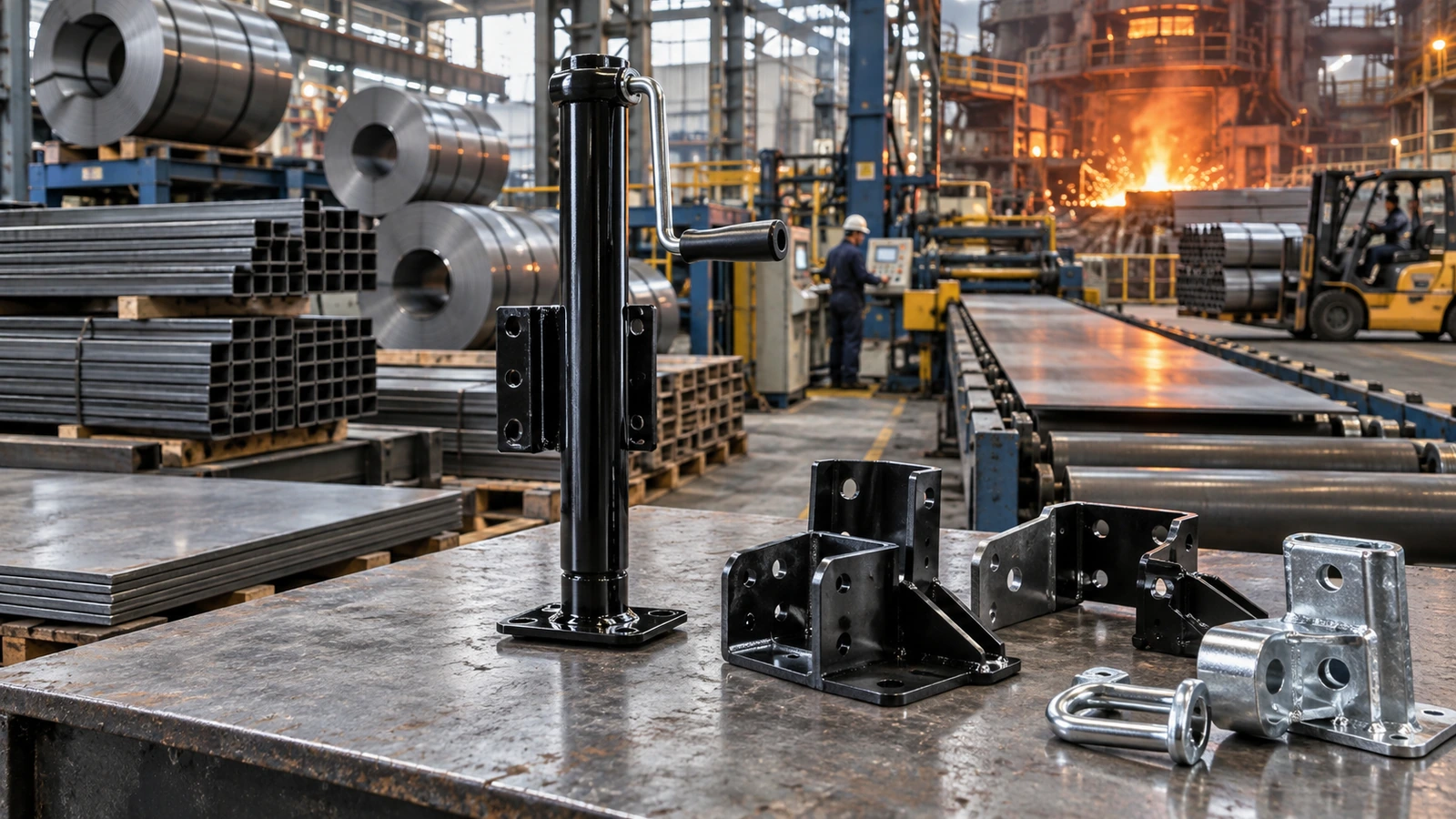
Most manual trailer jacks are heavily dependent on steel. Typical components may include steel outer and inner tubes, gears, screw mechanisms, welded mounting plates, drop legs, crank handles, brackets, wheel forks, fasteners and pins.
Whether a particular trailer jack is covered by an additional metal-related tariff depends on its HTSUS classification and the applicable tariff annex. It should not be assumed that every steel trailer jack automatically attracts the same rate.
The applicable treatment may depend on:
- The 10-digit HTSUS code
- Product construction
- Steel or aluminum content
- Country of origin
- Whether the product appears in a Section 232 annex
- Whether another trade-remedy duty applies
- Whether tariff-stacking restrictions or exceptions apply
Even when the finished trailer jack is not directly covered by a specific metal tariff, changes in steel prices can still affect the manufacturer’s production cost, galvanizing cost, component cost and final quotation.
Why DDP Quotations Are Becoming More Difficult
Under a DDP arrangement, the seller generally agrees to deliver the goods after handling import clearance and import-related costs.
When tariff rules and low-value shipment procedures change, a DDP quote can become risky if it is based only on product value and international freight.
Customs and government charges
- Basic customs duty
- Section 232 or other additional duties
- Entry-processing fees
- Bond-related costs
Logistics and service charges
- Customs-broker service fees
- Courier advancement charges
- Port or terminal charges
- Final-mile delivery
DDP quotations should therefore have a defined validity period. The supplier and buyer should also agree on what happens if a tariff rate, classification decision or government charge changes after the quotation is issued.
For repeat orders, it may be more practical for the U.S. buyer to act as importer of record and manage customs clearance through its own broker.
Small Parcels, LCL, FCL and U.S. Warehouse Stock
The best shipping model depends on order frequency, sales volume, inventory turnover and product mix.
| Shipping model | Best for | Unit logistics cost | Delivery speed after import | Inventory commitment |
|---|---|---|---|---|
| Courier parcel | Samples, warranty replacements and urgent spare parts | Usually high per unit | Fast | Very low |
| LCL shipment | Mixed models, trial orders and seasonal replenishment | Moderate | Moderate | Low to medium |
| FCL shipment | Distributors, trailer manufacturers and established brands | Usually lower at sufficient volume | Moderate | High |
| U.S. warehouse stock | Fast domestic fulfillment and stable recurring demand | Depends on replenishment efficiency | Fast after stock arrival | Medium to high |
Small Parcel or Courier Shipments
Small parcel delivery remains useful for urgent samples and replacement parts. However, after the suspension of duty-free de minimis treatment, the customs cost per unit may be disproportionately high.
LCL Shipments
Less-than-container-load shipping can be suitable for importers that cannot yet purchase a full container. It allows several models to be consolidated, although destination handling, documentation and warehouse-receiving charges should be reviewed carefully.
FCL Shipments
Full-container shipping normally offers a lower freight cost per unit when volume is sufficient. It also gives the supplier and buyer more control over pallet layout, carton stacking and SKU allocation.
U.S. Warehouse Inventory
Maintaining stock in a U.S. warehouse can reduce final delivery times and make domestic fulfillment easier. However, overseas warehousing changes when the import cost is paid; it does not eliminate customs duties.

Confirm the HS Code Before Confirming the Final Price
The HS or HTSUS code affects more than the basic customs duty. It may determine whether a shipment is subject to Section 232 duties, vehicle-parts tariffs, origin-specific additional tariffs, antidumping or countervailing duties, formal-entry requirements and special reporting obligations.
Before placing a bulk order, the importer should provide the customs broker with enough technical information to review the product.
Product information
- Product name and model number
- Product photographs
- Engineering drawings
- Load capacity
- Manual, electric or hydraulic operation
Classification information
- Main material
- Component list
- Mounting method
- Intended trailer type
- Country of manufacture
For high-volume or high-risk imports, the importer may consider requesting a binding classification ruling from U.S. Customs and Border Protection.
Country of Origin Requires More Than a Shipping Address
The country of origin is generally based on where a product is manufactured or substantially transformed, not simply where it is shipped from.
Sending products through a third country does not automatically change their origin.
Importers should retain appropriate supporting records, including:
- Commercial invoices
- Packing lists
- Bills of materials
- Production-flow information
- Supplier declarations
- Component-origin records
- Manufacturing records
- Metal-origin information where required
- Purchase and payment records
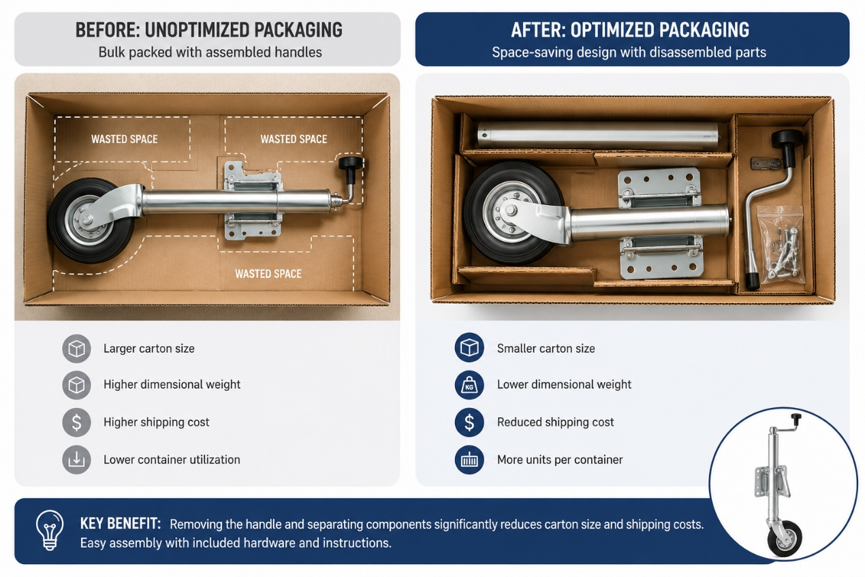
Packaging Optimization Can Reduce Unit Logistics Cost
Trailer jacks are dense, irregularly shaped products. Poor packaging can waste container space and increase the freight cost per unit.
Possible packaging improvements include:
- Removing or folding crank handles where the design permits
- Packing wheels or mounting hardware separately inside the master carton
- Using nesting arrangements for compatible tubes or brackets
- Reducing unnecessary empty carton space
- Using standardized carton dimensions
- Improving pallet stacking patterns
- Combining multiple SKUs in planned proportions
- Using reinforced cartons only where product weight requires them
A damaged gearbox, bent mounting plate or scratched zinc finish can cost more than the freight saved by using an unsuitable carton.
What U.S. Importers Should Do Before Their Next Order
- Confirm the full product specification Review function, construction, material, load capacity and installation method.
- Ask a customs broker to review the HTSUS code Check both the primary tariff classification and any applicable Chapter 99 additional-duty code.
- Recalculate the landed cost Include factory price, packaging, freight, duty, brokerage, inland transport and warehouse costs.
- Compare shipping models Review courier, LCL, FCL and warehouse-stock options on a per-unit basis.
- Build flexibility into supply agreements Clearly identify the Incoterm, importer of record, duty responsibility and treatment of newly imposed government charges.
Preparing for a More Compliance-Driven Trailer Parts Market
The U.S. remains an important market for trailer jacks, jockey wheels, stabilizer legs and towing accessories. However, importers now need greater visibility into classification, origin, metal content, customs entry and total landed cost.
A supplier that can provide consistent product specifications, export documentation, optimized packaging and flexible bulk-order solutions may help importers reduce uncertainty—even when the supplier cannot control the tariff rate itself.
For distributors and private-label brands, the most effective approach is to:
- Confirm the tariff code before shipment
- Consolidate repeat orders
- Optimize carton and pallet dimensions
- Select an appropriate Incoterm
- Maintain complete origin records
- Avoid relying on outdated de minimis assumptions
Careful preparation will not eliminate tariffs, but it can reduce unexpected charges and make import costs easier to manage.
Explore Our Trailer Jack Supply Solutions
Looking for a reliable manufacturer for your next trailer-parts order? Contact our team to discuss load capacity, mounting design, surface treatment, packaging, branding and bulk-order requirements.
Reference Sources
- U.S. Customs and Border Protection — E-commerce and de minimis guidance
- Federal Register — Rules concerning the suspension of de minimis treatment
- U.S. Customs and Border Protection — Section 232 automobile and automobile-parts guidance
- U.S. Harmonized Tariff Schedule and relevant customs classification rulings
New EU Tachograph Rules for Vans and Trailers Take Effect in July 2026
New Condition of Tariff between China and US
Related Article