New Boat Trailer Winch Strap Bunches Up on the Drum: What to Check Before Using It Again
In This Guide
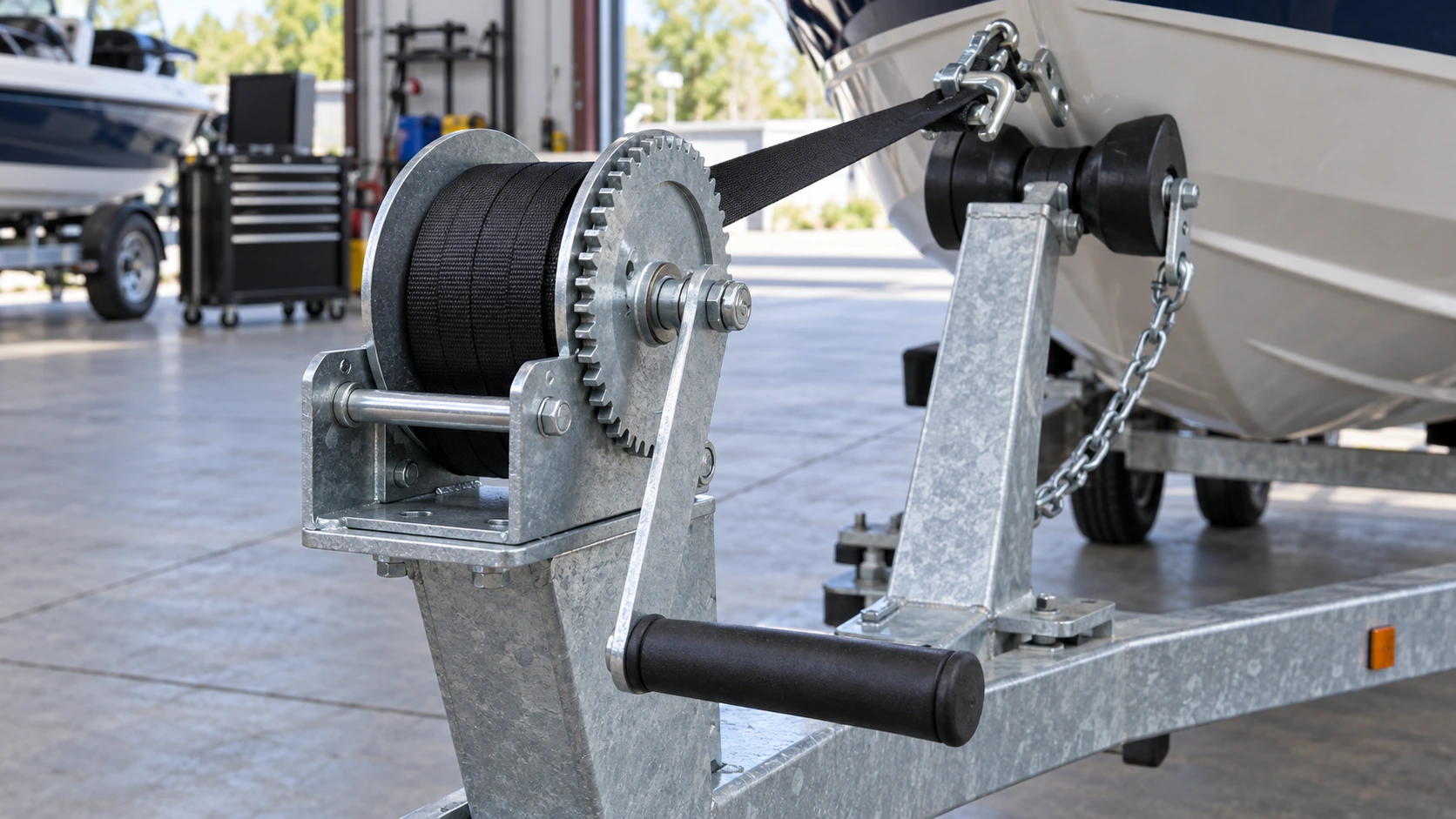
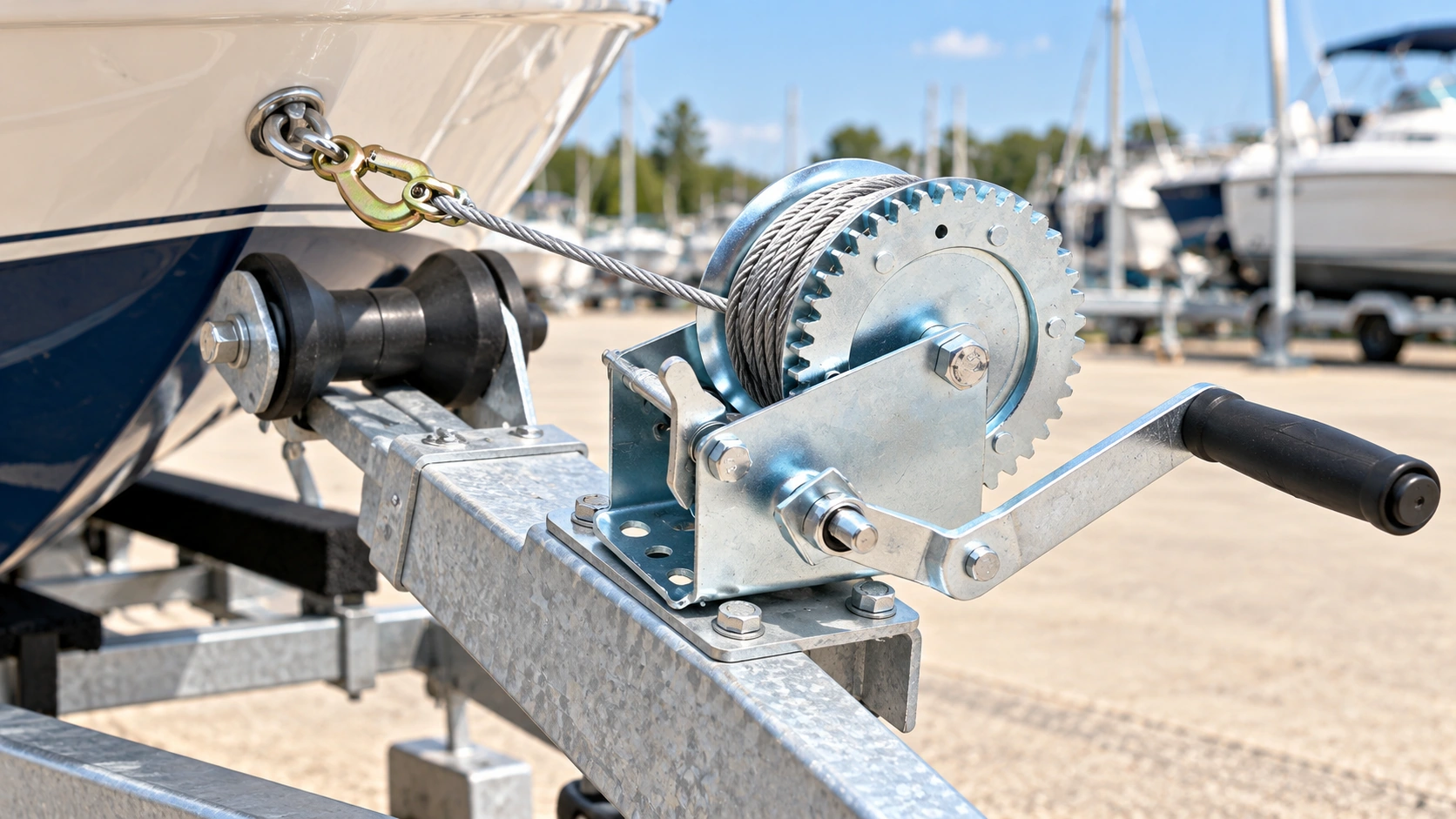
You replace an aging boat trailer winch strap with a new one rated for higher strength.
The width looks right. The hook fits the bow eye. The strap attaches to the winch drum.
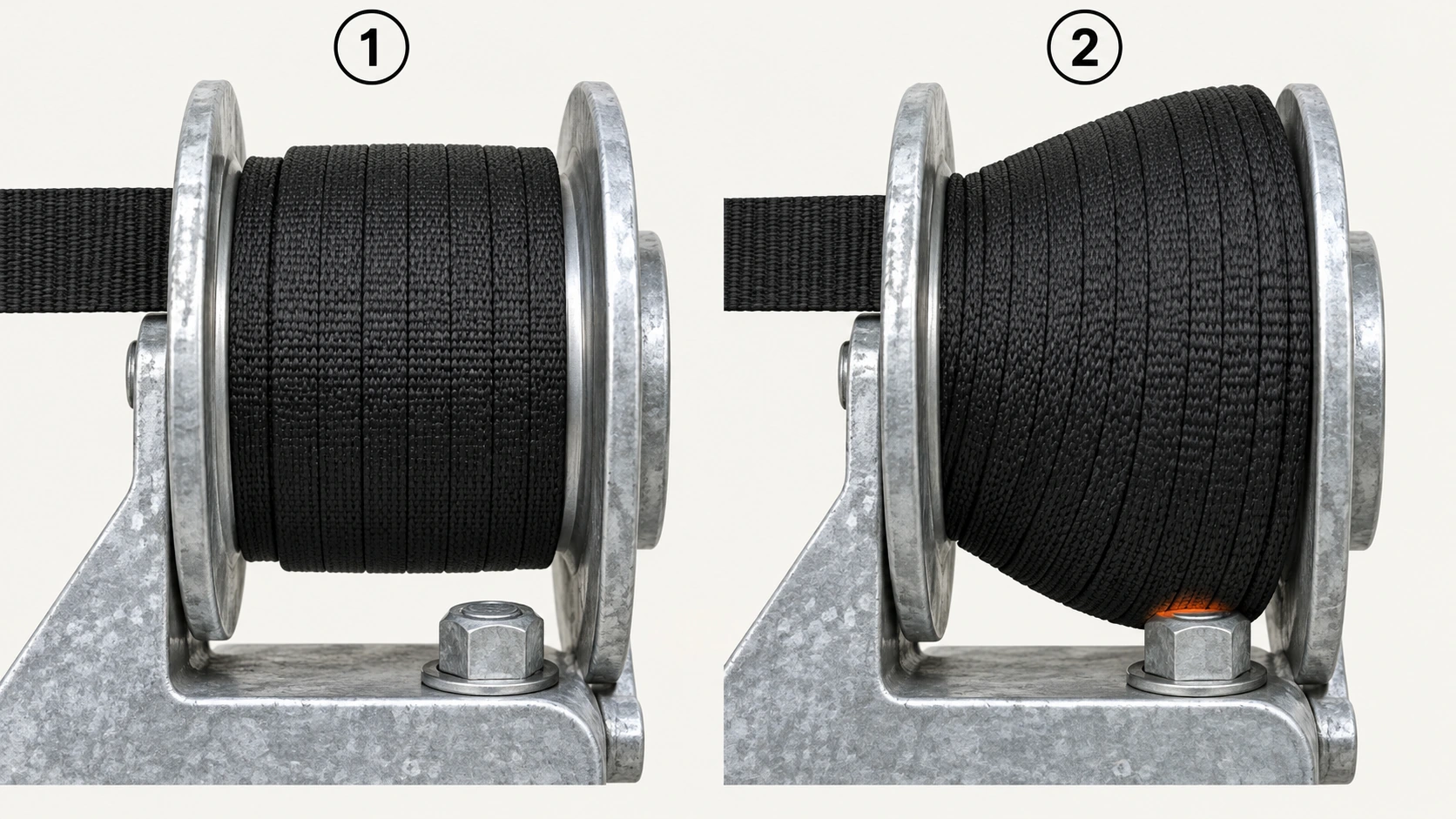
But when you turn the handle, the webbing starts building into an uneven lump. The wound strap grows beyond the available drum space, and eventually it rubs against a bolt beneath the winch.
Why would a stronger replacement strap perform worse than the old one?
The answer may have little to do with tensile strength. A winch strap must fit the drum, attach correctly, wind in the intended direction, and clear surrounding hardware throughout operation.
If any of those conditions fails, even a new strap can become unsuitable for use.
Installation & Maintenance #01 · Inspect with the boat independently secured. Model-specific instructions take precedence.
A Real Replacement Problem: Higher Strength, Worse Winding
In June 2025, a boat owner described an unusual replacement problem on Reddit's r/boating community.
The original winch strap had been in service for 22 years. Its replacement was only a few inches longer, but the new webbing was noticeably thicker near the drum attachment.
When installed using the original metal dowel arrangement, the replacement formed a pronounced teardrop-shaped buildup instead of winding evenly.
The owner tried attaching the sewn loop directly to the bolt without the dowel. The winding improved, but the finished roll still extended far enough to rub against a mounting bolt below the winch.
Several attempts to wind the strap under greater tension did not eliminate the problem. The contact had already started damaging the new webbing.
The owner reported that the replacement had a 10,000 lb strength rating and that the original strap wound normally when reinstalled. [1]
This case highlights three different questions:
- Was the new strap being wound correctly?
- Was its drum-end attachment compatible with the existing winch?
- Could the original drum physically accommodate the new strap's thickness and length?
These questions require different checks. Increasing winding tension may improve loose layers, but it cannot necessarily overcome an undersized drum or an excessively bulky attachment.
The important distinction is between a strap that is winding poorly and a strap that cannot fit properly even when wound correctly.
Why a Stronger Strap Can Exceed the Available Drum Space
A replacement strap has several characteristics that determine whether it can be accommodated by a winch:
- Webbing width
- Webbing thickness
- Overall length
- Thickness and construction of the sewn attachment loop
- Drum diameter and usable width
- Clearance around the wound strap
Strength rating is not a substitute for any of these dimensions.
Thickness and Length Determine How Quickly the Roll Builds Up
Consider two straps of the same width and length.
One is relatively thin and flexible. The other uses thicker webbing with a different construction.
Every revolution adds another layer to the drum. Although the difference between the two straps may seem small when measured individually, that difference accumulates across the full wound length.
A useful physical approximation is:
Webbing material volume ≈ Width × Thickness × Length
The actual wound package also depends on how tightly the layers settle, local stitching thickness, folds and spaces between layers.
For straps of the same width and length, thicker webbing generally requires more storage volume. The drum cannot simply compress the additional material away.
This matters most on compact boat trailer winches with limited space between the drum hub, sideplates and adjacent mounting hardware.
The Sewn Loop Can Create a Local Bulge
The drum-end loop deserves particular attention.
A sewn loop contains overlapping webbing and stitching. In some configurations, it is also retained around a bolt, pin or another dedicated anchor.
This creates a locally thicker section than the rest of the strap.
If that section cannot lie within the intended attachment space, the first layers may rise over it. Subsequent layers can follow the same raised profile, creating an uneven, teardrop-shaped roll.
That is different from ordinary loose winding.
A local bulge originating at the anchor may persist even when the remainder of the strap is wound under consistent tension.
Why the Old Strap May Still Fit
If the old strap winds normally while the new one consistently overfills the same drum, that comparison is useful evidence.
It suggests investigating differences in thickness, length and attachment construction before assuming the winch's winding mechanism is defective.
It does not establish that the old strap is still safe. An aged or damaged strap can fit perfectly while no longer being suitable for service.
A compatible replacement must meet both the mechanical fit requirements and the applicable strength requirements.
Check the Drum-End Attachment Before Rewinding
The first point of inspection is where the strap connects to the drum.
Boat trailer winches do not all use the same attachment system.
Some use a sewn loop secured by a retaining bolt. Others use a different pin, slot or manufacturer-designed anchor.
An arrangement that works on one winch should not automatically be transferred to another.
For example, Dutton-Lainson's instructions for its DL600A, DL900A, DL1100A and DL1300A pulling winches specify different retaining-bolt sizes depending on the model. They also describe the locknut type and the required position of the anchor bolt within the reel slots. [2]
These details matter because the anchor is part of the load path, not simply a convenient place to fasten the strap.
What to Inspect
With the boat independently secured and no load held by the winch, inspect the visible drum-end arrangement using the applicable service procedure.
Check whether:
- The strap uses the attachment method specified for that winch.
- The retaining bolt, pin or other anchor is the correct type and size.
- The sewn loop sits in the intended position without excessive bunching or twisting.
- The anchor hardware shows bending, movement, corrosion or damage.
- The first layer can form without being forced around a protruding component.
A replacement strap may appear properly attached while still having an unsuitable loop thickness or incorrect retention hardware.
What Different Results Mean
If the first layers rise sharply at the attachment point, but the remaining webbing is flat, the loop or anchor arrangement deserves closer examination.
If the entire roll is consistently oversized, the problem may involve overall thickness and length rather than the anchor alone.
If the anchor bolt is visibly bent or cannot remain in its designed position, rewinding is not the solution. The attachment system needs correction with compatible components before further use.
Do not remove a required dowel, substitute an arbitrary bolt or modify the sewn loop simply to make the roll smaller.
A different attachment arrangement is acceptable only when it is part of the winch manufacturer's approved configuration.
Does the Strap Need More Tension During Its First Winding?
Sometimes the strap fits the drum but winds into a loose, irregular package during initial installation.
This is a winding-condition problem rather than necessarily a dimensional mismatch.
Without sufficient controlled tension, individual layers may remain loose. Later layers can shift, fold or ride over them instead of settling evenly.
A twisted strap or poorly aligned entry path can make the result worse.
What Proper Initial Winding Should Achieve
For a compatible strap, a controlled initial winding procedure should produce:
- Flat webbing without persistent twists or folds
- Layers that remain within the intended drum width
- A stable roll rather than a series of loose loops
- No interference with the drum sideplates, winch frame or nearby hardware
- The correct winding direction for the model
Use the manufacturer's specified method for controlling line tension. Keep hands and loose clothing away from the drum, gears and pinch points during rotation.
The objective is consistent winding, not applying the maximum possible force to the strap.
How to Tell Whether Tension Is the Main Problem
Suppose the strap initially forms loose, irregular layers.
After the strap is safely rewound using the appropriate procedure, the layers settle into a stable shape and the wound package remains clear of surrounding hardware.
That result supports insufficient initial winding tension or alignment as a likely contributor.
Now consider a different result.
The layers are flat and reasonably compact, but the finished roll is still too large for the available space.
That points toward insufficient drum capacity or incompatible strap dimensions rather than a problem that can be solved through further tightening.
Repeatedly winding an oversized strap under greater force may increase loading on the attachment hardware without solving the underlying fit problem.
Winding Direction Is a Separate Check
The direction in which the strap winds around the drum also matters.
It should not be changed merely to make the strap clear a bolt or nearby bracket.
Dutton-Lainson explains that winding orientation varies among its winch models and can affect proper ratchet or brake operation. Some configurations require line to pass over the drum, while others specify a different arrangement. [3]
A strap that winds neatly in the wrong direction is not a correctly installed strap.
Before a loaded retrieval, confirm both the intended line exit and the correct ratchet engagement.
Check Clearance Around the Entire Wound Strap
A replacement strap may fit between the drum sideplates and still contact surrounding hardware as the roll grows.
This distinction is particularly important on boat trailers because winches are commonly installed near:
- Winch-stand mounting bolts
- Bow-stop brackets
- Support posts
- Gear and shaft assemblies
- Trailer-frame members
There are two kinds of clearance to consider.
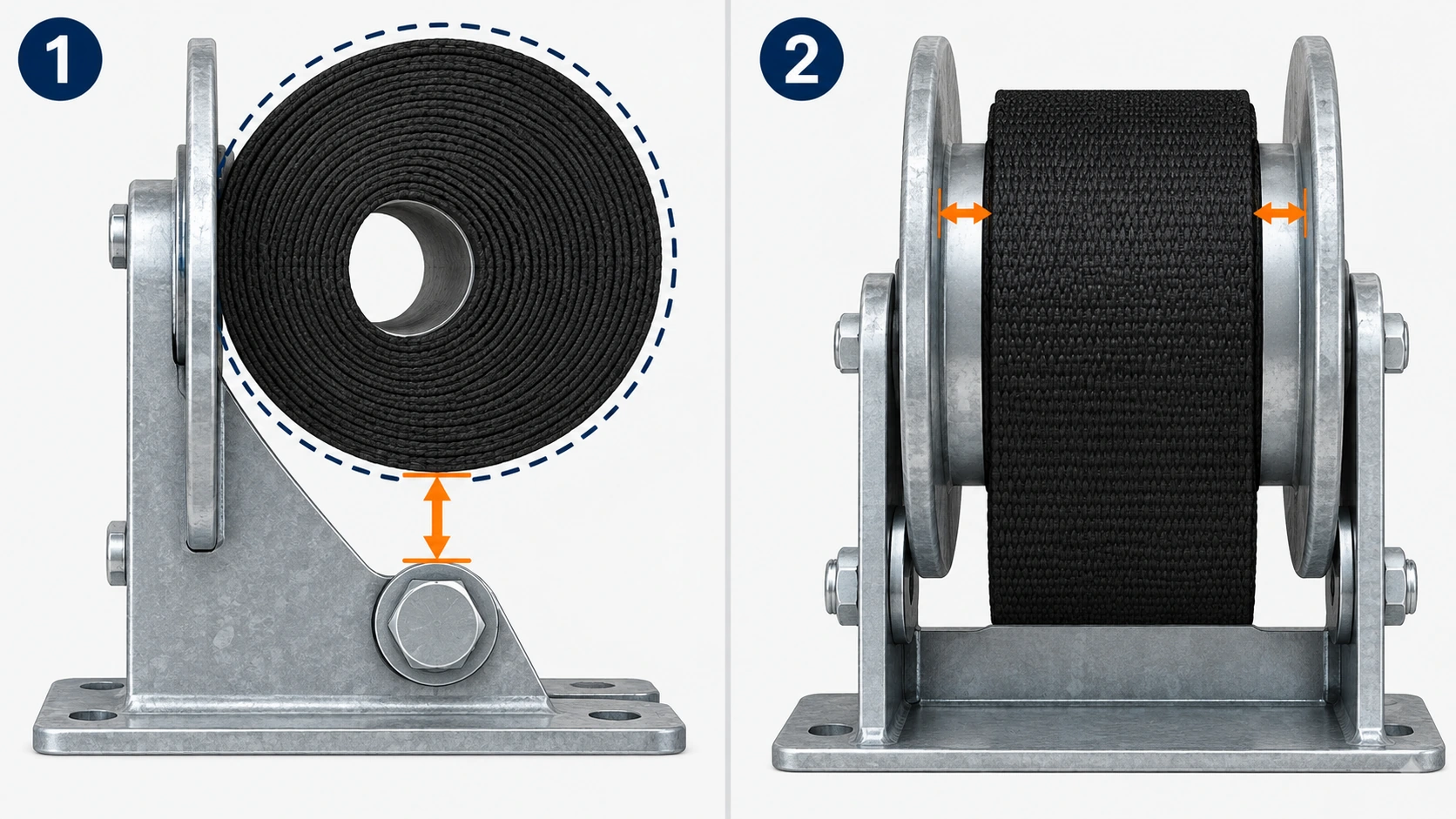
Radial Clearance: How Far the Roll Extends from the Drum
As the strap accumulates, its outer diameter increases.
The wound package must remain inside the available operating envelope throughout the intended winding range.
If a mounting bolt lies close beneath the drum, even a relatively small increase in roll diameter may create contact.
That contact can produce localized abrasion every time the drum rotates.
Once the webbing begins rubbing against metal hardware, further winding can damage load-bearing fibers.
BoatUS identifies fraying, cuts, tears and damaged stitching among the warning signs that a winch strap needs replacement. [4]
A strap that has developed abrasion from repeated contact should not be put back into service merely because the winding issue has been corrected.
Axial Clearance: How the Strap Sits Between the Drum Sides
The second dimension is the available width across the drum.
A strap that is too wide, folded, twisted or consistently pulled toward one side can rub against a sideplate or nearby component.
If the winding package remains within the drum's radial limit but continually shifts toward one side, inspect the line entry direction, alignment and webbing condition.
The strap should reach the load along the winch's intended pulling path rather than being dragged across the frame, shaft or mounting hardware.
Dutton-Lainson specifically warns that incorrect line routing can cause contact with important winch components and progressively damage the pulling medium. [3]
The Critical Question
Do not judge clearance only when the strap is partly wound.
Check the full operating range, including the maximum amount of strap expected to be on the drum during normal use.
A strap that clears the mounting bolt halfway through winding may still become unsuitable near the end of retrieval.
Likewise, moving a protruding bolt or changing the winch position is not automatically an acceptable correction. Mounting hardware and the supporting structure must retain their intended strength and configuration.
Identify the Problem from the Winding Pattern
Different winding patterns provide useful clues about the likely cause.
| Observed condition | Likely area to investigate | What the result suggests |
|---|---|---|
| A pronounced bulge begins at the drum-end loop | Sewn loop, anchor hardware, first-layer seating | Attachment construction may be preventing flat initial winding |
| Loose layers shift or fold during winding | Initial tension, twists, alignment | Winding conditions may be contributing to the buildup |
| Layers are flat but the complete roll is too large | Strap thickness, length, usable drum capacity | The replacement may be dimensionally incompatible |
| The strap continually collects toward one side | Line entry angle, drum alignment, strap condition | Side loading or routing may be disrupting even winding |
| Webbing rubs a bolt only near the end of winding | Maximum roll diameter, bolt clearance | The operating envelope is insufficient at higher fill levels |
| The drum turns but the load-holding mechanism does not engage correctly | Winding direction, pawl, ratchet or brake | A functional winch problem exists beyond strap storage |
| The strap has frayed edges or damaged stitching | Abrasion, cuts, contact points | The damaged strap needs replacement rather than further rewinding |
These findings should be considered together.
For example, a strap can be both too thick and initially wound too loosely. Improving one condition does not automatically eliminate the other.
A similar distinction applies to the winch itself. If the drum turns unevenly because of damaged bearings, shafts or other mechanical components, repeatedly adjusting strap tension will not address that defect.
A Practical Inspection Sequence Before the Next Launch
A systematic inspection can usually narrow the problem without repeatedly attempting to pull the boat.
Step 1 — Secure the Boat Independently
Before working on the strap or drum, ensure that the boat cannot move if the winch line is unloaded.
Use suitable independent restraints and a stable work area. Do not rely on the affected strap to hold the boat while investigating the problem.
Step 2 — Examine the Complete Strap
Inspect the webbing, both edges, sewn terminations and hook.
Pay particular attention to areas that contacted mounting bolts or sideplates.
Cuts, fraying, damaged stitching and other visible structural damage are replacement conditions, not reasons to apply more winding tension.
Step 3 — Compare the Old and New Strap
If the original strap and its specifications are available, compare their width, thickness, length and drum-end construction.
The original is useful as a dimensional reference, but not necessarily as a strength or serviceability standard.
Step 4 — Verify the Attachment
Check the installed loop, anchor hardware and manufacturer-specified winding direction.
Correct any installation discrepancy using the approved components and procedure.
Step 5 — Inspect the Drum and Surrounding Hardware
Examine the drum flanges, frame, mounting bolts, shafts and visible ratchet components.
Identify where the wound strap approaches surrounding metalwork.
Look for bent hardware, corrosion, sharp edges, loose mounting components or distortion that may have reduced the available clearance.
Step 6 — Evaluate Winding Under Controlled Conditions
If the strap and winch remain serviceable and the configuration is approved, carry out the manufacturer's unloaded inspection or initial winding procedure.
Observe where the irregularity first develops.
- If the first layers rise over the anchor, investigate the attachment.
- If loosely stacked layers become compact and even, initial winding conditions were likely contributing.
- If the compact roll remains oversized, investigate drum capacity and strap dimensions.
- If the strap tracks sideways, investigate line alignment and routing.
Stop the check if the strap approaches a pinch point, contacts hardware or the winch mechanism behaves abnormally.
Step 7 — Confirm the Complete System Before Returning to Service
A smooth unloaded winding check is useful, but it does not establish that the winch is suitable for the required pulling load.
Before the next retrieval, verify the correct ratchet or brake operation according to the model's instructions, along with the strap attachment, hook, mounting structure, line path and rated pulling capacity.
The strap must remain suitable throughout the complete loading cycle—not simply while the boat is stationary on the trailer.
When Is Rewinding Enough, and When Is Replacement Necessary?
The correct action depends on what the inspection establishes.
| Inspection outcome | Appropriate action |
|---|---|
| Strap is undamaged, correctly specified and settles evenly after approved rewinding | Return to service once the complete operating checks pass |
| Strap has a twist or alignment issue but remains undamaged | Correct the winding or routing condition and repeat inspection |
| Attachment hardware is incorrect but approved replacements exist | Restore the specified attachment before use |
| Strap repeatedly exceeds available drum space | Replace with a compatible approved strap configuration |
| Strap has cuts, significant abrasion, fraying or damaged stitching | Remove the strap from service and replace it |
| Drum, pawl, shaft, mounting structure or other critical hardware is damaged | Stop use until the affected assembly is repaired or replaced appropriately |
| Correct attachment, winding direction or reliable load holding cannot be established | Do not use the winch for loading until the configuration and function are verified |
Why Replacing the Whole Winch Is Not Always Necessary
A properly functioning winch with an unsuitable replacement strap does not necessarily need to be discarded.
If the winch remains in good condition and a correctly specified strap is available, replacing only the webbing may solve the problem.
However, a different conclusion applies when the drum cannot hold the required strap length, the approved attachment arrangement is unavailable, or the winch itself has mechanical damage.
In those cases, a different winch configuration or complete replacement may be necessary.
The decision should follow the identified problem rather than the assumption that a new product is always the best solution.
Why Boat Trailer Operating Conditions Matter After Installation
A successful first winding does not guarantee that the strap will remain correctly aligned indefinitely.
Boat trailers experience operating conditions that can gradually change strap behavior.
Frequent Wetting and Marine Exposure
Winch straps may be exposed to freshwater, saltwater, sediment and repeated wet-dry cycles.
These conditions make routine cleaning and inspection important, particularly around the webbing, sewn ends, hook and metal attachment hardware.
Salt deposits and corrosion on neighboring components can also create rough contact surfaces capable of damaging the strap.
Road Vibration
Road movement can gradually loosen mounting components or expose existing problems with the winch stand.
A winch that was correctly aligned during installation may subsequently develop an unsuitable line path if the supporting assembly becomes loose or distorted.
Repeated Retrieval Cycles
During boat loading, the strap moves through different winding positions as the drum fills.
The line also experiences changing tension as the boat transitions from water support onto the trailer bunks or rollers.
Repeated operation makes it important that the strap does not fold, rub or lose alignment at any stage.
Long-Term Storage
Extended outdoor storage adds another inspection consideration.
Exposure to weather, ultraviolet radiation and contamination can deteriorate webbing over time, even if the strap sees relatively few loading cycles.
Regular inspection should therefore include both winding condition and material condition.
GOODIN View: Correct Strap Capacity Means More Than a Strength Rating
For trailer manufacturers and distributors, repeated complaints about replacement straps may indicate a problem with how the strap and winch are specified together.
Two products can carry similar nominal ratings while using different pulling-medium configurations.
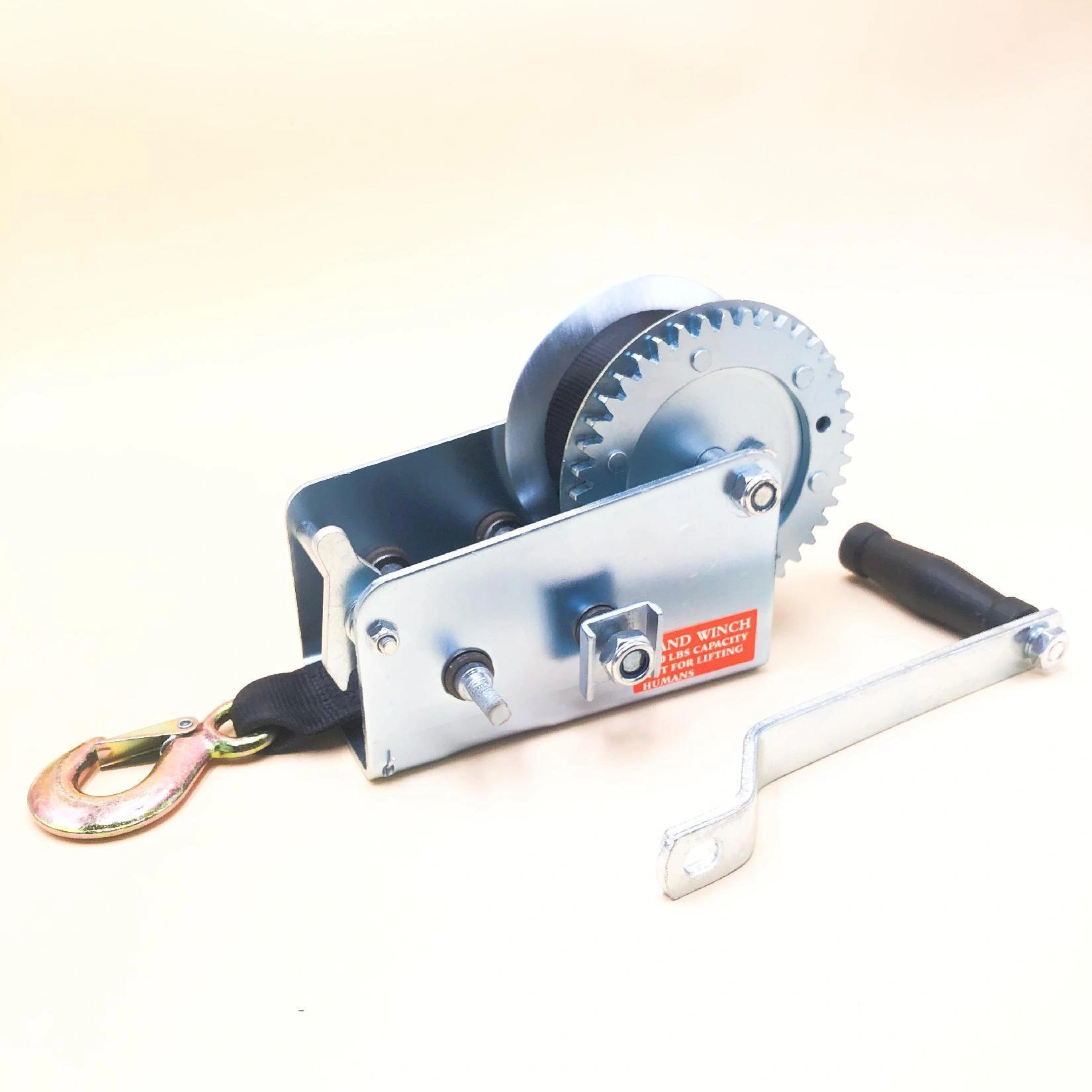
GOODIN's GD-S2000 is a 2,000 lb rated, two-speed manual strap winch with a published 50 mm-wide, 8 m web strap and 4:1 / 8:1 gear ratios. [5]
Its related GD-C2000 uses steel cable rather than webbing. The two versions are defined around different pulling media, even though they share the same rated-capacity class. [6]
This distinction is useful when planning replacement parts for an OEM trailer program.
A complete replacement specification should identify the approved strap dimensions and end attachment, not merely the width or breaking strength.
GOODIN GD-S2000
2,000 lb rated manual winch, 4:1 / 8:1 gearing, 50 mm × 8 m web strap.
Reference configuration for OEM and replacement-part discussions.
For a distributor dealing with a recurring bunching problem, the most useful information to record is:
- Existing winch model and drum configuration
- Replacement strap width, thickness and length
- Sewn loop and anchor-hardware construction
- Maximum wound diameter and nearest clearance
- Point in the winding cycle where the problem begins
- Evidence of rubbing, twisting or localized wear
This information helps distinguish a batch of incorrectly specified replacement straps from an installation issue or a deteriorated winch assembly.
It also creates a more reliable basis for repeat orders and aftermarket replacement kits.
For selection before replacement, see Winch Strap vs. Steel Cable: Which Should You Specify for a Boat Trailer?. For an OEM replacement kit, provide the existing model and attachment details when contacting GOODIN.
Frequently Asked Questions
Can a 10,000 lb-rated strap be too thick for a smaller boat winch?
Yes. Strap strength and drum storage capacity are different requirements.
A strap with a higher stated breaking strength may use thicker webbing or a bulkier termination. If the full required length cannot fit within the winch's available space, the strap is not suitable for that configuration regardless of its strength rating.
The strap must also meet the manufacturer's applicable working-strength requirements; breaking strength alone is not the normal operating limit.
Will winding the strap more tightly eliminate the bulge?
Only when loose or irregular winding is a significant contributor.
If the strap forms an uneven roll because the initial layers are slack, an approved rewinding procedure may correct it.
If the sewn loop creates a persistent raised section or the strap exceeds the drum capacity even when evenly wound, greater tension will not reliably solve the problem.
Can I keep using a new strap that has started rubbing against a bolt?
No. Stop using the affected strap and inspect it.
Where contact has caused cuts, fraying, damaged stitching or other visible webbing damage, replace the strap and correct the interference before returning the winch to service.
A replacement strap that immediately develops abrasion is not a normal break-in condition.
Does the strap have to wind over the top of the drum?
Not on every winch.
The correct direction depends on the model's ratchet or braking arrangement. Follow the specific winch's approved winding orientation rather than changing direction to obtain more clearance.
Conclusion: Diagnose the Winding Problem Before Replacing More Parts
A new boat trailer winch strap that bunches up is not necessarily defective.
The problem may originate from a bulky drum-end loop, unsuitable attachment hardware, poor initial winding, incorrect line alignment or insufficient storage space on the existing drum.
Each produces a different inspection result—and calls for a different response.
The key is to identify whether the irregularity disappears under correct winding conditions or remains because the replacement strap cannot fit the winch configuration.
If the strap is undamaged and the problem is limited to winding technique, correction may be straightforward. If the strap continues to overfill the drum, rub hardware or show material damage, further operation is not the answer.
A properly installed winch strap is one that fits, winds, clears surrounding hardware and operates correctly throughout the complete loading cycle—not simply one that can be attached to the drum.
Sources & Further Reading
The owner report illustrates a problem, not an independently verified diagnosis or an approved modification. Manufacturer instructions apply only to the models named.
- Reddit / r/boating — New winch strap — owner-reported replacement case
- Dutton-Lainson — DL600A, DL900A, DL1100A and DL1300A — Pulling Winches Instructions (206286)
- Dutton-Lainson — Technical FAQs — Line Routing and Winding Orientation
- BoatUS — Replacing a Winch Strap
- GOODIN — GD-S2000 — 2,000 lb Two-Speed Manual Strap Winch
- GOODIN — GD-C2000 — 2,000 lb Two-Speed Hand Winch with Cable
Hand Winch Ratchet Slips Under Load: How to Identify Pawl, Gear and Locking Failures
Welding Procedures in Trailer Jack Installation
Related Article