Aluminum Is Corrosion-Resistant—Until You Bolt the Wrong Metal to It: The Hidden Galvanic Problem in Trailer Assemblies
On this page
An aluminum boat trailer can spend years resisting the rust that attacks an ordinary steel frame. Yet the same trailer may develop corrosion around a stainless steel bolt, a jack mounting plate or a galvanized bracket.
The apparent contradiction begins with a distinction: corrosion resistance describes a material under particular conditions. A trailer is an assembly of materials operating together. Its aluminum frame may support a steel tongue jack, stainless mounting bolts and zinc-coated brackets, while saltwater, road spray and condensation reach their connections.
Each material can be appropriate individually. Combining them without considering the interface can introduce a new failure mechanism. A May 2026 etrailer question about a steel jack on an aluminum trailer exposed to weather and road salt shows that buyers already encounter this issue. The discussion is practical purchasing context—not a controlled corrosion investigation or approval of a universal installation method. [8]
How should manufacturers combine corrosion-resistant materials without creating a corrosion-prone assembly? The answer is in the electrical, environmental and mechanical conditions at the joint, not simply a rust-resistant label.
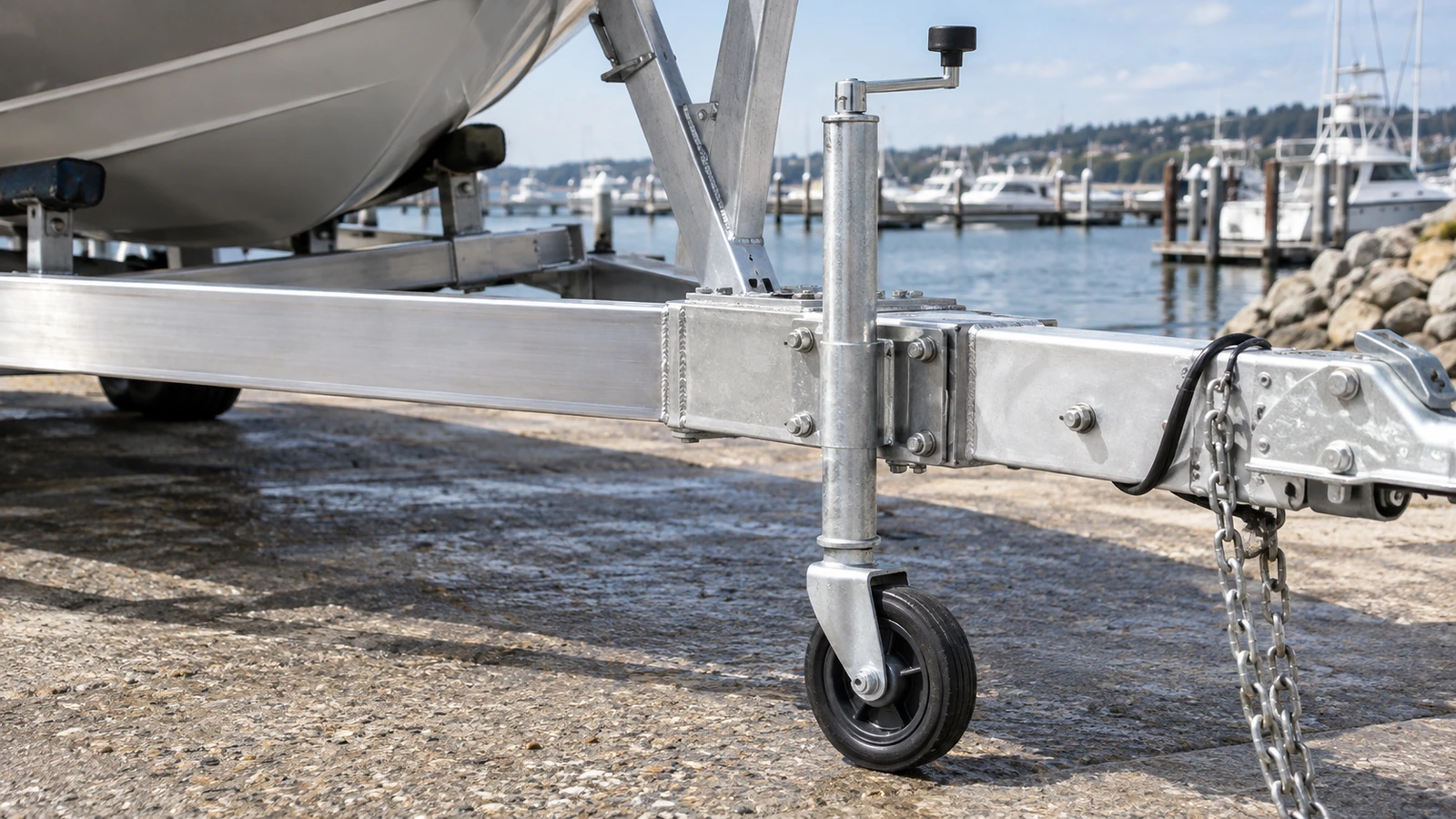
Materials & Manufacturing #7 · Metal compatibility, joint design and OEM sourcing
Why Aluminum Can Corrode Next to a Stainless Steel Bolt
Aluminum owes much of its corrosion resistance to a thin, adherent oxide film that forms naturally on its surface. Under suitable conditions, this film slows further attack. That is one reason aluminum performs well in many outdoor and marine applications. However, the oxide film does not make aluminum immune to corrosion. When aluminum is electrically connected to another metal with a sufficiently different electrochemical potential, and both are exposed to a conductive liquid, galvanic corrosion can occur.
In a typical passive-stainless-steel/aluminum couple, aluminum acts as the more active metal—the anode—and can experience accelerated corrosion. The stainless steel acts as the cathode. The Australian Stainless Steel Development Association explains that three conditions are necessary for galvanic corrosion: a sufficiently different potential between the materials, an electrically conductive connection, and a shared electrolyte. [1] For trailer manufacturing, each condition has a practical equivalent.
| Electrochemical requirement | Trailer assembly example |
|---|---|
| Different electrochemical potentials | Aluminum frame and passive stainless steel fastener |
| Electrical connection | Bolt, mounting plate, washer, or another conductive path |
| Shared electrolyte | Saltwater, road-salt solution, or conductive moisture |
If an effective electrical isolation system interrupts the conductive path, galvanic coupling between those components cannot operate. Likewise, if the connection remains dry and free from conductive contamination, the galvanic reaction cannot proceed. This explains why the same hardware combination can behave differently on a dry inland utility trailer and a boat trailer repeatedly exposed to saltwater. The material combination has not changed. The operating conditions have.
Why road salt deserves as much attention as seawater
Marine exposure is not limited to trailers launched into the ocean. A trailer used on salted winter roads can accumulate chloride-rich moisture around fasteners, brackets, and overlapping plates. As water evaporates, the remaining liquid can become more concentrated. Salt deposits may also absorb atmospheric moisture and keep a connection wet after surrounding surfaces appear dry. Consequently, a trailer that never enters seawater can still develop aggressive local corrosion at its mounting interfaces.
The relevant exposure is not simply how often the trailer gets wet. It is how long a conductive liquid remains available at the connection.
Electrical isolation controls this particular metal-to-metal galvanic path; it does not make aluminum immune to pitting, crevice attack or chemical exposure. Similarly, the protective oxide is not a reliable engineered separator beneath a tightened fastener. The distinction is between a corrosion-resistant surface and a verified nonconductive interface. The assembly must be evaluated in its installed condition, including other brackets or wiring that may restore electrical continuity.
The Area-Ratio Problem: Why the Smaller Component Can Change the Outcome
The electrochemical difference between two metals is important, but it does not determine corrosion severity by itself. The relative wetted areas of the anode and cathode also matter. Consider two simplified assemblies.
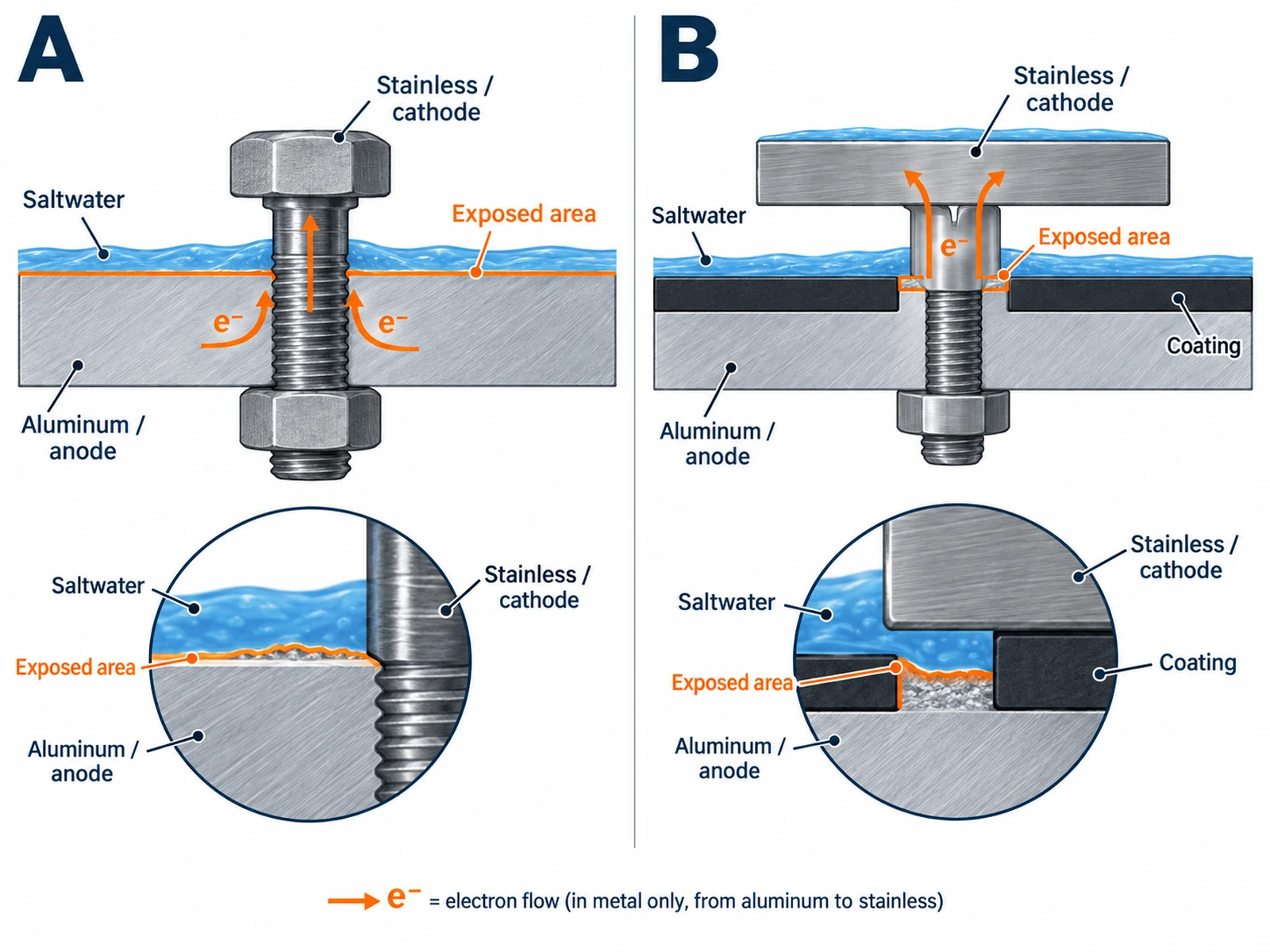
Assembly A: A small stainless steel bolt in a large aluminum frame
The exposed stainless steel surface may be relatively small compared with the wetted aluminum surface. Galvanic current can be distributed over a larger anodic area, reducing the average current density on the aluminum. This is one reason stainless steel fasteners can be used successfully in many aluminum structures.
Assembly B: A large stainless steel plate attached to a small exposed aluminum section
The relationship is reversed. A large cathodic area can support a greater total galvanic current, while the anodic reaction is concentrated on a much smaller aluminum surface. The result can be more aggressive localized attack. The same principle applies when a large stainless steel component is connected to a small zinc-coated bracket or fastener. ASSDA and the American Galvanizers Association both identify the ratio of wetted cathodic and anodic areas as a major factor in galvanic corrosion. [1] [2]
Why a large aluminum frame is not automatically safe
The entire trailer frame should not automatically be treated as one uniformly exposed anodic surface. Imagine a coated aluminum frame with a stainless steel mounting plate. Most of the aluminum is protected by its coating. A small section near a drilled mounting hole becomes exposed when the coating is damaged. If the connection becomes wet, galvanic attack may concentrate on that small exposed region. The frame is large, but the effectively exposed anodic area may be small.
This is why coating condition, mounting-hole geometry, and water retention can matter as much as the nominal size of the components. The important design question is not simply which metal is larger. It is how much of each metal is electrically connected and exposed to the electrolyte under actual service conditions.
The comparison is a design explanation, not a numerical life prediction. Wetted area changes as spray reaches the joint and then dries. A remote length of frame may contribute little if it is outside the connected electrolyte film. Neither the fastener diameter nor the total frame area establishes a universally safe ratio. Engineers need to consider credible coating damage and retained moisture at the actual interface, not only a clean, fully exposed drawing of the new components.
An Aluminum Frame, a Steel Jack, and Stainless Bolts: What Can Go Wrong?
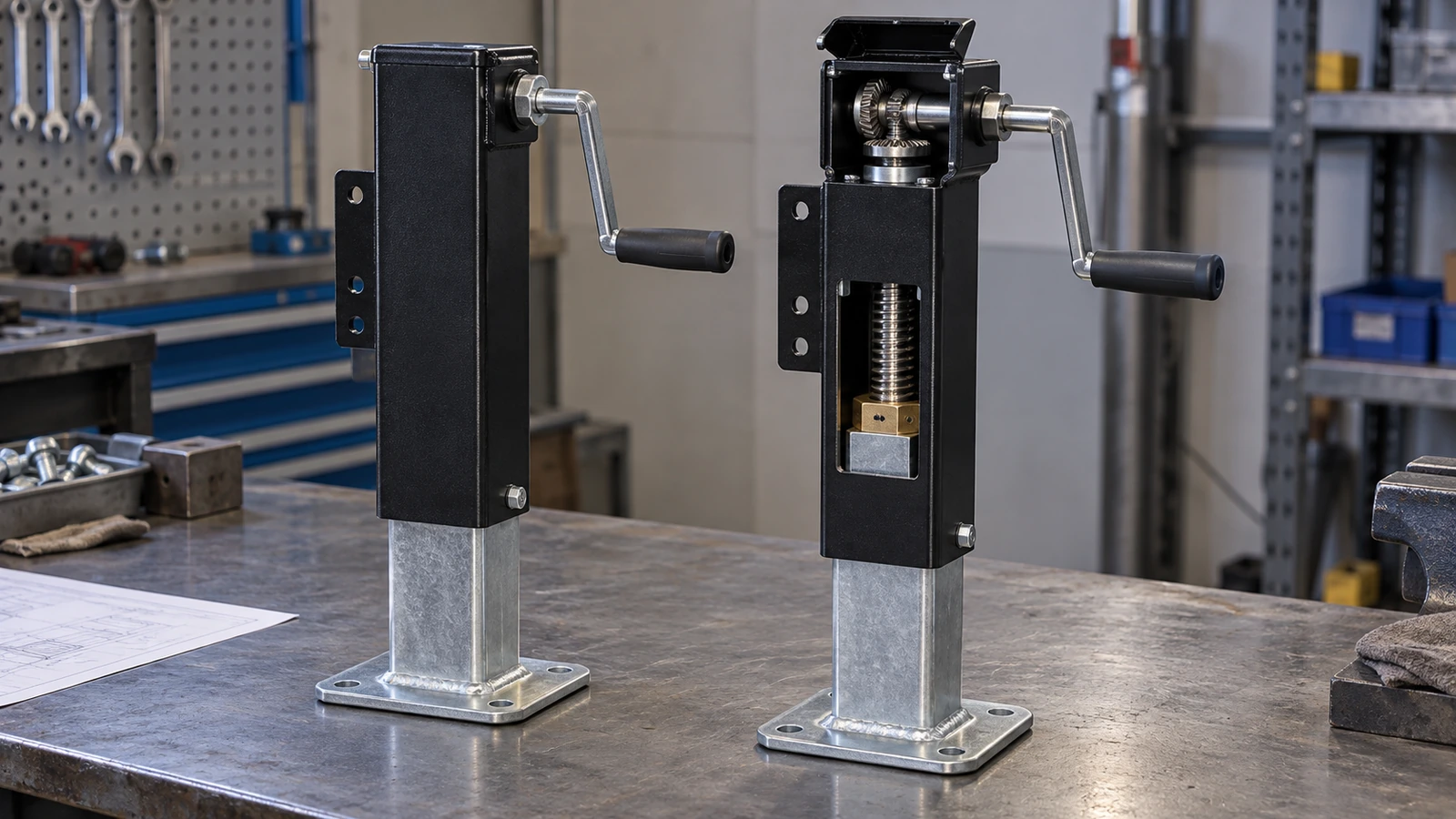
A tongue jack is a useful example because it combines different materials at a mechanically important connection. The jack must transfer vertical support loads into the trailer structure. Its mounting system may also experience vibration, road spray, repeated handling, and outdoor storage. Now consider an aluminum trailer fitted with a coated steel jack and stainless mounting bolts. There are several possible corrosion paths.
The aluminum-to-steel mounting interface
If a steel mounting plate contacts bare aluminum and both surfaces become wet, galvanic coupling may occur. A suitable protective coating on the steel can reduce exposed metal and help control the reaction. However, a scratched coating, damaged edge, or unprotected fastener hole can create a new contact point. Whether that contact creates significant corrosion depends on the metals' actual surface conditions, exposed areas, and environment.
The stainless fastener connection
A stainless bolt may pass through the steel mounting plate and the aluminum frame. Even if a nonconductive pad separates the two large surfaces, the bolt can still provide an electrical path between them. This is an important limitation of treating a single nylon washer as a complete isolation system. Electrical separation must be evaluated across the entire connection. That may require a combination of an insulating mounting pad, suitable washers, and nonconductive sleeves around the bolt shanks.
The trapped-moisture problem
A flat steel mounting plate can create a narrow space against the aluminum frame. Saltwater may enter this interface through an exposed edge or fastener hole. If the joint has poor drainage, the water can remain inside long after the visible surfaces have dried. The result may involve more than galvanic corrosion. Localized crevice conditions, chloride accumulation, and coating deterioration can develop at the same connection.
Galvanic corrosion and crevice corrosion are distinct mechanisms, but poor joint design can create conditions favorable to both. [7] A jack mounting plate therefore needs to be evaluated as a complete environmental and mechanical interface—not merely as a bracket with an adequate load rating.
For trailer jacks for marine applications, the relevant specification therefore includes the interface as well as rated capacity. BoatUS's discussion of trailer-jack replacement also illustrates why installation, fastener condition and maintenance belong in the ownership decision. It does not certify any particular mixed-metal mounting arrangement. [9]
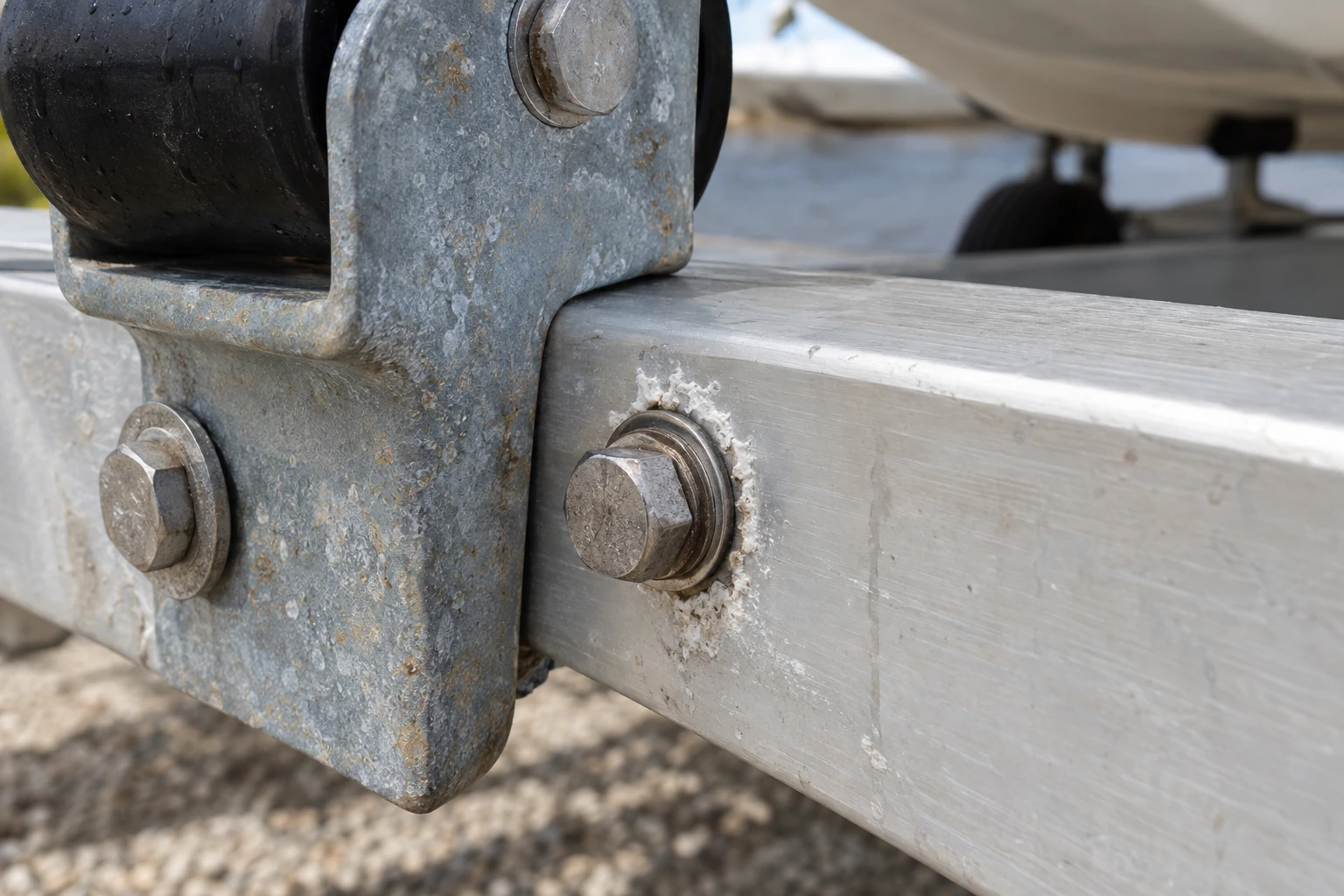
White deposits near a hole are a reason to inspect, not enough to diagnose galvanic corrosion from a photograph. A useful investigation records the metals, finishes, electrical contacts and exposure, and examines hidden mating surfaces where appropriate. Loss of section or mounting integrity needs a competent mechanical assessment; cleaning the visible deposit does not establish that the connection remains safe.
Why Galvanized Steel Is Not an Automatic Solution
Galvanized steel introduces another important material into the assembly: zinc. Zinc is used to protect steel because it provides a protective barrier and can corrode sacrificially when the underlying steel is exposed. This is a deliberate and useful application of galvanic corrosion. When a zinc coating is damaged, surrounding zinc can provide cathodic protection to nearby exposed steel. But that does not mean galvanized steel is universally compatible with every metal in every environment.
The American Galvanizers Association treats aluminum–zinc compatibility as exposure-dependent. Its guidance distinguishes comparatively mild contact conditions from humid or saltwater service, where electrical isolation may be appropriate. That is not a blanket approval of every galvanized bracket on every aluminum frame. [3] The distinction matters for boat trailers. A galvanized bracket may perform adequately against an aluminum frame under one exposure condition while experiencing accelerated zinc consumption under another. Adding stainless hardware creates another possible galvanic relationship.
Where stainless steel and zinc are electrically connected in a conductive environment, zinc may be consumed more rapidly. As the zinc coating becomes depleted, the underlying steel can become exposed to corrosion. This is one reason replacing every rusty fastener with stainless steel is not necessarily a complete corrosion strategy.
Zinc-plated and hot-dip galvanized are not interchangeable specifications
A further purchasing problem is the word galvanized. A thin electroplated zinc coating and an after-fabrication hot-dip galvanized coating are not necessarily equivalent. Their coating thickness, coverage, production methods, and suitability for different service conditions can vary. The American Galvanizers Association explicitly distinguishes hot-dip galvanizing from other zinc-coating processes and provides separate specifications for them. [4] For trailer brackets and jacks, an OEM should therefore ask for the actual coating process, specified thickness, and relevant test requirements.
Simply writing “galvanized finish” on a purchase order may leave too much room for interpretation.
GOODIN View
A zinc coating should protect the steel component it was specified for. It should not be assumed to provide unlimited sacrificial protection for every dissimilar metal connected to the assembly.
Isolation Works—But Only When the Entire Joint Is Designed for It
Electrical isolation is one of the most direct ways to control galvanic coupling. However, the phrase “use nylon washers” often makes the solution sound easier than it really is. A complete joint may contain several conductive pathways. The mounting plate may be separated from the frame, while a bolt shank still touches bare aluminum inside its hole. A metal washer may bridge an otherwise insulated interface.
A protective coating may be damaged during tightening. Another conductive component may reconnect the two metals elsewhere. Isolation therefore has to be considered at the assembly level.
A practical isolation arrangement
For a suitable bolted accessory connection, an engineered solution may include:
| Connection detail | Purpose |
|---|---|
| Nonconductive mounting pad | Separates the dissimilar mounting surfaces |
| Insulating bolt sleeve | Prevents the bolt shank from contacting the hole wall |
| Suitable insulating washers | Interrupts electrical contact beneath bolt heads or nuts |
| Compatible sealant or corrosion-inhibiting compound | Helps limit electrolyte access |
| Drainage and accessible joint geometry | Reduces prolonged moisture retention |
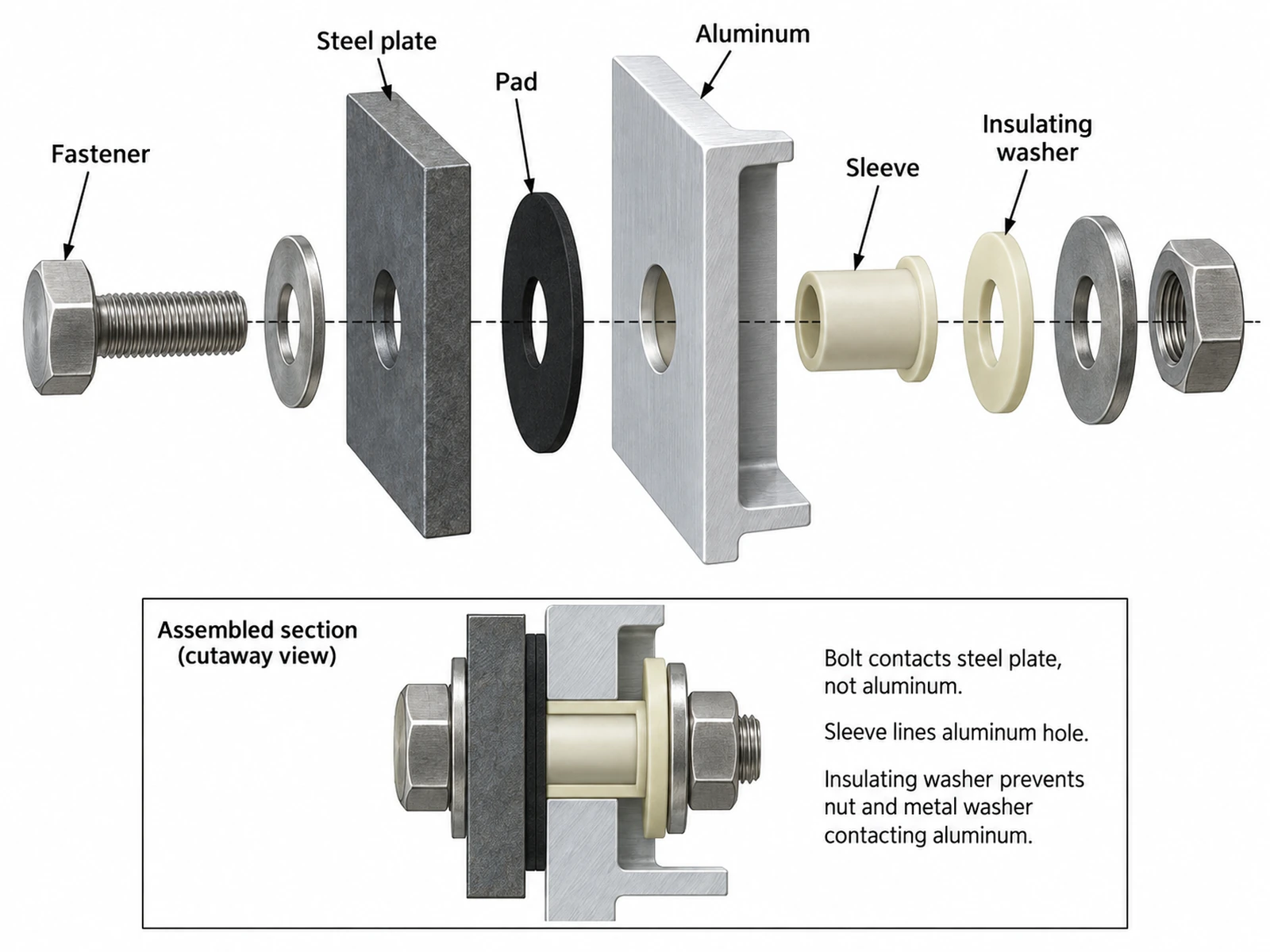
These details must work together. ASSDA identifies suitable plastic strips, washers, and sleeves as ways to interrupt galvanic contact. It also warns that paint alone is not a dependable electrical insulator around fasteners because installation and movement can damage it. [1]
The mechanical trade-off cannot be ignored
A jack mounting connection is not merely an electrical interface. It must carry load. An insulating washer may compress. A polymer pad may creep under sustained pressure. A sleeve may change bolt-hole fit or reduce the available bearing area. Some structural bolted connections cannot accept added dielectric washers or shims without further engineering. The American Galvanizers Association specifically cautions that insulating materials must be evaluated against the loading conditions of the connection. [2]
This makes isolation material selection a manufacturing decision. An OEM should verify that the revised connection maintains its required clamp force, load transfer, fatigue performance, and dimensional stability. It should also consider whether any electrical grounding or bonding function is intentionally provided through the connection. Corrosion isolation must not inadvertently compromise required electrical safety or lighting circuits. A corrosion solution that weakens the mounting connection is not an acceptable solution.
The correct approach is to engineer and validate both functions together.
The barrier specification should identify an actual material and thickness, not simply the word rubber or plastic. Fillers, contamination, moisture uptake, compression and wear can affect its suitability. A product selected as a seal is not automatically an electrical insulator or a structural bearing material. The illustrated stack is a principle diagram, without dimensions, torque values or load approval; it must not be copied as a retrofit instruction for a trailer jack.
Stainless Steel, Coatings, and the Limits of Material Upgrades
Stainless steel is often selected for marine hardware because it offers useful corrosion resistance without relying on a consumable zinc coating. However, stainless steel is a family of alloys, not one material with a universal corrosion rating. Grade 316 generally offers greater resistance to chloride-related pitting and crevice corrosion than grade 304. It is therefore commonly considered for more demanding marine applications. Nevertheless, 316 is not immune to localized corrosion, particularly in aggressive chloride environments and poorly ventilated crevices. [5] [7]
Upgrading a fastener from 304 to 316 may improve the fastener's own corrosion resistance. It does not automatically eliminate galvanic coupling with an aluminum frame. Nor does it establish whether the fastener meets the required mechanical specification. Fastener grade, strength, thread geometry, installation torque, corrosion resistance, and compatibility with the surrounding materials must be evaluated together.
Why protective coatings can create an unexpected trade-off
Coatings reduce corrosion by limiting environmental access to the underlying metal. But a damaged coating can change the distribution of exposed anodic and cathodic areas. Consider a large noble-metal component connected to coated aluminum. If only a small area of aluminum is exposed through a coating defect, corrosion can become concentrated at that defect. By contrast, maintaining a suitable coating on the cathodic component can reduce the exposed cathodic area and the galvanic reaction it can support.
This is why corrosion engineering guidance generally favors protecting both sides of a dissimilar-metal connection rather than relying on a fragile coating on the anodic component alone. [1] [2] For trailer manufacturing, this has several practical implications. Coating specifications should account for mounting-hole edges, contact surfaces, handling damage, and assembly operations. A coating that performs well on an isolated test panel may not deliver the same protection after the panel is drilled, clamped, or joined to dissimilar hardware.
Research published by the Association for Materials Protection and Performance has investigated how different surface pretreatments change galvanic attack on coated aluminum panels connected to stainless steel fasteners. The findings reinforce the importance of evaluating the coating and fastener as an interacting system. [6] A coating specification is not complete until it considers what happens after the parts are assembled.
The cited AMPP study examined coated and scribed AA7075-T6 panels with stainless fasteners under defined laboratory conditions. It is useful evidence that pretreatment and coupling interact, not a measured life model for a 6061 boat-trailer frame. Alloy, coating, damage geometry and exposure differ. Transferring a result to a production trailer requires additional evidence representative of that trailer, rather than assuming all aluminum alloys and coating systems behave alike. [6]
Why Manufacturing and Assembly Quality Determine the Real Corrosion Risk
Material selection establishes the starting conditions. Manufacturing and assembly determine whether those conditions are maintained in production. Two manufacturers may purchase aluminum extrusion, stainless fasteners, and galvanized brackets from comparable suppliers yet produce assemblies with different corrosion performance. The difference can originate in seemingly minor details.
Hole preparation
A drilled or punched mounting hole may expose bare aluminum or leave burrs that damage protective barriers. Hole diameter and position also influence whether an insulating sleeve can be installed without compromising the mechanical fit.
Surface preparation
Oil, machining residue, oxide contamination, and inadequate pretreatment can affect coating adhesion. If coating adhesion fails around a fastener, the joint may develop a new pathway for electrolyte penetration.
Assembly sequence
A protective pad can be torn or displaced during installation. A fastener can scratch a coating as it is inserted. A mounting plate can damage the underlying finish if the parts are misaligned and forced together. These defects may not be obvious after final assembly.
Moisture management
A sealed joint is not automatically a dry joint. Poorly applied sealant may leave entry points while preventing water that has entered from draining or evaporating. Likewise, a thick insulating pad can introduce a moisture-retaining interface if its edges, compression, and sealing details are not properly designed. The objective is not simply to add more sealant or insulation. It is to create a connection that limits electrolyte entry, remains mechanically sound, and can be inspected or maintained as intended.
Why production validation matters
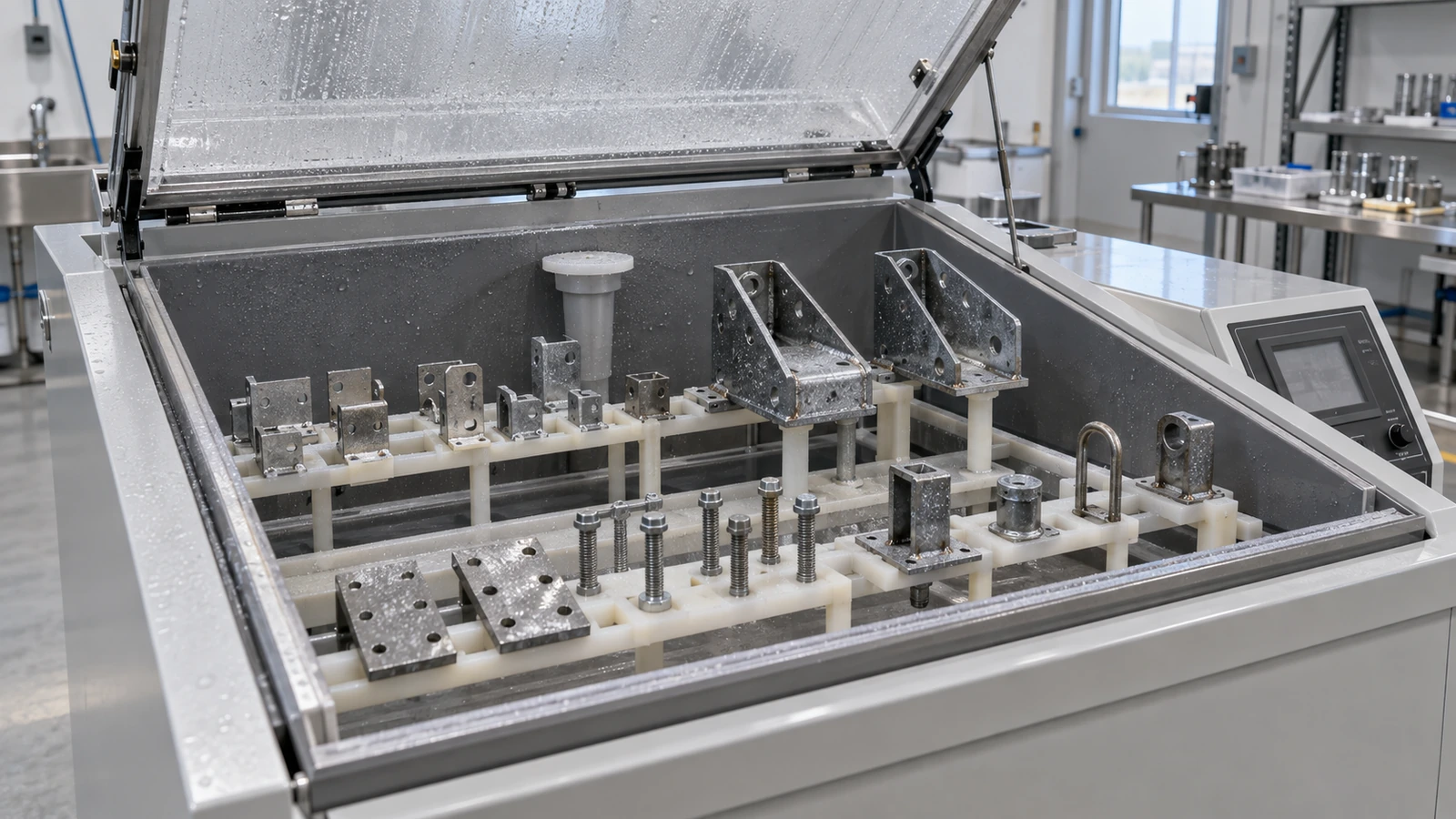
A corrosion protection strategy should be validated on representative assembled parts rather than inferred entirely from individual material certificates. For example, a practical qualification program for a marine jack mounting assembly could compare the production-intent configuration with an alternative isolation arrangement under representative chloride wetting and drying conditions. Inspection should include the mounting-hole edges, hidden contact surfaces, fasteners, coating condition, and any loss of mechanical function.
Depending on the application, cyclic corrosion testing, immersion testing, or field exposure may be appropriate. The test method and acceptance criteria should be selected to reflect the intended service environment. A laboratory exposure duration should not be presented as a direct prediction of years in service. This moves corrosion evaluation from a material-level claim to an assembly-level engineering process.
Qualification should also make the inspection sequence explicit. Record the assembly before exposure, define whether and how deposits are removed for evaluation, and examine interfaces after controlled disassembly when the protocol requires it. Document pitting, coating loss and any deterioration of the mounting function separately. This helps distinguish a cosmetic observation from a functional rejection without inventing a universal allowable damage limit.
Production changes deserve the same discipline. A substitute washer resin, altered coating process or revised hole tolerance may affect a previously qualified connection even when each replacement item meets its own purchase order. Identify who approves such changes and when assembly-level checks must be repeated. The objective is repeatability of the qualified arrangement, not a one-off specimen that production cannot reproduce.
What Trailer OEMs Should Change in Their Sourcing Specifications
The central procurement problem is that component specifications are often written independently. A frame supplier receives an aluminum alloy requirement. A jack supplier receives a load rating and finish requirement. A fastener supplier receives a stainless steel grade. Each supplier may satisfy its purchase order, while the completed assembly still has an unresolved corrosion risk. OEM specifications should therefore connect the materials, interfaces, exposure conditions, and production processes.
Three operating environments, three different decisions
| Operating environment | Exposure and engineering priority |
|---|---|
| Inland utility trailer | Occasional rain and condensation: verify compatibility, finish durability and drainage |
| Salted winter roads | Chloride deposits and repeated wet–dry cycles: protect holes, control trapped salt and validate isolation where needed |
| Saltwater boat trailer | Repeated immersion, splash and marine atmosphere: assess pairings, electrical paths, sealing, drainage and assembled performance |
These are engineering priorities rather than universal material prescriptions. A suitable solution for one trailer may be unnecessarily expensive for another. Conversely, a low-cost finish that performs adequately in an inland application may be insufficient for repeated saltwater exposure.
What should appear in an OEM RFQ?
For a jack, bracket, or hardware package intended for an aluminum trailer, the RFQ should establish the following requirements.
| Specification area | Information the OEM should request |
|---|---|
| Service environment | Freshwater, saltwater, road salt, storage conditions, and expected wetting frequency |
| Material identification | Aluminum alloy, steel grade, stainless grade, and other relevant materials |
| Surface protection | Actual coating process, specified thickness, coverage, and relevant test requirements |
| Dissimilar-metal interfaces | Identification of contacting materials and expected galvanic relationships |
| Isolation design | Barrier material, placement, bolt sleeves, washers, and electrical continuity requirements |
| Mechanical performance | Load rating, mounting geometry, fastener strength, clamp force, and connection validation |
| Corrosion verification | Test method, assembled sample configuration, exposure conditions, and acceptance criteria |
| Maintenance | Inspection access, cleaning guidance, replacement criteria, and service documentation |
A useful RFQ does not need to prescribe every manufacturing detail. It does need to establish which results the completed assembly must achieve and which interfaces require engineering verification. For example, specifying a stainless steel bolt without identifying the frame material, jack bracket finish, and operating environment leaves an important part of the design unresolved. Similarly, purchasing a galvanized bracket without defining the coating process or acceptance criteria makes meaningful supplier comparison difficult.
The objective is not to create the most expensive possible component package. It is to prevent apparently compliant individual parts from creating an avoidable system-level problem.
When discussing OEM jack and mounting requirements, attach the mating-part drawing and intended service environment to the RFQ. Assign responsibility for approving the complete interface, including any parts supplied by another vendor. Suppliers can then quote against a shared requirement rather than each assuming that someone else has resolved compatibility. Record the agreed configuration and revision so an apparently minor substitution does not silently change the approved assembly.
The GOODIN Perspective: Corrosion Resistance Must Be Designed Across the Assembly
For a trailer component supplier, corrosion performance cannot be reduced to a material name or a coating claim. A steel jack may be entirely appropriate for an aluminum trailer. Stainless hardware may also be a suitable choice. The engineering question is whether those components remain compatible after their materials, coatings, mounting geometry, and service environment are considered together. For OEM programs, GOODIN's recommended approach is to address corrosion compatibility before finalizing the component package:
Material pairing → Interface design → Manufacturing process → Assembly validation → Service requirements This sequence helps identify problems that a conventional component datasheet may not reveal. A jack's rated capacity does not establish whether its mounting arrangement is compatible with an aluminum frame. A stainless steel designation does not establish whether a bolted joint is adequately isolated. A galvanized finish does not establish how its protective coating will behave when connected to another metal in a chloride-rich environment.
For suppliers, the practical opportunity is to support OEMs with clearer material specifications, appropriate finish options, compatible mounting arrangements, and documented verification requirements. For buyers, the corresponding responsibility is to define the operating conditions and evaluate the complete component package rather than purchasing each item in isolation. This is particularly important for marine trailers, where corrosion prevention, mechanical reliability, maintainability, and manufacturing cost must be considered together.
The Bottom Line
Aluminum can provide substantial corrosion-resistance advantages in trailer manufacturing, but those advantages are not automatically preserved when aluminum is joined to steel, stainless steel, zinc-coated components, and other materials. Galvanic corrosion depends on electrical connection, electrochemical potential, electrolyte exposure, and the effective areas of the connected metals. Its severity can also be influenced by coating damage, trapped moisture, component geometry, and manufacturing quality. The appropriate response is not to prohibit every dissimilar-metal connection.
It is to understand where the risks arise and design the connection accordingly. For trailer OEMs, that means treating corrosion compatibility as a combined materials, manufacturing, and procurement decision. For component suppliers, it means looking beyond the performance of an individual part to the environment in which that part will operate.
Corrosion resistance belongs to the assembly, not to any single material.
For an OEM program, contact GOODIN to discuss the frame material, jack mounting interface, finish options and documentation needed for a defined verification plan.
Sources & Further Reading
Engineering sources support the mechanisms; retailer and BoatUS articles provide installation and ownership context. Figures are AI-generated illustrations, not customer failure records or approved installation drawings.
- ASSDA — FAQ 1: Galvanic/Dissimilar Metal Corrosion
- American Galvanizers Association — Dissimilar Metal Corrosion with Zinc
- American Galvanizers Association — In Contact with Other Metals
- American Galvanizers Association — Zinc Coatings for Steel Corrosion Protection
- ASSDA — Grade 316: The First Step Up
- CORROSION / AMPP — Effect of Surface Pretreatment on Galvanic Attack of Coated Al Alloy Panels — DOI 10.5006/1643
- ASSDA — Crevices and Corrosion
- etrailer — Can You Mount Steel Trailer Jacks on an Aluminum Trailer Without Corrosion?
- BoatUS — Hit The Road, Jack
A Perfect Cut Can Still Produce a Crooked Trailer: How Welding Sequence and Heat Distortion Destroy Dimensional Accuracy
1,000 Hours of Salt Spray Does Not Mean 10 Years Outside: How Trailer Buyers Should Read Corrosion Test Claims
Related Article