1,000 Hours of Salt Spray Does Not Mean 10 Years Outside: How Trailer Buyers Should Read Corrosion Test Claims
On this page
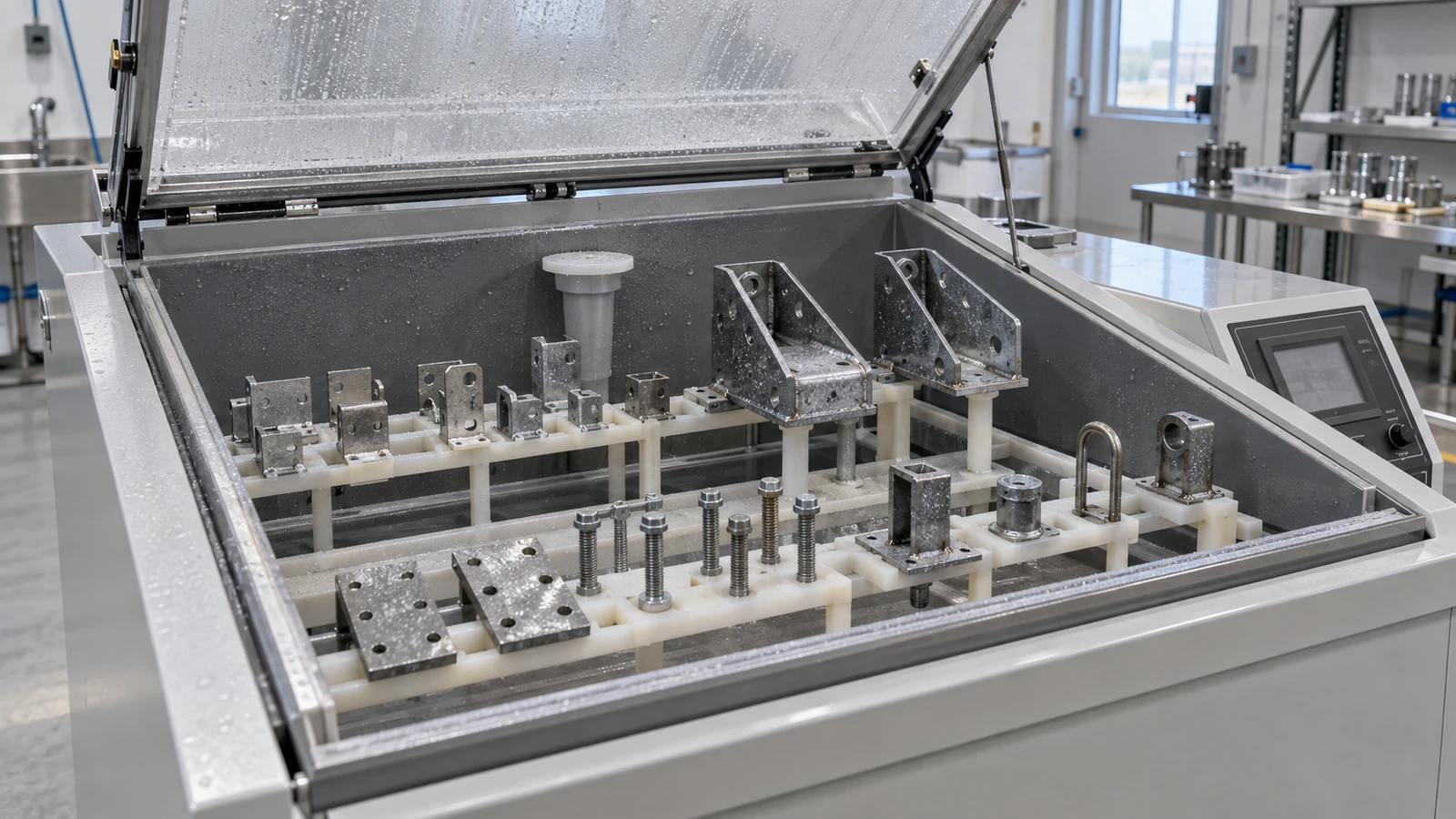
Three suppliers offer powder-coated steel trailer components. In this hypothetical comparison, Supplier A reports 500 hours of salt spray resistance, Supplier B reports 1,000, and Supplier C reports 1,500. Which will last longest on a boat trailer exposed to saltwater, or on an equipment trailer facing winter road salt?
The answer is not in the hour count alone. A controlled test can reveal protective-system weaknesses and verify an agreed requirement. It cannot, by itself, establish how many years a component will survive outdoors.
What was tested, what counted as failure, and does the evidence represent the component and environment you actually care about? Those questions make the test useful.
Materials & Manufacturing #6 · Testing evidence, production consistency and trailer sourcing
What the Standards Say—and What the Chamber Leaves Out
ASTM B117-26 describes a controlled corrosive environment for gathering relative corrosion-resistance information. It does not prescribe a specimen, exposure duration or interpretation for every product. Its significance-and-use provisions caution against predicting natural-environment performance from stand-alone salt spray results. Suitable corroborating long-term exposure evidence is needed before extrapolation. A procedure for operating a chamber is not a universal component durability specification. [1]
ISO 9227:2022, with its 2024 amendment, likewise separates the test method from the product specification. It covers several salt spray methods, including neutral salt spray, and is useful for detecting coating discontinuities and checking protective quality. It is not intended to rank different materials universally or predict their long-term corrosion resistance. The purchaser must identify the relevant method rather than assume that every report bearing the same standard number represents the same exposure. [2]
A supplier can therefore run a legitimate test and accurately report its duration while making an unsupported claim about outdoor service life. The report and the lifetime claim are different statements. One describes observed behavior under a defined laboratory challenge; the other needs evidence linking that challenge to the actual coating, component and environment.
Why Continuous Salt Fog Is Not the Same as Outdoor Corrosion
The difference becomes clearer when the corrosion environment is examined. A neutral salt spray test exposes specimens to a controlled mist of sodium chloride solution. The test environment is intended to remain consistent enough for specified comparisons and quality-control purposes. Outdoor exposure is not consistent in the same way. A trailer may become wet during rain and then dry in sunlight. Salt deposited during winter road treatment may remain on the underside after the road becomes dry.
A boat trailer may be immersed briefly in saltwater before being parked. An equipment trailer may experience both chemical exposure and abrasion from stones, gravel or cargo-handling equipment. The same steel component may also experience condensation, high humidity, temperature fluctuations and periodic washing. These changing conditions influence how water reaches the metal, how corrosion products develop and how the protective coating behaves. A continuously wet laboratory environment cannot reproduce every aspect of that process.
This is particularly important for coating systems whose protection depends on reactions occurring during alternating exposure conditions. For example, zinc coatings can form protective corrosion products during atmospheric exposure. The American Galvanizers Association explains that constant wetting in conventional salt spray testing can prevent the development of the protective zinc patina that forms under suitable natural wet-dry conditions. The test can therefore attack zinc in a way that does not adequately represent its long-term atmospheric behavior.
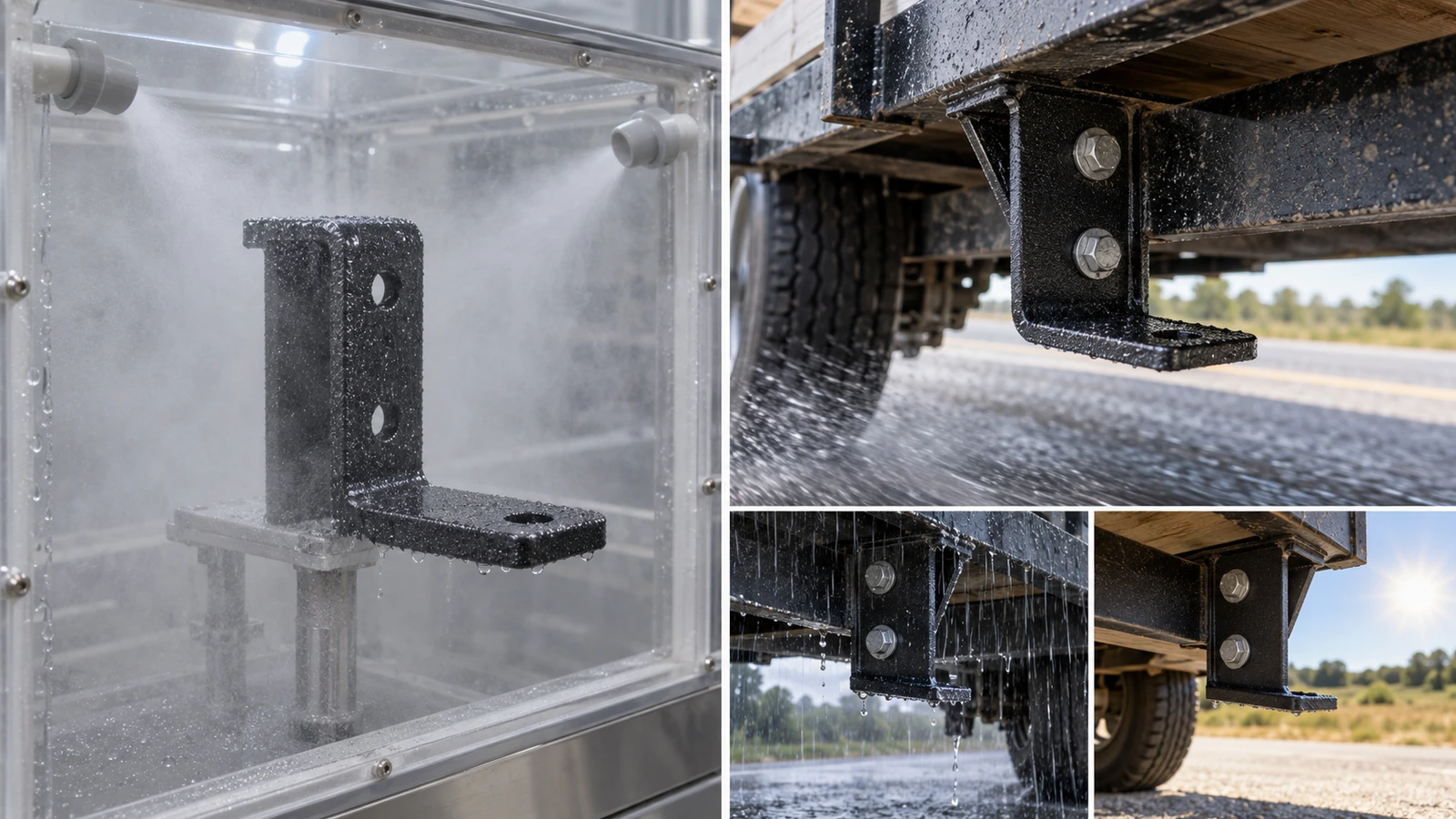
That does not make salt spray testing useless for all zinc-coated products. It means the test must be interpreted according to the actual coating system and the mechanism being evaluated. A powder-coated steel bracket, zinc-plated fastener and hot-dip galvanized trailer frame do not necessarily respond to the same artificial environment in equivalent ways. A harsher laboratory environment is not automatically a more representative laboratory environment. [9]
Define Failure Before Comparing Hours
Consider three hypothetical supplier reports.
| Illustrative report | What it demonstrates |
|---|---|
| A: 1,000 hours, no red rust | No red rust was reported under the specified test conditions and inspection criteria. |
| B: 1,000 hours, maximum 2 mm corrosion creep | Corrosion propagation around a defined defect remained within the specified limit. |
| C: 1,000 hours, no coating blistering | The coating satisfied a blistering requirement, but other corrosion criteria may not have been evaluated. |
These are illustrative examples, not actual supplier test results. The 2 mm value is not a universal acceptance limit. All three suppliers could advertise 1,000 hours of salt spray resistance. But they have not demonstrated the same thing. Supplier A may have tested an intact coated panel. Supplier B may have deliberately scratched the coating to expose the steel. Supplier C may have evaluated a different failure mechanism altogether. One test may be designed to investigate whether corrosion begins.
Another may investigate how corrosion propagates after the protective barrier is damaged. A third may focus on coating integrity. The hour count alone cannot distinguish between them. This leads to the first question every buyer should ask when reviewing a corrosion claim: What exactly counted as failure? Without that answer, the number is incomplete.
White Rust and Red Rust Are Not the Same Failure Criterion
The distinction becomes particularly important for zinc-coated trailer components. A steel fastener may receive an electroplated zinc coating, a zinc-alloy coating or a zinc-flake coating system. During corrosion testing, different corrosion products may appear at different stages. White corrosion products commonly indicate that the zinc-based protective layer is reacting with the environment. Red rust generally indicates corrosion of an iron-containing substrate. These observations represent different conditions.
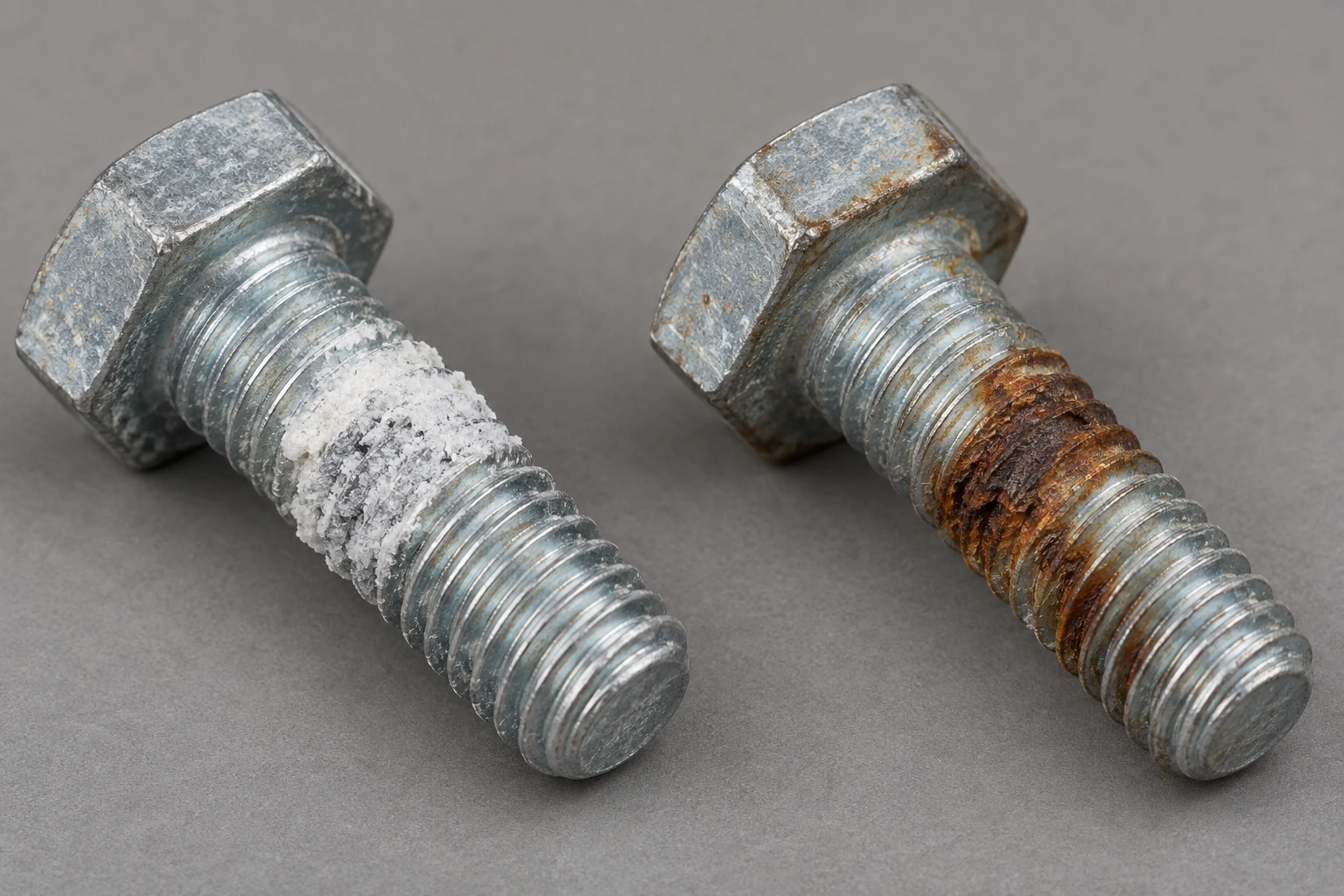
White corrosion does not automatically mean that the steel substrate has lost all protection. Red rust is generally a more direct indication that the underlying steel has become exposed to corrosive attack. However, the specific appearance and interpretation depend on the coating system. The 2026 technical report ISO/TR 19852 explicitly distinguishes the appearance of gray veil, white rust and red rust when evaluating coated fasteners. It documents these different observations because they cannot simply be treated as interchangeable end points.
For trailer procurement, this distinction creates a practical problem. A supplier may advertise 720 hours to red rust. Another may advertise 720 hours without white corrosion. The numbers are identical. The acceptance criteria are not. The second requirement may be more restrictive for a particular zinc-coating system, but the buyer cannot infer that the components are otherwise equivalent or that either has a longer outdoor service life.
The correct comparison requires the same relevant corrosion criterion. A meaningful RFQ should therefore state whether the requirement concerns white corrosion, red rust, coating blistering, corrosion creep or another defined condition. The corrosion endpoint is part of the specification, not a detail to be discovered after receiving the test report. [3]
A Scribe, a Panel and a Finished Part Are Different Tests
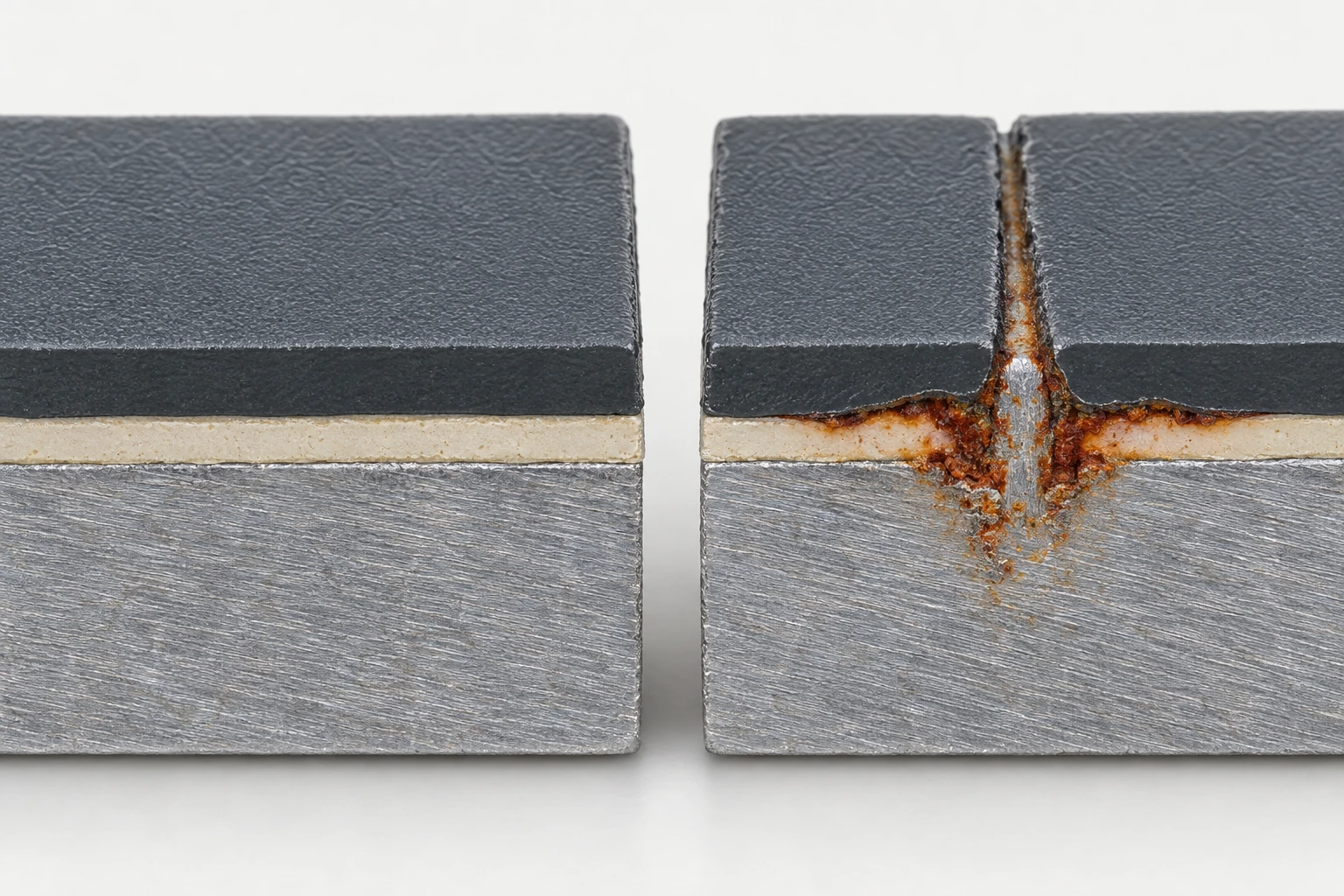
Organic coatings introduce another important distinction. A powder-coated steel panel may be tested with its coating intact. Alternatively, a deliberate scratch can be introduced through the coating to the underlying steel. The scratch is often called a scribe. These two configurations investigate different aspects of protection. An intact panel primarily challenges the coating system without introducing a deliberate path to the substrate. A scribed panel begins with a controlled defect.
The test can then investigate whether corrosion remains relatively localized or spreads beneath the surrounding coating. This matters because real trailer components can suffer coating damage. Road debris can strike a frame. A mounting bracket can be scratched during installation. A fastening operation can damage coating around a hole. A jack mounting structure can experience abrasion during handling or use. Once steel becomes exposed, the ability of the surrounding coating system to resist corrosion propagation becomes important.
A coating that performs well as an intact barrier does not automatically demonstrate equivalent resistance to corrosion creep from damage. ASTM D1654-24e1 addresses evaluation of painted or coated specimens after corrosive exposure, including corrosion, blistering, adhesion loss around a scribe and other film failures. The standard provides evaluation methods. The buyer still needs to specify the relevant acceptance requirement. For a trailer component, an intact-panel result and a scribed-panel result can both be useful.
They should not be presented as though they measure the same property. [6]
The Scribe Width and Measurement Method Matter Too
Even when two suppliers both use scribed panels, their results may not be directly comparable. A scribe has geometry. Its width, depth and location can influence the exposed area and the subsequent assessment. The method used to measure corrosion around the scribe also matters. A report may evaluate visible rust spreading from the defect. Another may evaluate coating delamination after removing loose material. The resulting measurements are related but not necessarily identical.
ISO 4628-8:2012 provides a method for evaluating corrosion and delamination around a scribe or other artificial defect. The standard distinguishes these forms of degradation because damage to the metal and loss of adhesion in the surrounding coating are not necessarily the same measurement. For an OEM, the practical implication is straightforward. If a specification requires a maximum corrosion-creep distance, the measurement method must be defined. The supplier should not be allowed to choose whichever interpretation produces the most favorable result after testing.
Likewise, a test report should identify the specimen preparation, defect geometry and evaluation procedure sufficiently clearly for another qualified laboratory to reproduce the intended assessment. This is particularly relevant when comparing different coating systems. A primer-and-topcoat system may behave differently from a single-layer powder coating after deliberate damage. Without a consistent evaluation method, apparent differences may reflect the test arrangement rather than the underlying product performance. [7]
A Flat Laboratory Panel Is Not a Trailer Frame
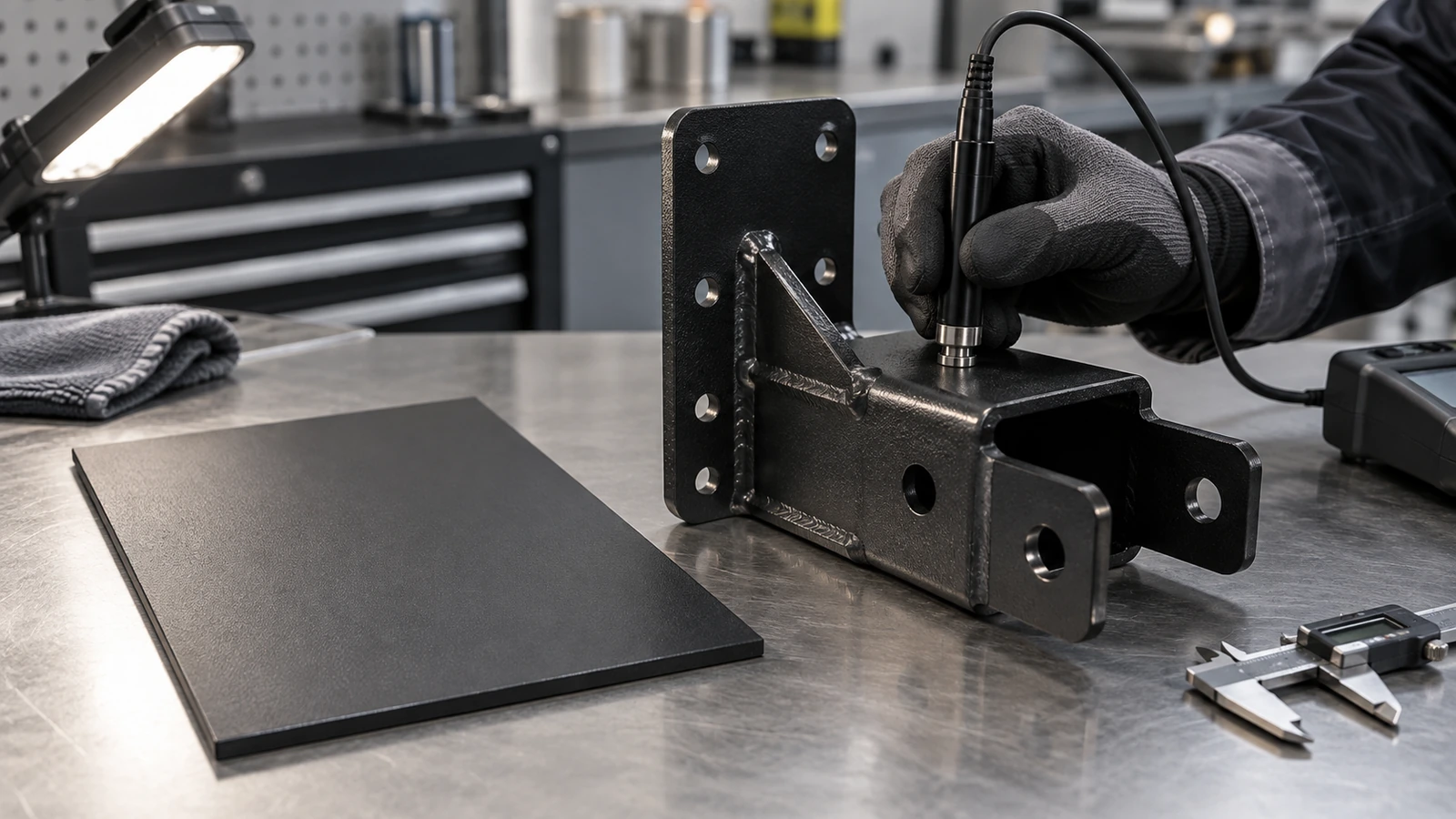
A standard coated test panel is useful because it provides a controlled specimen. Its geometry is simple. The coating can be applied relatively consistently. Thickness and adhesion can be measured at accessible locations. The specimen can be positioned predictably inside the test chamber. A completed trailer component is considerably more complicated. A trailer frame contains welded intersections, gussets, brackets, cut edges, mounting holes and potentially enclosed or recessed surfaces.
A powder-coated jack mounting bracket may have excellent film thickness on its broad face and inadequate coverage around a sharp edge. A welded connection may contain residual contamination that was absent from the laboratory panel. A recessed corner may receive less powder because of unfavorable electrostatic deposition conditions. A hot-dip galvanized assembly may contain drainage-sensitive details that were not present in the test specimen. These are manufacturing variables.
The corrosion test does not eliminate them. A supplier can demonstrate that a coating formulation performs well on a standardized panel while still manufacturing components with inadequate protection at critical locations. This is why specimen geometry must match the purchasing question. If the objective is to qualify a coating formulation, a controlled panel may be appropriate. If the objective is to validate a finished trailer bracket, a representative production component or a carefully designed representative test specimen may provide additional useful evidence.
The choice should follow the actual failure mechanism. A coating-system qualification is not automatically a finished-component qualification.
What Field Studies and Interlaboratory Results Actually Show
A 2024 study by Matthias J. Schmid compared neutral salt spray results with five years of field exposure for 19 organic coating systems intended for hydraulic steelwork. Four locations included atmospheric, splash and immersion zones. Results varied with coating system and exposure. Some systems that passed laboratory approval did not perform adequately outdoors. [8]
The statistical qualification matters: the paper reports four location/zone comparisons with significant correlations in the initial analysis, rising to six of twelve after removing two outlying coating systems. The six-of-twelve figure is not an unconditional success rate for salt spray testing.
These were hydraulic structures, not trailer chassis. Neither the years of exposure nor the measured relationships establish a service life for a trailer bracket. The useful sourcing lesson is narrower: laboratory approval and outdoor behavior can diverge, so evidence needs to be matched to its validated application. This does not make laboratory testing meaningless; it makes unqualified extrapolation unreliable.
The 2026 ISO Interlaboratory Study Reveals Another Problem: Reproducibility
ISO/TR 19852:2026 reports an international exercise involving 39 participants, 75 cabinets and 11 countries, using two zinc-based coating variants on M6 × 50 bolts. It recorded different corrosion appearances and evaluated cabinet conditions and reference panels. [3]
For those bolts, meeting the specified cabinet parameters did not reduce the scatter in recorded failure times. Reference-panel corrosion did not correlate with the behavior of the coated bolts tested alongside them. These findings support caution when comparing manufactured parts tested in different laboratories.
The report does not assign a universal variability percentage to powder-coated trailer frames. Nor does it excuse operating outside a specified method. Its practical implication is that laboratory, specimen and evaluation differences must be understood before treating a difference in hours as a difference in product quality. Buyers should agree on the protocol, assessment and appropriate replication. A 720-hour result from one arrangement and a 1,000-hour result from another cannot be ranked automatically.
Use Salt Spray to Verify a Requirement
Consider a manufacturer that has qualified a particular substrate, pretreatment, coating formulation, thickness and curing process. Testing production specimens against agreed acceptance criteria can help verify that the protective outcome is being maintained. It can also support an investigation after a change of pretreatment chemistry, curing practice or coating supplier.
ISO/TR 19852 supports coating-process monitoring and verification, and comparisons involving the same coating and coating process. It explicitly distinguishes that use from statistical process control. Salt spray results should not be turned into a stand-alone statistical process-capability measure. [3]
A failure against an agreed requirement needs investigation of the specimen, test execution and manufacturing history. It should not be dismissed because the test cannot predict field years; equally, it does not by itself identify the root cause. Passing a demanding test shows performance in that test, not a guaranteed life in Alaska, Florida or coastal Australia.
Why More Hours Are Not Always a More Useful Test
Increasing a requirement from 500 to 1,000 or 2,000 hours may be justified, but only if the extra exposure answers the intended engineering question. A longer test does not repair a mismatch between the chamber environment and the governing service failure.
Continuous fog does not itself reproduce gravel damage, ultraviolet degradation or every wet-dry interaction. Where protective zinc products develop differently outdoors, additional fog exposure can continue emphasizing a different mechanism. An organic coating may need separate weathering or damage-related evidence.
An established acceptance requirement needs an exposure duration that usefully discriminates acceptable from unacceptable production. A new application may need a broader qualification program. For a known field failure, reproducing the observed mechanism can be more valuable than extending an unrelated test. More hours should buy useful information, not just a larger marketing number.
Select Cyclic Testing for the Service Environment
Continuous salt spray is not the only accelerated corrosion test available. Cyclic corrosion tests expose specimens to changing environmental conditions. A typical cycle may include salt exposure, drying and high humidity. Some protocols also incorporate condensation or other conditions relevant to particular applications. The purpose is to reproduce selected features of outdoor exposure more realistically. In May 2026, ISO published the third edition of ISO 14993.
The standard describes accelerated testing involving cyclic exposure to neutral salt mist, dry conditions and wet conditions. Its introduction explains that real corrosion environments contain interacting variables that laboratory tests cannot reproduce completely. It also identifies the advantage of cyclic exposure for representing certain outdoor salt-contaminated conditions more closely than continuous neutral salt spray. Importantly, ISO 14993 does not turn laboratory exposure into a universal service-life prediction.
The method is intended for comparative quality evaluation under specified conditions. For organic coatings, ISO 11997-1:2026 provides additional cyclic corrosion methods involving wet salt fog, dry conditions and humidity. That standard is especially relevant when the purchasing question concerns a coating's behavior under an established cyclic exposure protocol. However, the OEM still needs to select the appropriate cycle, specimen and failure criteria. A cyclic test developed for one application should not automatically be assumed to represent every trailer service environment.
A boat trailer repeatedly immersed in saltwater may have different critical exposure conditions from a utility trailer that occasionally encounters winter road salt. A heavy-duty equipment trailer may also experience substantial mechanical damage that a corrosion chamber does not reproduce. Cyclic testing can improve environmental relevance, but it does not eliminate the need for application-specific validation. [4] [5]
SAE J2334 Shows Why Field Correlation Matters
The automotive industry provides a useful example of a more targeted approach to accelerated corrosion testing. SAE J2334 is a laboratory cyclic corrosion test developed with attention to vehicle field performance. Its scope describes the method as suitable for evaluating the corrosion performance of a particular coating system, substrate, process or design. It also states that field correlation must be established when applying the procedure to corrosion mechanisms outside its established scope.
That qualification is important. A field-correlated test is not a universal conversion calculator. Its relevance depends on the materials, failure mechanisms and exposure conditions for which the correlation has been established. For trailer manufacturers, SAE J2334 may be worth considering when evaluating coating systems exposed to automotive-type road environments. However, an OEM should still establish whether the selected protocol represents the actual trailer application. The appropriate standard for a trailer frame exposed to road salt may differ from the test program required for a boat trailer subjected to repeated immersion and abrasive handling.
The correct strategy is to select testing according to the service conditions and failure mechanism. Not simply to replace a familiar test with a newer or more complicated one. [10]
Why a Boat Trailer and an Equipment Trailer May Need Different Evidence
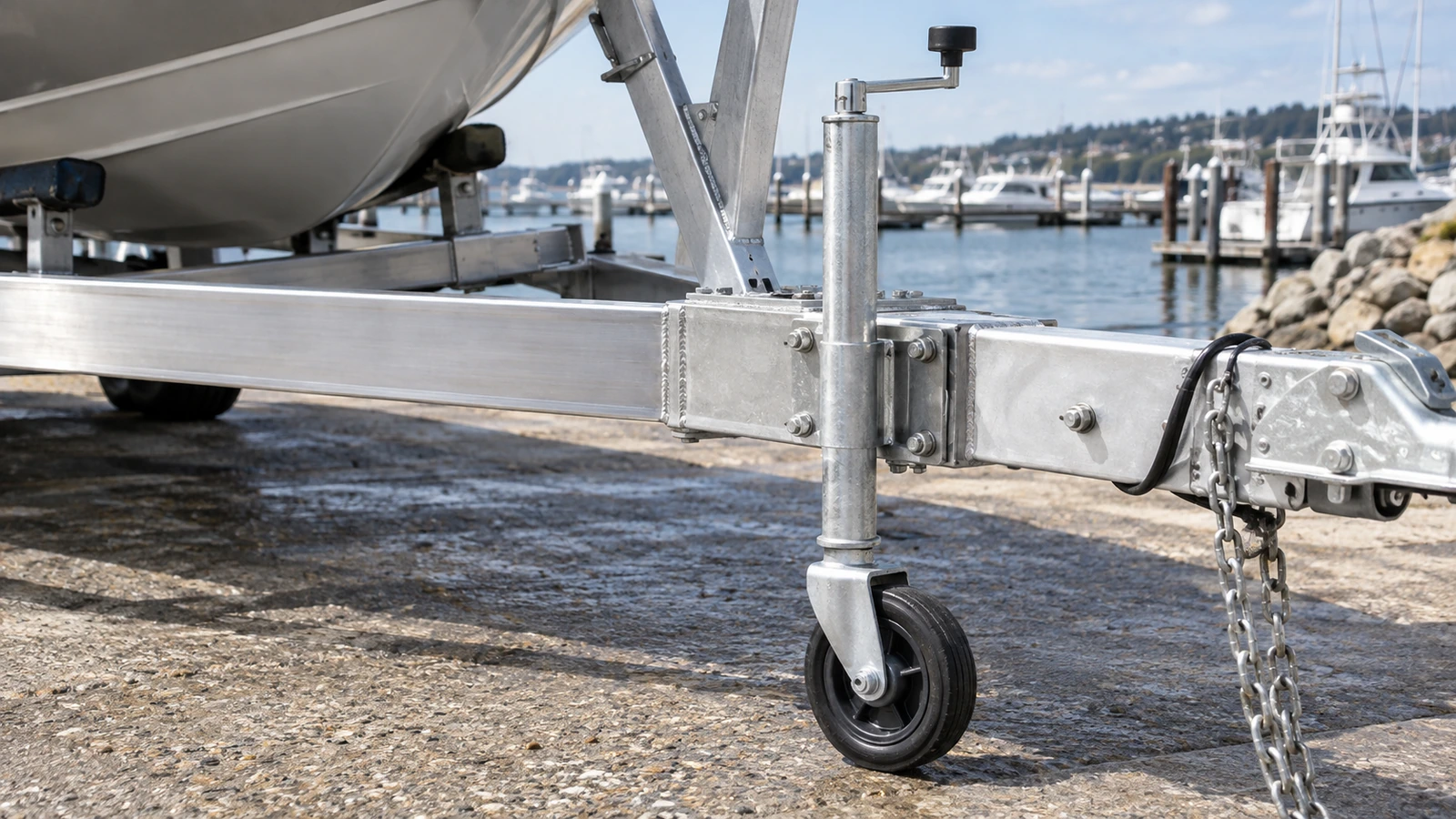
Consider two trailers. The first is a boat trailer. It is regularly launched into coastal water, retrieved and parked. Its frame, fasteners and mounting structures experience intermittent saltwater exposure. Some locations may retain water. Dissimilar-metal connections may create additional corrosion concerns. The second is an equipment trailer operating in a region where winter roads are treated with deicing chemicals. Its underside experiences chloride-containing road spray. It may then remain dry for extended periods.
Gravel and stones can damage exposed edges and welded brackets. Both trailers may be described as operating in corrosive environments. But their exposure histories are not identical. The boat trailer may require particular attention to repeated immersion, drainage, internal cavities and the compatibility of different materials. The equipment trailer may require particular attention to stone-chip damage, road-debris abrasion, coating edges and corrosion propagation after mechanical damage.
A single salt spray hour requirement cannot fully describe both applications. The OEM should identify the dominant exposure and failure mechanisms before selecting its validation program. The result may include neutral salt spray testing. It may also include cyclic corrosion testing, representative component testing, field exposure, inspection of production details or other relevant methods. The objective is not to require every possible test. It is to obtain evidence that addresses the actual service risk.
Validate the Manufacturing Process, Not Just the Powder
Salt spray results cannot be separated from the manufacturing process used to prepare the specimen. Consider a powder-coated steel bracket. Before coating, the steel may undergo degreasing, mechanical surface preparation and chemical pretreatment. The coating system may include a primer and topcoat. The powder must then be applied and cured under appropriate conditions. Each stage influences the final corrosion performance. A specimen with excellent pretreatment may perform differently from one using the same powder on inadequately prepared steel.
A primer-and-topcoat system may behave differently from a single-layer coating. A galvanized substrate beneath an organic coating may provide a different protective mechanism from bare steel beneath the same topcoat. This is why a coating brand and thickness do not fully define the tested product. The complete specimen must be identified. The previous Materials & Manufacturing article addressed this problem directly: powder coating failures can originate in contaminated steel, inadequate pretreatment, weld residues or poor edge coverage before the final coating appears defective.
Salt spray testing should help evaluate those manufacturing outcomes. It should not conceal them behind a single number. The buyer should know what was tested before deciding whether the result applies to the component being purchased.
A Material Certificate and a Corrosion Test Report Prove Different Things
Material traceability is important in trailer sourcing. A steel certificate may confirm the specified grade and mechanical properties. A coating certificate may provide details of the supplied coating material. A corrosion test report documents the performance of particular specimens under particular test conditions. These documents answer different questions. A steel certificate does not verify that the fabricated component received adequate pretreatment. A powder manufacturer's product data sheet does not prove that a particular supplier correctly applied and cured the powder.
A test performed on a laboratory panel does not prove that every production weld and cut edge has equivalent coating coverage. A successful prototype test does not establish batch-to-batch consistency. The finished component is the result of the complete manufacturing chain. For a critical trailer component, the procurement team should therefore identify which evidence is needed at each stage. The objective is not to collect as many certificates as possible.
It is to ensure that the documentation actually supports the intended product requirement.
Production Consistency Is More Important Than One Exceptional Test Result
Suppose a supplier submits a report showing 1,500 hours of salt spray resistance. The tested sample was carefully prepared. The steel was clean. The pretreatment process was operating correctly. Coating thickness and curing conditions were controlled. The laboratory specimen passed. Now consider what happens during normal production. Incoming steel surfaces vary. Welding residues accumulate around certain brackets. Pretreatment chemistry changes over time. Coating thickness varies across the component.
Oven loading changes the actual metal-temperature profile. The product leaving the factory may not reproduce the condition of the original test specimen. This is where process capability becomes important. The supplier should be able to demonstrate that routine production follows the qualified coating process. For relevant components, that may involve controlled pretreatment, film-thickness measurements, cure verification, inspection of vulnerable edges and appropriate periodic corrosion testing. The exact frequency and acceptance criteria should follow the component's importance and the OEM's quality requirements.
A single salt spray result can be affected by specimen and laboratory variability. Appropriate replication and consistent evaluation are therefore important; one exceptional result is not proof of permanent process capability. A supplier consistently meeting a defined, relevant acceptance requirement may provide more useful purchasing evidence than a supplier advertising an impressive maximum number without showing how production is controlled.
Rewrite the RFQ Around Comparable Evidence
An effective RFQ converts a general corrosion expectation into a testable manufacturing requirement. The following questions provide a practical framework.
| RFQ requirement | What the buyer should clarify |
|---|---|
| Substrate | Steel grade, aluminum alloy, galvanized steel or other material; actual surface condition before coating |
| Pretreatment | Cleaning method, surface preparation and applicable conversion-coating process |
| Coating system | Zinc plating, zinc-flake coating, powder coating, primer-and-topcoat system, hot-dip galvanizing or another specified system |
| Coating thickness | Required range, measurement method and measurement locations |
| Test standard | ASTM B117, ISO 9227 or another specifically identified method and edition |
| Specimen geometry | Flat panel, actual component or representative production specimen |
| Specimen preparation | Production coating process, cut-edge condition, masking and any deliberate scribe |
| Corrosion criterion | White corrosion, red rust, blistering, adhesion loss or corrosion propagation |
| Acceptance limit | Maximum permitted damage at the specified exposure time, including evaluation method |
| Laboratory | Agreed laboratory requirements, relevant test scope and report traceability |
| Batch consistency | Production controls, periodic verification and change-management requirements |
| Additional validation | Whether cyclic corrosion, field exposure or component-level testing is necessary for the actual application |
The applicable standards should be identified in the purchasing agreement. For example, ASTM B117-26 and ISO 9227:2022 describe salt spray testing environments, while ASTM D1654-24e1 addresses evaluation of coated specimens after corrosive exposure. These requirements should not be combined into a specification without confirming that the selected methods and acceptance criteria are compatible. A simple zinc-coated fastener does not require the same documentation package as a complete trailer chassis.
The RFQ should reflect the actual product and purchasing risk. The central improvement is that the buyer no longer asks only for a large number. The buyer defines what the number must demonstrate.
What a Useful Test Report Should Contain
An RFQ is only useful if the supplier's report provides enough information to verify compliance. A useful corrosion test report should identify the tested material and coating system. It should describe the specimen and relevant preparation. It should identify the test standard, edition and exposure duration. It should establish the inspection criteria and document the observations. When the evaluation concerns corrosion propagation, the report should explain how the relevant measurements were obtained.
When the coating system is claimed to represent production, the report should provide suitable traceability to the manufacturing process. Photographs can also help. Images of the specimen before and after exposure may reveal whether corrosion is localized around a scribe, concentrated on an edge or distributed across the surface. However, photographs alone do not replace the defined evaluation method. Lighting, image scale, cleaning before inspection and subjective interpretation can affect the apparent result.
The buyer should therefore expect both quantitative information where required and sufficient visual documentation to understand the observed failure pattern. A certificate stating only "Passed 1,000 hours" is not necessarily false. It is simply insufficient for some purchasing decisions.
When Two Suppliers Report Different Numbers, Compare the Test Conditions First
Consider a hypothetical sourcing decision involving two powder-coated trailer brackets. Supplier A reports 1,000 hours of neutral salt spray resistance. Supplier B reports 720 hours. The buyer initially assumes that Supplier A provides a more durable coating. Further review reveals that Supplier A tested an intact flat panel. Supplier B tested a representative bracket with a deliberate scribe. Supplier A reported the absence of visible red rust.
Supplier B evaluated maximum corrosion creep from the defect. The tests are not directly comparable. This does not establish that Supplier B's product is superior. It establishes that the available evidence does not support a simple comparison based on hours alone. The OEM could request that both suppliers test representative specimens under an agreed protocol. It could define identical substrate conditions, coating systems, specimen preparation and acceptance criteria.
If the products use different coating technologies, the OEM may also need additional evidence selected for the relevant service mechanisms. The goal is not to force every material into a meaningless universal ranking. It is to determine whether each proposed system satisfies the actual product requirement. Comparable evidence requires comparable test conditions and clearly defined performance criteria.
From a Test Result to a Responsible Durability Claim
Laboratory and field behavior can sometimes be connected, but the relationship must be demonstrated for the relevant system. An OEM with documented service data and corresponding test results may investigate a correlation for a particular coating, production process, component geometry and exposure.
The relationship remains bounded by its validation. A road-vehicle coating correlation cannot automatically be transferred to a boat trailer repeatedly immersed in saltwater, or from an organic coating to hot-dip galvanizing. A useful prediction identifies its field population, failure endpoint and uncertainty.
This separates three different commitments: a warranty is contractual; a corrosion test is evidence; a service-life prediction is an engineering estimate. None becomes the other simply because a report contains a large number of hours. Purchasing teams should ask which of those statements the supplier is actually making and what supports it.
For Dealers: Rust Complaints Should Be Investigated as Failure Mechanisms
Dealers often encounter corrosion after the component has already been in service. A buyer may report rust around a welded bracket. Another may find corrosion beneath a jack mounting plate. A third may observe widespread coating detachment after winter use. The original supplier may respond by pointing to its 1,000-hour salt spray certificate. That certificate can be relevant. It does not automatically resolve the complaint. The correct investigation begins by identifying where the corrosion started and how it progressed.
Corrosion concentrated around a sharp edge may indicate insufficient local protection or mechanical damage. Rust spreading from a weld may justify inspection of surface preparation, coating access or weld geometry. Widespread delamination may point toward a different failure mechanism involving the coating-substrate interface. A zinc-coated fastener showing white corrosion may require a different interpretation from one showing substantial red rust. These observations are diagnostic clues, not automatic proof of a particular manufacturing defect.
The actual service conditions and maintenance history also matter. The purpose of a warranty investigation should be to identify the failure mechanism and determine whether the qualified manufacturing process adequately addressed it. Repeating a salt spray test may be appropriate in some cases. In others, component inspection, process records or testing designed around the observed failure will provide more useful information.
GOODIN View: Salt Spray Hours Are Evidence, Not a Service-Life Clock
For GOODIN, corrosion performance should be discussed as a complete manufactured system: substrate, surface preparation, coating, local geometry and repeatable production. A test duration does not identify those features by itself, and a laboratory panel cannot stand in for every production weld or exposed edge.
When specifying trailer jacks and mounting hardware and accessories, connect the test requirement to the drawing, intended environment and protection system. Obtain evidence that the delivered component reproduces the qualified condition, rather than treating the largest advertised number as the purchasing objective.
Salt-spray hours are evidence of performance under defined conditions—not a service-life clock.
Severe applications may justify more demanding testing, cyclic exposure, component-level work or field validation. The appropriate combination follows the service risk. For an OEM program, contact GOODIN to discuss component specifications, coating requirements and the documentation needed for an agreed validation plan. No generic hour count should substitute for that conversation.
Sources & Further Reading
Standards are summarized from public publisher information and available previews; implementation requires the applicable full standard and an agreed product specification. Illustrations are AI-generated explanations, not measured results or photographs of supplier tests.
- ASTM International — ASTM B117-26 — Standard Practice for Operating Salt Spray (Fog) Apparatus
- ISO — ISO 9227:2022 — Corrosion tests in artificial atmospheres — Salt spray tests (with Amd 1:2024)
- ISO — ISO/TR 19852:2026 — Neutral salt spray test — Results of an international interlaboratory test and conclusions for practical application
- ISO — ISO 14993:2026 — Accelerated testing involving cyclic exposure to salt mist, dry and wet conditions
- ISO — ISO 11997-1:2026 — Paints and varnishes — Resistance to cyclic corrosion conditions — Wet (salt fog)/dry/humid
- ASTM International — ASTM D1654-24e1 — Evaluation of Painted or Coated Specimens Subjected to Corrosive Environments
- ISO — ISO 4628-8:2012 — Assessment of degree of delamination and corrosion around a scribe or other artificial defect
- Matthias J. Schmid — Correlation Between the Anticorrosive Performance of Protective Coatings Under Neutral Salt Spray Testing and Outdoor Atmospheric and Immersion Exposure (2024)
- American Galvanizers Association — Salt-Spray/Fog Accelerated Corrosion Testing of HDG Steel
- SAE International — SAE J2334_201604 — Laboratory Cyclic Corrosion Test
Aluminum Is Corrosion-Resistant—Until You Bolt the Wrong Metal to It: The Hidden Galvanic Problem in Trailer Assemblies
Powder Coat Failure Usually Starts Before the Powder: Why Pretreatment, Welds and Edges Decide Corrosion Performance
Related Article