
Boat Trailer Tongue Weight and Jack Load: Capacity, Position and Frame Strength
The total weight of a boat and trailer is an important towing number, but it is not the same as the vertical load carried by the trailer jack.
That distinction is behind many current setup problems. Owners see a trailer with a gross weight of 4,000 or 5,000 pounds and assume they need a jack rated for the same number. Others select a small jack because the trailer “does not feel heavy,” without measuring the tongue weight boat trailer operators actually place on the hitch and jack.
A third group buys a jack with sufficient capacity but mounts it on a weak, inconvenient or poorly positioned section of the tongue. The result can be excessive cranking effort, poor wheel movement, interference with the winch post or localized frame deformation.
The correct setup therefore requires three separate decisions: establish the loaded tongue weight, determine the load at the jack position, and verify that the trailer frame can safely support the selected mounting arrangement.
Measure the loaded tongue weight at the coupler, calculate or measure the load at the proposed jack position, verify the structural frame section, and only then select the jack capacity and mounting system.
Boat-trailer screening ranges vary between published guides. Use the trailer manufacturer's target as the controlling value, then verify the final loaded condition on a scale rather than relying on a percentage alone.
Three Setup Mistakes Behind Many Jack Problems
Mistake 1: Using Total Trailer Weight as the Jack Rating
A tongue jack normally supports only the front portion of the trailer when it is uncoupled. The trailer axles continue carrying most of the loaded weight.
For example, a loaded boat-and-trailer combination may weigh 4,000 pounds while the vertical load at the coupler is only several hundred pounds. This does not mean any small jack is acceptable, but it does mean the correct boat trailer jack capacity cannot be selected by copying the gross trailer weight.
The jack's rating must be compared with the actual vertical load at its support point, plus an appropriate capacity reserve and the manufacturer's operating limits.
Mistake 2: Ignoring Tongue Weight
Tongue weight is the downward force applied by the loaded trailer at the coupling point. It affects both jack selection and highway stability.
Too little tongue weight can allow the trailer to become unstable and begin oscillating behind the tow vehicle. Too much can overload the hitch, rear axle or suspension and reduce steering and braking control.
BoatUS commonly uses approximately 7% to 10% of loaded trailer weight as a screening reference in recent guidance, while some earlier boat-trailer guidance uses a wider 5% to 10% range. These figures are not a universal replacement for the trailer manufacturer's target.
The correct value should be measured with the boat, engine, fuel, batteries and normal equipment in their travel positions.
Mistake 3: Installing the Jack Wherever It Fits
A convenient empty area on the tongue is not automatically a suitable structural mounting point.
The jack applies a concentrated vertical force through its bracket, U-bolts or mounting plate. If that load is placed on a thin extension, corroded beam, unsupported plate or frame section with unsuitable geometry, the structure can flex or deform even when the jack itself remains within its rated capacity.
The jack mounting position also affects operating effort, swing clearance, wheel movement and the actual load carried by the jack.

What Tongue Weight Actually Means
Tongue weight is measured at the trailer coupler in the loaded towing condition. It is not simply the weight of the steel tongue or the force required to lift the coupler by hand.
The value changes when weight moves forward or rearward relative to the axle group.
Items That Can Increase Tongue Weight
- Moving the boat forward on the trailer.
- Moving the winch post forward.
- Carrying batteries, anchors or equipment near the bow.
- Moving the trailer axle group rearward.
- Adding front-mounted equipment or storage.
Items That Can Reduce Tongue Weight
- Moving the boat rearward.
- Moving heavy equipment toward the stern.
- Adding a heavier outboard motor.
- Moving the axle group forward.
- Carrying fuel or batteries behind the axle center.
These changes should not be made casually. Boat position affects hull support, transom location, bow-stop alignment and overall trailer geometry. Axle relocation changes braking, suspension and structural loading.
Why Tongue Weight Affects Fishtailing
A trailer with insufficient forward loading has less stabilizing force at the hitch. Small steering inputs, crosswinds or uneven road forces can start lateral movement that grows from side to side.
This is why owners searching for ways to avoid fishtailing should verify loaded tongue weight before adding accessories or attempting to correct the problem only through driving technique.
Excessive tongue weight creates another set of problems:
- The rear of the tow vehicle may sag.
- The front axle may lose steering load.
- The hitch or receiver may exceed its tongue-weight rating.
- The rear axle and tires may become overloaded.
- Braking and directional response may deteriorate.
The trailer, tow vehicle, receiver, ball mount, hitch ball and coupler must all remain within their respective ratings.
How to Measure Tongue Weight Correctly
Load the Trailer as It Will Be Towed
Include the normal amount of fuel, batteries, engine, anchor, fishing gear, safety equipment and other cargo. Secure everything in its travel position.
Use Level Ground
The trailer should be approximately level, with the coupler at its normal towing height. A nose-high or nose-low condition changes how weight is shared between the axles and support point.
Chock the Road Wheels
Prevent the trailer from rolling before lowering the coupler or jack onto a scale.
Measure at the Coupling Point
For the most direct tongue-weight reading, place a suitable scale or vertical support beneath the coupler at the hitch-ball location.
A reading taken beneath a side-mounted jack can differ from the load at the coupler because the jack is usually closer to the axle group.
Use a Scale with Adequate Capacity
A dedicated tongue-weight scale or commercial vehicle scale is preferred for heavier combinations. A household scale should only be used with a suitable lever arrangement and safe procedure within its capacity.

Tongue Weight and Jack Load Calculator
The following worksheet provides a practical first estimate. It does not replace actual scale measurements or the trailer and jack manufacturers' instructions.
Step 1: Calculate Loaded Trailer Weight
Add the weight of:
- The empty trailer.
- The boat and engine.
- Fuel and water.
- Batteries.
- Anchors and safety equipment.
- Fishing gear, coolers and personal cargo.
- Permanent accessories added after delivery.
The result is the loaded trailer weight used for the initial balance calculation.
Step 2: Estimate the Target Tongue Weight
Use the tongue-weight ratio specified by the trailer manufacturer.
For preliminary screening only:
Estimated Coupler Tongue Weight = Loaded Trailer Weight × Target Tongue-Weight Ratio
Example:
4,000 lb loaded trailer × 8% = 320 lb estimated coupler tongue weight.
Step 3: Estimate Load at a Side-Mounted Jack
A side-mounted jack is usually behind the coupler and therefore closer to the effective axle center. Because its lever arm is shorter, it may support more load than the tongue-weight reading at the coupler.
For a level, simplified trailer:
Estimated Jack Load = Coupler Tongue Weight × Coupler Distance ÷ Jack Distance
Where:
- Coupler Distance is measured horizontally from the effective axle-group center to the hitch-ball center.
- Jack Distance is measured from the effective axle-group center to the jack's ground-contact centerline.
Example:
- Coupler tongue weight: 320 lb.
- Axle center to coupler: 180 in.
- Axle center to jack: 150 in.
320 × 180 ÷ 150 = 384 lb estimated load at the jack position.
In this example, the jack carries approximately 20% more than the coupler tongue weight because it is mounted closer to the axles.
This formula is an estimate. Tandem-axle suspension movement, uneven ground, wheel chocks, trailer angle and structural flexibility can alter the real load. Direct measurement at the jack position provides a better final value.
| Calculator input | Your value | Example |
|---|---|---|
| Loaded trailer weight | ________ lb | 4,000 lb |
| Manufacturer-specified tongue-weight ratio | ________ % | 8% |
| Estimated coupler tongue weight | ________ lb | 320 lb |
| Axle center to coupler | ________ in | 180 in |
| Axle center to jack | ________ in | 150 in |
| Estimated jack support load | ________ lb | 384 lb |

How Much Jack Capacity Is Enough?
The jack should be rated above the maximum expected vertical load at its mounting and support position.
Selection should consider:
- Measured loaded tongue weight.
- Estimated or measured jack-position load.
- Fuel and equipment changes.
- Uneven ground and trailer angle.
- Frequency of use.
- Wheel or foot configuration.
- Manufacturer-required capacity reserve.
Do Not Confuse Support and Lift Ratings
Some products specify lifting capacity, support capacity or both. Confirm which number applies to the intended operation.
Higher Capacity Does Not Strengthen the Trailer Frame
Installing a 2,000 lb jack on a weak mounting plate does not create a 2,000 lb structural support point. The frame, bracket, fasteners and jack must all carry the load together.
Capacity Does Not Guarantee Easy Cranking
Cranking effort also depends on screw pitch, gear ratio, lubrication, handle length, corrosion, jack angle and side loading.
A correctly rated jack can still feel difficult if it is leaning, binding or mounted where the wheel cannot align with the direction of movement.
How Mounting Position Changes Jack Load and Frame Stress
Moving the Jack Rearward Can Increase Its Vertical Load
When the jack is moved closer to the trailer axles, its lever arm becomes shorter. To balance the same trailer moment, the jack may need to carry more vertical force.
This means a jack mounted well behind the coupler can experience more load than the tongue-weight value measured at the hitch ball.
Moving the Jack Forward Can Create Clearance Problems
A forward mounting position may reduce the calculated support load but can interfere with:
- The coupler handle.
- Safety chains.
- The winch post.
- The boat bow.
- Brake actuator travel.
- Electrical plugs and breakaway components.
The Jack Must Remain on a Structural Frame Section
Avoid mounting to:
- Thin accessory plates.
- Fender or light brackets.
- Severely corroded tubing.
- Unsupported tongue extensions.
- Areas with cracks or previous deformation.
- Locations that require incompatible U-bolts.
Check Local Beam Stress
A beam mount jack applies force over a limited contact area. Correctly fitted U-bolts and backing plates help distribute clamp load, but the beam wall thickness and section size must still be appropriate.
Overtightening U-bolts can deform thin tubing. Undertightening allows the bracket to rotate or slide. Follow the jack and trailer manufacturers' hardware and torque requirements.
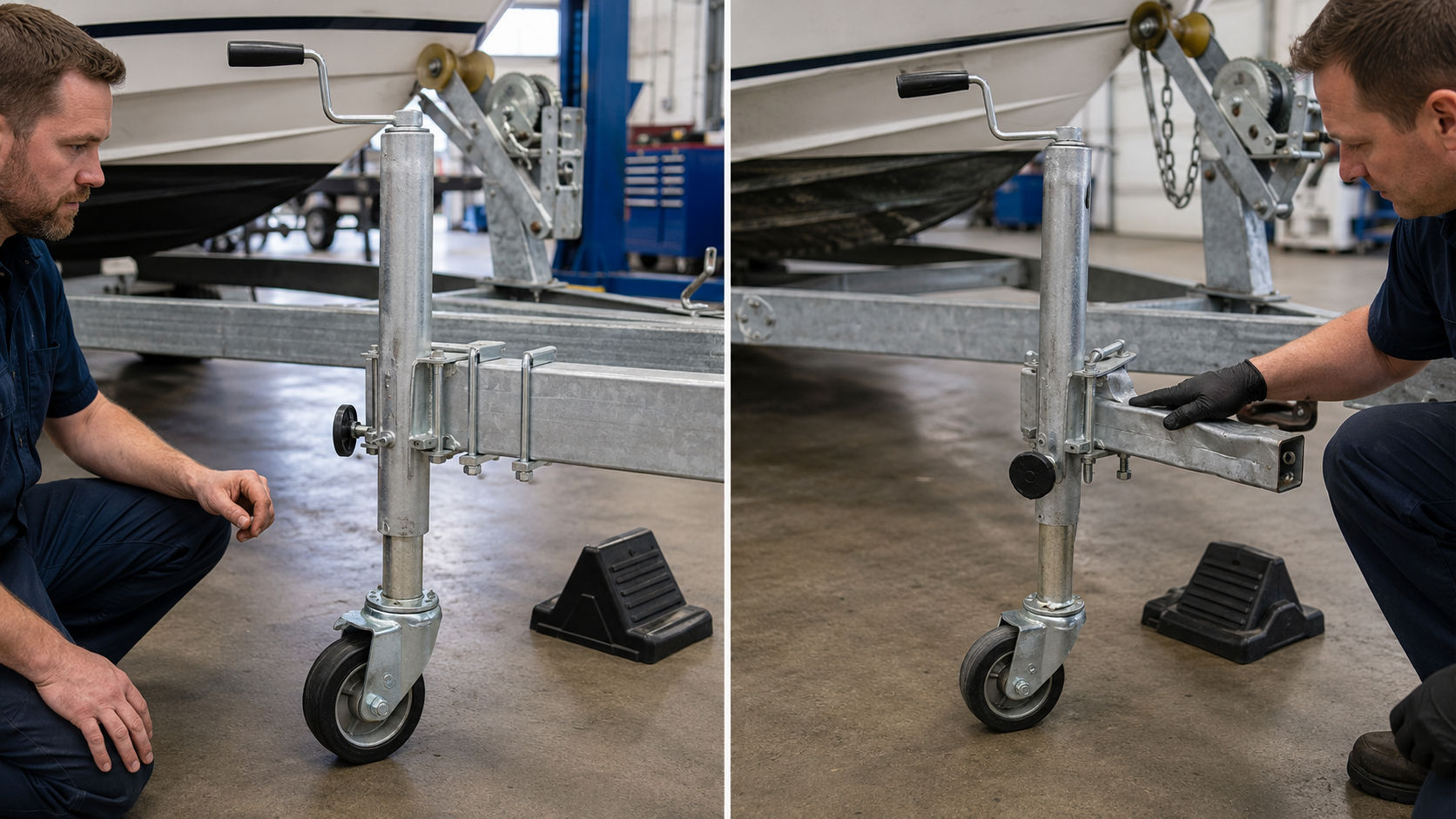
Beam-Mount Jack or Center-Mount Jack?
Side or Beam-Mount Jack
A side-mounted swivel jack clamps or bolts to a tongue beam and can rotate into a horizontal towing position.
Advantages include:
- Flexible mounting location.
- Wheel options for manual positioning.
- Fast swing-up storage.
- Compatibility with many straight or A-frame tongues.
Limitations include concentrated beam loading, possible bracket rotation, restricted frame space and a jack load that changes with mounting distance.
Center or A-Frame-Mount Jack
A center-mounted jack passes through an engineered A-frame plate near the trailer centerline.
Advantages include:
- Centralized support.
- Reduced steering bias while manually positioning.
- Potentially stronger integration with an engineered mounting plate.
- Higher-capacity fixed-jack options.
Limitations include restricted compatibility with surge-brake actuators, winch posts and existing tongue layouts. It may also provide less convenient swing-away storage.
Neither mounting style is automatically superior. The frame and trailer architecture should determine the correct choice.
Why Poor Mounting Can Make a Jack Hard to Operate
The Jack Is Not Vertical
A leaning jack creates side load on the inner tube, screw and wheel fork. This can increase friction and wear.
The Wheel Cannot Caster
If the jack is too close to the coupler, frame or winch stand, the wheel may not rotate freely into the direction of movement.
The Crank Has Insufficient Clearance
A sidewind handle can contact the boat bow, winch post or another accessory. A topwind handle may interfere with the hull or cover.
The Swing Mechanism Cannot Lock Fully
A bracket installed beside a weld, brake line or frame change may prevent the locking pin from entering completely.
The Jack Is Carrying Side Load
Tongue jacks are primarily intended for vertical support. Trying to force a heavily loaded trailer sideways, especially on a slope or against a blocked wheel, can bend the bracket or tube.
Boat Trailer Jack Setup Comparison
| Setup | Likely Result | Corrective Action |
|---|---|---|
| Jack selected from total trailer weight | Unnecessary cost, size or false confidence | Measure tongue and jack-position loads |
| Jack selected below actual support load | Heavy cranking, flexing and premature wear | Use measured load and suitable reserve |
| Jack mounted too far rearward | Higher jack reaction and difficult movement | Review lever distance and structural location |
| Jack mounted on thin unsupported plate | Localized bending or frame damage | Relocate to an approved structural member |
| Correct rating but poor clearance | Crank, wheel or swing mechanism interference | Check complete operating envelope before installation |
How to Correct Tongue Weight
Do not begin by moving the jack. The jack does not determine towing tongue weight while the trailer is connected to the tow vehicle.
Adjust Portable Cargo First
Move movable equipment gradually and remeasure. Keep heavy items low, secured and near structurally suitable storage areas.
Review Fuel and Battery Locations
Permanent or frequently carried heavy items can significantly change balance.
Confirm Boat Position
The bow should contact the intended stop, and the transom should remain correctly supported. Do not move the boat simply to achieve a number if the hull no longer fits the trailer correctly.
Do Not Relocate Axles Without Engineering Review
Axle movement changes tongue weight but also affects suspension loads, brake-line routing, fender clearance and frame stress. This work should follow the trailer manufacturer's design guidance.
Installation Checklist
Before Selecting the Jack
- Record the fully loaded trailer weight.
- Measure tongue weight at normal hitch height.
- Measure the axle-center-to-coupler distance.
- Measure the axle-center-to-jack distance.
- Estimate or measure the load at the jack position.
- Confirm the required lift and support ratings.
- Record the trailer-frame width, height and wall condition.
Before Drilling, Clamping or Welding
- Confirm the mounting point is approved and structural.
- Inspect for corrosion, cracks and deformation.
- Check brake lines, wiring and surge-actuator movement.
- Verify that the supplied bracket fits the frame.
- Confirm crank, wheel and swing clearance.
- Use a qualified welder where welding is permitted.
After Installation
- Confirm the jack is vertical in the operating position.
- Verify that all fasteners are tightened correctly.
- Test the jack through its complete travel.
- Confirm the locking mechanism engages fully.
- Check that the wheel or foot remains stable under load.
- Confirm the stored jack clears the road and trailer components.
- Recheck the mounting hardware after the first trips.
GOODIN Industry Perspective
For OEM buyers, a jack request should include more than a capacity number.
A useful RFQ should define:
- Fully loaded boat-and-trailer weight.
- Measured minimum and maximum tongue weight.
- Expected load at the jack mounting position.
- Axle-center, coupler and jack-location dimensions.
- Trailer tongue section size and wall condition.
- Beam mount, A-frame mount or weld-on requirement.
- Single-wheel, dual-wheel or footplate configuration.
- Required travel, retracted height and extended height.
- Freshwater or saltwater exposure.
- Required coating and fastener materials.
- Operating frequency and expected ground conditions.
GOODIN's Trailer Jack range covers marine, recreational, medium-duty and heavy-duty support applications.
The Boat Trailer Jack range includes wheeled and swing-back arrangements for loading ramps, storage yards and trailer positioning.
For lighter measured support loads and compact side-mounted applications, buyers can review the LF961-1010L 1000 lbs single-wheel swivel-lock trailer jack . Its suitability should be checked against the real support load, 6-inch wheel, 10-inch travel and available mounting space.
For applications requiring a higher rated capacity and broader dual-wheel footprint, the LF965-2010B 2000 lbs dual-wheel boat trailer jack provides another configuration to compare with the tongue load, jack-position load, ground surface and frame strength.

Match the Product to the Measured Load and Mounting Architecture
Compare the jack's operating rating, wheel or foot, travel and bracket arrangement only after the coupler load, jack-position load and structural mounting point have been established.
Send the Load, Lever Distances and Frame Details in One RFQ
Include loaded trailer weight, measured coupler tongue weight, axle-center-to-coupler distance, axle-center-to-jack distance, expected jack load, frame section dimensions and condition, mounting method, required travel, retracted height, wheel or foot configuration, water exposure, order volume and target market.
Focused FAQ
Should Trailer Jack Capacity Match the Total Trailer Weight?
No. A tongue jack normally supports the vertical load at the front of the trailer, not the complete trailer weight. Select capacity from the measured load at the jack position, with appropriate reserve and manufacturer guidance.
What Is the Correct Tongue Weight for a Boat Trailer?
Use the trailer manufacturer's specification. BoatUS commonly uses approximately 7% to 10% of loaded trailer weight as a screening reference, while some boat-trailer guidance uses 5% to 10%. The actual target depends on the trailer and towing system.
Can Too Little Tongue Weight Cause Fishtailing?
Yes. Insufficient tongue weight can reduce towing stability and allow trailer sway to develop. Load distribution should be corrected and verified before further highway towing.
Can Too Much Tongue Weight Damage the Tow Vehicle?
Excessive tongue weight can overload the hitch, receiver, rear axle, suspension or tires and reduce steering and braking control.
Why Is the Load on My Jack Higher Than the Tongue Weight?
A side-mounted jack is usually positioned behind the coupler and closer to the axle group. Its shorter lever arm can require it to support more vertical force than the load measured at the hitch ball.
Where Should a Beam-Mount Jack Be Installed?
Install it on a manufacturer-approved structural frame section that matches the bracket dimensions and provides sufficient crank, wheel and swing clearance. Do not attach it to a thin accessory plate or severely corroded beam.
Can a Trailer Jack Bend the Tongue?
The jack can contribute to localized deformation if it is mounted on a weak or unsupported section, if the bracket is incorrectly fitted, or if the trailer is subjected to side loads beyond the intended use.
Is a Center-Mount Jack Better Than a Side-Mount Jack?
Not universally. Center mounts provide centralized support but require a compatible A-frame structure. Side-mounted swivel jacks offer flexible placement and swing-away storage. Frame design and operating requirements should determine the choice.
Can I Measure Tongue Weight Under the Existing Jack?
You can measure the load at the jack position, but it may not equal the tongue weight at the coupler. For towing balance, measure at the hitch-ball point or apply an appropriate geometry correction.
Does Moving the Jack Change Highway Tongue Weight?
No. When the trailer is coupled and the jack is raised, moving the jack does not change highway tongue weight. It changes the load and leverage experienced by the jack when the trailer is uncoupled.
Conclusion
Trailer total weight is not the only number needed to select a jack. The more relevant values are loaded tongue weight, actual support load at the jack position and the capacity of the frame section carrying the mounting bracket.
Ignoring tongue weight can create towing instability. Ignoring jack-position leverage can lead to an under-rated support system. Ignoring the frame can cause a correctly rated jack to be installed on a structure that cannot use its capacity safely.
The correct sequence is straightforward: load the trailer as used, measure the tongue weight, calculate or measure the jack-position load, inspect the frame and then select the jack and mounting system.
A more expensive jack cannot correct the wrong load calculation or the wrong installation point. Proper setup has to begin with measurement.
Technical References
How to Move a Boat Trailer in a Tight Garage: Jacks, Dollies and Movers
Boat Trailer Jack Upgrade Guide: Wheel Size, Capacity and Swing-Back Fit
Related Article


