How Much Hand Winch Do You Actually Need? Choosing Line Pull and Gear Ratio for Boat Trailer Loading
In this guide
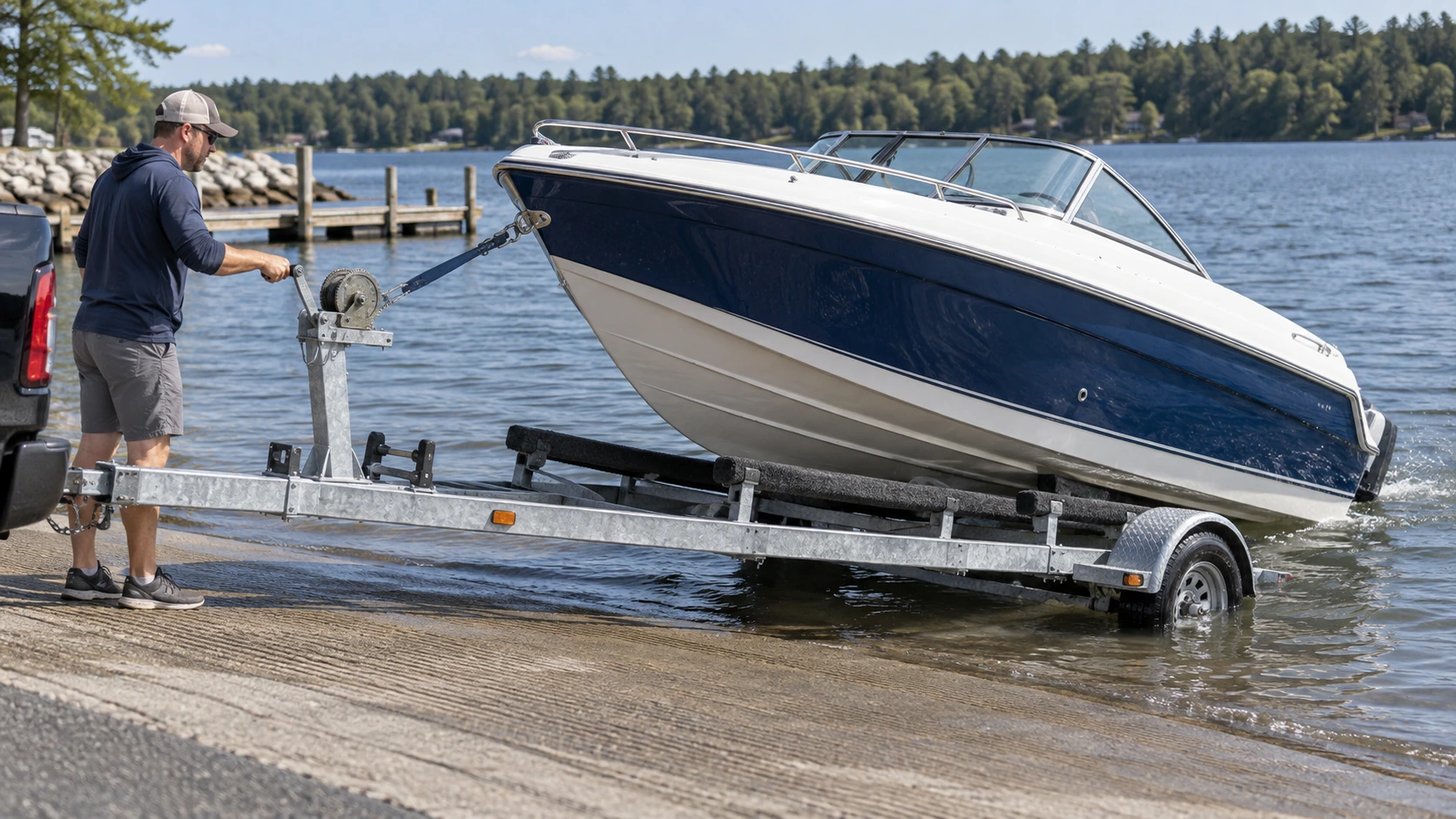
A boat weighs 3,000 lb fully loaded.
Does that mean it needs a 3,000 lb trailer winch?
Not necessarily.
But it also does not automatically mean that a 1,500 lb winch is sufficient just because a common sizing rule says the winch can be rated at roughly half the boat weight.
The boat's weight is only the starting information.
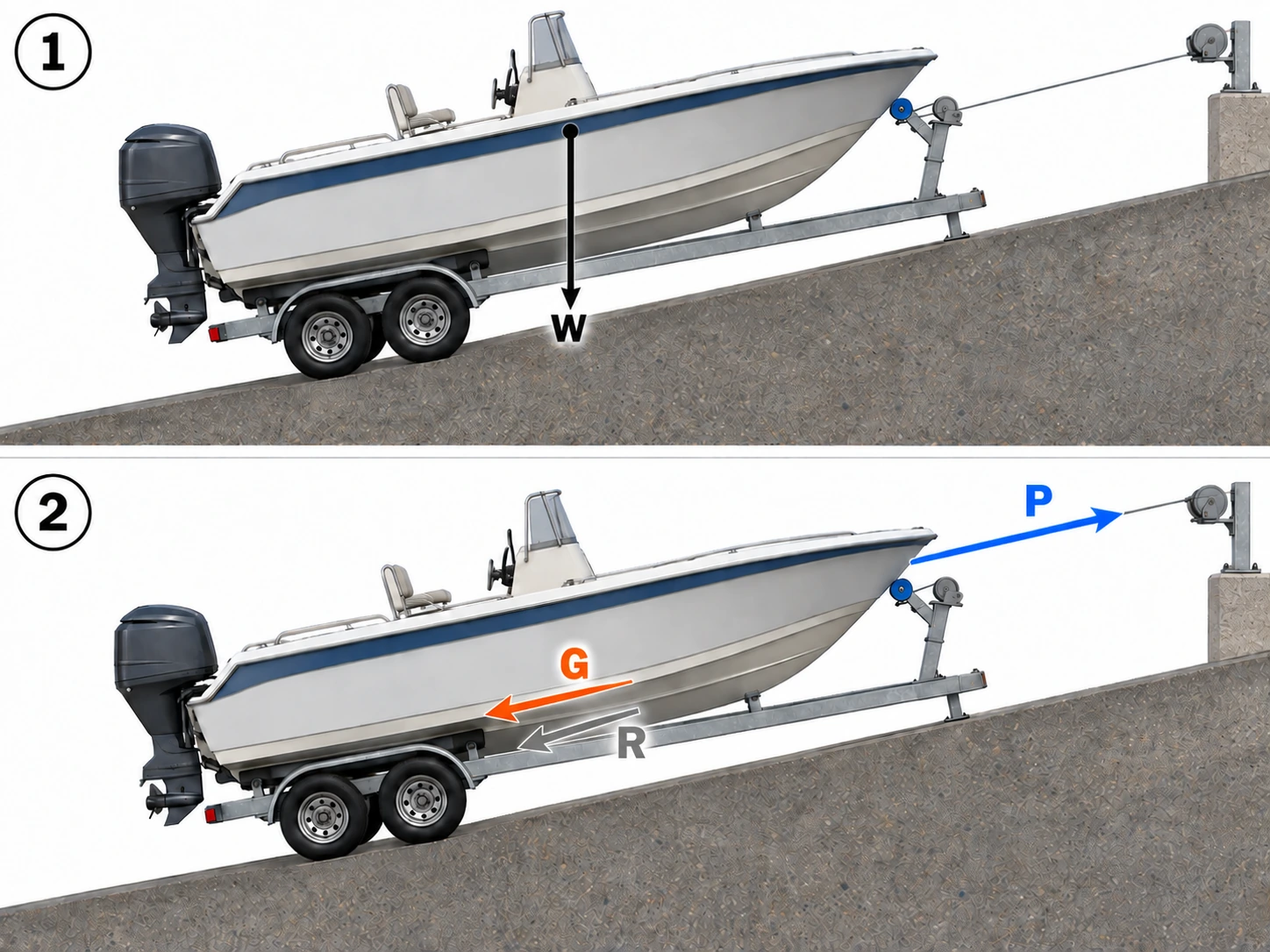
A hand winch does not normally lift the complete boat vertically. It pulls the boat along a trailer on an inclined ramp, while rollers, bunks, water support and friction determine how much resistance actually reaches the winch line.
Change those conditions and the same 3,000 lb boat can produce a very different pulling requirement.
This is why current boat-trailer winch guidance looks beyond boat weight. Fulton uses half of loaded boat weight as a general starting point, but recommends increasing the required winch capacity for shallow-water or steep-ramp retrieval. etrailer likewise changes its sizing guidance according to rollers, wooden bunks, pull distance and ramp conditions. [1] [3]
The correct purchasing question is therefore not:
“How heavy is the boat?”
It is:
“What is the highest line pull this loading system is expected to require, under what drum condition, and what gear ratio lets the operator produce that pull repeatedly?”
That is the specification the winch actually needs to satisfy.
Selection guidance, not model approval. Verify maximum operating line pull, drum-layer rating, approved line and mounting with the manufacturer.
From Boat Weight to Actual Line Pull
The first number to establish is still boat weight.
Use the expected loaded retrieval weight, including the equipment that normally remains aboard:
- boat;
- engine;
- fuel;
- batteries;
- permanently installed equipment; and
- normal onboard gear.
Fulton's trailer catalog guidance explicitly bases its initial selection on the maximum weight of the boat including motor, fuel and gear. [1]
For this article, consider a hypothetical loaded boat weighing:
3,000 lb
That number establishes the scale of the application.
It does not yet tell us the required winch capacity.
Two identical 3,000 lb boats can impose very different loads on their winches if one is retrieved over free-running rollers on a moderate ramp and the other must travel several feet across wet carpeted bunks on a steep ramp.
What Actually Creates Line Pull?
The required line pull is the force the winch must produce through the strap or cable to keep the boat moving toward its final trailer position.
Conceptually, it comes from several sources:
required pull ≈ resistance from the ramp + resistance from the trailer supports + other mechanical losses
The most important application variables are:
- ramp angle;
- roller or bunk resistance;
- how much of the boat remains supported by water;
- how far the boat must actually be winched;
- alignment between bow eye and winch;
- line buildup on the drum; and
- any abnormal resistance during the loading cycle.
Drum buildup changes available winch capability rather than the external resistance itself. If abnormal resistance occurs, stop and identify the cause rather than forcing the boat into position.
This is why a capacity label cannot be interpreted simply as “maximum boat weight.”
Ramp Angle Changes the Gravity Component
On a level surface, gravity does not pull the boat backward along the trailer in the same way it does on an incline.
Increase the launch-ramp angle and the winch must resist a larger component of the boat's weight.
That is why both Fulton and etrailer increase their recommended winch capacity as ramp conditions become more demanding. Fulton, for example, uses loaded boat weight divided by two as its normal screening rule but changes the divisor to 1.5 when shallow-water or steep-ramp launches are expected. [1]
For a 3,000 lb loaded boat, those two screening calculations would be:
| Screening condition | Calculation | Initial capacity screen |
|---|---|---|
| General Fulton starting point | 3,000 ÷ 2 | 1,500 lb |
| Shallow water / steep ramp | 3,000 ÷ 1.5 | 2,000 lb |
These numbers are useful.
But they should not be converted into a universal rule such as:
Every 3,000 lb boat needs exactly a 1,500 lb winch.
Other guidance uses different assumptions. etrailer, for example, notes that good rollers and a short pull can allow a roughly 3:1 boat-weight-to-winch relationship, while long pulls over wooden bunks can move the recommendation toward 1:1. [3]
West Marine currently uses another screening approach, recommending greater winch capacity as bunk friction and ramp severity increase. [6]
The lesson is not that one ratio must be correct.
It is that boat-weight ratios are application heuristics, not substitutes for knowing the actual retrieval conditions.
Rollers, Bunks and Loaded Pull Distance
The trailer's support system is one of the most important inputs.
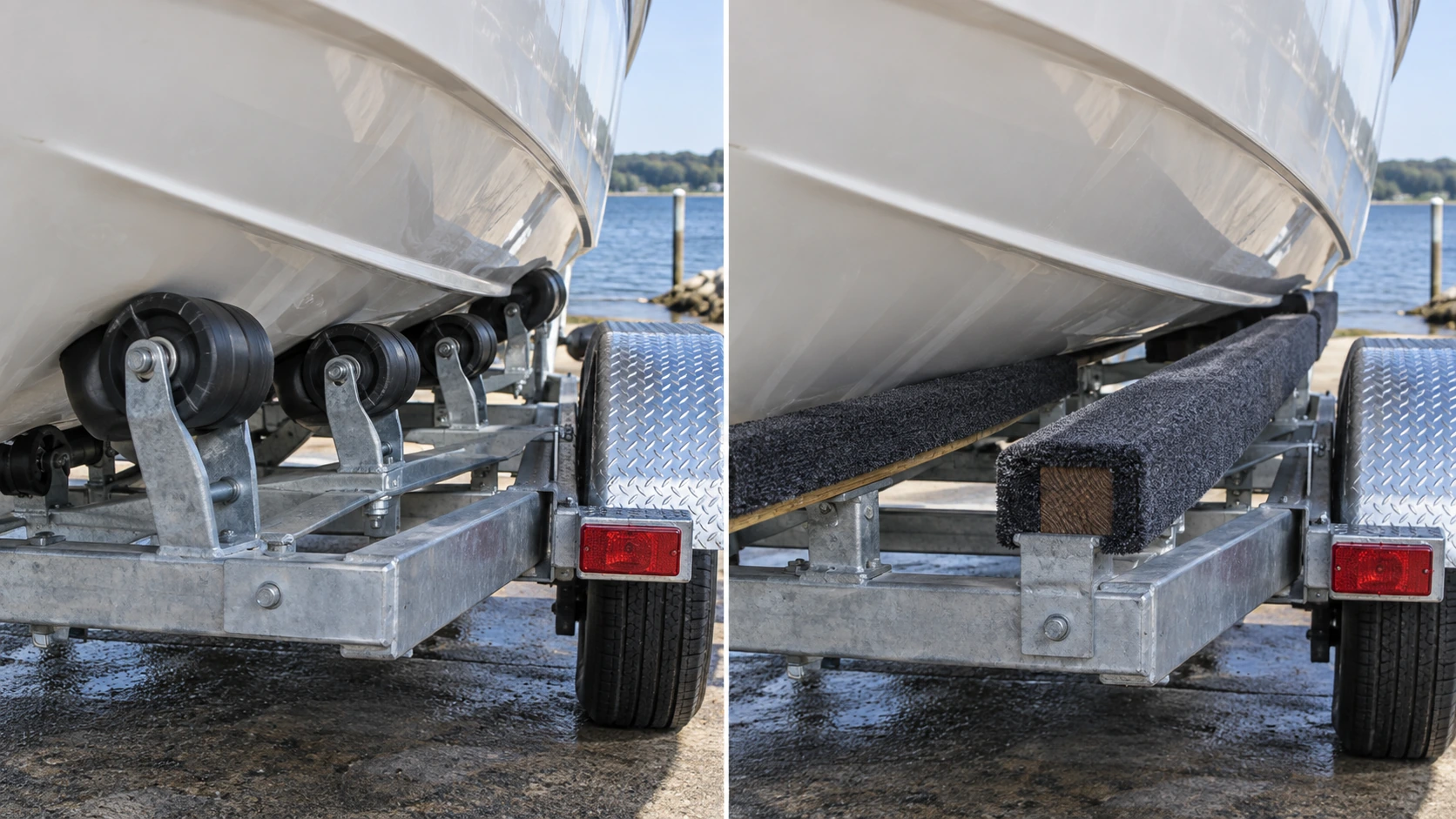
Roller Trailer
Well-functioning rollers allow the hull to move with relatively low rolling resistance.
For a boat that remains substantially supported by water until late in the loading process and then travels only a short distance on freely rotating rollers, required pull can be far below total boat weight.
That is why some selection guidance permits a smaller winch relative to boat weight for good roller systems. [3]
Carpeted Bunks
Carpeted wooden bunks introduce sliding friction rather than rolling resistance.
If the trailer must remain relatively far out of the water and the winch has to drag the boat a significant distance along those bunks, resistance can increase substantially.
Under these conditions, using a favorable roller-based sizing ratio can result in an underspecified winch.
The purchasing question should therefore record:
roller trailer or bunk trailer?
But even that is not enough.
The buyer should also record the condition of those components, because damaged rollers, poor alignment or heavily loaded bunks can change the real resistance.
Loading Distance Matters
Suppose two boats both need a peak 1,500 lb pull.
One must be winched only the final 3 ft.
The other must be pulled 15 ft.
Peak rated capacity may be similar, but the operator experience is not.
Longer manual pulls mean:
- more crank revolutions;
- more repeated operator effort;
- more line accumulated on the drum;
- more opportunity for misalignment;
- and greater importance of gear selection.
This is where capacity selection and gear-ratio selection begin to overlap.
A hand winch that can technically produce the required pull may still be a poor specification if every routine retrieval requires a long, slow, high-effort cranking cycle.
Operating Capacity Is Not Breaking Force
This distinction is especially important when comparing winch specifications.
GOODIN's current GD-C1200 cable winch publishes:
- Rated Capacity: 1,200 lb
- Breaking Force: 1,800 lb
- Gear Ratio: 4:1
- Cable: 4.5 mm × 8 m [4]
The GD-C2000 publishes:
- Rated Capacity: 2,000 lb
- Breaking Force: 3,000 lb
- Gear Ratios: 4:1 / 8:1
- Cable: 4.8 mm × 10 m [5]
The 3,000 lb breaking-force number on the GD-C2000 does not mean that it should routinely pull a 3,000 lb line load.
GOODIN's own current product information distinguishes the 2,000 lb rated capacity from the 3,000 lb breaking force and states that the breaking-force figure is not the normal operating capacity. [5]
The same applies to the 1,200 lb model: its 1,800 lb breaking-force specification is not a substitute for the published 1,200 lb rating. [4]
This produces a simple Product Selection rule:
Use the manufacturer's operating rating for selection. Do not size the application from breaking force.
Breaking strength describes a different boundary.
It is not spare everyday capacity.
Check Capacity at the Working Drum Layer
There is another complication.
A capacity number is only fully useful when the buyer knows under what conditions the manufacturer defines it.
This is especially important for winches because the effective drum radius increases as strap, rope or cable accumulates.
Fulton explicitly states that its trailer winches are rated on the first layer of the recommended rope, strap or cable on the drum. Fulton further specifies capacity derating as additional layers build up. [2]
Other winch data show the same mechanical effect: maximum pulling capacity occurs near the first layer, while capacity decreases as the effective drum radius grows. [1]
Why More Line on the Drum Reduces Pull
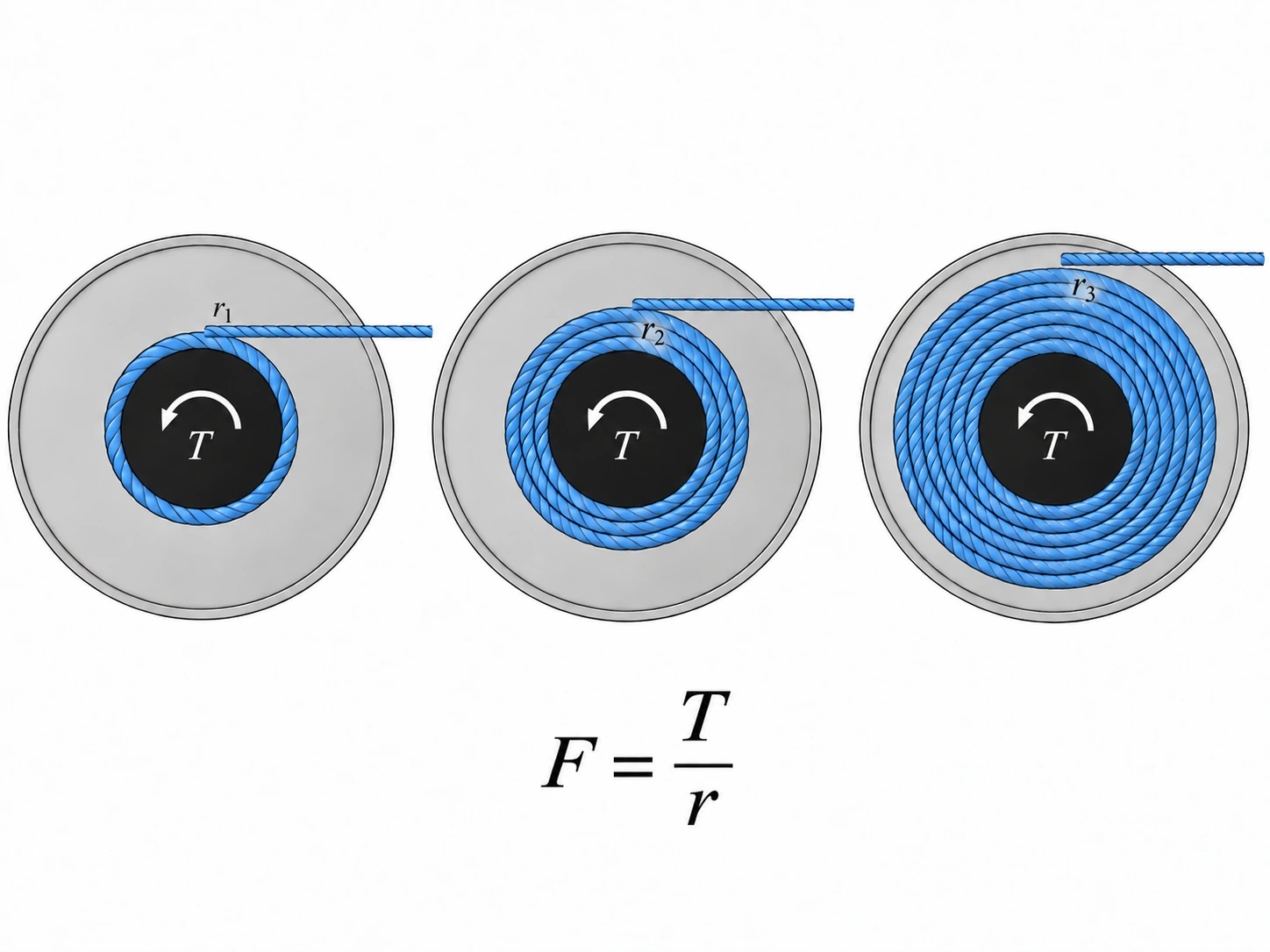
Think of the drum as a lever.
With only one layer of line, the line acts close to the drum center.
As more layers build up, the effective drum diameter becomes larger.
The gearing has not changed, but the winch now has to produce the same line force at a larger radius.
For a fixed available drum torque, the available line pull therefore decreases. This is a change in winch capability, not an automatic increase in the resistance imposed by the boat.
For boat loading, this can create an important interaction:
- at the beginning of retrieval, relatively little line may be wound onto the drum;
- toward the bow stop, more line has accumulated;
- at the same time, more of the boat may be supported by the trailer rather than water.
Depending on the trailer and ramp geometry, the most demanding part of the pull may therefore occur later in the cycle—exactly when the drum also contains more line.
That is why selection should consider the whole loading cycle, not merely the first crank movement.
Do Not Automatically Apply Another Brand's Layer Derating to GOODIN
Fulton specifies a particular derating method for Fulton products. etrailer also publishes example capacity reductions by drum layer. [1] [3]
Those percentages should not automatically be copied onto a GOODIN winch.
Drum diameter, line thickness and winch geometry can differ.
GOODIN's current public GD-C1200 and GD-C2000 pages publish rated capacity but do not establish, in the public specification shown, the exact rope-layer basis or a model-specific capacity-by-layer table. [4] [5]
For OEM or distributor selection, this becomes a supplier-confirmation item:
At which drum layer is rated capacity established, and what line-pull derating applies as cable or strap builds on the drum?
That question is more useful than assuming every 2,000 lb winch delivers 2,000 lb at every point in the retrieval cycle.
Match Gear Ratio to the Loading Cycle
Capacity answers:
Can the winch produce the required pull within its rating?
Gear ratio answers another question:
How much mechanical advantage and cranking speed does the operator have while producing it?
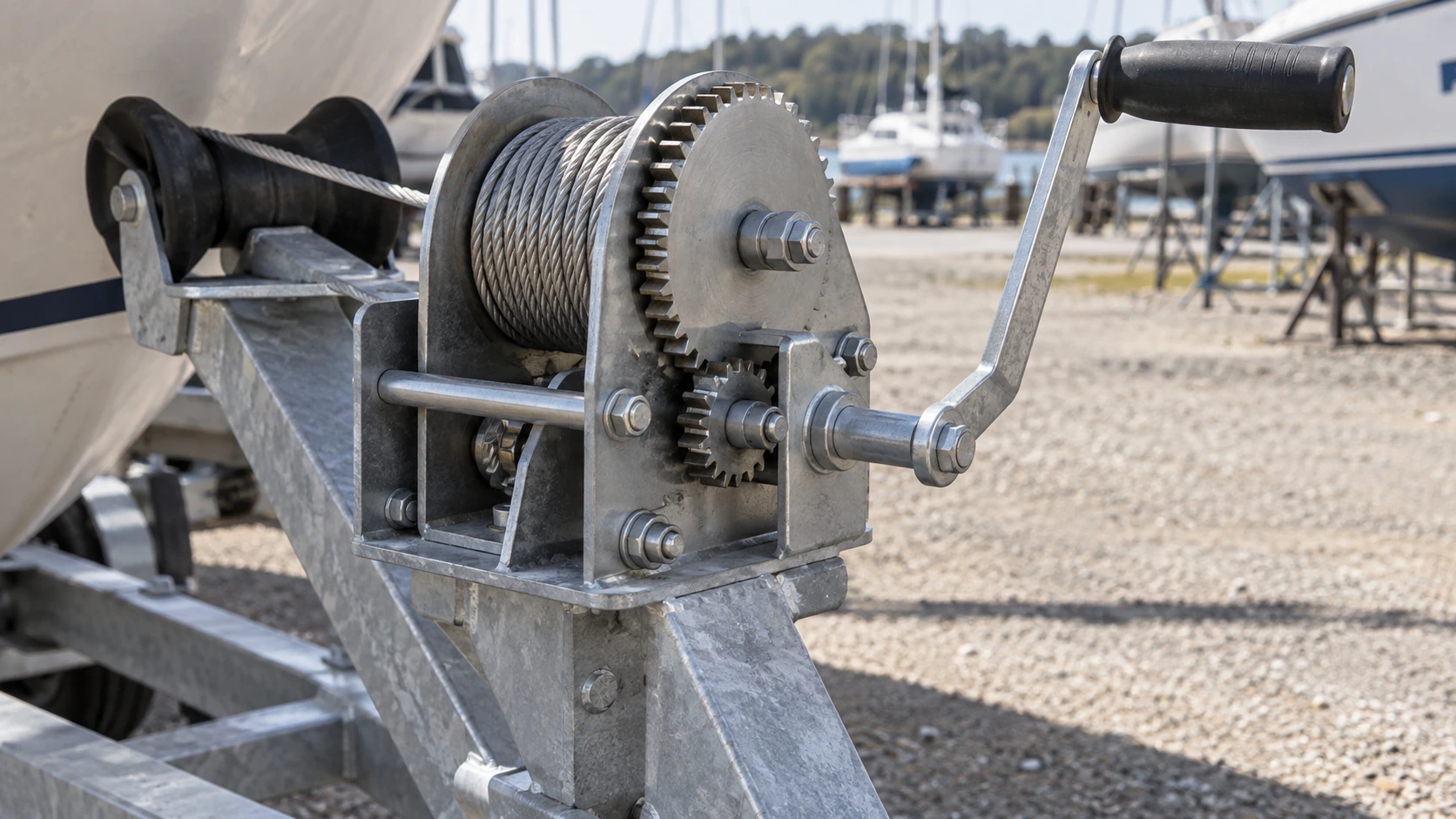
GOODIN's current GD-C1200 uses a single 4:1 gear ratio. [4]
The GD-C2000 provides 4:1 and 8:1 ratios in a two-speed configuration. [5]
4:1: Faster Drum Movement, Less Mechanical Advantage
At the same handle speed, a 4:1 drive turns the drum faster than an 8:1 drive. Nominally, these ratios mean 4 or 8 handle revolutions per drum revolution, respectively.
For lighter resistance, this can be useful because the operator retrieves line faster.
Typical situations might include:
- taking up slack;
- early-stage retrieval while the boat is still well supported by water;
- a lightly loaded roller trailer;
- or repositioning without high line tension.
But the lower numerical ratio provides less mechanical advantage than 8:1.
8:1: More Mechanical Advantage, Slower Retrieval
An 8:1 ratio requires more handle rotation for the same drum rotation.
The trade-off is greater mechanical advantage.
That makes the lower-speed gear valuable when resistance increases near the demanding portion of the loading cycle.
GOODIN describes the GD-C2000's two ratios accordingly: 4:1 provides faster line movement under lighter resistance, while 8:1 trades speed for increased mechanical advantage as resistance rises. [5]
That is the real value of a two-speed manual winch.
It does not create a second rated capacity.
It gives the operator two ways to deliver input to the same winch.
Do Not Calculate Operator Effort From Gear Ratio Alone
It is tempting to say:
An 8:1 winch requires exactly half the effort of a 4:1 winch.
That conclusion is too simplistic.
Actual handle force also depends on:
- handle length;
- effective drum radius;
- current drum layer;
- gear efficiency;
- bearing or bushing friction;
- and other mechanical losses.
GOODIN currently publishes the gear ratios for GD-C2000, but its public page does not publish enough of those variables to establish a precise crank-force figure. [5]
Therefore the correct purchasing conclusion is:
8:1 provides more mechanical advantage than 4:1, but exact operator force should come from manufacturer performance data or application testing—not ratio alone.
Four Scenarios for the Same Boat
Now the original question can be answered more usefully.
There is no single capacity that can be selected from the 3,000 lb weight alone.
Consider four different versions of the same boat.
| 3,000 lb boat loading scenario | Initial selection implication | What still needs verification |
|---|---|---|
| Good rollers, gently sloped ramp with sufficient launch depth, boat floated close to bow stop, short final pull | A lower-capacity winch may be feasible; some industry guidance allows approximately 3:1 boat-weight-to-winch screening under favorable roller conditions | Actual maximum pull, layer derating, line length and manufacturer rating basis |
| Normal recreational ramp, typical loading distance, no unusually high friction | A common 2:1 screen points to roughly 1,500 lb rated capacity | Actual bunks/rollers, ramp condition, drum layer and operator effort |
| Steeper ramp, shallow launch depth or higher-resistance bunk loading | Fulton-style 1.5:1 screening points to about 2,000 lb | Whether 2,000 lb remains available at the critical drum layer and whether low-speed gearing is adequate |
| Long high-friction bunk pull or unusually difficult retrieval | Required pull may approach or exceed the 2,000 lb class | Measure/establish actual peak line pull; a larger winch class or different loading system may be required |
The table reveals an important distinction for GOODIN's existing range.
A 3,000 lb boat does not automatically justify GD-C1200 simply because some favorable roller conditions can support a high boat-weight-to-winch ratio.
Nor does it automatically require GD-C2000.
The application decides.
However, if the buyer applies a conventional 2:1 preliminary screen, a 1,200 lb model falls below the resulting 1,500 lb screening requirement, while a 2,000 lb rated model remains within consideration. Fulton-style severe-condition screening also produces approximately 2,000 lb for the same 3,000 lb boat. [1]
That still does not prove that GD-C2000 is suitable.
The buyer must still confirm drum-layer capacity, loading resistance, line configuration and mounting.
A Six-Step Selection Process
Step 1: Establish Real Loaded Boat Weight
Do not use dry hull weight if the boat is normally retrieved with engine, fuel, batteries and equipment onboard.
Record:
Maximum expected retrieval weight: ______ lb
Step 2: Define the Ramp Condition
Record the normal and reasonably foreseeable worst-case launch conditions.
Include:
- typical ramp slope;
- steepest ramp expected;
- shallow-water retrieval possibility;
- tidal variation where relevant.
Do not size only around the easiest marina ramp if the trailer routinely visits several launch sites.
Step 3: Identify Roller or Bunk Resistance
Record:
- rollers;
- carpeted bunks;
- synthetic bunk surface;
- combination system;
- approximate condition;
- expected alignment.
The objective is not to assign an invented friction coefficient.
It is to identify whether the application belongs to a relatively free-rolling condition or a higher-resistance sliding condition.
Step 4: Determine Actual Winching Distance
How much line is under load?
If the boat usually floats nearly into position, the powered section of the retrieval cycle may be short.
If the boat must travel most of the trailer length under winch force, the operating requirement is very different.
Record:
Maximum loaded pull distance: ______ ft / m
This also determines how much line must be stored on the drum.
Step 5: Establish Maximum Expected Line Pull
At this point the buyer should use:
- manufacturer selection documentation;
- trailer/boat OEM data;
- measured loading data where available; or
- an appropriately validated engineering calculation.
Generic boat-weight ratios can be used to narrow the product class.
They should not replace application verification when the system is close to the winch's rated limit.
Step 6: Select Gear Arrangement
Once the required capacity class is known, decide whether one gear ratio provides acceptable operating effort through the whole cycle.
A single 4:1 product may be appropriate where loads are moderate and retrieval distances are manageable.
A two-speed arrangement becomes increasingly valuable when the same loading cycle contains both:
- long low-resistance sections where speed matters; and
- high-resistance sections where mechanical advantage matters.
That is precisely the distinction between GOODIN's current 1,200 lb single-speed class and 2,000 lb two-speed class. [4] [5]
Why Two-Speed Can Matter Even When Capacity Is Already Sufficient
Suppose a winch's rated capacity safely covers the maximum expected line pull.
The specification can still be poor if the operator must spend the entire loading cycle using an unnecessarily slow ratio—or must apply uncomfortable force with a fast ratio.
A two-speed winch addresses this operational variation.
On GOODIN's GD-C2000:
4:1
→ faster retrieval under lighter resistance.
8:1
→ slower retrieval with greater mechanical advantage. [5]
This can be especially relevant on boat trailers because resistance often changes during one retrieval.
The beginning of the pull may be relatively light.
The final section onto the bunks and toward the bow stop may be heavier.
This is a better reason to specify two speeds than simply saying:
Two-speed winches are for heavier boats.
The actual advantage is adaptability to changing line load during the cycle.
Change gears only under the model-specific procedure, with the load controlled and the selected drive fully engaged. A ratchet is not proof of an automatic load-holding brake; never allow a loaded drum to free-spool.
Specify the Line and the Complete Load Path
Capacity and gear ratio receive most of the attention, but the pulling medium must also reach the boat from the actual winch stand position.
GOODIN currently publishes:
| Model | Rated Capacity | Line | Length | Gear |
|---|---|---|---|---|
| GD-C1200 | 1,200 lb | 4.5 mm cable | 8 m | 4:1 |
| GD-C2000 | 2,000 lb | 4.8 mm cable | 10 m | 4:1 / 8:1 |
GOODIN also offers corresponding strap-winch products in the 1,200 lb and 2,000 lb classes. Its current product information states that the GD-S2000 shares the 2,000 lb rated class and 4:1 / 8:1 gearing but uses an 8 m web strap rather than GD-C2000's 10 m cable. [4] [5]
Longer line is not automatically better.
If excessive line remains wound on the drum during the highest-load section, the larger effective drum radius can work against pulling capacity.
Specify enough approved line to satisfy the trailer geometry while retaining the manufacturer-required minimum wraps on the drum. Do not remove required wraps, shorten the approved line or overfill the drum to pursue a theoretical capacity advantage.
Cable or Strap Should Be a Separate Decision
A 2,000 lb cable winch and a 2,000 lb strap winch can occupy the same capacity class while presenting different inspection and handling requirements.
Wire cable requires attention to:
- broken wires;
- kinks;
- crushing;
- corrosion;
- routing; and
- drum winding.
Web strap requires attention to:
- cuts;
- abrasion;
- edge damage;
- damaged stitching;
- twisting;
- and environmental deterioration.
GOODIN distinguishes its C-series cable models from S-series strap models on this basis rather than treating the line material as merely cosmetic. [5]
This article does not need to declare one universally superior.
The Product Selection question is simply:
Which approved pulling medium matches the winch, trailer geometry, environment and inspection practice?
The Winch Stand Must Carry the Same Pull
Selecting the correct winch capacity does not automatically validate the trailer's winch stand.
If the winch must produce a high line pull, that force travels through:
bow eye → hook → line → drum → winch frame → mounting bolts → winch stand → trailer structure
GOODIN's current winch documentation specifically notes that the mounting structure should carry the intended line pull without excessive flexing or movement. [5]
A buyer replacing a 1,200 lb unit with a 2,000 lb model should therefore check more than the bolt pattern.
Confirm:
- mounting-hole geometry;
- winch-stand construction;
- fastener specification;
- cable/strap alignment;
- crank clearance;
- bow-eye alignment.
A higher-capacity winch mounted to an unsuitable stand does not create a higher-capacity loading system.
Turn the Capacity Label Into a Procurement Specification
Use the following table before sending an RFQ.
| Selection input | Buyer should determine | Supplier should confirm |
|---|---|---|
| Loaded boat weight | Boat + engine + fuel + normal equipment | Whether proposed model is appropriate for that application |
| Ramp condition | Normal and worst expected slope / shallow-water condition | Any published selection limit or application guidance |
| Trailer supports | Rollers, bunks or combination | Whether capacity recommendation assumes a particular support condition |
| Loaded pull distance | Maximum distance boat is actually winched | Required cable/strap length and drum suitability |
| Maximum expected line pull | Application estimate, test data or OEM requirement | Rated operating capacity |
| Rating basis | — | First-layer or other defined drum condition |
| Drum-layer effect | Number of layers during highest-load section | Model-specific derating by layer |
| Gear requirement | Desired operating effort and retrieval speed | Gear ratios and operating procedure |
| Pulling medium | Cable or strap requirement | Approved type, dimensions and replacement specification |
| Mounting | Winch stand size and available footprint | Hole pattern, fasteners and installation requirements |
| Operating frequency | Occasional / frequent / commercial cycle | Suitable duty expectations |
| Environment | Freshwater / saltwater / storage exposure | Finish and corrosion specification |
| Safety boundary | Loading/pulling application | Whether product is approved only for pulling and what uses are prohibited |
What a Buyer Should Ask About “2,000 lb Capacity”
For B2B procurement, the specification “2,000 lb hand winch” is incomplete.
A useful supplier inquiry should ask:
- Is 2,000 lb the rated operating capacity, rated line pull or another capacity definition?
- At what drum layer is that rating established?
- What is the permitted line pull at the second, third and later layers?
- Does the rating apply with the supplied cable or strap?
- What cable/strap size and maximum length are approved?
- What are the available gear ratios?
- What handle length is used for the published performance?
- Are operator-force or performance curves available?
- What mounting structure and fasteners are required?
- Is the winch rated specifically for pulling only, or does it have any separately documented lifting/load-control approval?
- What proof-test or production inspection criteria apply?
- What environmental or corrosion specification applies for marine use?
These questions turn a catalog capacity number into an actual procurement specification.
GOODIN View: Specify the Maximum Pulling Condition, Not Just Boat Weight
For a boat-trailer hand winch, the most useful RFQ statement is not:
Boat weight: 3,000 lb. Please recommend winch.
A much better specification is:
Loaded boat weight is 3,000 lb. The trailer uses carpeted bunks, retrieval occurs on ramps up to the specified slope, the boat may require approximately X ft of loaded winching, and the expected maximum line pull must remain within the winch rating at the relevant drum layer. A two-speed manual configuration is preferred because loading resistance changes through the retrieval cycle.
That gives the supplier enough information to evaluate the actual application.
For GOODIN's current range, the GD-C1200 provides a 1,200 lb rated class with single 4:1 gearing, while GD-C2000 moves to a 2,000 lb rated class with 4:1 / 8:1 two-speed gearing. GOODIN separately publishes 1,800 lb and 3,000 lb breaking-force figures for those models, but those values are not routine operating capacities. [4] [5]
The correct model cannot be selected from 3,000 lb boat weight alone.
If the application is favorable, a relatively modest line pull may be sufficient.
If the same boat must climb a steep ramp over high-friction bunks for a long distance, its requirement can move into a much higher winch class.
And if the calculated or measured maximum pull exceeds 2,000 lb under the relevant drum condition, a 2,000 lb GOODIN model should not be made to fit the application merely because its published breaking force is 3,000 lb.
That leads to the central purchasing rule:
Select the winch from the maximum expected operating line pull; select the gear ratio from how that pull changes through the loading cycle.
Boat weight starts the calculation.
It does not finish it.
Send your loading conditions, required line pull and mounting details when you contact GOODIN.
Final Selection Checklist
Before approving a manual boat-trailer winch, confirm:
- Loaded boat weight, not only dry hull weight.
- Normal and worst expected ramp conditions.
- Whether the trailer uses rollers or bunks.
- The actual loaded winching distance.
- The maximum expected line pull.
- The manufacturer's precise definition of rated capacity / rated line pull.
- The drum layer at which that rating applies.
- Capacity reduction as additional line layers accumulate.
- Required cable or strap length and type.
- Whether a single-speed or two-speed drive better matches the cycle.
- The exact available gear ratio(s).
- Winch-stand and mounting compatibility.
- Crank-handle clearance.
- Marine-environment and corrosion requirements.
- The difference between rated operating capacity and breaking force.
If those fields are known, the buyer can choose a winch from the application rather than from a single number on the label.
Safety boundary: this guide concerns boat loading and pulling, not personnel lifting or suspended loads. Do not infer hoisting approval from a pulling rating. The winch is not a transport tie-down; use the separate restraints specified by the boat and trailer manufacturers.
Sources & Further Reading
Manufacturer guidance applies to the products and conditions it covers. The Fulton catalog is an archived manufacturer publication. Retailer guidance is cited for its own screening assumptions, not as a universal design standard. No unverified drum-layer derating is assigned to GOODIN.
- Fulton — Trailer Catalog — Trailer Winch Selection (archived manufacturer catalog)
- Fulton — Trailer Winches — Installation and Operating Instructions
- etrailer — Hand Winches — Selection Guide
- GOODIN — GD-C1200 — 1,200 lb Hand Winch with Cable
- GOODIN — GD-C2000 — 2,000 lb Two-Speed Hand Winch with Cable
- West Marine — Selecting a Trailer Winch
Winch Strap vs. Steel Cable: Which Should You Specify for a Boat Trailer?
A-Frame vs. Side-Mount Trailer Jacks: Which Configuration Fits a Crowded Trailer Tongue?
Related Article