Replacing a Boat Trailer Winch: How to Match the Mount, Bow Eye and Pulling Angle
In this guide
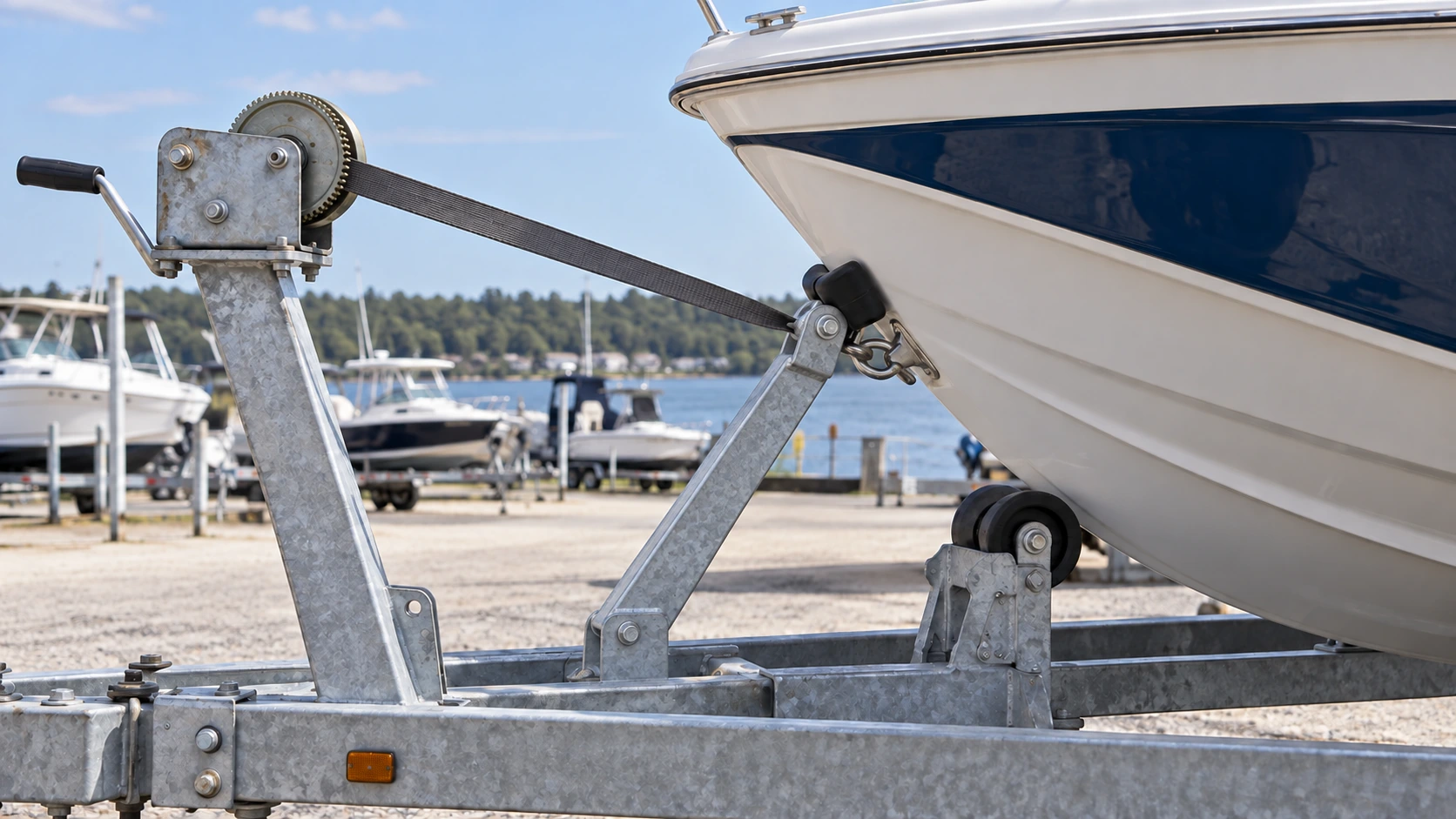
A boat trailer can have a winch powerful enough to pull the boat and still have a loading problem.
The boat approaches the front of the trailer, the bow eye nears the stop—and instead of seating cleanly, the strap begins pulling the bow upward or downward. The eye catches a roller. The hull refuses to settle against the bow stop. More cranking force makes the geometry worse rather than better.
Consider two illustrative versions of the same problem. These are diagnostic scenarios, not verified reports of specific incidents.
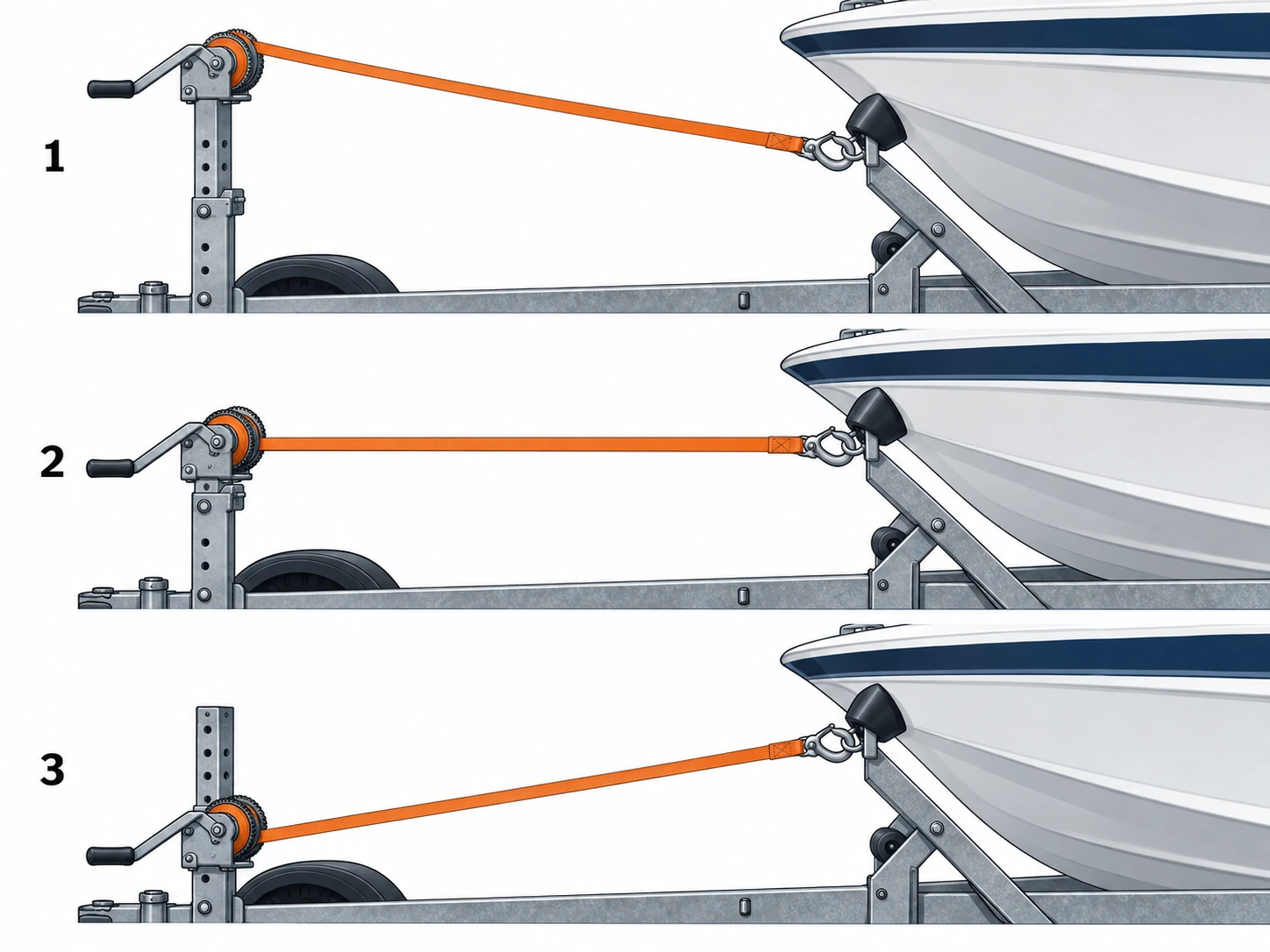
In one setup, the bow eye sits noticeably below the winch and the line pulls upward toward the drum. That raises a question about the upward component of the pull and how the bow is restrained. In the reverse setup, the winch sits too low, the cable runs across lower hardware and pulls the bow eye downward rather than drawing it cleanly toward its intended final position.
These are not primarily capacity problems.
They are installation-geometry problems.
A 2,000 lb winch will not correct a bow eye that is being pulled from the wrong height. A stronger cable will not make an incorrectly positioned bow stop compatible with the hull. And a replacement winch with a different base, drum height or crank layout can change the geometry even when its rated capacity appears to match the original.
For replacement selection, the better question is therefore:
Will the new winch fit the existing structure and place its line exit, bow eye and bow stop in the correct relationship when the boat is fully loaded on the trailer?
That is the compatibility test.
Selection guidance, not structural modification approval. Follow the exact boat, trailer and winch instructions; verify a stable, independently secured setup before measuring or adjusting.
Start With the Complete Pulling Geometry
A boat-trailer winch does not operate independently.
Its pull passes through a connected system:
winch mounting base → winch stand → drum/line exit → cable or strap → hook → bow eye → boat → bunks or rollers
The bow stop then determines where the boat is expected to finish.
If one element is moved, several others can be affected.
A replacement winch with a taller frame may raise the line exit.
A different mounting-hole pattern may force the winch farther forward or rearward.
A wider two-speed body may reduce crank clearance beside the bow-stop post.
Changing from cable to strap may alter the required drum configuration and routing.
This is why replacement fit should not be reduced to:
old winch = 2,000 lb → new winch = 2,000 lb
Rated pull addresses one question.
Installation geometry addresses another.
What Correct Geometry Is Trying to Achieve
Several mainstream boat-trailer manufacturers give very similar guidance on final winch alignment.
For the products covered by their instructions, Fulton describes a strap exit aligned horizontally with the loaded boat's bow eye; Venture places the line approximately parallel to the trailer frame and its bow roller above the eye; ShoreLand'r also describes straight rather than upward or downward pull. These are useful conventional-layout references, not universal installation approval for every boat and trailer. [1][2][3]
That gives replacement buyers a useful starting principle:
Judge winch position with the boat in its final loaded position—not from an empty trailer.
The drum may look correctly positioned when no boat is present.
The actual question is where the line exits relative to the bow eye once the hull is sitting correctly on its bunks or rollers and against its intended bow stop.
This guidance should still be checked against the specific boat and trailer manufacturer. Bow-stop architecture varies, especially on custom, older and multi-roller trailers.
Why an Upward Pull Can Be a Problem
Imagine the bow eye is substantially below the winch line exit.
As the operator cranks, the line pulls both:
- forward toward the winch, and
- upward toward the drum.
The winch is no longer applying its pull primarily along the intended trailer-loading direction.
The line-force direction matters independently of the winch's capacity. Venture's guidance warns that upward line geometry can contribute to bow movement during transport and calls for independent bow restraint. Correct loading alignment does not replace the required travel tie-downs. [2]
The illustrative high-winch setup makes the purchasing issue visible: a substantially lower bow eye creates an upward component of pull. That observation alone does not diagnose every cause of bow movement; hull support and independent restraint still need assessment.
The purchasing conclusion is not:
“Always mount the winch lower.”
It is:
“A replacement winch should not create an excessive upward pulling angle relative to the final bow-eye position.”
A Winch Can Also Be Too Low
The opposite geometry creates a different problem.
If the line exit is far below the bow eye, the winch pulls forward and downward.
That can draw the bow eye toward lower trailer hardware instead of toward the intended stop position.
In the illustrative low-winch setup, the bow eye approaches lower stop hardware while the line rubs it. The winch may operate normally, yet the final approach is obstructed. This is a geometry check, not proof that raising an unknown stand is safe.
Mechanically, a low line exit adds a downward force component at the bow eye. Depending on the hull-support arrangement, that can increase contact loading instead of assisting movement along the intended path. Suncor's trailer-winch instructions likewise call for the line to be near bow-eye height and free of obstacles. [4]
Again, the solution is not automatically:
raise the winch as high as possible.
The objective is to restore an appropriate line path between the winch and bow eye.
Bow Stop Position Must Be Checked at the Same Time
Adjusting winch height without checking the bow stop can simply move the interference elsewhere.
The three components should be treated together:
winch line exit + bow eye + bow stop
The conventional layouts described by Venture and ShoreLand'r place the roller above the bow eye and coordinate this position with the winch line. Check the complete arrangement rather than moving one part in isolation. [2][3]
This geometry helps explain why a boat can load poorly even though the winch itself is functioning correctly.
If the bow stop is:
- too low,
- too high,
- too far forward,
- too far rearward,
the bow eye may not approach it cleanly.
A user may then compensate by changing ramp depth, cranking harder or altering line routing—even though the real issue is trailer setup.
Do Not Treat Every Bow-Stop Layout as Identical
Older or custom trailers may use:
- a single roller;
- twin rollers;
- V-blocks;
- adjustable bow stops;
- integrated winch-post assemblies.
The exact relationship must therefore follow the trailer or boat manufacturer's design.
The Product Selection rule is:
Do not copy the bow-eye position from another trailer simply because it looks similar.
Use the actual hull and trailer geometry.
Establish the Boat Position and Mounting Footprint
Step 1: Confirm the Boat Is Correctly Positioned Before Measuring the Winch
Before measuring replacement geometry, establish where the boat is supposed to sit.
That means confirming:
- the hull is correctly supported by the bunks or rollers;
- the transom is in its intended position relative to the trailer;
- the boat is centered;
- the bow is seated at the intended stop;
- trailer setup and tongue-load requirements are otherwise correct.
This matters because moving the winch post to compensate for an incorrectly positioned boat can create another problem.
Venture treats winch-stand position as part of boat support, load balance and bow-stop setup, rather than as an isolated accessory adjustment. Do not move the boat simply to make a replacement winch fit without reassessing the trailer manufacturer's support and tongue-load requirements. [2]
Only once the boat is correctly located should the replacement winch geometry be measured.
Before measuring, keep the trailer stable and the boat independently secured. Do not loosen a loaded winch stand, release a supporting line or place hands in pinch points to obtain a measurement. If correct boat support or adjustment authority is uncertain, have the boat/trailer supplier or a qualified installer establish the setup first.
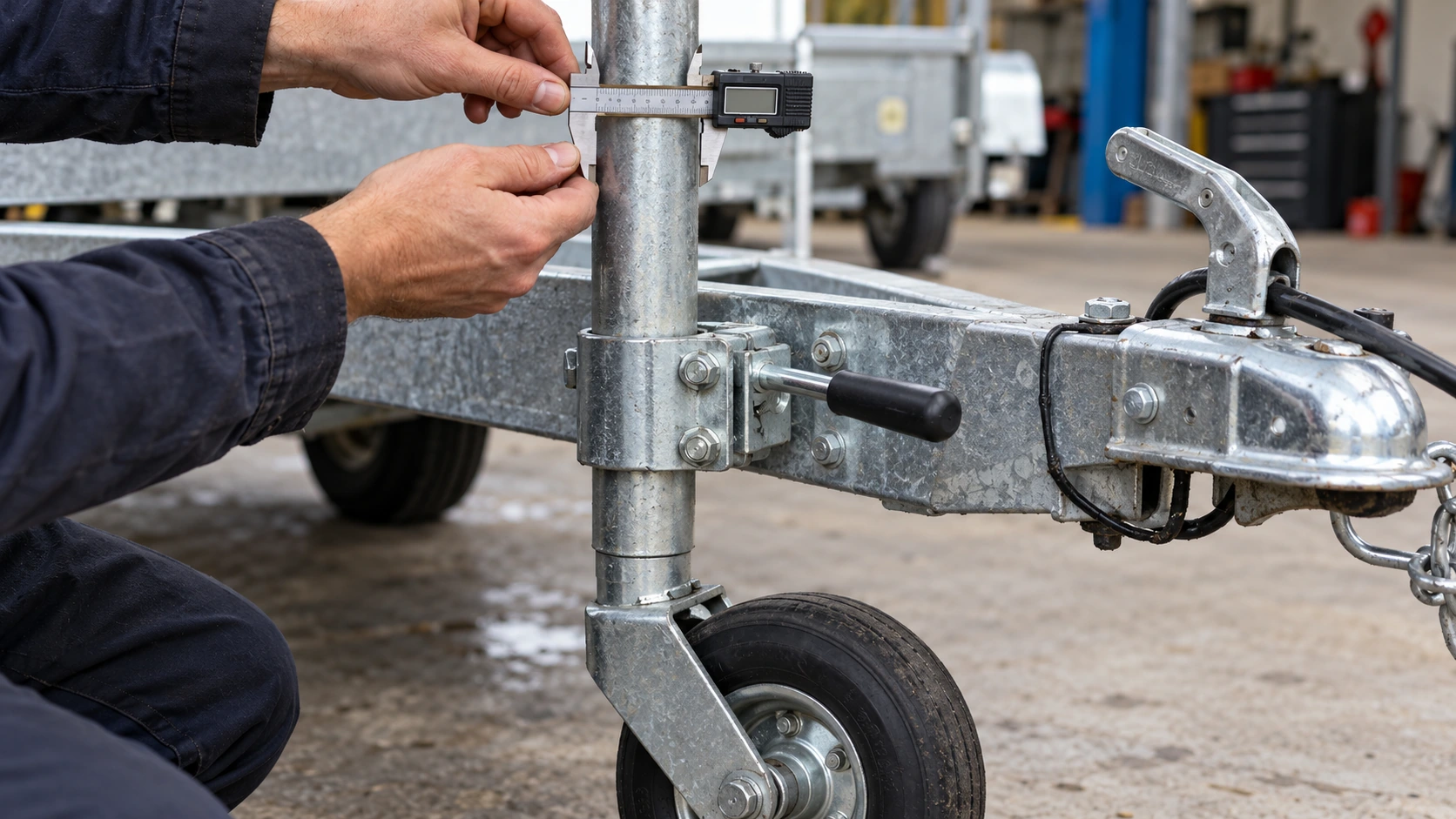
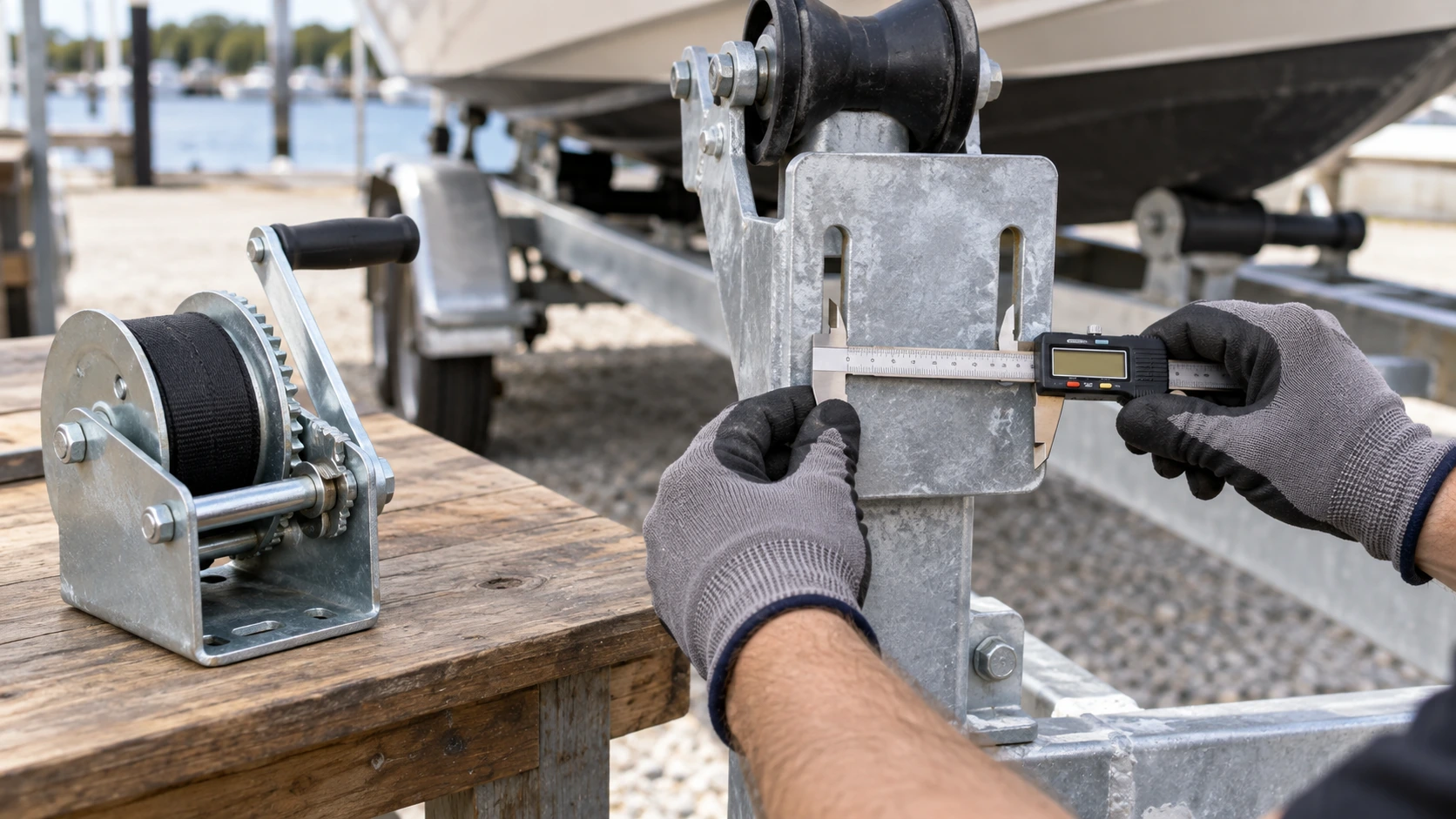
Step 2: Measure the Existing Mounting Footprint
The next question is purely mechanical:
Can the replacement winch actually bolt to the existing winch stand?
Record the current mounting interface.
At minimum, measure:
- usable mounting-plate length;
- usable mounting-plate width;
- existing hole or slot locations;
- center-to-center spacing;
- bolt diameter;
- available plate thickness;
- nearby edges or welded features;
- allowable fore-aft adjustment.
Then compare those measurements with the candidate winch's production drawing.
Do Not Judge Mounting Compatibility From Product Photos
GOODIN's current GD-C1200 and GD-C2000 product images clearly show formed mounting bases with multiple holes or slots, but the current public specifications do not publish authoritative mounting-hole centers, bolt specification or approved mounting orientation. GOODIN's own product information therefore directs buyers toward current production drawings for the exact mounting interface. [5][6]
This is important for replacement selection.
Two open-frame manual winches can look almost identical while using different:
- base lengths;
- slot positions;
- hole spacing;
- frame widths.
A visually similar winch is not automatically a bolt-on replacement.
Measure the Bow Eye and Actual Line Path
Step 3: Measure Bow-Eye Height in the Final Loaded Position
Once the boat is seated correctly, measure the vertical position of the bow eye relative to a stable trailer datum.
Then identify the candidate winch's actual line-exit height after installation.
For a simple manual winch, this may relate to the drum centerline and the direction in which the cable or strap leaves the drum.
The useful comparison is:
installed winch line exit height ↔ bow-eye height
not:
winch overall height ↔ bow-eye height
Those are different measurements.
A winch can have a taller frame but a similar line-exit position.
Or two winches can use nearly identical mounting bases while placing the drum at different elevations.
This is exactly why replacement selection requires a dimensional drawing rather than a capacity label.
Measure the actual line tangent and approved winding direction, not just the drum-axis height. The wound radius changes with line layers, so check the final seated condition and the useful retrieval range without treating one catalog overall-height dimension as a complete geometry definition.
Step 4: Check the Pulling Angle
With the candidate mounting position established, imagine—or ideally draw—the direct line between:
winch line exit → bow eye
The line should follow the intended loading geometry without being forced across:
- the bow stop;
- a roller bracket;
- bolt heads;
- sharp steel edges;
- trailer structure.
For many conventional boat trailers, manufacturer guidance aims for an approximately horizontal line when the boat is fully loaded. Fulton explicitly uses this relationship in its mounting instructions. [1]
A useful replacement worksheet is:
| Measurement | Existing Setup | Candidate Winch |
|---|---|---|
| Winch mounting datum height | ___ | ___ |
| Line-exit height | ___ | ___ |
| Bow-eye height | ___ | Same boat |
| Vertical offset | ___ | ___ |
| Horizontal distance to bow eye | ___ | ___ |
| Line clears bow stop | Yes / No | Yes / No |
| Line clears hardware | Yes / No | Yes / No |
The objective is not to calculate an arbitrary universal maximum angle.
The objective is to identify whether the proposed replacement reproduces an acceptable manufacturer-supported line path.
Also inspect alignment from above. An acceptable side view does not rule out sideways lead, flange rubbing or a hook that is twisted out of its intended plane. Never reverse the winding direction merely to obtain a convenient exit height unless the exact winch instructions allow it.
Check the Bow Stop With the Winch
Step 5: Check Bow-Stop Height and Fore-Aft Position
Now look at where the bow finishes.
The bow stop should contact the hull at the intended location when the boat is fully seated.
If the stop is several inches away even after the winch reaches maximum practical tension, buying a higher-capacity winch is not the logical first response.
Possible causes include:
- winch post too far forward;
- bow stop too far forward;
- winch post too far rearward;
- boat positioned incorrectly on bunks or rollers;
- stop height incorrect;
- line angle preventing the bow from approaching correctly.
In this kind of mismatch, first inspect post height, bracket arrangement and boat position. A capacity upgrade cannot remove an obstruction or move the intended contact point.
For an adjustable trailer, moving the approved winch-post/bow-stop assembly may solve the issue.
For a welded or structurally modified stand, the solution becomes more involved.
Allow Space for the Handle, Line and Hook
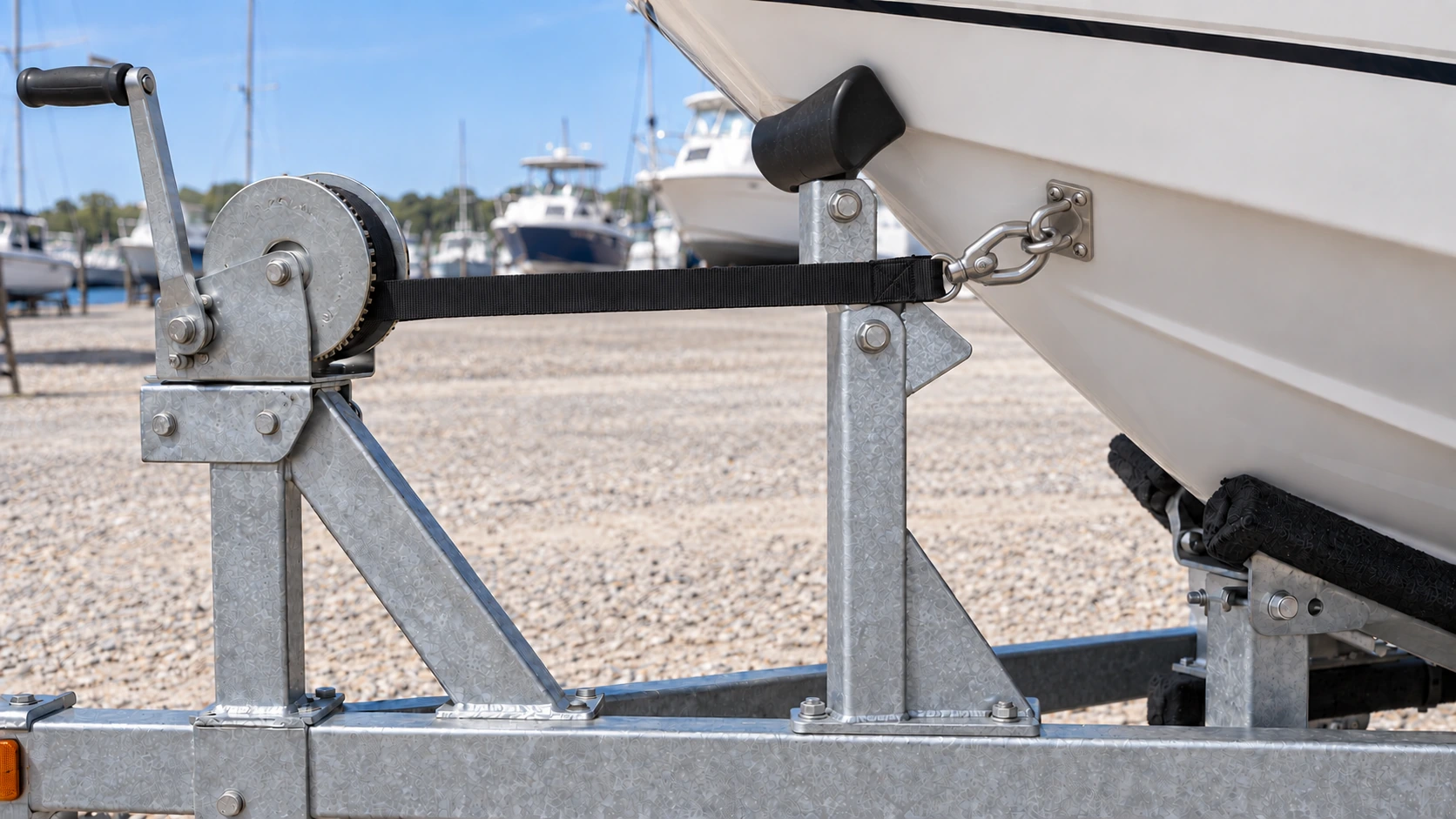
Step 6: Check Crank-Handle Clearance
Replacement compatibility does not stop once the line is correctly aligned.
The operator must still be able to turn the handle.
GOODIN's GD-C2000 uses a removable offset crank and two speed positions. Its current product information specifically notes that nearby trailer posts, bow stops or bodywork should not interfere with crank sweep or access to the drive positions. [5][6]
Measure:
- crank radius;
- operator hand clearance;
- bow-stop-post clearance;
- hull clearance;
- trailer-frame clearance;
- access to both gear positions on a two-speed winch.
This is especially important if the replacement winch is:
- wider than the original;
- mounted farther rearward;
- fitted beside a tall V-block assembly.
A winch that fits the bolt holes but cannot be cranked through a full revolution is not compatible.
Step 7: Check Required Cable or Strap Length
The pulling line still has to reach the bow eye from the actual launch position.
GOODIN currently publishes:
- GD-C1200: 4.5 mm × 8 m cable
- GD-C2000: 4.8 mm × 10 m cable
- corresponding strap configurations with different line packages. [5][6]
Do not select length only from the final bow-eye distance.
Measure the longest expected payout when the boat first needs winch assistance.
Then confirm that the hook can still reach the bow eye while maintaining the minimum wraps or other line-retention conditions required by the winch manufacturer.
This continues the rule established in the previous Product Selection article:
line length is part of winch geometry, not simply an accessory specification.
Step 8: Check Hook-to-Bow-Eye Fit
A new winch can be mechanically compatible with the trailer and still have the wrong hook for the boat.
Check:
- hook opening;
- bow-eye cross-section;
- latch closure;
- orientation under tension;
- surrounding clearance.
The hook should seat correctly without being forced sideways into the bow eye.
Do not assume that a larger hook supplied with a larger-capacity winch will automatically fit the existing bow eye.
This is another reason capacity upgrades can create unexpected installation problems.
Decide: Adjust, Replace or Reassess
Step 9: Check the Winch Stand, Not Just the Winch
The winch base carries the line pull into the stand.
The support must be suitable for the winch's intended load and installation. GOODIN treats the supporting structure, fasteners and line alignment as parts of the complete installation, not as consequences of the capacity label. [5][6]
Inspect the existing stand for:
- distortion;
- corrosion;
- cracked welds;
- elongated holes;
- bent mounting plate;
- loose U-bolts;
- improvised extensions;
- previous drilling or welding.
If the stand itself is unsuitable, purchasing a new winch does not solve the underlying problem.
A stronger winch may actually increase the demand placed on an already questionable mounting structure.
Three Different Replacement Outcomes
A useful buying guide should not force every reader toward a new winch.
After measurement, there are three legitimate outcomes.
Outcome 1: The Existing Winch Only Needs Correct Adjustment
This is the best-case scenario.
It applies when:
- existing rated capacity remains appropriate;
- gears, drum, ratchet and line are serviceable;
- mounting hardware is sound;
- the existing winch stand is designed for adjustment;
- the required line angle can be restored within that adjustment range;
- bow stop can be repositioned according to the trailer design.
For example, a bolt-on winch stand may allow approved:
- fore-aft movement;
- vertical adjustment;
- bow-stop adjustment.
Venture and ShoreLand'r both describe adjusting winch-post position to establish correct bow-eye and bow-stop geometry. [2][3]
In that case, replacing the winch may be unnecessary.
The problem was setup.
Outcome 2: Buy a Dimensionally Compatible Replacement Winch
Replacement makes sense when the existing winch is worn, damaged or otherwise due for replacement—but the trailer's basic winch-stand geometry remains suitable.
The new winch should then match:
- rated line-pull requirement;
- mounting footprint;
- bolt/slot pattern;
- installed drum or line-exit height;
- line direction;
- crank clearance;
- hook/bow-eye interface;
- required line length.
For GOODIN procurement, this means the inquiry should go beyond:
“Please quote GD-C1200 or GD-C2000.”
The buyer should request the current mounting drawing and compare it with the actual trailer stand.
GOODIN publicly identifies GD-C1200 as a 1,200 lb, 4:1 manual cable winch and GD-C2000 as a 2,000 lb two-speed 4:1 / 8:1 model, but its current public pages do not provide enough mounting-hole dimensions to declare either one a direct replacement for an unidentified existing winch. [5][6]
That is exactly what the production drawing is for.
Outcome 3: The Winch Stand or Bow Structure Needs Reassessment
This is the point where Product Selection should stop trying to solve the problem with another catalog winch.
Escalate the installation when:
- winch stand is visibly bent;
- existing stand appears modified or homemade;
- correct pull angle cannot be achieved within approved adjustment;
- mounting plate is too small;
- candidate bolt pattern requires drilling questionable new holes;
- welding or structural cutting is required;
- bow stop cannot reach the hull correctly;
- winch post is fundamentally too short or too tall;
- the boat and trailer appear mismatched;
- bow eye itself would need relocation.
The low-winch scenario shows why this category exists. If the bracket or stand is fundamentally unsuitable for the boat, changing the winch alone leaves the incompatible structure in place. Do not interpret a plausible explanation as approval for a structural modification.
At that point, the appropriate solution is evaluation by the relevant trailer/boat manufacturer, dealer or other qualified person—not choosing the next higher-capacity winch.
Do Not Move the Bow Eye Just to Make the Winch Fit
This deserves its own boundary.
The bow eye is part of the boat's structural connection system.
If the new winch geometry only works by changing the bow-eye position, that is no longer a simple accessory replacement.
Relocation can involve:
- hull structure;
- backing reinforcement;
- laminate or plate condition;
- load path into the boat.
A Product Selection article should therefore not instruct owners to reposition a bow eye as a routine fitment technique.
If the existing boat/trailer combination cannot achieve correct geometry without modifying that structure, the installation requires appropriate technical evaluation.
Separate Retrieval Conditions From Final Fit
There is one reason owners sometimes see apparently inconsistent behavior.
When the trailer is deep in the water, the boat may still be floating at a different pitch from its final resting attitude.
As the trailer comes out of the water:
- stern buoyancy decreases;
- the hull settles onto bunks or rollers;
- bow position relative to the stop can change.
A retrieval observation can therefore differ from the final dry, seated geometry. Record both conditions rather than assuming that temporary buoyancy proves the final setup is correct.
This means two different questions must be separated:
Does the boat approach the trailer correctly during retrieval?
and
Is the final winch–bow eye–bow stop geometry correct once the boat is fully seated?
Changing launch technique can improve retrieval.
It cannot compensate for a fundamentally incorrect final installation.
Worked Replacement Example
Consider a hypothetical trailer whose current winch is due for replacement.
The buyer confirms:
- required line pull already falls within the selected capacity class;
- existing boat position on bunks is correct;
- bow eye sits at a known height when fully loaded;
- bow stop is correctly positioned;
- original winch produces an approximately straight line to the bow eye.
A candidate replacement has the same rated capacity.
But its base geometry places the drum 60 mm higher after installation.
Capacity matches.
Geometry does not.
The force on the bow eye would now point upward toward the higher winch. Viewed from the winch toward the boat, the same line slopes downward; keep the reference direction clear.
The correct response is not:
“The winch is stronger, so it should still work.”
Instead determine whether:
- the winch can be mounted in another manufacturer-approved position;
- the existing adjustable stand can restore the required line height;
- another winch has a more compatible base-to-drum dimension.
If none is possible, that candidate should be rejected even though its pulling capacity is correct.
This is the core difference between capacity compatibility and installation compatibility.
The 60 mm change is illustrative, not a published tolerance or rejection limit. Its effect depends on horizontal span and the approved boat/trailer geometry; it triggers a fit review rather than an invented universal maximum angle.
Build a Replacement Specification
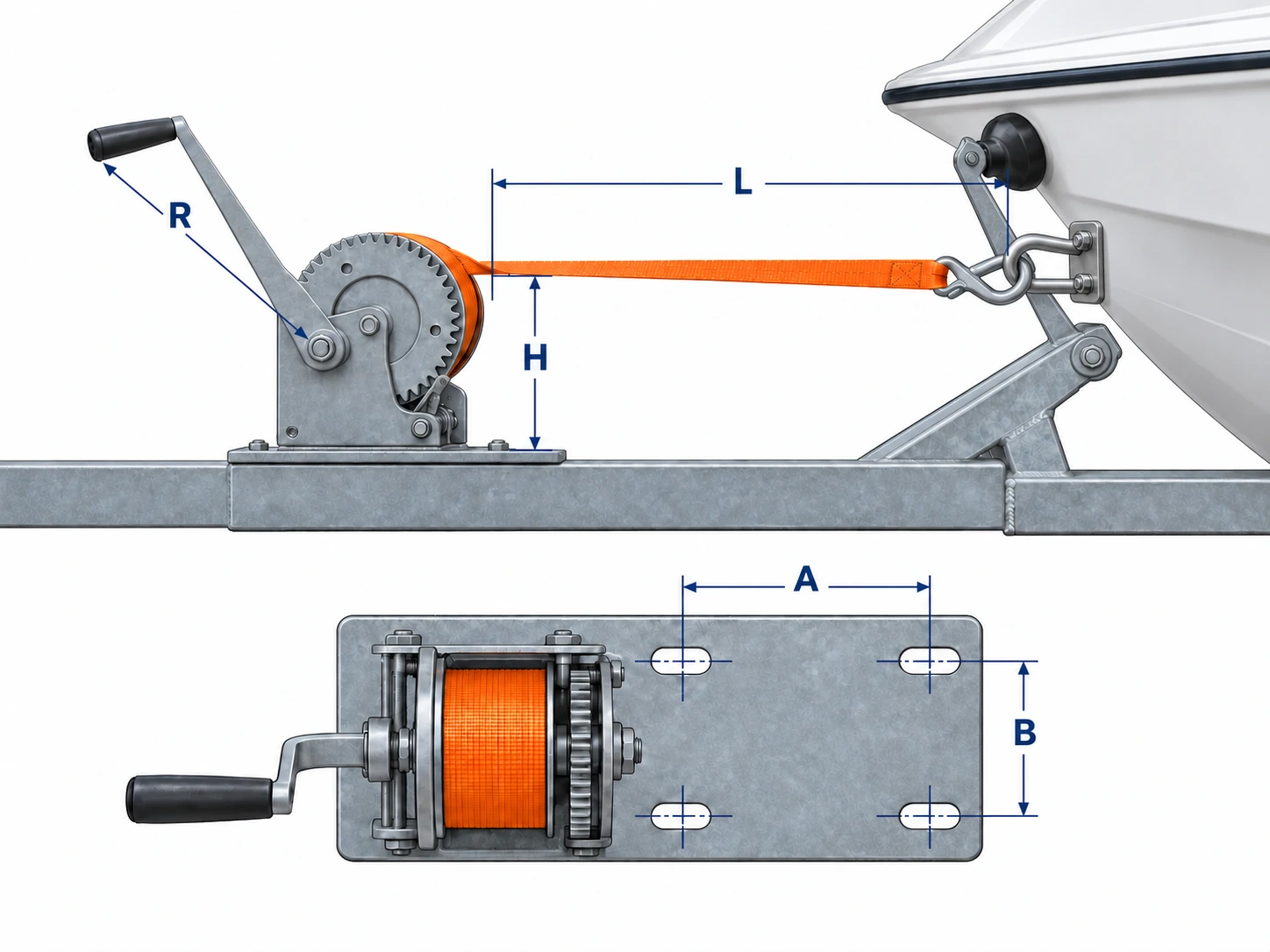
Use the following before ordering a replacement winch.
| Compatibility Item | What to Measure on Trailer/Boat | What to Confirm on New Winch | Reject / Escalate If… |
|---|---|---|---|
| Rated line pull | Existing loading requirement | Rated operating capacity | Capacity insufficient |
| Mounting plate | Length × width | Minimum base footprint | Base cannot sit fully on structural plate |
| Hole pattern | Centers, slots, bolt diameter | Production drawing | Requires unapproved drilling or incomplete support |
| Winch position | Fore-aft location | Base geometry | Winch cannot occupy correct longitudinal position |
| Bow-eye height | Final loaded position | Installed line-exit height | Excessive upward/downward pull remains |
| Bow stop | Height and hull contact | Line path around stop | Line/eye collides with stop |
| Line route | Winch to bow eye | Drum exit direction | Strap/cable rubs hardware or edges |
| Hook | Bow-eye opening | Hook dimensions | Hook cannot seat correctly |
| Crank clearance | Space around stand and hull | Handle sweep | Full crank rotation impossible |
| Two-speed access | Nearby structure | Shaft/selector access | High/low gear cannot be operated |
| Required line reach | Maximum retrieval payout | Cable/strap length | Hook cannot reach boat |
| Mount strength | Stand/plate/frame condition | Installation requirement | Stand is bent, cracked or inadequate |
This table should be completed before assuming that a replacement is bolt-on compatible.
What to Send GOODIN or Another Winch Supplier
For this type of inquiry, photographs and dimensions are more valuable than boat weight alone.
A useful RFQ should contain:
Existing installation
- current winch model, if known;
- photo from side;
- photo from above;
- mounting-plate dimensions;
- mounting-hole/slot drawing;
- bolt size;
- winch-stand construction.
Boat geometry
- bow-eye height relative to trailer datum;
- horizontal distance from winch location to bow eye;
- bow-stop location;
- photo showing boat fully seated.
Replacement requirements
- required rated line pull;
- cable or strap;
- required line length;
- single- or two-speed;
- hook requirement;
- corrosion/finish requirement.
Product dimensions to request
- mounting-base overall dimensions;
- hole/slot centers;
- bolt requirements;
- drum/line-exit height above base;
- drum position relative to mounting holes;
- overall width;
- crank radius;
- crank-shaft location;
- line exit direction.
For GOODIN's current manual winch range, those mounting dimensions should come from the latest production drawing rather than being estimated from product photographs. [5][6]
GOODIN View and Final Selection Check
The previous winch-selection article answered:
How much line pull and what gear ratio does this boat-loading application require?
This article answers the next question:
Can that winch be installed so the trailer actually uses that pulling capability correctly?
Those are different decisions.
A replacement is not correct simply because:
- the capacity is equal or higher;
- the cable is long enough;
- the mounting base looks similar.
The final installation must also place the winch in the correct relationship with:
mounting structure → bow eye → bow stop → hull
If the existing setup can be brought into correct geometry through manufacturer-approved adjustment, keep the adjustment problem separate from the winch purchase.
If the existing winch needs replacement, choose a product whose base dimensions and installed line-exit position actually match the trailer.
And if correct geometry requires cutting, welding, repositioning structural hardware or moving the boat's bow eye, stop treating the problem as a simple winch replacement.
The purchasing rule is:
A stronger winch can increase available pull. It cannot correct the direction in which that pull is applied.
For boat-trailer replacement, capacity tells you whether the winch can pull the load; geometry tells you whether it is the right winch for that trailer.
For a replacement inquiry, explore GOODIN hand winches and contact GOODIN with the installation measurements and a request for the current production drawing.
Final Selection Checklist
Before approving a replacement boat-trailer winch, confirm:
- The required rated line pull and gear ratio have already been established.
- The boat is sitting in its correct final position on the trailer.
- The existing mounting plate is structurally sound.
- The candidate winch's mounting footprint and hole pattern are confirmed from a drawing.
- The installed line-exit height matches the bow-eye geometry.
- The line does not pull excessively upward or downward.
- The bow stop contacts the hull in the intended position.
- The cable or strap does not rub the bow stop or mounting hardware.
- The hook fits the existing bow eye.
- The crank has sufficient operating clearance.
- Both speed positions remain accessible where applicable.
- The supplied line reaches the boat under actual retrieval conditions.
- No structural drilling, welding or bow-eye relocation is being assumed without proper approval.
- If the existing stand cannot achieve correct geometry, the stand or trailer installation is evaluated separately from the winch purchase.
If these checks pass, the buyer has more than a winch with the correct capacity.
They have a winch that actually fits the boat-trailer system.
Sources & Further Reading
Manufacturer instructions apply to the products they cover. Scenario examples and AI-generated visuals are illustrative, not verified incidents or approved production drawings. No universal pulling-angle limit or mounting-hole dimensions are inferred.
- Fulton — Winch Installation Instructions — N500621
- Venture Trailers — Owner’s Manual — Winch Stand and Bow Stop
- ShoreLand’r — Boat-to-Trailer Measuring Guide — Step 4: Winch Post Adjustment
- Suncor Stainless — Trailer Winch Manual
- GOODIN — GD-C1200 — 1200 lb Hand Winch with Cable
- GOODIN — GD-C2000 — 2000 lb 2-Speed Hand Winch with Cable
Trailer Jack Travel vs. Working Height: How to Choose a Jack That Actually Reaches Your Hitch
Winch Strap vs. Steel Cable: Which Should You Specify for a Boat Trailer?
Related Article