Replacement Trailer Jack Selection: Why Matching Capacity Does Not Guarantee a Direct Fit
In this guide
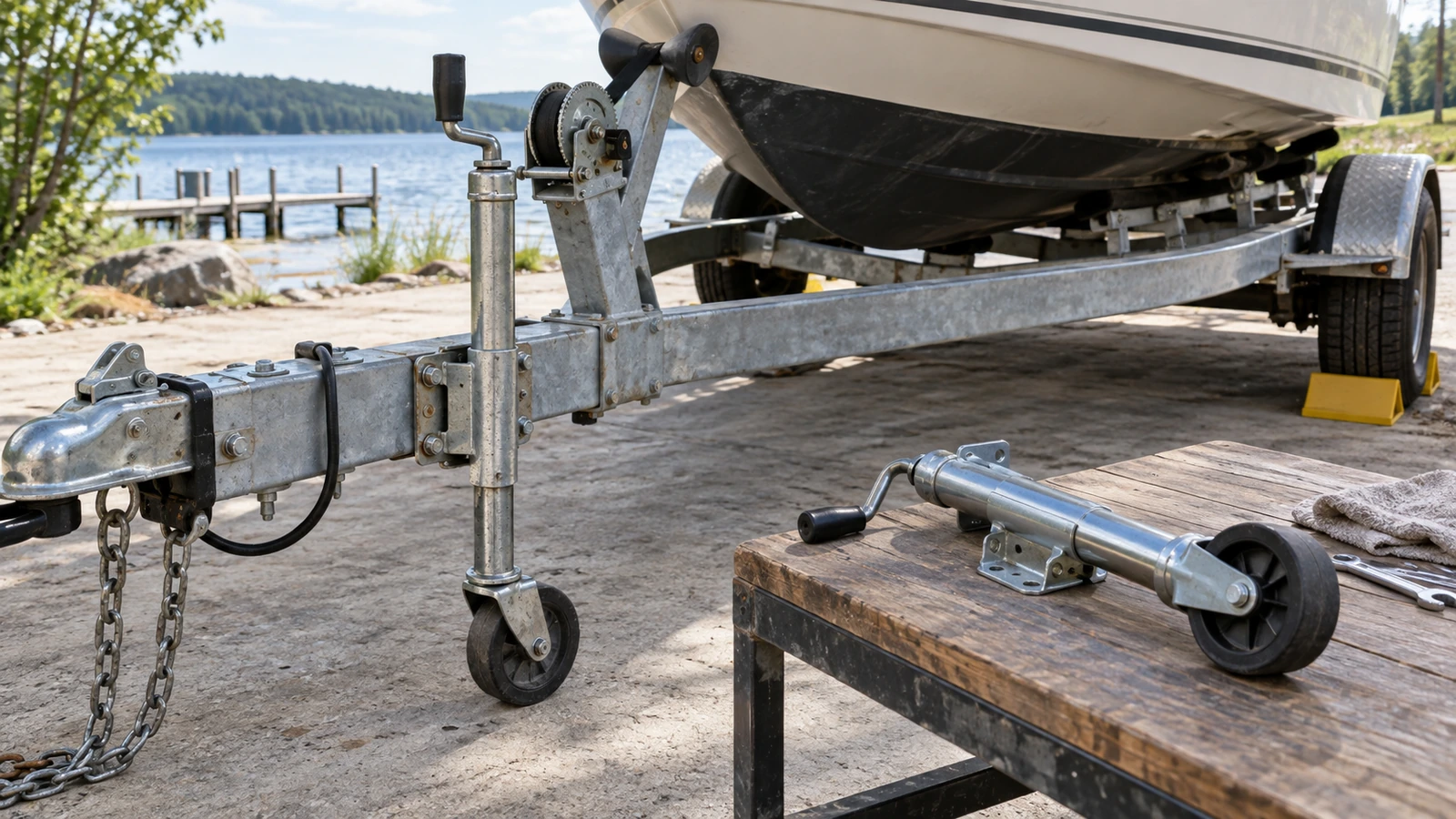
A replacement trailer jack can have the same load rating as the original and still be the wrong part.
The mounting plate may use a different hole pattern. A swivel jack may not engage with the existing bracket. The new handle may hit the trailer frame, or the jack may not retract far enough to provide safe ground clearance when towing.
The purchasing decision is therefore not simply whether the new jack can lift the trailer’s tongue weight. It is whether the replacement matches the existing trailer’s mounting interface, working-height requirements and available operating space.
This guide focuses on that specific task: identifying what to measure before ordering, when a replacement can reasonably be treated as a direct fit, and when the mounting arrangement needs further verification. It does not treat a shared load rating as evidence of interchangeability.
Selection guidance, not an installation approval. Confirm the current model drawing and manufacturer instructions before ordering or modifying a trailer mount.
Start with the Existing Installation
A failed trailer jack does not always mean that the entire mounting arrangement must be replaced.
On some trailers, the jack body can be removed from an existing swivel bracket. On others, the jack and bracket form a less easily separable assembly. An A-frame jack may be bolted through a mounting plate, while a side-mounted jack may use a bolt-on clamp, a welded pipe mount or a welded pivot plate.
Before looking at replacement products, identify which parts are damaged and which parts you intend to retain.
There are three practical replacement paths:
- Replace the jack while retaining the existing trailer-side mount. This requires confirmed compatibility with the original mounting and locking interface.
- Replace the jack and its mounting assembly. This requires confirming that the new mount is approved for the trailer frame and can be installed without compromising the structure.
- Repair or assess the trailer-side structure before selecting a jack. This applies when the original mounting area is bent, cracked, severely corroded or otherwise suspect.
The distinction matters because a replacement jack can be perfectly sound while the bracket remaining on the trailer is not.
If the existing jack leans, do not assume that buying a new jack body will correct the problem. The source of the lean could be the jack tube, pivot hardware, mounting plate or trailer tongue itself.
A replacement decision should begin with inspection, not a catalog capacity filter.
Identify the Existing Mounting Type
The mounting type is the first major compatibility filter.
An A-frame jack generally passes through a mounting opening in the trailer's A-frame structure and attaches to a mounting plate. A side-mounted jack attaches beside the trailer tongue. Many boat trailers use swivel arrangements that allow the jack to rotate into a stored position before towing.
Within those broad categories, the actual interfaces vary.
A-frame mounting. Check the opening, flange and bolt-hole pattern. A common three-hole arrangement does not prove that every A-frame jack will fit an older, modified or nonstandard trailer.
Bolt-on side mounting. Check the trailer-frame section, bracket orientation, clamp-plate dimensions, permitted mounting location and specified hardware. A bracket designed for one frame size may not clamp another securely.
Weld-on mounting. Identify whether the trailer has a welded pipe, plate or other bracket intended to mate with a removable jack. If the mount must be replaced, its attachment to the trailer becomes a separate structural and installation decision.
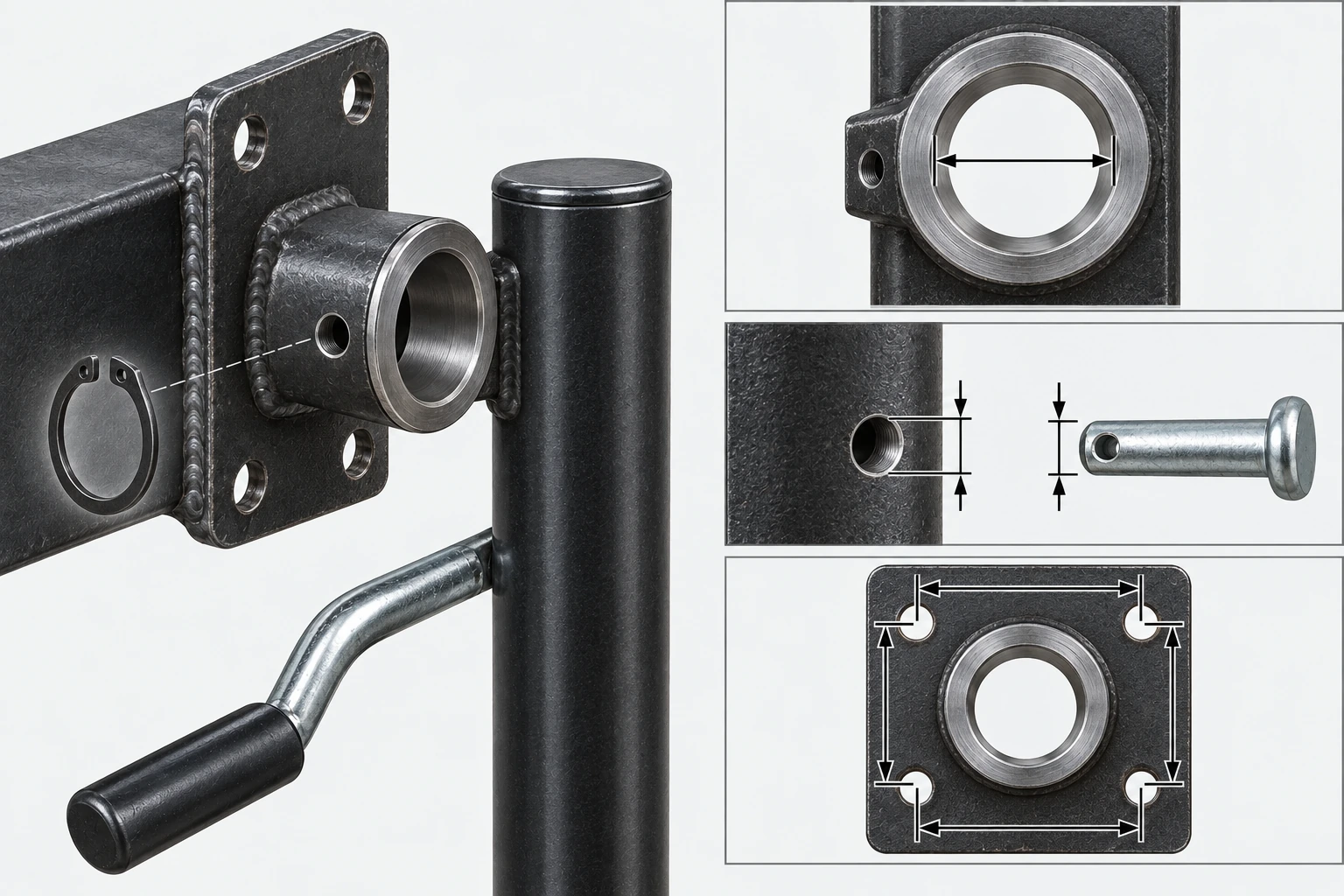
Swivel mounting. Determine how the jack rotates and locks. Similar-looking swivel jacks may use different pivot diameters, retaining methods, pin sizes and hole patterns.
A real etrailer replacement question illustrates the point. A buyer wanted to retain a welded bracket and install a different swivel jack. Etrailer's compatibility response required the buyer to check the mating bracket diameter and pull-pin size rather than relying on the jack's capacity alone. [1]
When an existing mount will remain in place, obtain the replacement manufacturer's interface drawing or a specific compatibility confirmation.
Matching the words “swivel jack” or “weld-on jack” is not the same as matching the mounting interface.
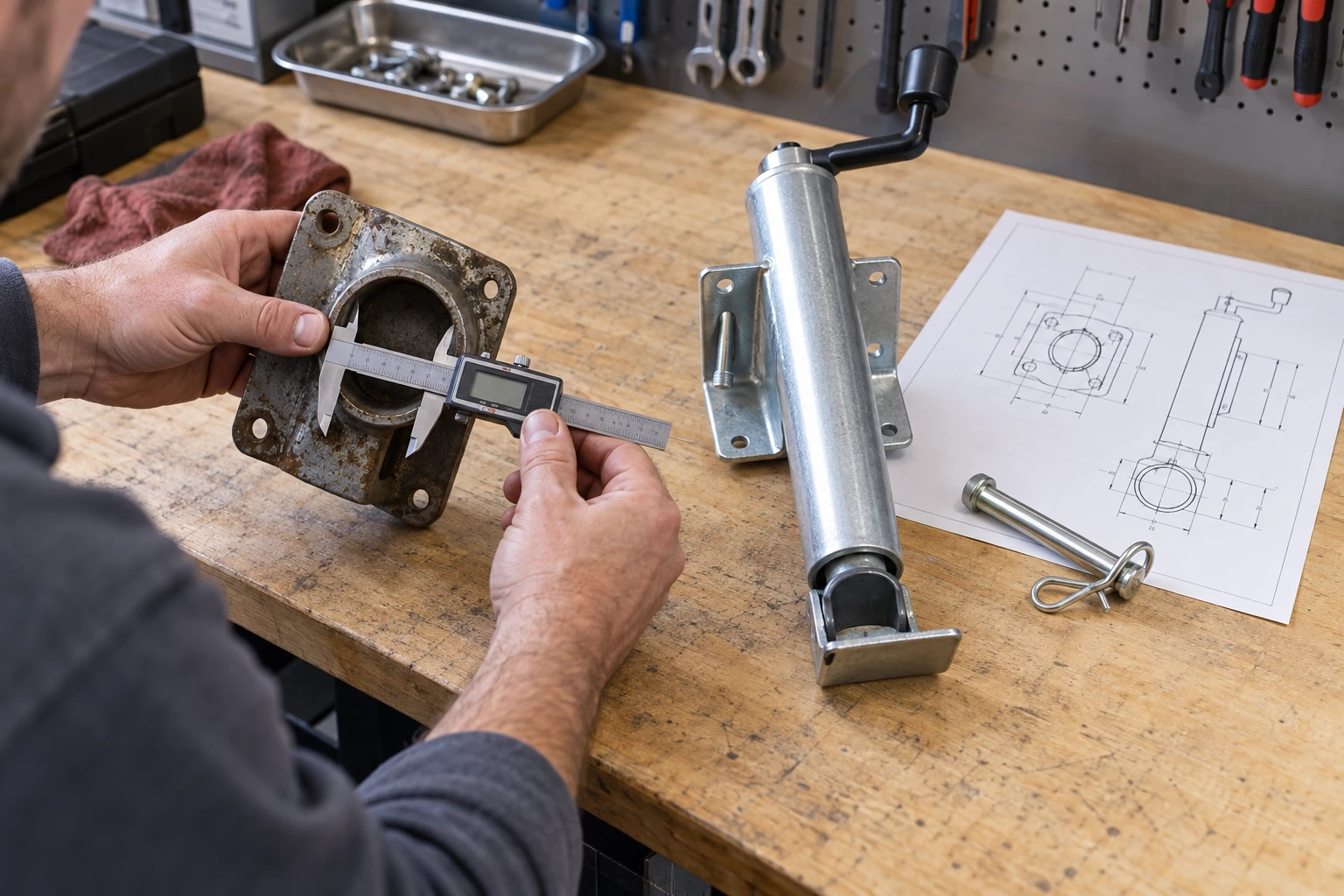
Measure the Interface—and Inspect Its Condition
The diameter or width of the jack body may be easy to measure, but it is often not the dimension that determines whether a replacement will attach.
For a bolt-on mount, measure the relevant trailer-frame dimensions and existing hole positions.
For a swivel system, document the full interface.
That may include the mating pipe or pivot diameter, retaining-ring arrangement, central fastener, locking-pin diameter, locking-hole spacing and the distance between the pivot center and the jack body.
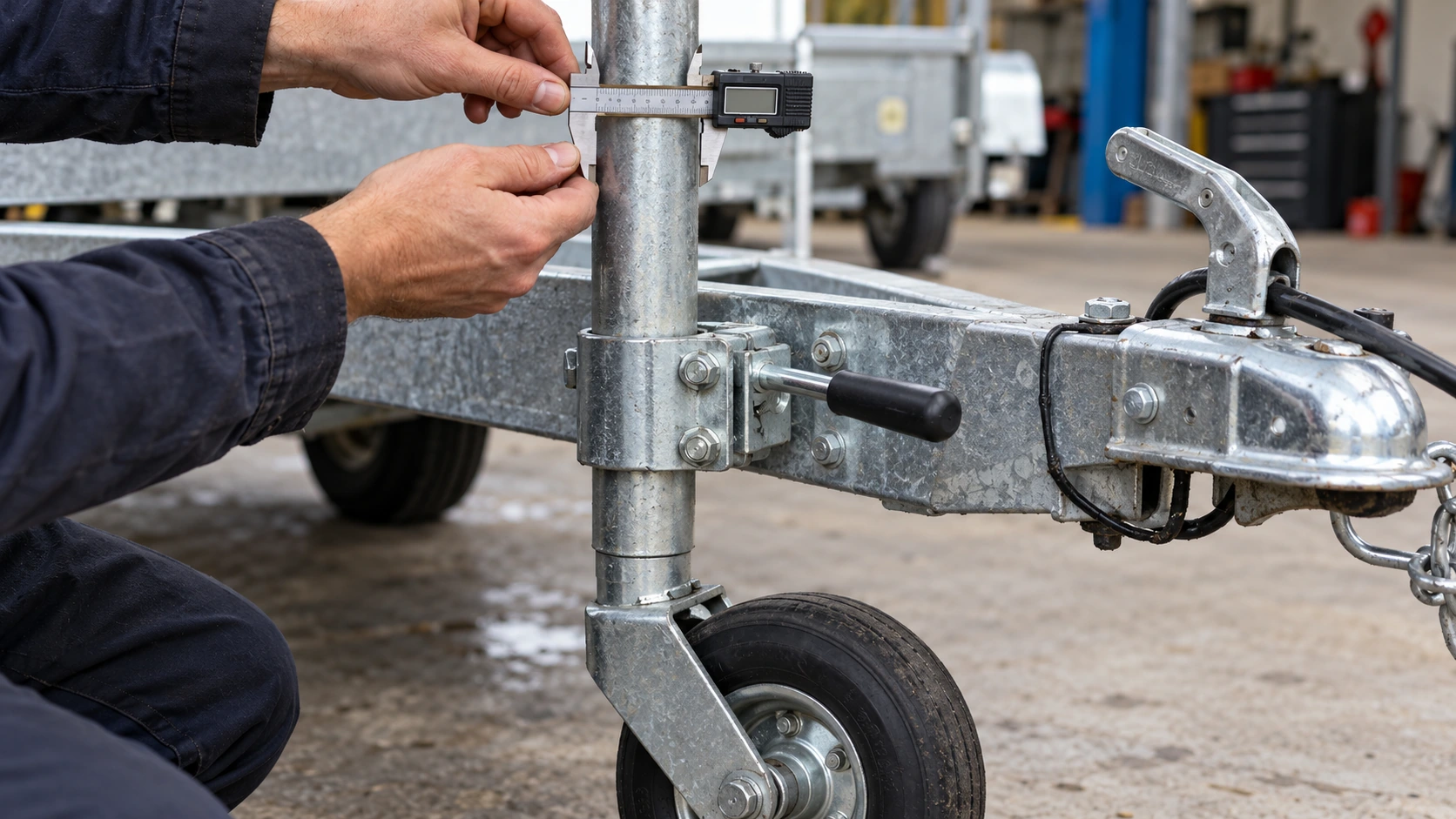
Measure hole spacing from center to center wherever the drawing specifies it. Photograph the mounting arrangement from the side and front, and record which side faces the trailer frame.
Do not assume that a pin fitting loosely into a hole establishes compatibility. The manufacturer's approved combination of pin, bracket and retaining hardware must still be confirmed.
Two real examples show how model-specific these details are:
- A Fulton snap-ring swivel jack discussed by etrailer uses a 2½-inch mating bracket opening and a ⅜-inch pull pin.
- A different Pro Series swivel-jack example uses a ½-inch pin and a separately specified snap-ring interface.
These measurements describe the products in those examples. They are not universal dimensions for trailer jacks. [1][2]
If an older jack has no readable model number, measurements and clear photographs become especially important. A visual resemblance between two brackets is not enough to approve a direct replacement.
Check Whether the Existing Bracket Is Still Serviceable
Retaining an existing welded bracket can avoid unnecessary modification to the trailer.
But reuse only makes sense if the bracket remains suitable for the replacement and its intended load.
Inspect the mounting area for visible bending, cracks, severe corrosion and damaged fastener holes. Pay particular attention to the swivel pivot and locking-pin holes.
A worn locking hole may become elongated. A deformed pivot or loose retaining arrangement may allow the jack to lean even when its telescoping mechanism remains functional.
In an etrailer discussion about a loose Fulton swivel jack, the response specifically identified an elongated or misshapen mounting hole as a possible reason the assembly had developed play and noted that a damaged mount would need replacement. [3]
This creates a clear purchasing boundary.
If the jack mechanism has failed but the original mounting interface is sound and confirmed compatible, a jack-only replacement may be appropriate.
If the bracket or trailer-side attachment is damaged, matching its dimensions does not make it safe to reuse.
A structurally questionable mounting area should be assessed and corrected before the new jack is installed. Welding, drilling or altering a load-bearing trailer member should follow an approved installation or repair method.
A direct-fit replacement requires a serviceable mount—not merely a mount that has the right measurements.
Compare Heights, Not Just Travel
Capacity and mounting compatibility are only the beginning.
A replacement must also raise and lower the trailer through the height range required for coupling, uncoupling and parked support.
Buyers often compare products using a single travel figure.
That can be misleading.
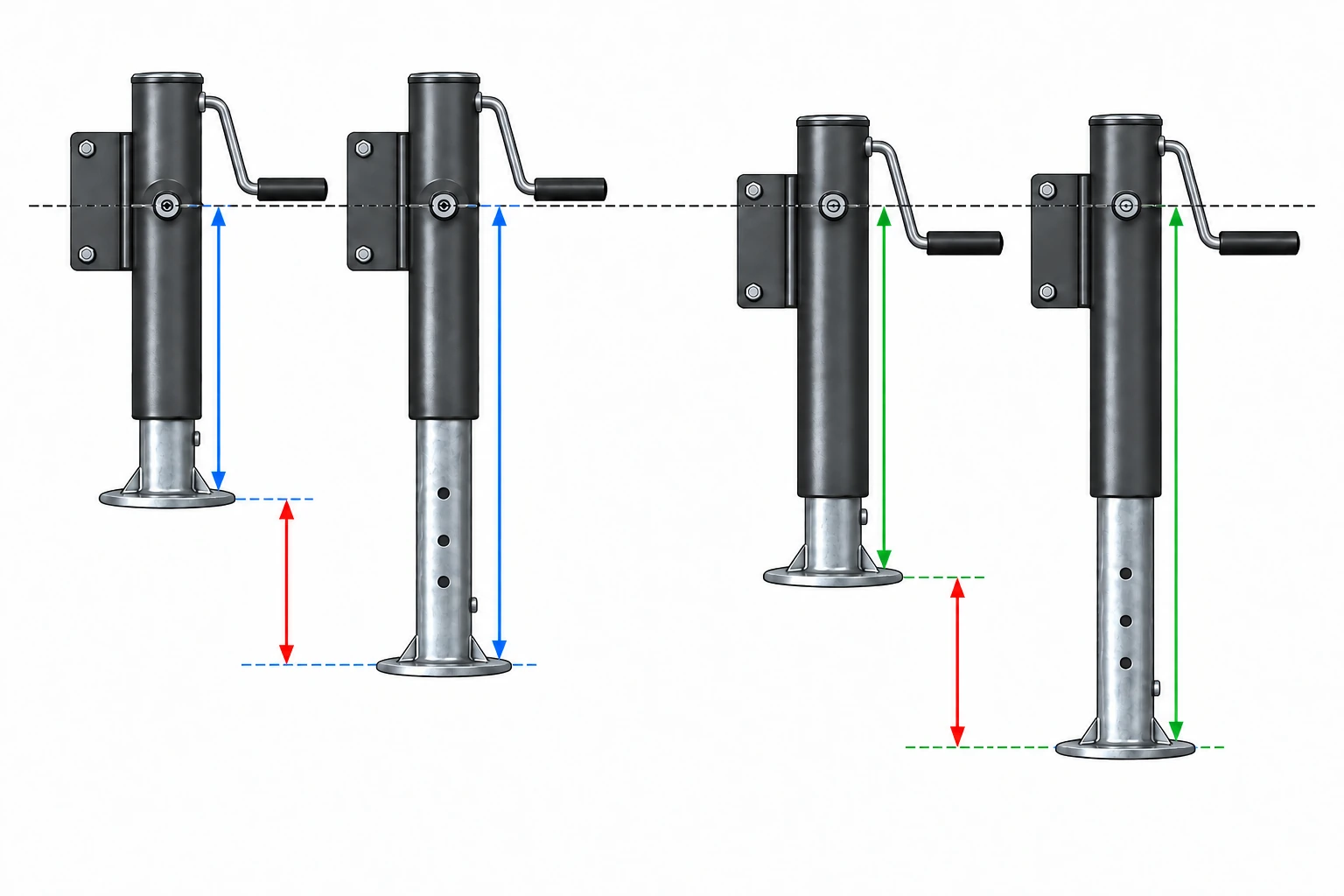
Two jacks may both advertise 10 inches of travel but begin and end that travel at different installed heights.
The measurement reference matters as well.
One product may define bracket height from the center of its side mounting bracket to the ground-contact point. Another may use the underside of an A-frame mounting flange. Overall retracted length is a different dimension again.
The relevant question is not simply whether both products offer the same stroke.
It is whether the new jack's installed minimum and maximum support positions cover the positions required by the trailer.
Measure the existing trailer in three conditions where practical:
- The coupler height when the trailer is connected to the tow vehicle.
- The height required to lift the coupler clear of the hitch during unhitching.
- The support height needed when the trailer is parked.
Record these measurements against a clearly identified datum, such as the trailer tongue or the center of the existing jack bracket.
Then compare them with the candidate jack's dimensions using an equivalent reference.
Etrailer's mounting-height guidance explicitly defines bracket height by reference to the center of a side-mounted jack's bracket and the ground-contact point. [4]
Do not assume that a larger maximum extension is always better. The jack must also retract sufficiently for the required towing or stored condition.
Same 2,000 lb Capacity, Different Height Geometry
GOODIN's current product range illustrates why published capacity and travel cannot establish replacement fit on their own.
| Published specification | LF931-2010 | LF965-2010B |
|---|---|---|
| Capacity | 2,000 lb | 2,000 lb |
| Handle style | Topwind | Sidewind |
| Travel | 10 in | 10 in |
| Published bracket height | 11.25 in | 12.4 in |
| Published extended height | 21.25 in | 22.4 in |
| Ground contact | Sand foot | 8 in wheel |
| Mounting information | Pipe-mount configuration | Exact replacement interface requires model-specific confirmation |
The values are taken from GOODIN's current product pages for LF931-2010 and LF965-2010B. [5][6]
Both models have a published 2,000 lb capacity and 10-inch travel.
They do not have identical height values, handle arrangements or ground-contact configurations.
Their published bracket-height measurements must also be checked against the same reference on the actual product drawings before a buyer compares installed heights.
The available data does not establish that either model will fit a particular existing swivel or pipe bracket. That interface requires separate confirmation.
For a replacement buyer, this is exactly why matching the two most prominent catalog specifications is insufficient.
Check the Entire Operating Envelope
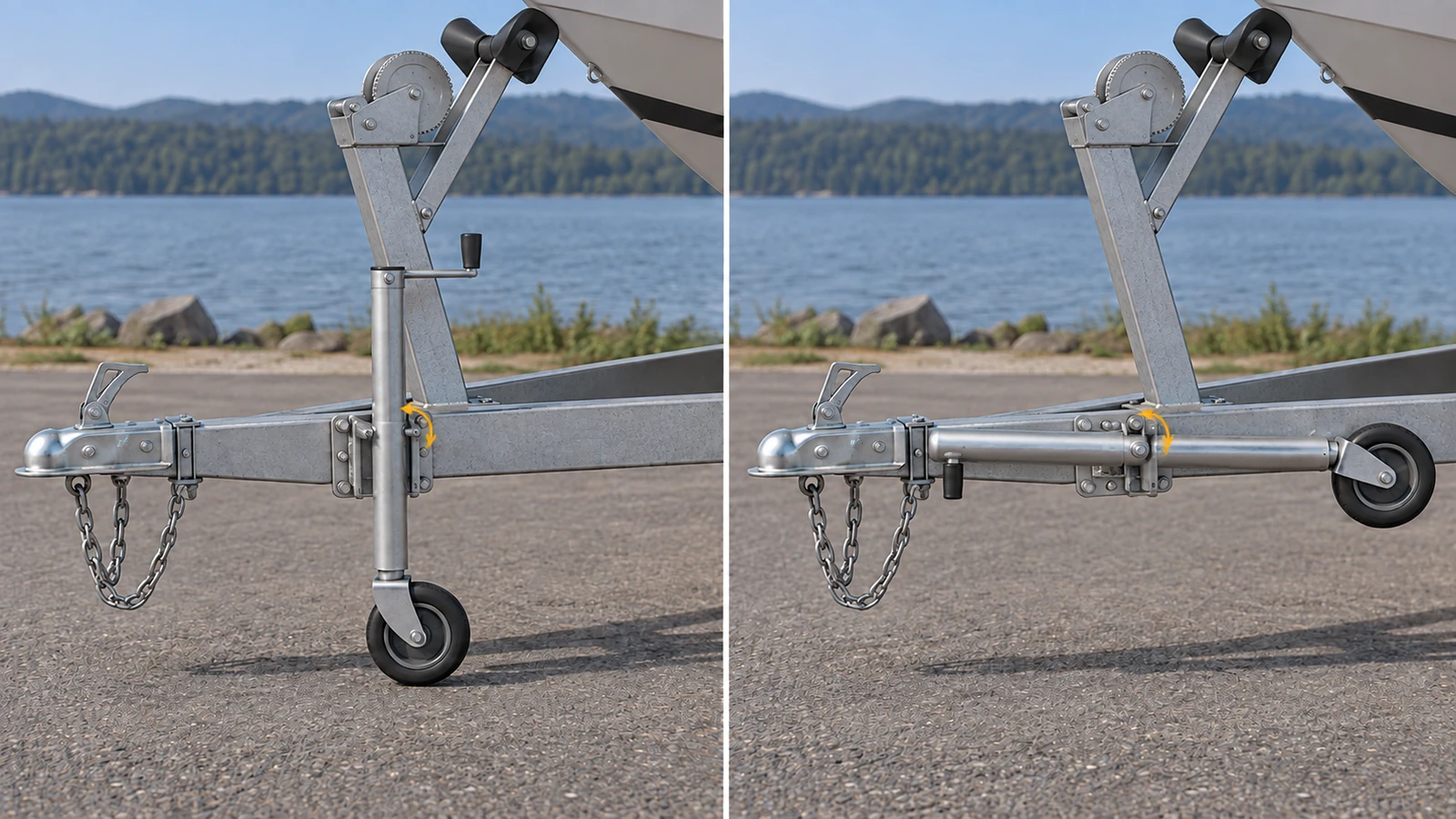
A swivel jack has to work in two distinct configurations.
In the deployed position, it must support the trailer through the intended load path.
In the stored position, the jack must be secured according to the manufacturer's instructions and remain clear of the road and nearby equipment.
The transition between those positions is itself a compatibility requirement.
A replacement may attach to the existing pivot yet fail to lock in the intended orientation.
Its locking pin may not align with the available holes.
Its wheel or foot may contact the trailer tongue before the jack reaches the stored position.
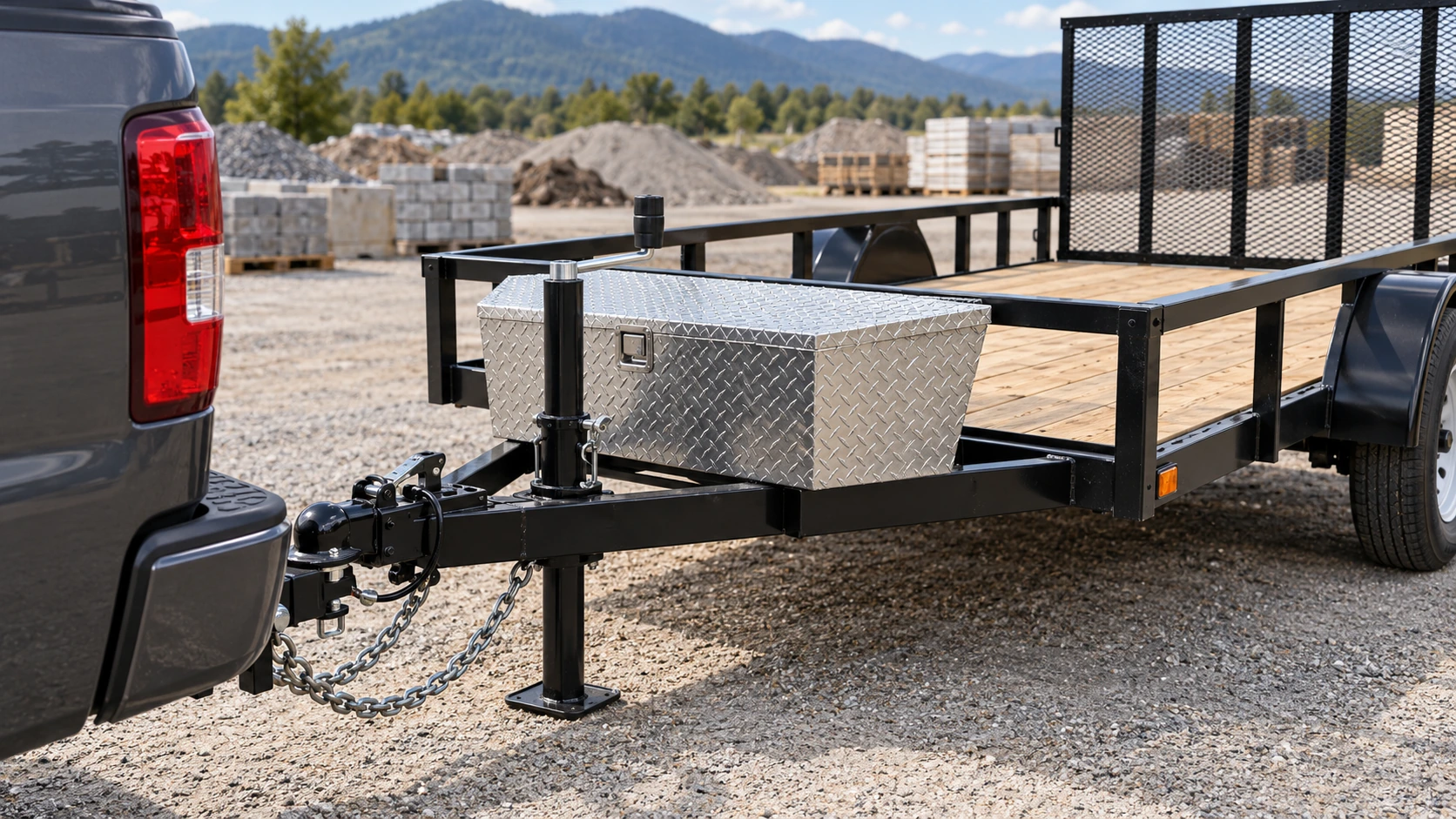
The jack may also rotate into position but leave insufficient clearance for a nearby winch post, toolbox, coupler or safety-chain arrangement.
Measure the actual available space rather than judging it from a product photograph.
For a swivel jack, record the distance from the pivot to the main jack body, the length and location of the wheel or foot assembly, and the position of the crank handle.
Then confirm that the candidate has sufficient clearance throughout its permitted swivel movement, not only at the two end positions.
A real etrailer fitting question about a Trailer Valet swivel jack addressed this exact issue by checking the clearance needed to rotate the jack into position. [7]
A jack that cannot be safely deployed and locked for towing is not a direct-fit replacement, even if its bracket bolts line up.
Topwind or Sidewind: Check Handle Clearance
The handle may be the part that makes an otherwise suitable replacement unusable.
A topwind jack requires space above the jack head for the crank to rotate.
A sidewind jack requires space to the side.
The actual clearance also depends on the handle's length, folding arrangement and orientation.
Consider a boat trailer with a winch post near the jack.
A replacement with a top-mounted handle may strike the winch structure.
On an enclosed trailer, a sidewind crank may interfere with a toolbox or body panel.
The tow vehicle matters too. A tailgate can conflict with the top of an A-frame jack when the vehicle and trailer are connected.
These clearance checks are practical purchasing requirements. Trailer-equipment supplier guidance calls for clearance around the jack handle and coupler latch when placing a tongue toolbox, while an etrailer fitting question addresses tailgate clearance for an A-frame jack. [11] [8]
Before ordering, make sure the proposed handle can complete its intended rotation without contacting permanent trailer equipment, the tow vehicle or the user.
Where a product permits handle reorientation, follow the specific manufacturer's instructions. Do not assume that every sidewind or topwind assembly can be repositioned in the same way.
A replacement must fit the operator's working space, not just the trailer's mounting plate.
Recheck Ground Contact, Clearance and Load
A replacement jack must reach the ground when needed, but it must also stay clear of the ground when towing.
These are different checks.
For a fixed A-frame jack, the lower tube or foot may remain below the trailer's mounting plate even when fully retracted.
For a swivel jack, rotating the body into its stored position may improve clearance—but only if the wheel, foot and handle fit within the available space.
The ground-contact attachment matters. A jack measured without its removable foot may have a different overall retracted height after that foot is installed.
In a product-specific etrailer measurement for e23ZV, the fully retracted overall height is given as 27½ inches without the footplate and 29½ inches with it: a two-inch difference. That figure is not a universal footplate allowance; it demonstrates why the complete installed assembly needs to be measured. [9]
For a replacement, compare the candidate jack against the trailer in its actual towing configuration. Consider the wheel or foot, the lowest exposed part of the jack and any permitted stored positions.
If the original jack frequently scraped the ground, matching its nominal travel may reproduce the same problem. Investigate whether a compatible replacement provides a more suitable retracted or stored envelope without compromising the required working height.
A jack should not be modified, left partly unlocked or operated beyond its specified travel to create clearance.
Should the Foot or Wheel Change?
An existing jack may use a wheel, a fixed footplate or a removable ground-contact attachment.
The replacement should suit the trailer's actual operating needs.
A wheel can be useful when a compatible trailer is repositioned over an appropriate surface. A footplate may be more appropriate where the primary task is stationary support.
But changing between them can change the jack's effective support height, retracted clearance and contact with the ground.
It may also change the load conditions applied to the jack.
A wheel-equipped jack's published lifting capacity should not automatically be treated as a separate rating for moving a loaded trailer across rough ground.
Before replacing a wheeled jack with a footplate model—or the reverse—confirm the intended use, the approved ground-contact attachment and the resulting installed dimensions.
This guide is not intended to determine which wheel material or footplate design is best for every trailer. The replacement question is narrower:
Will the new ground-contact arrangement preserve the functions and clearances the existing trailer requires?
If the original wheel or foot is to be reused, verify that it is approved for the candidate jack. Similar-looking attachment pins and tube dimensions do not establish universal interchangeability.
Capacity Is Not Total Trailer Weight
Matching capacity alone is insufficient, but capacity still has to be appropriate.
The relevant loading is the vertical load supported by the jack in its intended installed position, not the trailer's entire gross vehicle weight rating.
A boat and trailer weighing 1,800 lb in total do not necessarily impose a 1,800 lb vertical load on the tongue jack.
Likewise, an advertised 2,000 lb jack capacity does not mean that the complete trailer must weigh less than 2,000 lb.
For replacement screening, establish the actual loading the jack is expected to lift and support.
Check whether the manufacturer distinguishes lifting capacity from static support capacity and compare like with like.
If the original jack failed because it was overloaded, replacing it with an otherwise identical model may repeat the problem.
However, increasing the capacity number does not resolve a mismatched bracket, an inadequate trailer-side attachment or insufficient working height.
A higher-rated jack can be a suitable replacement only when the entire installed arrangement is compatible.
Do not assume that a higher-rated jack automatically makes an existing, damaged bracket or trailer tongue capable of carrying more load.
Decide: Direct Replacement or a New Mount?
After completing the measurements, the buyer should be able to place the candidate into one of three categories.
| Result | When it applies | Purchasing decision |
|---|---|---|
| Direct-fit candidate | The original mount is serviceable; the manufacturer confirms the mounting and locking interfaces; capacity, height, swivel path, crank access and towing clearance all meet requirements. | Consider replacing the jack without changing the approved trailer-side mount. |
| New mounting arrangement required | The jack itself is suitable, but its bracket, pivot or hole pattern does not match the existing interface. | Select a compatible jack-and-mount assembly and verify its approved attachment to the trailer. |
| Do not approve the replacement yet | The original mount is damaged; trailer-side structure is questionable; dimensions are missing; or the replacement cannot safely deploy, lock, retract or operate. | Resolve the structural or dimensional issue before ordering or installing the replacement. |
These categories are more useful than treating every similarly rated jack as a possible drop-in part.
They also prevent an unnecessary bracket replacement when the original mount is sound and a genuinely compatible jack is available.
Worked Example: An Older Weld-On Swivel Jack
Imagine an older boat trailer fitted with a side-mounted swivel jack.
The jack mechanism no longer operates reliably, but the trailer has an existing welded mounting bracket that the owner would prefer to retain.
A replacement jack appears in a catalog with the same capacity and similar wheel size.
At first glance, it looks suitable.
Before ordering, however, the owner discovers that the replacement uses a different swivel interface.
The central pivot dimensions are not confirmed, and the locking pin does not match the original assembly.
The two products are therefore not established as directly interchangeable.
There are two reasonable paths.
The owner can identify a replacement specifically confirmed to work with the original bracket.
Alternatively, the owner can obtain a complete compatible jack-and-mount assembly and have the trailer-side installation assessed and performed according to the manufacturer's requirements.
A real etrailer question involving an older Shelby jack illustrates this decision. The buyer wanted to retain a welded baseplate, could not find a serial number and asked about a slightly longer replacement. The response did not identify an exact attachment match, recommended a replacement jack with a new weld-on bracket, and explained the installation trade-off between weld-on and bolt-on mounting. [10]
The lesson is not that old welded brackets must always be replaced.
It is that their reuse must be based on confirmed compatibility and condition.
Keeping the old bracket is a valid purchasing objective—not a reason to assume a new jack will fit it.
No Model Number? Build a Replacement Record
This is common with older trailers.
The original manufacturer's label may be missing, unreadable or painted over.
The trailer may also have been modified by a previous owner.
In that situation, do not guess the model from capacity, color or tube shape alone.
Create a replacement record using the physical installation.
Photograph the jack in its deployed and stored positions. Include the full trailer tongue and nearby equipment so the available space is visible.
Take close-up photographs of the mounting bracket, pivot, retaining arrangement and locking pin.
Record the measured interface dimensions and the reference points used.
Note the original handle style, ground-contact attachment and required support-height range.
If the mounting assembly is worn, document that condition separately rather than using its damaged dimensions as an unquestioned specification.
A replacement supplier can use these details to identify a compatible model or explain what further measurement is needed.
A photograph is useful evidence, but it should not replace a dimensional drawing or a manufacturer-specific compatibility confirmation when those are necessary.
The Replacement Measurement Checklist
Before placing an order, collect the following information from the existing trailer and candidate jack.
| Check | What to record | Why it matters |
|---|---|---|
| Original jack | Brand, model and readable markings, if available | Helps identify a confirmed replacement or approved mounting system |
| Trailer-side structure | Frame section, mounting location and visible condition | Establishes whether the installation point is suitable |
| Mounting method | A-frame, bolt-on side mount, welded pipe, welded pivot plate or another arrangement | Determines the relevant interface |
| Bolt pattern | Number of holes, center-to-center spacing, hole diameter and flange arrangement | Screens bolt-on compatibility |
| Swivel interface | Mating dimensions, pivot design, locking-pin dimensions and retaining method | Determines whether the original bracket can be retained |
| Mount position | Height of the relevant mounting datum above the ground in a defined trailer condition | Allows valid comparison with jack height data |
| Required support range | Coupling, uncoupling and parked-support positions | Establishes the necessary working-height window |
| Stored envelope | Wheel or foot position, jack-body sweep and lowest point when stored | Establishes towing and swivel clearance |
| Handle envelope | Handle style, crank radius and nearby obstructions | Confirms that the jack can actually be operated |
| Ground contact | Wheel or foot configuration and any attachment intended for reuse | Affects height, clearance and intended use |
| Vertical load | Load supported at the installed jack position and applicable rating definition | Confirms capacity suitability |
| Candidate drawing | Current model-specific dimensions and approved mounting hardware | Supports final compatibility approval |
The buyer does not need to perform complex calculations to use this checklist.
The important improvement is to compare each relevant feature against a clearly identified requirement instead of relying on a shared capacity number.
Make the Supplier Inquiry Specific
A useful replacement inquiry should make the existing installation clear enough for the supplier to evaluate it.
Send the original jack's model number if available, plus photographs showing the full jack, trailer tongue and mounting details.
Include measured hole spacing, pivot or mating dimensions, locking-pin details and the height reference you used.
State the required coupling and stored positions, the intended ground-contact arrangement and any obstacles around the handle or swivel path.
Describe the condition of the existing bracket, especially if the old jack has leaned, loosened or suffered impact damage.
Finally, provide the vertical load requirement and the intended service environment.
Ask the supplier to identify which mounting components are confirmed compatible and which must be replaced.
That is a more useful request than asking for “a 2,000 lb replacement jack.”
For bulk purchasing, also request the current revision of the product drawing and clarify whether the quoted assembly includes the bracket, pin, fasteners, wheel or foot required for the approved installation.
This prevents a purchase from appearing complete on paper while missing the hardware necessary to fit the trailer.
GOODIN Product Selection
GOODIN's Trailer Jack range includes boat, A-frame, medium-duty, heavy-duty and customized trailer jack options.
For an existing trailer, that range should be used to identify a candidate configuration, not to claim that all products within a capacity class share one mounting interface.
For example, the LF961-1010L is published as a 1,000 lb single-wheel swivel-lock jack with a 6-inch wheel and 10-inch travel. [12]
The LF962-1512 is published as a 1,500 lb dual-wheel swivel jack with 12-inch travel. [13]
Those specifications help a buyer narrow the product family. They do not, on their own, establish that either jack mates with an unknown existing trailer bracket.
For a replacement request, GOODIN should confirm the exact model's mounting drawing, required hardware, installed height range and swivel clearance against the customer's measurements.
Where the original bracket cannot be reused, the inquiry should cover the complete compatible jack-and-mount arrangement rather than the jack body alone.
The same principle applies across the full product range:
Select the candidate by the required function. Approve the replacement by the complete installed fit.
GOODIN View: Confirm the Installation
Replacing a trailer jack should be a straightforward purchasing task.
But the original trailer has already established a set of physical requirements.
It has a mounting structure, a coupling height, a stored position and a limited amount of space around the tongue.
The replacement must work within those conditions.
A matching capacity number does not establish the bolt pattern.
A matching tube size does not establish swivel compatibility.
A matching travel figure does not establish the same installed working-height range.
And a jack that can be bolted into place is not necessarily one that can be operated, locked and stored correctly.
The purchasing process should therefore begin with the existing trailer, not with the replacement catalog.
Measure the interface.
Check the original mounting structure.
Compare the correct height references.
Verify the swivel and handle clearance.
Confirm the complete assembly and required hardware.
Only then can a candidate be treated as a direct-fit replacement.
GOODIN View: A replacement trailer jack is not a direct fit because its capacity matches. It is a direct fit only when its mounting, working height and operating envelope have been verified against the existing trailer.
For buyers, that prevents an avoidable second purchase.
For dealers, it reduces uncertainty when supplying parts for older or modified trailers.
For OEMs, it creates a repeatable replacement-specification process instead of relying on visual similarity or assumed interchangeability.
The result is a more useful purchasing decision: not merely a new jack with the correct number on its label, but a replacement that fits the trailer it is intended to serve.
For a model-specific replacement review, contact GOODIN with the original bracket photographs, measured interface, required height range and intended load.
Sources & Further Reading
Product-specific dimensions are examples, not universal standards. Sources are linked for compatibility checks; final approval requires the applicable manufacturer documentation.
- etrailer — Replacement Snap-Ring Trailer Jack That Uses Original Mounting Bracket
- etrailer — Dimensions of the Pro Series Round Swivel Jack to Fit Existing Mounting Bracket
- etrailer — Loose Fulton Magnum Series Swivel Trailer Jack on 2002 Ranger Boat Trailer
- etrailer — What is Bracket Height for etrailer 2 Swivel Jacks e34RV and e94RV
- GOODIN — 2000 lb Topwind Pipe-Mount Utility Trailer Jack — LF931-2010
- GOODIN — 2000 lb Sidewind Trailer Jack with 8 in Wheel — LF965-2010B
- etrailer — How Much Height Clearance is Needed to be Able to Rotate Trailer Valet 5X Swivel Jack
- etrailer — Can I Rotate the Electric Jack with Footplate and 7-Way Plug on the Trailer for Tailgate Clearance?
- etrailer — What Are the Dimensions of the Mounting Bracket on the etrailer Jack? — e23ZV
- etrailer — Availability of Replacement for Shelby Jack with Weld-On Bracket
- Nationwide Trailers — Trailer Tool Boxes & Storage — installation clearance guidance
- GOODIN — 1000 lb Single-Wheel Swivel-Lock Trailer Jack with 6 in Wheel — LF961-1010L
- GOODIN — 1500 lb Trailer Jack with Dual Wheels — LF962-1512
A-Frame vs. Side-Mount Trailer Jacks: Which Configuration Fits a Crowded Trailer Tongue?
Trailer Jack Encyclopedia
Related Article