Stronger Steel Does Not Automatically Make a Better Trailer: The Hidden Design Changes Behind High-Strength Steel
On this page

A trailer manufacturer uses 3 mm conventional structural steel for a load-bearing component. A new steel offers roughly twice the yield strength. Can the part simply become 2 mm?
Less steel means less mass and potentially more payload. Thinner material can reduce cutting time and welding consumables. But yield strength is only one limit: a thinner part may resist permanent deformation and still deflect excessively, buckle locally or expose weld details to higher cyclic stresses. Forming, springback, heat input, fit-up and production variation also change.
SSAB’s example upgrading an S355 main beam to Strenx 700MC reduced calculated beam weight by approximately 35% in a static-load-based comparison. That is a specific design example, not a universal saving. Fatigue, elastic deflection and stability require additional checks. [1] [4]
The key question is not simply how strong the new steel is. It is which failure mechanism becomes critical after the structure is made thinner. High-strength steel (HSS) creates an opportunity to redesign—not permission to change only the thickness on a drawing.
Engineering analysis—not a component design approval, thickness recommendation or qualified welding procedure.
Yield Strength Is Not Stiffness
The first misunderstanding is one of the most important. A 700 MPa steel has roughly twice the yield strength of a 350 MPa-class structural steel. It does not have twice the elastic stiffness. For structural steels, Young's modulus—the material property governing elastic deformation—is approximately the same across ordinary and high-strength grades. SSAB states this directly in its trailer design guidance: because steel grades have essentially the same Young's modulus, trailer bending stiffness is controlled mainly by geometry rather than yield strength. If section geometry remains unchanged and thickness is reduced, bending stiffness falls. [2] This creates a fundamental distinction:
Yield strength tells us when permanent deformation begins.
Stiffness tells us how much the structure elastically moves before that point.
A trailer does not need to yield before excessive flexibility becomes a problem. A chassis that deflects too much can affect:
- deck alignment,
- ground clearance,
- loading geometry,
- ramp operation,
- door opening,
- coupling behavior,
- suspension alignment,
- equipment mounting,
- and the distribution of loads into secondary structures.
A component can therefore be “strong enough” according to yield strength and still be functionally inadequate. That is why simply replacing 3 mm conventional steel with 2 mm high-strength steel using identical geometry is not a complete design calculation. The material became stronger. The geometry became less stiff. Both happened at the same time.
High-Strength Steel Works Best When Geometry Is Allowed to Change
This leads to one of the most important principles in lightweight structural design:
If higher material strength allows thickness to decrease, geometry often needs to do more work.
For bending stiffness, the controlling structural quantity is:
EI
The material contributes the elastic modulus E. The cross-section contributes the second moment of area I. If E stays approximately unchanged, the designer must manage I. That can mean increasing beam depth, changing flange width, replacing open profiles with more efficient sections, adding folds, moving material farther from the neutral axis or tailoring the cross-section along the trailer according to local load demand. This is why a lighter HSS beam does not have to look like a thinner version of the old beam. It can—and often should—have different proportions.
SSAB's trailer design guidance demonstrates this with a comparison between an original S355 main beam and Strenx 700MC alternatives. One lightweight option reduced mass by roughly 36% but retained only about 66% of the original moment of inertia. Another alternative used more carefully adjusted geometry, reduced weight by about 30%, yet restored the moment of inertia to approximately the original level. [1] The steel grade was the same in both lightweight solutions. The structural behavior was different because the geometry was different. That is exactly why “material substitution” and “structural upgrading” are not the same thing.

Thinner Sections Change the Governing Failure Mode
Reducing thickness does more than reduce stiffness. It changes the stability of plates, webs and flanges. Consider a flat portion of a trailer beam under compression. If the plate becomes sufficiently thin relative to its unsupported width, it may buckle locally before the steel reaches its full yield strength. This is called local buckling. The basic parameter is slenderness. For a plate element, that is strongly related to the ratio:
b/t
where b represents plate width and t represents thickness. Reduce thickness while maintaining width, and the plate becomes more slender.
SSAB identifies this explicitly as an important issue when designing with HSS. Reduced thickness and higher working stresses make local buckling increasingly significant, and flange or web geometry can limit how much of the material's higher yield strength can actually be used. [3] [2] The classical elastic buckling relationship also reveals why this effect becomes serious quickly. For a plate under compression, the elastic critical buckling stress is described by the following proportionality under otherwise identical boundary conditions:
σcr ∝ (t/b)²
As a simple illustration—not a trailer design calculation—if width remained constant and thickness fell from 3 mm to 2 mm, the thickness term becomes:
(2/3)² ≈ 0.44
So the idealized elastic buckling stress associated with that geometry could fall to roughly 44% of its former value. Meanwhile, the material's yield strength may have increased dramatically.
The 44% illustration holds elastic modulus, Poisson’s ratio, unsupported width and the relevant buckling coefficient fixed. It is not a 44% trailer payload rating, ultimate resistance or fatigue-life prediction. Real design must account for imperfections, residual stresses, support conditions and the applicable stability method.
This creates the paradox.
The steel becomes harder to yield while the thinner plate can become easier to buckle.
The governing failure mechanism has moved. That is why increasing yield strength beyond a certain point delivers diminishing benefit unless section geometry is also redesigned.
A Stronger Material Can Shift Failure Somewhere Else
This principle appears repeatedly in trailer design. Suppose a conventional main beam is limited by yielding. Upgrade the material and reduce thickness. Now yielding may no longer be the controlling mode. The structure may instead be limited by:
- elastic deflection,
- local flange buckling,
- web shear buckling,
- torsional instability,
- welded-joint fatigue,
- attachment fatigue,
- or local deformation around concentrated loads.
The structure did not become worse because high-strength steel was used. The weakest link changed. This is one of the reasons SSAB describes trailer upgrading as being constrained not only by static load-carrying capacity but often even more by fatigue and stability. [4] It also explains why choosing steel based only on MPa can be misleading. A 900 MPa grade may offer substantially more yield strength than a 700 MPa grade. But if the structure is already governed by local buckling at 600 MPa of actual compressive stress, the extra 200 MPa of nominal material strength may never be used. The correct question is therefore:
Can the structure develop the material's strength before another failure mode occurs?
If not, the design needs to change.

Fatigue, Load Paths and Cut-Edge Quality
Trailer structures rarely experience only one maximum static load. They experience repeated bending, twisting, road vibration, braking forces, loading cycles and localized suspension or attachment loads. That makes fatigue unavoidable as a design consideration. High-strength steel can improve the fatigue performance of smooth base material. But welded joints behave differently.
When load and section layout remain comparable, reducing thickness usually raises nominal working stress. SSAB notes that although HSS provides improved base-material fatigue strength, the benefit at welded joints is much more limited because weld geometry, stress concentration and initial imperfections dominate the response. If the original weld detail and quality are simply carried over into a thinner, higher-stressed chassis, fatigue resistance can decrease. [5] This has major consequences for material upgrading. Imagine an S355 trailer beam redesigned in 700 MPa steel. The flange becomes thinner. The average service stress rises because less material carries the same structural load.
If the beam contains the same transverse reinforcement weld, bracket termination or abrupt attachment as the old design, that detail now sees the higher working stress. The HSS base material may be stronger. The weld detail did not become proportionally better. The extra material strength may therefore be consumed by the poor joint geometry. This is why the previous Materials & Manufacturing principle applies again:
A stronger material does not automatically create a stronger welded component.
Lightweighting Makes Load Paths More Important, Not Less
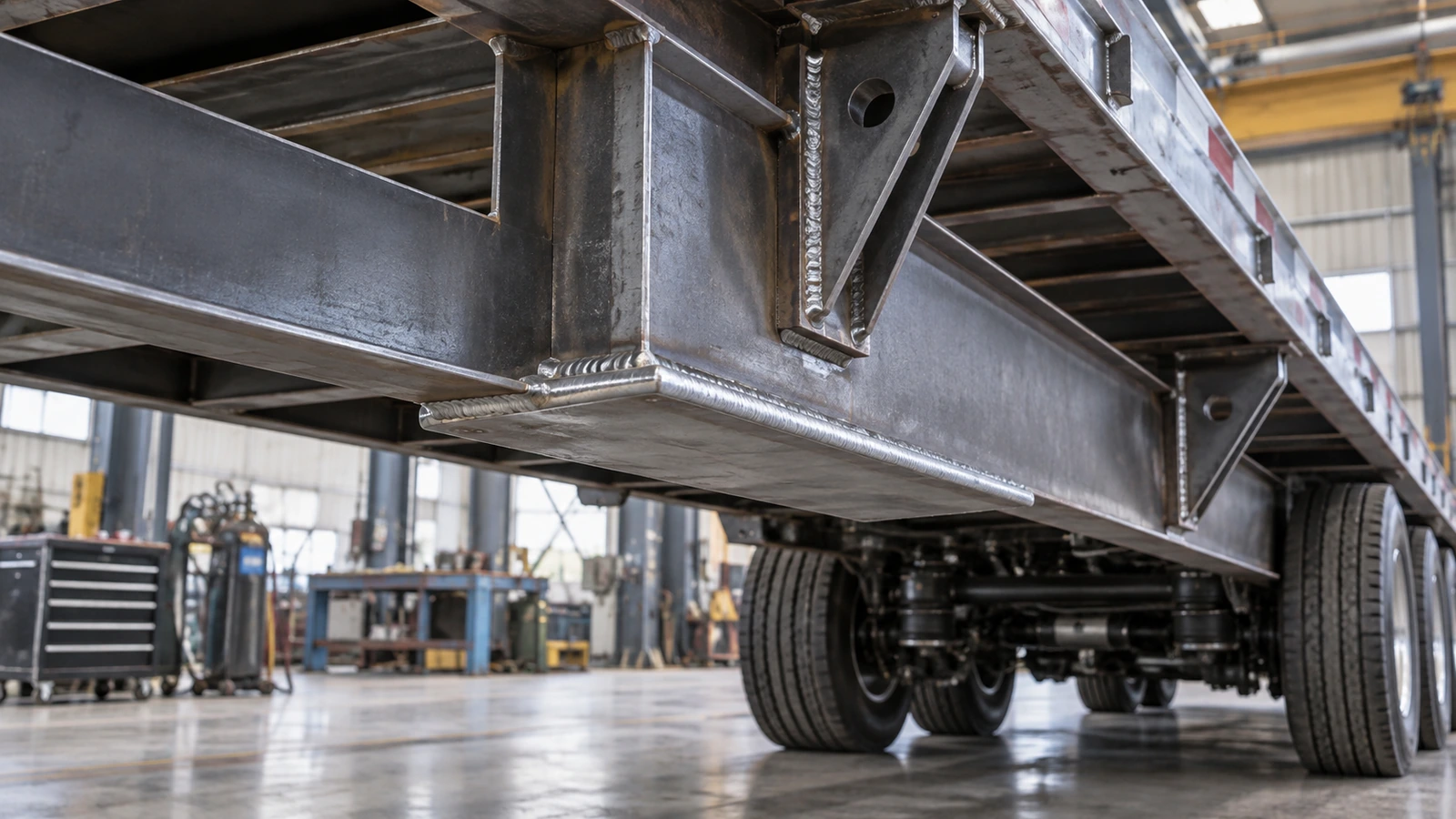
Heavy structures can sometimes tolerate inefficient load transfer because abundant material keeps local stresses relatively low. Lightweight structures have less room for that inefficiency. As thickness decreases, concentrated loads become more important. Suspension brackets, landing gear, cross-members, kingpin structures, ramps, hydraulic equipment and other attachments all introduce force into the chassis. The designer must increasingly ask: Where does the load enter? How quickly does it spread? Does the local section have enough stiffness? Is force introduced into a flange, web or closed section? Does a reinforcement create a stiffness discontinuity? Does the attachment require a fatigue-sensitive transverse weld? High-strength steel creates the opportunity to remove material from low-value regions.
But that makes it even more important to place the remaining material where the loads actually need it. SSAB's future-oriented trailer guidance therefore describes the full utilization of 700–1100 MPa steels not simply as thinner steel, but as a broader redesign involving beams, cross-members, alternative joining methods, elimination of unnecessary welded joints, structural stability and fatigue control. [15] That is a very different philosophy from:
Change S355 to S700 and update the thickness cell in the drawing.
Cutting Quality Can Become a Fatigue Variable
High-strength steel can also make edge quality more important where cut edges experience cyclic stress. SSAB reports fatigue testing on Strenx 700MC showing different fatigue performance between milled, laser-cut and sheared edge conditions. Its guidance recommends removing visible crack-like defects from mechanically cut edges and placing thermal-cutting start and stop positions in lower-stress regions. [13] Again, the lesson is not that one cutting process is universally required. It is that manufacturing details matter more as designers increase stress utilization. In a heavy conventional structure, an imperfect edge may sit far below the fatigue-critical stress range. In an optimized lightweight structure, the same edge may now experience much higher cyclic stress.
The material became stronger. The permissible manufacturing complacency did not.
Use Higher Grades Where the Structure Can Benefit
One of the most revealing statements in SSAB's trailer guidance concerns the upper end of material strength. Its typical-upgrading example states that conventional trailer main-beam designs may have limited ability to utilize structural strength above approximately Strenx 700MC level; to take meaningful advantage of higher grades, different chassis concepts may be required. SSAB notes that higher grades such as 960 MPa can still be appropriate for certain special trailers and specific components. [1] This is an important design boundary. It does not mean that 900 or 960 MPa steel is unsuitable for trailers.
The 2026 Murray Trailers case shows precisely the opposite: Murray uses Strenx 900MC in the top flanges of its heavy-haul low-bed trailer gooseneck while using another high-strength grade throughout other parts of the structure. [14] But the application is selective. The higher grade is placed where its properties provide value. That is a more sophisticated strategy than maximizing the MPa number everywhere. A trailer may benefit from different materials in different regions because different parts are governed by different mechanisms. One region may be controlled by bending strength. Another by fatigue. Another by impact or dent resistance. Another by formability. Another by buckling. Another by weldability or production cost.
This leads to a more useful material-selection principle:
The optimum trailer does not necessarily use the strongest available steel. It uses the appropriate strength where that strength can actually be converted into structural value.
The Best HSS Design May Actually Have Fewer Parts
A common mistake is to keep the conventional chassis architecture unchanged and simply make every component thinner. That preserves:
- the same number of brackets,
- the same gussets,
- the same reinforcement plates,
- the same welds,
- and the same load-path discontinuities.
It captures only part of the opportunity. Higher-strength steel can enable different production strategies. Bent profiles may replace welded assemblies. A formed section can integrate a feature that previously required a separate reinforcement. A tailored flange can put material only where bending moment requires it. A closed section can provide torsional stiffness more efficiently than a heavier open arrangement. SSAB's trailer design guidance explicitly recommends reducing part count, integrating attachments where possible and minimizing welded joints as part of lightweight HSS design. [16] This is Design for Manufacturing in its strongest form. The benefit of HSS is no longer simply thinner material. It becomes:
less material + fewer parts + fewer welds + better load paths + lower production effort.
That is where material substitution becomes structural redesign.
Closed Sections Can Solve Problems That Higher Yield Strength Cannot
Torsional stiffness provides a good example. Increasing yield strength does little to directly increase elastic torsional stiffness. Geometry is much more important. SSAB notes that trailer torsional behavior depends strongly on cross-member arrangement and section type. Its trailer guidance shows that closed cross-sections can significantly improve torsional stiffness, while simply changing material strength does not solve the underlying geometry problem. [3] This matters particularly for:
- tippers,
- heavy-haul trailers,
- uneven loading,
- off-road use,
- and structures subjected to significant chassis twisting.
If an OEM reduces cross-member thickness without reconsidering torsional geometry, the vehicle may become more flexible even though every component has a higher yield strength. The solution may not be thicker steel. It may be a better cross-section. This is exactly what HSS design should enable.
Springback and Formability Change the Production Plan
Structural redesign is only half of the problem. Production must also manufacture the new geometry. Higher-strength steels generally produce more springback during bending. Springback occurs because the elastically deformed portion of the material recovers after forming force is removed. SSAB notes that springback increases with steel strength and with the ratio of die width to plate thickness. Therefore, high-strength grades often require greater overbending, different tooling assumptions or compensation in the forming process. [7] This is easy to underestimate during material substitution. A manufacturer may have:
- a proven press-brake program,
- existing tooling,
- standard bend allowances,
- fixed fixtures,
- established hole locations,
- and downstream robotic welding positions
based on the old material. Change the steel grade and thickness, and the part may no longer leave the press brake at the same angle. That small angular error can propagate downstream. A flange sits several millimeters away from its fixture. A mating cross-member no longer fits correctly. The operator clamps it into position. The gap becomes inconsistent. Welding is used to pull the assembly together. Residual stress and distortion increase. The material upgrade has now created a manufacturing problem that did not exist in the original design. The causal chain becomes:
higher strength → more springback → geometry variation → fit-up variation → fixture compensation → weld variation → assembly inconsistency.
That is why bending is not a secondary production issue. It is part of structural design.
“High Strength” Is Not One Formability Level
Even within high-strength steel, formability differs significantly by grade and product. For example, SSAB's published data for Strenx 700MC lists minimum inside bend radii for a 90-degree bend ranging from roughly 0.8 to 1.6 times material thickness depending on thickness range. Its Strenx 900MC data specifies larger minimum bend radii—around 3.0 to 3.5 times thickness for the listed gauges. [8] [9] Those figures apply specifically to those products and should not be generalized to every 700 or 900 MPa steel. But they illustrate a broader sourcing lesson:
Yield strength alone does not describe manufacturability.
A buyer specifying only “900 MPa high-strength steel” may be omitting properties that determine whether the actual component can be produced. Depending on the application, procurement may also need to understand:
- minimum bend radius,
- elongation,
- edge ductility,
- thickness tolerance,
- flatness,
- impact toughness,
- weldability,
- delivery condition,
- surface condition,
- and consistency between batches.
The correct material is the one that satisfies the complete design-and-production requirement.

Welding and Distortion Belong in the Redesign
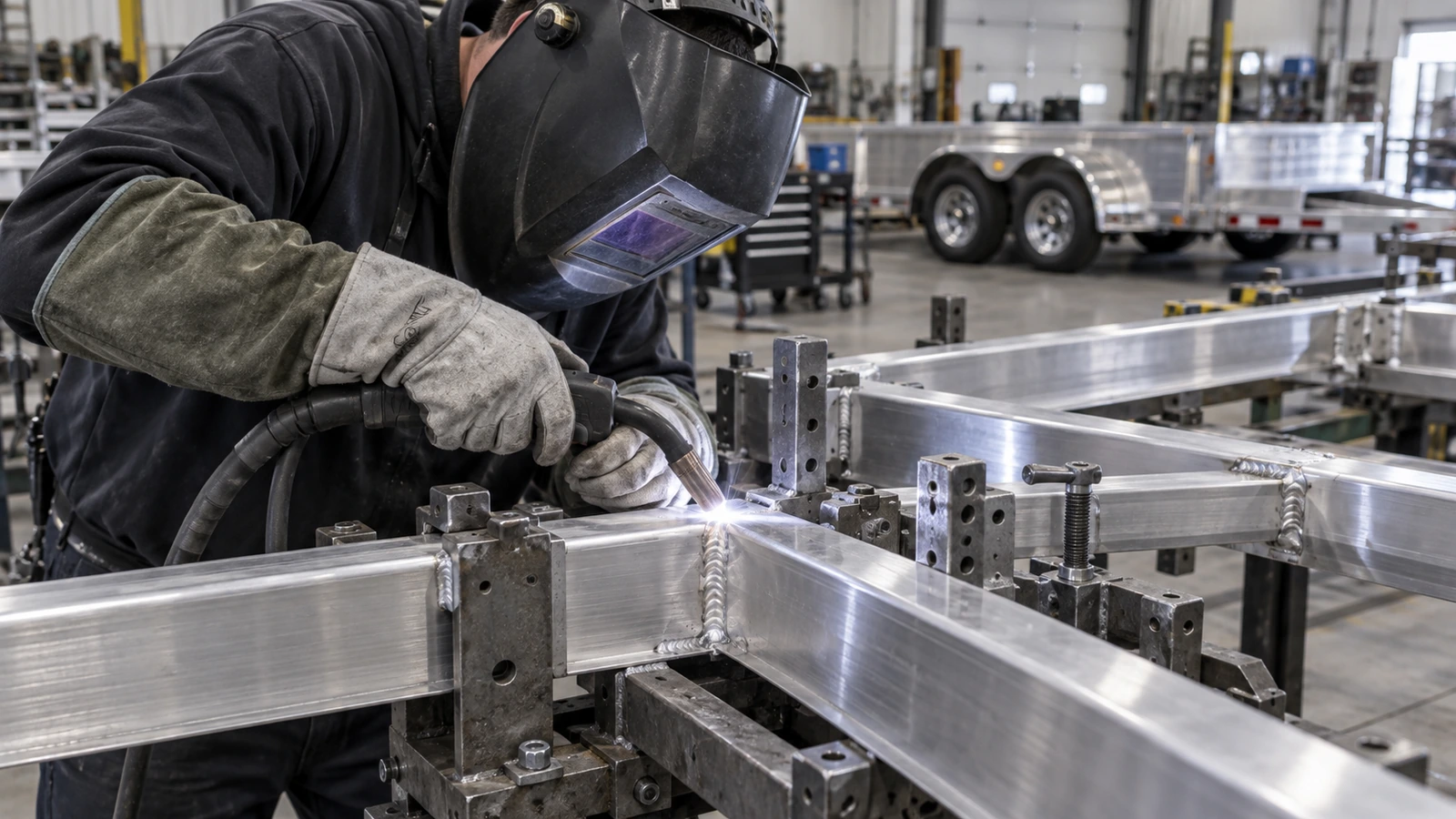
High-strength structural steels are weldable, but the welding process cannot be assumed to be irrelevant. SSAB's current trailer guidance states that excessively high heat input can reduce the strength and impact toughness of HSS welded joints. Its recommended limits vary with material thickness and the mechanical properties required from the finished weld. [10] At the same time, using the highest-strength available filler metal is not automatically necessary. SSAB notes that trailer welds are often not stressed highly enough to require fully matching filler strength and that undermatching filler can be appropriate in many applications, depending on the joint and loading. [11] This reinforces the same principle seen throughout the article:
One maximum number does not define quality.
The optimum weld is not necessarily the one with:
- the strongest filler,
- the largest bead,
- or the greatest heat input.
It is the joint that safely transfers the intended load while preserving acceptable fatigue performance, toughness, geometry and production consistency. High-strength steel therefore changes welding from a simple joining task into part of material utilization.
Thinner Structures Also Make Distortion More Expensive
Welding distortion is particularly relevant because lightweight components are less geometrically forgiving. A small angular change that was insignificant in a thick conventional beam can become important when:
- plates are thinner,
- assembly clearances are smaller,
- automated fixtures expect repeatable geometry,
- or load paths have been optimized around more precise positioning.
SSAB's trailer manufacturing guidance goes so far as to state that welding distortion in trailer production can be more critical in practice than the static strength of the weld. It recommends minimizing unnecessary weld cross-section, controlling heat input, optimizing welding sequence, maintaining consistent root gaps and using appropriate clamping or prebending. [12] This is another reason high-strength steel cannot be evaluated only through tensile strength. If a material enables a 25% lighter component but the production process introduces enough distortion to require extensive straightening and rework, part of the economic value has already been lost.
If straightening or forced fit-up also changes residual stress and geometry, structural consistency can be affected as well. Lightweighting therefore increases the value of process control.
Neither lower heat input nor undermatching filler is a blanket shop-floor instruction. The qualified procedure must also provide fusion, toughness and required joint resistance, with preheat, interpass limits and hydrogen control where applicable. Required weld dimensions and applicable safety factors remain part of the design.
Murray Trailers: Turning Material Consistency into Repeatable Production
The 2026 Murray Trailers example is useful because it moves the discussion away from laboratory material strength. According to SSAB's published case study, Murray uses Strenx 900MC in the gooseneck top flanges of its heavy-haul trailers and Strenx 110XF throughout other parts, and emphasizes not only strength but predictable material dimensions and manufacturing behavior. [14] The case study specifically highlights tight thickness tolerance, flatness and bending consistency. SSAB also states that Murray's laser cutting and automated welding operations benefit from narrow dimensional tolerances, while consistent bending response helps the same forming setup produce more repeatable springback from plate to plate. [14]
This is manufacturer-supplied case-study evidence rather than an independent comparative trial, so it should be interpreted accordingly. But the production logic is important. When designers remove material, variation becomes more significant. Suppose a thick conventional component contains generous structural margin. A small variation in plate thickness may have limited practical effect. Now optimize the component around a thinner section. Thickness influences:
- cross-sectional area,
- section modulus,
- stiffness,
- buckling slenderness,
- component weight,
- forming response,
- and fit-up.
Variation therefore becomes more expensive. High-quality HSS is valuable not only because its nominal strength is high, but because predictable material can help the manufacturer reproduce the optimized design repeatedly. That leads to a principle especially relevant to volume production:
The more optimized the design becomes, the more valuable manufacturing consistency becomes.
A Lightweight Prototype Is Not Enough
It is relatively easy to create one carefully built lightweight prototype. The more difficult question is whether the factory can build the 1,000th trailer like the first. High-strength steel upgrading may require changes to:
- nesting programs,
- cutting parameters,
- press-brake tooling,
- bend compensation,
- fixture dimensions,
- weld sequence,
- robot programs,
- inspection points,
- straightening procedures,
- handling methods,
- and supplier tolerances.
If these are not controlled, production variation can erase the engineering benefit. For example, a designer may reduce a flange thickness because the nominal material strength provides enough static capacity. But if bending variation causes assembly misalignment, weld position moves. If weld position moves into a higher-stress region, fatigue performance changes. If the operator compensates with a larger weld, distortion increases. If the thinner flange becomes locally wavy from heat, stability changes. This is why Materials & Manufacturing must follow the entire chain:
material → design → forming → welding → geometry → structural behavior.
Stopping at material strength misses the product.
Thinner Material Can Save Manufacturing Cost—But Only After the Process Is Rebalanced
High-strength steel is often more expensive per tonne than conventional structural steel. That does not automatically mean the finished component costs more. Less steel is used. Thinner sheet can cut faster. Smaller welds may require less filler metal. Welding speed may increase. Forming can replace welded assemblies. Part count can sometimes be reduced.
SSAB's trailer manufacturing study compared a conventional S355 flatbed chassis with a redesigned HSS solution. The study reported a chassis weight reduction of up to 1,500 kg and estimated overall production-cost reduction of up to 30% in that specific example, with lower cutting and welding costs partly offset by increased bending requirements associated with the redesigned profiles. [6] The exact percentages should not be treated as universal trailer-industry savings. Labor rates, production volume, automation, steel prices, design geometry and plant capability all vary. But the mechanism matters. HSS economics are not simply:
higher steel price versus lower steel weight.
They are:
material + cutting + forming + welding + fixtures + cycle time + scrap + rework + payload value + lifecycle performance.
That is a much more useful OEM calculation.

What OEMs Should Specify, Test and Purchase
An OEM considering HSS should not begin by asking:
What is the thinnest gauge we can use?
A better sequence is: What currently limits the component? Yielding? Deflection? Fatigue? Buckling? Impact? Wear? Manufacturing cost? Then ask whether additional material strength actually addresses that limitation. If yielding controls, higher-strength steel may create substantial lightweighting potential. If deflection controls, geometry must change. If local buckling controls, section slenderness needs attention. If fatigue at a welded attachment controls, the joint needs redesign. If manufacturing variation controls, tighter tolerances or a different production process may create more value than another increase in nominal yield strength. That is how HSS becomes an engineering tool instead of a specification upgrade.
Specifications Must Move Beyond “S700” or “900 MPa”
The sourcing implications follow directly from the engineering. A procurement specification that says only:
High-strength steel, minimum yield strength 700 MPa
may be incomplete for an optimized trailer component. Depending on the application, the RFQ may also need to control:
Material properties
- minimum yield strength,
- tensile range,
- elongation,
- toughness,
- chemical-equivalent or weldability requirements.
Dimensional properties
- thickness and tolerance,
- flatness,
- width and length tolerance.
Forming performance
- minimum bend radius,
- rolling direction where relevant,
- springback consistency,
- edge quality requirements.
Welding requirements
- permitted welding processes,
- filler strategy,
- heat-input limits where necessary,
- joint geometry,
- critical weld location,
- distortion control.
Traceability
- material certificate,
- heat or batch identification where required,
- supplier documentation.
Finished-component controls
- dimensions,
- alignment,
- critical section geometry,
- weld inspection,
- load or fatigue validation where appropriate.
The exact list should follow the actual component. A simple toolbox bracket does not require the same specification as a main chassis flange. But the principle remains:
High-strength steel is a production system requirement, not merely a purchase-grade requirement.
Testing Must Also Ask the Right Question
The same caution applies to material and component tests. A tensile test establishes important properties such as yield strength and tensile strength. It does not measure trailer chassis stiffness. It does not establish local buckling resistance of a thin web. It does not reproduce welding distortion. It does not establish welded-joint fatigue life. It does not confirm that a press brake can reproduce the intended geometry across production batches. A static component load test can demonstrate resistance to a specified load. It cannot by itself prove long-term fatigue durability. A dimensional inspection can verify geometry. It does not prove material toughness. A fatigue test can provide valuable durability evidence.
But its result depends on load spectrum, boundary conditions, weld detail and test configuration. This is why one engineering metric should never become the complete definition of quality. A 900 MPa certificate proves something important. It does not prove that the finished trailer is better than a correctly designed 700 MPa or 355 MPa alternative. That conclusion belongs to the entire structure.
For Procurement Teams: Compare the Manufacturing Window, Not Only Price per Tonne
Purchasing decisions can easily undervalue HSS by comparing raw material cost alone. A higher price per tonne may still result in lower component cost if:
- less steel is consumed,
- cutting becomes faster,
- weld length or size decreases,
- forming replaces fabrication,
- payload value increases,
- or assembly becomes simpler.
The opposite can also happen. A cheaper HSS supplier may create higher production cost if the material has:
- wider thickness variation,
- inconsistent flatness,
- unpredictable springback,
- poor edge condition,
- or inconsistent forming behavior.
Those differences can cause:
- setup changes,
- scrap,
- rework,
- robot-program interruptions,
- fixture problems,
- and dimensional variation.
The lowest steel price is therefore not necessarily the lowest manufactured-component cost. The proper sourcing unit is not only $/tonne. It is closer to:
cost per repeatably manufactured structural function.
GOODIN View: Design Freedom, Not an Automatic Upgrade
Lightweight trailers can sometimes create skepticism. A thinner beam may look weaker than a heavier conventional one. That visual judgment can be just as misleading as assuming that higher-strength steel automatically creates a better trailer. If a lightweight structure has been correctly redesigned, thinner HSS may deliver equal or greater required load capacity while reducing tare weight. But buyers cannot determine that from thickness alone. The relevant questions are:
- Was the structure redesigned for HSS?
- Are stiffness and stability controlled?
- Are fatigue-critical welds managed?
- Are forming and welding processes appropriate?
- Is production consistency maintained?
- Has the component been validated for its actual service conditions?
A thinner trailer can be well engineered. A thicker trailer can be poorly engineered. Material volume alone does not answer the question.
The Real Opportunity Is Not “Use Less Steel Everywhere”
High-strength steel does not eliminate conventional structural steel. Nor does every trailer component benefit equally from the highest available grade. The real opportunity is selective material efficiency. Use higher strength where load-carrying capacity allows mass to be removed. Use geometry where stiffness is required. Use closed or shaped sections where torsional stability matters. Use careful joint design where fatigue controls. Use appropriate forming grades where complex geometry is necessary. Use predictable material tolerances where automation and repeatability matter. And retain more thickness where local buckling, impact, wear, fastening or manufacturing practicality requires it. This is a system approach. The grade is only one variable.
GOODIN View: High-Strength Steel Creates Design Freedom, Not an Automatic Upgrade
High-strength steel can fundamentally improve trailer design. It can lower tare weight. It can increase payload. It can reduce material consumption. It can reduce cutting and welding work. And when used intelligently, it can enable simpler and more efficient structures. SSAB's trailer studies and current production examples show that these benefits are technically achievable. [6] [14] But higher yield strength does not increase every useful structural property. Young's modulus does not rise in proportion with strength. Thinner plates become more slender. Buckling can appear before yielding. Working stresses can increase if geometry is not rebalanced. Welded fatigue details may become more critical. Springback changes. Bend requirements change. Welding heat and distortion need tighter control.
And production variation matters more when the design uses material efficiently. The question is therefore not whether 700, 900 or 960 MPa steel is “better” than mild steel. The question is whether the trailer has been designed and manufactured in a way that converts that additional material strength into useful product performance. A direct grade substitution may preserve much of the old structure's inefficiency while introducing thinner-material problems.
A genuine HSS redesign can do something much more valuable: move steel to the places where it carries load efficiently, change the geometry where stiffness is needed, eliminate unnecessary parts and welds, and build a production process capable of repeating the optimized structure.
GOODIN View: High-strength steel creates design freedom, not an automatic upgrade. Material substitution without structural redesign often leaves much of the material's value unused—and can create new manufacturing problems.
The best lightweight trailer is therefore not the one that uses the highest MPa number or the thinnest possible sheet. It is the one in which material strength, section geometry, load path, stability, fatigue and manufacturing capability have been redesigned together. That is how stronger steel becomes a better trailer.
The same interface review applies to trailer jacks and mounting hardware and accessories: component ratings do not validate the thinner supporting structure. Confirm load introduction, attachment geometry and manufacturing requirements together.
For a new OEM program, discuss the application with GOODIN with the load cases, interface drawing, material condition and validation requirements. Define the finished assembly before treating a steel grade as the complete specification.
Sources & Further Reading
SSAB product data and guidance apply to the stated products and conditions. Supplier case studies are not independent comparative tests. Illustrative figures do not replace component-specific engineering or qualified production procedures.
- SSAB — Typical upgrading
- SSAB — Bending stiffness
- SSAB — Stability
- SSAB — Loading situations
- SSAB — Fatigue
- SSAB — Trailer Design Guideline — production economics and structural redesign
- SSAB — Springback
- SSAB — Strenx 700MC D/E — product data
- SSAB — Strenx 900MC — product data
- SSAB — Welding heat input
- SSAB — Welding methods and filler material
- SSAB — Welding distortion
- SSAB — Edge quality
- SSAB — Murray Trailers reinvents low-bed heavy haulers with Strenx steel
- SSAB — Trailer Design Guideline — greater trailer capacity
- SSAB — Trailer Design Guideline
6061-T6 After Welding Is Not the Same Material: Why Aluminum Trailer Components Fail Around the Weld
Related Article