Powder Coat Failure Usually Starts Before the Powder: Why Pretreatment, Welds and Edges Decide Corrosion Performance
On this page
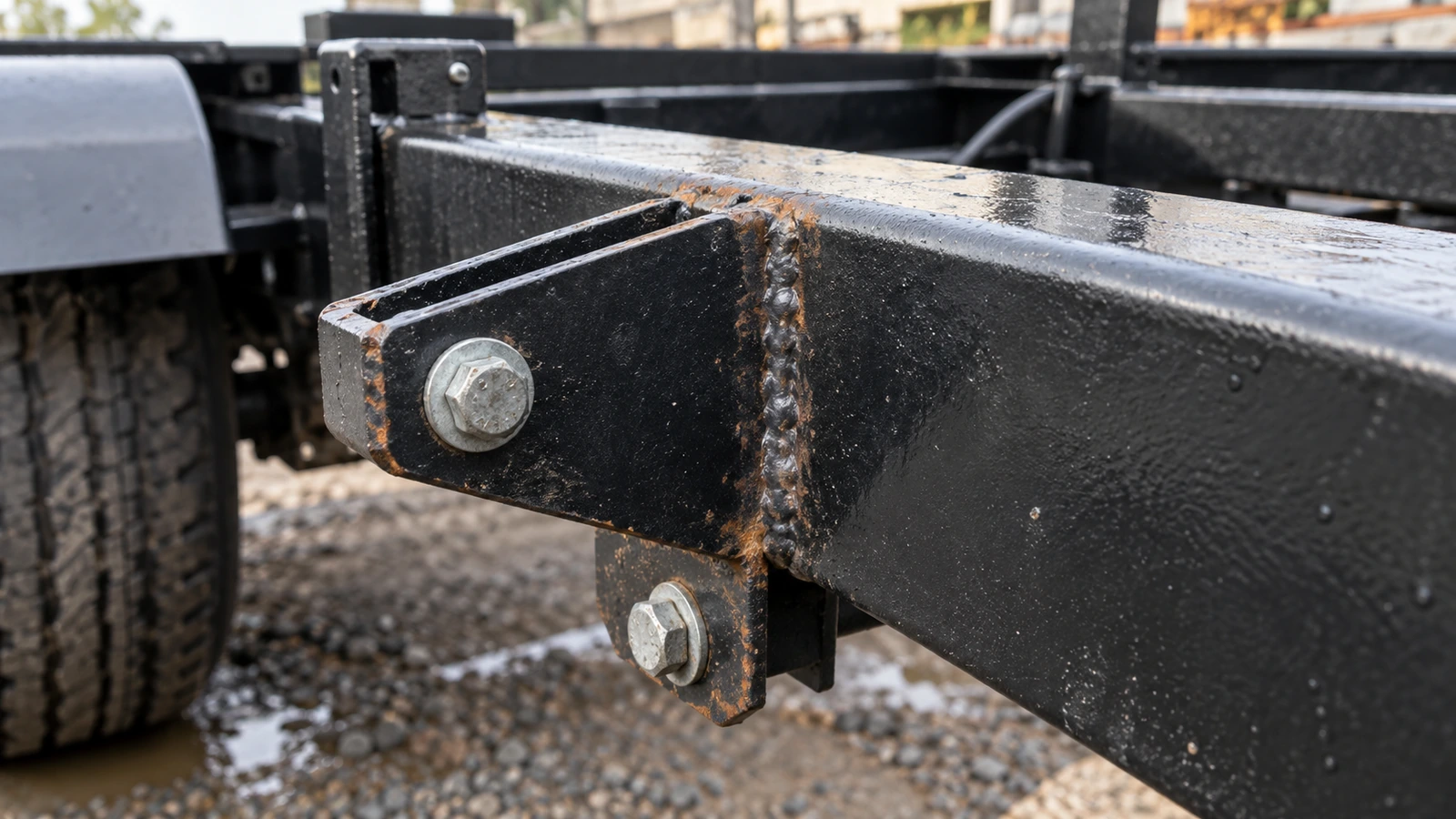
Two trailer manufacturers buy the same powder, apply similar film thicknesses and deliver equally attractive parts. Later, one develops rust around welds and peeling near mounting points while the other retains its protection. The difference may have originated before either part entered the spray booth.
Cleaning, pretreatment, weld preparation, edge geometry, coverage and cure all influence the finished system. A coating inspection focused on an accessible flat face can miss the detail where failure begins. Sherwin-Williams’ transportation guidance treats the substrate, preparation and coating process as connected variables. [1]
The engineering question is not merely whether powder coating resists corrosion. It is what must happen before, during and after application for that protection to exist on the actual trailer component.
Engineering analysis, not a coating-line operating procedure or a universal durability guarantee. Validate the coating system and acceptance criteria for the actual component and exposure.
Start With the Steel, Not the Powder
Powder coating is a manufactured system, not simply a layer of paint. Its protective chain starts with steel condition and fabrication, continues through cleaning, pretreatment, application and cure, and extends into assembly and service. A contaminated surface can weaken adhesion. A sharp edge or inaccessible recess can remain inadequately protected. Incorrect curing can prevent the film from developing its intended properties. Assembly can damage a coating that passed inspection.
The powder formulation matters, but it cannot independently control all these interfaces. An RFQ that specifies only the powder brand and minimum thickness leaves much of the corrosion-performance requirement undefined.
Why Surface Contamination Can Defeat a Good Powder Coating
Consider a steel trailer bracket leaving the welding station. The metal may carry cutting oil, handling contamination, welding residues and localized oxidation. Its surface can look reasonably clean. That does not mean it is ready for powder coating. Oil and grease can interfere with the ability of the coating to establish intimate contact with the underlying steel. Residual contamination can also compromise the effectiveness of chemical pretreatment.
During curing, trapped contaminants may contribute to defects such as craters, pinholes or localized loss of adhesion. The result is that the coating can appear satisfactory over much of the part while containing weak areas that become vulnerable in service. A corrosion problem may therefore begin with an ineffective cleaning operation rather than a defective powder. This is the practical meaning of Sherwin-Williams' emphasis on pretreatment.
The coating must be matched to the substrate and the preparation process used before application. [1] For an OEM, the manufacturing consequence is important. Cleaning cannot simply be treated as an operation that happens somewhere between welding and painting. The factory needs to understand what contamination its own fabrication processes create. A change in cutting lubricant may affect cleaning requirements. A different welding consumable may change the residues left on the part.
A new forming process may introduce additional oils. A supplier delivering components with a different surface condition may require adjustment of the existing pretreatment process. The cleaning system must therefore be compatible with the actual incoming material and fabrication route. A coating process cannot be considered stable if the condition of the steel entering it is uncontrolled.
Mill Scale Is Not a Corrosion-Protective Foundation
Hot-rolled steel frequently arrives with mill scale. Mill scale consists primarily of iron oxides formed during high-temperature steel processing. It can adhere strongly in some locations and poorly in others. For certain coating systems, leaving unsuitable mill scale in place creates a weak foundation. The powder may adhere to the scale rather than directly to a properly prepared steel surface. If the scale subsequently separates from the underlying metal, the coating can detach with it.
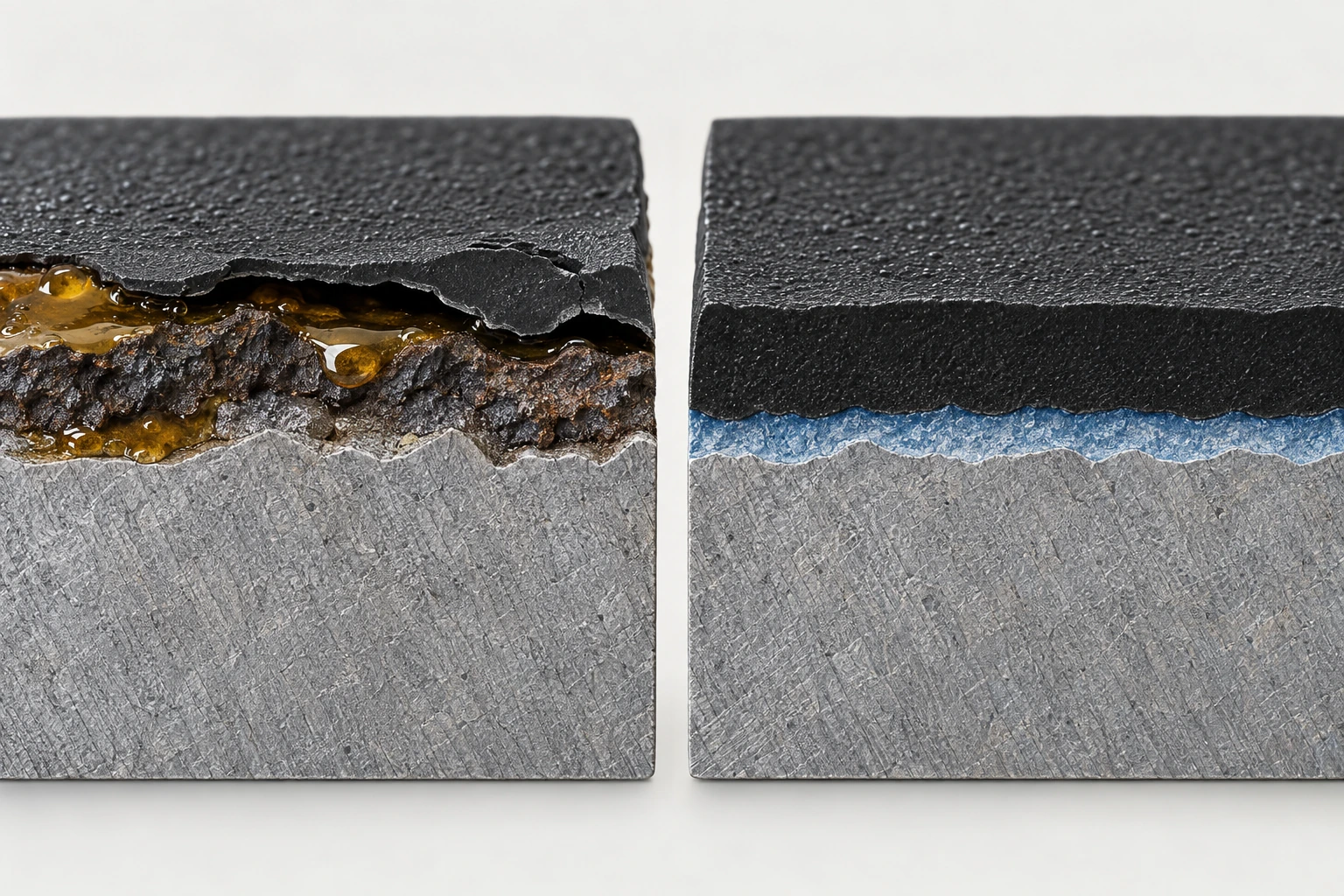
Moisture may also reach exposed or poorly protected steel around defects in the scale. Corrosion then develops beneath the organic coating. The important point is that the manufacturer may see coating detachment and conclude that the powder has poor adhesion. The actual failure may have occurred at the steel-to-scale interface. Changing the powder formulation without addressing the substrate may not solve the problem.
This is especially relevant to heavy-duty trailer frames using hot-rolled structural sections. A supplier may deliver steel with a different surface condition from the material used during the original coating qualification. The nominal steel grade can remain unchanged. The surface-preparation requirement may not. Mechanical preparation, such as appropriate abrasive blasting, may be required where the coating specification demands removal of mill scale or a particular surface profile.
The required preparation should follow the coating manufacturer's instructions and the applicable project specification. It should not be replaced by an assumption that a thicker powder layer can compensate for an unstable substrate.
Welds and Edges Decide Where Protection Becomes Thin
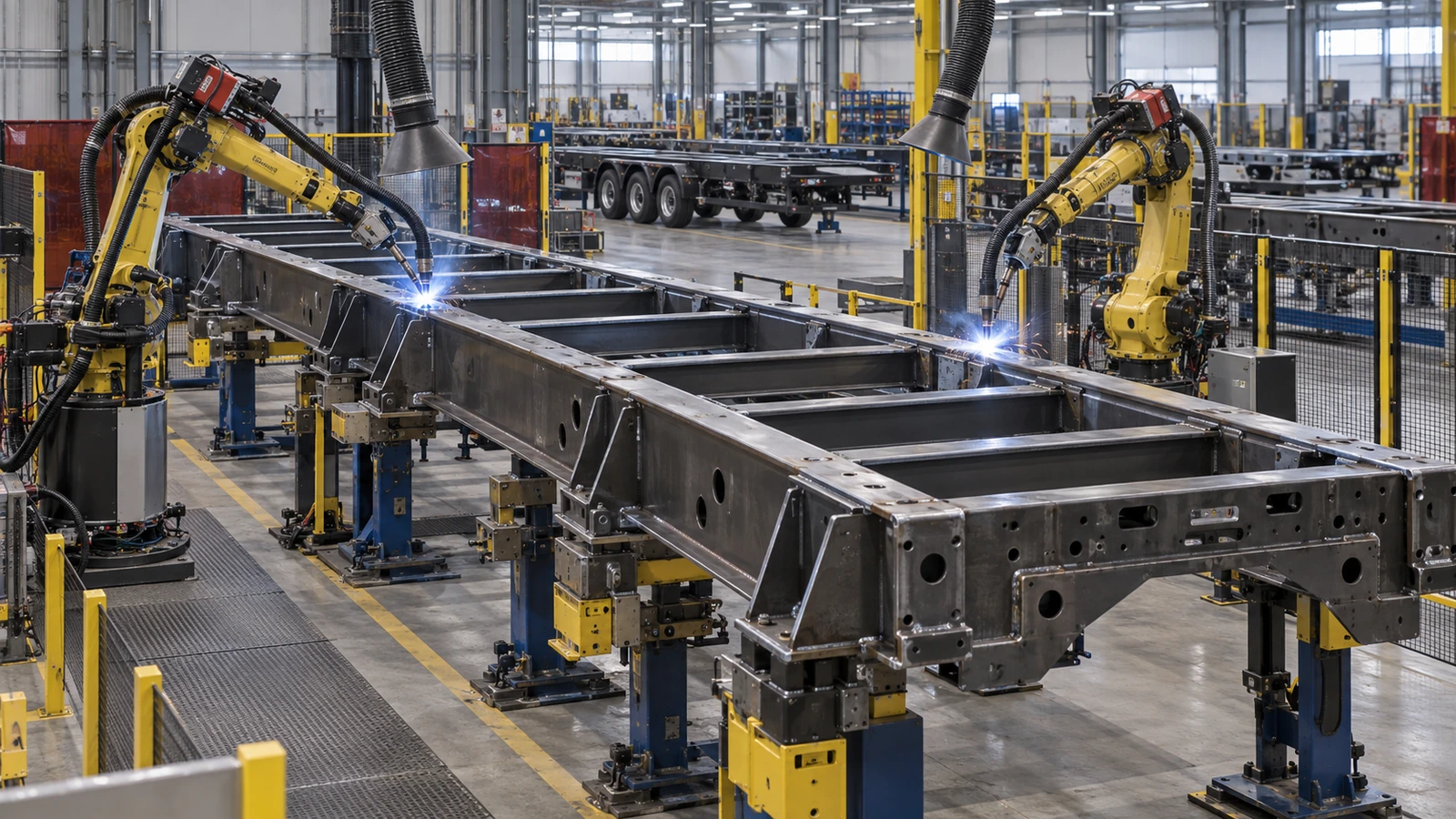
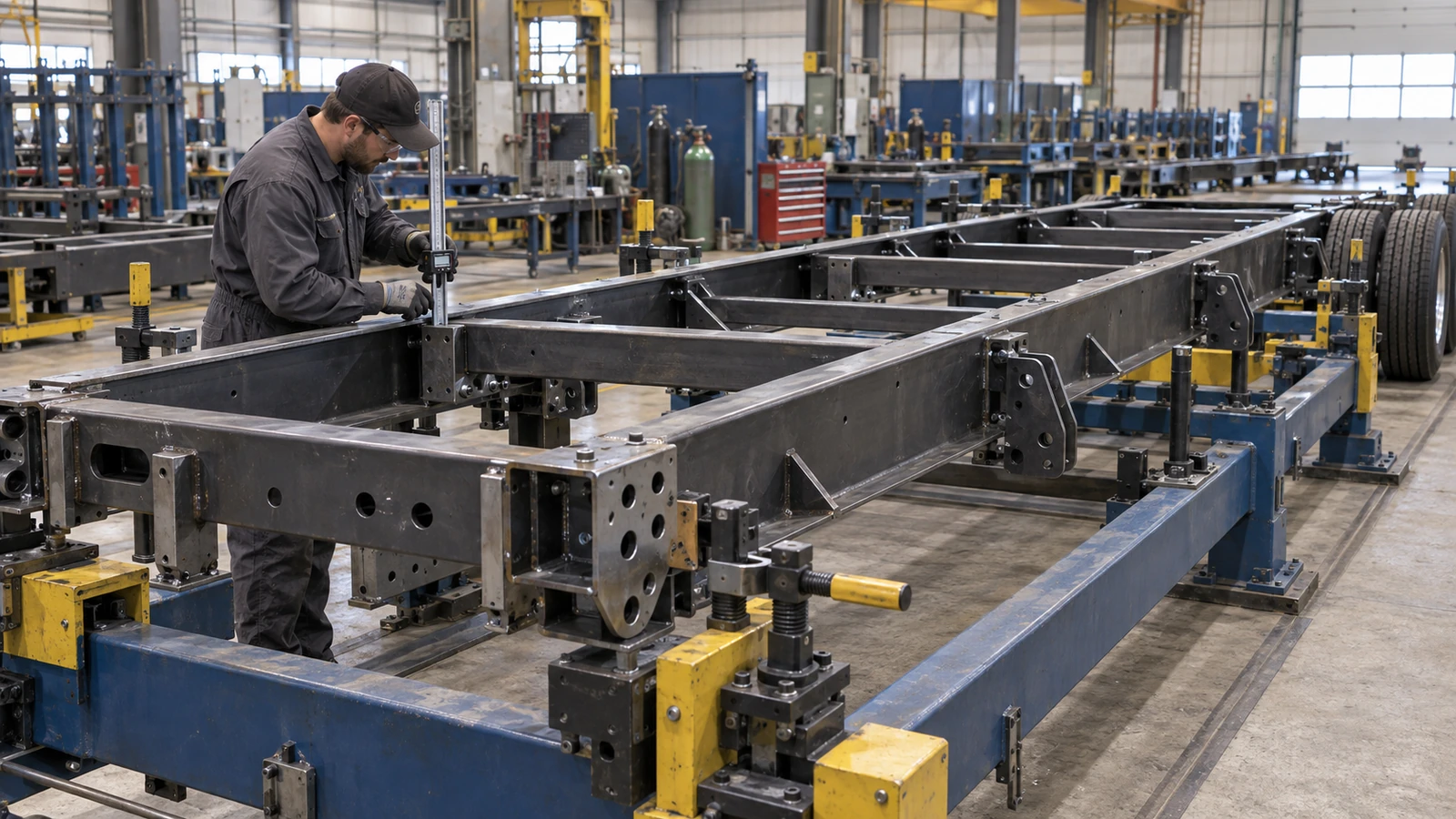
Trailer frames contain many welded connections. Cross-members join longitudinal beams. Brackets attach to structural tubes. Gussets reinforce local connections. Jack mounting plates, suspension components and other attachments create additional welded details. Each of these regions can be more difficult to prepare and coat than an open steel plate. Welding creates local geometry, heat-affected surfaces and potential discontinuities. Depending on the welding process and workmanship, the area may contain spatter, slag, residual flux, sharp transitions, undercut or small surface cavities.
These features affect coating performance in different ways. Spatter can create small protrusions and shadowed regions. Slag or other residues can prevent coating from contacting the intended steel surface. Undercut and irregular weld geometry can create narrow recesses that are difficult to clean and coat. Surface cavities may retain contamination or moisture. Welds can therefore become preferential locations for corrosion, not simply because welding occurred, but because fabrication created a surface that the coating process did not adequately prepare or protect.
The solution is not to demand perfectly smooth cosmetic welds everywhere. Nor is it necessarily to grind every weld flush. Excessive grinding of a structural weld can remove required weld metal or alter fatigue-sensitive geometry. Instead, the coating specification should identify the required condition of the welded surface while preserving the structural integrity of the connection. For fatigue-sensitive trailer components, any significant weld dressing should follow an approved procedure.
The coating process must accommodate the structural weld, and the weld must be manufactured in a condition that the coating process can protect. That is a combined welding and surface-treatment design requirement.
Sharp Edges Can Fail Even When the Flat Surface Passes Inspection
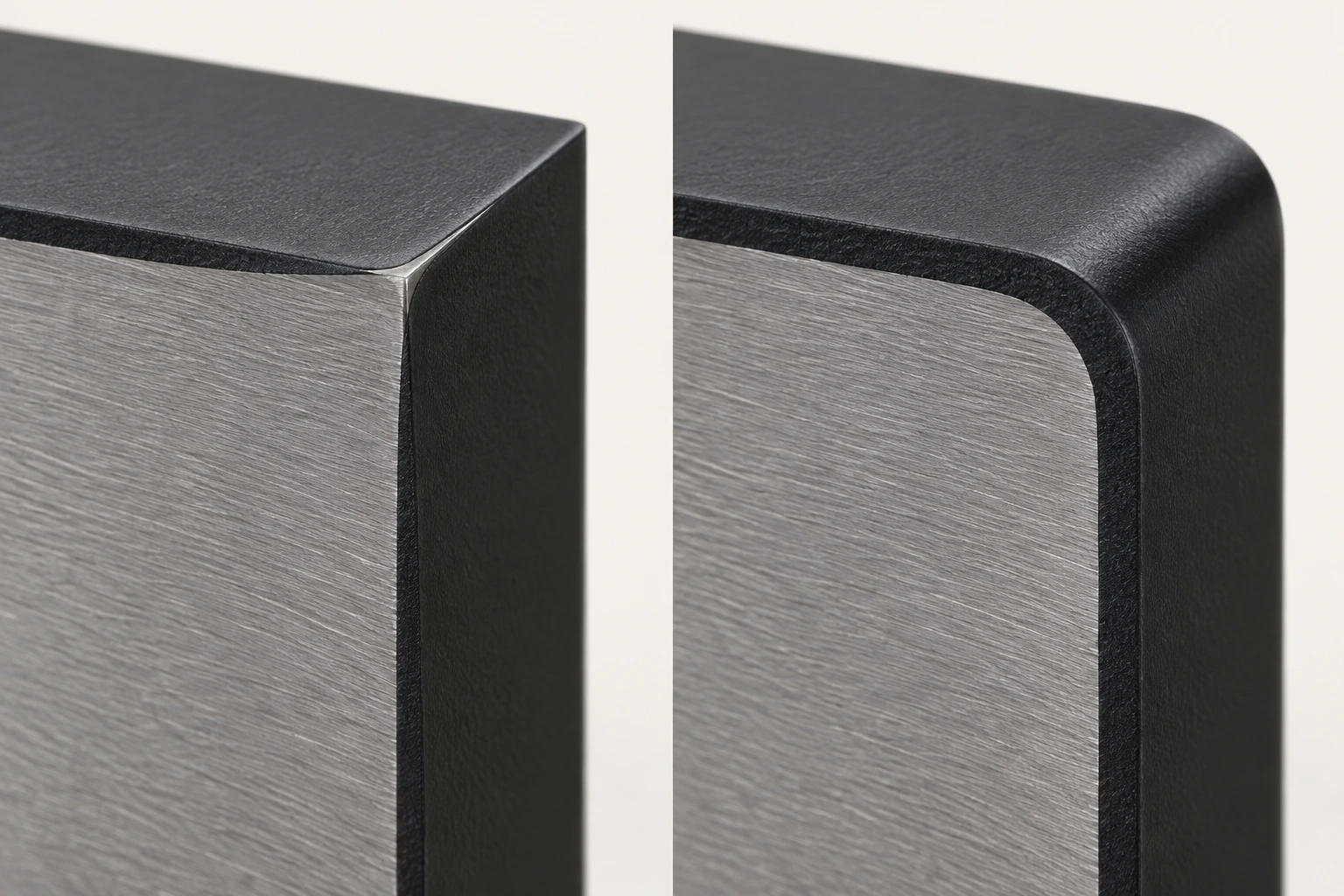
One of the most important corrosion mechanisms in powder-coated steel begins at the edge. A trailer bracket may have a broad flat surface with an adequate coating thickness. The same part may have laser-cut edges, punched holes or sharp corners. During powder application and curing, those regions may not retain the same film thickness as the flat surface. The American Coatings Association's 2026 technical discussion of corrosion-resistant powder systems explains that coating flow and shrinkage during curing can reduce coverage on sharp edges. This can leave vulnerable steel at precisely the locations where corrosion later begins. [2]
The mechanism is relatively straightforward. Powder is deposited on the component. During curing, the particles melt and flow into a continuous film. Surface tension and the coating's flow behavior influence how that film redistributes. At a sharp external edge, the coating may pull away from the corner. The resulting film can be thinner than the coating on the adjacent flat surface.
In an unfavorable case, coverage may be insufficient to provide the intended protection. Now expose the bracket to road spray containing salt. Moisture reaches the vulnerable edge. Steel begins to corrode. Corrosion products develop beneath the nearby coating. The film can progressively lose adhesion around the original defect. The visible failure may eventually spread across a much larger area, but the initial weakness was concentrated at a small geometric feature.
This is why measuring coating thickness only at the center of a flat plate can be misleading. A supplier may report a compliant average film thickness while the actual corrosion-critical edges remain inadequately protected.
Why a Thicker Coating Is Not Automatically the Answer
If a sharp edge has insufficient coating, increasing the overall powder thickness seems like an obvious solution. Sometimes additional film build can help. But increasing thickness on flat surfaces does not necessarily produce a proportional increase at the edge. The coating's flow behavior, edge geometry and application conditions still matter. A component could receive substantially more powder on its broad faces while retaining a comparatively thin film at the most vulnerable corners.
Excessive coating thickness can also create other manufacturing problems. Depending on the formulation and process, it may affect appearance, curing, dimensional fit or the performance of the finished film. For a trailer jack bracket, additional buildup around a mounting interface may create assembly interference. For a precision hole, coating thickness may reduce available clearance. The engineering objective is therefore not simply to maximize average thickness.
It is to achieve the specified coverage in the locations that matter. ASTM D2967 provides a method for evaluating powder coating coverage at defined corners. Importantly, the standard cautions that its measurements on square-cornered test bars do not necessarily establish protection of sharper edges or burrs encountered in actual components. [5] That limitation is especially relevant to laser-cut and punched trailer parts.
A laboratory corner-coverage result cannot automatically guarantee corrosion protection at every production edge. The actual component geometry still needs to be evaluated. The correct coating specification must distinguish between nominal film thickness and effective coverage at vulnerable details.
Edge Preparation Is Part of Component Design
The edge-coverage problem begins before the powder enters the spray booth. A laser-cut bracket can leave the cutting station with sharp edges or localized burrs. A punched mounting hole may contain a different edge profile. A sheared plate may have a combination of rollover, burnished material, fracture surface and burr. These surfaces do not necessarily provide the same foundation for coating. Where corrosion performance requires improved edge coverage, the manufacturing route may need to include appropriate deburring, edge rounding or other preparation.
That decision should be made according to the component's actual geometry and coating requirements. It should not be reduced to an arbitrary rule that every edge must have the same radius. A trailer mounting plate with generous clearance may allow more edge modification than a precision mating component. A heavily loaded bracket may require engineering review before material is removed around a critical hole.
A fatigue-sensitive edge may have different requirements from an unloaded decorative panel. The essential principle is that edge preparation must be designed into the manufacturing process. A supplier should not be expected to correct every difficult edge by increasing powder output. The problem may already have been created during cutting or forming.
Recess Access and Pretreatment Need Different Controls
Sharp external edges and recessed internal corners can both produce inadequate coating coverage, but they do not necessarily fail for the same reason. External edges can lose film build through coating flow during cure. Deep recesses can be difficult to coat during electrostatic powder application. In conventional electrostatic spraying, charged powder particles are attracted toward the grounded workpiece. The electric field is influenced by the component's geometry.
External surfaces and protruding features can receive powder more readily than deep internal corners. Inside a narrow channel, the electric field may be less favorable for deposition. This is commonly described as the Faraday cage effect. For trailer manufacturing, the problem may appear around recessed bracket connections, narrow channels or complex welded assemblies. A broad external face receives adequate powder. The root of a deep internal corner receives much less.
An operator may attempt to compensate by increasing powder application. But additional powder can accumulate on accessible surfaces without adequately correcting the recessed region. Application technique, gun settings, grounding, component orientation and coating formulation may all influence the result. The design itself also matters. A recess that is difficult to access with the spray equipment may remain a production problem regardless of how attractive the exposed surfaces look.
This is why coating accessibility belongs in Design for Manufacturing. A structural bracket should not be evaluated solely by whether it can be welded. The OEM should also consider whether the finished geometry can be cleaned, pretreated and coated consistently. Nordson’s troubleshooting guidance identifies recess penetration, grounding and application settings as connected process issues. Follow the equipment supplier’s approved procedures rather than treating additional powder output as a universal remedy. [8]
Pretreatment Is a Chemical Process, Not Just Cleaning
Removing visible contamination is important, but many corrosion-resistant powder coating systems require additional pretreatment. Depending on the substrate and specification, this may include phosphate treatments or other suitable conversion-coating technologies. The purpose is not simply to make the steel look clean. A compatible pretreatment can modify the metal surface to improve coating adhesion and resistance to corrosion spreading beneath the film. The exact process depends on the steel, the coating chemistry, production conditions and the intended service environment.
Sherwin-Williams' transportation corrosion guidance distinguishes between pretreatment approaches and emphasizes that the complete coating system must be matched to the substrate and cleaning process. [1] This creates another manufacturing distinction. Two suppliers may both describe their products as powder coated. One may use a carefully controlled multistage cleaning and conversion-coating process. The other may apply powder after limited surface preparation. Their finished components may look similar.
Their resistance to moisture penetration and corrosion spreading may be significantly different. The chemistry also needs to remain under control during production. Pretreatment performance may depend on variables such as bath concentration, temperature, contact time, rinsing and contamination. If the process changes without adequate monitoring, the coating line can produce inconsistent results even when the same powder and spray equipment are used.
For OEMs, the relevant requirement is therefore not simply: "Use chemical pretreatment." It is: Use a validated pretreatment system compatible with the substrate, powder coating and intended exposure, and control it throughout production.
Cure the Actual Part—and Repeat the Process
Powder coating performance also depends on the curing process. For thermosetting powder coatings, heating allows the deposited material to melt, flow and undergo the chemical reactions required to develop its finished properties. But a powder coating oven does not guarantee that every component experiences the intended curing conditions. Consider a heavy steel trailer bracket and a thin sheet-metal cover moving through the same oven.
The thin part may reach the required temperature quickly. The heavier bracket may take longer. If the process is controlled only by oven air temperature or conveyor speed, the actual thermal history of the components can differ. A part may appear fully coated while failing to receive the required time at the specified metal temperature. Depending on the powder formulation, insufficient cure can compromise properties such as adhesion, hardness, chemical resistance or durability.
Excessive thermal exposure can also be undesirable. The correct curing schedule must follow the coating manufacturer's technical requirements. For production qualification, a temperature profile measured on representative components can help establish whether the actual metal experiences the intended cure. This becomes especially relevant when a trailer component contains both thick and thin steel sections. The coating line should be validated against the actual thermal mass and geometry of the product.
Oven settings are manufacturing inputs. The temperature history of the coated component is what determines whether the curing requirement has been achieved. PPG’s cure-curve guidance distinguishes substrate temperature from air temperature and specifies product-dependent cure conditions. A single oven setting cannot be assumed to qualify every powder or part. [9]
Why One Component Can Pass and Another Can Fail on the Same Coating Line
Production variation is a major reason coating quality cannot be judged from a single successful sample. Imagine a trailer component that performs well during initial qualification. The steel is clean. The pretreatment system is operating within its intended conditions. The spray equipment is correctly adjusted. The oven provides an appropriate cure. The finished component passes inspection. Now consider the next production batch.
The incoming steel carries more residual oil. A welded bracket has additional spatter. A pretreatment bath is approaching its maintenance limit. A grounding contact becomes unreliable. The spray pattern changes around a recessed connection. The oven is loaded with heavier components than those used during qualification. None of these changes necessarily alters the powder specification. All can influence the final coating. This is why consistency at production scale matters.
A supplier must be able to reproduce the intended surface condition, pretreatment, coating coverage and cure across hundreds or thousands of components. The manufacturing system should therefore include appropriate controls for incoming surface condition, cleaning, pretreatment chemistry, application conditions, grounding, coating thickness, oven performance and final inspection. Not every simple trailer bracket requires the same monitoring program as a critical chassis assembly.
But every specification should identify the variables that could compromise its intended service performance. A coating system is only as reliable as the production process used to reproduce it.
How a Small Defect Becomes Underfilm Corrosion
A coating failure often appears to begin at a small defect. A stone strikes the exposed edge of a trailer bracket. A mounting surface is scratched during assembly. A poorly protected weld toe becomes exposed to moisture. Initially, the damage may be localized. The surrounding powder coating can remain intact. But once water and an electrolyte reach susceptible steel, corrosion can begin.
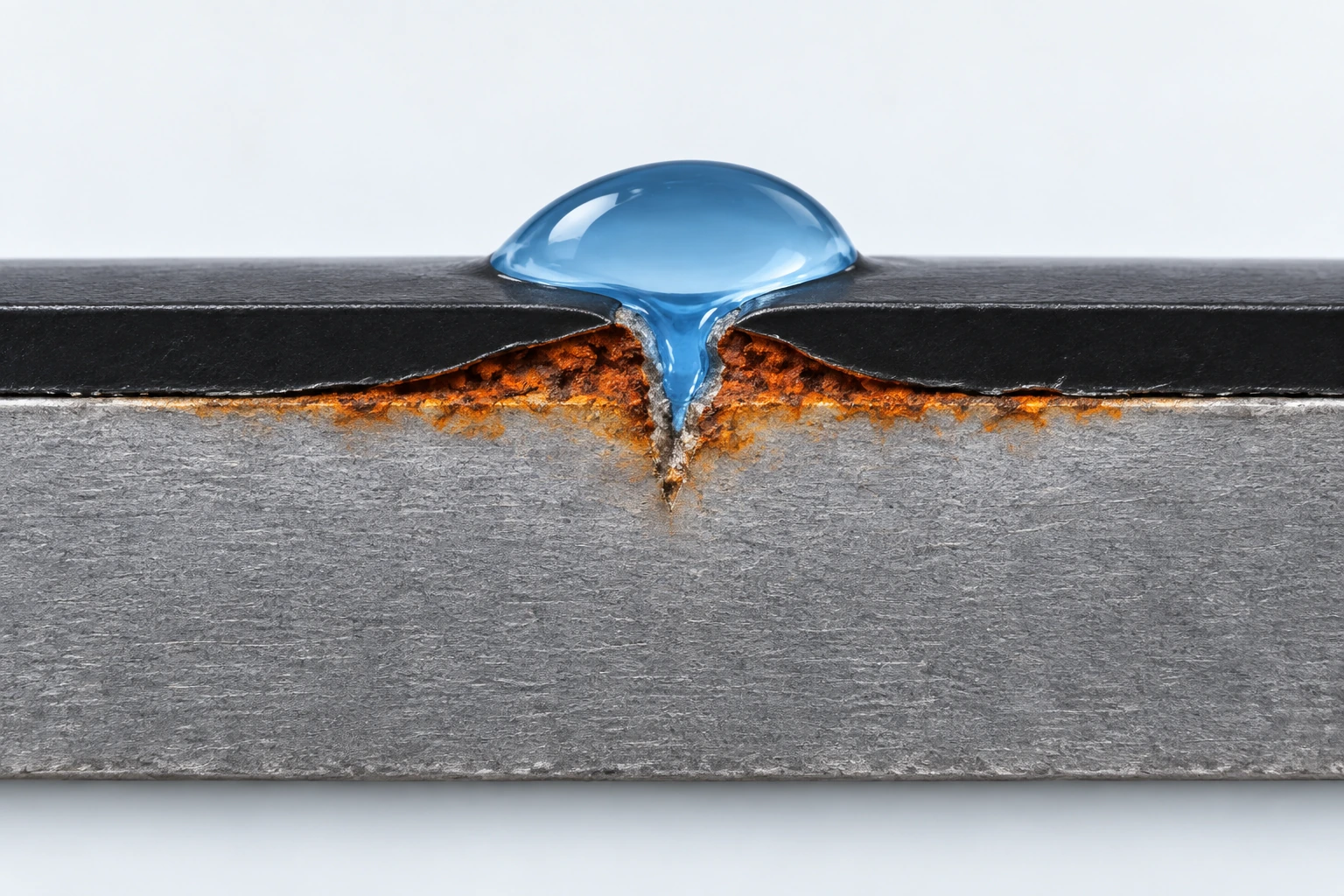
Rust products occupy a greater volume than the original metal consumed in forming them. Their development can generate local forces beneath the coating. As corrosion progresses, the surrounding film may lose adhesion. Moisture can then spread farther along the coating-metal interface. The visible damaged area grows beyond the original opening. This is commonly described as underfilm corrosion. The rate and extent of propagation depend on the complete coating system and the service environment.
Surface preparation and pretreatment are important because they influence the condition of the coating-metal interface. Edge coverage matters because it influences where the corrosive environment first reaches the substrate. Coating toughness and adhesion matter because they influence how the film responds to damage. The service environment matters because freshwater exposure, chloride-containing road spray and repeated wet-dry cycles do not create identical corrosion conditions.
This explains why two trailer parts with similar initial scratches may deteriorate differently. The difference may lie in the corrosion resistance of the complete system rather than simply the thickness of the coating surrounding the damage.
Trailer Jack Brackets Show Why Corrosion and Assembly Must Be Considered Together
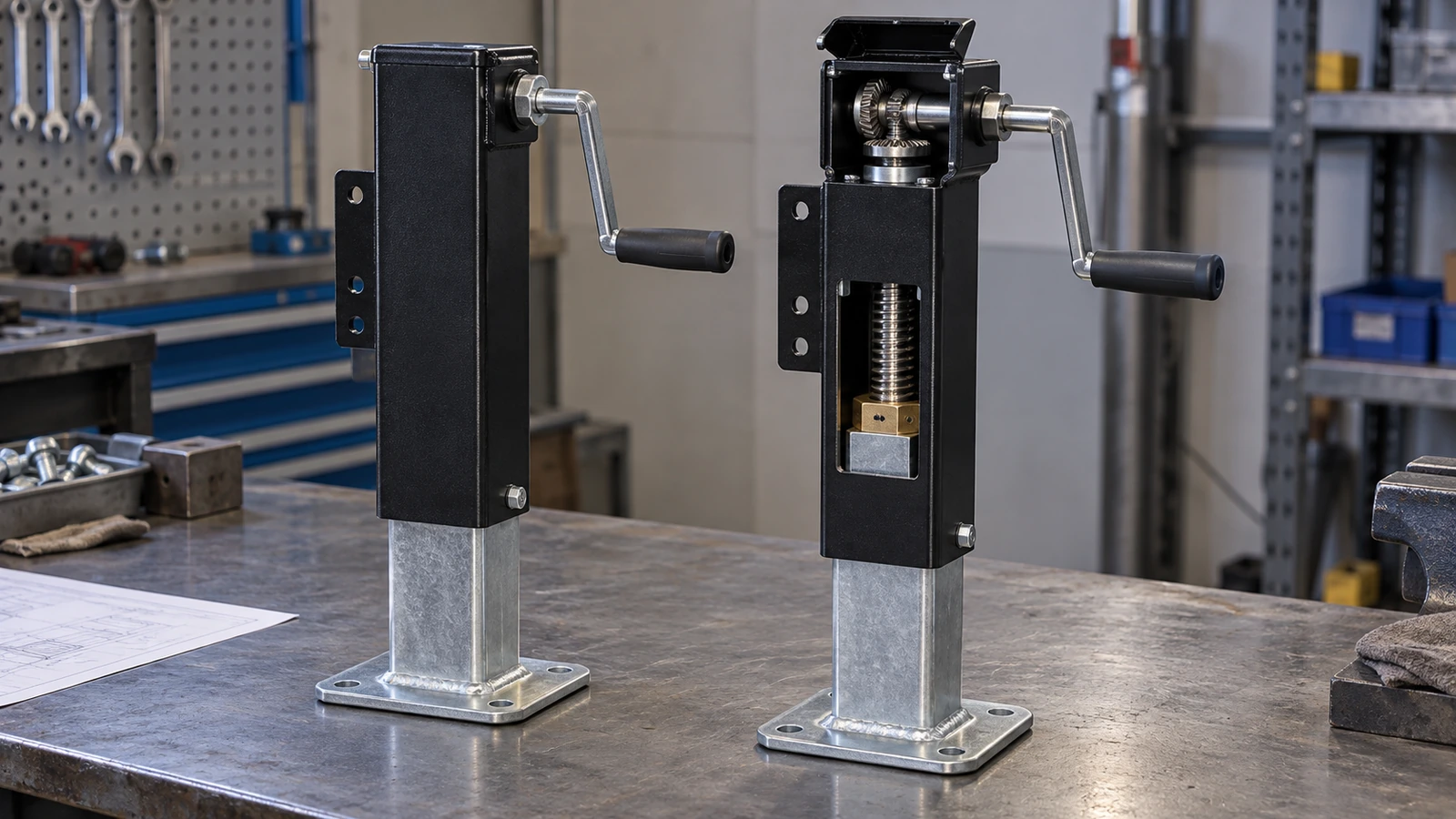
A trailer jack mounting bracket provides a useful example of the full manufacturing chain. The bracket may begin as a laser-cut steel plate. It is formed, welded to a mounting structure and prepared for powder coating. The finished assembly contains cut edges, mounting holes, welded connections and mating surfaces. Each feature presents a different coating challenge. Cut edges require sufficient protection. Welded regions require appropriate cleaning and accessible coating geometry.
Mounting holes need compatible dimensions after coating. Contact surfaces may experience coating damage when fasteners are tightened or components are installed. A supplier could apply a thick powder coating to the broad faces of the bracket and still leave these critical details inadequately controlled. The result may be a visually impressive part that develops corrosion around mounting holes or welded attachments after repeated outdoor exposure.
The solution is not necessarily to select a more expensive powder. The OEM may need to revise edge preparation, pretreatment, coating coverage, masking, assembly sequence or corrosion-protection strategy. Where particular surfaces must remain uncoated for functional reasons, their exposure and corrosion risk should be addressed deliberately. The complete component must be considered. A coating is successful only when the protected part can still be assembled and perform its intended function.
Choose a Coating System, Not Just More Topcoat
One approach to improving corrosion performance is to use a compatible primer beneath the powder topcoat. The two layers serve complementary purposes. Depending on the formulation, a primer can improve corrosion resistance and help manage the coating-metal interface. The topcoat may contribute weathering resistance, appearance, mechanical durability and other required properties. But primer selection is not independent of the rest of the system.
The primer must be compatible with the substrate, pretreatment and topcoat. The intended cure schedule and film thickness must also be appropriate. A poorly selected or poorly applied primer can introduce another interface at which failure may occur. A two-coat system is therefore not automatically better merely because it contains more coating material. The relevant question is whether the complete system has been validated for the intended exposure.
For a trailer operating primarily in mild atmospheric conditions, one coating system may satisfy the requirement. For a component exposed to frequent road salt, stone impacts and repeated wet-dry cycles, a different system may be justified. The correct choice depends on the substrate, component geometry, service environment and required durability. This is particularly important for procurement teams comparing supplier quotations. A quotation for a single powder topcoat is not directly equivalent to a quotation for a validated primer-and-topcoat system.
The comparison must consider the full manufacturing route and demonstrated performance.
OneCure Shows How Coating Chemistry and Production Design Are Converging
On June 15, 2026, a Sherwin-Williams announcement published by NATM introduced the OneCure portfolio: a compatible dust-on-dust primer-and-topcoat system cured together in one bake. The announcement describes a newly unified portfolio built on established technologies—not the invention of powder-on-powder coating in 2026. [3] The manufacturing relevance is the connection between coating chemistry and production design. Eliminating a separate cure and intermediate handling stage can change work-in-process flow, equipment requirements and energy use. Sherwin-Williams also promotes edge coverage and corrosion performance for its matched systems. These are supplier claims, not independent guarantees for every trailer component. [4]
Single-bake processing does not remove the need for clean steel, compatible pretreatment, accessible geometry or a verified metal-temperature history. A supplier must qualify the complete system on the intended production route. The useful lesson is that corrosion protection and manufacturing efficiency should be assessed together.
What Salt Spray and Adhesion Tests Really Prove
Salt spray testing is frequently used to compare corrosion performance. A supplier may advertise 500, 1,000 or more hours of salt spray resistance. Those figures can be useful when the test conditions, specimen preparation and acceptance criteria are clearly defined. They are not direct measurements of trailer service life. ASTM B117 establishes a controlled salt fog environment used to obtain relative corrosion-resistance information.
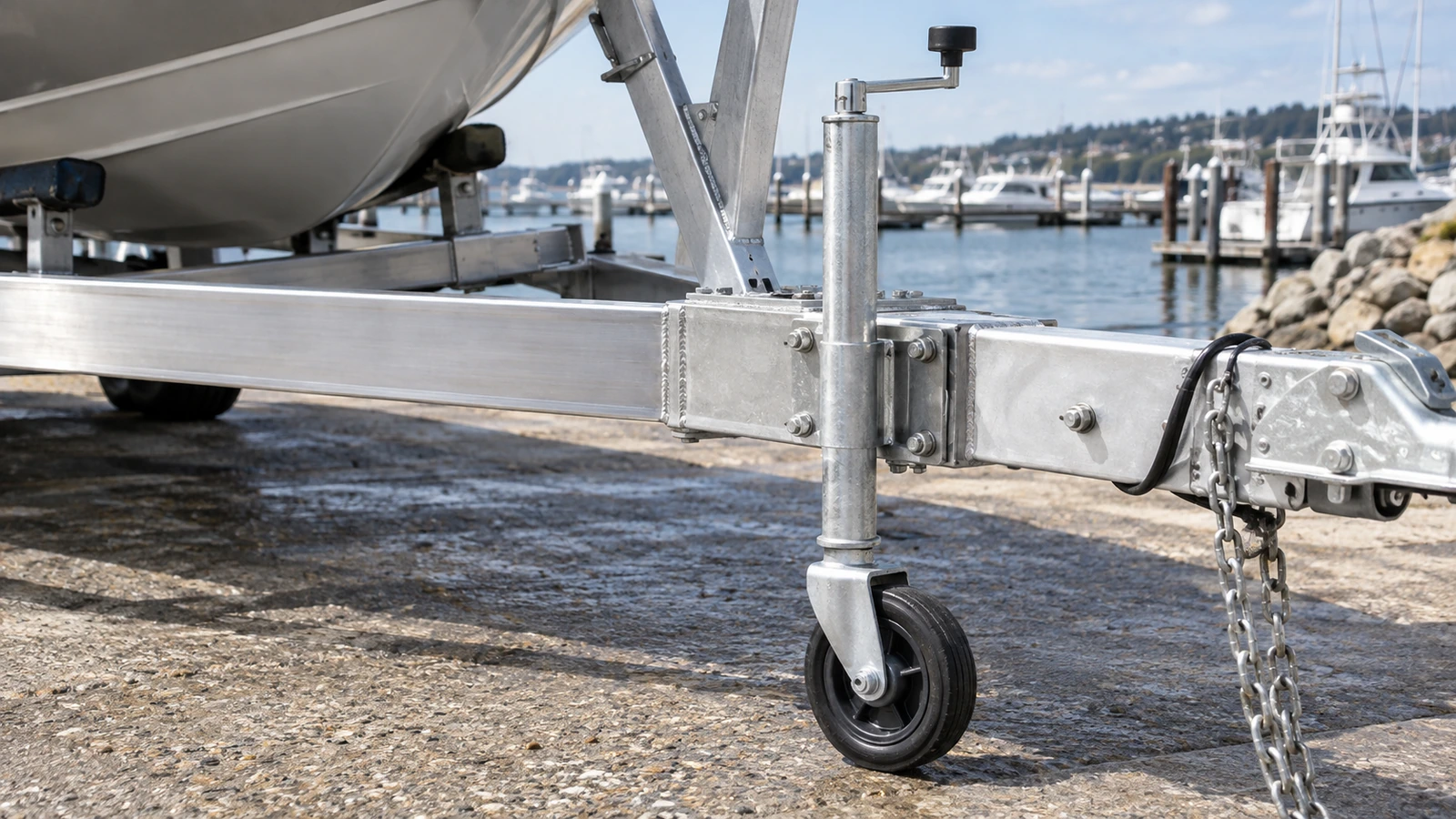
The 2026 edition explicitly cautions that results from the test, used alone, have seldom been correlated reliably with performance in natural environments. [6] This matters because a real trailer does not experience constant laboratory salt fog throughout its life. It may experience rain, dry periods, temperature changes, road debris, abrasion, washing chemicals and varying salt concentrations. A boat trailer may face repeated immersion or coastal exposure.
A utility trailer may experience winter road salt but relatively dry summers. An equipment trailer may suffer frequent stone impacts and mechanical damage. These environments create different coating demands. A laboratory result cannot be converted into a universal statement such as: "1,000 hours of salt spray equals ten years of corrosion protection." The test also needs a defined failure criterion. Was the specimen evaluated for visible red rust?
Blistering? Corrosion spreading from a deliberate scribe? Loss of adhesion? And was the specimen a flat laboratory panel or a representative welded production component? These distinctions are essential. A flat panel with carefully prepared edges may pass a test while an actual trailer bracket contains difficult-to-coat welds and sharp cut edges. A meaningful test program should therefore reflect the intended failure mechanism and, where necessary, include representative production geometry.
What an Adhesion Test Can—and Cannot—Prove
Adhesion testing is another useful quality-control method. ASTM D3359 describes tape-test methods for evaluating coating adhesion. Its scope and limitations make an important point: the test can help establish whether adhesion is generally adequate, but it is not a complete measure of every aspect of coating durability. [7] A coating can demonstrate acceptable initial adhesion and still have poor edge coverage. A part can pass a tape test before service and later experience corrosion spreading from a damaged mounting hole.
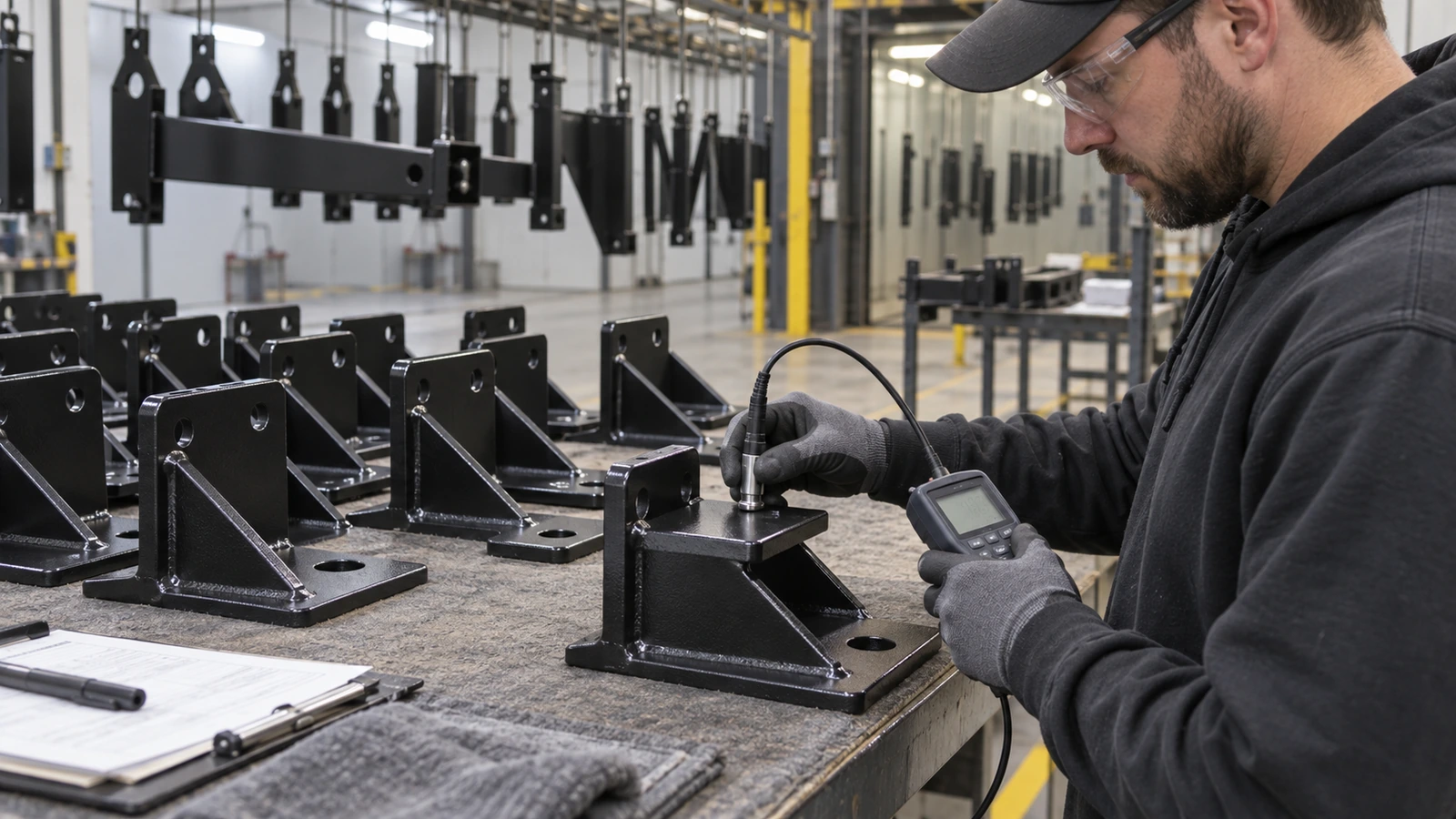
A flat test panel can perform well while a recessed welded connection remains inadequately coated. The test therefore answers a specific question. It does not independently establish the service life of a complex trailer component. A more meaningful quality plan may combine several types of evidence. Film-thickness measurements verify coating buildup at specified locations. Adhesion tests evaluate the relevant interface under defined conditions.
Cure verification checks whether the coating experienced the required thermal process. Corrosion tests provide comparative performance information. Visual and dimensional inspection address defects associated with the actual component geometry. None of these measurements should be treated as a complete substitute for the others. The purpose of testing is to verify the controlling failure risks—not simply to accumulate impressive numbers on a supplier certificate.
Turn the Failure Risks Into an OEM Specification
For an OEM, the first step is to identify the exposure and failure mechanisms that matter to the actual trailer component. A decorative panel, suspension bracket and trailer jack mounting structure may all receive powder coating. They do not necessarily require the same coating specification. Their geometry, mechanical loading and exposure conditions differ. The OEM should consider whether the component is primarily exposed to atmospheric moisture, road salt, stone impacts, abrasion, chemicals or a combination of these factors.
Then the design review should examine the component's manufacturability. Can the selected pretreatment reach the required surfaces? Are welds sufficiently prepared? Do cut edges need additional finishing? Are there deep recesses that will be difficult to coat? Will the coating interfere with mounting holes or functional clearances? Can the component be cured consistently given its thickness and thermal mass? Will final assembly damage critical coated surfaces?
These questions should be resolved before the finishing specification is finalized. A different powder formulation may be part of the answer. But the solution may instead involve changing a weld detail, improving edge preparation, revising the pretreatment process or modifying the assembly sequence. The goal is to create a component that can be protected repeatedly and economically. Not simply to select a coating that performs well on an ideal laboratory panel.
What Procurement Teams Should Ask Suppliers
Two supplier quotations may both state: "Steel component, black powder coating." That description provides very little information about the finished product's corrosion performance. For a corrosion-sensitive trailer component, the RFQ should identify the intended substrate, fabrication condition, preparation requirements, coating system and acceptance criteria. The following questions help translate the engineering requirements into sourcing specifications.
| Procurement question | Why it matters |
|---|---|
| What substrate and surface condition enter the coating line? | Steel chemistry, mill scale, oil and other contamination can affect preparation and coating performance. |
| How are welds and cut edges prepared? | Residues, sharp edges and irregular geometry can create vulnerable coating locations. |
| What cleaning and pretreatment system is used? | The coating's adhesion and corrosion resistance depend on the condition of the substrate interface. |
| Is the coating a single layer or a primer-and-topcoat system? | The complete formulation and process determine the intended performance. |
| Where is film thickness measured? | A compliant flat-surface measurement may not establish adequate edge or recess coverage. |
| How is cure verified? | Oven settings alone may not establish the required metal-temperature history. |
| Which corrosion and adhesion tests apply? | Test methods, specimen geometry and acceptance criteria must match the intended performance requirement. |
| What happens after coating? | Drilling, welding, fastening and assembly may damage the coating or create exposed surfaces. |
| How is batch consistency controlled? | A successful prototype does not guarantee repeatable production performance. |
Match the RFQ detail to the component and exposure; do not hide essential requirements behind “powder coated.”
The Lowest Coating Price Is Not Necessarily the Lowest Finished-Component Cost
Powder coating economics are also affected by the complete production route. A supplier offering a low coating price may use a simpler preparation process. Another supplier may include more extensive surface preparation, controlled pretreatment, additional edge finishing or a primer system. The quotations are not necessarily equivalent. The total cost can also include rework, scrap, energy consumption, handling, inspection and warranty exposure.
Consider a batch of trailer brackets that receives an attractive coating but fails around mounting holes after exposure. The immediate coating cost may have been low. The total cost may include replacement components, freight, labor, customer complaints and additional inspection. A more robust process may have a higher initial applied cost but lower total lifecycle cost. The reverse can also be true.
An unnecessarily complicated coating system may add expense without meaningful value for a mild service environment. The appropriate decision depends on the actual product requirement. The purchasing objective should be the lowest repeatable cost of achieving the required corrosion performance—not simply the lowest price per coated square meter.
GOODIN View: Investigate the Mechanism, Control the Process
The location of early rust provides clues, not a definitive diagnosis. Edge corrosion may involve thin coverage or impact damage; broad peeling may involve adhesion or surface preparation; defects around welds may involve residue or difficult geometry. Mounting-point corrosion can originate in assembly damage or contact abrasion. Dealers should not assume every rust spot proves defective powder, and manufacturers should not dismiss premature corrosion without investigation. Inspect the initiation site, steel beneath the film, adjacent details and actual exposure. A repeatable pattern across a batch may reveal a manufacturing problem that changing powder alone will not solve.
GOODIN View: Corrosion Protection Is Manufactured Before It Is Applied
Powder can provide durable protection, but the finished system depends on its weakest prepared and protected detail. Cleaning establishes the foundation; pretreatment conditions the interface; weld and edge preparation determine accessibility; application establishes coverage; curing develops properties; assembly must preserve them.
A thicker film cannot stabilize unsuitable mill scale. A premium powder cannot remove oil beneath it. A flat-panel salt-spray result does not demonstrate adequate coverage in a recessed production weld. Production consistency is therefore part of corrosion performance, not a separate purchasing consideration.
For trailer jacks and mounting hardware and accessories, define the substrate condition, vulnerable details, finished fit and intended exposure together. The supplier should demonstrate the process that repeatedly protects the component, not merely supply an attractive sample.
GOODIN View: A durable powder-coated trailer component is defined by how consistently the manufacturing process protects its most vulnerable surfaces—not by how much powder is applied.
To review a coating specification alongside the fabrication drawing and assembly requirements, discuss the OEM requirements with GOODIN.
Sources & Further Reading
Source titles are retained as published. Product benefits are supplier-reported; ASTM scope pages describe test purposes and limitations, not complete operating procedures. Confirm the applicable edition and agreed acceptance criteria.
- Sherwin-Williams — Beyond the Spec: Understanding Corrosion and Its Mitigation
- American Coatings Association / PPG — Powder Coating Systems for Improved Corrosion Protection
- National Association of Trailer Manufacturers — Introducing OneCure: The Powder Portfolio Changing How OEMs Coat
- Sherwin-Williams — OneCure
- ASTM International — ASTM D2967-24 — Standard Test Method for Corner Coverage of Powder Coatings
- ASTM International — ASTM B117-26 — Standard Practice for Operating Salt Spray (Fog) Apparatus
- ASTM International — ASTM D3359-23 — Standard Test Methods for Rating Adhesion by Tape Test
- Nordson — Powder Coating System Troubleshooting Guide
- PPG — What Is a Cure Curve?
1,000 Hours of Salt Spray Does Not Mean 10 Years Outside: How Trailer Buyers Should Read Corrosion Test Claims
Hot-Dip Galvanizing Changes the Part Before It Protects It: Why Venting, Drainage and Distortion Must Be Designed In
Related Article