A-Frame vs. Side-Mount Trailer Jacks: Which Configuration Fits a Crowded Trailer Tongue?
In this guide
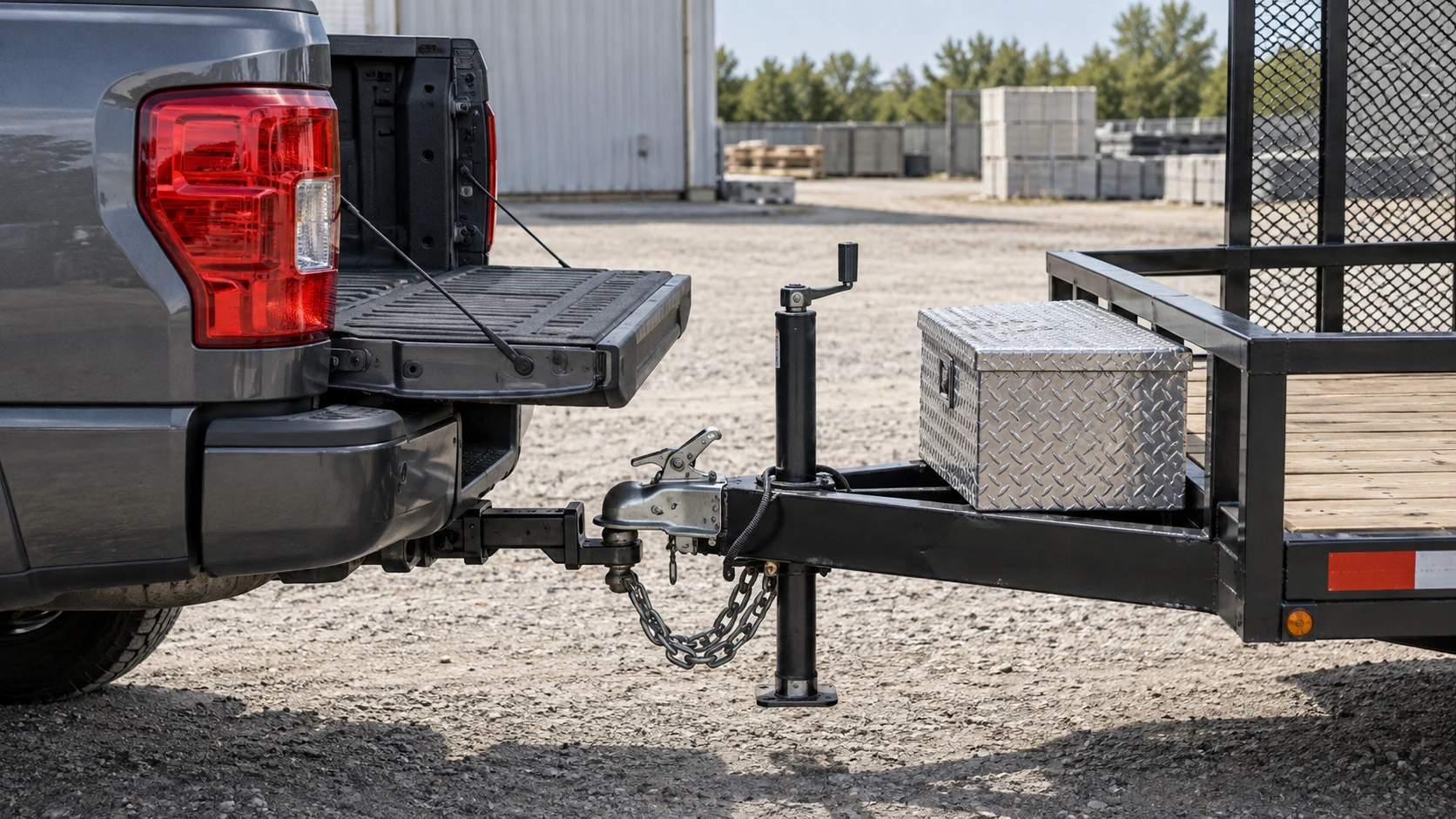
A trailer jack can fit perfectly when the trailer is parked and still be in the wrong place.
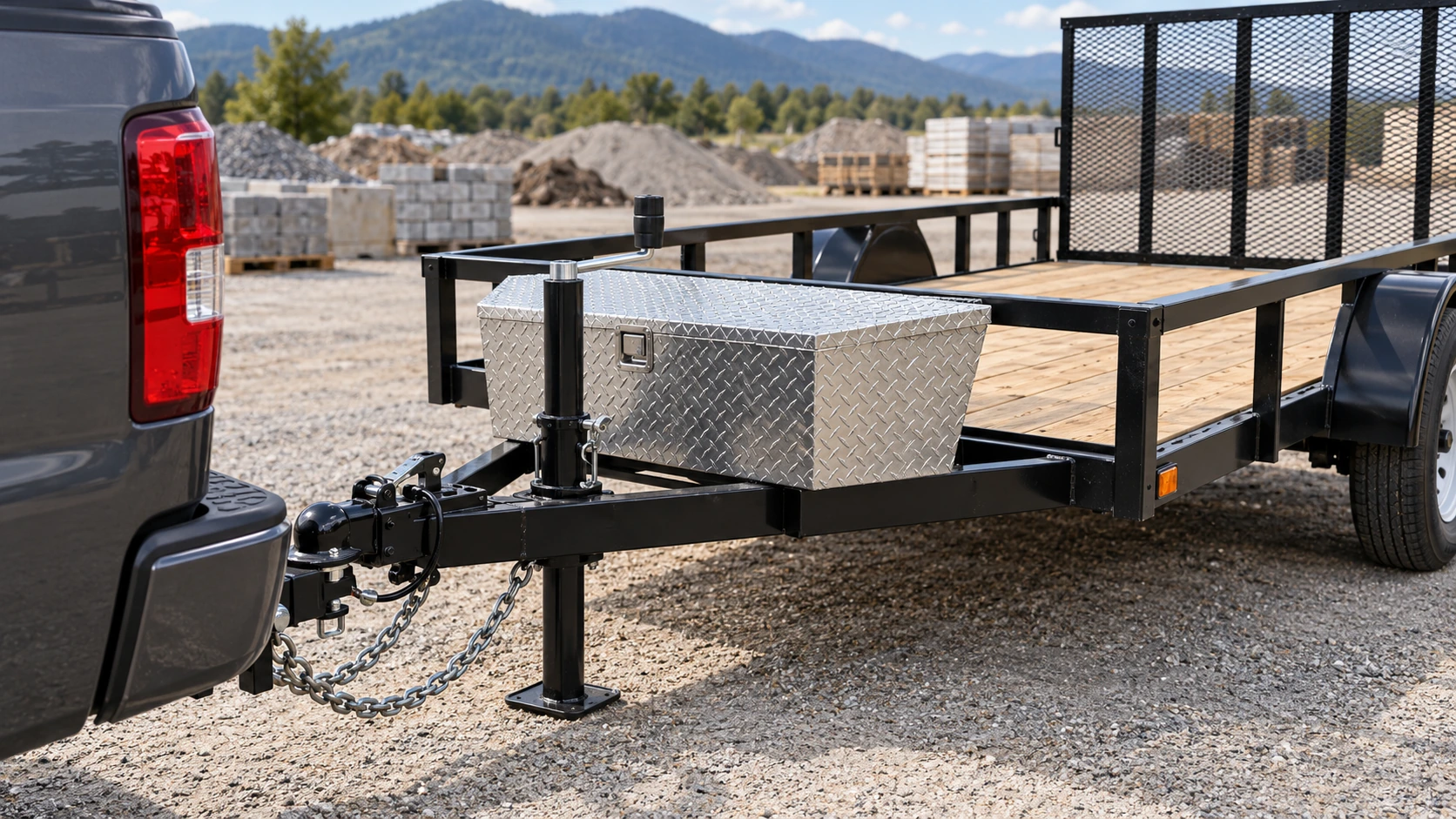
The conflict may appear when the pickup tailgate is lowered. It may only occur during a tight turn. A tongue toolbox can leave enough room for the jack tube but block the crank handle. A swivel jack can clear the tailgate when vertical but strike the toolbox while rotating into its towing position.
Consider two illustrative purchasing scenarios.
One buyer considers a purpose-designed removable jack to clear a lowered pickup tailgate, including during turns. Another considers replacing a center-mounted A-frame jack with a 5,000 lb side-mounted jack—and asks the more important question: would the offset support introduce unwanted twisting into the trailer structure? These are hypothetical scenarios, not verified owner reports.
These scenarios identify the right purchasing problem.
It is not simply:
A-frame or side-mount—which jack is better?
It is:
Which mounting configuration clears every required operating envelope while remaining compatible with the trailer's intended load path?
That distinction matters because a side-mounted jack can solve one interference problem while creating another.
Selection guidance, not an installation approval. Confirm the current model drawing and manufacturer instructions before ordering or modifying a trailer mount.
Map the Complete Clearance Envelope
Before choosing a jack configuration, stop treating the trailer tongue as a collection of individual components.
It is one shared packaging zone.
The jack has to coexist with:
- the coupler;
- pickup tailgate;
- tow-vehicle rear bodywork;
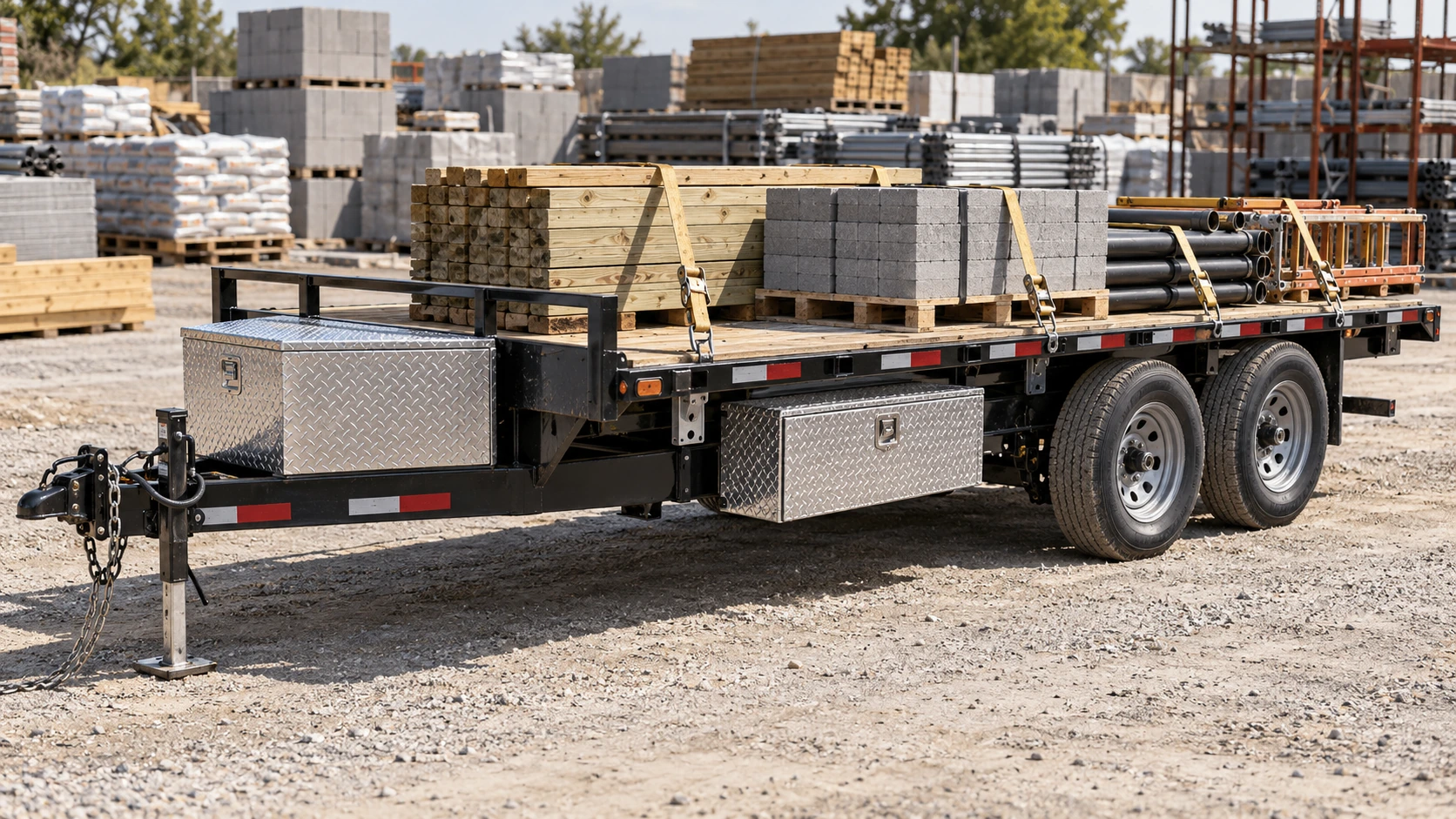
- tongue toolbox;
- battery or propane equipment;
- winch or other accessories;
- safety chains and breakaway equipment;
- weight-distribution hardware where used;
- wiring;
- jack handle; and
- the jack's own stored position.
Fulton installation instructions make this principle explicit: before mounting a jack, users are told to check for interference with the tow vehicle, trailer tongue, ground and mounted accessories while stationary and in motion, including the handle-swing and swivel positions. [1]
That gives Product Selection a useful rule:
Do not select a trailer jack from its installed footprint alone. Select it from its complete operating and towing envelope.
A 3-inch gap around a stationary jack does not prove that the installation works.
First Map Four Different Clearance Zones
The fastest way to make a poor decision is to measure only where the jack sits.
For a crowded tongue, four separate envelopes should be reviewed.
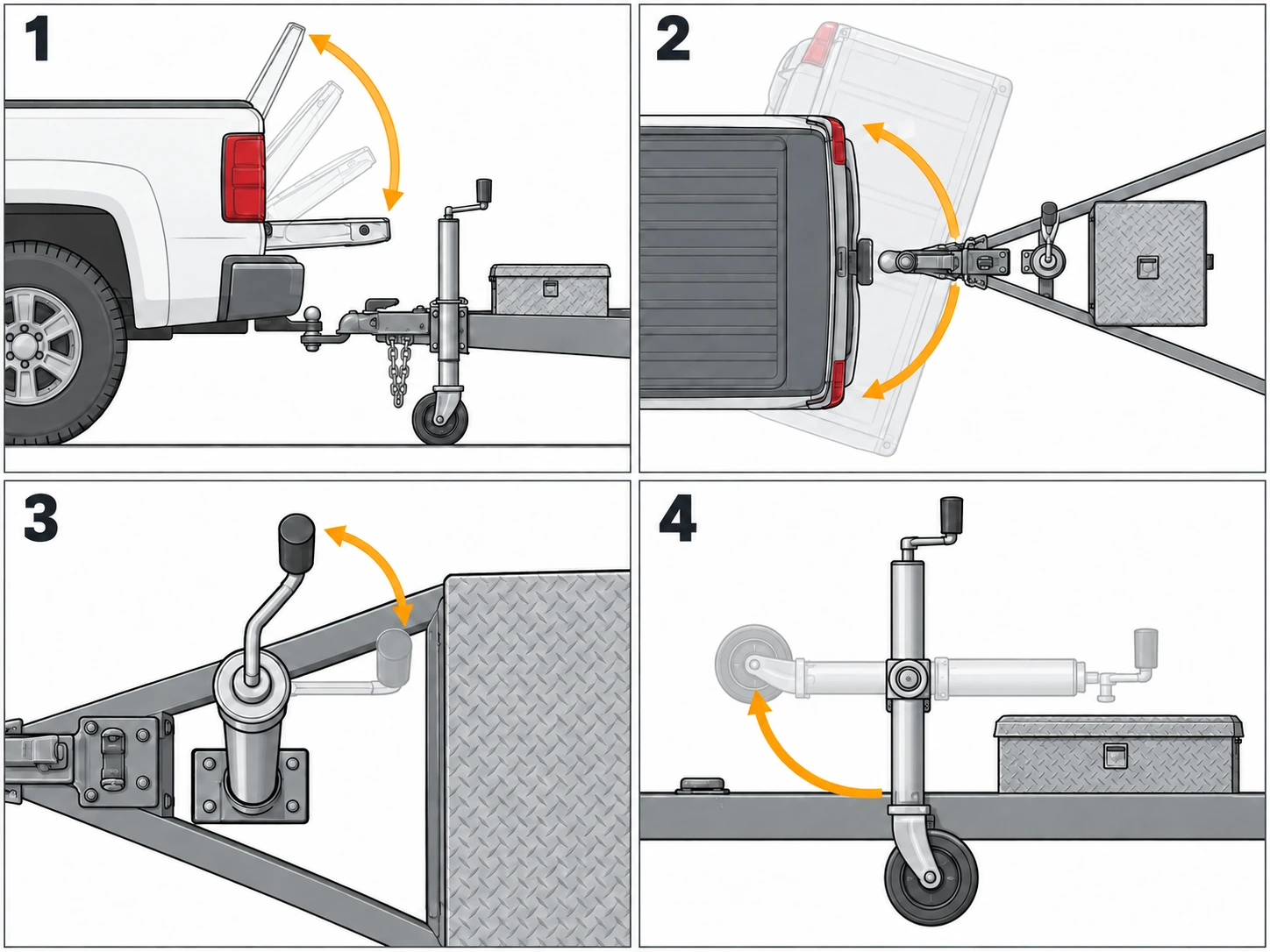
1. Tailgate and Rear-Body Clearance
With the trailer coupled in its normal towing geometry, determine whether the tailgate must:
- remain closed during towing;
- open while parked but still coupled;
- remain partially open;
- or remain fully lowered during travel for a specific cargo arrangement.
Those are very different requirements.
This guide does not authorize towing with the tailgate down. Follow the vehicle, hitch and trailer manufacturers’ restrictions; if that travel condition is not permitted, clearance alone cannot make it acceptable.
If the tailgate only needs to open at a campsite while the combination is straight, a small change in handle orientation may solve the problem.
If the tailgate must remain down while towing, the problem becomes more demanding because the clearance must remain acceptable while the truck and trailer articulate relative to each other.
2. Turning Clearance
The tow vehicle and trailer do not remain aligned.
As the combination turns, the rear corner of the vehicle and the lowered tailgate sweep across a different area relative to the tongue.
A jack that clears the truck when everything is straight may become the first point of contact in a sharper turn.
This is why the removable-jack scenario requires a turning-envelope check, not just a stationary gap measurement.
For an OEM layout, this should ideally be evaluated from drawings or CAD using the intended articulation envelope.
For a replacement installation, the buyer should at minimum identify which parts of the tow vehicle approach the jack and tongue accessories as the combination changes angle rather than measuring only straight-ahead clearance.
Use drawings or a controlled inspection by a qualified installer. Do not stand between moving vehicles, put hands into pinch points or use contact as a clearance test.
3. Jack Operating Clearance
A jack also needs room to function.
For a topwind jack, the important space is above the jack.
For a sidewind jack, the crank needs lateral rotational clearance.
GOODIN's current LF932-2015 sidewind swivel jack specifically requires both a usable lateral crank envelope and sufficient clearance for the jack body to rotate between its deployed and stored positions. [2]
A toolbox may therefore clear the tube but still make the jack unusable.
4. Jack Storage Clearance
A swivel jack creates another envelope that a fixed A-frame jack does not have: the transition into storage.
Check:
- the complete jack body;
- foot or wheel;
- crank;
- pivot;
- locking pin;
- trailer frame;
- toolbox;
- coupler hardware; and
- road clearance after storage.
The jack must not merely “swing up.”
It must be able to complete the movement and lock in the manufacturer's intended towing position.
Compare Three Configuration Paths
For a crowded trailer tongue, the practical decision usually comes down to three approaches.
| Configuration | Main packaging advantage | Main limitation | Reject or verify further when… |
|---|---|---|---|
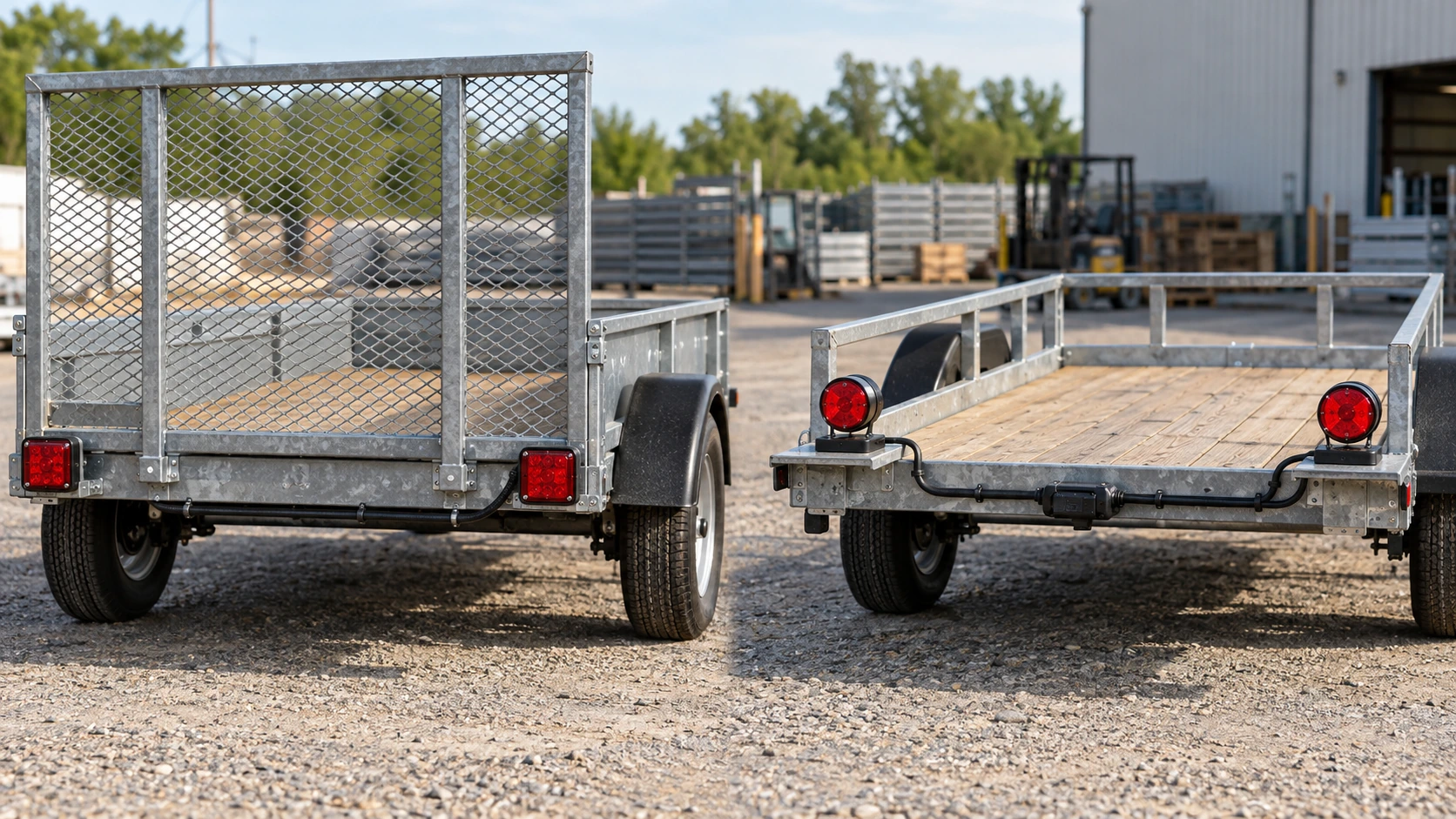
| Center A-frame jack | Uses the central jack location and keeps the support point near the trailer centerline | Vertical jack body or handle may interfere with the tailgate or toolbox | Existing jack location blocks required vehicle/accessory movement |
| Side-mount swivel jack | Removes the jack from the center and can rotate clear for towing | Requires suitable side-frame mounting structure plus crank and swivel clearance | Trailer frame or bracket is not approved for the installation |
| Approved removable / reoriented arrangement | Can preserve the central structure while moving an obstruction during towing | Highly model-specific; removal, orientation and retention must be designed features | The proposed change requires modifying a jack or mount beyond manufacturer instructions |
None is universally better.
The correct configuration is the one that satisfies space, operation and structure at the same time.
Check the Existing Center Mount First
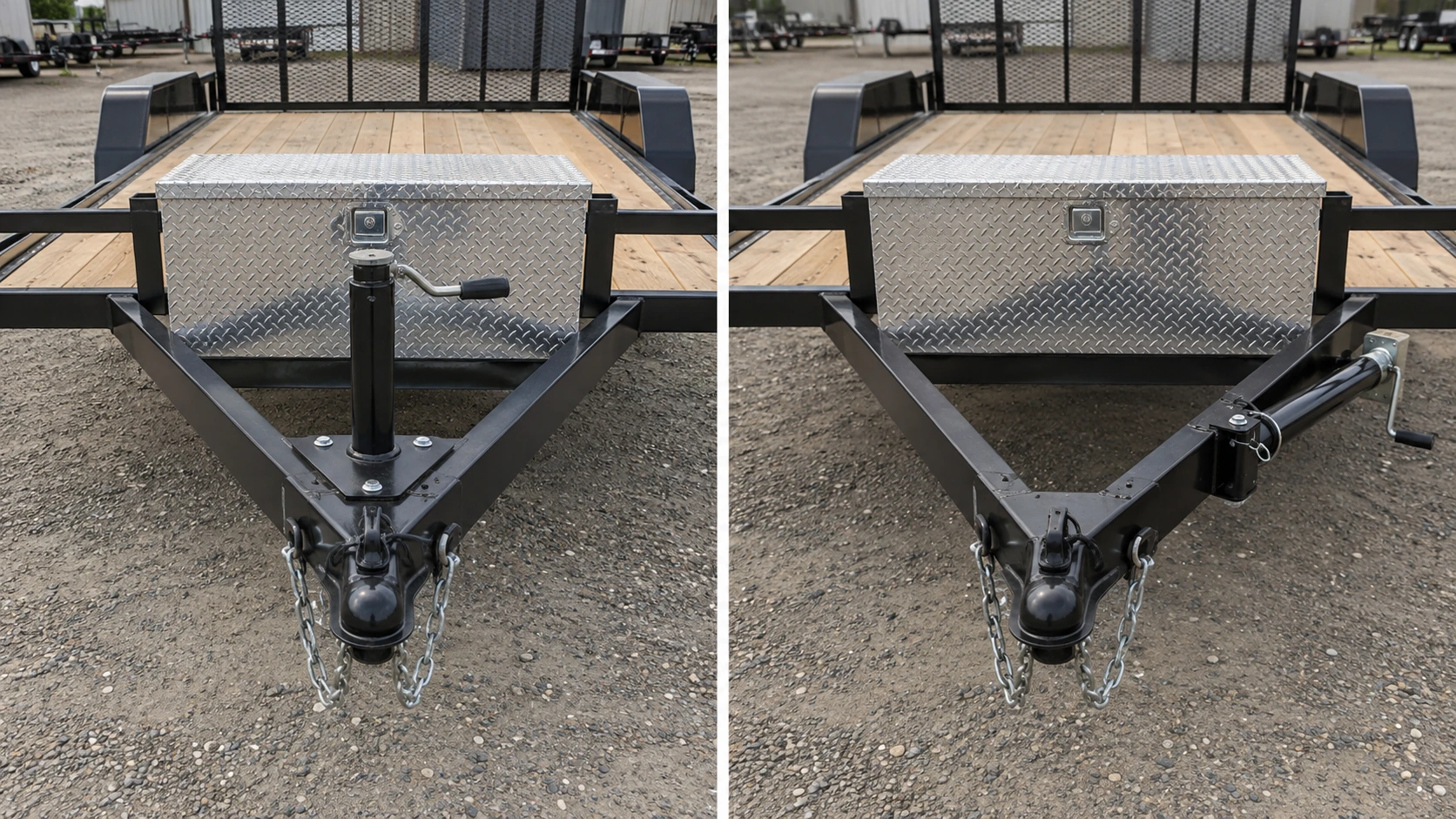
An A-frame jack passes through or attaches around the trailer's central A-frame mounting area.
GOODIN maintains a dedicated A-frame jack product family for compatible central trailer-tongue installations. [3]
If the trailer already has an intended center mounting plate, retaining that architecture has an important advantage:
you are not automatically creating a new trailer-side load path merely to solve a clearance problem.
That does not mean every A-frame jack fits every A-frame trailer.
You still need to confirm:
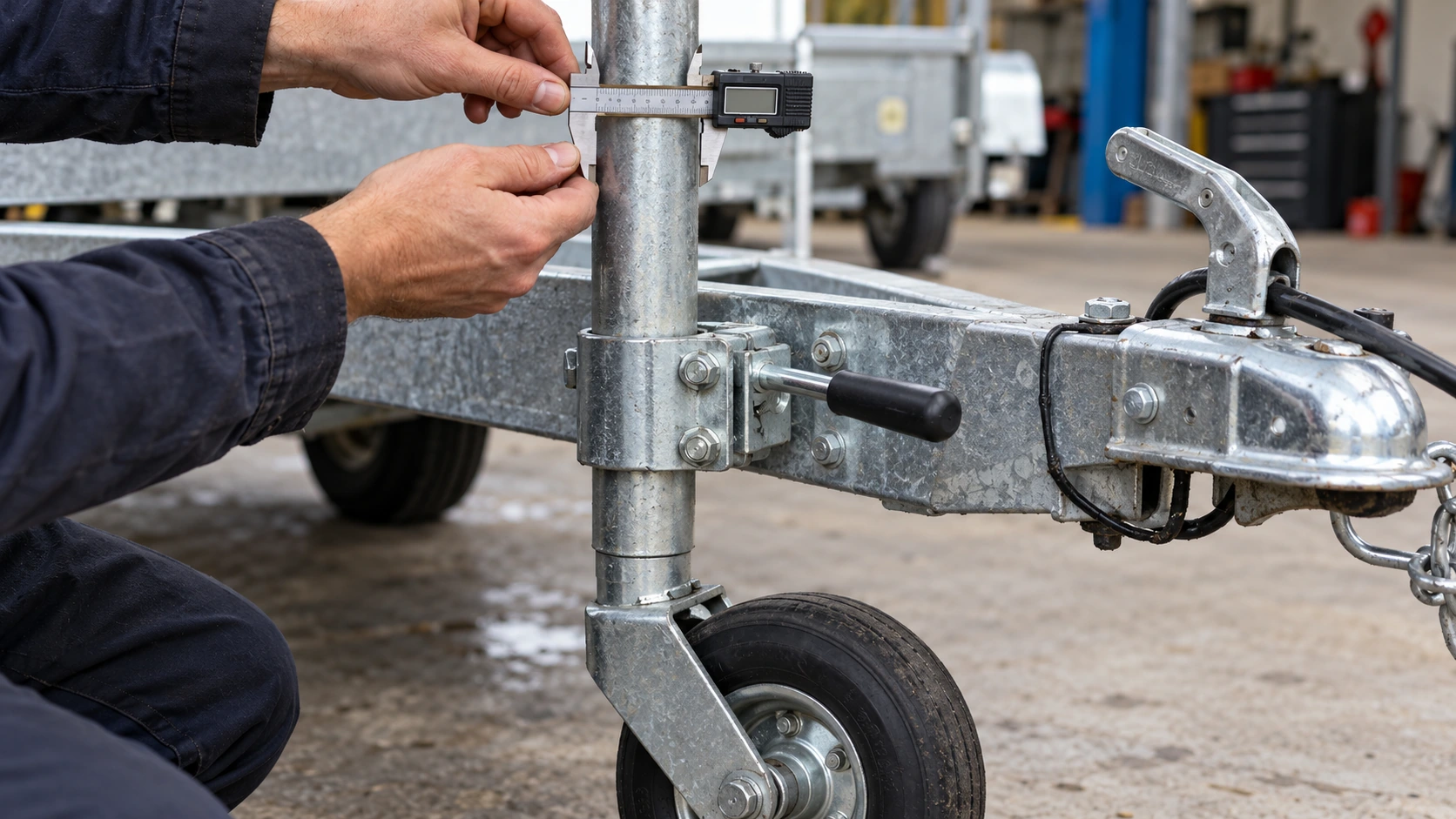
- tube diameter;
- bolt pattern;
- mounting plate;
- bracket height;
- working height;
- handle position;
- body diameter; and
- towing clearance.
But before abandoning the central mount, determine exactly which part of the current jack causes the interference.
Sometimes the Jack Body Is Not the Problem
Consider a tailgate that contacts only the crank handle.
Moving the entire jack to another frame rail may be unnecessary.
Possible model-specific solutions can include:
- a topwind instead of sidewind operating layout;
- a different sidewind orientation;
- a lower-profile jack head;
- a jack whose manufacturer permits the upper assembly to face another direction; or
- another approved model using the same central mount.
This is not theoretical.
Bulldog's powered A-frame installation documentation describes a dual mounting pattern that allows that particular jack to be positioned facing the tow vehicle or for side operation. That does not mean every A-frame jack can simply be rotated or modified; it shows why model-specific mounting instructions should be checked before changing the trailer itself. [5]
The purchasing sequence should therefore be:
identify the interfering component → check whether the existing architecture offers an approved orientation solution → only then evaluate relocation.
When a Side-Mount Swivel Makes Sense
A side-mounted swivel jack changes two things at once.
First, it moves the support assembly away from the center of the tongue.
Second, the swivel mechanism can move the jack out of its vertical deployed position for towing.
That combination can be valuable when the central tongue zone is needed for:
- tailgate movement;
- an A-frame toolbox;
- coupler access;
- a battery box;
- winch equipment; or
- ground clearance.
For a buyer whose A-frame jack drags on a driveway or blocks the pickup tailgate, a side-mounted swivel configuration is therefore worth evaluating—but only after frame fit, road clearance and rotation clearance have been checked.
GOODIN's LF932-2015 provides a relevant example of the architecture: it is a 2,000 lb published-capacity sidewind swivel jack with 15 inches of travel. GOODIN's current page also makes the important limitation explicit—the swivel feature requires clearance not only in the operating position but throughout the rotation into storage. [2]
But this is where many buyers stop too early.
They see that the side jack physically fits and assume the problem is solved.
It is not.
Offset Support Needs Structural Approval
The side of an A-frame trailer may look like a convenient mounting surface.
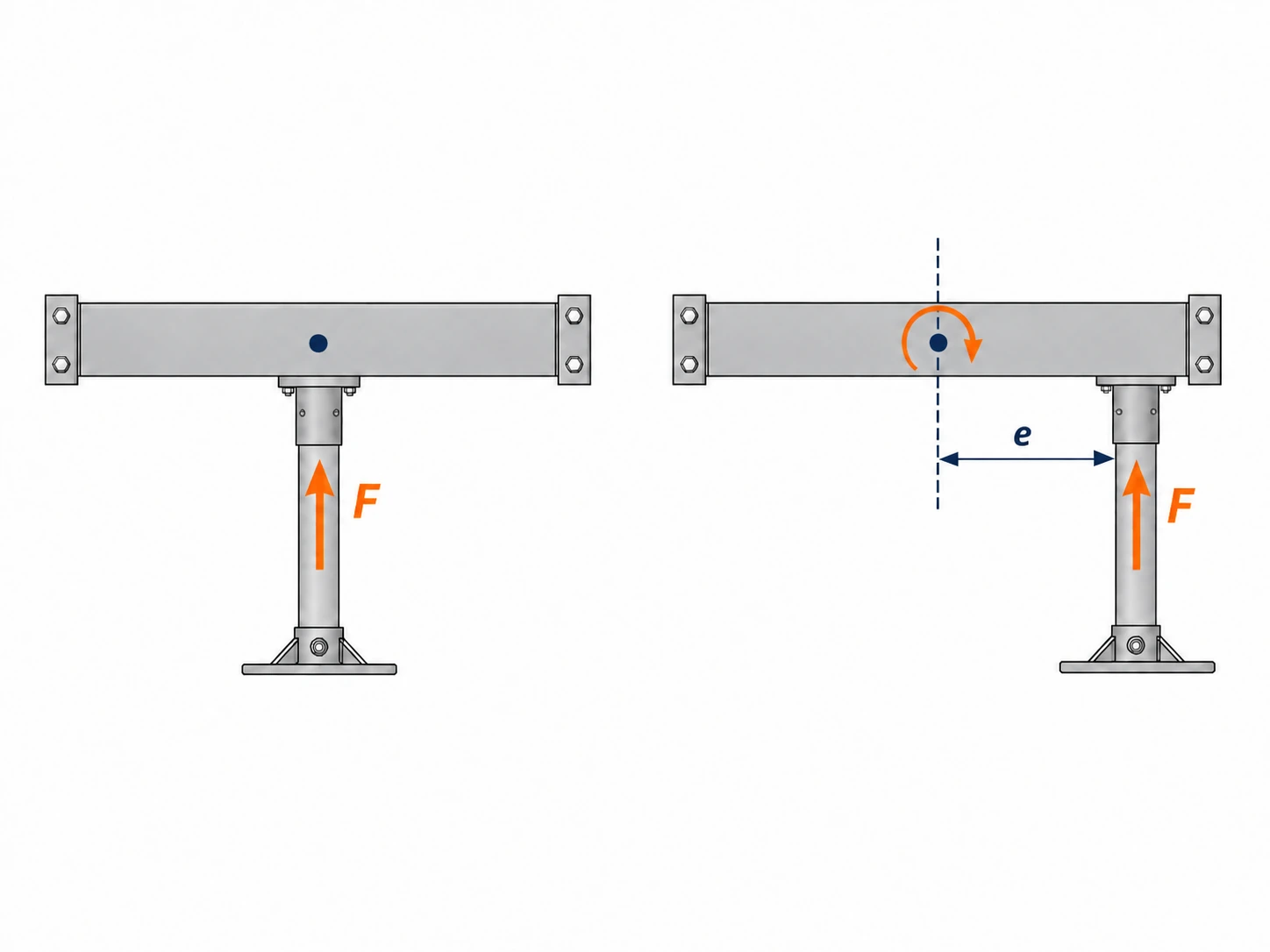
Structurally, however, moving the jack away from the centerline changes where the support force enters the tongue structure.
With the trailer uncoupled, a center-mounted jack applies its vertical support close to the trailer's longitudinal centerline.
Move that support to one side and the load becomes eccentric.
That means the trailer-side structure may have to resist not only the vertical support force but also the twisting effect created by the offset.
The basic point does not require a complex calculation:
Increasing the jack's capacity does not remove the effect of moving the support point.
A 5,000 lb jack mounted off-center is still mounted off-center.
Its larger capacity may tell you something about the jack itself. It does not independently certify:
- the A-frame rail;
- the new bracket;
- the welds;
- clamp interface;
- reinforcement;
- or the trailer's resistance to the resulting load path.
This is the unresolved issue in the hypothetical conversion above: an oversized side jack does not, by itself, resolve torsional loading of the A-frame.
GOODIN applies the same distinction on its current swivel product documentation: the LF932-2015's 2,000 lb rating does not validate the trailer-side bracket or frame structure by itself. [2]
Capacity Is a Component Rating, Not a Mount Approval
This should become one of the article's main purchasing rules.
Do not reason:
Hypothetical example: tongue load = 600 lb → side jack = 5,000 lb → installation must be safe.
The jack rating and the mounting arrangement answer different questions.
One concerns the product.
The other concerns the complete structural load path.
For a replacement trailer, moving from a designed center mount to a new offset mount should therefore be confirmed against appropriate trailer and jack-manufacturer documentation.
For an OEM trailer project, jack position, local reinforcement and attachment design should be treated as part of the trailer-frame design rather than being decided after the tongue is already finalized.
Side Space Is Shared Space
Another trap is assuming that moving the jack sideways creates free space.
It creates different space requirements.
Sidewind Handle
A sidewind jack requires a lateral crank arc.
GOODIN's current product information repeatedly identifies this requirement for sidewind products: toolboxes, rails, wiring and other installed hardware must remain outside the crank envelope. [2]
If the toolbox is the reason you moved the jack in the first place, measure it with the lid both closed and open.
Swivel Path
The jack must also rotate.
A wheel-equipped swivel jack may have a much larger stored envelope than the outer jack tube suggests because the wheel, yoke and handle all travel through space during rotation.
GOODIN's LF961-1010L, for example, requires sufficient clearance for the jack body and wheel in both working and stored orientations. [4]
Locking Position
A swivel mechanism is only useful if the locking system can fully engage after the jack reaches its defined working or towing position.
For illustration—not as a universal locking-angle specification—a jack that can rotate 85 degrees before hitting a toolbox is not equivalent to one that reaches and locks at its intended 90-degree position.
Toolbox Interference Needs Two Measurements, Not One
A tongue toolbox creates its own moving envelope.
The first measurement is obvious:
Does the box physically fit beside the jack?
The second is often overlooked:
Can the box still open and be used after the jack is installed?
A jack can interfere with:
- toolbox lid travel;
- latch access;
- operator hand space;
- crank operation; or
- removal of items from the box.
The correct layout therefore evaluates the toolbox and jack together.
This is particularly important on an A-frame because available width changes continuously as the rails converge toward the coupler.
For OEM buyers, the toolbox outline, lid arc, jack envelope and tow-vehicle clearance should ideally be included on the same tongue-layout drawing.
Do Not Forget Weight-Distribution Hardware
On some travel and equipment trailers, the jack is not the only component competing for frame-rail space.
Weight-distribution systems can require brackets along the A-frame.
A side-mounted jack that appears to fit the bare trailer may occupy the same frame area later required for those brackets.
Equal-i-zer’s installation guide assigns model-specific positions to its frame brackets and addresses obstructions near them. The layout implication is straightforward: a side jack and hitch brackets must be checked on the same drawing rather than approved separately. [6]
This means a side-mount decision should include all permanent hitch equipment, not just the jack and toolbox.
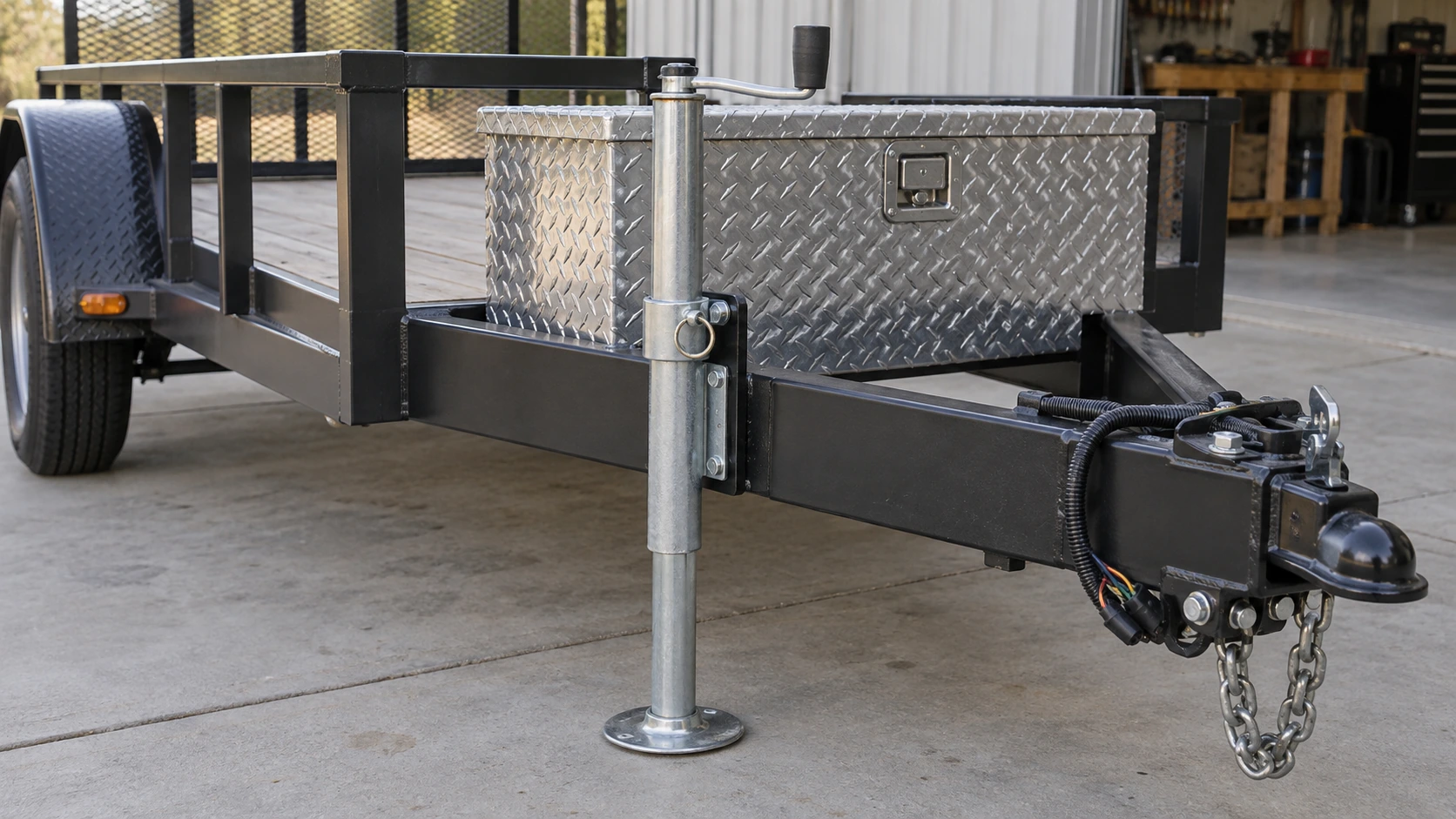
Use Only Purpose-Designed Removable Systems
A purpose-designed removable jack can be an effective packaging solution because it addresses the obstruction differently.
Rather than moving the support point permanently to another part of the trailer, the jack can be removed from the towing envelope after it is no longer carrying the trailer and the trailer is safely supported as the system instructions require.
In the illustrative removable-jack scenario, the aim is to clear a lowered tailgate without relying on a hitch extender. That aim does not establish that tailgate-down towing is permitted for the particular vehicle and trailer.
But the important word is purpose-designed.
A removable arrangement should not be created by casually removing bolts, pins or structural hardware from a jack that was never designed for repeated removal.
The product and mounting system should define:
- how the jack attaches;
- how it is retained;
- when it may be removed;
- whether any trailer-side component remains in place;
- how the mount handles the support load;
- and how the system is secured for towing.
Fulton installation documentation warns against unapproved jack modifications and defines model-specific pivot and attachment arrangements. [1]
A removable solution is therefore a separate configuration—not a workaround created with generic hardware.
A Seven-Step Configuration Decision
For a crowded trailer tongue, do not start by deciding that you want a side-mount jack.
Use the following order.
Step 1: Identify the Actual Interference
Record exactly what collides:
- tailgate with jack body;
- tailgate with handle;
- toolbox with handle;
- toolbox with swivel path;
- jack with road surface;
- jack with weight-distribution brackets;
- or several of these at once.
A vague “not enough space” description is not enough for product selection.
Step 2: Determine When the Interference Occurs
Separate:
Stationary interference
from:
turning or towing interference.
A tailgate that clears while parked may still enter the jack envelope during articulation.
Conversely, if the tailgate only needs to open while stationary and the trailer remains straight, relocating the entire jack could be unnecessary.
Step 3: Test Whether the Existing Center Mount Can Be Retained
Check approved alternatives within the same mounting architecture:
- different handle style;
- different permitted orientation;
- more compact jack body;
- different working-height geometry.
If one of these solves the packaging problem, the buyer may avoid creating a new side-frame installation.
Step 4: Map the Candidate Side-Mount Location
If moving to a side jack remains necessary, measure:
- frame-section size;
- available straight mounting length;
- bracket location;
- crank clearance;
- swivel radius;
- locked vertical position;
- locked towing position;
- foot or wheel clearance;
- toolbox envelope;
- hitch hardware; and
- wiring.
Do not order a jack merely because its mounting bracket appears visually large enough.
Fulton instructions for some bolt-on swivel jacks, for example, specify particular trailer-tube sizes and attachment arrangements. Mount compatibility is therefore a model-specific parameter, not a generic “bolt-on” characteristic. [1]
Step 5: Confirm the New Load Path
This is the structural gate.
If the trailer was designed around a center A-frame jack and you now intend to load one side rail, obtain appropriate confirmation for:
- mounting location;
- attachment method;
- local frame section;
- required reinforcement if any;
- jack bracket; and
- intended operating load.
If this cannot be confirmed, a physically convenient side location should not automatically become the chosen solution.
Step 6: Check Height After Changing the Mount
Moving the jack sideways can also change mounting elevation.
That directly affects:
- minimum deployed height;
- maximum working height;
- coupler clearance;
- and towing clearance.
The previous selection rule still applies:
a configuration is not acceptable unless its installed working-height window covers the trailer's actual requirement.
Step 7: Approve the Complete Towing Envelope
Finally confirm the trailer in its towing configuration.
For an A-frame jack, verify the fully retracted position.
For a swivel jack, verify the complete stored orientation and positive lock.
For a removable jack, verify the manufacturer-defined towing condition.
Then review the tow-vehicle clearance across the required operating geometry.
Configuration Matching Table
The final decision can be reduced to a practical screening table.
| Requirement | Center A-Frame | Side-Mount Swivel | Approved Removable / Reoriented |
|---|---|---|---|
| Existing engineered center mount available | Strong candidate | Requires new mounting review | May retain center mount |
| Tailgate blocked by jack body | May remain problematic | Often creates more center clearance | Can be effective if system is designed for removal |
| Only handle causes interference | Check alternative handle/orientation first | May be unnecessary | Model-specific orientation may solve it |
| Tongue toolbox occupies center rear area | Packaging may be difficult | Can move jack beside toolbox | Depends on system |
| Need maximum road clearance | Must retract sufficiently | Swivel can move assembly out of vertical position | Removable design can remove obstruction |
| Limited side-frame space | Often preferable | May be unsuitable | Depends on center interface |
| Weight-distribution brackets use frame rails | Usually preserves side-rail space | Possible conflict | Depends on design |
| Side-frame structural approval unavailable | Retaining original mount is easier to justify | Do not infer approval from jack rating | Use only verified arrangement |
| Frequent removal acceptable to operator | Not relevant | Not normally required | Can be appropriate |
| OEM trailer still in design stage | Center mount can be designed in | Offset mount and reinforcement can be engineered from the start | Custom interface can be designed intentionally |
The table is not a ranking.
It is a way to eliminate configurations that cannot satisfy the application.
Specify the Layout, Not Just the Capacity
GOODIN currently supports both sides of this configuration decision.
Its A-frame jack family includes manual A-frame models intended for compatible central trailer-tongue installations. [3]
For side-mounted swivel applications, models such as the LF932-2015 provide a verified sidewind/swivel architecture, while wheel-equipped swivel products such as LF961-1010L add another set of storage and wheel-clearance considerations. [4]
This does not mean buyers should select between them from a product-family name alone.
The inquiry should include the trailer layout.
For this purchasing problem, the drawing is more useful than saying:
“I need a 2,000 lb jack.”
What to Send a Supplier Before Asking for a Recommendation
A useful RFQ or technical inquiry should include:
Trailer information
- trailer type;
- tongue/A-frame drawing;
- frame-section dimensions;
- existing jack mounting location;
- actual vertical load at the jack position;
- required working-height range.
Clearance information
- tow vehicle;
- tailgate requirement;
- tailgate-to-coupler or jack clearance;
- toolbox dimensions and lid opening direction;
- other tongue-mounted accessories;
- required turning or articulation envelope;
- weight-distribution hardware, if applicable.
Jack requirement
- center A-frame or side-mount under consideration;
- topwind or sidewind preference;
- swivel requirement;
- foot or wheel requirement;
- towing/stored position;
- preferred mounting method.
For a proposed side-mount conversion, add one especially important question:
Is this jack and mounting interface approved for the proposed trailer-frame location, and what trailer-side structural requirements must be met?
That question is far more useful than requesting a higher capacity.
GOODIN View: Solve the Interference Before Changing the Load Path
The best first response to a crowded trailer tongue is not automatically to move the jack.
First determine whether the interference is caused by:
- jack location;
- jack body height;
- crank orientation;
- storage position;
- toolbox location;
- or tow-vehicle geometry.
If the existing A-frame mount can remain and an approved change in jack geometry solves the problem, that may be the cleaner specification.
If the center location fundamentally conflicts with the required tailgate, toolbox or towing envelope, a side-mounted swivel or purpose-designed removable arrangement can be a valid product direction—but only when its mounting structure and complete operating envelope are verified.
The key purchasing principle is:
Clearance determines where the jack needs to be. Structure determines whether it is allowed to be there.
Neither can replace the other.
A 5,000 lb capacity label does not turn an arbitrary point on an A-frame into a 5,000 lb jack mount.
And a structurally acceptable mount is still the wrong configuration if the tailgate strikes it in the first tight turn.
For a crowded trailer tongue, the right jack is therefore not simply the smallest, strongest or most convenient model.
It is the configuration whose mounting location, load path and full movement envelope all fit the trailer as one system.
Send your tongue layout, operating envelope and mounting requirements when you contact GOODIN.
Sources & Further Reading
Manufacturer documents apply to the models they cover. The scenarios and diagrams illustrate selection questions; they are not installation approvals. The Bulldog manual is a manufacturer-authored document hosted by a third-party archive.
How Much Hand Winch Do You Actually Need? Choosing Line Pull and Gear Ratio for Boat Trailer Loading
Replacement Trailer Jack Selection: Why Matching Capacity Does Not Guarantee a Direct Fit
Related Article